

20 Common Idioms with Meanings and Sentences
Idioms are phrases whose meaning is different from the literal meaning of the individual words. You do not need hundreds of them to begin. These 20 common idioms are a practical starter set for conversations, films, podcasts, and everyday messages.
- Level: A2–B1
- List size: 20 high-use idioms
- Best for: understanding natural everyday English
- Study goal: learn the meaning, hear the context, and use one idiom naturally
Start with the expressions you are most likely to hear. For a broader reference, read 100 Idioms and Their Meanings or the complete English Idioms guide.
Everyday Situations
| Idiom | Meaning | Example sentence |
|---|---|---|
| a piece of cake | very easy | The homework was a piece of cake. |
| break the ice | make people feel more comfortable at the start | She told a joke to break the ice. |
| call it a day | stop working or doing something | We have finished enough. Let’s call it a day. |
| give it a shot | try something | I have never cooked Thai food, but I’ll give it a shot. |
| under the weather | feeling slightly ill | I’m a little under the weather today. |
Use an idiom only when it fits the situation. A piece of cake is friendly and informal; it works well with friends, classmates, and colleagues you know, but not in every formal report.
How to Recognize an Idiom in Context
An idiom often sounds strange if you translate every word literally. Ask one simple question: does the literal picture make sense in this situation? If someone says “I have butterflies in my stomach before an interview,” they are not talking about insects. The surrounding situation — an interview, a test, or a first meeting — tells you that the person feels nervous.
When you meet an unfamiliar phrase, first listen for the speaker’s reaction. Are they happy, annoyed, encouraging someone, or describing a problem? Tone and context usually reveal more than a word-for-word translation. Then check the full phrase in a reliable dictionary or save it in Linglify with the complete example sentence.
Idioms and Clear Direct Alternatives
Knowing a direct alternative helps you choose the right register. The meaning stays clear even when an idiom would sound too casual.
| Idiom | Direct alternative | When the direct version helps |
|---|---|---|
| give it a shot | try it | a formal email or report |
| get the ball rolling | begin the project | a formal meeting note |
| on the same page | have the same understanding | instructions or a contract |
| go the extra mile | make extra effort | formal feedback |
| the last straw | the final problem | a calm explanation of a complaint |
This does not mean idioms are wrong. In a friendly conversation, they can sound natural and warm. The useful skill is being able to switch to a direct phrase when the situation requires it.
Work, Study, and Decisions
| Idiom | Meaning | Example sentence |
|---|---|---|
| get the ball rolling | start an activity or process | Let’s get the ball rolling on the presentation. |
| on the same page | sharing the same understanding | Let’s check that we are on the same page. |
| hit the nail on the head | describe something exactly right | You hit the nail on the head — that is the real issue. |
| back to square one | return to the beginning after a failure | The file was lost, so we are back to square one. |
| learn the ropes | learn how a job or activity works | It takes time to learn the ropes in a new role. |
These idioms are common in informal workplace talk, but keep your audience in mind. In a formal email, a direct sentence may be safer: “Let’s begin the project” instead of “Let’s get the ball rolling.”
Feelings and Relationships
| Idiom | Meaning | Example sentence |
|---|---|---|
| on cloud nine | extremely happy | She was on cloud nine after the good news. |
| butterflies in your stomach | nervous excitement | I had butterflies in my stomach before the interview. |
| get cold feet | become nervous and not want to continue | He got cold feet before the speech. |
| spill the beans | reveal a secret | Who spilled the beans about the surprise? |
| speak your mind | say what you really think | You can speak your mind in the discussion. |
Some idioms are playful, but they can still be strong. Spill the beans is fine for a surprise party; it may sound too casual when you talk about confidential work information.
Time, Support, and Communication
| Idiom | Meaning | Example sentence |
|---|---|---|
| keep someone in the loop | keep someone informed | Please keep me in the loop about the schedule. |
| once in a blue moon | very rarely | We eat out once in a blue moon. |
| hang in there | continue despite difficulty | Hang in there — your English is improving. |
| go the extra mile | make more effort than expected | Our tutor always goes the extra mile. |
| the last straw | the final problem that causes a reaction | The missed deadline was the last straw. |
Learn the whole phrase, including its tone. Hang in there is warm encouragement; the last straw expresses frustration. A good idiom choice shows how you feel as well as what happened.
Hear Idioms in a Real Exchange
Reading an idiom is a good start, but short exchanges show how people actually respond to it.
After a difficult task
- A: Was the presentation hard?
- B: At first, yes, but after some practice it was a piece of cake.
- A: Great — you really went the extra mile.
When a plan changes
- A: The restaurant is closed, and the bus is late.
- B: That is frustrating. Do you want to call it a day?
- A: Not yet. Let’s give another place a shot.
Notice that the answer does not contain many idioms. One natural expression is usually enough. If every sentence contains one, the conversation can sound rehearsed.
How to Remember Idioms without Translating Them
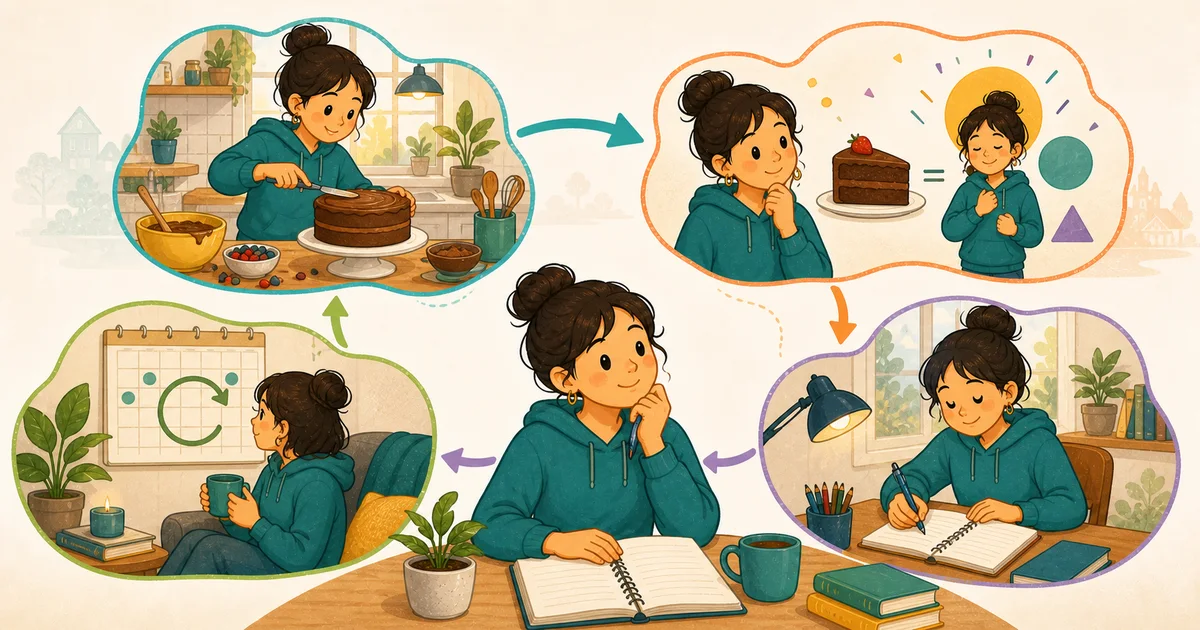
Idioms are easier to remember as small scenes than as direct translations.
- Picture the situation. Imagine a difficult task that becomes a piece of cake.
- Keep the original phrase. Do not replace its words with literal alternatives.
- Write one true context. “I got cold feet before my first online class.”
- Notice register. Ask whether the phrase sounds friendly, informal, humorous, or too strong.
For more examples and topic groups, use Idiom Examples: 200+ English Idioms. A few well-understood idioms are more useful than a long list you only recognize.
Common Idiom Mistakes to Avoid
- Changing the fixed words. Say on cloud nine, not in cloud nine. Learn the complete phrase.
- Using an idiom in the wrong tone. Spill the beans is playful; it may not fit a serious discussion about confidential information.
- Translating an idiom from your first language. A direct translation may be understandable but not natural in English.
- Forcing every new idiom into speech. First recognise it, then try it in one relaxed, appropriate conversation or message.
Vocabulary to Practise
Save these useful words in Linglify and use them to make your own short examples. Reviewing words around an idiom also helps you remember the situation where it belongs.
boom
noun
A loud, deep sound or a sudden increase in activity or popularity.
Examples
- The boom of thunder echoed across the valley.
- The technology boom created many new millionaires.
cooperate
verb
To work together with others towards a common goal.
evaluate
verb
To judge or measure the value, quality, or importance of something.
Examples
- Companies evaluate job candidates based on experience, skills, and personality.
- Teachers evaluate student progress through tests, projects, and classroom participation.
graduate
verb
To complete a course of study at a school or university.
Examples
- She will graduate from university next year with a degree in engineering.
- Students must complete all requirements before they can graduate from high school.
horizon
noun
The line where the earth or the sky appears to meet in the distance.
Examples
- The sun disappeared behind the horizon as evening approached.
- Traveling broadens your horizon and exposes you to new cultures.
indispensable
adjective
Absolutely necessary; essential.
Examples
- Clean water is indispensable for human survival and good health.
- Her experience and skills make her indispensable to the research team.
jury
noun
A group of people who listen to evidence in a court and decide if someone is guilty.
Examples
- The jury deliberated for several hours before reaching a verdict.
- The talent show jury consisted of professional musicians and entertainers.
lifelong
adjective
Continuing for a very long time or for the whole life.
Examples
- Learning is a lifelong process that never truly ends.
- Their lifelong friendship began during elementary school years.
motivated
adjective
Feeling driven or inspired to do something because of a reason or goal.
Examples
- Motivated employee seeks additional responsibilities and challenges at work.
- Success requires being motivated even when facing difficult obstacles.
normally
adverb
Usually; under normal conditions.
Examples
- Heart normally beats between sixty and hundred times per minute.
- Students normally arrive at school before morning bell rings.
off
adjective
Describes something that is not fresh or is no longer suitable for eating, often used for food and drinks.
Examples
- Please turn off the lights before leaving the room.
- The dog ran off into the forest chasing wild rabbits.
prejudice
noun
Preconceived opinions or feelings, often negative, about a person or group.
Examples
- Education helps overcome prejudice and promotes understanding.
- Racial prejudice damages communities and individuals alike.
resolve
verb
To find a solution or answer to a problem or question.
Examples
- Mediator helps parties resolve dispute through negotiation.
- Technical team will resolve software problems quickly.
stress
verb
To feel mental or emotional pressure or worry; to emphasize or give importance to something.
Examples
- Heavy workload may stress employees beyond limits.
- Teacher will stress importance of homework completion.
total
adjective
An adjective describing something that is complete or whole, not divided or broken.
Examples
- Total cost includes all fees and expenses.
- Total silence fills room during meditation session.
tragedy
noun
An extremely sad or serious event that causes suffering or loss.
Examples
- Natural tragedy affects thousands of innocent people.
- Personal tragedy changes person's life perspective completely.
union
noun
A group of people or things joined together for a purpose.
Examples
- Labor union protects worker rights and interests.
- Marriage union joins two people in partnership.
voyage
noun
A long journey to a distant place, often by sea or air.
Examples
- Space exploration represents humanity's greatest voyage into the unknown.
- The ocean voyage from Europe to America took several weeks in the past.
candidate
noun
A person who is competing in an election or contest.
Examples
- Each presidential candidate presented their policy plans to voters.
- The job candidate impressed the interview panel with her experience.
discourage
verb
To try to make someone feel less confident or hopeful about something.
Examples
- Don't let one failure discourage you from pursuing your dreams.
- High prices discourage many people from buying organic food products.
donate
verb
To give something, especially money or goods, to help a cause or person.
Examples
- Many people donate money to charities that help homeless individuals.
- She decided to donate blood to help patients in emergency situations.
firmly
adverb
An adverb indicating a way of doing something with certainty or stability.
Examples
- Hold the rope firmly while climbing down the steep mountain slope.
- The manager firmly believed in treating all employees with respect.
guide
verb
To show or direct someone how to do something.
Examples
- Parents should guide their children to make responsible decisions.
- The experienced hiker will guide the group through the mountain trail safely.
humorous
adjective
Funny or amusing, often making people laugh.
Examples
- She writes humorous articles about everyday life and family experiences.
- The humorous speech made everyone laugh and lightened the serious mood.
admission
noun
The process or fact of being allowed to enter or join.
Examples
- Her admission to the prestigious medical school was the result of hard work.
- The museum offers free admission on the first Sunday of every month.
What to Do Next
- Choose five idioms from this page and make one personal sentence for each.
- Explore 100 common idioms when these phrases feel familiar.
- Learn everyday vocabulary in the B1 library.
- Add your favourite idioms to Linglify and review them again later this week.
FAQ
What are the easiest idioms to learn first?
Start with idioms you can use in everyday situations, such as a piece of cake, give it a shot, and under the weather. They appear often and their contexts are easy to imagine.
Can I use idioms in formal English?
Some idioms appear in friendly professional speech, but formal writing usually needs direct language. If you are unsure, choose a clear literal phrase instead of an idiom.
How many idioms should I learn each week?
Three to five is a practical target. Learn each one with a situation and a personal sentence, then review it before adding more.
Why should I not translate idioms word by word?
The literal words usually do not explain the real meaning. Learn an idiom as one complete unit connected to a situation, tone, and example.


