
50 Most Common Phrasal Verbs for Everyday English
English has over 10,000 phrasal verb combinations, but you do not need anywhere near that many. Just 50 phrasal verbs cover the vast majority of what native speakers say in daily conversation. If you learn the 50 on this list, you will understand most phrasal verbs you hear in movies, podcasts, workplace conversations, and casual texts.
This guide organizes them by base verb — GET, TAKE, GO, PUT, TURN, LOOK, and others — because phrasal verbs are easier to remember when you learn them in verb families. Each entry gives you the meaning and two example sentences showing real everyday usage.
- Total phrasal verbs: 50
- Level: A2–B2 (elementary to upper-intermediate)
- Best for: everyday conversation, IELTS Speaking, general fluency
- Organization: by base verb (10 verb families)
Why Learn by Base Verb?
Most phrasal verb lists dump 100 random verbs in a table. That makes them hard to memorize. When you group by base verb, patterns appear:
- GET = movement, change of state, obtaining
- TAKE = removing, accepting, starting
- GO = moving, continuing, changing
- PUT = placing, tolerating, delaying
- TURN = changing direction or state
Learning “get up,” “get on,” “get off,” and “get over” together is faster than learning them scattered across an alphabetical list. Your brain links them to the same root, and each new phrasal verb becomes easier.
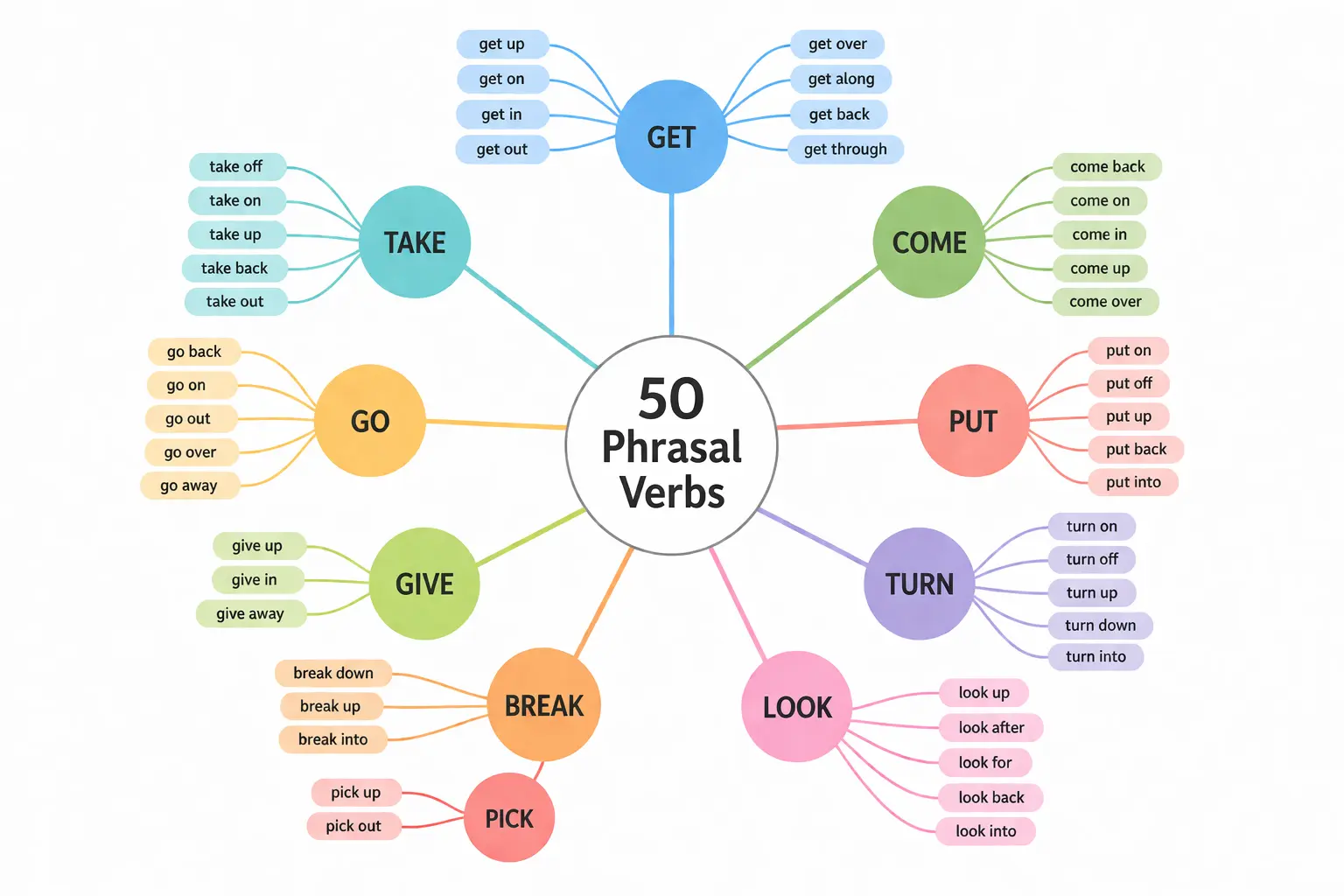
GET — The Most Versatile Verb
GET forms more common phrasal verbs than any other English verb. These eight appear in almost every conversation.
| # | Phrasal Verb | Meaning | Examples |
|---|---|---|---|
| 1 | get up | rise from bed; stand up | I get up at 6:30 every morning for work. / She got up from her chair and walked to the window. |
| 2 | get on | board a vehicle; have a relationship | We got on the bus just as it was about to leave. / How do you get on with your new neighbours? |
| 3 | get off | leave a vehicle; finish work | Get off at the third stop — the library is right there. / What time do you get off work today? |
| 4 | get along with | have a friendly relationship | She gets along with everyone in the office. / My cat does not get along with the new dog. |
| 5 | get over | recover from something | It took him weeks to get over the flu. / She finally got over the shock of losing her job. |
| 6 | get back | return; receive something again | What time did you get back from the trip? / I lent him my book a month ago and still have not got it back. |
| 7 | get into | enter; become interested or involved in | He got into the car without saying a word. / She got into photography during the lockdown. |
| 8 | get rid of | remove or throw away something unwanted | We need to get rid of this old sofa — it is falling apart. / I finally got rid of those annoying pop-up ads on my phone. |
Pattern to notice: GET almost always implies a change — a change of position (get up, get on, get off), a change of state (get over, get into), or a change of possession (get back, get rid of).
TAKE — Remove, Accept, Start
TAKE phrasal verbs involve removing something, accepting responsibility, or beginning an activity.
| # | Phrasal Verb | Meaning | Examples |
|---|---|---|---|
| 9 | take off | remove clothing; (of a plane) leave the ground; suddenly become successful | Take off your jacket — it is warm inside. / The plane took off 20 minutes late because of the weather. |
| 10 | take on | accept a task or responsibility; hire | She took on the project even though she was already busy. / The company is taking on 50 new employees this quarter. |
| 11 | take up | start a new hobby or activity; occupy space or time | He took up running last year and has already done a marathon. / This table takes up too much space in the kitchen. |
| 12 | take care of | look after; handle | Can you take care of the kids while I go to the dentist? / Do not worry about the invoice — I will take care of it. |
| 13 | take out | remove from inside; bring someone to a restaurant or event | He took out his wallet and paid for the meal. / I am taking my parents out for dinner on their anniversary. |
Pattern to notice: TAKE often means “remove from one place or state.” You take off clothes (remove them), take out your wallet (remove from pocket), take on work (remove it from someone else’s pile).
COME — Arrive, Happen, Discover
COME phrasal verbs describe arriving, things happening, and unexpected discoveries.
| # | Phrasal Verb | Meaning | Examples |
|---|---|---|---|
| 14 | come back | return to a place | She went to Australia for a year but came back because she missed her family. / When are you coming back from lunch? |
| 15 | come in | enter a room or building | Come in and sit down — the meeting is about to start. / The door was open, so I just came in. |
| 16 | come up | arise; be mentioned; approach | Something urgent came up at work, so I will be late. / Your name came up in the conversation. |
| 17 | come up with | think of an idea, plan, or solution | She came up with a creative solution to the problem. / We need to come up with a name for the new product. |
| 18 | come across | find something by chance; appear or seem | I came across your article while researching online. / He comes across as confident, but he is actually quite shy. |
Pattern to notice: COME implies movement toward the speaker or toward a result. Things come back (return to you), come up (rise to your attention), and come across your path (appear in your experience).
GO — Move, Continue, Change
GO phrasal verbs express movement away, continuation, and change.
| # | Phrasal Verb | Meaning | Examples |
|---|---|---|---|
| 19 | go on | continue; happen | Please go on — I did not mean to interrupt you. / What is going on here? Why is everyone shouting? |
| 20 | go out | leave the house for social activity; stop burning | We go out for dinner every Friday night. / The candle went out because of the wind. |
| 21 | go ahead | proceed; begin | Go ahead and start without me — I will catch up. / The concert will go ahead despite the rain. |
| 22 | go back | return to a place or previous state | I left my phone at the office and had to go back for it. / Once you send the email, you cannot go back and change it. |
| 23 | go through | experience something difficult; examine carefully | She went through a very tough period after the divorce. / The lawyer went through every clause in the contract. |
Pattern to notice: GO implies movement away from the current position. You go out (leave), go back (return to where you were before), and go through difficult experiences (pass from one side to the other).
PUT — Place, Delay, Tolerate
PUT phrasal verbs involve placing things, postponing, and handling situations.
| # | Phrasal Verb | Meaning | Examples |
|---|---|---|---|
| 24 | put on | dress in; add weight; play music/a show | Put on a warm coat — it is freezing outside. / She put on some music to help her concentrate. |
| 25 | put off | postpone; make someone not want to do something | Do not put off the dentist appointment again — you need to go. / The long commute put me off taking the job. |
| 26 | put up with | tolerate something annoying or unpleasant | I cannot put up with his constant complaining anymore. / How do you put up with the noise from the construction site? |
| 27 | put away | return something to its proper place | Please put away the dishes after you dry them. / The kids need to put away their toys before bedtime. |
| 28 | put down | place on a surface; criticize someone | He put down his phone and looked at me. / Stop putting yourself down — your work is excellent. |
Pattern to notice: PUT involves placing something somewhere — literally (put on clothes, put away dishes, put down a phone) or figuratively (put off = place in the future, put up with = place yourself beneath something unpleasant).
TURN — Change Direction or State
TURN phrasal verbs describe switches, changes, and transformations.
| # | Phrasal Verb | Meaning | Examples |
|---|---|---|---|
| 29 | turn on | start a device; make something work | Turn on the air conditioning — it is too hot in here. / She turned on the laptop and checked her emails. |
| 30 | turn off | stop a device; leave a road | Please turn off the lights when you leave the room. / Turn off at the next exit to reach the hotel. |
| 31 | turn out | have a particular result; prove to be | The party turned out to be much more fun than I expected. / It turned out that he had been lying the whole time. |
| 32 | turn up | arrive (often unexpectedly); increase volume | She turned up at the party without telling anyone. / Can you turn up the volume? I cannot hear the news. |
| 33 | turn down | refuse; decrease volume | She turned down the job offer because the salary was too low. / Turn down the music — the baby is sleeping. |
Pattern to notice: TURN always implies a change of state. ON/OFF = operating state. UP/DOWN = level of something. OUT = the final state that something reaches. DOWN (refuse) = turning away from something offered.
LOOK — Search, Watch, Expect
LOOK phrasal verbs relate to seeing, searching, and directing attention.
| # | Phrasal Verb | Meaning | Examples |
|---|---|---|---|
| 34 | look for | try to find something | I am looking for my car keys — have you seen them? / She has been looking for a new apartment for three months. |
| 35 | look after | take care of | My mother looks after the children when I am at work. / You need to look after your health — you have been working too hard. |
| 36 | look up | search for information; improve | Look up the word in a dictionary if you do not know it. / Business has been looking up since the new manager arrived. |
| 37 | look forward to | feel excited about a future event | I am looking forward to the weekend. / We look forward to meeting you at the interview. |
| 38 | look out | be careful; watch for danger | Look out! There is a step right in front of you. / Look out for pickpockets in crowded tourist areas. |
Pattern to notice: LOOK is always about directing your attention. FOR = toward something you want. AFTER = toward someone who needs you. UP = toward a source of information. FORWARD TO = toward the future. OUT = toward potential danger.
GIVE — Stop, Return, Distribute
| # | Phrasal Verb | Meaning | Examples |
|---|---|---|---|
| 39 | give up | stop trying; quit a habit | She gave up smoking three years ago. / The puzzle is impossible — I give up. |
| 40 | give back | return something to its owner | Can you give back the tools you borrowed last week? / The charity works to give back to the community. |
| 41 | give away | donate; reveal a secret | We gave away our old furniture when we moved. / Do not give away the ending of the movie! |
BREAK — End, Stop, Enter
| # | Phrasal Verb | Meaning | Examples |
|---|---|---|---|
| 42 | break up | end a relationship; lose signal | They broke up after dating for two years. / You are breaking up — I will call you back on a better connection. |
| 43 | break down | stop working; lose emotional control | The car broke down in the middle of the highway. / She broke down in tears when she heard the news. |
| 44 | break into | enter by force; start suddenly | Someone broke into the house while they were on holiday. / He broke into a run when he saw the bus leaving. |
PICK — Choose, Collect, Learn
| # | Phrasal Verb | Meaning | Examples |
|---|---|---|---|
| 45 | pick up | collect someone; learn casually; improve | I will pick you up at the station at 5 PM. / She picked up some Spanish while living in Barcelona. |
| 46 | pick out | choose; select from a group | She picked out a dress for the wedding. / Can you pick out the best candidate from these CVs? |
SET and BRING — Start and Introduce
| # | Phrasal Verb | Meaning | Examples |
|---|---|---|---|
| 47 | set up | arrange; establish; prepare | He set up his own business after leaving the bank. / Can you help me set up the projector for the presentation? |
| 48 | set off | begin a journey; trigger | We set off early to avoid the morning traffic. / The alarm was set off by a cat walking past the sensor. |
| 49 | bring up | mention a topic; raise a child | He brought up the salary issue during the meeting. / She was brought up in a small village in the south of France. |
| 50 | bring back | return something; cause to remember | Please bring back the library books before Friday. / This song brings back memories of my school days. |
Quick Reference: All 50 at a Glance
| Base Verb | Phrasal Verbs | Count |
|---|---|---|
| GET | get up, get on, get off, get along with, get over, get back, get into, get rid of | 8 |
| TAKE | take off, take on, take up, take care of, take out | 5 |
| COME | come back, come in, come up, come up with, come across | 5 |
| GO | go on, go out, go ahead, go back, go through | 5 |
| PUT | put on, put off, put up with, put away, put down | 5 |
| TURN | turn on, turn off, turn out, turn up, turn down | 5 |
| LOOK | look for, look after, look up, look forward to, look out | 5 |
| GIVE | give up, give back, give away | 3 |
| BREAK | break up, break down, break into | 3 |
| PICK | pick up, pick out | 2 |
| SET | set up, set off | 2 |
| BRING | bring up, bring back | 2 |
| Total | 50 |
Vocabulary to Practice
These 25 words frequently appear alongside common phrasal verbs. Add them to your Linglify dictionary to practice with spaced repetition.
finance
verb
This verb means to provide money for a project or activity, or to manage financial matters.
Examples
- Many students need loans to finance their college education expenses.
- The bank agreed to finance the construction of the new shopping center.
executive
adjective
Relating to people in high positions of management or authority.
Examples
- Executive decisions require careful consideration of multiple factors and consequences.
- The executive branch of government is responsible for implementing laws.
valid
adjective
Having legal or official force; acceptable.
Examples
- Valid argument supports logical reasoning and conclusion.
- Valid passport allows international travel without problems.
culmination
noun
The highest point or final stage of a process or event.
Examples
- The graduation ceremony was the culmination of four years of hard study.
- Winning the championship represented the culmination of the team's efforts.
transmit
verb
To send or pass on information, signals, or messages.
Examples
- Disease may transmit through contact with surfaces.
- Satellites transmit signals across vast distances effectively.
gulp
verb
This verb means to swallow quickly or in large amounts, often with a gulping sound.
Examples
- She had to gulp nervously before giving her presentation to the board.
- The thirsty runner gulped down an entire bottle of cold water.
cherished
adjective
Deeply loved or valued; treasured.
Examples
- His cherished dream of becoming a pilot finally came true.
- The old photograph was her most cherished possession from childhood.
fate
noun
The power or force that is believed to determine what happens in the future.
Examples
- She believes that fate brought them together at the right moment.
- The explorer's fate remained unknown after he disappeared in the jungle.
spellbound
adjective
Fascinated or captivated by something.
Examples
- Audience sits spellbound during magical performance tonight.
- Children remain spellbound by storyteller's fascinating tales.
pet
adjective
Relating to a domesticated animal kept for companionship or amusement.
Examples
- Pet project receives extra attention and resources.
- Pet theory explains professor's research focus area.
master
noun
A person who has control or authority over something or someone, often skilled in a particular area.
Examples
- Apprentices learn traditional crafts from experienced master craftsmen.
- The chess master defeated opponents using brilliant strategic moves.
payable
adjective
Able to be paid; due for payment.
Examples
- All dues are payable at the end of the month.
- The invoice is payable within 30 days.
serenity
noun
A state of calm, peacefulness, and mental clarity.
Examples
- She maintained her serenity despite the chaos.
- The serenity of the lake was calming.
classy
adjective
This adjective describes someone or something that is stylish, elegant, or of high quality.
Examples
- Classy restaurant serves gourmet food in elegant dining atmosphere.
- Her classy appearance impressed everyone at formal business meeting.
revolt
verb
To openly oppose or fight against authority, rules, or established order.
Examples
- A revolt broke out in the city center last night.
- The workers decided to revolt against the unfair conditions.
rethink
verb
To reconsider or think about something again, often leading to a new decision or opinion.
Examples
- He decided to rethink his position on the issue.
- We need to rethink our strategy for the project.
gypsy
noun
A member of a traditionally nomadic ethnic group known for their itinerant lifestyle and distinct culture.
Examples
- Traditional gypsy music features violin and passionate vocals.
- Wandering gypsy caravan traveled through European countryside.
buffoon
noun
A person who acts in a silly or foolish way, often to entertain others.
Examples
- Court buffoon entertained royal family with silly performances.
- Don't act like buffoon during important business presentation.
execution
noun
The act of carrying out a plan or law; the process of killing or executing.
Examples
- Perfect execution of the dance routine impressed judges and audience members.
- The execution of the business plan requires careful coordination and timing.
territory
noun
An area of land with defined borders, often controlled by a country.
Examples
- Animal territory provides food and shelter resources.
- National territory requires protection from foreign invasion.
tribe
noun
A group of people who share a common culture, language, or history.
Examples
- Ancient tribe lived in harmony with nature.
- Indigenous tribe preserves traditional customs and languages.
resolve
verb
To find a solution or answer to a problem or question.
Examples
- Mediator helps parties resolve dispute through negotiation.
- Technical team will resolve software problems quickly.
flexible
adjective
Able to change or bend without breaking; adaptable.
Examples
- Flexible working arrangements help employees balance work and family life.
- The flexible plastic tube can bend without breaking or cracking.
How to Study These 50 Phrasal Verbs
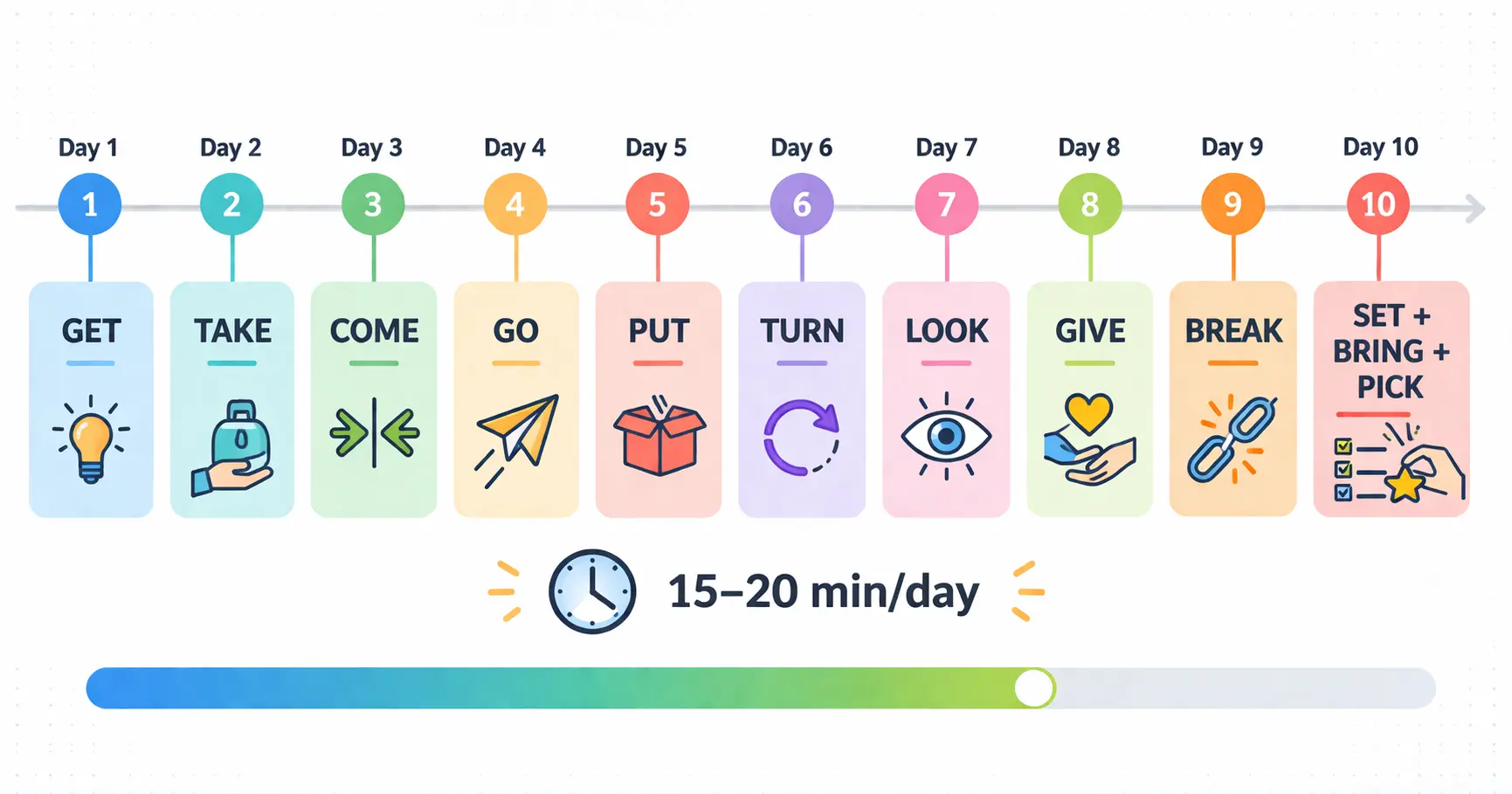
1. Learn one verb family per day. Monday = GET phrasal verbs. Tuesday = TAKE. Wednesday = COME. In 10 days, you will have covered all 50. Spend 15–20 minutes per family.
2. Write sentences about your own life. Do not just read the examples — write your own. “I got up at 7 today.” “I need to get rid of my old phone.” Personal sentences create stronger memories than generic textbook examples.
3. Use the “replace and upgrade” method. For one day, try replacing basic verbs in your speech: instead of “I started running,” say “I took up running.” Instead of “I returned,” say “I came back.” Conscious substitution builds the habit.
4. Watch English content with subtitles. Pick a TV show or YouTube channel and count how many of these 50 phrasal verbs you hear in one episode. You will be surprised — most episodes contain 15–20 of them.
5. Test yourself with the base verb. Cover the meaning column and try to recall what each phrasal verb means. Then cover the phrasal verb column and try to produce it from the meaning. Both directions build stronger recall.
For a complete vocabulary learning system, read our guide on how to improve your vocabulary.
What to Do Next
-
Expand to 100. Once you are comfortable with these 50, move to our 100 phrasal verbs with meanings and sentences for the full essential list organized by topic.
-
Go deeper into specific verbs. For a complete breakdown of every phrasal verb with MAKE (5+ meanings for “make up” alone), see our phrasal verbs with MAKE guide.
-
Level up to advanced. For C1–C2 phrasal verbs used in academic and professional English, read our advanced phrasal verbs guide.
-
Apply them at work. For phrasal verbs specific to meetings, emails, and business communication, check our business phrasal verbs guide.
-
Build a daily study habit. Follow our step-by-step vocabulary system to turn these 50 into active vocabulary within two weeks.
FAQ
What are the 10 most common phrasal verbs in English?
Based on frequency data, the top 10 are: get up, go on, come back, find out, give up, turn out, pick up, look for, take off, and go out. These appear thousands of times per million words in spoken English. If you only learn 10, make it these.
What is the difference between this list and the 100 phrasal verbs list?
This article teaches 50 phrasal verbs organized by base verb (GET, TAKE, COME, etc.) with two examples and a pattern explanation for each family. Our 100 phrasal verbs list is organized by topic (daily life, work, travel, emotions) and covers twice as many verbs with one example each. Use this article to learn the patterns; use the 100 list as a reference.
How long does it take to learn 50 phrasal verbs?
With focused daily study, most learners can learn 50 phrasal verbs in 2–3 weeks. Learn one verb family per day (15–20 minutes), then review the previous day’s family before starting the new one. After 10 days of learning, spend another week on active practice — writing and speaking using them.
Are these phrasal verbs the same in British and American English?
Yes, all 50 phrasal verbs on this list are used in both British and American English. A few have slight preference differences — Americans tend to say “get rid of” more than British speakers, who might also use “dispose of” — but all 50 are universally understood and used in both varieties.
Can I use these phrasal verbs in IELTS Writing?
Some are appropriate for IELTS Writing: “carry out” (not on this list but related), “go through,” “come up with,” and “set up” work well in essays. Others like “hang out” and “get rid of” are better for Speaking. For IELTS-specific phrasal verb advice, see our IELTS vocabulary guide.
Why are phrasal verbs so difficult to learn?
Three reasons: (1) the meaning is usually not predictable from the words — “put up with” does not logically mean “tolerate”; (2) many phrasal verbs have multiple meanings — “take off” means remove clothes, leave the ground, or become successful; (3) grammar is tricky — some are separable (“turn the light off”) and others are not (“look after the kids,” not “look the kids after”). The base-verb organization in this article helps with reason #1 by showing patterns within verb families.


