A1 English Vocabulary: 500 Essential Beginner Words
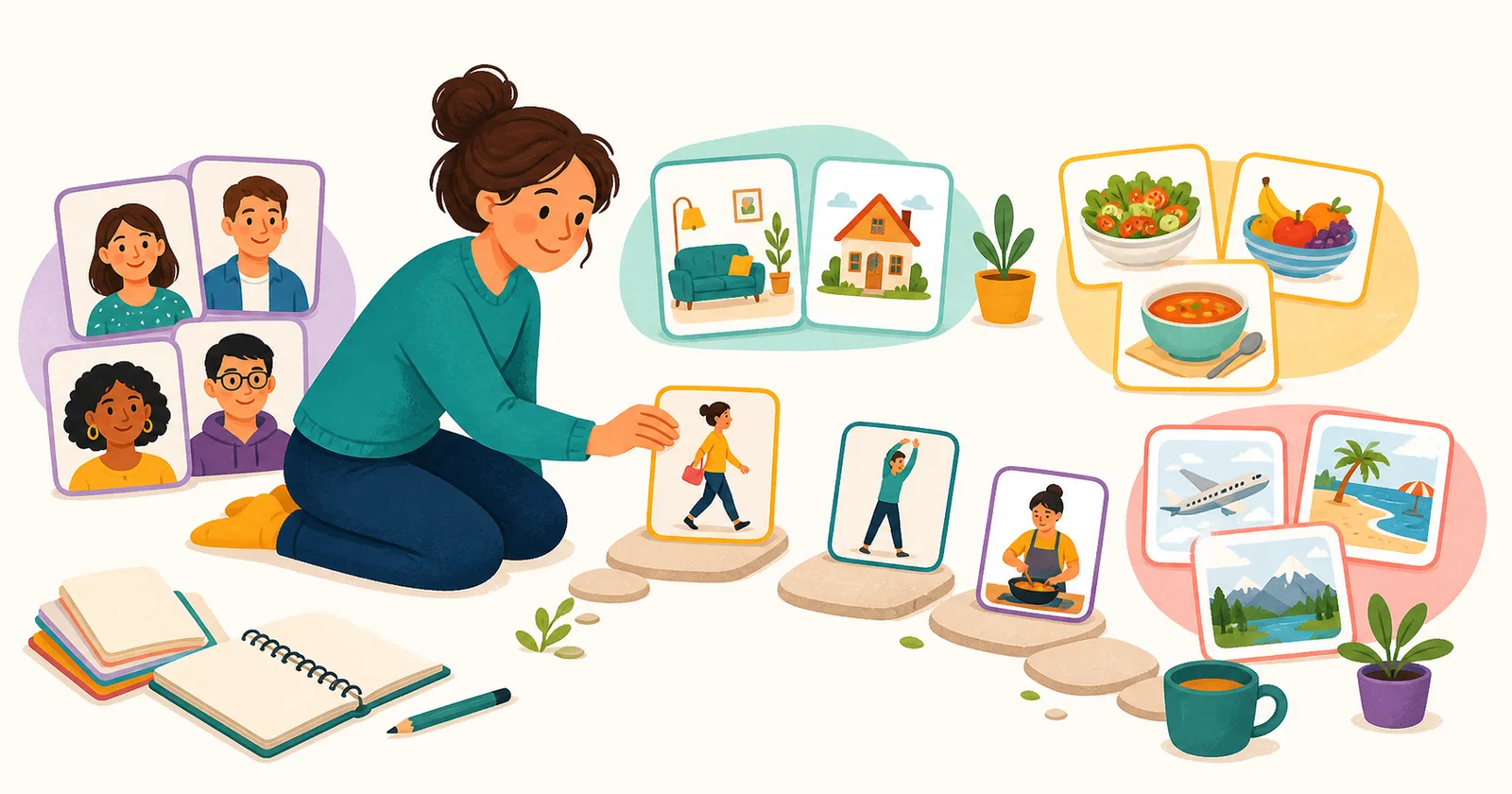
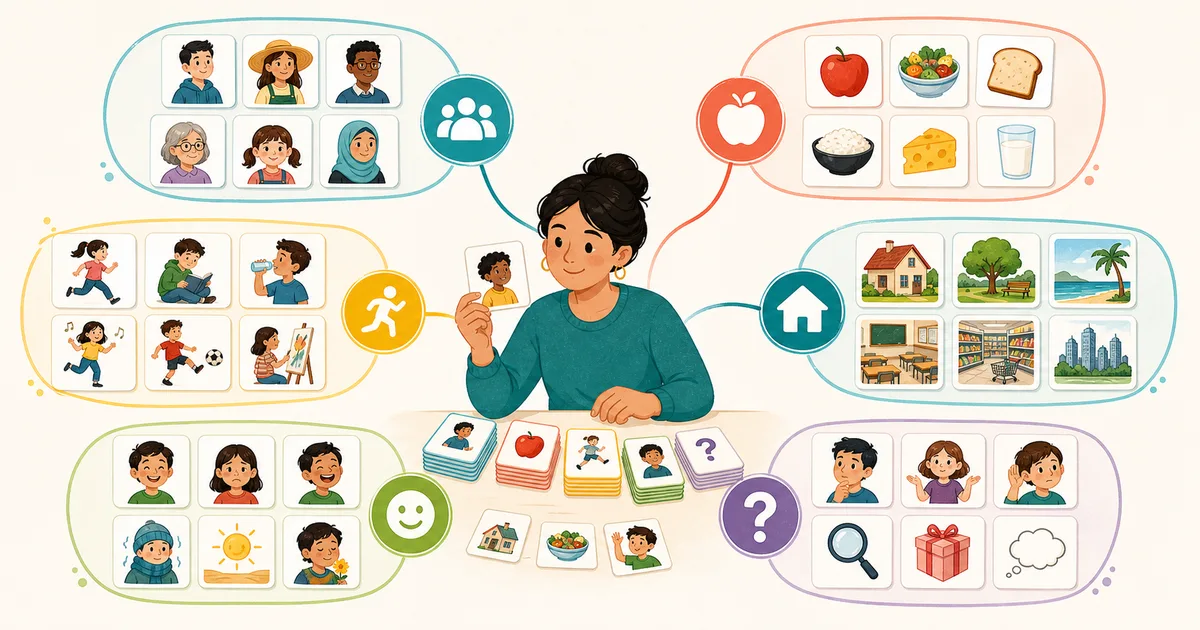
An A1 English vocabulary of around 500 useful words gives you a practical start. You can introduce yourself, talk about family and daily routines, buy food, ask simple questions, and understand short messages. The key is not to memorize an alphabetical list. Learn words in groups that help you make real sentences.
This guide organizes essential beginner vocabulary by everyday use. The tables show representative words from a 500-word A1 core; use the A1 vocabulary library to practise them in small, reviewable sets.
- Level: A1 (beginner)
- Core target: 500 high-use words
- Best for: new learners and anyone rebuilding basic gaps
- Study rule: learn a noun, a verb, a describing word, and a small grammar word together
What Can You Do with A1 Vocabulary?
At A1, you do not need abstract vocabulary. You need words for immediate needs: people, places, things, actions, numbers, time, food, and basic feelings. With a small core, you can say “My sister works at a café,” ask “Where is the station?”, and understand “The shop opens at nine.”
The same word becomes more useful when you combine it with others. Coffee is one word; I would like a coffee, please is communication. Start with words that appear in many sentences, then reuse them in your own life. For a wider map of the levels ahead, read English Vocabulary by CEFR Level.
People, Home, and Everyday Things
| Word | Part of speech | Meaning | Example |
|---|---|---|---|
| family | noun | people related to you | My family lives near the city centre. |
| friend | noun | a person you know and like | Her friend is in my class. |
| child | noun | a young person | The child is reading a book. |
| home | noun | the place where you live | I am at home today. |
| room | noun | part of a building | This room has two windows. |
| school | noun | place for learning | The school is near our house. |
| shop | noun | place to buy things | The shop closes at six. |
| phone | noun | device for calling people | My phone is in my bag. |
Everyday Actions
Verbs give your sentences movement. Learn the base form first, then notice common forms such as work / works / worked.
| Word | Part of speech | Meaning | Example |
|---|---|---|---|
| be | verb | exist; describe a person or thing | They are happy today. |
| have | verb | own or experience | I have a new job. |
| do | verb | perform an action | What do you do after class? |
| go | verb | move to another place | We go to the park on Sunday. |
| come | verb | move toward a place or person | Please come here. |
| want | verb | wish for something | I want a cup of tea. |
| need | verb | require something | You need your passport. |
| like | verb | enjoy something | They like Italian food. |
Food, Shopping, and Daily Life
| Word | Part of speech | Meaning | Example |
|---|---|---|---|
| food | noun | things people eat | The food is very good. |
| water | noun | drink without colour | Can I have some water, please? |
| breakfast | noun | first meal of the day | We have breakfast at seven. |
| money | noun | what you use to pay | I do not have much money. |
| price | noun | how much something costs | What is the price of this bag? |
| buy | verb | get something by paying | I need to buy some bread. |
| pay | verb | give money for something | Can I pay by card? |
| open | verb | begin business or make not closed | The café opens at eight. |
Time, Travel, and Places
| Word | Part of speech | Meaning | Example |
|---|---|---|---|
| today | adverb | on this day | I work from home today. |
| tomorrow | adverb | on the day after today | See you tomorrow. |
| morning | noun | early part of the day | Good morning. |
| bus | noun | large road vehicle | The bus is late. |
| station | noun | place for trains or buses | The station is over there. |
| street | noun | road in a town or city | Our street is quiet. |
| left | adverb | direction opposite to right | Turn left at the bank. |
| near | preposition/adverb | not far away | Is there a hotel near here? |
Describing Words and Feelings
| Word | Part of speech | Meaning | Example |
|---|---|---|---|
| good | adjective | pleasant, useful, or correct | That is a good idea. |
| big | adjective | large | They have a big house. |
| small | adjective | little in size | I need a small table. |
| new | adjective | recently made or obtained | Her new job starts Monday. |
| old | adjective | not new | This is an old photo. |
| happy | adjective | pleased | I am happy to see you. |
| tired | adjective | needing rest | We are tired after the trip. |
| easy | adjective | not difficult | The first exercise is easy. |
Question Words and Sentence Builders
Small grammar words appear in almost every sentence. Learn them early because they let you understand and create useful questions.
| Word | Use | Example |
|---|---|---|
| who | asks about a person | Who is that woman? |
| what | asks about a thing or action | What do you need? |
| where | asks about a place | Where is the bus stop? |
| when | asks about time | When does the film start? |
| why | asks for a reason | Why are you late? |
| how | asks about method or condition | How are you today? |
| because | gives a reason | I am home because it is raining. |
| with | shows connection or company | I study with my friend. |
Build Sentences, Not a Random List
Use a simple pattern: person + action + thing/place + time. For example:
- My friend works at a shop today.
- We have breakfast at home.
- I want water because I am tired.
Change one part each time. This turns a small vocabulary into many sentences and teaches you where each word belongs.
A Six-Week Plan for 500 A1 Words
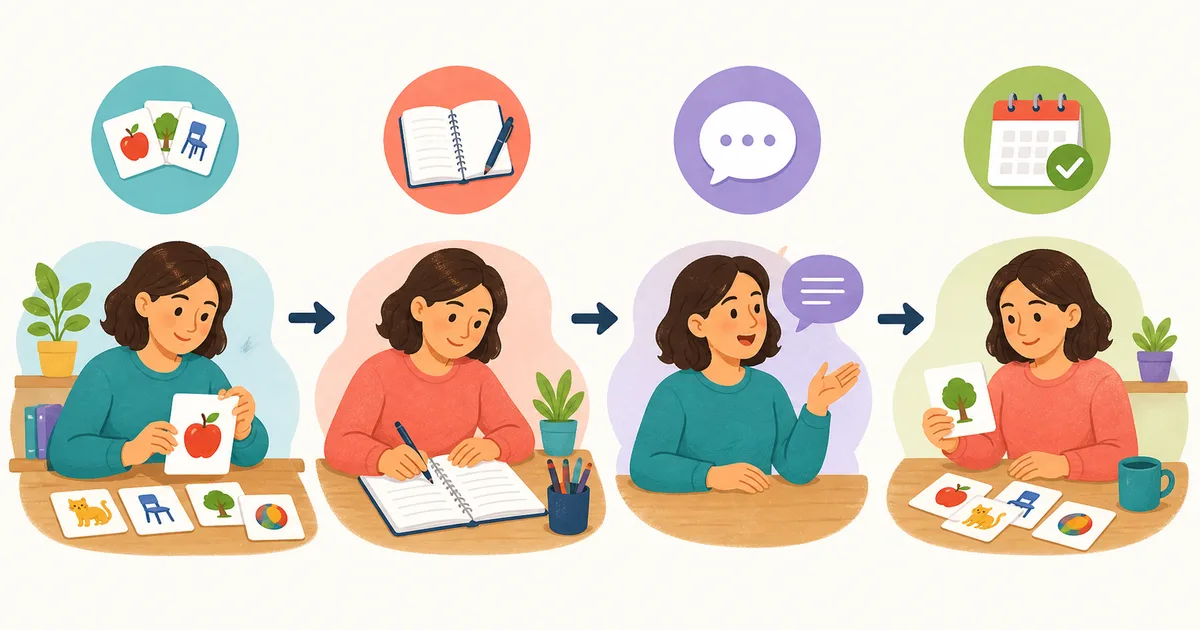
Weeks 1–2: Learn people, home, food, common verbs, and question words. Aim for 8–10 words a day.
Weeks 3–4: Add travel, shopping, time, clothes, health, and simple describing words. Make four personal sentences each day.
Weeks 5–6: Review the whole list in mixed groups. Practise short dialogues: ordering food, asking directions, introducing yourself, and talking about your routine.
Do not add new words until you can recognize most of yesterday’s group without looking. Linglify’s spaced repetition schedule makes these short reviews easier to keep.
Vocabulary to Practice
Save these A1 words in Linglify and make a personal sentence for each one. The goal is not perfect translation; it is being able to use the word when you need it.
abuse
noun
Wrong or improper use of something, often causing harm or damage.
Examples
- It's important to report any signs of child abuse to the authorities.
- The investigation revealed serious abuse of power by government officials.
actually
adverb
In fact; in truth; used to emphasize something surprising or true.
Examples
- I thought the meeting was today, but it's actually scheduled for tomorrow.
- The book looks boring, but it's actually quite interesting and engaging.
affection
noun
A feeling of fondness or warmth towards someone or something.
Examples
- The child showed deep affection for his grandmother who raised him.
- Their mutual affection was evident to everyone who saw them together.
agreement
noun
A formal statement of shared understanding or arrangement.
Examples
- The trade agreement will benefit both countries' economic development significantly.
- There was general agreement among the committee members about the proposed changes.
airport
noun
A place where aircraft take off and land.
Examples
- International airports handle millions of travelers and tons of cargo annually.
- We need to arrive at the airport two hours before our departure time.
alternate
adjective
Describing something that can be used instead of another.
Examples
- The parking lot uses alternate spaces for cars and motorcycles.
- We need an alternate plan in case the weather doesn't cooperate.
announce
verb
To make a public statement about something or tell people about it.
Examples
- Airlines announce flight delays through the terminal's public address system.
- The principal will announce the scholarship winners during tomorrow's assembly.
apart
adverb
Separated by a distance; not together.
Examples
- Please keep these chemicals apart to prevent dangerous reactions.
- The two friends lived far apart but stayed in regular contact.
apply
verb
To make a formal request or to put to use.
Examples
- Apply pressure to the wound to stop the bleeding immediately.
- Students can apply for financial aid to help pay tuition costs.
arrest
noun
A formal act of stopping someone and taking them into custody.
Examples
- He was under arrest for suspected involvement in the robbery.
- The arrest of the criminal was reported on the evening news.
attend
verb
To be present at an event, meeting, or activity.
Examples
- All students must attend classes regularly to pass their courses.
- The nurse will attend to the patient's needs throughout the night.
ballet
noun
A form of dance performed to music, often involving graceful movements and storytelling.
Examples
- She studied ballet for many years before becoming a professional dancer.
- The ballet performance featured graceful movements and beautiful costumes.
basis
noun
The underlying support or reason for something.
Examples
- The selection process is conducted on the basis of merit alone.
- Trust forms the basis of any successful relationship or partnership.
bedroom
noun
A room used for sleeping in a house or apartment.
Examples
- She decorated her bedroom with posters and colorful curtains.
- The master bedroom has a beautiful view of the garden.
biotechnology
noun
The use of living organisms or systems to develop products or processes.
Examples
- Agricultural biotechnology helps create disease-resistant crop varieties.
- Biotechnology companies develop new medical treatments and therapies.
borrow
verb
To take something temporarily for use, usually with permission, expecting to return it.
Examples
- Can I borrow your pen for a few minutes?
- He had to borrow money from the bank for repairs.
browser
noun
A software application used to access and view websites on the internet.
Examples
- Chrome is the most popular web browser worldwide.
- The store welcomes browsers as well as buyers.
candidate
noun
A person who is competing in an election or contest.
Examples
- Each presidential candidate presented their policy plans to voters.
- The job candidate impressed the interview panel with her experience.
cat
noun
A small domesticated animal with fur, often kept as a pet.
Examples
- The fluffy cat sat peacefully by the warm fireplace in the evening.
- Their pet cat loves to play with colorful balls of yarn.
cherished
adjective
Deeply loved or valued; treasured.
Examples
- His cherished dream of becoming a pilot finally came true.
- The old photograph was her most cherished possession from childhood.
cloudy
adjective
This describes the sky when it is covered with many clouds, making it appear dull or gray.
Examples
- The water became cloudy after stirring up sediment from the bottom.
- The weather forecast predicts cloudy skies with possible rain this evening.
commute
verb
To travel regularly between two places, especially to work.
Examples
- Public transportation helps people commute efficiently reducing traffic congestion.
- Workers commute daily between suburban homes and downtown offices.
confirmation
noun
A statement or proof that something is true or correct.
Examples
- She received confirmation of her job application via email yesterday.
- The confirmation ceremony was held at the local church on Sunday.
correspond
verb
A verb that means to match or be in agreement with something else.
Examples
- She corresponds regularly with her friends who live in different countries.
- The witness testimony should correspond with the physical evidence found at the scene.
custom
noun
A traditional way of doing things that is specific to a community or society.
Examples
- It is a local custom to remove shoes before entering homes.
- The wedding ceremony followed traditional customs from their culture.
What to Do Next
- Start with manageable groups in the A1 vocabulary library.
- Use your new words in Simple English Sentences for Daily Use.
- Return to English Vocabulary by CEFR Level when you are ready to plan your next level.
- Once you have a strong everyday foundation, see what upper-intermediate vocabulary looks like in B2 English Vocabulary: 500 Words.
- Add eight words today, then say four sentences about your real life tomorrow.
FAQ
Is 500 words enough for A1 English?
Around 500 high-use words can support many basic situations when you also know simple grammar and common sentence patterns. You will still meet new words, but you can begin communicating and learning from context.
How many A1 words should I learn each day?
Eight to ten new words a day is realistic if you review them and make short sentences. Learning fewer words well is better than forgetting a large daily list.
Should I learn grammar or vocabulary first?
Learn both together in small amounts. Grammar helps you connect the words into sentences, while vocabulary gives you something meaningful to say.
What should I study after A1 vocabulary?
Move into A2 grammar, daily conversations, simple reading and listening, and more vocabulary by topic. Keep reviewing A1 words while you add the next level; strong basics support every later stage.