

Advanced English Collocations: C1–C2 Word Combinations
Advanced English collocations help you express complex ideas with precision. At C1–C2, the difference is not simply knowing more difficult words. It is knowing which words naturally belong together, how formal they sound, and when they are useful.
This guide focuses on high-value combinations for formal discussion, reports, academic writing, professional communication, and advanced exam answers. Use them to make an accurate point, not to make a sentence look impressive.
- Level: C1–C2, with useful stretch material for strong B2 learners
- Focus: formal arguments, cause and effect, evaluation, disagreement, and change
- Best for: learners preparing for advanced writing, presentations, or high-level exams
- Rule: choose the phrase that fits the situation and support it with a clear idea
What Makes a Collocation Advanced?
Advanced collocations often combine an abstract noun with a precise verb or adjective: mitigate the impact, a compelling case, or far-reaching implications. They allow you to be economical. Instead of writing “This change will probably affect many parts of society in an important way,” you can write “This change may have far-reaching implications.”
However, advanced does not mean “formal in every situation.” You might make a strong case in a report, but tell a friend “I have a good reason.” Match your language to the audience first. If you need a level-by-level foundation, begin with English Collocations in Use.
Building and Evaluating an Argument
These combinations help you introduce evidence, make a claim, and judge its strength. They are useful in essays, meetings, and analytical speaking.
| Collocation | Meaning | Example |
|---|---|---|
| make a compelling case | give very persuasive reasons | The researchers make a compelling case for earlier intervention. |
| substantiate a claim | support a statement with evidence | You must substantiate the claim with reliable data. |
| draw a distinction | show an important difference | The report draws a distinction between cost and value. |
| reach a consensus | arrive at a shared decision | The committee failed to reach a consensus. |
| challenge an assumption | question an accepted idea | The findings challenge the assumption that growth is always positive. |
| a flawed argument | reasoning with an important weakness | It is a flawed argument because it ignores the evidence. |
| a coherent framework | a logical organized system | The policy needs a coherent framework. |
| mounting evidence | evidence that is steadily increasing | There is mounting evidence that sleep improves memory. |
Notice the grammar around each phrase. You substantiate a claim with data, but you make a case for a policy. Record the complete pattern, including the preposition.
Cause, Change, and Consequences
Advanced discussions often require you to explain how one event leads to another. These phrases are more exact than repeating cause and effect.
| Collocation | Meaning | Example |
|---|---|---|
| give rise to | cause something, usually a problem or question | The proposal could give rise to legal disputes. |
| have far-reaching implications | affect many areas in an important way | Automation may have far-reaching implications for work. |
| bring about a change | cause a change to happen | Public pressure brought about a change in the law. |
| mitigate the impact | make a negative effect less severe | New shelters can mitigate the impact of extreme weather. |
| exacerbate the problem | make a problem worse | Delays may exacerbate the problem. |
| undergo a transformation | experience a major change | The industry has undergone a transformation. |
| a marked decline | a clearly noticeable fall | The survey shows a marked decline in trust. |
| sweeping changes | large changes affecting many things | The reform introduced sweeping changes to the system. |
Use the strength of the phrase honestly. Far-reaching and sweeping describe major effects; they are not suitable for a small inconvenience. Precision makes your writing more credible.
Position, Conflict, and Priority
When ideas compete, advanced English gives you concise ways to show agreement, contrast, priorities, and relationships.
| Collocation | Meaning | Example |
|---|---|---|
| take precedence over | be more important than | Safety should take precedence over speed. |
| be at odds with | disagree with or conflict with | The decision is at odds with the stated policy. |
| strike a balance | find a reasonable middle position | Schools must strike a balance between freedom and support. |
| a vested interest | a personal reason to want a result | The company has a vested interest in the outcome. |
| a contentious issue | a topic that causes strong disagreement | Tax policy remains a contentious issue. |
| mutually exclusive | unable to exist together | The two options are not mutually exclusive. |
| inextricably linked | connected so closely that they cannot separate | Poverty and health are inextricably linked. |
| a stark contrast | a very clear difference | There is a stark contrast between the two regions. |
These phrases are powerful because they name the relationship between ideas. Before using one, ask yourself: is this really a conflict, a priority, or a contrast? The answer helps you choose the right collocation.
Evaluation and Formal Response
In reports and formal debate, you often need to assess a plan, describe a response, or state a position clearly.
| Collocation | Meaning | Example |
|---|---|---|
| categorically deny | deny completely and without doubt | The minister categorically denied the allegation. |
| flatly refuse | refuse firmly and directly | The landlord flatly refused to negotiate. |
| fall short of expectations | be less good than expected | The results fell short of expectations. |
| prove counterproductive | have the opposite of the intended result | A strict ban may prove counterproductive. |
| wholly inadequate | completely insufficient | The funding is wholly inadequate. |
| a viable solution | a practical solution that can work | We need a viable solution before winter. |
| a resounding success | a very clear and complete success | The campaign was a resounding success. |
| warrant attention | deserve careful consideration | The trend warrants attention from policymakers. |
Avoid a dramatic phrase when a neutral one is enough. Wholly inadequate is much stronger than not enough. It is best when evidence clearly supports the judgement.
Upgrade a Basic Sentence Without Losing Clarity
The goal is not to replace every ordinary word. Upgrade the part that carries your main meaning.
| Basic version | Precise version |
|---|---|
| This could cause more problems. | This could give rise to further concerns. |
| The policy has big effects. | The policy may have far-reaching implications. |
| We need to make the bad effect smaller. | We need to mitigate the adverse impact. |
| The two things are very different. | There is a stark contrast between the two. |
| The plan is not good enough. | The plan falls short of the required standard. |
Read each upgraded sentence aloud. If you could not explain it in simpler language, do not use it yet. Active vocabulary is language you can adapt, not a phrase you can only copy.
A Reliable Practice Routine for C1–C2 Collocations
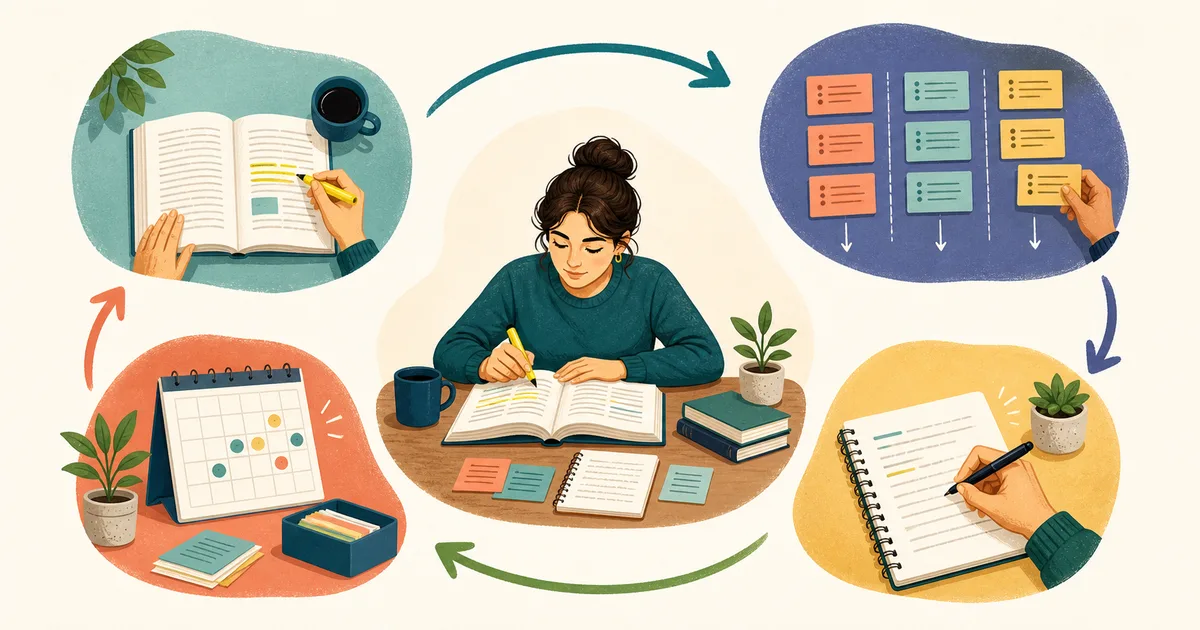
- Collect phrases from real advanced input. Choose one article, lecture, or report and save only five useful combinations.
- Record the context. Note whether the source is formal, neutral, academic, or conversational.
- Write a controlled variation. Change the topic but keep the grammar: “The proposal may give rise to privacy concerns.”
- Use a contrast. Put two phrases in one sentence: “Speed should not take precedence over safety.”
- Review after a delay. Cover the phrase and rebuild it from the meaning and situation.
Vocabulary to Practice
Save these useful words in Linglify, then combine them with the nouns, verbs, and situations in this guide. Review them with spaced repetition and make your own formal and neutral examples.
adequate
adjective
Sufficient for a particular purpose; not too little or too much.
Examples
- Students need adequate time to prepare for their final examinations properly.
- The hotel room was small but adequate for our short weekend trip.
advance
verb
To move forward or make progress, or to present something for consideration or discussion.
Examples
- Technology continues to advance at an incredible rate every year.
- The army decided to advance toward the enemy position at dawn.
adverse
adjective
Describes something that is harmful or unfavorable, often causing problems or difficulties.
Examples
- Adverse weather conditions forced the pilot to cancel the flight immediately.
- The medication may have adverse effects on some patients with allergies.
coherent
adjective
Coherent describes something that is logical, clear, and well-organized.
Examples
- After the accident, he wasn't coherent enough to answer police questions.
- The professor gave a coherent explanation of the complex scientific theory.
comprehensive
adjective
Including all necessary details and information, covering a wide range.
Examples
- Students need comprehensive insurance coverage while studying abroad.
- The comprehensive report covers all aspects of the company's financial performance.
contemporary
noun
Existing or happening now; modern or current.
controversy
noun
A serious disagreement or argument about something important.
deliberate
adjective
Done intentionally after careful thought; not accidental.
Examples
- He made a deliberate choice to study medicine instead of law.
- The damage to the car was deliberate, not accidental as claimed.
dilemma
noun
A situation in which a difficult choice has to be made between two options.
Examples
- Parents face the dilemma of balancing work responsibilities with family time.
- The ethical dilemma required careful consideration of all possible consequences.
dimension
noun
A measurement of size, length, or amount in a particular direction.
Examples
- The furniture won't fit because we misjudged the room's dimensions.
- The social dimension of the problem requires community involvement and support.
dynamic
adjective
Always changing or capable of change; full of energy and movement.
Examples
- Technology companies operate in a dynamic environment of constant change.
- The dynamic leader inspired her team to achieve extraordinary results.
enhance
verb
To improve or make something better.
Examples
- New software will enhance the computer's performance and processing speed.
- Regular exercise can enhance both physical health and mental wellbeing.
entrepreneur
noun
A person who starts and runs a business, often taking financial risks.
Examples
- Successful entrepreneurs take calculated risks to achieve their business goals.
- The young entrepreneur started a successful technology company from scratch.
evaluate
verb
To judge or measure the value, quality, or importance of something.
Examples
- Companies evaluate job candidates based on experience, skills, and personality.
- Teachers evaluate student progress through tests, projects, and classroom participation.
implication
noun
A suggestion or hint about something that is not directly stated.
Examples
- Scientists are studying the implications of climate change for future generations.
- The implication of his statement was that he disagreed with the policy.
inevitable
adjective
Certain to happen and cannot be avoided.
Examples
- Change is inevitable in life, and we must learn to adapt.
- The inevitable result of poor planning is confusion and failure.
innovation
noun
The act of creating new ideas, methods, or products.
Examples
- Technological innovation has transformed the way we communicate and work.
- The company's latest innovation will revolutionize the healthcare industry.
perspective
noun
A noun for a particular way of looking at or thinking about something.
Examples
- Different perspective helps solve complex problems creatively.
- Historical perspective reveals patterns in human behavior.
phenomenon
noun
A noun for an unusual or observable event or fact that can be studied.
Examples
- Aurora borealis is beautiful natural phenomenon.
- Social media phenomenon changes how people communicate.
revolution
noun
A complete change in the way people think about or do something, often involving new ideas or methods.
Examples
- Digital revolution changes how people communicate and.
- Industrial revolution transformed society and economy completely.
sustainable
adjective
This adjective describes something that can be maintained or continued without depleting resources.
Examples
- Company implements sustainable business model for long-term success.
- Sustainable farming practices protect soil and water resources.
downside
noun
Moving or falling toward the bottom or lower position.
Examples
- One downside of the plan is the cost.
- The downside is that it takes more time.
immune system
noun
The body's defense system that fights infections and illnesses.
Examples
- A healthy immune system helps fight off infections.
- Stress can weaken your immune system.
What to Do Next
- Practise vocabulary at this level in the C1 library or C2 library.
- Revisit the level-by-level collocations guide if any of these phrases feel too formal or unfamiliar.
- If you are preparing for a test, use Collocations for PTE and IELTS to practise exam-ready combinations.
- Add five phrases to Linglify and write one concise argument using two of them tomorrow.
FAQ
Are C1 and C2 collocations necessary for fluent English?
They are not necessary for every daily conversation, but they give you precision when you discuss complex topics, write formal texts, or present an argument. Fluency also depends on choosing a phrase that fits the situation naturally.
How can I tell whether a collocation is too formal?
Look at the source and audience. A phrase such as categorically deny is common in reports and news, while say no clearly is more natural in casual speech. Keep a note of the register with every new phrase.
Should I use advanced collocations in every IELTS essay?
No. Use them only where they express your meaning accurately and where you can control the grammar. Clear, relevant writing with a few natural advanced phrases is safer than forced complexity.
What is the fastest way to remember advanced word combinations?
Learn each phrase in a meaningful sentence, then create two variations on different topics. Spaced repetition in Linglify helps you revisit the phrase, but your own examples make it flexible.


