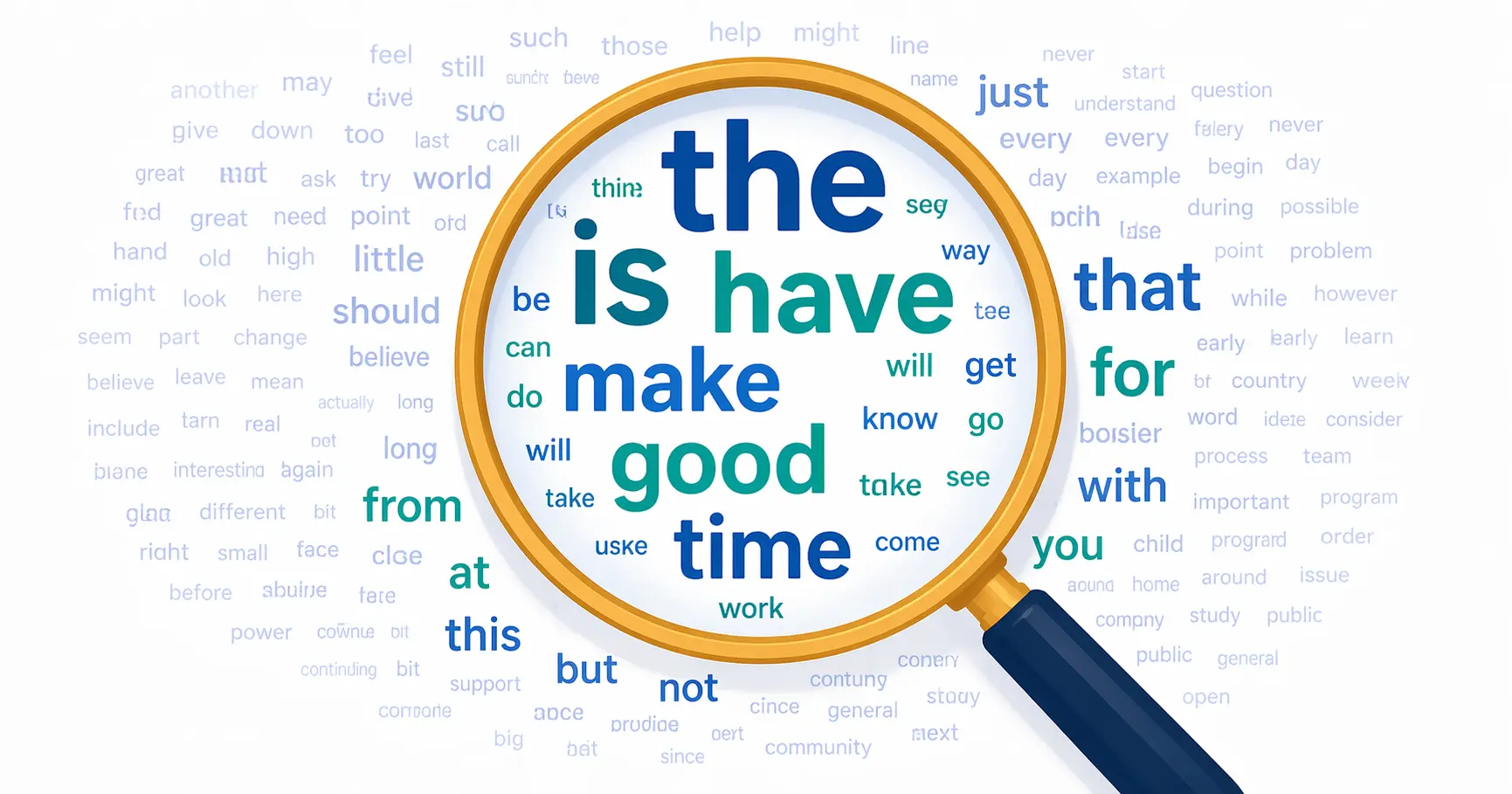

B2 Upper-Intermediate Vocabulary: 500 Words
B2 English vocabulary lets you move beyond familiar daily topics. You can discuss a news article, explain an opinion with reasons, participate in a meeting, write a clear essay, and understand much more of films and podcasts. The next step is not to collect rare words; it is to use precise, flexible vocabulary in common topics.
This guide organizes a 500-word B2 core into practical groups. The tables give representative words with context, while the B2 vocabulary library lets you practise words in manageable sets.
- Level: B2 (upper-intermediate)
- Core target: 500 useful words and word families
- Best for: independent learners moving from B1 toward advanced English
- Focus: analysis, work, society, technology, environment, and nuanced opinions
What Does B2 Vocabulary Let You Do?
At B2, you can discuss both concrete and abstract topics with reasonable fluency. Instead of saying “This is a big problem,” you can say “This issue has a significant impact.” Instead of “I think it will happen,” you can say “It is likely to occur.”
The key is control. A B2 learner does not need to sound academic in every sentence, but should be able to choose a more precise word when the topic needs it. Review the full progression in English Vocabulary by CEFR Level, then use the groups below to build active range.
Analysis, Evidence, and Ideas
These words help you explain what you think and why. They are useful in discussions, essays, reports, and presentations.
| Word | Part of speech | Meaning | Example |
|---|---|---|---|
| analyze | verb | examine carefully | We need to analyze the results before deciding. |
| assumption | noun | an idea accepted without proof | The plan is based on an incorrect assumption. |
| evidence | noun | facts showing something is true | There is little evidence for that claim. |
| evaluate | verb | judge quality or value | Students must evaluate several sources. |
| imply | verb | suggest without saying directly | His answer implies that he disagrees. |
| perspective | noun | particular way of seeing something | Try to see the issue from another perspective. |
| relevant | adjective | connected to the subject | Please include only relevant information. |
| significant | adjective | important or noticeable | The survey found a significant difference. |
Work, Study, and Society
| Word | Part of speech | Meaning | Example |
|---|---|---|---|
| achieve | verb | succeed in reaching a goal | She achieved her target ahead of time. |
| contribute | verb | help produce a result | Regular practice contributes to progress. |
| deadline | noun | latest time for completion | The team met the deadline. |
| employment | noun | work that is paid | Technology has changed employment patterns. |
| inequality | noun | unfair difference between groups | Income inequality remains a concern. |
| negotiate | verb | discuss to reach agreement | They will negotiate a new contract. |
| opportunity | noun | favourable chance | The course offers an opportunity to practise. |
| requirement | noun | something necessary | English is a requirement for this role. |
Environment, Technology, and Change
| Word | Part of speech | Meaning | Example |
|---|---|---|---|
| adapt | verb | change to suit a new situation | Businesses must adapt to new technology. |
| consume | verb | use or eat | This device consumes less energy. |
| emission | noun | gas sent into the air | The city aims to reduce carbon emissions. |
| innovation | noun | new useful idea or method | Innovation can improve public services. |
| maintain | verb | keep at the same level or condition | The company must maintain quality. |
| renewable | adjective | naturally replaced | Wind is a renewable energy source. |
| sustainable | adjective | able to continue without harm | We need sustainable transport. |
| transform | verb | change completely | Remote work has transformed many offices. |

Communication and Nuanced Opinions
B2 speakers can make their point carefully, show contrast, and avoid overly absolute language.
| Word or phrase | Use | Example |
|---|---|---|
| although | introduces contrast | Although it is expensive, the service is reliable. |
| despite | shows contrast before a noun | Despite the rain, the event continued. |
| furthermore | adds another formal point | Furthermore, the plan is affordable. |
| nevertheless | shows an unexpected contrast | The task was difficult; nevertheless, we finished it. |
| tend to | describes a usual pattern | People tend to remember stories. |
| to some extent | makes a statement less absolute | I agree to some extent. |
| whereas | compares two different facts | Cities grew, whereas villages declined. |
| be likely to | describes probability | Prices are likely to rise. |
B2 Collocations That Make Your English More Natural
Knowing individual B2 words is only half the job. Learn their usual partners.
| Collocation | Meaning | Example |
|---|---|---|
| address an issue | deal with a problem | The report addresses the issue of housing. |
| draw a conclusion | form an opinion from facts | We cannot draw a conclusion yet. |
| gain experience | get knowledge by doing | Volunteers gain experience at the event. |
| have an impact on | affect something | Sleep can have an impact on memory. |
| meet a requirement | satisfy a necessary condition | This course meets the requirement. |
| pose a threat | create possible danger | Floods pose a threat to homes. |
| raise awareness | help people notice an issue | The video raises awareness of waste. |
| take into account | consider a fact | We must take cost into account. |
For a focused guide to these combinations, read English Collocations in Use. Accurate collocations are one of the clearest signs that your B2 vocabulary is becoming active.
How to Study 500 B2 Words Effectively
- Study by topic, not alphabetically. Choose one group such as work or environment for a week.
- Learn word families. With significant, also notice significance and significantly.
- Add a collocation. Do not stop at impact; learn have an impact on.
- Use a real opinion. Write “Technology has transformed my work routine” or disagree with it in your own words.
- Review mixed sets. After several days, mix old and new topics so the word is not tied to one table only.
A Five-Week B2 Study Plan
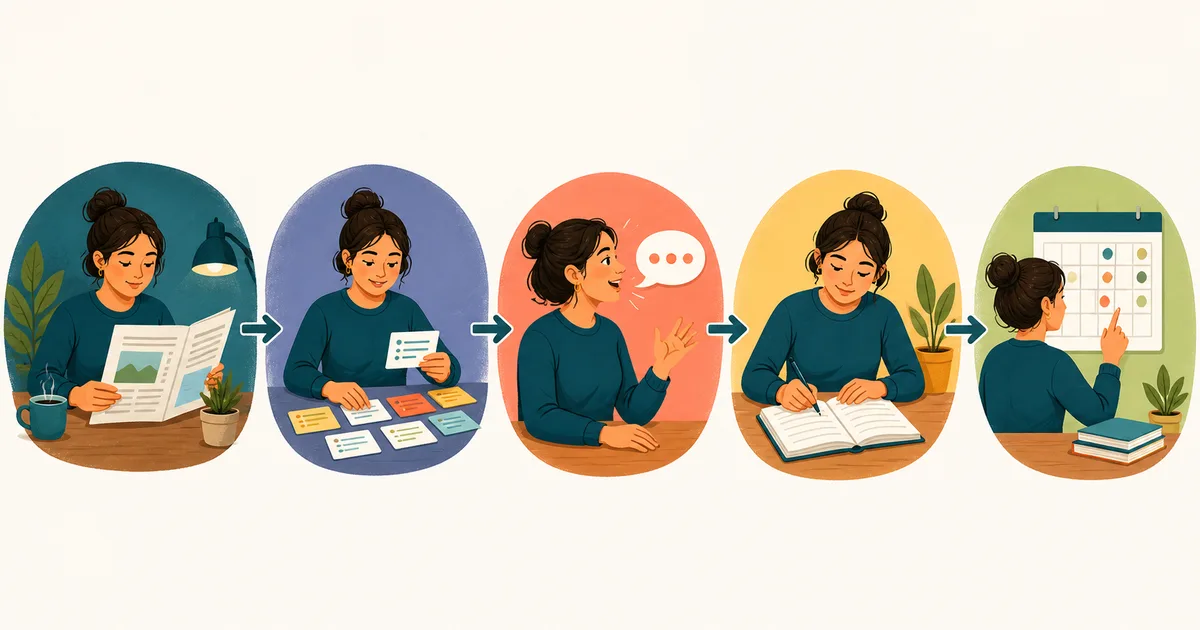
Week 1: analysis and opinion language. Write two short paragraphs using evidence, perspective, and significant.
Week 2: work, study, and society. Describe a career goal or a local social issue.
Week 3: environment and technology. Read one article and summarize it using five new words.
Week 4: connectors and collocations. Improve an older piece of writing by replacing vague language only where it helps.
Week 5: mixed review. Discuss or write about two unfamiliar topics and check whether you can retrieve vocabulary without a list.
Vocabulary to Practice
Save these B2 words in Linglify. Combine them with a personal example and one natural collocation so that review strengthens both the word and its use.
accommodation
noun
A place where someone lives or stays temporarily, often with facilities.
Examples
- The university provides accommodation for international students in modern dormitories.
- We need to make special accommodation for employees with young children.
accumulate
verb
To gather or collect gradually over time.
Examples
- Over time, dust will accumulate on surfaces that aren't cleaned regularly.
- She managed to accumulate enough savings to buy her first apartment.
adequate
adjective
Sufficient for a particular purpose; not too little or too much.
Examples
- Students need adequate time to prepare for their final examinations properly.
- The hotel room was small but adequate for our short weekend trip.
advance
verb
To move forward or make progress, or to present something for consideration or discussion.
Examples
- Technology continues to advance at an incredible rate every year.
- The army decided to advance toward the enemy position at dawn.
adverse
adjective
Describes something that is harmful or unfavorable, often causing problems or difficulties.
Examples
- Adverse weather conditions forced the pilot to cancel the flight immediately.
- The medication may have adverse effects on some patients with allergies.
coherent
adjective
Coherent describes something that is logical, clear, and well-organized.
Examples
- After the accident, he wasn't coherent enough to answer police questions.
- The professor gave a coherent explanation of the complex scientific theory.
comprehensive
adjective
Including all necessary details and information, covering a wide range.
Examples
- Students need comprehensive insurance coverage while studying abroad.
- The comprehensive report covers all aspects of the company's financial performance.
contemporary
noun
Existing or happening now; modern or current.
controversy
noun
A serious disagreement or argument about something important.
deliberate
adjective
Done intentionally after careful thought; not accidental.
Examples
- He made a deliberate choice to study medicine instead of law.
- The damage to the car was deliberate, not accidental as claimed.
dilemma
noun
A situation in which a difficult choice has to be made between two options.
Examples
- Parents face the dilemma of balancing work responsibilities with family time.
- The ethical dilemma required careful consideration of all possible consequences.
dimension
noun
A measurement of size, length, or amount in a particular direction.
Examples
- The furniture won't fit because we misjudged the room's dimensions.
- The social dimension of the problem requires community involvement and support.
dynamic
adjective
Always changing or capable of change; full of energy and movement.
Examples
- Technology companies operate in a dynamic environment of constant change.
- The dynamic leader inspired her team to achieve extraordinary results.
enhance
verb
To improve or make something better.
Examples
- New software will enhance the computer's performance and processing speed.
- Regular exercise can enhance both physical health and mental wellbeing.
entrepreneur
noun
A person who starts and runs a business, often taking financial risks.
Examples
- Successful entrepreneurs take calculated risks to achieve their business goals.
- The young entrepreneur started a successful technology company from scratch.
evaluate
verb
To judge or measure the value, quality, or importance of something.
Examples
- Companies evaluate job candidates based on experience, skills, and personality.
- Teachers evaluate student progress through tests, projects, and classroom participation.
implication
noun
A suggestion or hint about something that is not directly stated.
Examples
- Scientists are studying the implications of climate change for future generations.
- The implication of his statement was that he disagreed with the policy.
inevitable
adjective
Certain to happen and cannot be avoided.
Examples
- Change is inevitable in life, and we must learn to adapt.
- The inevitable result of poor planning is confusion and failure.
innovation
noun
The act of creating new ideas, methods, or products.
Examples
- Technological innovation has transformed the way we communicate and work.
- The company's latest innovation will revolutionize the healthcare industry.
perspective
noun
A noun for a particular way of looking at or thinking about something.
Examples
- Different perspective helps solve complex problems creatively.
- Historical perspective reveals patterns in human behavior.
phenomenon
noun
A noun for an unusual or observable event or fact that can be studied.
Examples
- Aurora borealis is beautiful natural phenomenon.
- Social media phenomenon changes how people communicate.
revolution
noun
A complete change in the way people think about or do something, often involving new ideas or methods.
Examples
- Digital revolution changes how people communicate and.
- Industrial revolution transformed society and economy completely.
sustainable
adjective
This adjective describes something that can be maintained or continued without depleting resources.
Examples
- Company implements sustainable business model for long-term success.
- Sustainable farming practices protect soil and water resources.
downside
noun
Moving or falling toward the bottom or lower position.
Examples
- One downside of the plan is the cost.
- The downside is that it takes more time.
immune system
noun
The body's defense system that fights infections and illnesses.
Examples
- A healthy immune system helps fight off infections.
- Stress can weaken your immune system.
What to Do Next
- Practise in small groups in the B2 vocabulary library.
- Check your foundation or plan the next step with A1 English Vocabulary: 500 Essential Beginner Words and English Vocabulary by CEFR Level.
- Build more natural combinations with Advanced English Collocations.
- Add ten words to Linglify today and use five of them in one short opinion paragraph tomorrow.
FAQ
How many words do I need for B2 English?
There is no official total, because word knowledge includes meanings, forms, collocations, and the ability to use words. A focused 500-word B2 core gives you a strong set of high-value words to activate alongside the vocabulary you already know.
What is the difference between B1 and B2 vocabulary?
B1 lets you manage familiar situations and give straightforward opinions. B2 adds abstract vocabulary, more precise linking language, wider topic range, and collocations for discussions and clear writing.
Should I learn B2 words for IELTS or work?
Both. B2 vocabulary appears in many academic, professional, and everyday contexts. Choose extra words by your own goal, but build the common core first.
How can I make B2 vocabulary active?
Use each word in a personal sentence, learn a common collocation, say it aloud, and revisit it after a delay. Linglify can schedule the review, but your own sentences give the word a usable context.