
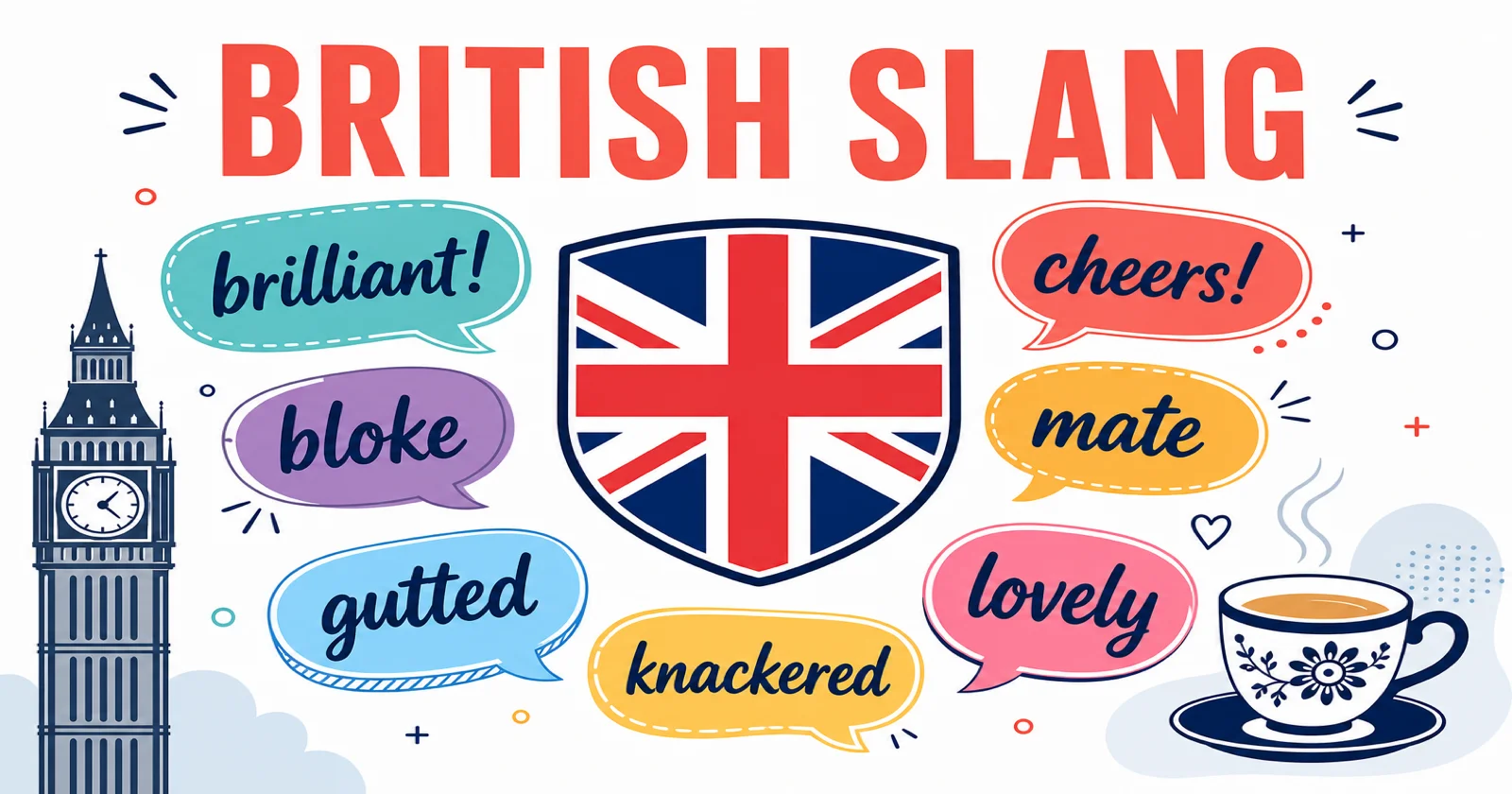
British Slang Words: 200+ Expressions You Need to Know
If you’ve learned English from American textbooks but then watched a British TV show, you probably understood about 70% of it. Not because of the accent — because of the vocabulary. When a British person says “I’m absolutely knackered after that dodgy kebab, and now I need to pop to the chemist before I go to my mate’s gaff,” every word is English, but the sentence might as well be a foreign language for anyone who learned American English.
British English has its own massive vocabulary of slang, informal words, and expressions that rarely appear in textbooks. Some of these words are used across the UK; others are specific to London, the North, or Scotland. Many have been around for centuries; others appeared last year.
This guide covers 200+ of the most useful British slang words and expressions, organized by category. Each word includes a definition, example sentence, and notes on how widely it’s used. Whether you’re planning to live in the UK, watching British TV, or just want to understand what your British friends are actually saying — this is your reference.
- Total: 200+ British slang words
- Organized by: 10 categories
- Format: Word → Meaning → Example
- Level: B1–C2
- For: understanding British English, travel prep, cultural literacy
People and Relationships
| # | Word/Expression | Meaning | Example |
|---|---|---|---|
| 1 | bloke | man, guy | He’s a nice bloke — you’d like him. |
| 2 | mate | friend; also used as a casual greeting | Alright, mate? How’s it going? |
| 3 | lad | boy, young man | The lads are going to the pub tonight. |
| 4 | lass | girl, young woman (Northern) | She’s a lovely lass from Yorkshire. |
| 5 | chap | man (slightly old-fashioned, polite) | He’s a decent chap, that one. |
| 6 | bird | woman, girlfriend (informal, can be offensive) | He’s been seeing some bird from Manchester. |
| 7 | missus / Mrs | wife or girlfriend | I need to check with the missus first. |
| 8 | geezer | man (London) | Some geezer just knocked on the door. |
| 9 | bruv | brother, friend (London) | Thanks, bruv — I owe you one. |
| 10 | muppet | a foolish person | He forgot his passport — what a muppet! |
| 11 | plonker | a stupid person | Don’t be such a plonker, Rodney! |
| 12 | nutter | a crazy person | He jumped in the river — absolute nutter. |
| 13 | tosser | an unpleasant or contemptible person | The boss is a complete tosser. |
| 14 | numpty | a foolish or incompetent person (Scottish) | Some numpty parked across two spaces. |
| 15 | bairn | a child (Scottish/Northern) | She’s got three bairns under five. |
| 16 | love / luv | term of address (like “dear”) | What can I get you, love? |
| 17 | darling | term of endearment (used casually in the South) | Thanks, darling — that’s very kind. |
| 18 | posh | upper-class, fancy | She went to a posh school in Surrey. |
| 19 | chav | someone perceived as lower-class and aggressive | The media loves stereotyping chavs. |
| 20 | punter | customer; ordinary person | The punters seemed happy with the show. |
Positive Feelings and Approval
| # | Word/Expression | Meaning | Example |
|---|---|---|---|
| 21 | brilliant | great, wonderful | “How was the concert?” “Brilliant!” |
| 22 | lovely | great, nice, pleasant | That was a lovely meal — thank you. |
| 23 | smashing | excellent, wonderful | We had a smashing time at the festival. |
| 24 | cracking | excellent, very good | She’s done a cracking job on this report. |
| 25 | proper | real, genuine (intensifier) | That’s a proper cup of tea. |
| 26 | well | very (intensifier) | That film was well good. |
| 27 | dead | very (intensifier, Northern) | She’s dead funny when she wants to be. |
| 28 | mint | excellent (Northern) | “How was the match?” “Mint!” |
| 29 | sound | good, reliable; also “okay” | He’s a sound bloke. / “I’ll be there at 7.” “Sound.” |
| 30 | chuffed | very pleased, proud | She was chuffed to bits with her exam results. |
| 31 | over the moon | extremely happy | He was over the moon when he got the job. |
| 32 | buzzing | very excited | I’m absolutely buzzing about the trip. |
| 33 | gobsmacked | amazed, shocked | I was gobsmacked when I heard the news. |
| 34 | ace | great, brilliant | “How was the party?” “Ace!” |
| 35 | wicked | awesome, cool (informal) | That trick was wicked! |
| 36 | lush | lovely, attractive (Welsh) | The cake was absolutely lush. |
| 37 | fit | attractive (about a person) | She’s well fit, isn’t she? |
| 38 | tidy | good, neat (Welsh) | “How was the gig?” “Tidy!” |
| 39 | belting | excellent (Northern) | We had a belting night out. |
| 40 | boss | excellent (Liverpool) | That goal was boss! |
Negative Feelings and Disapproval
| # | Word/Expression | Meaning | Example |
|---|---|---|---|
| 41 | rubbish | nonsense; bad quality | “He said he’ll be on time.” “That’s rubbish.” |
| 42 | naff | unfashionable, lame | That jumper is a bit naff, isn’t it? |
| 43 | pants | terrible, awful | The film was absolutely pants. |
| 44 | dodgy | suspicious, unreliable, risky | That kebab looks a bit dodgy. |
| 45 | grim | unpleasant, depressing | The weather’s been grim all week. |
| 46 | manky | disgusting, dirty | The kitchen was absolutely manky. |
| 47 | rank | disgusting | That milk smells rank — throw it out. |
| 48 | gutted | very disappointed | I was gutted when they cancelled the concert. |
| 49 | miffed | slightly annoyed | She was a bit miffed about not being invited. |
| 50 | narked | annoyed, irritated | He was well narked about the traffic. |
| 51 | minging | ugly, disgusting | That toilet was absolutely minging. |
| 52 | bog-standard | ordinary, basic | It’s just a bog-standard laptop — nothing special. |
| 53 | daft | silly, stupid | Don’t be daft — of course I’ll help. |
| 54 | barmy | crazy, mad | You want to swim in January? You’re barmy! |
| 55 | bonkers | crazy | The housing prices in London are bonkers. |
| 56 | mental | crazy (informal) | The traffic was mental this morning. |
| 57 | knackered | extremely tired | I’m absolutely knackered after that shift. |
| 58 | shattered | exhausted | We walked 20 miles — I’m shattered. |
| 59 | cream-crackered | knackered (Cockney rhyming slang) | I’m cream-crackered — need a kip. |
| 60 | fed up | tired of, frustrated | I’m fed up with this rain. |
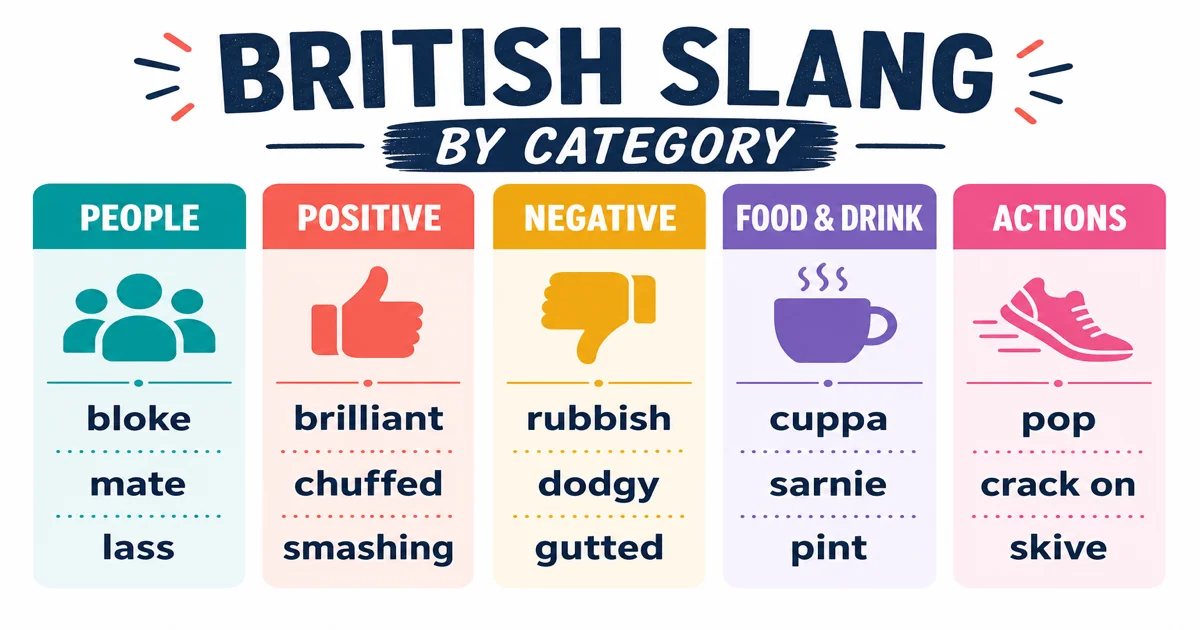
Food and Drink
| # | Word/Expression | Meaning | Example |
|---|---|---|---|
| 61 | cuppa | cup of tea | Fancy a cuppa? |
| 62 | brew | cup of tea | Put the kettle on — I need a brew. |
| 63 | biscuit | cookie (in American English) | Would you like a biscuit with your tea? |
| 64 | chips | french fries | Fish and chips, please. |
| 65 | crisps | potato chips | Pass me the crisps — salt and vinegar. |
| 66 | sarnie | sandwich | I’ll grab a bacon sarnie for lunch. |
| 67 | butty | sandwich (Northern) | A chip butty is a Northern classic. |
| 68 | nosh | food; to eat | Let’s grab some nosh before the film. |
| 69 | scran | food (Northern/military) | What’s for scran tonight? |
| 70 | peckish | slightly hungry | I’m a bit peckish — got any snacks? |
| 71 | starving | very hungry (exaggeration) | I’m starving — can we eat soon? |
| 72 | brekkie | breakfast | What are you having for brekkie? |
| 73 | tea | dinner/evening meal (Northern) | “What’s for tea, Mum?” |
| 74 | gaffer tape | duct tape | Fix it with gaffer tape — that’ll do. |
| 75 | ploughman’s | a cold lunch of bread, cheese, and pickle | I’ll have the ploughman’s, please. |
| 76 | pint | a glass of beer | Let’s grab a pint after work. |
| 77 | off-licence | a shop selling alcohol | Pop to the off-licence and grab some wine. |
| 78 | bladdered / trolleyed | very drunk | He was absolutely bladdered by 9 o’clock. |
| 79 | legless | extremely drunk | She was legless after three cocktails. |
| 80 | pissed | drunk (NOT angry, as in American English) | He got pissed at the office Christmas party. |
Everyday Actions
| # | Word/Expression | Meaning | Example |
|---|---|---|---|
| 81 | pop | go quickly | I’m just going to pop to the shops. |
| 82 | nip | go quickly (Northern) | I’ll nip out for some milk. |
| 83 | crack on | get started, continue working | Right, let’s crack on with the meeting. |
| 84 | faff about | waste time, fiddle around | Stop faffing about and get ready! |
| 85 | have a go | try | I’ve never tried it, but I’ll have a go. |
| 86 | sort it | fix it, organize it | Don’t worry — I’ll sort it. |
| 87 | suss out | figure out, investigate | I need to suss out the best route. |
| 88 | take the mickey / take the mick | tease someone, make fun | Are you taking the mick? |
| 89 | wind someone up | annoy or tease someone deliberately | He loves winding his sister up. |
| 90 | leg it | run away quickly | We saw the security guard and legged it. |
| 91 | skive | avoid work or school | He skived off school to go to the cinema. |
| 92 | bunk off | skip school or work | We used to bunk off on Fridays. |
| 93 | chat up | flirt with | He was trying to chat up the barmaid. |
| 94 | kip | a nap; to sleep | I need a quick kip before we go out. |
| 95 | bog | toilet | Where’s the bog? I need a wee. |
| 96 | loo | toilet (polite) | Excuse me, where’s the loo? |
| 97 | ring / give a bell | call on the phone | Give me a bell when you arrive. |
| 98 | nick | steal; also “police station” or “prison” | Someone nicked my bike! |
| 99 | grass | inform on someone, snitch | Don’t grass on your mates. |
| 100 | chuck | throw; also “end a relationship” | Chuck that in the bin. / She chucked him last week. |
Places and Things
| # | Word/Expression | Meaning | Example |
|---|---|---|---|
| 101 | gaff | house, home | Come round to my gaff tonight. |
| 102 | flat | apartment | She lives in a flat in Notting Hill. |
| 103 | the tube | the London Underground | Take the tube to Piccadilly Circus. |
| 104 | chemist | pharmacy | I need to pop to the chemist for some paracetamol. |
| 105 | off-licence | liquor store | Grab a bottle from the off-licence. |
| 106 | boot | trunk of a car | Put the bags in the boot. |
| 107 | bonnet | hood of a car | Open the bonnet — something’s rattling. |
| 108 | lorry | truck | A lorry broke down on the M25. |
| 109 | motorway | highway | Take the motorway — it’s faster. |
| 110 | pavement | sidewalk | Walk on the pavement, not the road. |
| 111 | zebra crossing | pedestrian crossing | Use the zebra crossing to get across. |
| 112 | roundabout | traffic circle | Take the third exit at the roundabout. |
| 113 | queue | line (of people waiting) | There’s a massive queue outside the shop. |
| 114 | telly | television | What’s on the telly tonight? |
| 115 | mobile | cell phone | What’s your mobile number? |
| 116 | quid | pound (£1) | That’ll be five quid, mate. |
| 117 | fiver | £5 note | Have you got a fiver I can borrow? |
| 118 | tenner | £10 note | It only costs a tenner to get in. |
| 119 | brolly | umbrella | Grab your brolly — it’s going to rain. |
| 120 | jumper | sweater, pullover | Put a jumper on — it’s freezing. |
Conversation Phrases
| # | Word/Expression | Meaning | Example |
|---|---|---|---|
| 121 | alright? | hello, how are you? | “Alright, mate?” “Yeah, not bad.” |
| 122 | cheers | thanks; also a toast | Cheers for helping me with that. |
| 123 | ta | thanks (very informal) | “Here’s your change.” “Ta!” |
| 124 | sorted | done, arranged, taken care of | “Is everything ready?” “Yeah, sorted.” |
| 125 | no worries | it’s fine, don’t worry | “Sorry I’m late.” “No worries.” |
| 126 | fair enough | that’s reasonable, I accept that | “I can’t come tonight.” “Fair enough.” |
| 127 | innit | isn’t it? (London) | Cold today, innit? |
| 128 | you what? | what? pardon? (surprise or disbelief) | “I’m moving to Australia.” “You what?!” |
| 129 | blimey | expression of surprise | Blimey, that was quick! |
| 130 | bloody hell | expression of surprise or frustration | Bloody hell, look at the time! |
| 131 | crikey | expression of surprise (old-fashioned) | Crikey, the prices have gone up! |
| 132 | cor blimey | strong expression of surprise | Cor blimey, that’s expensive! |
| 133 | bob’s your uncle | and there you have it (= it’s done) | Put it in the oven for 20 minutes, and Bob’s your uncle. |
| 134 | easy peasy | very easy | “Is it hard to make?” “No, easy peasy.” |
| 135 | spot on | exactly right, perfect | Your prediction was spot on. |
| 136 | not my cup of tea | not something I enjoy | Horror films aren’t my cup of tea. |
| 137 | taking the biscuit | going too far, outrageous | Arriving two hours late really takes the biscuit. |
| 138 | you’re having a laugh | you must be joking | £200 for a parking fine? You’re having a laugh! |
| 139 | do one | go away (rude) | Tell him to do one. |
| 140 | get in! | yes! (celebration) | “We won the match!” “Get in!” |
Weather and Moods
| # | Word/Expression | Meaning | Example |
|---|---|---|---|
| 141 | chilly | cold (but not freezing) | It’s a bit chilly out — grab a jacket. |
| 142 | nippy | cold | It’s nippy this morning! |
| 143 | brass monkeys | extremely cold | It’s brass monkeys outside — stay in. |
| 144 | bucketing down | raining very heavily | It’s absolutely bucketing down out there. |
| 145 | drizzle | light rain | It’s just a drizzle — you don’t need a brolly. |
| 146 | scorching | very hot | It’s scorching today — 35 degrees! |
| 147 | muggy | hot and humid | It’s so muggy — I can barely breathe. |
| 148 | miserable | unpleasant (weather) | What miserable weather we’re having. |
| 149 | moody | temperamental, unpredictable | The weather’s been dead moody this week. |
| 150 | right | very, total (intensifier) | He’s a right laugh. / It’s a right mess. |
Work and Money
| # | Word/Expression | Meaning | Example |
|---|---|---|---|
| 151 | sack / get the sack | fire / get fired | He got the sack for being late too often. |
| 152 | make redundant | lay off | They made 200 workers redundant. |
| 153 | do overtime | work extra hours | I’ve been doing overtime all month. |
| 154 | cushy | easy, comfortable (job) | He’s got a cushy job in the city. |
| 155 | doddle | something very easy | The exam was an absolute doddle. |
| 156 | skint | having no money | I’m skint until payday. |
| 157 | loaded | very rich | Her parents are absolutely loaded. |
| 158 | splash out | spend a lot of money | We splashed out on a fancy dinner. |
| 159 | rip-off | something overpriced | £8 for a coffee? What a rip-off! |
| 160 | a steal | a bargain | That coat was a steal at £30. |
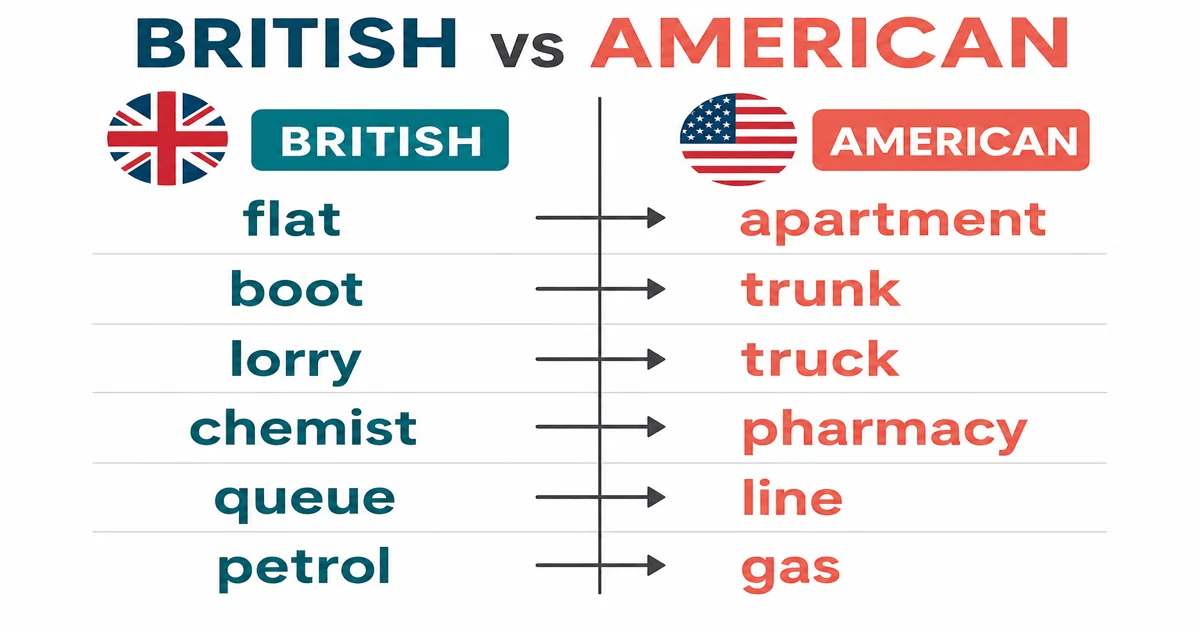
British vs. American English: Key Differences
These aren’t slang — they’re standard British English that differs from American English.
| British | American | Meaning |
|---|---|---|
| flat | apartment | a home on one floor |
| lift | elevator | vertical transport |
| boot | trunk | back of a car |
| bonnet | hood | front of a car |
| lorry | truck | large vehicle |
| petrol | gas/gasoline | fuel |
| nappy | diaper | baby underwear |
| dummy | pacifier | baby soother |
| cot | crib | baby bed |
| post | letters and packages | |
| torch | flashlight | portable light |
| holiday | vacation | time off |
| queue | line | people waiting |
| bin | trash can | waste container |
| rubber | eraser | removes pencil marks |
| autumn | fall | the season |
| football | soccer | the sport |
| trousers | pants | leg covering |
| pants | underwear | undergarment |
| trainers | sneakers | athletic shoes |
Warning: “Pants” means underwear in British English. Saying “nice pants” to a British person will get a very different reaction than in America.
Regional Variations
British slang varies enormously by region:
| Region | Unique Slang | Examples |
|---|---|---|
| London | Cockney rhyming slang | dog and bone (phone), plates of meat (feet) |
| Manchester | Mancunian | mint (great), our kid (sibling/close friend) |
| Liverpool | Scouse | boss (great), la (lad, mate) |
| Newcastle | Geordie | canny (nice), gan (go), howay (come on) |
| Birmingham | Brummie | bostin (brilliant), bab (babe, term of address) |
| Yorkshire | Yorkshire dialect | reyt (right/very), nowt (nothing), summat (something) |
| Scotland | Scots | braw (fine, good), wee (small), ken (know) |
| Wales | Welsh English | lush (lovely), tidy (good), tamping (very angry) |
How to Understand British Slang
1. Watch British TV. Shows like Peep Show, The Inbetweeners, Derry Girls, and Top Boy are goldmines of real British slang in context.
2. Listen to context. Even if you don’t know a word, the tone and surrounding words usually reveal whether it’s positive or negative.
3. Ask. British people love explaining their slang. “What does ‘chuffed’ mean?” is a perfectly normal question.
4. Start using it (carefully). Begin with universally understood words like “brilliant,” “cheers,” “mate,” and “lovely.” Avoid regional or potentially offensive slang until you understand the social context.
5. Add to Linglify. Add British slang to your vocabulary for spaced repetition practice.
Words to Practice
boom
noun
A loud, deep sound or a sudden increase in activity or popularity.
Examples
- The boom of thunder echoed across the valley.
- The technology boom created many new millionaires.
cooperate
verb
To work together with others towards a common goal.
evaluate
verb
To judge or measure the value, quality, or importance of something.
Examples
- Companies evaluate job candidates based on experience, skills, and personality.
- Teachers evaluate student progress through tests, projects, and classroom participation.
graduate
verb
To complete a course of study at a school or university.
Examples
- She will graduate from university next year with a degree in engineering.
- Students must complete all requirements before they can graduate from high school.
horizon
noun
The line where the earth or the sky appears to meet in the distance.
Examples
- The sun disappeared behind the horizon as evening approached.
- Traveling broadens your horizon and exposes you to new cultures.
indispensable
adjective
Absolutely necessary; essential.
Examples
- Clean water is indispensable for human survival and good health.
- Her experience and skills make her indispensable to the research team.
jury
noun
A group of people who listen to evidence in a court and decide if someone is guilty.
Examples
- The jury deliberated for several hours before reaching a verdict.
- The talent show jury consisted of professional musicians and entertainers.
lifelong
adjective
Continuing for a very long time or for the whole life.
Examples
- Learning is a lifelong process that never truly ends.
- Their lifelong friendship began during elementary school years.
motivated
adjective
Feeling driven or inspired to do something because of a reason or goal.
Examples
- Motivated employee seeks additional responsibilities and challenges at work.
- Success requires being motivated even when facing difficult obstacles.
normally
adverb
Usually; under normal conditions.
Examples
- Heart normally beats between sixty and hundred times per minute.
- Students normally arrive at school before morning bell rings.
off
adjective
Describes something that is not fresh or is no longer suitable for eating, often used for food and drinks.
Examples
- Please turn off the lights before leaving the room.
- The dog ran off into the forest chasing wild rabbits.
prejudice
noun
Preconceived opinions or feelings, often negative, about a person or group.
Examples
- Education helps overcome prejudice and promotes understanding.
- Racial prejudice damages communities and individuals alike.
resolve
verb
To find a solution or answer to a problem or question.
Examples
- Mediator helps parties resolve dispute through negotiation.
- Technical team will resolve software problems quickly.
stress
verb
To feel mental or emotional pressure or worry; to emphasize or give importance to something.
Examples
- Heavy workload may stress employees beyond limits.
- Teacher will stress importance of homework completion.
total
adjective
An adjective describing something that is complete or whole, not divided or broken.
Examples
- Total cost includes all fees and expenses.
- Total silence fills room during meditation session.
tragedy
noun
An extremely sad or serious event that causes suffering or loss.
Examples
- Natural tragedy affects thousands of innocent people.
- Personal tragedy changes person's life perspective completely.
union
noun
A group of people or things joined together for a purpose.
Examples
- Labor union protects worker rights and interests.
- Marriage union joins two people in partnership.
voyage
noun
A long journey to a distant place, often by sea or air.
Examples
- Space exploration represents humanity's greatest voyage into the unknown.
- The ocean voyage from Europe to America took several weeks in the past.
candidate
noun
A person who is competing in an election or contest.
Examples
- Each presidential candidate presented their policy plans to voters.
- The job candidate impressed the interview panel with her experience.
discourage
verb
To try to make someone feel less confident or hopeful about something.
Examples
- Don't let one failure discourage you from pursuing your dreams.
- High prices discourage many people from buying organic food products.
donate
verb
To give something, especially money or goods, to help a cause or person.
Examples
- Many people donate money to charities that help homeless individuals.
- She decided to donate blood to help patients in emergency situations.
firmly
adverb
An adverb indicating a way of doing something with certainty or stability.
Examples
- Hold the rope firmly while climbing down the steep mountain slope.
- The manager firmly believed in treating all employees with respect.
guide
verb
To show or direct someone how to do something.
Examples
- Parents should guide their children to make responsible decisions.
- The experienced hiker will guide the group through the mountain trail safely.
humorous
adjective
Funny or amusing, often making people laugh.
Examples
- She writes humorous articles about everyday life and family experiences.
- The humorous speech made everyone laugh and lightened the serious mood.
admission
noun
The process or fact of being allowed to enter or join.
Examples
- Her admission to the prestigious medical school was the result of hard work.
- The museum offers free admission on the first Sunday of every month.
What to Do Next
-
Pick 10 words from this list that you’ve heard before but never used. Write them down with meanings.
-
Watch a British TV show and listen for these words. Note how they’re used in real conversation.
-
Add British slang to Linglify for spaced repetition practice.
-
Learn British idioms too — English Idioms: 500+ Common Expressions includes many British-specific idioms.
-
Compare with American English — understanding the differences will prevent embarrassing mix-ups (especially with “pants”).
FAQ
What are the most common British slang words?
The most widely used across all regions are: mate (friend), brilliant (great), cheers (thanks), lovely (nice), rubbish (nonsense/bad), knackered (exhausted), quid (pound), dodgy (suspicious), sorted (arranged), and bloke (man). These words are understood throughout the UK and are safe to use in most informal situations.
Is British slang considered rude?
It depends on the word and context. Words like “brilliant,” “lovely,” “cheers,” and “mate” are perfectly polite. Words like “bloody,” “pissed,” and “sod off” are mildly rude. Words like “tosser” and stronger terms are offensive and should be avoided in polite company. As a general rule, if you wouldn’t use a word in front of your grandmother, don’t use it with strangers.
Do all British people use the same slang?
No. British slang varies enormously by region, age, and social class. A teenager in London uses very different slang from a farmer in Yorkshire or a student in Edinburgh. Some words are universal (“cheers,” “mate”), while others mark you immediately as being from a specific area (“boss” = Liverpool, “mint” = Manchester, “braw” = Scotland).
Can I use British slang in IELTS or formal situations?
No. IELTS examiners and formal contexts require standard English. Using slang in academic writing, business presentations, or job interviews will hurt your credibility. British slang is for informal conversation, texting, and social situations. In the IELTS Speaking test, very common words like “brilliant” or “lovely” are acceptable, but heavy slang like “gutted” or “well fit” is not.
How is British slang different from American slang?
British and American slang evolved independently from different cultural influences. Key differences include: “pissed” (British: drunk / American: angry), “pants” (British: underwear / American: trousers), “chips” (British: fries / American: crisps), “fit” (British: attractive / American: physically healthy). Many British slang words have no American equivalent at all (“chuffed,” “gobsmacked,” “knackered”), and vice versa.


