
C1–C2 Grammar and Vocabulary: An Advanced Study Guide
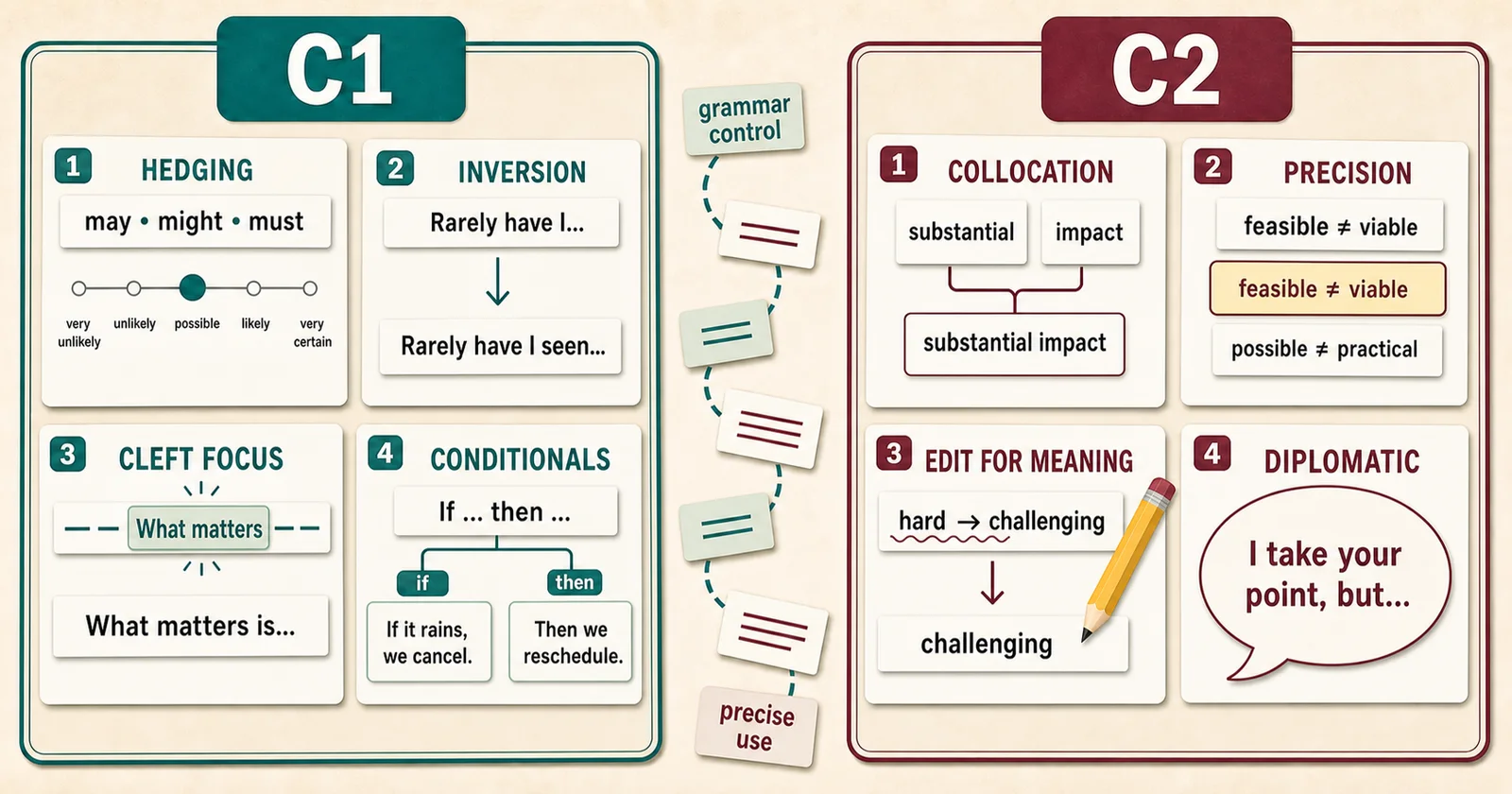
C1–C2 grammar and vocabulary are best studied together. Advanced grammar gives your ideas shape: contrast, emphasis, distance, caution, and logical connection. Advanced vocabulary gives those ideas precision. If you study only lists of words, your sentences may still sound basic; if you study only grammar rules, you may have nothing specific to say.
This guide is a structured, free study path for learners looking for C1–C2 grammar and vocabulary practice or a digital alternative to a coursebook-led routine. It does not copy any textbook. Instead, it shows the language systems that advanced learners need, the vocabulary that works with them, and a four-week way to practise both. Use the C1 library and C2 library to review the vocabulary in manageable sets.
- Level: C1 to C2, from confident advanced use to flexible proficiency
- Focus: complex grammar choices, precise vocabulary, and active production
- Best for: learners preparing for advanced exams, study, or professional communication
- Study goal: write and speak accurately without translating a rule word by word
For a focused word bank, read C2 Proficiency Vocabulary. For a C1 foundation, begin with C1 English Vocabulary.
The Difference Between C1 and C2 Control
At C1, you can usually explain a complex idea, use a broad range of language, and correct many mistakes yourself. At C2, you choose from that range with more speed, precision, and flexibility. You can adjust the same message for a formal report, a careful discussion, or an informal conversation without losing your point.
| Area | C1 control | C2 control |
|---|---|---|
| grammar | uses complex structures accurately most of the time | chooses structures for emphasis, tone, and subtle meaning |
| vocabulary | uses advanced words and collocations | distinguishes close meanings and changes register naturally |
| writing | develops a clear argument | manages nuance, exceptions, and a highly coherent line of reasoning |
| speaking | explains and defends an opinion | responds flexibly, qualifies claims, and reformulates smoothly |
The goal is not to remove every simple word. It is to have alternatives ready when simple language is not exact enough. “The plan is bad” may be perfect in a quick chat. In a report, you may need “The plan is not financially viable” or “The plan may be counterproductive in the long term.”
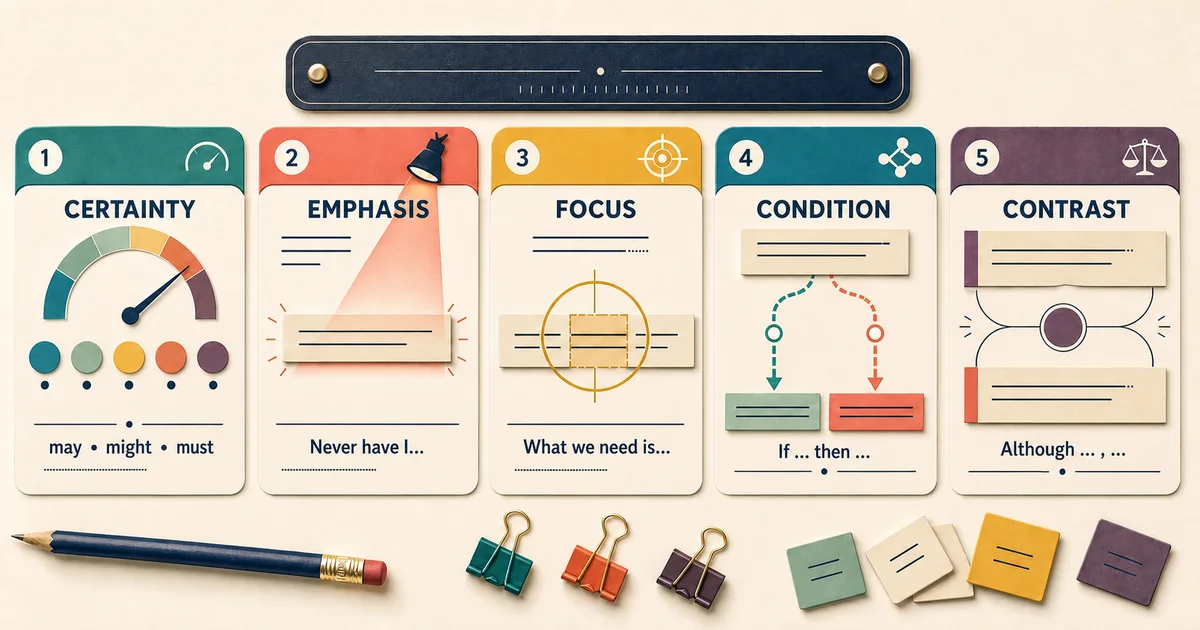
Grammar 1: Hedging, Modality, and Degrees of Certainty
Advanced English often needs careful claims. Modal verbs and reporting verbs help you show how sure you are and how strong your recommendation should sound.
| Purpose | Useful pattern | Example |
|---|---|---|
| strong conclusion | must have + past participle | They must have overlooked the message. |
| weak possibility | may / might well + verb | The change might well affect demand. |
| careful claim | tend to + verb | Small errors tend to accumulate over time. |
| evidence-based view | appear / seem to + verb | The results appear to support the proposal. |
| cautious recommendation | it would be advisable to + verb | It would be advisable to review the policy. |
| limited certainty | there is likely to be + noun | There is likely to be some resistance. |
The grammar changes the relationship with your reader. “This will fail” is absolute. “This may prove unworkable unless…” is still clear, but it leaves room for evidence and conditions. Pair these structures with words such as plausible, tentative, inherent, and likely.
Grammar 2: Inversion and Emphasis
Inversion is useful when you want a formal or emphatic style. It is common in polished writing and prepared speech, but it should be used sparingly in casual conversation.
| Standard sentence | Advanced emphasis | When to use it |
|---|---|---|
| We rarely see such a result. | Rarely do we see such a result. | strong emphasis in formal writing |
| We understood the scale only then. | Only then did we understand the scale. | a key turning point |
| The plan will work only if funding continues. | Only if funding continues will the plan work. | a strict condition |
| I had never felt so prepared. | Never had I felt so prepared. | a strong personal or narrative point |
| The team not only reduced costs; it also improved quality. | Not only did the team reduce costs, but it also improved quality. | balanced contrast |
Check the auxiliary carefully: Rarely do we see, not “Rarely we see.” Inversion is a grammar choice, not a decoration. One well-placed structure can create emphasis; five in a short paragraph can sound unnatural.
Grammar 3: Cleft Sentences and Controlled Focus
Cleft sentences let you move the most important part of the message to the front. They are especially useful when correcting an assumption or making a distinction.
| Pattern | Example | Effect |
|---|---|---|
| What + clause + be … | What we need is a realistic timetable. | highlights the result or need |
| It is/was + focus + that/who … | It was the final review that revealed the error. | highlights one cause or person |
| The thing that … is … | The thing that concerns me is the lack of evidence. | makes an abstract concern clear |
| All + clause + be … | All I am asking for is a clear answer. | creates a controlled, polite tone |
Compare “We need a realistic timetable” with “What we need is a realistic timetable.” The second version is useful when many possible solutions are being discussed and you want to state the priority clearly.
Grammar 4: Conditionals, Concessions, and Hypothetical Distance
Advanced learners need more than the basic if patterns. These structures help you discuss unreal past decisions, present consequences, and unexpected contrast.
| Purpose | Pattern | Example |
|---|---|---|
| past cause, present result | If + past perfect, would + infinitive | If we had planned earlier, we would have more time now. |
| present state, past result | If + past simple, would have + past participle | If I were more confident, I would have applied. |
| formal condition | Were + subject + to + verb | Were demand to fall, we would revise the forecast. |
| formal negative condition | Had + subject + past participle | Had they known, they might have acted differently. |
| concession | much as / however + adjective | Much as I value speed, accuracy matters more. |
| unexpected result | even if / even though | The policy may help even if costs remain high. |
Do not choose a complex conditional merely because it is advanced. Use it when the time relationship is truly mixed. “If I had left earlier, I would be there now” connects a past decision with a present result; that is why the mixed form is meaningful.
Grammar 5: Participle Clauses and Information Density
Participle clauses can make writing more compact by linking actions and ideas. They are useful in reports, summaries, and formal explanations.
| Full clause | More compact version | Meaning |
|---|---|---|
| Because the team had reviewed the data, it noticed an error. | Having reviewed the data, the team noticed an error. | earlier action explains later action |
| The device was designed for beginners, so it is easy to use. | Designed for beginners, the device is easy to use. | description gives background |
| The proposal affects several teams and requires further discussion. | Affecting several teams, the proposal requires further discussion. | simultaneous fact or reason |
| If it is used carefully, the method can be effective. | Used carefully, the method can be effective. | condition |
The subject must be clear. “Having reviewed the data, the error was noticed” is wrong because the error did not review the data. Say “Having reviewed the data, the team noticed the error.”
Vocabulary 1: Upgrade Meaning, Not Just Difficulty
The most useful advanced vocabulary gives you a more exact meaning. Build small contrast sets instead of one long list.
| Basic word | Precise choices | Difference in meaning |
|---|---|---|
| important | crucial, substantial, indispensable | crucial = necessary for success; substantial = large or significant; indispensable = impossible to do without |
| problem | issue, obstacle, drawback, discrepancy | each names a different type of difficulty |
| change | shift, transition, fluctuation, deterioration | describes direction, process, or pattern |
| show | demonstrate, indicate, reveal, corroborate | changes the strength and source of evidence |
| possible | feasible, viable, plausible, conceivable | practical, workable, reasonable, or imaginable |
| bad | detrimental, counterproductive, flawed, unsustainable | harm, opposite result, weak reasoning, or poor long-term fit |
Make sentences that show the distinction. “The idea is plausible” means it sounds reasonable. “The idea is viable” means it can actually work. These words cannot always replace one another.
Vocabulary 2: Collocations for an Advanced Argument
Collocations make advanced writing and speaking sound natural. Learn the full phrase, including the grammar around it.
| Function | Collocation | Example |
|---|---|---|
| state a claim | put forward an argument | The article puts forward a convincing argument. |
| add caution | acknowledge a limitation | We should acknowledge a limitation in the sample. |
| examine evidence | draw a conclusion | It is too early to draw a conclusion. |
| discuss effects | have far-reaching implications | The decision may have far-reaching implications. |
| explain cause | give rise to concerns | The delay has given rise to concerns. |
| compare aims | reconcile competing priorities | Leaders must reconcile competing priorities. |
| make a recommendation | warrant further investigation | The findings warrant further investigation. |
| describe a risk | pose a significant risk | Weak security can pose a significant risk. |
| show improvement | make tangible progress | The team has made tangible progress. |
| express contrast | on balance, … | On balance, the benefits outweigh the cost. |
For a wider collection of natural combinations, use Advanced English Collocations. A collocation is not a phrase to insert at random; it is a familiar partnership between words that helps your meaning sound precise and natural.
A Four-Week C1–C2 Study Plan
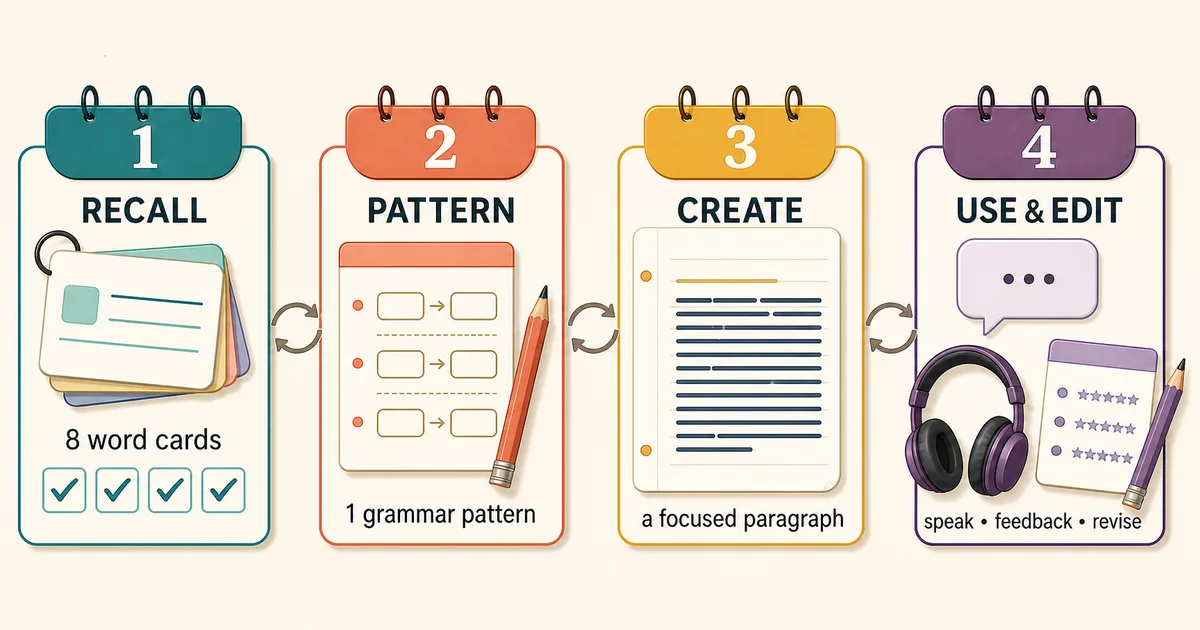
Regular short production is more useful than occasional rule reading. This four-week cycle gives grammar and vocabulary equal attention.
| Week | Grammar focus | Vocabulary focus | Active task |
|---|---|---|---|
| 1 | hedging and modality | certainty, evidence, and evaluation | write a 150-word balanced opinion |
| 2 | inversion and cleft sentences | contrast and emphasis collocations | record a two-minute presentation opening |
| 3 | mixed conditionals and concessions | change, risk, and consequences | rewrite a basic paragraph with precise links |
| 4 | participle clauses and editing | review your personal weak words | edit one old text and explain every change |
On each study day, spend ten minutes recalling a small vocabulary set in Linglify, ten minutes studying one grammar pattern, and ten minutes creating language. Your output can be a message, a paragraph, a voice note, or a response to a question. The important part is noticing whether the grammar choice changes the meaning you intended.
Common Advanced-Learner Mistakes
- Using every sentence pattern at once. Choose one structure for one communicative purpose; clarity comes first.
- Treating formal and advanced as the same. A word can be advanced but still sound wrong in an informal context.
- Memorizing a rule without producing it. After studying a pattern, write or say three sentences that are true for you.
- Ignoring collocation. Learn pose a risk, not only pose; learn substantial evidence, not only substantial.
- Correcting only grammar. After editing a sentence, also ask whether a more precise verb, noun, or connector would improve the idea.
Vocabulary to Practise
Add a selective advanced set to Linglify. Then use it with one grammar pattern from this guide in a short, meaningful response.
alleviate
verb
To make something less severe or painful.
Examples
- Government programs aim to alleviate poverty in rural communities.
- The medication will alleviate pain and reduce inflammation significantly.
ambiguous
adjective
Having more than one possible meaning or interpretation.
Examples
- The politician's ambiguous statement confused voters about his actual position.
- The test question was ambiguous and could be interpreted in multiple ways.
coherent
adjective
Coherent describes something that is logical, clear, and well-organized.
Examples
- After the accident, he wasn't coherent enough to answer police questions.
- The professor gave a coherent explanation of the complex scientific theory.
concede
verb
To admit that something is true or valid, often reluctantly.
Examples
- He had to concede that his opponent made some valid points during the debate.
- The candidate decided to concede defeat after losing the election clearly.
tycoon
noun
A wealthy, influential person who dominates a particular industry or field.
Examples
- Media tycoon owns newspapers and television stations worldwide.
- Oil tycoon donated millions to educational and charitable causes.
detest
verb
To intensely dislike or hate something or someone.
Examples
- Many people detest the sound of nails scratching on chalkboard.
- She absolutely detests dishonesty and deception in any form.
portrayal
noun
The act of representing or describing someone or something visually or in words.
Examples
- Critic praised actor's nuanced portrayal of troubled protagonist.
- Film's portrayal of war emphasizes human cost over glory.
fury
noun
Intense anger or rage.
Examples
- His fury was evident after hearing the news.
- She lost her fury when she saw the damage.
grumpy
adjective
Having a bad mood and often complaining or being unfriendly.
Examples
- His grumpy attitude made it hard to work with him.
- She looked grumpy after waking up late.
superficial
adjective
Lacking depth or significance; shallow.
Examples
- His knowledge of the subject was superficial and incomplete.
- The wound appeared serious but was actually quite superficial.
impeccable
adjective
Describes something of perfect or faultless quality, especially in manners or appearance.
Examples
- Hotel provides impeccable service ensuring guest satisfaction and comfort.
- Professional maintains impeccable reputation for honesty and integrity.
precaution
noun
A noun that refers to an action taken as a safeguard against potential danger or harm.
Examples
- Take the necessary precautions before starting.
- Wearing a helmet is a safety precaution.
insular
adjective
Isolated or narrow-minded, often lacking awareness of wider perspectives.
Examples
- His insular thinking prevents him from considering alternative perspectives.
- Insular community rarely interacts with outside world effectively.
plausible
adjective
Believable or reasonable enough to be accepted.
Examples
- His explanation sounds plausible but lacks supporting evidence.
- Scientists seek plausible theories to explain observed phenomena.
reconstruction
noun
The process of rebuilding or repairing a building or area.
Examples
- Historical reconstruction helps us understand the past.
- The reconstruction of the building took two years.
enterprising
adjective
Having initiative and resourcefulness; willing to undertake new projects.
Examples
- Enterprising entrepreneur identified market gap and created innovative solution.
- Enterprising students organize fundraising events for school improvement projects.
substantial
adjective
Important or large enough to have a noticeable effect.
Examples
- Substantial improvement shows in student test scores.
- Substantial investment creates new business opportunities today.
subtle
adjective
Having a very slight difference that is not obvious or easy to notice.
Examples
- Subtle flavor enhances dish without overpowering taste.
- Subtle hint suggests solution without direct statement.
verify
verb
To establish the truth or correctness of something through evidence or proof.
Examples
- Please verify the information before publishing.
- They need to verify the results of the experiment.
occupant
noun
A person who occupies a place or building, especially temporarily.
Examples
- Building occupant reported strange noises during night hours.
- Car crash injured both driver and passenger occupants.
tell sb/sth apart
Phrasal Verbs
to distinguish two similar people or things
Examples
- It's hard to tell the twins apart.
- Can you tell the difference between these two paintings?
What to Do Next
- Build a C1 base in the C1 vocabulary library, then move your strongest sets to the C2 library.
- Use C2 Proficiency Vocabulary for precise words and nuanced language.
- Practise natural advanced phrases with Advanced English Collocations.
- Return to B2 Grammar and Vocabulary if a core structure still feels unstable.
Frequently Asked Questions
Is C1–C2 grammar mostly about difficult rules?
No. It is mainly about choice and control. You need familiar grammar to be accurate, then advanced patterns help you show emphasis, distance, conditions, contrast, and a more precise relationship between ideas.
Can I reach C2 by memorizing advanced vocabulary lists?
Vocabulary lists help, but they are not enough. C2 requires flexible use: choosing the right register, building natural collocations, and combining vocabulary with accurate grammar in real reading, writing, listening, and speaking.
What should I study first: C1 grammar or C2 vocabulary?
Study them together, but begin with your weakest point. If your grammar makes your writing unclear, choose one grammar pattern and a small vocabulary group that lets you practise it. If your sentences are accurate but repetitive, focus on precise verbs, nouns, and collocations.
Is this a replacement for a C1–C2 coursebook?
It is an independent online study guide, not a copy or substitute for a specific book. Use it as a structured path for practice, alongside any course, teacher, or exam materials you already use.
How often should I practise advanced grammar?
Three short sessions each week are enough if each includes production and review. Regularly writing, speaking, and editing with one pattern is more effective than reading many rules once a month.


