C2 Proficiency Vocabulary: Mastering Nuance in English
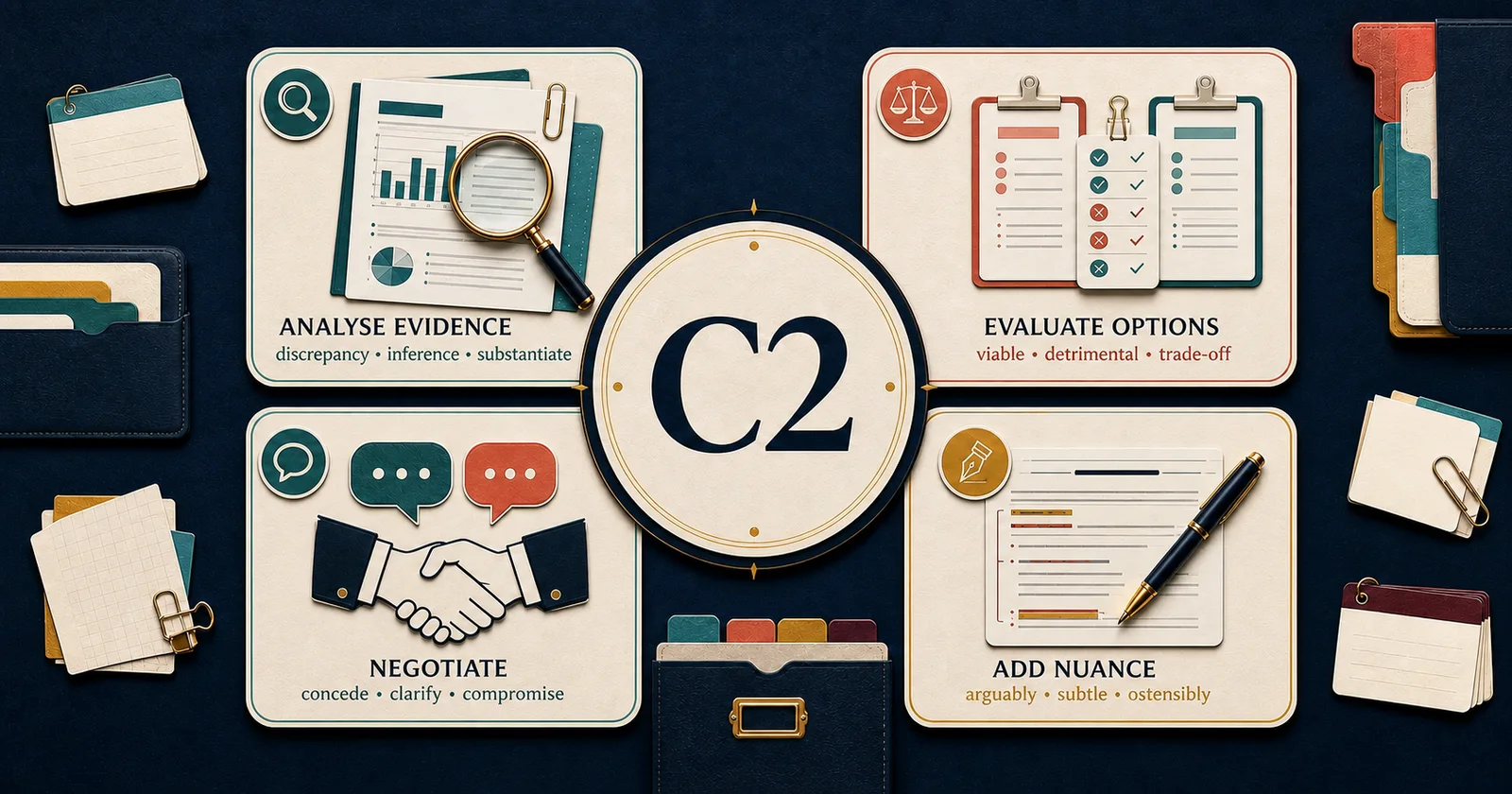
C2 proficiency vocabulary is not a list of obscure words to use everywhere. At the highest CEFR level, you need to understand fine distinctions, adjust your register, and choose language that reflects exactly how certain, critical, cautious, or diplomatic you want to be. The same idea may need a direct sentence in a meeting, a qualified claim in an essay, or a warm explanation in conversation.
This guide organizes advanced vocabulary by communicative purpose. The words and patterns are useful for analytical reading, formal writing, presentations, negotiation, and complex discussion. Use the C2 vocabulary library to turn a small selection into active language rather than trying to sound advanced in every sentence.
- Level: C2 proficiency, with a bridge from strong C1
- Focus: nuance, evidence, evaluation, argument, and precise tone
- Best for: advanced learners, university study, demanding work, and high-level exams
- Study goal: choose the exact word, collocation, and register for the situation
If your C1 foundation is not automatic yet, start with C1 English Vocabulary. C2 works best when familiar advanced language is already easy to retrieve.
What C2 Vocabulary Actually Means
At C2, vocabulary control has four parts:
| Skill | Basic version | More controlled C2 version |
|---|---|---|
| degree | The effect was big. | The effect was substantial, but not uniform. |
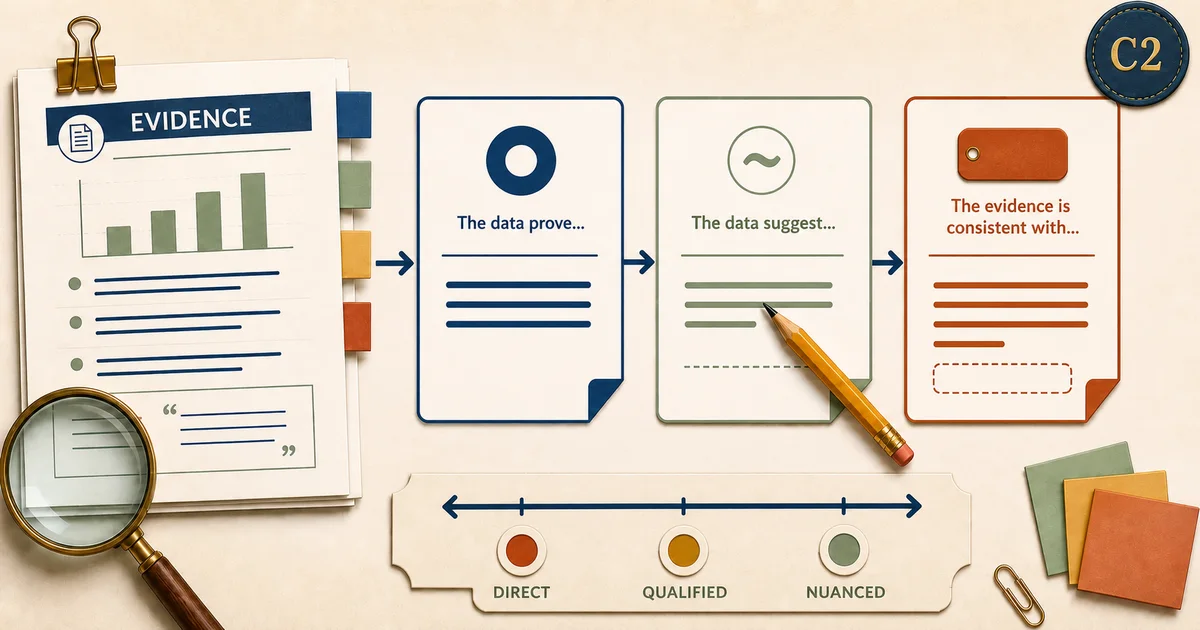
| certainty | This is true. | The evidence strongly suggests this, although it is not conclusive. |
| evaluation | The plan is bad. | The plan is impractical and may prove counterproductive. |
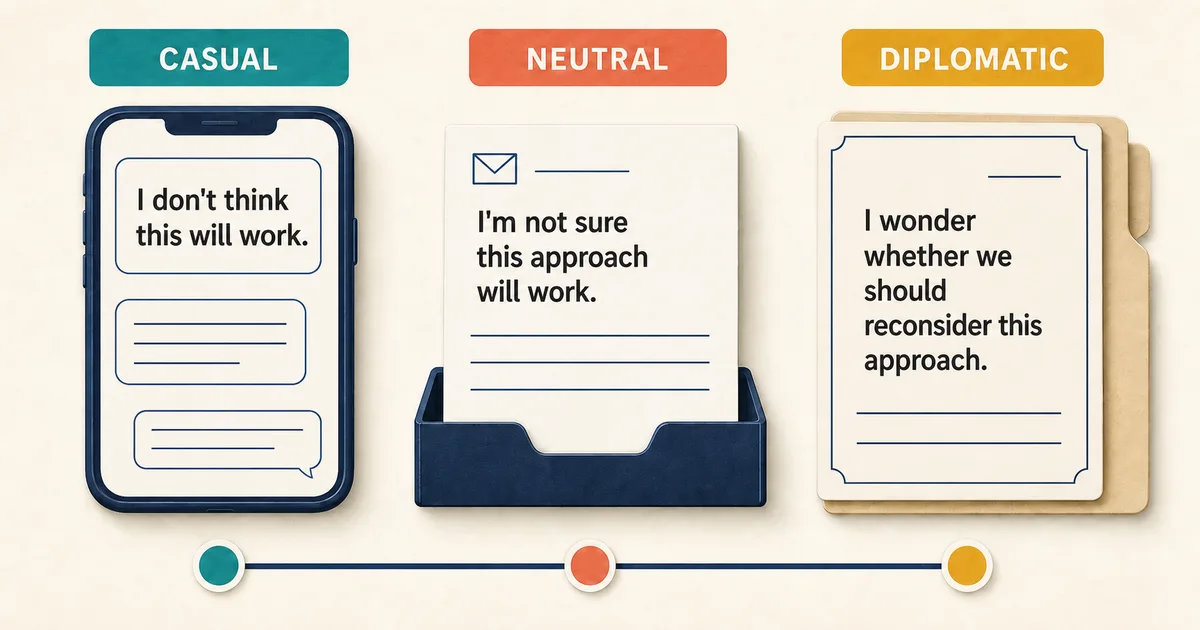
| tone | You are wrong. | I see the point, but I would challenge the assumption. |
The right-hand column is not “better” because it is longer. It is better when the situation needs the added precision. C2 learners can move along this scale deliberately: simple when clarity matters, formal when the context requires it, and nuanced when the evidence is mixed.
One useful rule is this: do not learn a C2 word until you can explain when not to use it. Meticulous is excellent for careful research or detailed work; it is unnatural for a quick text message about choosing lunch. Register is part of word knowledge.
Qualify Ideas Without Becoming Vague
Careful speakers and writers need ways to show degrees of certainty. These words let you avoid absolute claims when the facts are more complicated.
| Word or phrase | Meaning | Natural phrase | Example sentence |
|---|---|---|---|
| apparently | according to what seems true | apparently minor | The change was apparently minor but affected many users. |
| arguably | it can reasonably be claimed | arguably the best | This is arguably the most practical option. |
| inherently | as a natural part of something | inherently difficult | The task is inherently difficult, not impossible. |
| ostensibly | appearing or claiming to be a certain way | ostensibly simple | The rule is ostensibly simple but hard to apply. |
| presumably | thought to be true, although not certain | presumably aware | They were presumably aware of the risk. |
| relatively | compared with something else | relatively limited | The evidence is relatively limited so far. |
| seemingly | appearing to be true | seemingly unrelated | Two seemingly unrelated events may share a cause. |
| tentative | not final or certain | tentative conclusion | We can draw only a tentative conclusion. |
| unprecedented | never known or done before | unprecedented demand | The service faced unprecedented demand. |
| virtually | almost completely | virtually impossible | Without access, the task is virtually impossible. |
Hedging is not weakness. It shows that you can match the strength of a claim to the strength of the evidence. In formal writing, arguably, relatively, and tentative often create a more credible argument than a confident but unsupported statement.
Analyse Evidence and Complex Relationships
These words are useful when you need to move beyond “this caused that.” They help you describe patterns, support a claim, and identify a hidden connection.
| Word | Meaning | Natural phrase | Example sentence |
|---|---|---|---|
| attribute | say that something is caused by something | attribute success to | The team attributes its success to clear priorities. |
| corroborate | provide information that supports a claim | corroborate the findings | A second survey corroborates the findings. |
| discern | recognize something that is not obvious | discern a trend | It is difficult to discern a trend in one week of data. |
| discrepancy | a difference that should not exist | a discrepancy between | We found a discrepancy between the two figures. |
| implication | a possible effect or meaning | far-reaching implications | The decision has far-reaching implications. |
| inference | a conclusion based on evidence | draw an inference | We should not draw an inference from one case. |
| premise | an idea used as the basis of an argument | a flawed premise | The proposal rests on a flawed premise. |
| rationale | the reason or logic behind a decision | the rationale for | Please explain the rationale for the change. |
| substantiate | support with evidence | substantiate a claim | The author fails to substantiate the claim. |
| underlying | existing beneath the surface | an underlying cause | We need to address the underlying cause, not only the result. |
Try building an evidence chain: “The data suggest a discrepancy. Before we draw an inference, we need to identify the underlying cause and substantiate the conclusion.” Such chains are more useful than learning a group of advanced nouns separately.
Evaluate Options and Anticipate Consequences
C2 vocabulary often helps you judge a plan without sounding simplistic. The aim is to describe trade-offs accurately.
| Word | Meaning | Natural phrase | Example sentence |
|---|---|---|---|
| beneficial | having a good effect | mutually beneficial | The partnership could be mutually beneficial. |
| counterproductive | having the opposite result to the intended one | prove counterproductive | Constant reminders may prove counterproductive. |
| detrimental | causing harm | detrimental to trust | The delay was detrimental to public trust. |
| feasible | possible and practical | financially feasible | Is the project financially feasible? |
| futile | unable to achieve a useful result | a futile attempt | Without agreement, further discussion is futile. |
| indispensable | completely necessary | an indispensable role | Clear feedback plays an indispensable role in learning. |
| marginal | small or not very important | marginal improvement | The update produced only a marginal improvement. |
| pragmatic | practical and realistic | a pragmatic compromise | We reached a pragmatic compromise. |
| sustainable | able to continue long term | sustainable solution | A sustainable solution must fit the team’s capacity. |
| viable | able to work successfully | commercially viable | The plan is not commercially viable yet. |
Feasible, viable, and sustainable are a useful C2 trio. A solution can be feasible this month, viable over the next year, and sustainable over many years. Choosing the right one tells the listener exactly which test you are applying.
Disagree, Concede, and Negotiate with Precision
Advanced communication is often about responding to another person’s idea without making the discussion personal. These patterns help you disagree respectfully and move the conversation forward.
| Pattern | Purpose | Example |
|---|---|---|
| I concede that … | accept one part of an opposing view | I concede that the first option is faster. |
| That said, … | introduce a contrasting point | That said, it may create a larger problem later. |
| I would question whether … | challenge an assumption politely | I would question whether the evidence is strong enough. |
| The caveat is that … | state an important limit | The caveat is that the sample is very small. |
| We should distinguish between … | separate two ideas that are being confused | We should distinguish between cost and value. |
| It would be premature to … | say that an action is too early | It would be premature to announce a result. |
| The proposal warrants … | say that it deserves attention | The proposal warrants further discussion. |
| There is scope for … | say that improvement is possible | There is scope for improvement in the process. |
| The priority should be … | state the most important action | The priority should be to protect users. |
| Weigh up the trade-offs | compare advantages and disadvantages | We need to weigh up the trade-offs carefully. |
These patterns are formal enough for a seminar, report, or meeting, but they are not empty phrases. Use one only when you can explain the reasoning that follows. A C2 response needs both sophisticated language and a clear idea.
Describe Process, Change, and Fine Distinctions
Complex work often involves gradual change rather than a simple success or failure. These words help you describe that movement accurately.
| Word | Meaning | Natural phrase | Example sentence |
|---|---|---|---|
| alleviate | make a problem less severe | alleviate a burden | The new tool should alleviate the administrative burden. |
| consolidate | combine or make stronger | consolidate gains | The team needs time to consolidate its gains. |
| deteriorate | become worse | deteriorate rapidly | Conditions deteriorated rapidly after the outage. |
| exacerbate | make a problem worse | exacerbate inequality | The policy may exacerbate inequality. |
| fluctuate | rise and fall irregularly | fluctuate considerably | Prices fluctuate considerably during the year. |
| gradual | happening slowly over time | gradual shift | We observed a gradual shift in behaviour. |
| pervasive | spreading through many parts | pervasive influence | Social media has a pervasive influence on language. |
| preliminary | coming before a final version | preliminary results | These are preliminary results, not final findings. |
| reconcile | find a way to make two things agree | reconcile two aims | We must reconcile speed with accuracy. |
| subtle | small but important or hard to notice | subtle distinction | There is a subtle distinction between the terms. |
Pay attention to word form. Subtle is an adjective, while subtly describes how something happens. C2 control includes changing form accurately: “The policy subtly changed expectations.”
Build C2 Vocabulary into a Reliable System
At this level, a long alphabetical list is rarely efficient. Organize vocabulary around functions you return to: evaluating evidence, qualifying a claim, disagreeing diplomatically, or describing change. Each study session should produce a small output, such as a paragraph, a short presentation answer, or a summary of a complex article.
Use this 20-minute routine two or three times a week:
- Choose six words from one functional group and read the example sentences aloud.
- Write a short response to a question that requires a balanced opinion. Use only two or three target words; accuracy matters more than quantity.
- Rephrase the response for a different audience: a colleague, a tutor, or a friend. Decide which words stay and which become too formal.
- Review the words in Linglify on later days. When a word feels natural in a new context, move on; when it still feels forced, keep it as recognition vocabulary.
For advanced collocations that make these words sound natural, read Advanced English Collocations. For a course-like path that combines grammar with vocabulary, continue with C1–C2 Grammar and Vocabulary.
Vocabulary to Practise
Add a focused C2 set to your Linglify dictionary. Review the cards, then build one careful argument or recommendation that uses only the words that genuinely fit.
alleviate
verb
To make something less severe or painful.
Examples
- Government programs aim to alleviate poverty in rural communities.
- The medication will alleviate pain and reduce inflammation significantly.
tycoon
noun
A wealthy, influential person who dominates a particular industry or field.
Examples
- Media tycoon owns newspapers and television stations worldwide.
- Oil tycoon donated millions to educational and charitable causes.
detest
verb
To intensely dislike or hate something or someone.
Examples
- Many people detest the sound of nails scratching on chalkboard.
- She absolutely detests dishonesty and deception in any form.
portrayal
noun
The act of representing or describing someone or something visually or in words.
Examples
- Critic praised actor's nuanced portrayal of troubled protagonist.
- Film's portrayal of war emphasizes human cost over glory.
fury
noun
Intense anger or rage.
Examples
- His fury was evident after hearing the news.
- She lost her fury when she saw the damage.
grumpy
adjective
Having a bad mood and often complaining or being unfriendly.
Examples
- His grumpy attitude made it hard to work with him.
- She looked grumpy after waking up late.
superficial
adjective
Lacking depth or significance; shallow.
Examples
- His knowledge of the subject was superficial and incomplete.
- The wound appeared serious but was actually quite superficial.
impeccable
adjective
Describes something of perfect or faultless quality, especially in manners or appearance.
Examples
- Hotel provides impeccable service ensuring guest satisfaction and comfort.
- Professional maintains impeccable reputation for honesty and integrity.
precaution
noun
A noun that refers to an action taken as a safeguard against potential danger or harm.
Examples
- Take the necessary precautions before starting.
- Wearing a helmet is a safety precaution.
insular
adjective
Isolated or narrow-minded, often lacking awareness of wider perspectives.
Examples
- His insular thinking prevents him from considering alternative perspectives.
- Insular community rarely interacts with outside world effectively.
plausible
adjective
Believable or reasonable enough to be accepted.
Examples
- His explanation sounds plausible but lacks supporting evidence.
- Scientists seek plausible theories to explain observed phenomena.
reconstruction
noun
The process of rebuilding or repairing a building or area.
Examples
- Historical reconstruction helps us understand the past.
- The reconstruction of the building took two years.
enterprising
adjective
Having initiative and resourcefulness; willing to undertake new projects.
Examples
- Enterprising entrepreneur identified market gap and created innovative solution.
- Enterprising students organize fundraising events for school improvement projects.
subtle
adjective
Having a very slight difference that is not obvious or easy to notice.
Examples
- Subtle flavor enhances dish without overpowering taste.
- Subtle hint suggests solution without direct statement.
verify
verb
To establish the truth or correctness of something through evidence or proof.
Examples
- Please verify the information before publishing.
- They need to verify the results of the experiment.
occupant
noun
A person who occupies a place or building, especially temporarily.
Examples
- Building occupant reported strange noises during night hours.
- Car crash injured both driver and passenger occupants.
tell sb/sth apart
Phrasal Verbs
to distinguish two similar people or things
Examples
- It's hard to tell the twins apart.
- Can you tell the difference between these two paintings?
concede
verb
To admit that something is true or valid, often reluctantly.
Examples
- He had to concede that his opponent made some valid points during the debate.
- The candidate decided to concede defeat after losing the election clearly.
coherent
adjective
Coherent describes something that is logical, clear, and well-organized.
Examples
- After the accident, he wasn't coherent enough to answer police questions.
- The professor gave a coherent explanation of the complex scientific theory.
substantial
adjective
Important or large enough to have a noticeable effect.
Examples
- Substantial improvement shows in student test scores.
- Substantial investment creates new business opportunities today.
inevitable
adjective
Certain to happen and cannot be avoided.
Examples
- Change is inevitable in life, and we must learn to adapt.
- The inevitable result of poor planning is confusion and failure.
What to Do Next
- Practise a small C2 set in the C2 vocabulary library.
- Review Unfamiliar English Words if you need a clearer bridge from recognition to active use.
- Combine your vocabulary work with C1–C2 Grammar and Vocabulary.
- Use English Collocations in Use to keep advanced words connected to natural phrases.
Frequently Asked Questions
How many words do I need for C2 English?
There is no single magic number. C2 is defined more by flexible, accurate use than by a word count: you need to understand a wide range of vocabulary and select precise language quickly across different topics and registers.
Are rare words necessary for C2 proficiency?
Not usually. You need to understand some rare or literary words in context, but active C2 language is often made from common advanced words, accurate collocations, and strong control of nuance.
How can I make my English sound more nuanced?
Practise degree and qualification: compare always with generally, proves with suggests, and bad with a precise evaluation such as counterproductive or detrimental. Then check whether the stronger word really changes the meaning.
Is C2 vocabulary only for formal writing?
No. C2 learners can adjust their vocabulary to informal, professional, and academic settings. The skill is knowing when a formal word adds clarity and when a simple phrase is warmer and more natural.
How should I revise advanced words?
Use spaced repetition, but add production: write a short argument, summarize an article, or explain a difficult choice aloud. Reuse each word in a new context instead of memorizing the original example forever.