Daily Use English Words with Meanings and Sentences
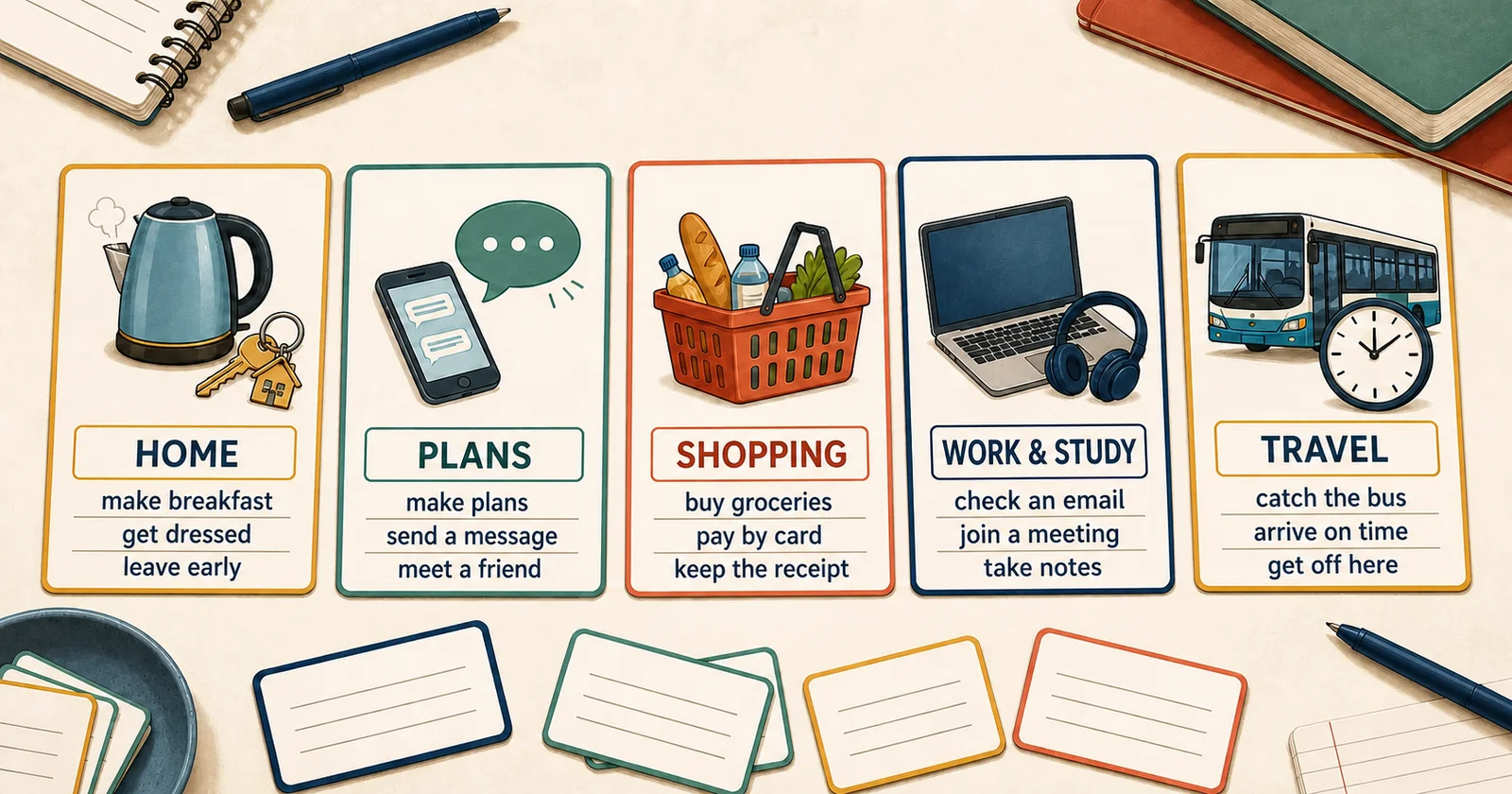
Daily use English words are the words that help you get things done: make a plan, change an appointment, ask for help, explain a problem, or respond politely. You may already know thousands of English words, but daily communication becomes easier when the useful ones are ready in your mind at the right moment.
This guide groups practical vocabulary by situation and gives each word a short meaning plus a sentence you could genuinely use. It is designed for learners around A2–B1 who can form basic sentences but want to speak and write with less stopping and translating. Practise the groups in the B1 vocabulary library in small sets rather than trying to memorize the page at once.
- Focus: everyday actions, plans, services, travel, work, and polite conversation
- Level: mostly A2–B1, with a few useful B2 upgrades
- Best for: learners who want active words, not a random list
- Study goal: learn a word together with one phrase and one personal sentence
For a broader, situation-by-situation collection, see English Words for Daily Use. This article is narrower: it teaches the high-use words that help you manage ordinary conversations clearly.
How to Choose Daily Use English Words
Useful vocabulary is not always the most impressive vocabulary. A word is worth learning early when it appears in many situations, combines naturally with other words, and helps you solve a small communication problem. Confirm, for example, works with a booking, a time, an address, a plan, or an answer. That gives you five useful sentence patterns from one word.
Do not learn a word as a translation only. Build a three-part note:
- Meaning: confirm = say that information or an arrangement is correct.
- Partner words: confirm a booking, confirm the time, confirm by email.
- Your sentence: “Could you confirm the meeting time?”
This method helps you retrieve a complete phrase instead of searching for separate words. It also prevents a common problem: knowing a word on a flashcard but not being able to use it while speaking.
Everyday Actions and Small Tasks
These verbs appear whenever you organize your day. They are more flexible than very basic alternatives such as do or make.
| Word | Meaning | Natural phrase | Example sentence |
|---|---|---|---|
| arrange | plan or organize | arrange a meeting | I need to arrange a dentist appointment. |
| confirm | say that something is correct | confirm the details | Please confirm the address before you leave. |
| delay | make something happen later | delay a decision | Rain may delay the delivery. |
| handle | deal with a task or problem | handle a request | Maya will handle the customer emails today. |
| manage | succeed in doing something | manage to finish | I managed to finish the report before lunch. |
| remind | help someone remember | remind someone about | Can you remind me about the call tomorrow? |
| reschedule | move to a different time | reschedule an appointment | Could we reschedule our lesson for Friday? |
| sort out | solve or organize | sort out a problem | I will sort out the payment this afternoon. |
| submit | officially send work or a form | submit an application | You must submit the form by Monday. |
| update | give new information | update someone on | Please update me on the repair. |
| wait for | stay until something happens | wait for a reply | We are waiting for the manager’s reply. |
| work out | find an answer or arrangement | work out a solution | Let’s work out a time that suits everyone. |
Notice the noun partners. You do not usually make an appointment in every context; you can arrange, book, confirm, cancel, or reschedule one. Learning that small network gives your English more control.
Plans, People, and Everyday Communication
Daily conversations often depend on clear planning language. These words help you invite people, make a suggestion, and react when plans change.
| Word or phrase | Meaning | Natural phrase | Example sentence |
|---|---|---|---|
| available | free and able to do something | be available on Tuesday | Are you available after six? |
| cancel | decide that something will not happen | cancel a booking | They had to cancel the picnic. |
| expect | think something will happen | expect a response | I expect a reply by the end of the day. |
| invite | ask someone to come | invite someone over | We invited our neighbours over for dinner. |
| join | take part with other people | join us for lunch | Would you like to join us? |
| prefer | like one option more | prefer to walk | I prefer to pay by card. |
| recommend | say that something is a good choice | recommend a place | Can you recommend a quiet café nearby? |
| suggest | offer an idea | suggest a time | I suggest meeting near the station. |
| suit | be convenient or right for someone | Does Thursday suit you? | Ten o’clock suits me well. |
| take turns | do something one after another | take turns cooking | We take turns cooking during the week. |
| whether | if one of two possibilities is true | decide whether to | I cannot decide whether to go now or later. |
| work for | be suitable or convenient | That works for me | Friday morning works for me. |
For speaking practice, turn each table row into a short question and answer. “What time suits you?” — “Four works for me, but I am not available after five.” This is much more useful than repeating isolated vocabulary.
Home, Shopping, and Services
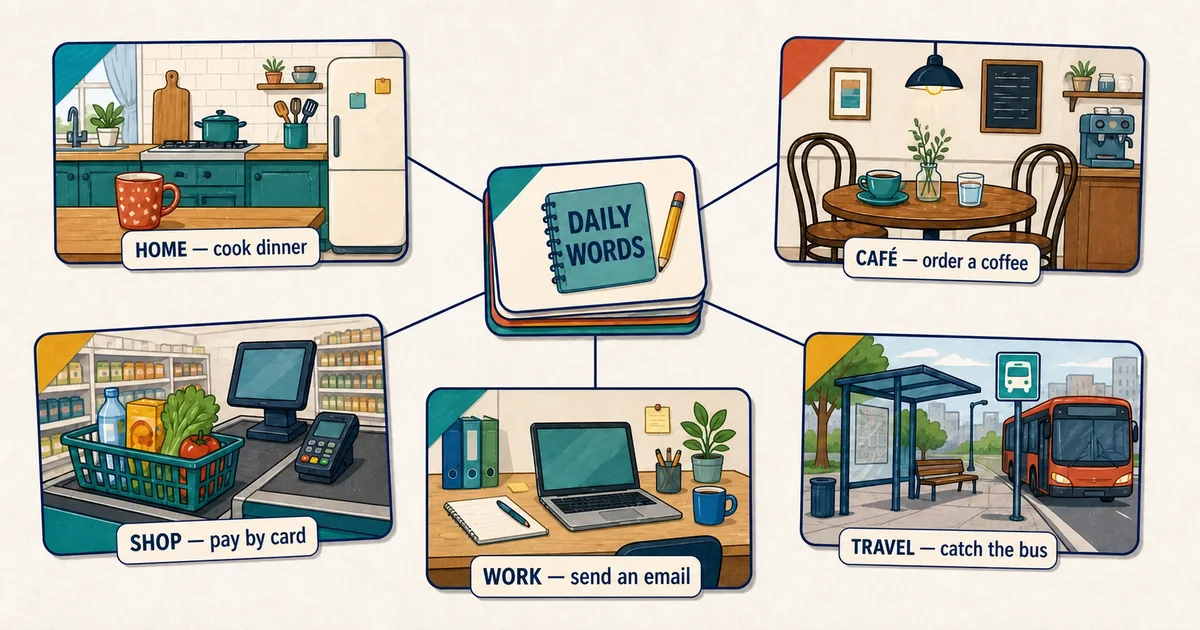
At home and in shops, precise everyday words help you explain what you need without using long, difficult sentences. Start with the phrases that you personally use most often.
| Word | Meaning | Natural phrase | Example sentence |
|---|---|---|---|
| borrow | take and use something temporarily | borrow a charger | Could I borrow your charger for a minute? |
| deliver | take something to a place | deliver an order | The store will deliver the desk on Saturday. |
| household | connected with the home | household items | We need a few household items. |
| lend | give something temporarily | lend someone money | My brother lent me his umbrella. |
| order | ask for food or goods | place an order | I placed an order online last night. |
| receipt | paper or digital proof of payment | keep the receipt | Keep the receipt in case you need to return it. |
| refund | money returned after a purchase | ask for a refund | She asked for a refund because the item was damaged. |
| replace | put one thing instead of another | replace a battery | We need to replace the kitchen light. |
| return | take something back | return an item | You can return the shoes within fourteen days. |
| run out of | have no more left | run out of milk | We have run out of coffee. |
| spare | extra and available | a spare key | Do you have a spare key? |
| store | keep something for later | store food safely | Store the medicine in a cool place. |
Two verbs are easy to confuse: borrow means you receive something temporarily; lend means you give it temporarily. Say “Can I borrow your pen?” but “Can you lend me your pen?”
Work, Study, and Digital Life
Even informal work messages need clear action words. These choices sound direct without sounding rude.
| Word | Meaning | Natural phrase | Example sentence |
|---|---|---|---|
| attach | add a file to a message | attach a document | I have attached the revised schedule. |
| check | look at something carefully | check the figures | Could you check the figures once more? |
| complete | finish something | complete a task | Please complete the training this week. |
| download | copy a file to your device | download the file | Download the guide before the lesson. |
| forward | send a message on to another person | forward an email | Could you forward me the link? |
| log in | enter a system | log in to your account | I cannot log in to the course page. |
| notice | see or become aware of something | notice an error | I noticed an error in the total. |
| reply | answer a message | reply to an email | Please reply when you have time. |
| save | keep a file or document | save your work | Save your work before you close the page. |
| share | let others use or see something | share a folder | I will share the folder with the team. |
| upload | put a file on a system | upload a photo | Upload your photo in JPG format. |
| version | a form of a document or product | latest version | Make sure you are using the latest version. |
When you write a request, add a reason or a deadline when it helps: “Could you check the figures before the meeting?” That makes your message easy to act on. For broader workplace vocabulary, continue with English Verbs List.
Travel, Time, and Getting Around
Travel vocabulary becomes most useful when a plan changes. Learn the words below as short ready-made messages.
| Word | Meaning | Natural phrase | Example sentence |
|---|---|---|---|
| arrive | reach a place | arrive at the station | We arrived at the station early. |
| book | arrange and pay for a place or service | book a ticket | You should book a ticket in advance. |
| commute | travel regularly between home and work | commute by train | She commutes by train three days a week. |
| fare | the price of a journey | pay the fare | The bus fare is cheaper with a travel card. |
| miss | fail to catch or attend something | miss the bus | I missed the bus by two minutes. |
| reserve | keep a place for later use | reserve a seat | We reserved a table for eight. |
| route | the way from one place to another | take a route | This route avoids the busy road. |
| schedule | a plan showing times | check the schedule | Check the train schedule before you leave. |
| transfer | change from one vehicle or service to another | transfer to a line | You need to transfer at Central Station. |
| traffic | cars and other vehicles on roads | heavy traffic | There was heavy traffic this morning. |
| visit | go to a place or person for a time | visit a museum | We are visiting the museum tomorrow. |
| weather | conditions outside | check the weather | Check the weather before your trip. |
Useful travel questions are built from these words: “Which route should I take?”, “Do I need to transfer?”, and “Can I reserve a seat?” If travel is your next priority, use the B1 library to make a personal travel set.
Feelings, Problems, and Polite Solutions
You do not need advanced vocabulary to sound calm and considerate. These words help you explain a problem, make a request, and keep the conversation constructive.
| Word or phrase | Meaning | Natural phrase | Example sentence |
|---|---|---|---|
| appreciate | be thankful for something | appreciate your help | I really appreciate your help with this. |
| concerned | worried about something | concerned about a delay | I am concerned about the delivery delay. |
| convenient | easy and suitable | at a convenient time | Is this a convenient time to talk? |
| disappointed | unhappy because hopes were not met | disappointed with the result | We were disappointed with the service. |
| frustrated | annoyed because progress is difficult | feel frustrated | I feel frustrated because the page keeps closing. |
| grateful | thankful | grateful for the advice | I am grateful for your advice. |
| helpful | useful or willing to help | a helpful response | Your explanation was very helpful. |
| issue | a problem or important matter | report an issue | I would like to report an issue with my order. |
| patient | able to wait calmly | be patient | Please be patient while we check. |
| polite | showing respect | a polite request | “Could you…?” is a polite request. |
| solve | find an answer to a problem | solve the problem | We hope to solve the problem today. |
| urgent | needing attention quickly | an urgent request | This is not urgent, so tomorrow is fine. |
Compare “Your service is bad” with “There seems to be an issue with my order. Could you help me solve it?” The second sentence names the problem, stays polite, and gives the listener a clear next step.
Turn a Word List into Useful Sentences
Reading a list is only the first step. To make daily use English words active, practise the same word in several small patterns.
| Pattern | Example with confirm | Why it helps |
|---|---|---|
| statement | I confirmed the booking. | links the word to a past action |
| question | Can you confirm the time? | prepares a real request |
| polite message | Could you please confirm by email? | practises register and a useful partner phrase |
| personal detail | I need to confirm my appointment tomorrow. | connects the word to your life |
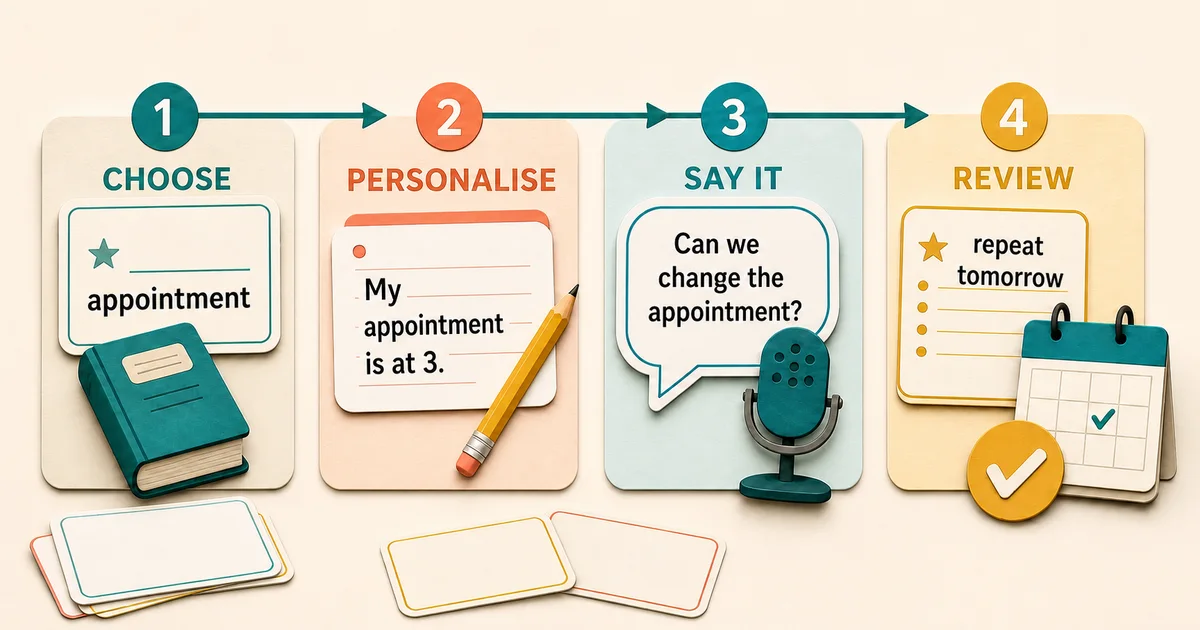
Use a 15-minute cycle three or four times a week:
- Choose five words from one situation.
- Read the example sentences aloud once, then cover the right side of the table and explain each word in your own words.
- Write one true message, question, or note for every word.
- Say the sentences without looking. If one feels slow, keep it for tomorrow’s review.
- Add the words you want to retain to your Linglify dictionary, then review them after one day, three days, and a week.
This approach is especially effective for words that are easy to recognize but hard to retrieve. You are not memorizing a long definition; you are rehearsing a small piece of communication.
Vocabulary to Practise
Save a few words first, then use their example sentences as speaking prompts. The buttons in this block add words to your Linglify dictionary for later review.
academy
noun
A place for study or training in a special subject.
Examples
- She graduated from the military academy with honors last spring.
- The film academy recognizes outstanding achievements in cinema each year.
achievable
adjective
Possible to be done or achieved; within reach.
Examples
- Setting achievable goals is important for maintaining motivation and confidence.
- The project timeline seems achievable if we work efficiently together.
adjective
noun
A word that describes or modifies a noun.
Examples
- In English grammar, an adjective describes or modifies a noun.
- The adjective 'beautiful' comes before the noun 'garden' in this sentence.
affordable
adjective
Able to be bought or reached at a reasonable price.
Examples
- The government is working to provide affordable housing for low-income families.
- This restaurant offers delicious and affordable meals for college students.
amount
noun
The total quantity or number of something.
Examples
- A small amount of sugar is needed to balance the acidity.
- The amount of homework assigned seems excessive for elementary school children.
assault
noun
A sudden, violent attack or act of violence.
Examples
- The army launched a fierce assault on the enemy fortress.
- The police arrested the man for assault and battery charges.
audience
noun
A group of people who watch or listen to a performance or event.
Examples
- Television shows depend on audience ratings to determine their success.
- The speaker engaged the audience with humor and interesting stories.
beam
noun
A long, sturdy piece of wood or metal used to support or carry weight.
Examples
- A beam of sunlight streamed through the window brightening the room.
- The wooden beam supports the weight of the ceiling above.
biotechnology
noun
The use of living organisms or systems to develop products or processes.
Examples
- Agricultural biotechnology helps create disease-resistant crop varieties.
- Biotechnology companies develop new medical treatments and therapies.
brewery
noun
A place where beer, cider, or other drinks are produced and sold.
Examples
- She works as a quality control manager at brewery.
- The local brewery offers tours every Saturday afternoon.
carelessness
noun
The quality of not being careful or paying attention, often causing mistakes.
Examples
- Her carelessness with money led to serious financial problems.
- The accident was caused by the pilot's carelessness during takeoff.
choose
verb
To select or prefer one thing over another.
Examples
- She will choose the dress that looks best for the wedding ceremony.
- Students must choose their courses carefully for next semester's schedule.
come
verb
To move closer or arrive at a place or event.
Examples
- Please come to the meeting at three o'clock this afternoon.
- Spring will come early this year according to weather predictions.
continent
noun
A large landmass on Earth, such as Africa or Asia.
curry
noun
A spicy mixture of ground meat and vegetables, usually eaten with rice or bread.
Examples
- Indian curry dishes use many different spices to create complex flavors.
- She prepared a delicious chicken curry with rice for dinner.
department store
noun
A store selling a variety of goods, often located in a shopping center.
Examples
- Holiday shopping at the department store can be crowded and stressful.
- The department store sells everything from clothing to electronics.
disco
noun
A type of dance music and social event popular in the 1970s and 1980s.
Examples
- Disco music became extremely popular during the nineteen seventies era.
- The disco was crowded with young people dancing to energetic music.
earth
noun
The planet we live on; the ground or soil of the world.
Examples
- Earth is the third planet from the sun in our solar system.
- Farmers plant seeds in rich earth to grow healthy crops.
exactly
adverb
Precisely; in a way that is exactly correct or true.
Examples
- That's exactly what I was thinking about this important situation too.
- The train arrived exactly on time at nine fifteen this morning.
firearm
noun
A noun for a weapon that shoots bullets or projectiles.
Examples
- Police officers receive extensive training in firearm safety and usage.
- The museum displays historical firearms from different time periods.
generous
adjective
Willing to give more than necessary or expected; kind and generous.
Examples
- She gave a generous portion of food to everyone at the dinner table.
- The generous donation will help fund scholarships for deserving students.
have to
verb
Must do something because of a rule or obligation.
Examples
- She doesn't have to work on weekends unless there's an emergency.
- Students have to complete their homework before coming to class tomorrow.
indirect
adjective
Not directly caused by or connected to something; not straightforward.
Examples
- His indirect criticism was subtle but everyone understood his meaning.
- The indirect route takes longer but avoids the heavy traffic areas.
know
verb
This verb describes being aware of facts or information.
Examples
- Do you know anyone who speaks fluent Spanish or Portuguese?
- I know the answer to that difficult mathematical question.
manner
noun
A way of doing or behaving; a style or method.
Examples
- Children learn proper table manners through family guidance and practice.
- She speaks in confident manner that commands attention and respect.
What to Do Next
- Start a manageable review set in the B1 vocabulary library.
- Build short conversations with Basic English for Speaking.
- Use Simple English Sentences for Daily Use to turn vocabulary into full messages.
- When these words feel automatic, expand your range with C1 English Vocabulary.
Frequently Asked Questions
How many daily use English words should I learn first?
Start with 30 to 50 words that match your real week: travel, work, shopping, study, or family life. It is better to use 40 words confidently than to recognize 300 words that you cannot retrieve in a conversation.
Are daily English words only for beginners?
No. Daily vocabulary includes simple words, but the skill is choosing the accurate word and natural phrase quickly. B1 and B2 learners still benefit from practising polite requests, plans, problems, and everyday work messages.
Should I learn single words or full sentences?
Learn both, but keep every word attached to a phrase and one example sentence. A sentence shows grammar, common partners, and the situation where the word is useful.
How can I remember English words with meanings?
Use active recall: look at the meaning or situation, say the English word, then make a personal sentence. Short spaced reviews in Linglify work better than reading the same long list repeatedly.
What is the fastest way to make vocabulary active?
Use new words within 24 hours. Send a practice message, describe your plans aloud, or make three questions with the word. Fast, repeated use creates the link between recognition and speaking.