
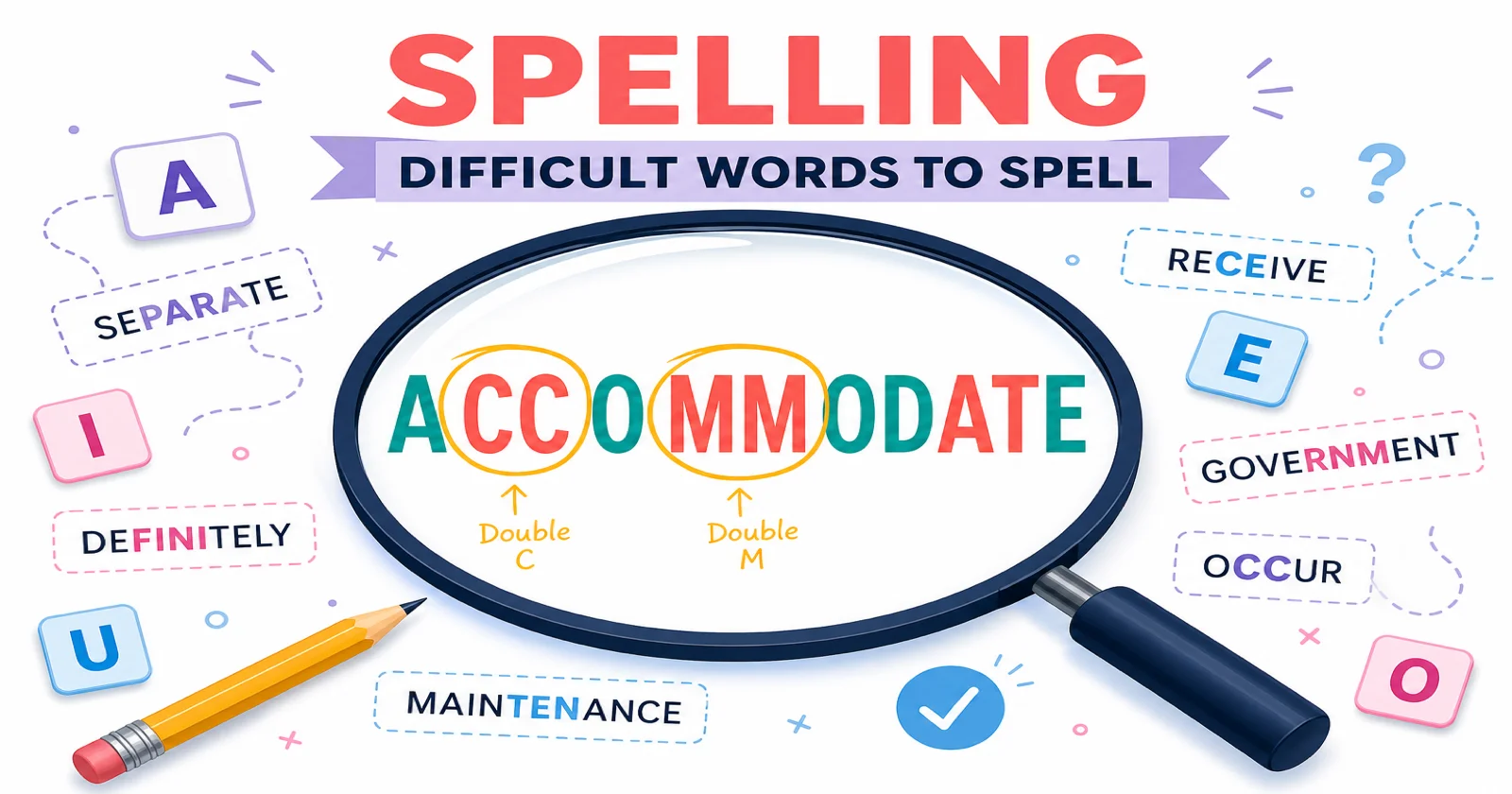
Difficult Words to Spell in English: 200 Tricky Words with Tips
English spelling is famously irregular. The same sound can be spelled ten different ways (through, too, blue, shoe, crew, you, flu, coup, Hugh, lieu), and the same letters can produce completely different sounds (cough, through, though, thought, tough). Even native speakers misspell common words their entire lives.
Why is English spelling so chaotic? Because English borrowed words from Latin, Greek, French, German, Old Norse, Arabic, Hindi, and dozens of other languages — and often kept the original spelling while changing the pronunciation. The result: a language where “colonel” is pronounced “kernel” and “Wednesday” has a silent “d.”
This guide lists 200 of the most commonly misspelled English words, organized by the type of spelling trap. Each word includes the common mistake, the correct spelling, and a memory trick to help you get it right.
- Total: 200 difficult words
- Format: Correct spelling → Common mistake → Memory tip
- Organized by: spelling pattern (silent letters, double letters, etc.)
- Level: A2–C1
- For: spelling improvement, exam prep, writing confidence
For more hard words beyond spelling, see our Hard English Words: 500+ Difficult Words.
Why English Spelling Is So Difficult
English has 44 sounds but only 26 letters. This mismatch creates chaos:
| Problem | Example | What Goes Wrong |
|---|---|---|
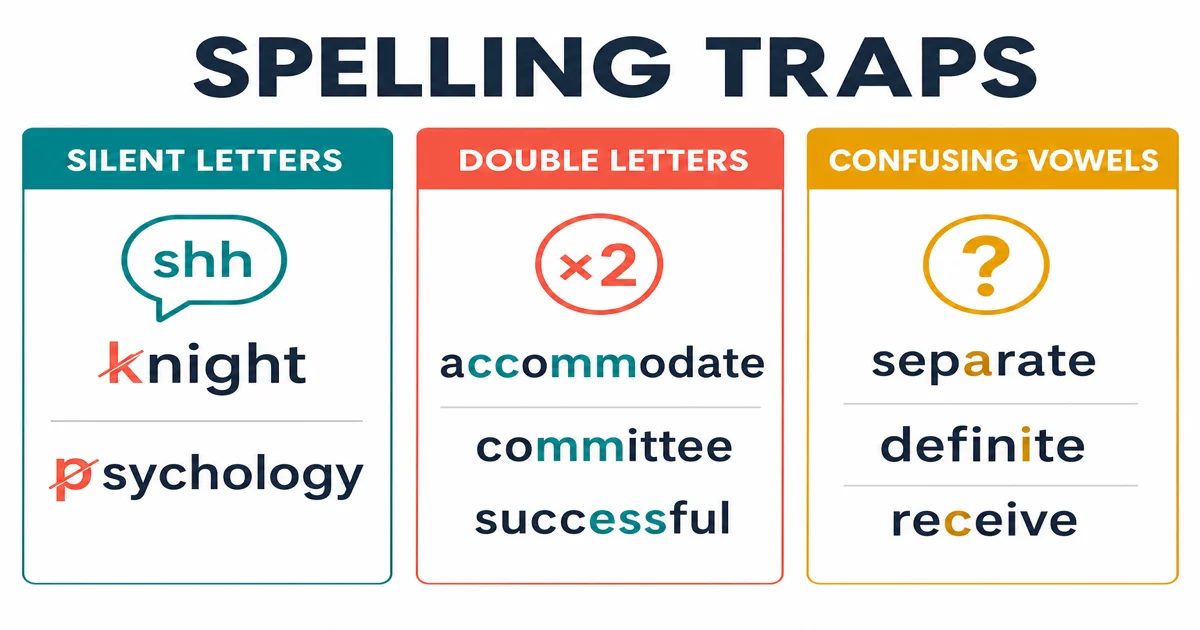
| Silent letters | knight, psychology, receipt | Letters you see but don’t hear |
| Double letters | accommodate, occurrence | One or two? Hard to remember |
| Unstressed vowels | separate, definitely | Vowels that sound like “uh” in speech |
| -ible vs. -able | responsible, comfortable | No clear rule for which ending |
| -ence vs. -ance | occurrence, resistance | Both sound identical |
| i before e | receive, weird, seize | The “rule” has more exceptions than followers |
The good news: most spelling errors fall into predictable patterns. Learn the patterns, and you eliminate 80% of mistakes.
Silent Letters (30 Words)
These words contain letters that are written but not pronounced — the most deceptive trap in English spelling.
| # | Correct Spelling | Common Mistake | Memory Tip |
|---|---|---|---|
| 1 | acquaintance |
|
ACQuire an ACQuaintance |
| 2 | acknowledge |
|
You need to aCKnowledge the CK |
| 3 | column |
|
The N is silent like a column standing quietly |
| 4 | conscience |
|
CON + SCIENCE = conscience |
| 5 | fascinate |
|
There’s a hidden SC — like in “science” |
| 6 | foreign |
|
FORE + IGN — ignore the weird order |
| 7 | government |
|
GOVERN + MENT — keep the N |
| 8 | guarantee |
|
GUA + RAN + TEE — three parts |
| 9 | handkerchief |
|
HAND + KERCHIEF — it’s for your hand |
| 10 | island |
|
An island IS LAND |
| 11 | knight |
|
Silent K — from Old English |
| 12 | knowledge |
|
KNOW + LEDGE — you know the ledge |
| 13 | listen |
|
LISTEN has a silent T |
| 14 | mortgage |
|
MORT (death) + GAGE — death pledge |
| 15 | muscle |
|
MUSC + LE — think of “muscular” |
| 16 | pneumonia |
|
P is silent — from Greek “pneuma” (breath) |
| 17 | psychology |
|
P is silent — from Greek “psyche” (mind) |
| 18 | receipt |
|
Silent P — receiPt |
| 19 | rhythm |
|
Rhythm Has Your Two Hips Moving |
| 20 | salmon |
|
Silent L — SALmon |
| 21 | scissors |
|
SC + ISSORS — double S |
| 22 | subtle |
|
The B is subtle in “subtle” |
| 23 | sword |
|
Silent W — from Old English |
| 24 | technique |
|
TECH + NIQUE — keep the H |
| 25 | Wednesday |
|
WED + NES + DAY — named after Woden |
| 26 | whistle |
|
WH at the start, T in the middle |
| 27 | wrestle |
|
Silent W — like “write” and “wrong” |
| 28 | yacht |
|
From Dutch — the CH is silent |
| 29 | answer |
|
Silent W — ansWer |
| 30 | doubt |
|
Silent B — from Latin “dubitare” |
Double Letters (35 Words)
The most common spelling error: forgetting to double a letter, or doubling the wrong one.
| # | Correct Spelling | Common Mistake | Memory Tip |
|---|---|---|---|
| 31 | accommodate |
|
2 C’s and 2 M’s — it’s big enough to accommodate both |
| 32 | accelerate |
|
2 C’s, 1 L — aCCeLerate |
| 33 | accessory |
|
2 C’s, 2 S’s — aCCeSSory |
| 34 | aggressive |
|
2 G’s — aGGressive |
| 35 | apparent |
|
2 P’s — aPParent |
| 36 | broccoli |
|
2 C’s, 1 L — broCColi |
| 37 | Caribbean |
|
1 R, 2 B’s — caRiBBean |
| 38 | committed |
|
2 M’s, 2 T’s — coMMiTTed |
| 39 | committee |
|
2 M’s, 2 T’s, 2 E’s — coMMiTTEE |
| 40 | disappear |
|
1 S, 2 P’s — diSaPPear |
| 41 | disappoint |
|
1 S, 2 P’s — diSaPPoint |
| 42 | embarrass |
|
2 R’s, 2 S’s — embaRRaSS |
| 43 | exaggerate |
|
2 G’s — exaGGerate |
| 44 | excellence |
|
2 L’s — exceLLence |
| 45 | harass |
|
1 R, 2 S’s — haRaSS |
| 46 | innocence |
|
2 N’s — iNNocence |
| 47 | interrupt |
|
2 R’s — inteRRupt |
| 48 | millennium |
|
2 L’s, 2 N’s — miLLeNNium |
| 49 | misspell |
|
MIS + SPELL — 2 S’s (ironically!) |
| 50 | necessary |
|
1 C, 2 S’s — a shirt has 1 Collar and 2 Sleeves |
| 51 | occasion |
|
2 C’s, 1 S — oCCaSion |
| 52 | occurrence |
|
2 C’s, 2 R’s — oCCuRRence |
| 53 | parallel |
|
2 L’s in the middle — paraLLel |
| 54 | possession |
|
2 S’s twice — poSSESSion |
| 55 | professional |
|
1 F, 2 S’s — proFeSSional |
| 56 | questionnaire |
|
2 N’s — questioNNaire |
| 57 | recommend |
|
1 C, 2 M’s — reCcoMMend |
| 58 | referring |
|
2 R’s — refeRRing |
| 59 | succeed |
|
2 C’s — suCCeed |
| 60 | suggest |
|
2 G’s — suGGest |
| 61 | tomorrow |
|
1 M, 2 R’s — toMoRRow |
| 62 | address |
|
2 D’s — aDDress |
| 63 | assistant |
|
2 S’s — aSSistant |
| 64 | beginning |
|
2 N’s — begiNNing |
| 65 | different |
|
2 F’s — diFFerrent |
Confusing Vowels (30 Words)
When vowels are unstressed, they all sound like “uh” (the schwa sound /ə/). This makes spelling by ear impossible.
| # | Correct Spelling | Common Mistake | Memory Tip |
|---|---|---|---|
| 66 | separate |
|
There’s A RAT in separate |
| 67 | definitely |
|
FINITE is in the middle — deFINITEly |
| 68 | desperate |
|
Think of “PERATE” not “PARATE” |
| 69 | calendar |
|
cAlEndAr — three A’s |
| 70 | cemetery |
|
All E’s — cEmEtEry |
| 71 | category |
|
catEgory — E in the middle |
| 72 | privilege |
|
No D — it’s priviLEGE |
| 73 | relevant |
|
relEvAnt — E then A |
| 74 | independent |
|
DENT at the end — indepenDENT |
| 75 | repetition |
|
rEpEtition — two E’s |
| 76 | resistance |
|
resistANCE — A not E |
| 77 | maintenance |
|
MAIN + TEN + ANCE |
| 78 | miniature |
|
MINI + ATURE — keep the I |
| 79 | original |
|
ORIGIN + AL |
| 80 | temperature |
|
TEMPER + ATURE — keep the second E |
| 81 | tolerance |
|
tolerANCE — A not E |
| 82 | ignorance |
|
ignorANCE — A not E |
| 83 | abundance |
|
abundANCE — A not E |
| 84 | existence |
|
existENCE — E not A |
| 85 | occurrence |
|
occurrENCE — E not A |
| 86 | preference |
|
preferENCE — E not A |
| 87 | reference |
|
referENCE — E not A |
| 88 | experience |
|
experiENCE — E not A |
| 89 | absence |
|
abSENCE — not SENSE |
| 90 | license |
|
LICENSE — C before S |
| 91 | medicine |
|
mEDICine — MEDIC is inside |
| 92 | vegetable |
|
vEGEtable — two E’s |
| 93 | secretary |
|
SECRET + ARY |
| 94 | laboratory |
|
LABOR + ATORY — keep the second O |
| 95 | vocabulary |
|
VOCAB + ULARY |
-ible vs. -able (20 Words)
No reliable rule exists. You simply need to learn which ending each word takes.
| # | Correct Spelling | Common Mistake | Memory Tip |
|---|---|---|---|
| 96 | responsible |
|
responsIBLE |
| 97 | terrible |
|
terrIBLE |
| 98 | visible |
|
visIBLE |
| 99 | possible |
|
possIBLE |
| 100 | flexible |
|
flexIBLE |
| 101 | incredible |
|
incredIBLE |
| 102 | accessible |
|
accessIBLE |
| 103 | compatible |
|
compatIBLE |
| 104 | comfortable |
|
comfortABLE |
| 105 | available |
|
availABLE |
| 106 | reasonable |
|
reasonABLE |
| 107 | knowledgeable |
|
knowledgeABLE |
| 108 | manageable |
|
manageABLE |
| 109 | noticeable |
|
noticeABLE — keep the E |
| 110 | changeable |
|
changeABLE — keep the E |
| 111 | believable |
|
believABLE |
| 112 | dependable |
|
dependABLE |
| 113 | considerable |
|
considerABLE |
| 114 | inevitable |
|
inevitABLE |
| 115 | memorable |
|
memorABLE |
ie vs. ei (15 Words)
The rule “i before e, except after c” has so many exceptions it barely counts as a rule.
| # | Correct Spelling | Common Mistake | Memory Tip |
|---|---|---|---|
| 116 | receive |
|
After C → EI: reCEIve |
| 117 | believe |
|
No C → IE: beLIEve (don’t beLIEve a LIE) |
| 118 | achieve |
|
No C → IE: achIEve |
| 119 | deceive |
|
After C → EI: deCEIve |
| 120 | perceive |
|
After C → EI: perCEIve |
| 121 | conceive |
|
After C → EI: conCEIve |
| 122 | ceiling |
|
After C → EI: cEIling |
| 123 | weird |
|
Exception! WEIRD is weird |
| 124 | seize |
|
Exception! SEIze |
| 125 | their |
|
Exception! THEIR = THEy + IR |
| 126 | height |
|
Exception! HEIght — sounds like “ite” |
| 127 | neighbor |
|
EI when sounding like “ay”: nEIghbor |
| 128 | freight |
|
EI when sounding like “ay”: frEIght |
| 129 | protein |
|
Exception! protEIn |
| 130 | foreign |
|
Exception! forEIgn |
Words People Mix Up (25 Words)
These words are not just hard to spell — they are hard to tell apart.
| # | Correct Form | Confused With | The Difference |
|---|---|---|---|
| 131 | affect (verb) | effect (noun) | The rain will affect your plans. / The effect was immediate. |
| 132 | principal (main/head) | principle (rule) | The principal announced a new principle. |
| 133 | stationary (not moving) | stationery (paper) | Stationary = stand still; Stationery = pen and pencil |
| 134 | complement (complete) | compliment (praise) | Complement completes; Compliment = “I like you” |
| 135 | conscience (morals) | conscious (aware) | ConsciENCE = inner sENSE; ConsciOUS = YOU are aware |
| 136 | desert (dry land) | dessert (sweet food) | Dessert has 2 S’s — you always want Seconds of deSSert |
| 137 | loose (not tight) | lose (misplace) | Loose = goose; Lose = one O gone (you lost it!) |
| 138 | its (possessive) | it’s (it is) | It’s = it IS (apostrophe = contraction) |
| 139 | their (possessive) | there/they’re | Their = ownership; There = place; They’re = they are |
| 140 | your (possessive) | you’re (you are) | You’re = you ARE |
| 141 | than (comparison) | then (time) | ThAN = compArison; ThEN = whEN |
| 142 | weather (climate) | whether (if) | wEAther has EAr — you hear weather forecasts |
| 143 | advice (noun) | advise (verb) | AdvICE = noun (like ICE); AdvISE = verb (like “wISE”) |
| 144 | practice (noun) | practise (verb) | Same pattern: PractICE = noun; PractISE = verb (British) |
| 145 | licence (noun) | license (verb) | Same pattern (British English) |
| 146 | brake (stop) | break (smash) | BrAKE = stAKE in stopping; BreAK = something breAKs |
| 147 | quiet (silent) | quite (fairly) | quiET = pET is quiet; quiTE = quiTE different |
| 148 | accept (take) | except (but) | ACcept = ACquire; EXcept = EXclude |
| 149 | ensure (make certain) | insure (insurance) | ENsure = make cERtain; INsure = INsurance |
| 150 | emigrate (leave) | immigrate (arrive) | Emigrate = Exit; Immigrate = come In |
| 151 | elicit (draw out) | illicit (illegal) | eLICit = Legal; iLLICit = iLLegal |
| 152 | farther (distance) | further (more) | fARther = how fAR; fURther = more |
| 153 | discreet (careful) | discrete (separate) | discrEET = sEEcretive; discrETE = separaTE |
| 154 | proceed | precede | proCEED = go forward; preCEDE = come before |
| 155 | personnel (staff) | personal (private) | personNEL = employees; personAL = private |
Commonly Misspelled Everyday Words (45 Words)
These are words you use every day — and many people misspell every time.
| # | Correct Spelling | Common Mistake | Memory Tip |
|---|---|---|---|
| 156 | accommodation |
|
2 C’s, 2 M’s |
| 157 | argument |
|
Drop the E from “argue” |
| 158 | beautiful |
|
BEAUTY + FUL (one L) |
| 159 | beginning |
|
Double N — begiNNing |
| 160 | business |
|
BUS + I + NESS |
| 161 | completely |
|
COMPLETE + LY |
| 162 | convenience |
|
conVENience — VENI (Latin: come) |
| 163 | curiosity |
|
Drop the “ous” — CURIOS + ITY |
| 164 | decision |
|
DECIS + ION (from “decide”) |
| 165 | description |
|
DESCription — DESCRIBE without the B + TION |
| 166 | development |
|
DEVELOP + MENT (no E before MENT) |
| 167 | dictionary |
|
DICTION + ARY |
| 168 | disappearance |
|
1 S, 2 P’s — DIS + APPEARANCE |
| 169 | discipline |
|
DISC + IP + LINE |
| 170 | environment |
|
ENVIRON + MENT — keep the N |
| 171 | especially |
|
E + SPECIAL + LY |
| 172 | exaggeration |
|
2 G’s — exaGGeration |
| 173 | exercise |
|
EXER + CISE |
| 174 | February |
|
FEB + RU + ARY — keep the first R |
| 175 | grammar |
|
grammAR ends in AR, not ER |
| 176 | immediately |
|
2 M’s — iMMediately |
| 177 | jewelry |
|
JEWEL + RY |
| 178 | judgment |
|
JUDGE − E + MENT (American English) |
| 179 | library |
|
LIB + RARY — keep the first R |
| 180 | lightning |
|
LIGHT + NING (no E) |
| 181 | occasionally |
|
2 C’s, 1 S — oCCaSionally |
| 182 | particular |
|
PARTICULAR — PAR not PER |
| 183 | perseverance |
|
perseverANCE — A not E |
| 184 | preferred |
|
2 R’s — prefeRRed |
| 185 | probably |
|
PROB + ABLY |
| 186 | pronunciation |
|
proNUNciation — no “OUNCE” |
| 187 | restaurant |
|
REST + AU + RANT |
| 188 | schedule |
|
SCHED + ULE |
| 189 | sentence |
|
SENT + ENCE |
| 190 | surprise |
|
SUR + PRISE — don’t forget the first R |
| 191 | thorough |
|
THOROUGH — OUGH at the end |
| 192 | truly |
|
TRUE − E + LY |
| 193 | twelfth |
|
TWELF + TH — keep the F |
| 194 | unnecessary |
|
1 C, 2 S’s — UN + NECESSARY |
| 195 | until |
|
1 L — untiL |
| 196 | usually |
|
USUAL + LY |
| 197 | vacuum |
|
1 C, 2 U’s — vaCUUm |
| 198 | various |
|
VARI + OUS |
| 199 | weather |
|
WEATH + ER |
| 200 | weird |
|
WEIRD breaks the ie/ei rule — it IS weird |
5 Rules That Actually Help
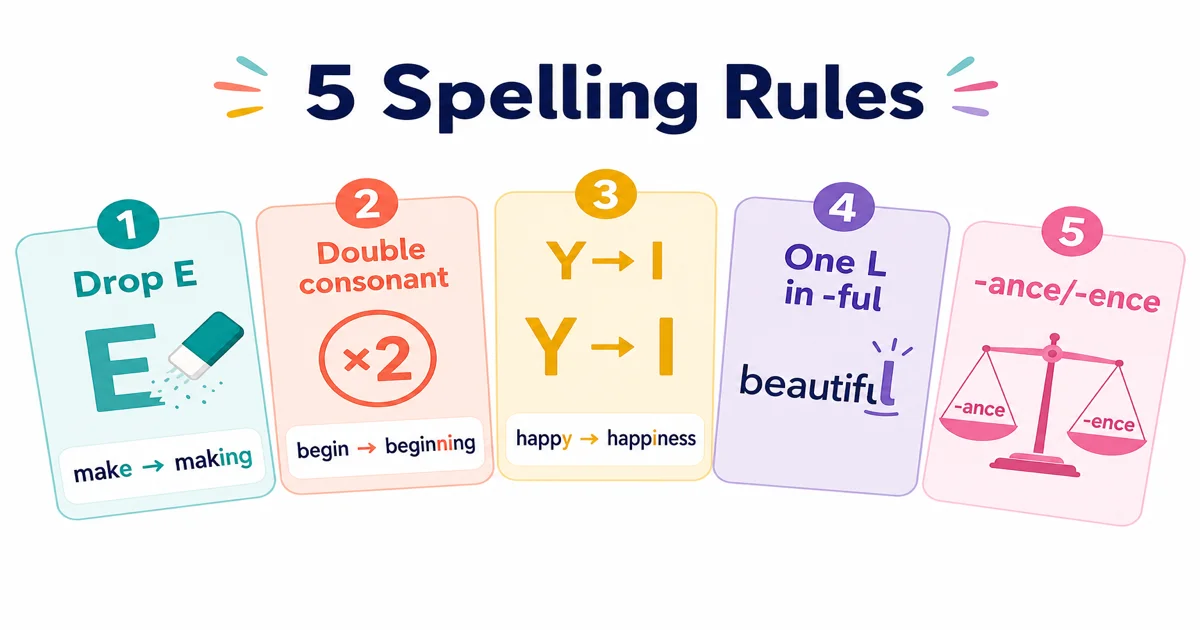
Rule 1: Drop the E before -ing and -able
make → making, love → lovable, write → writing
Exceptions: noticeable, changeable (keep E after soft C or G).
Rule 2: Double the final consonant before -ing/-ed if the last syllable is stressed
begin → beginning, prefer → preferred, commit → committed
But: offer → offering (stress on FIRST syllable, so no doubling).
Rule 3: Change Y to I before adding a suffix
happy → happiness, carry → carried, beauty → beautiful
But keep Y before -ing: carry → carrying, study → studying.
Rule 4: Use -ful, not -full
Every adjective ending in -ful has ONE L: beautiful, wonderful, grateful, helpful.
Add -ly and you get two L’s: beautifully, wonderfully, gratefully.
Rule 5: -ance/-ence depends on the verb form
If the verb ends in -ate → noun usually ends in -ance: tolerate → tolerance If the verb ends in -ere → noun usually ends in -ence: interfere → interference
How to Improve Your Spelling
Read more. Spelling is primarily visual memory. The more you see words spelled correctly, the more automatic correct spelling becomes.
Write by hand. Typing autocorrects your mistakes silently. Handwriting forces you to recall spelling actively. Write 5–10 problem words by hand each day.
Use spaced repetition. Add your personal “problem words” to Linglify. The system will test you at optimal intervals until the correct spelling is automatic.
Learn word roots. Words built from Latin and Greek roots follow consistent patterns. If you know “psych-“ means “mind” (Greek), you’ll never forget the silent P in psychology, psychiatrist, psyche.
Create mnemonics. The best memory tricks are personal: “There’s A RAT in separate” is silly but effective. Create your own for words you consistently misspell.
Words to Practice
These 25 words frequently appear in academic and professional writing. Add them to your Linglify dictionary for spaced repetition.
boom
noun
A loud, deep sound or a sudden increase in activity or popularity.
Examples
- The boom of thunder echoed across the valley.
- The technology boom created many new millionaires.
cooperate
verb
To work together with others towards a common goal.
evaluate
verb
To judge or measure the value, quality, or importance of something.
Examples
- Companies evaluate job candidates based on experience, skills, and personality.
- Teachers evaluate student progress through tests, projects, and classroom participation.
graduate
verb
To complete a course of study at a school or university.
Examples
- She will graduate from university next year with a degree in engineering.
- Students must complete all requirements before they can graduate from high school.
horizon
noun
The line where the earth or the sky appears to meet in the distance.
Examples
- The sun disappeared behind the horizon as evening approached.
- Traveling broadens your horizon and exposes you to new cultures.
indispensable
adjective
Absolutely necessary; essential.
Examples
- Clean water is indispensable for human survival and good health.
- Her experience and skills make her indispensable to the research team.
jury
noun
A group of people who listen to evidence in a court and decide if someone is guilty.
Examples
- The jury deliberated for several hours before reaching a verdict.
- The talent show jury consisted of professional musicians and entertainers.
lifelong
adjective
Continuing for a very long time or for the whole life.
Examples
- Learning is a lifelong process that never truly ends.
- Their lifelong friendship began during elementary school years.
motivated
adjective
Feeling driven or inspired to do something because of a reason or goal.
Examples
- Motivated employee seeks additional responsibilities and challenges at work.
- Success requires being motivated even when facing difficult obstacles.
normally
adverb
Usually; under normal conditions.
Examples
- Heart normally beats between sixty and hundred times per minute.
- Students normally arrive at school before morning bell rings.
off
adjective
Describes something that is not fresh or is no longer suitable for eating, often used for food and drinks.
Examples
- Please turn off the lights before leaving the room.
- The dog ran off into the forest chasing wild rabbits.
prejudice
noun
Preconceived opinions or feelings, often negative, about a person or group.
Examples
- Education helps overcome prejudice and promotes understanding.
- Racial prejudice damages communities and individuals alike.
resolve
verb
To find a solution or answer to a problem or question.
Examples
- Mediator helps parties resolve dispute through negotiation.
- Technical team will resolve software problems quickly.
stress
verb
To feel mental or emotional pressure or worry; to emphasize or give importance to something.
Examples
- Heavy workload may stress employees beyond limits.
- Teacher will stress importance of homework completion.
total
adjective
An adjective describing something that is complete or whole, not divided or broken.
Examples
- Total cost includes all fees and expenses.
- Total silence fills room during meditation session.
tragedy
noun
An extremely sad or serious event that causes suffering or loss.
Examples
- Natural tragedy affects thousands of innocent people.
- Personal tragedy changes person's life perspective completely.
union
noun
A group of people or things joined together for a purpose.
Examples
- Labor union protects worker rights and interests.
- Marriage union joins two people in partnership.
voyage
noun
A long journey to a distant place, often by sea or air.
Examples
- Space exploration represents humanity's greatest voyage into the unknown.
- The ocean voyage from Europe to America took several weeks in the past.
candidate
noun
A person who is competing in an election or contest.
Examples
- Each presidential candidate presented their policy plans to voters.
- The job candidate impressed the interview panel with her experience.
discourage
verb
To try to make someone feel less confident or hopeful about something.
Examples
- Don't let one failure discourage you from pursuing your dreams.
- High prices discourage many people from buying organic food products.
donate
verb
To give something, especially money or goods, to help a cause or person.
Examples
- Many people donate money to charities that help homeless individuals.
- She decided to donate blood to help patients in emergency situations.
firmly
adverb
An adverb indicating a way of doing something with certainty or stability.
Examples
- Hold the rope firmly while climbing down the steep mountain slope.
- The manager firmly believed in treating all employees with respect.
guide
verb
To show or direct someone how to do something.
Examples
- Parents should guide their children to make responsible decisions.
- The experienced hiker will guide the group through the mountain trail safely.
humorous
adjective
Funny or amusing, often making people laugh.
Examples
- She writes humorous articles about everyday life and family experiences.
- The humorous speech made everyone laugh and lightened the serious mood.
admission
noun
The process or fact of being allowed to enter or join.
Examples
- Her admission to the prestigious medical school was the result of hard work.
- The museum offers free admission on the first Sunday of every month.
What to Do Next
-
Test yourself. Read through the lists above and mark every word you have ever misspelled. Those are your priority words.
-
Learn by pattern. Focus on one category at a time — silent letters one week, double letters the next. Pattern-based learning is more effective than random lists.
-
Add problem words to Linglify for spaced repetition. Tag them as “spelling” for focused review sessions.
-
Read the complete guide — our Hard English Words: 500+ Difficult Words covers hard-to-spell, hard-to-pronounce, and hard-to-use words.
-
Practice in writing. Use your problem words deliberately in emails, essays, and notes. Active use builds muscle memory faster than passive review.
FAQ
What are the 10 hardest words to spell in English?
The most frequently misspelled words include: accommodate (double C, double M), separate (A not E in the middle), definitely (no A — it’s FINITE), occurrence (double C, double R), embarrass (double R, double S), rhythm (no vowels in the middle), millennium (double L, double N), conscience (SC combination), questionnaire (double N), and pronunciation (no “ounce”). These words trip up even native speakers.
Why is English spelling so irregular?
English borrowed words from Latin, Greek, French, German, Old Norse, and many other languages — often keeping the original spelling while changing pronunciation over centuries. Additionally, English pronunciation shifted dramatically between 1400–1700 (the Great Vowel Shift), but spelling was already standardized by then. The result is a written system that reflects medieval pronunciation, not modern speech.
How can I improve my spelling quickly?
Three methods work best together: (1) Read extensively — spelling is primarily visual memory, and seeing correct forms repeatedly builds unconscious recognition. (2) Write by hand — this forces active recall instead of relying on autocorrect. (3) Use spaced repetition — add your personal problem words to a review system and practice them at increasing intervals. Focus on patterns (all double-letter words together, all silent-letter words together) rather than random lists.
Do spelling rules actually work in English?
A few rules are reliable: “drop E before -ing” (make → making), “double the consonant if the last syllable is stressed” (begin → beginning), and “-ful always has one L” (beautiful, not beautifull). However, many “rules” like “i before e except after c” have so many exceptions that they cause more confusion than they solve. The most efficient approach is learning patterns by category and using spaced repetition for exceptions.
Is British spelling different from American spelling?
Yes, in predictable ways. British uses -our (colour, favour), -ise (organise, realise), -re (centre, theatre), and -ence (licence, defence). American uses -or (color, favor), -ize (organize, realize), -er (center, theater), and -ense (license, defense). Both are correct — use one system consistently. For international exams like IELTS, either is acceptable as long as you don’t mix them.


