English Phrasal Verbs: The Complete Guide with 200+ Examples
Phrasal verbs are the single most frustrating part of English for non-native speakers. You learn that “give” means to hand something to someone — then discover that “give up” means to quit, “give in” means to surrender, “give away” means to donate, and “give off” means to emit a smell. One base verb, four particles, four completely different meanings. Multiply that by every common verb in English, and you have thousands of combinations.
But here is the thing: phrasal verbs are not optional. Native English speakers use them constantly — in conversation, at work, in emails, on social media, and even in academic contexts. If you avoid phrasal verbs, your English will always sound formal and robotic, no matter how large your general vocabulary is. And if you do not understand them, you will miss the meaning of half the sentences you hear.
This guide covers everything you need to know about phrasal verbs:
- what they are and how they work grammatically,
- the difference between separable, inseparable, and three-word phrasal verbs,
- 200+ essential phrasal verbs organized by base verb,
- examples in real contexts for every entry,
- a study system to actually learn them (not just read about them).
What Is a Phrasal Verb?
A phrasal verb is a combination of a verb and one or two particles (a preposition, an adverb, or both) that creates a meaning different from the original verb.
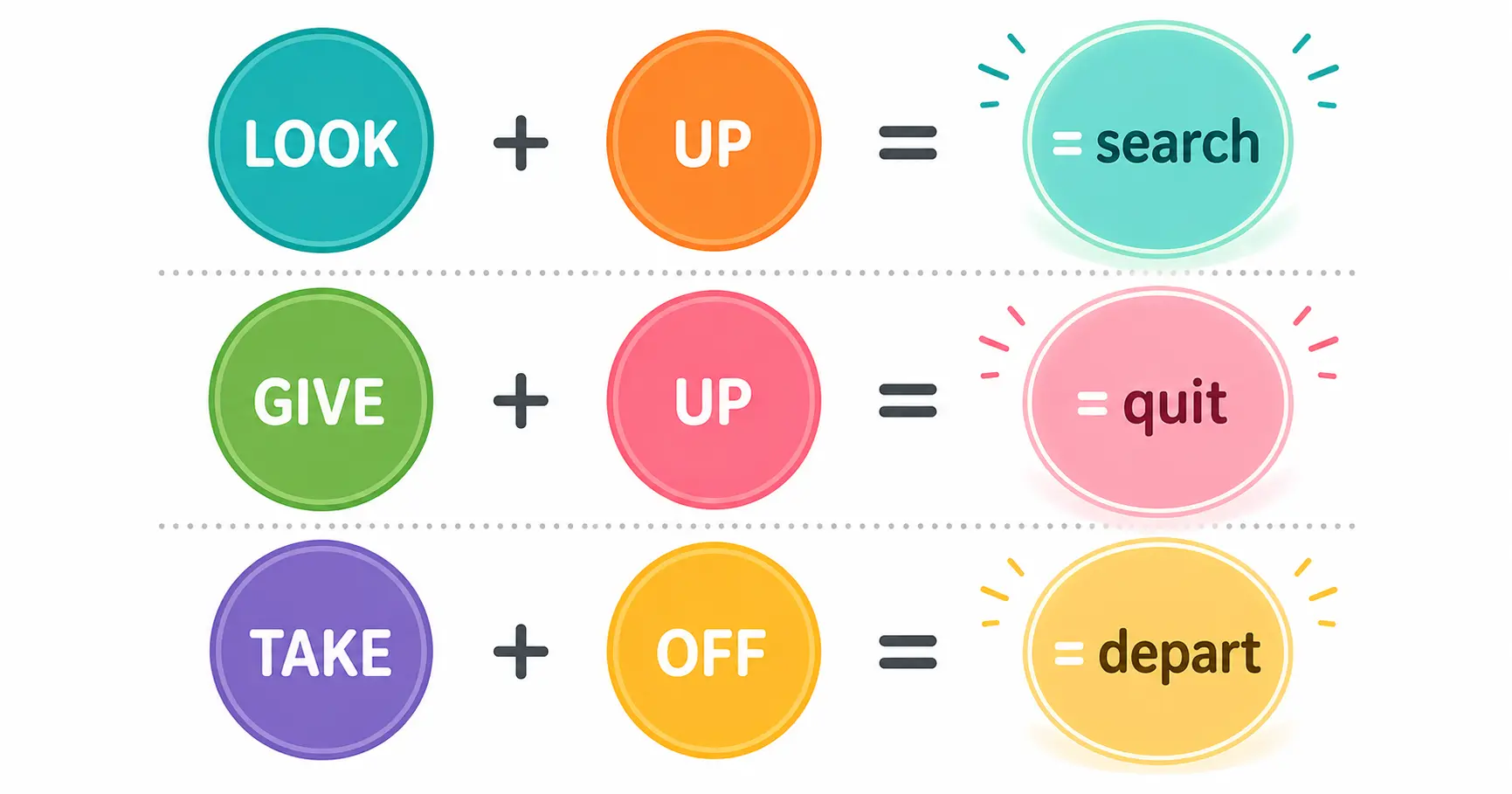
Verb alone: look = to use your eyes Phrasal verb: look up = to search for information Phrasal verb: look after = to take care of Phrasal verb: look forward to = to anticipate with pleasure
The critical point: you cannot guess the meaning of a phrasal verb from its parts. “Look” + “up” does not logically equal “search for information.” This is what makes phrasal verbs hard — and why you need to learn them as complete units, not try to decode them word by word.
Phrasal Verbs vs. Prepositional Verbs
Not every verb + preposition combination is a phrasal verb. Compare:
| Type | Example | Test |
|---|---|---|
| Phrasal verb | She looked up the word. | Meaning changes if you remove the particle. “She looked the word” makes no sense. |
| Prepositional verb | She looked at the painting. | “Look” retains its core meaning; “at” just shows direction. |
The practical difference: phrasal verbs have idiomatic meanings you must memorize. Prepositional verbs are predictable.
Why Phrasal Verbs Matter
| Context | Formal Alternative | Phrasal Verb |
|---|---|---|
| Everyday conversation | I need to discover the answer. | I need to find out the answer. |
| Could you investigate this issue? | Could you look into this issue? | |
| Meeting | Let us postpone the decision. | Let’s put off the decision. |
| News | The company terminated 200 employees. | The company laid off 200 employees. |
Native speakers default to phrasal verbs in most situations. The formal alternatives sound stiff in speech and unnecessarily complex in casual writing. If your English sounds “too formal” even though your grammar is correct, the likely cause is that you are avoiding phrasal verbs.
Types of Phrasal Verbs
Understanding phrasal verb types is not just grammar theory — it determines where you can place the object in a sentence, which directly affects whether your sentence is correct or incorrect.
Type 1: Separable Transitive
The object can go between the verb and the particle, or after the particle. If the object is a pronoun (it, them, her), it must go in the middle.
| Phrasal Verb | Correct | Correct | Incorrect |
|---|---|---|---|
| turn off | Turn off the TV. | Turn the TV off. |
|
| pick up | Pick up your bag. | Pick your bag up. |
|
| figure out | Figure out the answer. | Figure the answer out. |
|
Pronoun rule: Always split.
- Turn it off. ✓
-
Turn off it.✗
Type 2: Inseparable Transitive
The verb and particle must stay together. The object always comes after.
| Phrasal Verb | Correct | Incorrect |
|---|---|---|
| look after | Look after the children. |
|
| run into | I ran into an old friend. |
|
| get over | She got over the flu. |
|
Type 3: Intransitive (No Object)
These phrasal verbs do not take an object at all.
| Phrasal Verb | Example |
|---|---|
| break down | My car broke down on the highway. |
| show up | He showed up late to the meeting. |
| pass out | She passed out from the heat. |
| grow up | I grew up in a small town. |
Type 4: Three-Word Phrasal Verbs
These combine a verb + adverb + preposition. They are always inseparable.
| Phrasal Verb | Meaning | Example |
|---|---|---|
| look forward to | to anticipate with pleasure | I look forward to hearing from you. |
| put up with | to tolerate | I can’t put up with this noise anymore. |
| come up with | to think of (an idea) | She came up with a brilliant solution. |
| get along with | to have a good relationship | Do you get along with your colleagues? |
| look down on | to consider inferior | He looks down on people who didn’t go to university. |
| run out of | to have no more of | We’ve run out of milk. |
| keep up with | to maintain the same speed/level | I can’t keep up with all the new updates. |
| look up to | to admire and respect | I’ve always looked up to my grandmother. |
For a detailed guide with practice exercises on separable vs. inseparable rules, see Separable vs Inseparable Phrasal Verbs: Rules and Practice.
200+ Essential Phrasal Verbs by Base Verb
The most effective way to learn phrasal verbs is by base verb — because your brain already has a “file” for GET, TAKE, LOOK, etc. Adding phrasal verbs to existing files is faster than learning random combinations.
GET
GET produces more phrasal verbs than any other English verb. It is the first verb family you should master.
| Phrasal Verb | Meaning | Example |
|---|---|---|
| get up | to rise from bed; to stand | I get up at 6:30 every morning. |
| get along (with) | to have a good relationship | My sister and I get along really well now that we are adults. |
| get over | to recover from | It took me weeks to get over that cold. |
| get through | to finish; to survive a difficult time | I don’t know how she got through that exam — it was brutal. |
| get away | to escape; to leave | The thief got away before the police arrived. |
| get away with | to avoid punishment for | He cheated on the test and got away with it. |
| get by | to manage with limited resources | She gets by on a very modest salary. |
| get on | to board (a vehicle); to progress | Get on the bus at the third stop. |
| get off | to leave (a vehicle); to finish work | What time do you get off work? |
| get back | to return | I’ll get back to you tomorrow with an answer. |
| get into | to become involved in; to enter | She got into photography during the lockdown. |
| get out of | to avoid doing something | He always tries to get out of washing the dishes. |
| get rid of | to remove or dispose of | I need to get rid of these old magazines. |
| get across | to communicate an idea clearly | The teacher struggled to get the concept across to the students. |
| get around | to travel; to find a way to avoid a rule | News gets around fast in a small town. |
For the complete GET reference with all meanings and example sentences, see Phrasal Verbs with GET.
TAKE
| Phrasal Verb | Meaning | Example |
|---|---|---|
| take off | to remove (clothes); for a plane to leave the ground; to become successful | The plane took off 20 minutes late. / Her career really took off after the promotion. |
| take on | to accept (work, responsibility); to hire | The company is taking on new staff this quarter. |
| take up | to start (a hobby or activity); to occupy (time/space) | I took up running during the pandemic. |
| take over | to gain control of | A larger company took over the startup last year. |
| take after | to resemble (a family member) | She takes after her mother — they have the same eyes. |
| take back | to return something; to retract a statement | I take back what I said — you were right. |
| take down | to remove; to write/record | Can you take down the decorations? / Take down this number. |
| take in | to absorb (information); to deceive | There was so much to take in on the first day of training. |
| take apart | to disassemble | He took the engine apart to find the problem. |
| take out | to remove; to buy food to eat elsewhere | Let’s take out the trash. / Do you want to eat in or take out? |
For the full TAKE list, see Phrasal Verbs with TAKE.
MAKE
| Phrasal Verb | Meaning | Example |
|---|---|---|
| make up | to invent (a story); to apply cosmetics; to reconcile | She made up an excuse for being late. / They argued but made up the next day. |
| make out | to understand with difficulty; to manage | I can’t make out what this handwriting says. |
| make up for | to compensate | I’ll make up for the lost time by working late. |
| make for | to move toward; to contribute to | Good communication makes for a healthy relationship. |
| make do (with) | to manage with what is available | We don’t have butter, so we’ll have to make do with margarine. |
| make off (with) | to escape, usually with something stolen | The burglar made off with all the jewelry. |
For a detailed guide with exercises, see Phrasal Verbs with MAKE.
PUT
| Phrasal Verb | Meaning | Example |
|---|---|---|
| put off | to postpone; to discourage | Don’t put off your homework until tomorrow. / The bad reviews put me off going. |
| put on | to dress; to gain (weight); to stage (an event) | Put on your coat — it’s cold outside. |
| put up with | to tolerate | I can’t put up with his constant complaints. |
| put away | to store; to save (money) | Put the groceries away, please. |
| put out | to extinguish (a fire); to produce | The firefighters put out the blaze in under an hour. |
| put forward | to suggest (an idea or plan) | She put forward a proposal to reduce costs. |
| put down | to write; to criticize; to euthanize (an animal) | He’s always putting people down with sarcastic comments. |
| put together | to assemble | It took three hours to put the furniture together. |
TURN
| Phrasal Verb | Meaning | Example |
|---|---|---|
| turn on/off | to start/stop a device | Turn off the lights when you leave. |
| turn up | to arrive; to increase (volume) | She turned up an hour late. / Turn up the music. |
| turn down | to reject; to reduce (volume) | He turned down the job offer. |
| turn out | to result; to attend | The party turned out to be amazing. / Thousands turned out for the concert. |
| turn into | to transform; to become | The caterpillar turns into a butterfly. |
| turn around | to reverse direction; to improve | The new CEO turned the company around in two years. |
| turn over | to flip; to give control | Turn the page over. / He turned the business over to his daughter. |
LOOK
| Phrasal Verb | Meaning | Example |
|---|---|---|
| look up | to search for information | Look up the word in a dictionary. |
| look after | to take care of | Who looks after your children when you work? |
| look into | to investigate | The police are looking into the incident. |
| look forward to | to anticipate with pleasure | I look forward to meeting you. |
| look out (for) | to be careful; to watch for | Look out — there’s a car coming! |
| look down on | to feel superior to | She looks down on people who shop at discount stores. |
| look up to | to admire | Many young athletes look up to professional players. |
| look over | to review or examine | Could you look over my essay before I submit it? |
| look through | to examine; to browse | I looked through all the applications yesterday. |
COME
| Phrasal Verb | Meaning | Example |
|---|---|---|
| come up | to arise; to be mentioned | Something has come up — I can’t make it tonight. |
| come up with | to think of; to produce | We need to come up with a new marketing strategy. |
| come across | to find by chance; to give an impression | I came across an interesting article yesterday. / He comes across as very confident. |
| come back | to return | When are you coming back from your trip? |
| come down with | to become ill with | I think I’m coming down with a cold. |
| come around | to change your mind; to visit | She was skeptical at first but eventually came around. |
| come out | to be released; to become known | The new iPhone comes out next month. |
GO
| Phrasal Verb | Meaning | Example |
|---|---|---|
| go on | to continue; to happen | Go on — tell me what happened. / What’s going on? |
| go through | to experience; to examine carefully | She went through a difficult divorce last year. |
| go over | to review | Let me go over the main points one more time. |
| go off | to explode; to ring (an alarm); to spoil (food) | The fire alarm went off at 3 AM. |
| go ahead | to proceed | Go ahead and start without me. |
| go out | to leave the house; to stop burning | We go out for dinner every Friday. |
| go along with | to agree with; to accompany | I’ll go along with whatever the team decides. |
| go back | to return | I don’t want to go back to my old job. |
BREAK
| Phrasal Verb | Meaning | Example |
|---|---|---|
| break down | to stop working (machine); to become emotional; to analyze | The car broke down on the highway. / She broke down in tears. |
| break up | to end a relationship; to disperse | They broke up after five years together. |
| break out | to start suddenly (war, fire, disease); to escape | A fire broke out on the third floor. |
| break into | to enter by force; to begin a new career | Someone broke into my apartment. / She broke into journalism after studying law. |
| break through | to overcome a barrier | Scientists broke through with a new treatment for the disease. |
SET
| Phrasal Verb | Meaning | Example |
|---|---|---|
| set up | to establish; to arrange | She set up her own company at 25. |
| set off | to begin a journey; to trigger | We set off early to avoid traffic. / The alarm was set off by a bird. |
| set out | to start with an intention; to display | He set out to prove everyone wrong. |
| set back | to delay progress | The supply chain issues set the project back by three months. |
| set apart | to make different or special | Her attention to detail sets her apart from other candidates. |
GIVE
| Phrasal Verb | Meaning | Example |
|---|---|---|
| give up | to stop trying; to quit a habit | Never give up on your dreams. / He gave up smoking last year. |
| give in | to surrender; to yield | After hours of negotiation, the company gave in to the workers’ demands. |
| give away | to donate; to reveal a secret | She gave away all her old clothes. / Don’t give away the ending! |
| give off | to emit (smell, heat, light) | The factory gives off a terrible smell. |
| give back | to return | Can you give back the book I lent you? |
| give out | to distribute; to stop working | They gave out free samples at the supermarket. / My legs gave out after the marathon. |
BRING
| Phrasal Verb | Meaning | Example |
|---|---|---|
| bring up | to raise (a child); to mention (a topic) | She brought up three children on her own. / Don’t bring up politics at dinner. |
| bring about | to cause | Technology has brought about major changes in education. |
| bring back | to return; to restore | This song brings back memories of my childhood. |
| bring down | to cause to fall or fail | The scandal brought down the government. |
| bring out | to release (a product); to highlight | They brought out a new model last month. |
CARRY
| Phrasal Verb | Meaning | Example |
|---|---|---|
| carry on | to continue | Carry on with your work — I’ll wait. |
| carry out | to perform; to execute | The team carried out the experiment successfully. |
| carry over | to transfer to the next period | Unused vacation days carry over to the next year. |
WORK
| Phrasal Verb | Meaning | Example |
|---|---|---|
| work out | to exercise; to solve; to succeed | I work out three times a week. / Don’t worry — it will all work out. |
| work on | to spend time improving | I’m working on my pronunciation. |
| work through | to deal with gradually | She’s working through some personal issues. |
HOLD
| Phrasal Verb | Meaning | Example |
|---|---|---|
| hold on | to wait; to grip tightly | Hold on — I’ll check for you. |
| hold up | to delay; to rob | Sorry I’m late — I was held up in traffic. |
| hold back | to restrain; to not share | She held back tears during the speech. |
RUN
| Phrasal Verb | Meaning | Example |
|---|---|---|
| run into | to meet by chance; to encounter (a problem) | I ran into my old teacher at the supermarket. |
| run out (of) | to exhaust a supply | We’ve run out of paper for the printer. |
| run over | to exceed (time); to hit with a vehicle | The meeting ran over by 30 minutes. |
PICK
| Phrasal Verb | Meaning | Example |
|---|---|---|
| pick up | to lift; to collect; to learn informally | Pick up your clothes from the floor. / I picked up some Spanish during my trip. |
| pick out | to choose; to identify | Can you pick out a tie for my interview? |
| pick on | to bully or single out unfairly | The bigger kids used to pick on him at school. |
CUT
| Phrasal Verb | Meaning | Example |
|---|---|---|
| cut off | to disconnect; to interrupt | The phone call was cut off. |
| cut down (on) | to reduce | I’m trying to cut down on sugar. |
| cut out | to stop doing; to remove | Cut out the junk food if you want to lose weight. |
FALL
| Phrasal Verb | Meaning | Example |
|---|---|---|
| fall behind | to fail to keep up | If you miss classes, you’ll fall behind quickly. |
| fall apart | to break into pieces; to collapse emotionally | The old house is falling apart. |
| fall for | to fall in love with; to be deceived by | She fell for the scam and lost her savings. |
| fall through | to fail to happen | Our plans for the trip fell through when the flights were cancelled. |
KEEP
| Phrasal Verb | Meaning | Example |
|---|---|---|
| keep up (with) | to maintain the same pace | It’s hard to keep up with all the new slang. |
| keep on | to continue doing something | She kept on talking even after the bell rang. |
| keep away (from) | to stay at a distance | Keep away from the edge of the cliff. |
DO
| Phrasal Verb | Meaning | Example |
|---|---|---|
| do away with | to abolish or get rid of | The company did away with the dress code. |
| do up | to fasten; to renovate | Do up your seatbelt. / They did up the old cottage beautifully. |
| do without | to manage without | I can’t do without my morning coffee. |
| do over | to redo | The report was full of errors, so I had to do it over. |
For a complete DO reference, see Phrasal Verbs with DO.
Phrasal Verbs by Topic
If you are preparing for a specific context (IELTS, work, travel), these topic groupings help you prioritize what to learn.
For Work and Business
| Phrasal Verb | Meaning | Example |
|---|---|---|
| carry out | to perform a task | We carried out a thorough risk assessment. |
| set up | to establish | She set up a meeting for Friday afternoon. |
| take on | to accept responsibility | He took on the project manager role. |
| draw up | to prepare a document | The lawyers drew up a new contract. |
| lay off | to dismiss from employment | The factory laid off 300 workers. |
| follow up (on) | to check progress | I’ll follow up on your application next week. |
| step down | to resign from a position | The CEO stepped down after the scandal. |
| bring in | to introduce; to earn | The new policy brought in more revenue. |
For a deeper dive, see Business Phrasal Verbs.
For Travel
| Phrasal Verb | Meaning | Example |
|---|---|---|
| check in / check out | to register at/leave a hotel or airport | We checked in at the hotel around 3 PM. |
| set off | to begin a journey | We set off at dawn to reach the summit by noon. |
| get around | to travel within an area | The easiest way to get around Bangkok is by BTS train. |
| pick up | to collect someone by vehicle | I’ll pick you up at the airport. |
| drop off | to deliver someone to a location | The taxi dropped us off at the wrong hotel. |
| stop over | to stay briefly during a journey | We stopped over in Dubai on the way to Bali. |
For Exams (IELTS, TOEFL)
| Phrasal Verb | Meaning | Exam Use |
|---|---|---|
| point out | to draw attention to | The graph points out a clear trend in urban migration. |
| account for | to explain; to represent | Rising temperatures account for the decline in glacial mass. |
| bring about | to cause | Industrialization brought about major social changes. |
| break down | to divide into parts | The data can be broken down into three categories. |
| make up | to constitute | Women make up 52% of the total workforce. |
| stand for | to represent | GDP stands for Gross Domestic Product. |
For idioms that complement these phrasal verbs in IELTS Speaking, see Idioms for IELTS Speaking: 50 Natural Expressions.
Vocabulary to Practice
These 25 phrasal verb base words and related vocabulary are among the most useful to add to your active vocabulary. Save them to your Linglify dictionary for spaced repetition.
affordable
adjective
Able to be bought or reached at a reasonable price.
Examples
- The government is working to provide affordable housing for low-income families.
- This restaurant offers delicious and affordable meals for college students.
commute
verb
To travel regularly between two places, especially to work.
Examples
- Public transportation helps people commute efficiently reducing traffic congestion.
- Workers commute daily between suburban homes and downtown offices.
demanding
adjective
Requiring a lot of effort, patience, or skill; often demanding more than expected.
Examples
- Medical school is very demanding and requires years of intensive study.
- She has a demanding boss who expects perfection in all tasks.
DJ
noun
A person who plays and mixes recorded music, A person who plays music or mixes sounds on a radio or at events.
Examples
- The DJ played my favorite song.
- The DJ took song requests all night.
heritage
noun
The traditions, achievements, and qualities of a particular group or nation.
Examples
- She inherited a rich heritage of family traditions from her grandparents.
- The ancient castle is an important part of our cultural heritage.
leisure
noun
Free time when someone can relax or do leisure activities.
Examples
- People enjoy various leisure activities during weekends and holidays.
- Reading books is popular leisure pursuit for many educated people.
luxurious
adjective
Extremely comfortable, elegant, or opulent; very fancy.
Examples
- She dreams of owning luxurious car with leather seats and sunroof.
- The luxurious hotel suite includes marble bathroom and ocean view.
memorable
adjective
Causing a strong impression or worth remembering.
Examples
- Graduation day was memorable occasion for entire family.
- The memorable speech inspired students to pursue their dreams.
nutritious
adjective
Providing good health benefits and nutrition.
Examples
- Fresh vegetables are nutritious and support overall health.
- Nutritious breakfast provides energy for productive school day.
passionate
adjective
Having or showing strong feelings or enthusiasm.
Examples
- Passionate speech moves audience to take action.
- Passionate teacher inspires students to learn more.
pollution
noun
The introduction of harmful substances into the environment.
Examples
- Air pollution affects public health in cities.
- Ocean pollution threatens marine life worldwide.
privacy
noun
The right or ability to keep personal matters or information secret.
Examples
- Hotel guests expect privacy during their stay.
- Internet privacy becomes increasingly important issue nowadays.
scenic
adjective
Related to beautiful natural views or landscapes.
Examples
- Scenic overlook provides perfect spot for photographs.
- Scenic route takes longer but offers beautiful.
traditional
adjective
Following the customs or ways of the past; not new or different.
Examples
- Traditional cooking methods preserve authentic flavors perfectly.
- Traditional music reflects cultural history and values.
uneven
adjective
Not level or smooth; uneven.
Examples
- Uneven ground makes walking difficult and dangerous.
- Uneven performance shows inconsistent skill level development.
volunteer
verb
To offer to do a service or task willingly, often without being asked.
Examples
- Citizens volunteer time for community improvement projects.
- Students volunteer at local charity organizations regularly.
substantially
adverb
To a large extent or degree; significantly.
Examples
- Her performance substantially improved after additional training and practice.
- Prices have increased substantially over the past few months.
liaison
noun
A close working relationship or communication link between people or organizations.
Examples
- Military liaison officers coordinate operations between allied forces.
- She serves as liaison between different departments.
sustainable
adjective
This adjective describes something that can be maintained or continued without depleting resources.
Examples
- Company implements sustainable business model for long-term success.
- Sustainable farming practices protect soil and water resources.
acclaimed
adjective
Describing someone or something that has been publicly praised or recognized.
Examples
- His performance was acclaimed by critics.
- The acclaimed author received many awards for her novel.
cancellation
noun
The act of stopping or calling off an event, activity, or arrangement.
Examples
- Due to weather, the flight cancellation was inevitable.
- The concert's cancellation disappointed many fans.
colour
noun
The way something appears to the eye, often related to hue or shade.
Examples
- She chose a bright colour for her dress.
- The colour of the sky was a deep blue.
discretion
noun
The ability to judge what is appropriate or prudent in a particular situation.
Examples
- He exercised discretion in his decisions.
- Use your discretion when sharing information.
indication
noun
A sign or signal that points to or suggests something.
Examples
- The indication of his illness was clear after the tests.
- There was no indication that she was unhappy.
serenity
noun
A state of calm, peacefulness, and mental clarity.
Examples
- She maintained her serenity despite the chaos.
- The serenity of the lake was calming.
How to Learn Phrasal Verbs (That Actually Stick)
Most learners try to memorize phrasal verbs from lists — and forget them within a week. Here is what works instead.
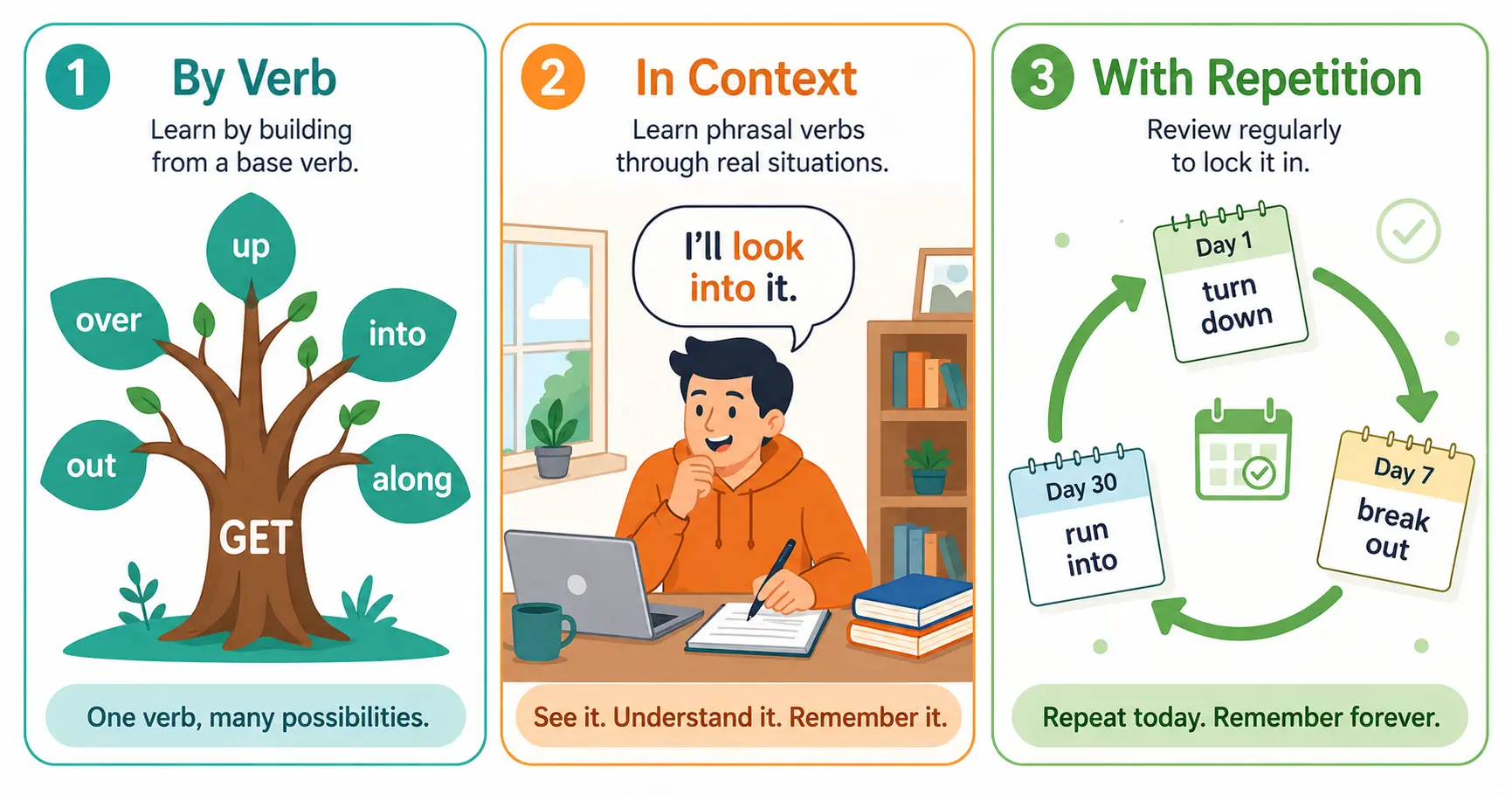
1. Learn by Base Verb, Not Alphabetically
Your brain already has a mental file for GET, TAKE, MAKE, etc. Adding new phrasal verbs to an existing verb file is far easier than memorizing unrelated combinations. Start with GET (the most common), then TAKE, then LOOK.
2. Learn in Context, Not in Isolation
“Put off = postpone” is hard to remember. “I keep putting off my dentist appointment” is a real situation you can visualize. For every phrasal verb, write a sentence about your own life.
3. Focus on the 50 Most Common First
You do not need 200 phrasal verbs. The 50 most common phrasal verbs cover the vast majority of daily conversation. Master those before moving to less common ones.
4. Notice Phrasal Verbs in the Wild
When watching a TV show, reading a news article, or listening to a podcast, note every phrasal verb you hear. Write it down with the sentence it appeared in. Real-context exposure is the most powerful learning tool.
5. Use Spaced Repetition
Add phrasal verbs to a spaced repetition system like Linglify. Research shows that you need 8–12 encounters with a word before it becomes automatic. Spaced repetition ensures those encounters happen at the right intervals.
For science-backed memorization strategies, read How to Memorize Vocabulary.
6. Practice with Conversations, Not Exercises
Fill-in-the-blank exercises test recognition, not production. To actually use phrasal verbs, practice speaking: describe your day using only phrasal verbs, or retell a story replacing formal verbs with their phrasal verb equivalents.
Common Mistakes with Phrasal Verbs
Mistake 1: Splitting Inseparable Phrasal Verbs
Wrong: I ran my old friend into. Right: I ran into my old friend.
If the phrasal verb is inseparable, the object must come after the particle.
Mistake 2: Not Splitting with Pronouns
Wrong: Turn off it. Right: Turn it off.
With separable phrasal verbs, pronouns (it, them, her, him) must go between the verb and particle.
Mistake 3: Using the Wrong Particle
Wrong: She got over the bus. (= she climbed over the bus) Right: She got on the bus. (= she boarded the bus)
One wrong particle changes the meaning entirely. This is why you must learn phrasal verbs as complete units.
Mistake 4: Avoiding Phrasal Verbs Entirely
Some learners use only formal single-word verbs: investigate instead of look into, tolerate instead of put up with, postpone instead of put off. While these are grammatically correct, they sound unnatural in conversation and limit your score in exams like IELTS, where “natural, idiomatic language” is a scoring criterion.
Mistake 5: Using Too Many in Formal Writing
Phrasal verbs are essential in speech and informal writing, but in academic essays and formal reports, single-word verbs are often preferred. “The study investigated the effects” sounds better in a research paper than “The study looked into the effects.” Know when to use which.
Phrasal Verbs vs. Formal Alternatives: Quick Reference
Sometimes you need the formal version (academic writing), sometimes the phrasal verb (conversation). This table helps you choose.
| Formal Verb | Phrasal Verb | When to Use the Formal Version |
|---|---|---|
| postpone | put off | Academic writing, formal emails |
| investigate | look into | Research papers, official reports |
| tolerate | put up with | Formal complaints, legal contexts |
| eliminate | get rid of | Scientific writing, policy documents |
| discover | find out | Academic papers |
| continue | carry on / go on | Formal instructions, academic writing |
| resemble | take after | Formal descriptions |
| recover | get over | Medical reports |
| submit | hand in | Official guidelines |
| establish | set up | Business documents, legal texts |
| raise (children) | bring up | Formal biographies |
| reject | turn down | Official correspondence |
| succeed | work out | Academic contexts |
| examine | look over / go through | Professional auditing, legal review |
| encounter | run into / come across | Academic writing |
What to Read Next
This pillar guide gives you the complete framework for understanding phrasal verbs. Here are the deep-dive guides for specific areas:
By level:
- 50 Most Common Phrasal Verbs for Everyday English — start here if you are intermediate
- 100 Phrasal Verbs with Meanings and Sentences — the next step after the top 50
- Advanced Phrasal Verbs for C1–C2 English — for upper-intermediate and advanced learners
By base verb:
- Phrasal Verbs with MAKE — 20+ combinations with exercises
- Phrasal Verbs with GET — the most common base verb
- Phrasal Verbs with TAKE — essential for everyday English
By context:
- Business Phrasal Verbs — for professional English
- Idioms for IELTS Speaking — idioms that complement phrasal verbs in exams
Vocabulary learning:
- How to Learn English Vocabulary — a step-by-step system
- How to Improve Your Vocabulary — strategies for all levels
FAQ
How many phrasal verbs are there in English?
Estimates range from 5,000 to over 10,000 combinations. However, only about 200–300 are used frequently in everyday English. The 50 most common phrasal verbs account for the majority of what native speakers say in daily conversation. Focus on learning these 50 first, then expand to 100, then 200 — prioritizing frequency over completeness.
What is the difference between a phrasal verb and an idiom?
A phrasal verb is a verb + particle combination: “give up,” “look into,” “take off.” An idiom is any fixed expression with a non-literal meaning: “a piece of cake” (= something easy), “under the weather” (= feeling ill). There is overlap — some phrasal verbs are idiomatic (“come across” = to find by chance) — but idioms are broader and include noun phrases, adjective phrases, and whole sentences.
Do I need to know all phrasal verbs for IELTS?
No. For IELTS Band 7, you need to demonstrate “flexibility” in vocabulary, which includes some phrasal verbs used naturally. For Band 8–9, phrasal verbs should be part of your active vocabulary in Speaking. In Writing, use phrasal verbs selectively — they are appropriate in Task 2 informal examples but should be balanced with formal vocabulary. Knowing 50–80 phrasal verbs well is sufficient for any IELTS band.
Why are phrasal verbs so hard to learn?
Three reasons: (1) the meaning is unpredictable — you cannot guess that “look up” means “search for information” from the individual words; (2) one phrasal verb can have multiple meanings — “take off” means remove clothing, depart (planes), and become successful; (3) the grammar rules (separable vs. inseparable) have exceptions. The solution is learning them in context and through repeated exposure, not from grammar rules.
Are phrasal verbs informal?
Many phrasal verbs are informal or neutral (“hang out,” “give up,” “find out”), but some are used in academic and professional English (“carry out,” “set up,” “account for,” “point out”). The formality depends on the specific phrasal verb, not on phrasal verbs as a category. In general, use phrasal verbs freely in conversation and selectively in formal writing.
What is the best way to memorize phrasal verbs?
Study them by base verb (all GET phrasal verbs together, all TAKE together), learn them in context (with real sentences, not just definitions), and use spaced repetition to review them at increasing intervals. Avoid studying long alphabetical lists — research shows that organized, contextual learning is 3–4 times more effective than rote memorization.
Can I just use formal verbs instead of phrasal verbs?
Technically yes, but your English will sound stiff and unnatural. Compare: “I discovered the answer” vs. “I found out the answer.” The first sounds like a translated sentence; the second sounds like a native speaker. In conversation, avoiding phrasal verbs is the single biggest marker of non-native speech. The goal is to have both formal and phrasal options and to choose the right one for the context.