
English Synonyms and Antonyms: The Complete Guide with 1000+ Word Pairs
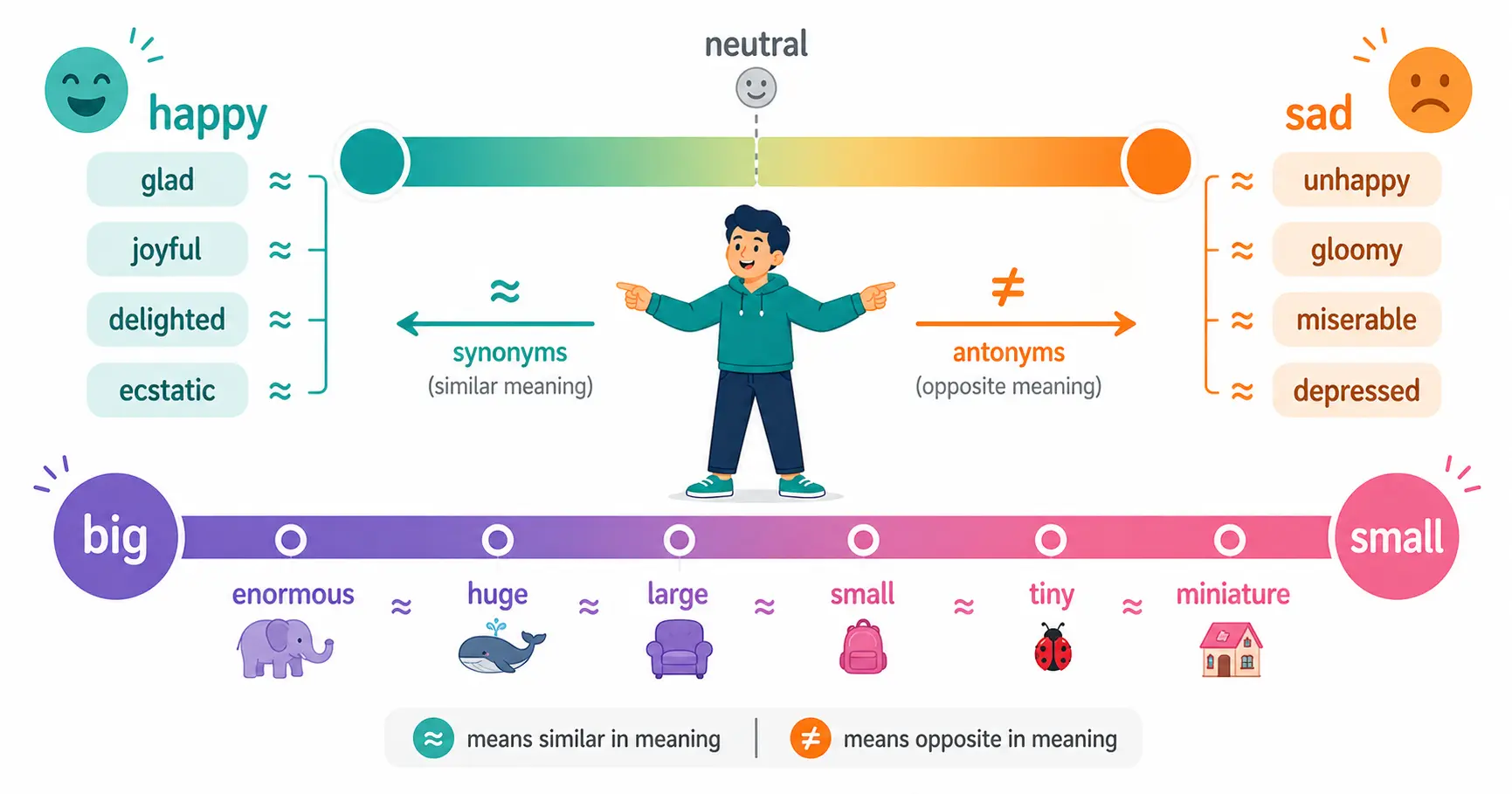
Every word in English exists in a web of relationships. “Happy” connects to “joyful,” “content,” “elated,” and “cheerful” — words that share its meaning. It also connects to “sad,” “miserable,” “unhappy,” and “gloomy” — words with the opposite meaning. The first group are synonyms. The second group are antonyms. Together, they form the foundation of vocabulary flexibility — the ability to say the same thing in different ways and to understand the full spectrum of meaning between two extremes.
This matters practically. In IELTS, the “Lexical Resource” criterion rewards you for using synonyms — not repeating the same word. In academic writing, paraphrasing with synonyms demonstrates intellectual maturity. In everyday conversation, knowing antonyms helps you express nuance: “I’m not happy” means something different from “I’m unhappy,” which is different from “I’m miserable.” The distance between these words is the distance between basic English and fluent English.
This guide covers:
- what synonyms and antonyms are (with clear definitions and examples),
- 1000+ synonym and antonym pairs organized by topic,
- the critical difference between exact synonyms and near synonyms,
- 100+ most common opposite word pairs,
- how to use synonyms without changing meaning,
- a study system for building synonym and antonym knowledge.
What Are Synonyms?
A synonym is a word that has the same or nearly the same meaning as another word. The word comes from Greek: syn- (together) + onoma (name) — “same name.”
| Word | Synonyms |
|---|---|
| big | large, huge, enormous, massive, vast |
| happy | glad, joyful, content, pleased, delighted |
| smart | intelligent, clever, bright, sharp, brilliant |
| fast | quick, rapid, swift, speedy |
| important | significant, crucial, vital, essential, key |
Do Synonyms Mean Exactly the Same Thing?
Almost never. Most synonyms are near synonyms — they share a core meaning but differ in formality, intensity, or context.
| Word | Synonym | Difference |
|---|---|---|
| big | enormous | “Enormous” is much stronger than “big” |
| ask | interrogate | “Interrogate” is formal/aggressive; “ask” is neutral |
| old | ancient | “Ancient” implies thousands of years; “old” is general |
| thin | slim | “Slim” is positive; “thin” can be neutral or negative |
| cheap | affordable | “Affordable” is positive; “cheap” can imply low quality |
This distinction is critical. Swapping synonyms without considering context is one of the biggest vocabulary mistakes learners make. “The teacher interrogated the students” means something very different from “The teacher asked the students.”
What Are Antonyms?
An antonym is a word that means the opposite of another word. The word comes from Greek: anti- (against) + onoma (name) — “opposite name.”
| Word | Antonym |
|---|---|
| hot | cold |
| big | small |
| happy | sad |
| fast | slow |
| buy | sell |
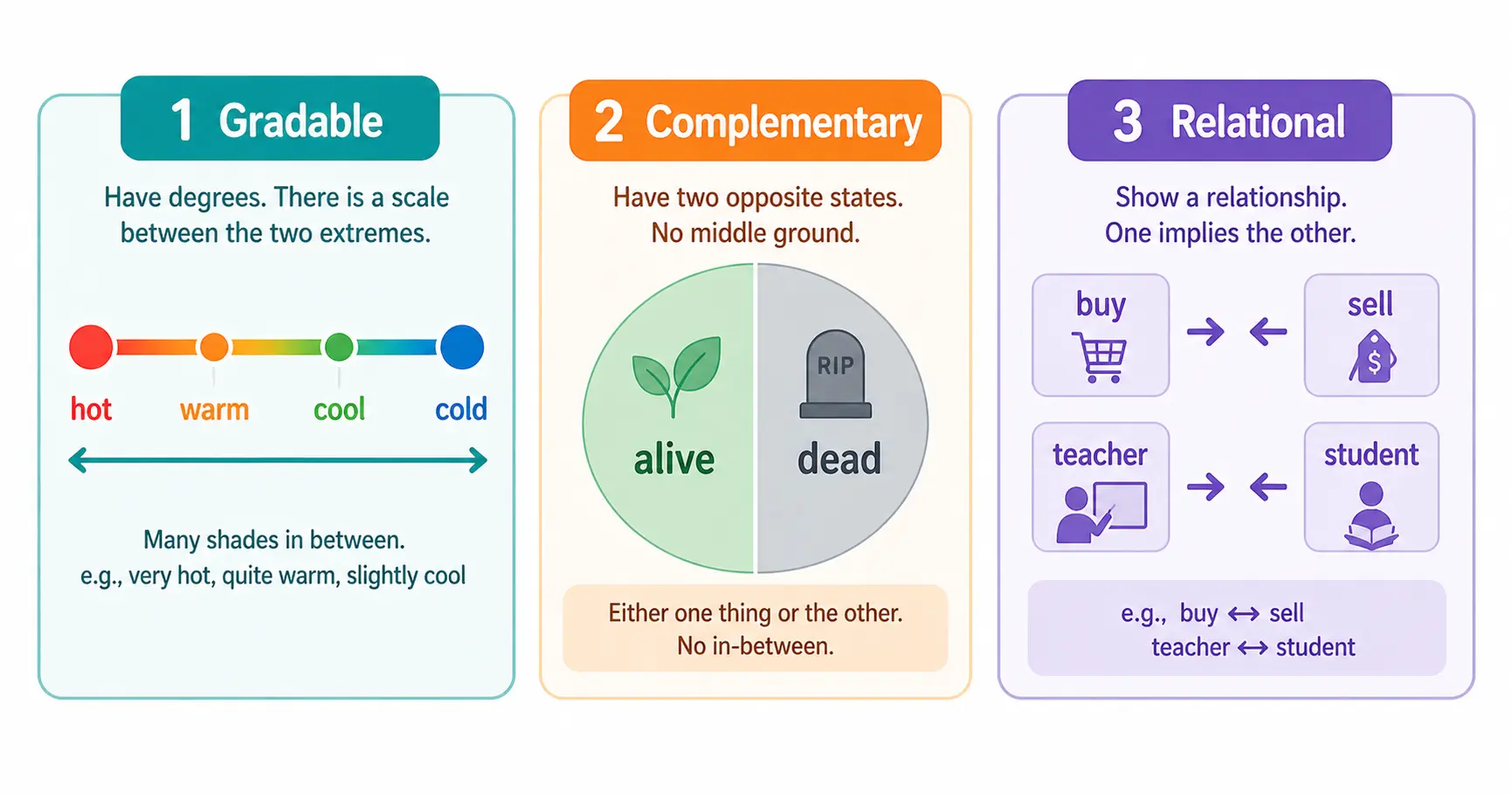
Three Types of Antonyms
1. Gradable antonyms — opposites on a scale, with degrees between them.
- hot ↔ cold (but also warm, cool, lukewarm)
- big ↔ small (but also large, medium, tiny)
- happy ↔ sad (but also content, neutral, unhappy)
2. Complementary antonyms — absolute opposites with no middle ground.
- alive ↔ dead
- true ↔ false
- on ↔ off
- male ↔ female
3. Relational antonyms — opposites that depend on each other; one cannot exist without the other.
- buy ↔ sell
- teacher ↔ student
- parent ↔ child
- give ↔ receive
- husband ↔ wife
Synonyms for the 50 Most Overused English Words
These are the words that every learner uses too often. Replacing them with synonyms is the fastest way to sound more fluent.
Adjectives
Good
| Synonym | Formality | Best Context | Example |
|---|---|---|---|
| excellent | neutral–formal | quality, performance | The service was excellent. |
| outstanding | formal | achievement, results | She received outstanding reviews. |
| remarkable | formal | impressive events | His recovery was remarkable. |
| superb | neutral | quality, experiences | The food was superb. |
| terrific | informal | enthusiasm | That’s a terrific idea! |
| wonderful | neutral | positive experiences | We had a wonderful time. |
| fine | neutral | acceptable quality | The weather looks fine today. |
| decent | neutral–informal | adequate quality | He makes a decent salary. |
| splendid | formal/literary | high quality | The view from the top was splendid. |
Bad
| Synonym | Formality | Best Context | Example |
|---|---|---|---|
| terrible | neutral | strong negative | The traffic was terrible. |
| awful | neutral–informal | strong negative | The movie was awful. |
| dreadful | formal | very bad situations | The conditions were dreadful. |
| poor | neutral | quality, performance | The essay received a poor grade. |
| unacceptable | formal | standards, behavior | This behavior is unacceptable. |
| inadequate | formal | insufficient quality | The funding was inadequate. |
| appalling | formal | shocking/bad | The hygiene standards were appalling. |
| mediocre | neutral | average-to-low | The restaurant was mediocre. |
Important
| Synonym | Formality | Best Context | Example |
|---|---|---|---|
| significant | formal | data, research | The results show a significant improvement. |
| crucial | neutral–formal | critical decisions | Time management is crucial for success. |
| vital | neutral–formal | essential things | Water is vital for survival. |
| essential | neutral | necessary things | Teamwork is essential in this job. |
| key | neutral | central factors | Education is a key factor in economic growth. |
| paramount | very formal | highest priority | Safety is paramount in this industry. |
| pivotal | formal | turning points | The election was a pivotal moment in history. |
| fundamental | formal | basic principles | Trust is fundamental to any relationship. |
Big
| Synonym | Formality | Best Context | Example |
|---|---|---|---|
| large | neutral | size, quantity | They live in a large house. |
| huge | neutral | very big | There was a huge crowd at the concert. |
| enormous | neutral | extremely big | The project requires an enormous budget. |
| massive | neutral–informal | very large | The company made a massive profit. |
| vast | formal | area, quantity | The Sahara is a vast desert. |
| substantial | formal | quantity, amount | There was a substantial increase in sales. |
| immense | formal | scale, emotion | She felt immense relief after the exam. |
| considerable | formal | significant amount | She has considerable experience in the field. |
Small
| Synonym | Formality | Best Context | Example |
|---|---|---|---|
| tiny | neutral | very small physical size | The apartment was tiny — only 20 square meters. |
| minor | neutral–formal | importance, severity | It was a minor issue that we fixed quickly. |
| slight | neutral–formal | small degree | There was a slight delay in the schedule. |
| negligible | formal | insignificant | The risk is negligible. |
| modest | neutral | not large, humble | They started with a modest investment. |
| minimal | formal | very small amount | The impact was minimal. |
| compact | neutral | small but efficient | The car has a compact design. |
Verbs
Think
| Synonym | Formality | Best Context | Example |
|---|---|---|---|
| believe | neutral | opinions | I believe education should be free. |
| consider | formal | careful thought | We should consider all the options. |
| assume | neutral | without proof | I assumed you knew about the meeting. |
| suppose | neutral | uncertain belief | I suppose you’re right. |
| reckon | informal (BrE) | casual opinion | I reckon it’ll rain tomorrow. |
| contemplate | formal | deep thought | She contemplated the offer for days. |
| reflect (on) | formal | looking back | He reflected on his years at the company. |
| maintain | formal | strong belief | She maintains that the decision was correct. |
| contend | very formal | arguing a position | Critics contend that the policy is flawed. |
Say
| Synonym | Formality | Best Context | Example |
|---|---|---|---|
| state | formal | official statements | The report states that crime has decreased. |
| claim | neutral–formal | assertions (possibly doubtful) | He claims he was at home all evening. |
| argue | neutral–formal | making a case | She argued that the policy was unfair. |
| mention | neutral | brief reference | He mentioned the project in passing. |
| point out | neutral | drawing attention | She pointed out several errors in the report. |
| declare | formal | official announcements | The government declared a state of emergency. |
| suggest | neutral | proposing ideas | I suggest we postpone the meeting. |
| assert | formal | strong claims | The CEO asserted that the company was profitable. |
| remark | neutral–formal | comments | He remarked on the quality of the presentation. |
Show
| Synonym | Formality | Best Context | Example |
|---|---|---|---|
| demonstrate | formal | proof, evidence | The study demonstrates a clear link between sleep and performance. |
| illustrate | formal | examples, visuals | The chart illustrates the trend over the last decade. |
| indicate | formal | data suggesting | The results indicate a possible solution. |
| reveal | neutral–formal | hidden information | The investigation revealed widespread fraud. |
| display | neutral | showing openly | The museum displays artifacts from ancient Egypt. |
| exhibit | formal | characteristics, quality | He exhibited remarkable patience during the crisis. |
| highlight | neutral | emphasis | The report highlights several key challenges. |
Make
| Synonym | Formality | Best Context | Example |
|---|---|---|---|
| create | neutral | producing something new | She created a beautiful sculpture. |
| produce | neutral–formal | manufacturing, results | The factory produces 10,000 units per day. |
| generate | formal | creating results, energy | The campaign generated significant interest. |
| construct | formal | building | They constructed a bridge in just six months. |
| develop | neutral–formal | creating over time | She developed a new training program. |
| establish | formal | founding, creating systems | He established the company in 2010. |
| manufacture | formal | industrial production | The phone is manufactured in South Korea. |
Get
| Synonym | Formality | Best Context | Example |
|---|---|---|---|
| obtain | formal | acquiring officially | She obtained a visa for Australia. |
| acquire | formal | gaining possession | He acquired the property in 2018. |
| receive | neutral–formal | being given | We received your application. |
| gain | neutral–formal | achieving | She gained valuable experience abroad. |
| earn | neutral | income, respect | He earns a good salary. |
| secure | formal | obtaining with effort | They secured funding for the project. |
Change
| Synonym | Formality | Best Context | Example |
|---|---|---|---|
| modify | formal | adjusting | We need to modify the design slightly. |
| alter | neutral–formal | making different | The dress was altered to fit perfectly. |
| transform | neutral–formal | major change | Technology has transformed the education sector. |
| adjust | neutral | small changes | Adjust the temperature to your preference. |
| revise | formal | updating, correcting | They revised the report after the review. |
| convert | neutral | changing form or use | They converted the warehouse into apartments. |
| reshape | formal | fundamentally changing | The pandemic reshaped how we work. |
Common Adjective Antonym Pairs
| Word | Antonym | Example (Word) | Example (Antonym) |
|---|---|---|---|
| hot | cold | It’s a hot summer day. | It’s a cold winter night. |
| happy | sad | She looked happy at the party. | He seemed sad after the news. |
| fast | slow | He’s a fast runner. | The traffic was painfully slow. |
| young | old | She’s too young to drive. | The building is very old. |
| rich | poor | They live in a rich neighborhood. | Many poor families need support. |
| easy | difficult | The first question was easy. | The final exam was very difficult. |
| early | late | She arrived early for the meeting. | He’s always late. |
| strong | weak | He has a strong grip. | The signal was too weak. |
| deep | shallow | The lake is very deep. | The river is shallow here. |
| wide | narrow | The road was wide enough for two lanes. | The alley was narrow and dark. |
| thick | thin | The walls are very thick. | The ice was dangerously thin. |
| heavy | light | The suitcase was too heavy. | The bag was surprisingly light. |
| loud | quiet | The music was too loud. | The library was quiet. |
| bright | dark | The room was bright and airy. | It was dark outside by 5 PM. |
| smooth | rough | The surface was smooth to the touch. | The road was rough and bumpy. |
| soft | hard | The pillow was wonderfully soft. | The mattress was too hard. |
| wet | dry | My shoes are still wet. | The climate here is hot and dry. |
| full | empty | The restaurant was full. | The parking lot was empty. |
| safe | dangerous | Is this neighborhood safe? | Driving in fog is dangerous. |
| clean | dirty | The kitchen was spotlessly clean. | His hands were dirty from gardening. |
| fresh | stale | The bread was fresh from the oven. | The crackers have gone stale. |
| sweet | bitter | The mango was perfectly sweet. | The coffee was too bitter. |
| simple | complex | The instructions were simple. | The issue is more complex than it seems. |
| modern | ancient | The building has a modern design. | We visited an ancient temple. |
| temporary | permanent | It’s a temporary solution. | They’re looking for a permanent home. |
Common Verb Antonym Pairs
| Word | Antonym | Example (Word) | Example (Antonym) |
|---|---|---|---|
| buy | sell | I bought a new laptop. | She sold her car last month. |
| start | finish | The concert starts at 8 PM. | We finished the project on time. |
| open | close | Open the window, please. | Close the door behind you. |
| arrive | leave | We arrived at 3 PM. | He left without saying goodbye. |
| win | lose | Our team won the match. | They lost the final game. |
| remember | forget | Do you remember her name? | I always forget my password. |
| accept | reject | She accepted the job offer. | The committee rejected the proposal. |
| allow | forbid | Pets are allowed in the park. | Photography is forbidden in the museum. |
| agree | disagree | I agree with your analysis. | We strongly disagree with that decision. |
| appear | disappear | A rainbow appeared after the storm. | The boat disappeared into the fog. |
| attack | defend | The army attacked at dawn. | They defended the city for months. |
| borrow | lend | Can I borrow your pen? | She lent me her umbrella. |
| create | destroy | She created a masterpiece. | The fire destroyed the building. |
| increase | decrease | Prices have increased this year. | The population has decreased slightly. |
| push | pull | Push the door to open it. | Pull the handle toward you. |
| raise | lower | They raised the minimum wage. | The company lowered its prices. |
| succeed | fail | She succeeded on her first attempt. | The experiment failed twice before working. |
| teach | learn | She teaches English at university. | I’m learning Japanese. |
Common Noun Antonym Pairs
| Word | Antonym |
|---|---|
| advantage | disadvantage |
| beginning | end |
| cause | effect |
| question | answer |
| success | failure |
| strength | weakness |
| problem | solution |
| majority | minority |
| supply | demand |
| wealth | poverty |
| knowledge | ignorance |
| victory | defeat |
| benefit | drawback |
| progress | decline |
| similarity | difference |
Synonyms and Antonyms by Topic
Emotions
| Positive | Synonyms | Negative (Antonym) | Synonyms |
|---|---|---|---|
| happy | glad, cheerful, joyful, delighted, content | sad | unhappy, sorrowful, gloomy, miserable, depressed |
| excited | thrilled, enthusiastic, eager, ecstatic | bored | uninterested, indifferent, apathetic, weary |
| calm | peaceful, serene, relaxed, tranquil | anxious | nervous, worried, tense, stressed, restless |
| confident | self-assured, certain, bold, poised | insecure | uncertain, doubtful, self-conscious, hesitant |
| proud | gratified, pleased, satisfied | ashamed | embarrassed, humiliated, mortified, guilty |
| grateful | thankful, appreciative, indebted | ungrateful | unappreciative, thankless |
| brave | courageous, fearless, bold, daring | afraid | scared, frightened, terrified, fearful, timid |
| hopeful | optimistic, positive, encouraged | hopeless | pessimistic, despairing, bleak |
Character and Personality
| Positive | Synonyms | Negative (Antonym) | Synonyms |
|---|---|---|---|
| kind | generous, compassionate, thoughtful, considerate | cruel | harsh, ruthless, heartless, merciless, brutal |
| honest | truthful, sincere, genuine, frank, candid | dishonest | deceitful, deceptive, untruthful, insincere |
| hardworking | diligent, industrious, dedicated, committed | lazy | idle, inactive, lethargic, sluggish, slothful |
| intelligent | smart, clever, bright, brilliant, sharp | foolish | stupid, ignorant, unwise, senseless, dim |
| polite | courteous, respectful, well-mannered, civil | rude | impolite, disrespectful, ill-mannered, coarse |
| patient | tolerant, calm, composed, understanding | impatient | restless, irritable, agitated, hasty |
| humble | modest, unassuming, down-to-earth | arrogant | proud, conceited, vain, haughty, pompous |
Academic and Professional
| Formal | Informal Synonym | Antonym | Antonym Synonyms |
|---|---|---|---|
| analyze | look at, examine | overlook | ignore, disregard |
| demonstrate | show, prove | conceal | hide, cover up |
| significant | important, notable | insignificant | trivial, minor, negligible |
| comprehensive | complete, thorough | incomplete | partial, limited, insufficient |
| beneficial | helpful, useful, positive | harmful | damaging, detrimental, destructive |
| permanent | lasting, enduring, fixed | temporary | short-term, brief, provisional |
| complex | complicated, intricate | simple | easy, straightforward, basic |
| abundant | plentiful, ample, copious | scarce | rare, limited, insufficient |
| accurate | correct, precise, exact | inaccurate | incorrect, imprecise, wrong |
| frequent | common, regular, repeated | rare | uncommon, infrequent, occasional |
Size and Quantity
| Word | Synonyms (Same Direction) | Antonym | Antonym Synonyms |
|---|---|---|---|
| big | large, huge, enormous, massive, vast, immense | small | tiny, little, minute, miniature, compact |
| long | extended, lengthy, prolonged | short | brief, concise, compact |
| tall | high, towering, lofty | short | low, small, squat |
| wide | broad, expansive, extensive | narrow | thin, slim, tight |
| thick | dense, heavy, bulky | thin | slim, fine, slender, lean |
| many | numerous, several, countless, abundant | few | scarce, limited, sparse, rare |
| much | a lot, plenty, considerable, substantial | little | barely, hardly, scarcely, minimal |
Speed and Movement
| Word | Synonyms | Antonym | Antonym Synonyms |
|---|---|---|---|
| fast | quick, rapid, swift, speedy, brisk | slow | sluggish, gradual, unhurried, leisurely |
| increase | rise, grow, expand, escalate, surge | decrease | decline, drop, fall, diminish, shrink |
| arrive | reach, come, appear, show up | depart | leave, go, exit, set off |
| advance | progress, proceed, move forward | retreat | withdraw, go back, recede |
| accelerate | speed up, hasten, quicken | decelerate | slow down, brake |
Synonyms for IELTS and Academic Writing
In IELTS, repeating the same word lowers your Lexical Resource score. These synonym groups cover the words candidates overuse most.
Words to Replace in IELTS Writing
| Overused Word | Better Synonyms for Band 7+ | Example |
|---|---|---|
| people | individuals, citizens, residents, the population, the public | Many individuals struggle to find affordable housing. |
| children | youngsters, minors, the younger generation, young people | The younger generation is more technologically literate. |
| problem | issue, concern, challenge, obstacle, dilemma, predicament | Air pollution is a growing concern in urban areas. |
| increase | rise, grow, escalate, surge, climb, expand | Housing prices have surged in the last decade. |
| decrease | decline, drop, fall, diminish, shrink, plummet | Newspaper readership has declined steadily since 2010. |
| important | significant, crucial, vital, essential, paramount | Education plays a crucial role in economic development. |
| good | beneficial, positive, advantageous, favorable | Regular exercise has beneficial effects on mental health. |
| bad | detrimental, harmful, adverse, negative, damaging | Pollution has detrimental effects on public health. |
| think | believe, argue, maintain, contend, assert | Many experts contend that renewable energy is the solution. |
| because | due to, owing to, as a result of, on account of, since | Attendance dropped due to the severe weather conditions. |
| very | highly, extremely, remarkably, considerably, significantly | The results were remarkably consistent across all groups. |
| many | numerous, a significant number of, a large proportion of | Numerous studies have confirmed these findings. |
For a complete IELTS synonym guide with 200+ paraphrasing words, see Synonyms for IELTS: 200+ Paraphrasing Words.
Prefix-Based Antonyms
Many English antonyms are formed by adding a prefix to the original word. Learning these prefix patterns lets you predict antonyms for hundreds of words.
un-
| Word | Antonym | Example |
|---|---|---|
| happy | unhappy | She seemed unhappy with the results. |
| usual | unusual | There was an unusual silence in the room. |
| fair | unfair | The decision was unfair to the younger students. |
| likely | unlikely | It’s unlikely to rain tomorrow. |
| comfortable | uncomfortable | The chair was uncomfortable. |
| certain | uncertain | The outcome remains uncertain. |
| aware | unaware | She was unaware of the problem. |
| expected | unexpected | The result was completely unexpected. |
| reliable | unreliable | The data source proved unreliable. |
| successful | unsuccessful | The first attempt was unsuccessful. |
in- / im- / il- / ir-
| Word | Antonym | Example |
|---|---|---|
| possible | impossible | Nothing is impossible with hard work. |
| polite | impolite | It’s impolite to interrupt someone. |
| patient | impatient | He became impatient waiting in line. |
| legal | illegal | Downloading pirated software is illegal. |
| literate | illiterate | Millions of adults remain illiterate worldwide. |
| regular | irregular | The schedule is irregular — it changes every week. |
| responsible | irresponsible | Leaving children alone is irresponsible. |
| complete | incomplete | The application was rejected because it was incomplete. |
| dependent | independent | She became financially independent at 22. |
| accurate | inaccurate | The report contained several inaccurate figures. |
dis-
| Word | Antonym | Example |
|---|---|---|
| agree | disagree | I disagree with that interpretation. |
| appear | disappear | The ship disappeared over the horizon. |
| honest | dishonest | It would be dishonest to hide the truth. |
| advantage | disadvantage | The main disadvantage is the high cost. |
| connect | disconnect | The phone was disconnected after non-payment. |
| approve | disapprove | Her parents disapproved of her career choice. |
| obey | disobey | The soldiers disobeyed the order. |
| like | dislike | I dislike crowded places. |
| respect | disrespect | Disrespecting your teachers is unacceptable. |
| satisfy | dissatisfy | Several customers were dissatisfied with the service. |
mis-
| Word | Antonym | Example |
|---|---|---|
| understand | misunderstand | I think you misunderstood the instructions. |
| lead | mislead | The advertisement misled consumers about the product. |
| behave | misbehave | The children misbehaved during the assembly. |
| inform | misinform | The public was misinformed about the risks. |
| judge | misjudge | I misjudged the distance and missed the goal. |
over- / under-
| Word | Antonym | Example (over-) | Example (under-) |
|---|---|---|---|
| estimate | overestimate / underestimate | They overestimated the costs. | Don’t underestimate the difficulty. |
| pay | overpay / underpay | He was overpaid for the work. | Workers are underpaid in many industries. |
| value | overvalue / undervalue | The stock was overvalued. | Her contribution was undervalued. |
| react | overreact | He overreacted to the news. | — |
| achieve | underachieve | — | The student underachieved despite high potential. |
Vocabulary to Practice
Add these 25 high-frequency words that appear in key synonym and antonym pairs to your Linglify dictionary for spaced repetition.
affordable
adjective
Able to be bought or reached at a reasonable price.
Examples
- The government is working to provide affordable housing for low-income families.
- This restaurant offers delicious and affordable meals for college students.
commute
verb
To travel regularly between two places, especially to work.
Examples
- Public transportation helps people commute efficiently reducing traffic congestion.
- Workers commute daily between suburban homes and downtown offices.
conservation
noun
The protection and preservation of natural resources or the environment.
Examples
- Water conservation becomes increasingly important during periods of severe drought.
- Wildlife conservation is essential for protecting endangered species from extinction.
demanding
adjective
Requiring a lot of effort, patience, or skill; often demanding more than expected.
Examples
- Medical school is very demanding and requires years of intensive study.
- She has a demanding boss who expects perfection in all tasks.
DJ
noun
A person who plays and mixes recorded music, A person who plays music or mixes sounds on a radio or at events.
Examples
- The DJ played my favorite song.
- The DJ took song requests all night.
heritage
noun
The traditions, achievements, and qualities of a particular group or nation.
Examples
- She inherited a rich heritage of family traditions from her grandparents.
- The ancient castle is an important part of our cultural heritage.
leisure
noun
Free time when someone can relax or do leisure activities.
Examples
- People enjoy various leisure activities during weekends and holidays.
- Reading books is popular leisure pursuit for many educated people.
luxurious
adjective
Extremely comfortable, elegant, or opulent; very fancy.
Examples
- She dreams of owning luxurious car with leather seats and sunroof.
- The luxurious hotel suite includes marble bathroom and ocean view.
memorable
adjective
Causing a strong impression or worth remembering.
Examples
- Graduation day was memorable occasion for entire family.
- The memorable speech inspired students to pursue their dreams.
nutritious
adjective
Providing good health benefits and nutrition.
Examples
- Fresh vegetables are nutritious and support overall health.
- Nutritious breakfast provides energy for productive school day.
passionate
adjective
Having or showing strong feelings or enthusiasm.
Examples
- Passionate speech moves audience to take action.
- Passionate teacher inspires students to learn more.
pollution
noun
The introduction of harmful substances into the environment.
Examples
- Air pollution affects public health in cities.
- Ocean pollution threatens marine life worldwide.
privacy
noun
The right or ability to keep personal matters or information secret.
Examples
- Hotel guests expect privacy during their stay.
- Internet privacy becomes increasingly important issue nowadays.
scenic
adjective
Related to beautiful natural views or landscapes.
Examples
- Scenic overlook provides perfect spot for photographs.
- Scenic route takes longer but offers beautiful.
traditional
adjective
Following the customs or ways of the past; not new or different.
Examples
- Traditional cooking methods preserve authentic flavors perfectly.
- Traditional music reflects cultural history and values.
uneven
adjective
Not level or smooth; uneven.
Examples
- Uneven ground makes walking difficult and dangerous.
- Uneven performance shows inconsistent skill level development.
volunteer
verb
To offer to do a service or task willingly, often without being asked.
Examples
- Citizens volunteer time for community improvement projects.
- Students volunteer at local charity organizations regularly.
substantially
adverb
To a large extent or degree; significantly.
Examples
- Her performance substantially improved after additional training and practice.
- Prices have increased substantially over the past few months.
liaison
noun
A close working relationship or communication link between people or organizations.
Examples
- Military liaison officers coordinate operations between allied forces.
- She serves as liaison between different departments.
sustainable
adjective
This adjective describes something that can be maintained or continued without depleting resources.
Examples
- Company implements sustainable business model for long-term success.
- Sustainable farming practices protect soil and water resources.
acclaimed
adjective
Describing someone or something that has been publicly praised or recognized.
Examples
- His performance was acclaimed by critics.
- The acclaimed author received many awards for her novel.
cancellation
noun
The act of stopping or calling off an event, activity, or arrangement.
Examples
- Due to weather, the flight cancellation was inevitable.
- The concert's cancellation disappointed many fans.
discretion
noun
The ability to judge what is appropriate or prudent in a particular situation.
Examples
- He exercised discretion in his decisions.
- Use your discretion when sharing information.
indication
noun
A sign or signal that points to or suggests something.
Examples
- The indication of his illness was clear after the tests.
- There was no indication that she was unhappy.
serenity
noun
A state of calm, peacefulness, and mental clarity.
Examples
- She maintained her serenity despite the chaos.
- The serenity of the lake was calming.
How to Learn Synonyms and Antonyms
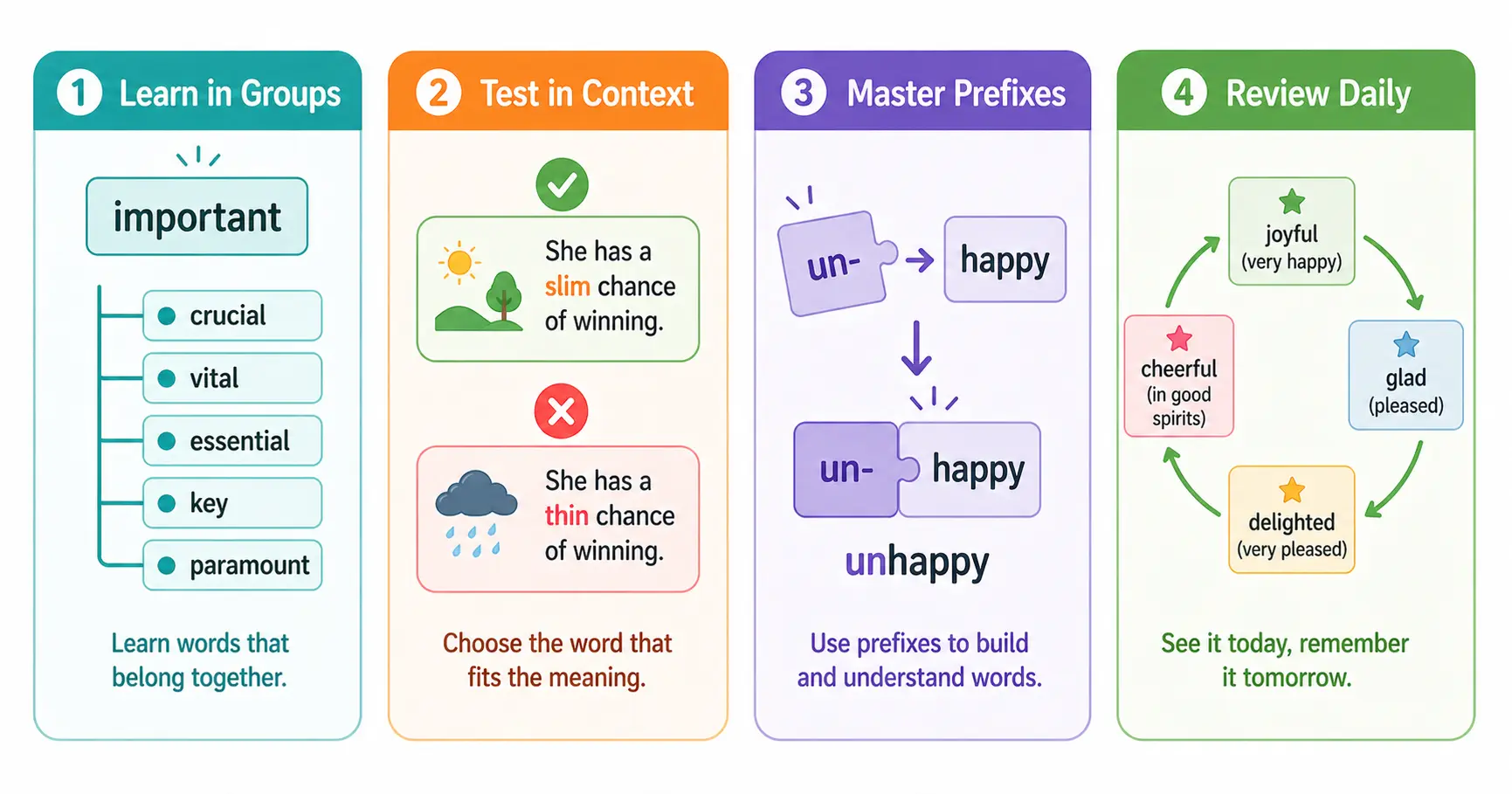
1. Learn in groups, not in pairs
Do not just learn “big = large.” Learn the full synonym group: big → large → huge → enormous → massive → vast → immense. Each word sits at a different point on the formality and intensity scale. Understanding the group gives you options; learning a single pair gives you nothing.
2. Always learn the context
“Slim” and “thin” are synonyms, but “slim chance” works while “thin chance” does not. “Strong tea” is correct, but “powerful tea” is wrong. Always learn a synonym with the sentence or collocation it appears in. For a deep dive into collocations, see English Collocations Guide.
3. Use the “swap test”
When you learn a new synonym, try swapping it into 3 different sentences where you would normally use the basic word. If it sounds wrong in any of them, note the restriction. “Vast” works for “a vast desert” but not “a vast cup of coffee.” This builds precision over time.
4. Study prefix patterns
Learning the un-, in-, dis-, mis-, over-, under- patterns gives you antonyms for hundreds of words at once. It is one of the highest-leverage vocabulary skills you can develop.
5. Use spaced repetition
Add synonym and antonym groups to Linglify or any spaced repetition system. Study them as groups (the full synonym set for “important”), not isolated pairs. For science-backed memorization strategies, see How to Memorize Vocabulary.
6. Read for synonyms
When reading articles from the Economist, BBC, or Guardian, notice how writers avoid repeating words. They use “increase” in one sentence and “rise” in the next, then “surge” in the third. This natural synonym rotation is exactly what IELTS examiners and academic readers expect.
What to Read Next
This pillar guide gives you the complete framework for synonyms and antonyms. Here are the deep-dive guides:
Synonym lists:
- Synonyms for Common English Words: 200+ Upgrades — replace “good,” “bad,” “interesting” and more
- Synonyms List: 300 Academic Synonyms for Essays — for university and exam writing
Antonym lists:
- 500+ Opposite Words in English: Antonyms List A–Z — the complete antonym reference
For exams:
- Synonyms for IELTS: 200+ Paraphrasing Words — exam-specific synonyms that boost your score
- IELTS Advanced Vocabulary: Words for Band 8–9 — precision vocabulary for top scores
Related vocabulary:
- English Collocations Guide — knowing which words go together
- English Idioms: 500+ Common Expressions — fixed expressions with figurative meanings
- Advanced English Words: 300+ C1–C2 Vocabulary — words that serve as powerful synonyms
- How to Improve Your Vocabulary — a complete vocabulary building strategy
FAQ
How many synonyms should I know for each word?
For everyday fluency, knowing 3–5 synonyms for the 100 most common adjectives, verbs, and nouns is sufficient. For IELTS Band 7+, you need at least 3 alternatives for every word you tend to repeat. For Band 8–9, you should have 5+ options with awareness of which one fits each context. Quality (knowing when to use each synonym) matters more than quantity (knowing 20 synonyms but not their differences).
Do synonyms have exactly the same meaning?
Almost never. Most English synonyms are “near synonyms” — they share a core meaning but differ in formality, intensity, connotation, or context. “Slim” and “skinny” both mean thin, but “slim” is positive and “skinny” can be negative. “Home” and “residence” both mean where you live, but “residence” is formal. Treating synonyms as interchangeable is one of the most common vocabulary mistakes.
What is the best way to learn antonyms?
Learn prefix patterns first (un-, dis-, in-/im-/il-/ir-, mis-, over-/under-). These six prefixes create antonyms for hundreds of English words. After mastering prefixes, learn complementary antonyms (alive/dead, true/false) and gradable antonyms (hot/cold, big/small). Finally, study relational antonyms (buy/sell, teach/learn).
Are synonyms important for IELTS?
Extremely. The IELTS Lexical Resource criterion specifically rewards synonym use and paraphrasing. Band 6 candidates “attempt to use less common vocabulary but with some inaccuracy.” Band 7 candidates show “flexibility and precision” by using synonyms naturally. Band 8–9 candidates use “a wide range of vocabulary” with “skilful” synonym choices. Not using synonyms virtually guarantees a low Lexical Resource score.
What is the difference between a synonym and a definition?
A synonym is another word with the same or similar meaning: “happy” → “glad.” A definition explains what a word means in a phrase: “happy” = “feeling pleasure or contentment.” In IELTS, using synonyms is paraphrasing; using definitions is explaining — both are useful, but examiners reward synonyms more because they demonstrate vocabulary range.
Can I use a thesaurus to find synonyms?
Yes, but with caution. A thesaurus gives you synonym options but does not tell you which one fits your specific context. Always check: (1) Is this synonym the right formality level? (2) Does it work in this collocation? (3) Does it carry the same connotation? For example, a thesaurus might suggest “interrogate” as a synonym for “ask,” but you would not say “I interrogated my friend about her weekend.” Use a learner’s dictionary alongside the thesaurus.
How are synonyms and antonyms tested in exams?
In IELTS Reading, you must recognize when a passage paraphrases information using synonyms — this is the core skill for True/False/Not Given and matching questions. In IELTS Writing, you must use synonyms to avoid repetition and demonstrate range. In TOEFL Reading, synonym questions are explicit: “The word X in paragraph 3 is closest in meaning to…” In vocabulary tests (Cambridge, Pearson), both synonyms and antonyms appear in multiple-choice format.


