
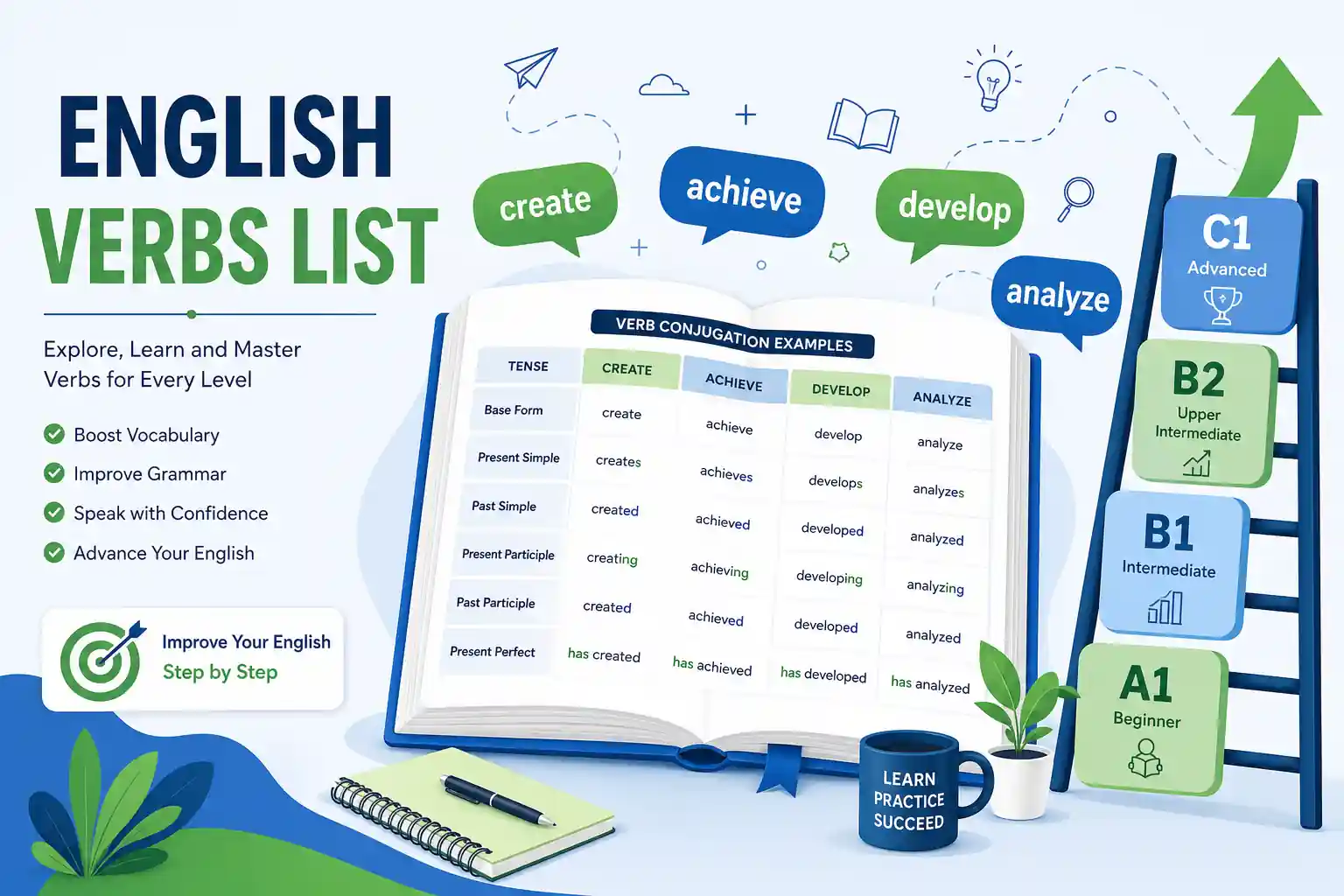
English Verbs List: 300 Most Important Verbs by Level
Verbs are the engine of every English sentence. Without a verb, nothing happens — no one does anything, becomes anything, or experiences anything. Nouns name the world; adjectives describe it; but verbs make it move.
English has approximately 25,000 verbs, but you do not need most of them. Research on spoken and written English shows that the 300 most frequent verbs cover roughly 90% of all verb usage in everyday communication. Master these 300, and you can express nearly anything you need to say.
This guide gives you those 300 verbs organized by CEFR level (A1–C1) and usage category. Each verb includes its meaning, an example sentence, and common patterns showing how native speakers actually use it. Use it as a study list, a reference, or a self-assessment tool to find gaps in your vocabulary.
- Total verbs: 300
- Organized by: CEFR level (A1–C1) and semantic category
- Format: Verb → Meaning → Pattern → Example
- Best for: vocabulary building, grammar reference, exam preparation
For irregular verb forms specifically (past tense and past participle), see Irregular Verbs List: 200 Verbs with Past Forms. For verbs that combine with prepositions, see English Phrasal Verbs: Complete Guide.
How English Verbs Work: Quick Overview
Before the list, here is what makes English verbs unique:
Verb Forms
Every English verb has 5 forms (regular verbs) or up to 5 irregular forms:
| Form | Regular (work) | Irregular (go) | Used For |
|---|---|---|---|
| Base | work | go | Present simple, infinitive |
| 3rd person -s | works | goes | He/she/it present |
| Past simple | worked | went | Past events |
| Past participle | worked | gone | Perfect tenses, passive |
| -ing form | working | going | Continuous tenses, gerunds |
Transitive vs. Intransitive
| Type | Definition | Example |
|---|---|---|
| Transitive | Needs an object | She wrote a letter. (wrote what?) |
| Intransitive | No object needed | He arrived late. (arrived what? — nothing) |
| Both | Used either way | She runs a company. (transitive) / She runs every morning. (intransitive) |
Verb Patterns
Knowing a verb’s meaning is not enough — you need to know what follows it:
| Pattern | Example |
|---|---|
| verb + infinitive (to + verb) | I want to learn English. |
| verb + -ing | I enjoy reading books. |
| verb + object | She made a decision. |
| verb + object + infinitive | He asked me to help. |
| verb + preposition | She depends on her family. |
The verb list below includes the most common pattern for each verb, so you know how to use it — not just what it means.
A1 Level: Essential Verbs (75 Verbs)
These verbs are the absolute foundation. Every English learner needs them from day one.
Being and Having
| # | Verb | Meaning | Pattern | Example |
|---|---|---|---|---|
| 1 | be | exist; equal | be + adjective/noun | She is happy. / He is a teacher. |
| 2 | have | possess; experience | have + noun | I have two children. / She had a great time. |
| 3 | do | perform an action | do + noun | He does his homework every evening. |
| 4 | become | change into | become + adjective/noun | She became a doctor. / It became clear. |
| 5 | seem | appear to be | seem + adjective/to + verb | He seems tired. / It seems to work. |
Movement
| # | Verb | Meaning | Pattern | Example |
|---|---|---|---|---|
| 6 | go | move to a place | go + to + place | I go to work at 8 AM. |
| 7 | come | move toward speaker | come + to/from | Come to my office after lunch. |
| 8 | get | obtain; arrive; become | get + noun/adj/to | I got a message. / She got angry. |
| 9 | run | move fast on foot | run + direction | He runs every morning in the park. |
| 10 | walk | move on foot | walk + to/along | We walked to the station in ten minutes. |
| 11 | move | change position/place | move + to/from | They moved to London last year. |
| 12 | leave | go away from | leave + place/time | She leaves the office at 6 PM. |
| 13 | arrive | reach a destination | arrive + at/in | We arrived at the airport two hours early. |
| 14 | return | come/go back | return + to | He returned to his hometown after 10 years. |
| 15 | follow | go after/behind | follow + noun | Follow this road until you reach the bridge. |
Communication
| # | Verb | Meaning | Pattern | Example |
|---|---|---|---|---|
| 16 | say | speak words | say + that/quote | She said she was busy. |
| 17 | tell | give information to someone | tell + person + that/to | Tell me what happened. |
| 18 | ask | request information/help | ask + person + question/to | He asked me to wait outside. |
| 19 | speak | use voice; know a language | speak + language/to person | She speaks three languages fluently. |
| 20 | talk | have a conversation | talk + to/about | We talked about the project for an hour. |
| 21 | call | phone; name | call + person/noun | I’ll call you tomorrow morning. |
| 22 | answer | respond | answer + noun/that | She didn’t answer my question. |
| 23 | write | put words on paper/screen | write + noun/to person | He wrote a long email to the team. |
| 24 | read | understand written words | read + noun | She reads the newspaper every morning. |
| 25 | listen | pay attention to sound | listen + to | Listen to this song — it’s beautiful. |
Actions and Work
| # | Verb | Meaning | Pattern | Example |
|---|---|---|---|---|
| 26 | make | create; cause | make + noun/adj | She made a cake for his birthday. |
| 27 | take | get; carry; require time | take + noun/time | Take your keys. / It takes 20 minutes. |
| 28 | give | hand to someone | give + person + thing | He gave her a beautiful gift. |
| 29 | put | place in a position | put + thing + place | Put the book on the table. |
| 30 | use | employ for a purpose | use + noun + to/for | I use this app to learn vocabulary. |
| 31 | work | do a job; function | work + at/for/as | She works for a tech company. |
| 32 | play | engage in a game/sport | play + sport/music | The children play in the park every afternoon. |
| 33 | help | assist someone | help + person + (to) verb | Can you help me carry these boxes? |
| 34 | try | attempt | try + to verb / -ing | I’m trying to learn 5 new words every day. |
| 35 | start | begin | start + -ing/to verb | She started learning English two years ago. |
| 36 | stop | cease | stop + -ing | Stop talking and listen. |
| 37 | open | make accessible | open + noun | He opened the door and invited us in. |
| 38 | close | shut | close + noun | Please close the window — it’s cold. |
| 39 | turn | rotate; change direction | turn + direction | Turn left at the traffic light. |
| 40 | pay | give money | pay + for/amount | She paid $50 for the ticket. |
Thinking and Feeling
| # | Verb | Meaning | Pattern | Example |
|---|---|---|---|---|
| 41 | think | use your mind; believe | think + about/that | I think this is a good idea. |
| 42 | know | have information/skill | know + that/how/noun | I know how to cook Italian food. |
| 43 | want | desire | want + to verb/noun | She wants to travel the world. |
| 44 | need | require | need + to verb/noun | You need to study more before the exam. |
| 45 | like | enjoy; find pleasant | like + -ing/noun | I like reading before bed. |
| 46 | love | feel strong affection | love + -ing/noun/person | She loves her job. |
| 47 | feel | experience emotion/sensation | feel + adjective | I feel tired after a long day. |
| 48 | believe | think something is true | believe + that/in | I believe this plan will work. |
| 49 | understand | comprehend meaning | understand + noun/that | I don’t understand this question. |
| 50 | remember | keep in memory | remember + -ing/to verb | I remember meeting her at the conference. |
| 51 | forget | fail to remember | forget + to verb/about | Don’t forget to lock the door. |
| 52 | hope | wish for something | hope + to verb/that | I hope to see you again soon. |
| 53 | worry | feel anxious | worry + about | Don’t worry about the exam — you’ll be fine. |
Daily Life
| # | Verb | Meaning | Pattern | Example |
|---|---|---|---|---|
| 54 | live | have your home; be alive | live + in/at | She lives in a small apartment downtown. |
| 55 | eat | consume food | eat + noun | We usually eat dinner at 7 PM. |
| 56 | drink | consume liquid | drink + noun | He drinks three cups of coffee a day. |
| 57 | sleep | rest unconsciously | sleep + time/place | I slept for ten hours last night. |
| 58 | buy | purchase | buy + noun + for | She bought a new laptop for work. |
| 59 | sell | exchange for money | sell + noun + to/for | They sold their house for a good price. |
| 60 | bring | carry toward | bring + noun + to | Bring your book to class tomorrow. |
| 61 | carry | hold and move | carry + noun | He carried the bags to the car. |
| 62 | send | cause to go/be delivered | send + noun + to | I sent the document to your email. |
| 63 | wait | stay until something happens | wait + for | We waited for the bus in the rain. |
| 64 | look | direct your eyes | look + at/for | Look at this photo — isn’t it beautiful? |
| 65 | see | perceive with eyes | see + noun/that | I can see the mountains from my window. |
| 66 | watch | observe intentionally | watch + noun/-ing | She watches the news every evening. |
| 67 | hear | perceive with ears | hear + noun/that | I heard a strange noise outside. |
| 68 | find | discover; locate | find + noun + adjective | I found the exercise difficult. |
| 69 | keep | continue to have; maintain | keep + -ing/noun | Keep studying — you’re making progress. |
| 70 | hold | have in your hand | hold + noun | She held the baby carefully. |
| 71 | sit | be in a seated position | sit + down/on | Please sit down and make yourself comfortable. |
| 72 | stand | be in an upright position | stand + up/place | He stood at the window and looked out. |
| 73 | learn | gain knowledge/skill | learn + to verb/noun | She learned to drive when she was 17. |
| 74 | teach | give knowledge to others | teach + person + noun/to | He teaches English to beginners. |
| 75 | change | make/become different | change + noun/into | The city has changed a lot in ten years. |
B1 Level: Intermediate Verbs (75 Verbs)
At B1, verbs become more specific and expressive. You move beyond basic actions into describing processes, opinions, and abstract concepts.
Work and Achievement
| # | Verb | Meaning | Pattern | Example |
|---|---|---|---|---|
| 76 | manage | be in charge; succeed in | manage + to verb/noun | She manages a team of 15 people. |
| 77 | achieve | reach a goal through effort | achieve + noun | He achieved his target of saving $10,000. |
| 78 | develop | grow; create | develop + noun/into | The company developed a new product line. |
| 79 | improve | make or become better | improve + noun/at | Her English has improved significantly this year. |
| 80 | produce | make; create output | produce + noun | The factory produces 10,000 units per day. |
| 81 | provide | give; supply | provide + noun + for/to | The school provides lunch for all students. |
| 82 | create | make something new | create + noun | She created a website for her small business. |
| 83 | build | construct | build + noun | They built the house in just four months. |
| 84 | support | help; hold up | support + noun/person | I support your decision completely. |
| 85 | lead | guide; be in front | lead + noun/to | She leads the marketing department. |
| 86 | serve | work for; provide food | serve + noun/as | He served as president for two terms. |
| 87 | complete | finish entirely | complete + noun | She completed her degree in three years. |
| 88 | continue | keep going | continue + -ing/to verb | They continued working despite the difficulty. |
| 89 | increase | make or become larger | increase + noun/by | Sales increased by 20% this quarter. |
| 90 | reduce | make smaller/less | reduce + noun + by/to | We reduced costs by eliminating waste. |
Decision and Control
| # | Verb | Meaning | Pattern | Example |
|---|---|---|---|---|
| 91 | decide | make a choice | decide + to verb/that | She decided to accept the job offer. |
| 92 | choose | select from options | choose + noun/to verb | I chose the cheaper option to save money. |
| 93 | allow | permit | allow + person + to verb | The company allows employees to work from home. |
| 94 | prevent | stop from happening | prevent + noun + from -ing | The barrier prevents cars from entering the area. |
| 95 | control | have power over | control + noun | The software controls the temperature automatically. |
| 96 | avoid | stay away from | avoid + -ing/noun | She avoids eating sugar during the week. |
| 97 | accept | agree to receive/believe | accept + noun/that | He accepted the invitation to speak at the conference. |
| 98 | refuse | say no; decline | refuse + to verb/noun | She refused to sign the contract without changes. |
| 99 | offer | present for acceptance | offer + to verb/noun | They offered her a promotion with a higher salary. |
| 100 | suggest | propose an idea | suggest + -ing/that | I suggest taking a break before continuing. |
Communication (Advanced)
| # | Verb | Meaning | Pattern | Example |
|---|---|---|---|---|
| 101 | explain | make clear | explain + noun/that/how | Can you explain how this works? |
| 102 | describe | say what something is like | describe + noun + as | She described the experience as life-changing. |
| 103 | discuss | talk about in detail | discuss + noun/with | We discussed the plan with the whole team. |
| 104 | mention | say briefly | mention + noun/that | He mentioned that he was planning to leave. |
| 105 | argue | give reasons for; disagree | argue + that/with/about | They argued about politics for hours. |
| 106 | complain | express dissatisfaction | complain + about/that | Customers complained about the long waiting times. |
| 107 | admit | confess; accept as true | admit + -ing/that | She admitted that she had made a mistake. |
| 108 | promise | commit to doing | promise + to verb/that | He promised to call her every day. |
| 109 | warn | alert to danger | warn + person + about/not to | The sign warns visitors not to feed the animals. |
| 110 | encourage | give confidence/support | encourage + person + to verb | His teacher encouraged him to apply to university. |
Experience and Emotion
| # | Verb | Meaning | Pattern | Example |
|---|---|---|---|---|
| 111 | enjoy | find pleasure in | enjoy + -ing/noun | I really enjoy traveling to new countries. |
| 112 | prefer | like one thing more | prefer + noun/-ing + to | She prefers working from home to commuting. |
| 113 | miss | feel sad about absence | miss + -ing/noun | I miss living near the sea. |
| 114 | expect | think something will happen | expect + to verb/that | I didn’t expect to win — it was a surprise. |
| 115 | notice | become aware of | notice + noun/that | I noticed a change in his behavior recently. |
| 116 | realize | become aware; understand | realize + that | She realized she had left her keys at home. |
| 117 | wonder | want to know | wonder + if/why/what | I wonder why he didn’t come to the meeting. |
| 118 | suppose | think probably; assume | suppose + that | I suppose you’re right — we should wait. |
| 119 | consider | think carefully about | consider + -ing/noun | Have you considered changing jobs? |
| 120 | imagine | form a picture in mind | imagine + -ing/noun | Imagine living in a city with no cars. |
Physical and Change
| # | Verb | Meaning | Pattern | Example |
|---|---|---|---|---|
| 121 | grow | increase in size; cultivate | grow + adjective/noun | The company has grown rapidly this year. |
| 122 | fall | drop downward | fall + down/off | The temperature fell to minus 10 last night. |
| 123 | rise | move upward | rise + by/to | Prices have risen by 15% since January. |
| 124 | drop | fall; let fall; decrease | drop + noun/by | She dropped her phone and cracked the screen. |
| 125 | push | apply force away from you | push + noun/direction | He pushed the door open with one hand. |
| 126 | pull | apply force toward you | pull + noun/direction | She pulled the curtains shut. |
| 127 | throw | send through the air | throw + noun + to/at | He threw the ball to his son in the garden. |
| 128 | catch | grab a moving object | catch + noun | She caught the bus just in time. |
| 129 | hit | strike with force | hit + noun | The car hit a tree and stopped. |
| 130 | break | separate into pieces | break + noun | Who broke the window? |
| 131 | cut | divide with blade | cut + noun + into | Cut the pizza into eight slices. |
| 132 | connect | join together | connect + noun + to/with | Connect your phone to the Wi-Fi network. |
| 133 | fill | make full | fill + noun + with | She filled the glass with water. |
| 134 | contain | have inside | contain + noun | This box contains all my old photos. |
| 135 | mix | combine | mix + noun + with | Mix the flour with water to make the dough. |
Society and Interaction
| # | Verb | Meaning | Pattern | Example |
|---|---|---|---|---|
| 136 | share | give part to others; use together | share + noun + with | She shared her experience with the audience. |
| 137 | join | become part of; connect | join + noun/person | He joined the company straight after university. |
| 138 | introduce | present for the first time | introduce + person + to | Let me introduce you to my colleague. |
| 139 | invite | ask to come | invite + person + to | She invited everyone to her birthday party. |
| 140 | visit | go to see a person/place | visit + noun | We visited the museum during our trip. |
| 141 | meet | see for the first time; gather | meet + person/at | I’m meeting my friend at 3 PM. |
| 142 | agree | have the same opinion | agree + with/to/that | I agree with your suggestion completely. |
| 143 | compare | examine similarities/differences | compare + noun + with/to | Compare these two options and choose the better one. |
| 144 | depend | be affected by; rely on | depend + on | The result depends on how hard you work. |
| 145 | belong | be property of; be a member | belong + to | This book belongs to the library. |
| 146 | include | have as a part | include + noun | The price includes breakfast and parking. |
| 147 | involve | require participation/include | involve + -ing/noun | The job involves traveling twice a month. |
| 148 | represent | stand for; act for | represent + noun | She represents the company at international conferences. |
| 149 | remain | stay in same state | remain + adjective/noun | He remained calm during the emergency. |
| 150 | appear | become visible; seem | appear + adjective/to verb | She appeared confident but was actually nervous. |
B2 Level: Upper-Intermediate Verbs (75 Verbs)
At B2, verbs express nuance, professional competence, and abstract thinking. These are the verbs that separate “good” English from “fluent” English.
Analysis and Research
| # | Verb | Meaning | Pattern | Example |
|---|---|---|---|---|
| 151 | analyze | examine in detail | analyze + noun | The team analyzed the data and found three trends. |
| 152 | examine | look at carefully | examine + noun | The doctor examined the patient thoroughly. |
| 153 | investigate | search for facts | investigate + noun/whether | Police are investigating the cause of the fire. |
| 154 | determine | find out; decide officially | determine + noun/that/whether | Scientists determined that the drug was effective. |
| 155 | identify | recognize; establish what | identify + noun + as | Researchers identified stress as the main factor. |
| 156 | assess | evaluate quality or importance | assess + noun | We need to assess the risks before proceeding. |
| 157 | evaluate | judge the value of | evaluate + noun | The committee evaluated all applications carefully. |
| 158 | measure | find the size/amount of | measure + noun + in/by | Success cannot be measured by money alone. |
| 159 | observe | watch carefully; notice | observe + noun/that | I observed that he always arrives early on Mondays. |
| 160 | indicate | show; point to | indicate + that/noun | Studies indicate that exercise reduces anxiety. |
Influence and Control
| # | Verb | Meaning | Pattern | Example |
|---|---|---|---|---|
| 161 | influence | affect how something develops | influence + noun | Social media strongly influences consumer behavior. |
| 162 | affect | have an impact on | affect + noun | The new policy will affect all employees. |
| 163 | determine | decide the outcome of | determine + noun | Your preparation determines your exam result. |
| 164 | establish | set up; prove | establish + noun/that | The company established a new office in Berlin. |
| 165 | maintain | keep in good condition; claim | maintain + noun/that | It’s expensive to maintain an old building. |
| 166 | ensure | make certain | ensure + that | Double-check to ensure that everything is correct. |
| 167 | require | need; demand officially | require + noun/-ing | The position requires five years of experience. |
| 168 | impose | force rules/conditions | impose + noun + on | The government imposed new regulations on banks. |
| 169 | restrict | limit | restrict + noun + to | Access is restricted to authorized personnel only. |
| 170 | enable | make possible | enable + person + to verb | Technology enables us to work from anywhere. |
Business and Strategy
| # | Verb | Meaning | Pattern | Example |
|---|---|---|---|---|
| 171 | invest | put money into for profit | invest + in + noun | She invested heavily in renewable energy stocks. |
| 172 | acquire | obtain; buy (a company) | acquire + noun | The tech giant acquired three startups last year. |
| 173 | generate | produce; create | generate + noun | The campaign generated significant media coverage. |
| 174 | launch | start something new publicly | launch + noun | They launched the product with a global marketing campaign. |
| 175 | expand | grow larger; add to | expand + noun/into | The company expanded into Asian markets in 2024. |
| 176 | implement | put a plan into action | implement + noun | The school implemented a new attendance policy. |
| 177 | negotiate | discuss to reach agreement | negotiate + noun/with | She negotiated a better salary before accepting. |
| 178 | estimate | calculate approximately | estimate + that/noun | Engineers estimated the cost at $2 million. |
| 179 | fund | provide money for | fund + noun | The project is funded by private donations. |
| 180 | distribute | give out to many | distribute + noun + to | The charity distributed food to 500 families. |
Communication (Sophisticated)
| # | Verb | Meaning | Pattern | Example |
|---|---|---|---|---|
| 181 | acknowledge | recognize; admit publicly | acknowledge + noun/that | The CEO acknowledged that mistakes were made. |
| 182 | clarify | make clearer | clarify + noun/that | Could you clarify what you mean by “soon”? |
| 183 | emphasize | stress importance | emphasize + noun/that | She emphasized the need for better communication. |
| 184 | imply | suggest without saying directly | imply + that | Are you implying that I was wrong? |
| 185 | convince | persuade to believe/act | convince + person + to verb/that | She convinced me to apply for the position. |
| 186 | confirm | verify as true | confirm + noun/that | Can you confirm that the meeting is at 3 PM? |
| 187 | deny | say something is not true | deny + -ing/that | He denied taking the money from the register. |
| 188 | reveal | make known; show | reveal + noun/that | The report revealed that costs had doubled. |
| 189 | propose | suggest formally | propose + -ing/that/noun | She proposed a new approach to the problem. |
| 190 | respond | reply; react | respond + to + noun | The company responded to criticism by changing its policy. |
Society and Systems
| # | Verb | Meaning | Pattern | Example |
|---|---|---|---|---|
| 191 | contribute | give; help to cause | contribute + to + noun | Everyone contributed to the success of the project. |
| 192 | participate | take part | participate + in | Over 200 people participated in the survey. |
| 193 | promote | support; advertise; give higher role | promote + noun/person | She was promoted to senior manager after two years. |
| 194 | operate | function; run a business | operate + noun/in | The airline operates flights to 40 countries. |
| 195 | regulate | control by rules | regulate + noun | The industry is heavily regulated by the government. |
| 196 | transform | change completely | transform + noun + into | Technology has transformed how we communicate. |
| 197 | demonstrate | show clearly; protest | demonstrate + noun/that/how | The experiment demonstrates that the theory is correct. |
| 198 | illustrate | make clear with examples | illustrate + noun/how | This chart illustrates the growth in revenue. |
| 199 | interpret | explain meaning; translate | interpret + noun + as | Some people interpreted his silence as agreement. |
| 200 | apply | use for a purpose; request | apply + noun + to / apply + for | These rules apply to all employees equally. |
Abstract and Academic
| # | Verb | Meaning | Pattern | Example |
|---|---|---|---|---|
| 201 | assume | suppose without proof | assume + that | I assumed you already knew about the change. |
| 202 | conclude | reach a decision; finish | conclude + that/noun | The study concluded that diet affects concentration. |
| 203 | define | state the meaning of | define + noun + as | The dictionary defines “resilience” as the ability to recover quickly. |
| 204 | justify | give good reasons for | justify + -ing/noun | How can you justify spending so much money? |
| 205 | distinguish | see the difference between | distinguish + between | It’s important to distinguish between facts and opinions. |
| 206 | recognize | identify; accept officially | recognize + noun/that | She recognized his voice immediately on the phone. |
| 207 | reflect | think deeply; show | reflect + on/noun | Take some time to reflect on what you’ve learned this year. |
| 208 | occur | happen; come to mind | occur + to person/in place | It suddenly occurred to me that I had forgotten her birthday. |
| 209 | consist | be made up of | consist + of | The team consists of five engineers and two designers. |
| 210 | relate | connect; tell a story | relate + to/noun | This chapter relates to what we discussed last week. |
| 211 | vary | differ; change | vary + from/by | Prices vary depending on the season. |
| 212 | arise | come into existence; happen | arise + from | Several problems arose from the misunderstanding. |
| 213 | involve | include as necessary part | involve + -ing/noun | The project involves working with international teams. |
| 214 | obtain | get through effort | obtain + noun + from | She obtained permission from the director. |
| 215 | replace | take the place of | replace + noun + with | They replaced the old system with a modern one. |
| 216 | remove | take away | remove + noun + from | Please remove your personal items from the locker. |
| 217 | eliminate | get rid of completely | eliminate + noun | The new process eliminates unnecessary paperwork. |
| 218 | solve | find the answer to | solve + noun | We need to solve this problem before it gets worse. |
| 219 | handle | deal with; manage | handle + noun | She handled the situation with impressive calm. |
| 220 | commit | dedicate; promise; do (crime) | commit + to -ing/noun | He committed to studying for one hour every day. |
| 221 | engage | involve; attract attention | engage + in/with | The students were fully engaged in the discussion. |
| 222 | seek | look for; try to get | seek + noun/to verb | She is seeking a new job in marketing. |
| 223 | adapt | change for new conditions | adapt + to + noun | It took time to adapt to the new work environment. |
| 224 | overcome | defeat; deal successfully with | overcome + noun | She overcame her fear of public speaking with practice. |
| 225 | recover | get back to normal | recover + from | He fully recovered from the surgery within a month. |
C1 Level: Advanced Verbs (75 Verbs)
C1 verbs are precise, sophisticated, and mark you as a highly competent English speaker. They allow you to express subtle shades of meaning that simpler verbs cannot.
Critical Thinking
| # | Verb | Meaning | Pattern | Example |
|---|---|---|---|---|
| 226 | perceive | notice; understand in a particular way | perceive + noun + as | The public perceived the decision as unfair. |
| 227 | anticipate | expect and prepare for | anticipate + noun/that | We anticipated strong demand and increased production. |
| 228 | speculate | form theories without evidence | speculate + about/that | Analysts speculated that the company might be sold. |
| 229 | infer | conclude from evidence | infer + that/noun + from | From his tone, I inferred that he was not happy. |
| 230 | deduce | reach conclusion by logic | deduce + that/noun | She deduced the answer from the clues available. |
| 231 | contemplate | think about deeply | contemplate + -ing/noun | He contemplated leaving his career for a year of travel. |
| 232 | scrutinize | examine very carefully | scrutinize + noun | The auditors scrutinized every transaction from the past year. |
| 233 | validate | confirm as correct/worthwhile | validate + noun | The experiment validated the original hypothesis. |
| 234 | undermine | gradually weaken | undermine + noun | Constant criticism undermines a person’s confidence. |
| 235 | contradict | say the opposite; conflict with | contradict + noun/person | The new evidence contradicts earlier findings. |
Causation and Change
| # | Verb | Meaning | Pattern | Example |
|---|---|---|---|---|
| 236 | trigger | cause to start suddenly | trigger + noun | The announcement triggered widespread protests. |
| 237 | provoke | cause a reaction; anger | provoke + noun/person | His comments provoked an angry response from the audience. |
| 238 | facilitate | make easier; enable | facilitate + noun | Good infrastructure facilitates economic growth. |
| 239 | accelerate | make faster; speed up | accelerate + noun | The pandemic accelerated the shift to remote work. |
| 240 | diminish | make or become smaller/less | diminish + noun | His influence has diminished over the past decade. |
| 241 | intensify | become or make stronger | intensify + noun | Competition in the sector has intensified significantly. |
| 242 | exacerbate | make worse | exacerbate + noun | Poor communication exacerbated the conflict between teams. |
| 243 | sustain | maintain over time; suffer | sustain + noun | The economy cannot sustain this level of growth indefinitely. |
| 244 | erode | gradually destroy/weaken | erode + noun | Years of neglect eroded public trust in the institution. |
| 245 | disrupt | interrupt; radically change | disrupt + noun | Streaming services disrupted the traditional TV industry. |
Professional and Institutional
| # | Verb | Meaning | Pattern | Example |
|---|---|---|---|---|
| 246 | allocate | distribute for a purpose | allocate + noun + to/for | The government allocated additional funds for healthcare. |
| 247 | authorize | give official permission | authorize + noun/person + to | Only the manager is authorized to approve refunds over $500. |
| 248 | oversee | supervise | oversee + noun | She oversees the operations of three regional offices. |
| 249 | enforce | make people obey rules | enforce + noun | The new parking rules will be strictly enforced. |
| 250 | comply | act according to rules | comply + with | All companies must comply with the new data protection law. |
| 251 | mandate | officially require | mandate + that/noun | The law mandates that all buildings have fire exits. |
| 252 | consolidate | strengthen; combine | consolidate + noun | The merger consolidated their position as market leader. |
| 253 | delegate | give tasks to others | delegate + noun + to | Good managers delegate tasks instead of doing everything themselves. |
| 254 | terminate | end formally | terminate + noun | The company terminated his contract due to repeated absences. |
| 255 | stipulate | state as a requirement | stipulate + that/noun | The agreement stipulates that payment must be received within 30 days. |
Precise Communication
| # | Verb | Meaning | Pattern | Example |
|---|---|---|---|---|
| 256 | articulate | express clearly | articulate + noun | She articulated her vision for the company with impressive clarity. |
| 257 | convey | communicate (meaning/feeling) | convey + noun + to | The painting conveys a sense of loneliness and isolation. |
| 258 | elaborate | explain in more detail | elaborate + on | Could you elaborate on your second point? |
| 259 | reiterate | say again for emphasis | reiterate + that/noun | I want to reiterate that safety is our top priority. |
| 260 | dispute | disagree with; challenge | dispute + noun/that | Scientists dispute the claim that the product is safe. |
| 261 | denounce | publicly criticize strongly | denounce + noun/person + as | Human rights organizations denounced the policy as inhumane. |
| 262 | advocate | publicly support | advocate + for/noun/-ing | She advocates for better working conditions in factories. |
| 263 | endorse | publicly approve; support | endorse + noun | Several celebrities endorsed the environmental campaign. |
| 264 | assert | state firmly and confidently | assert + that/noun | He asserted that the project would be finished on schedule. |
| 265 | concede | admit reluctantly; give up | concede + that/noun | She conceded that the opposing argument had some merit. |
Social and Psychological
| # | Verb | Meaning | Pattern | Example |
|---|---|---|---|---|
| 266 | empathize | understand and share feelings | empathize + with | I empathize with anyone trying to learn a new language as an adult. |
| 267 | resent | feel bitter about | resent + -ing/noun | He resented being passed over for promotion twice. |
| 268 | cherish | value highly and protect | cherish + noun | She cherishes the memories from that summer in Italy. |
| 269 | endure | suffer patiently; last | endure + noun | The team endured months of setbacks before succeeding. |
| 270 | yearn | desire strongly | yearn + for/to verb | After years abroad, she yearned to return home. |
| 271 | nurture | care for and encourage growth | nurture + noun | Good teachers nurture curiosity in their students. |
| 272 | alienate | make someone feel excluded | alienate + person/noun | His arrogant behavior alienated his colleagues. |
| 273 | captivate | attract and hold attention | captivate + person | The speaker captivated the audience for a full hour. |
| 274 | compel | force; make it necessary | compel + person + to verb | The evidence compelled them to change their conclusion. |
| 275 | inhibit | prevent; make difficult | inhibit + noun | Fear of making mistakes inhibits many learners from speaking. |
Abstract Precision
| # | Verb | Meaning | Pattern | Example |
|---|---|---|---|---|
| 276 | constitute | make up; be equivalent to | constitute + noun | Women constitute 60% of the university’s graduates. |
| 277 | encompass | include a wide range | encompass + noun | The study encompasses data from 30 countries over 20 years. |
| 278 | entail | necessarily involve | entail + -ing/noun | The role entails extensive international travel. |
| 279 | warrant | justify; make necessary | warrant + noun/-ing | The situation warrants immediate action. |
| 280 | preclude | make impossible; prevent | preclude + noun/-ing | Heavy rain precluded any outdoor activities that weekend. |
| 281 | transcend | go beyond limits | transcend + noun | Good music transcends language and cultural barriers. |
| 282 | epitomize | be a perfect example of | epitomize + noun | She epitomizes dedication — 15 years without missing a single day. |
| 283 | manifest | show clearly; appear | manifest + itself + in/as | His anxiety manifests itself as insomnia and irritability. |
| 284 | fluctuate | change frequently and irregularly | fluctuate + between | Oil prices fluctuate between $60 and $80 per barrel. |
| 285 | correlate | have a mutual relationship | correlate + with | Research shows that exercise correlates with better sleep quality. |
| 286 | deviate | differ from the norm | deviate + from | The results deviated significantly from our predictions. |
| 287 | converge | come together to one point | converge + on | Several lines of evidence converge on the same conclusion. |
| 288 | diverge | move apart; differ | diverge + from | Opinions on the issue diverge sharply along political lines. |
| 289 | proliferate | increase rapidly in number | proliferate + across/in | Misinformation has proliferated across social media platforms. |
| 290 | stagnate | stop developing; not grow | stagnate + — | Wages have stagnated while the cost of living continues to rise. |
| 291 | deteriorate | become worse | deteriorate + — | His health deteriorated rapidly after the diagnosis. |
| 292 | alleviate | make less severe | alleviate + noun | The new measures aim to alleviate traffic congestion in the city center. |
| 293 | mitigate | reduce the harmful effects of | mitigate + noun | Steps were taken to mitigate the environmental impact of the construction. |
| 294 | perpetuate | make continue indefinitely | perpetuate + noun | The media perpetuates harmful stereotypes about certain groups. |
| 295 | supersede | replace something older | supersede + noun | The new guidelines supersede all previous versions. |
| 296 | relinquish | give up power or possession | relinquish + noun | He relinquished control of the company to his daughter. |
| 297 | withhold | refuse to give | withhold + noun + from | The company withheld information from investors. |
| 298 | invoke | use as a reason; call upon | invoke + noun | The lawyer invoked the right to remain silent. |
| 299 | elucidate | make clear; explain | elucidate + noun | The professor elucidated the theory with a series of examples. |
| 300 | synthesize | combine elements into a whole | synthesize + noun | The essay synthesizes ideas from multiple fields into a coherent argument. |
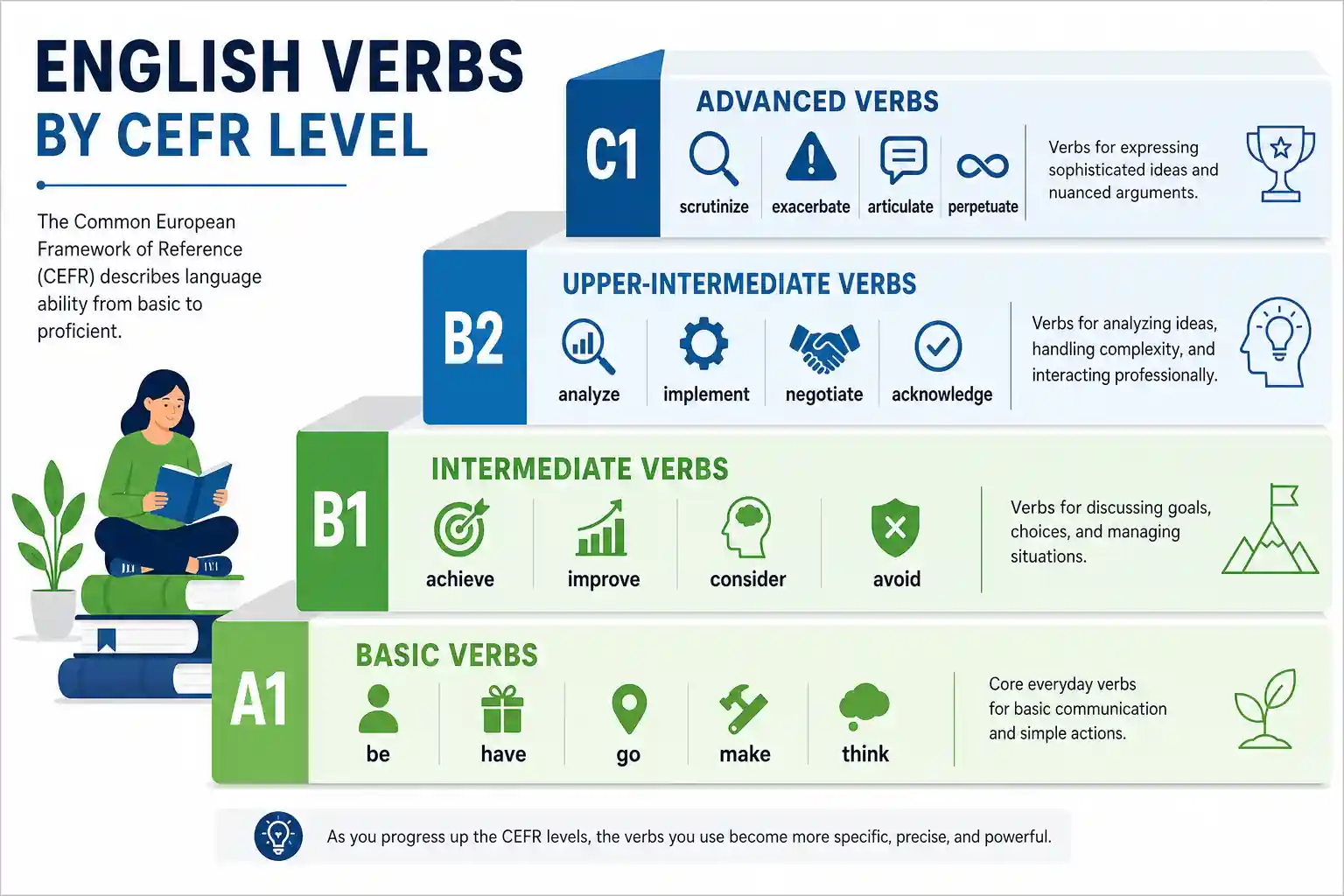
Quick Progress Check
Use this table to honestly assess your verb knowledge. For each level, count how many verbs you can:
- Use — produce in speech or writing without thinking
- Recognize — understand when you read or hear them
- Don’t know — completely unfamiliar
| Level | Total | I Can Use | I Recognize | I Don’t Know | Your Level |
|---|---|---|---|---|---|
| A1 | 75 | _ | _ | _ | If 60+ “Use” → ready for B1 |
| B1 | 75 | _ | _ | _ | If 60+ “Use” → ready for B2 |
| B2 | 75 | _ | _ | _ | If 60+ “Use” → ready for C1 |
| C1 | 75 | _ | _ | _ | If 50+ “Use” → advanced speaker |
Goal: Move verbs from “Recognize” to “Use.” That is the difference between passive and active vocabulary. Write sentences, use the verbs in conversation, and review with spaced repetition.
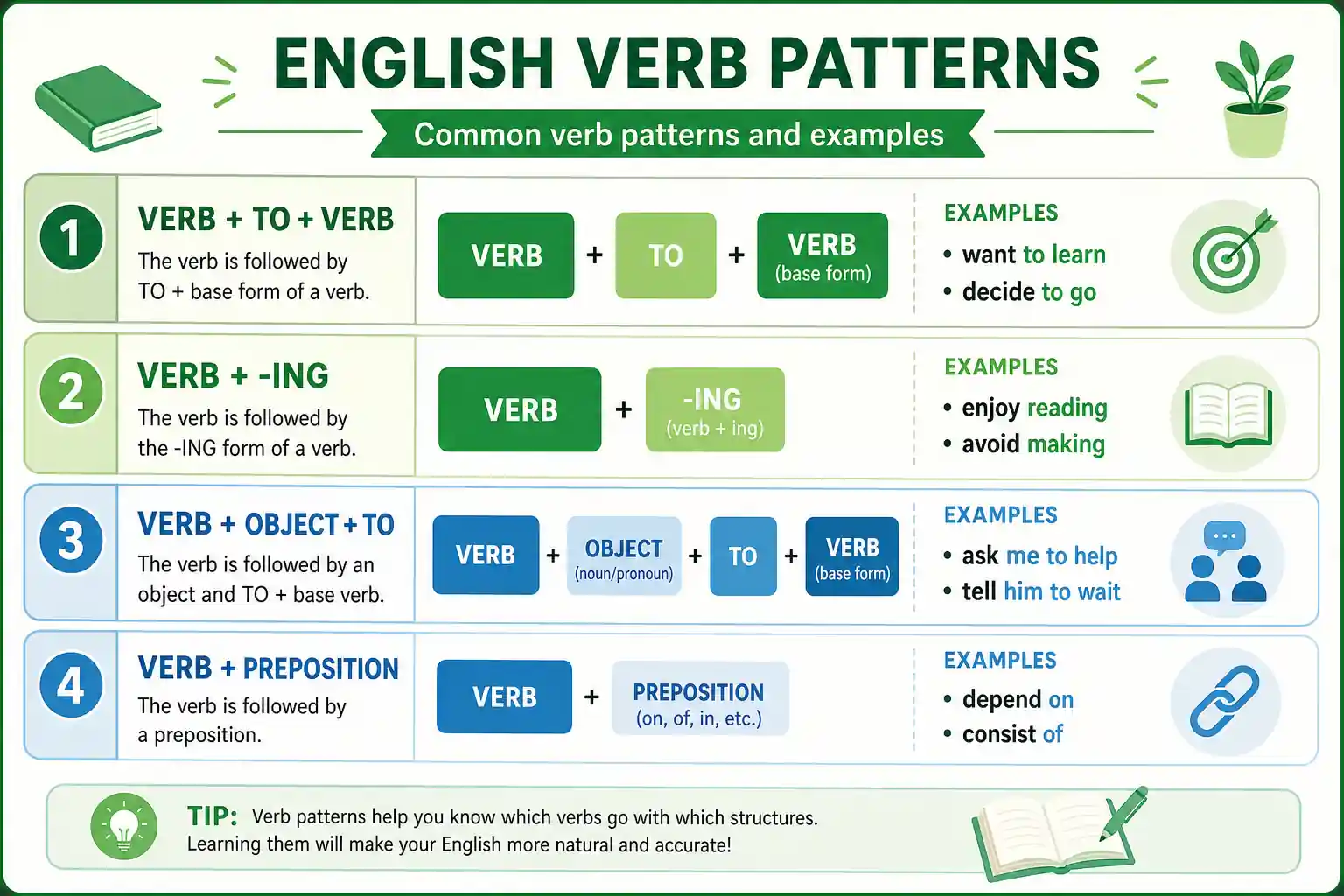
Verb Patterns: Master Reference
The most common source of errors is not the verb meaning — it is what follows the verb. Here is a master reference of the key patterns:
Verb + TO + Infinitive
These verbs are followed by “to + verb”:
want, need, decide, hope, plan, offer, refuse, promise, agree, learn, seem, appear, tend, manage, fail, afford, attempt, expect, intend, pretend
She decided to leave early. / They agreed to pay the full amount.
Verb + -ING (Gerund)
These verbs are followed by the -ing form:
enjoy, avoid, consider, suggest, finish, mind, keep, practice, deny, admit, imagine, involve, risk, miss, delay, recommend, appreciate
I enjoy reading before bed. / She avoided answering the question.
Verb + Object + TO + Infinitive
These verbs need an object, then “to + verb”:
ask, tell, want, expect, allow, encourage, invite, force, remind, persuade, advise, warn, convince, enable, require
He asked me to help. / They encouraged her to apply.
Verb + Preposition
These common verb + preposition combinations cause mistakes when learners use the wrong preposition:
| Verb | Correct Preposition | Example |
|---|---|---|
| depend | on | It depends on the weather. |
| consist | of | The team consists of ten people. |
| belong | to | This belongs to me. |
| apply | for (a job) / to (a rule) | She applied for a visa. |
| suffer | from | He suffers from allergies. |
| contribute | to | Exercise contributes to good health. |
| result | in / from | The error resulted in delays. |
| comply | with | You must comply with the rules. |
| object | to | She objected to the proposal. |
| cope | with | He couldn’t cope with the pressure. |
Words to Practice With
Here are 25 versatile verbs from the B1–B2 sections. Add them to your vocabulary and practice using them in sentences with the correct patterns.
cooperate
verb
To work together with others towards a common goal.
evaluate
verb
To judge or measure the value, quality, or importance of something.
Examples
- Companies evaluate job candidates based on experience, skills, and personality.
- Teachers evaluate student progress through tests, projects, and classroom participation.
donate
verb
To give something, especially money or goods, to help a cause or person.
Examples
- Many people donate money to charities that help homeless individuals.
- She decided to donate blood to help patients in emergency situations.
discourage
verb
To try to make someone feel less confident or hopeful about something.
Examples
- Don't let one failure discourage you from pursuing your dreams.
- High prices discourage many people from buying organic food products.
graduate
verb
To complete a course of study at a school or university.
Examples
- She will graduate from university next year with a degree in engineering.
- Students must complete all requirements before they can graduate from high school.
resolve
verb
To find a solution or answer to a problem or question.
Examples
- Mediator helps parties resolve dispute through negotiation.
- Technical team will resolve software problems quickly.
off
adjective
Describes something that is not fresh or is no longer suitable for eating, often used for food and drinks.
Examples
- Please turn off the lights before leaving the room.
- The dog ran off into the forest chasing wild rabbits.
stress
verb
To feel mental or emotional pressure or worry; to emphasize or give importance to something.
Examples
- Heavy workload may stress employees beyond limits.
- Teacher will stress importance of homework completion.
guide
verb
To show or direct someone how to do something.
Examples
- Parents should guide their children to make responsible decisions.
- The experienced hiker will guide the group through the mountain trail safely.
artery
noun
A blood vessel that carries blood away from the heart to the body.
Examples
- The blocked artery required immediate surgical intervention to save his life.
- This highway is a major artery connecting the city to surrounding areas.
coastal
adjective
Coastal describes areas near or along the coast.
Examples
- Coastal towns often depend on fishing and tourism for their economy.
- The coastal erosion threatens many beachfront properties and buildings.
candidate
noun
A person who is competing in an election or contest.
Examples
- Each presidential candidate presented their policy plans to voters.
- The job candidate impressed the interview panel with her experience.
horizon
noun
The line where the earth or the sky appears to meet in the distance.
Examples
- The sun disappeared behind the horizon as evening approached.
- Traveling broadens your horizon and exposes you to new cultures.
jury
noun
A group of people who listen to evidence in a court and decide if someone is guilty.
Examples
- The jury deliberated for several hours before reaching a verdict.
- The talent show jury consisted of professional musicians and entertainers.
prejudice
noun
Preconceived opinions or feelings, often negative, about a person or group.
Examples
- Education helps overcome prejudice and promotes understanding.
- Racial prejudice damages communities and individuals alike.
tragedy
noun
An extremely sad or serious event that causes suffering or loss.
Examples
- Natural tragedy affects thousands of innocent people.
- Personal tragedy changes person's life perspective completely.
boom
noun
A loud, deep sound or a sudden increase in activity or popularity.
Examples
- The boom of thunder echoed across the valley.
- The technology boom created many new millionaires.
admission
noun
The process or fact of being allowed to enter or join.
Examples
- Her admission to the prestigious medical school was the result of hard work.
- The museum offers free admission on the first Sunday of every month.
union
noun
A group of people or things joined together for a purpose.
Examples
- Labor union protects worker rights and interests.
- Marriage union joins two people in partnership.
voyage
noun
A long journey to a distant place, often by sea or air.
Examples
- Space exploration represents humanity's greatest voyage into the unknown.
- The ocean voyage from Europe to America took several weeks in the past.
humorous
adjective
Funny or amusing, often making people laugh.
Examples
- She writes humorous articles about everyday life and family experiences.
- The humorous speech made everyone laugh and lightened the serious mood.
lifelong
adjective
Continuing for a very long time or for the whole life.
Examples
- Learning is a lifelong process that never truly ends.
- Their lifelong friendship began during elementary school years.
motivated
adjective
Feeling driven or inspired to do something because of a reason or goal.
Examples
- Motivated employee seeks additional responsibilities and challenges at work.
- Success requires being motivated even when facing difficult obstacles.
indispensable
adjective
Absolutely necessary; essential.
Examples
- Clean water is indispensable for human survival and good health.
- Her experience and skills make her indispensable to the research team.
total
adjective
An adjective describing something that is complete or whole, not divided or broken.
Examples
- Total cost includes all fees and expenses.
- Total silence fills room during meditation session.
What to Do Next
-
Find your level. Scan the list at your current CEFR level. Mark verbs you can understand but not actively use — those are your priority targets.
-
Learn 5 verbs per day. For each verb, learn its meaning, primary pattern (what follows it), and one example sentence. Write your own sentence using the same pattern.
-
Focus on patterns. Knowing that “suggest” takes -ing (not “to + verb”) prevents errors that even advanced learners make. Pay as much attention to patterns as meanings.
-
Read verb-heavy content. News articles, academic texts, and business writing are dense with B2–C1 verbs. Our blog articles are written to expose you to these verbs naturally.
-
Study related forms. Each verb connects to a family of words. Analyze → analysis (noun), analytical (adjective), analytically (adverb). Learning the whole family from one verb multiplies your vocabulary efficiently. Browse the library by CEFR level for organized word lists.
FAQ
What are the most common verbs in English?
The 10 most frequent English verbs are: be, have, do, say, go, get, make, know, think, take. These account for approximately 25% of all verb usage in spoken English. Combined with the next 40 most common verbs (see A1 section above), they cover about 70% of everyday verb usage. The remaining 30% is distributed across thousands of less frequent but still important verbs.
How many verbs are in English?
English has approximately 25,000 verbs in total, but most are rare or highly specialized. About 5,000 verbs appear in general-purpose dictionaries. For practical fluency, knowing 300–500 verbs (with their patterns and collocations) is enough to express virtually anything in everyday communication. For academic or professional contexts, add another 200–300 specialized verbs.
What is the difference between regular and irregular verbs?
Regular verbs form the past tense by adding “-ed” (work → worked, play → played). Irregular verbs have unpredictable past forms that must be memorized (go → went, think → thought, be → was). About 200 commonly used English verbs are irregular, and these tend to be the most frequent ones. For the complete irregular verbs list with all forms, see our Irregular Verbs guide.
What are verb patterns and why do they matter?
Verb patterns are the grammatical structures that follow specific verbs. For example, “enjoy” is always followed by -ing (enjoy reading), while “want” is always followed by “to + verb” (want to read). Using the wrong pattern (enjoy to read or want reading) is a grammatical error that native speakers immediately notice. Learning verb patterns alongside verb meanings prevents these errors and makes your English sound natural.
How can I learn English verbs faster?
Learn verbs in context, not isolation. For each new verb: (1) learn its meaning, (2) learn its main pattern (what follows it), (3) read 2–3 example sentences, (4) write your own sentence. Use spaced repetition to review. Group verbs by theme (all “communication” verbs together) rather than alphabetically — thematic groups are remembered better because your brain stores related words in networks.


