English Words for Daily Use: The Complete Guide to Everyday Vocabulary
You do not need to know 50,000 English words to have a real conversation. Research consistently shows that the most common 2,000–3,000 words cover about 90–95% of everyday spoken English. The remaining 5–10% are words you can learn as you encounter them.
The real question is not “how many words do I need?” but “which words do I need?” A learner who knows 500 practical, high-frequency words — and can actually use them in sentences — will communicate better than someone who has memorized 5,000 words from random vocabulary lists but cannot put them together.
This guide gives you exactly that: 500+ English words for daily use, organized by the situations where you actually need them. Every word includes its meaning, part of speech, and a sentence you might hear or say in real life.
How This Guide Is Organized
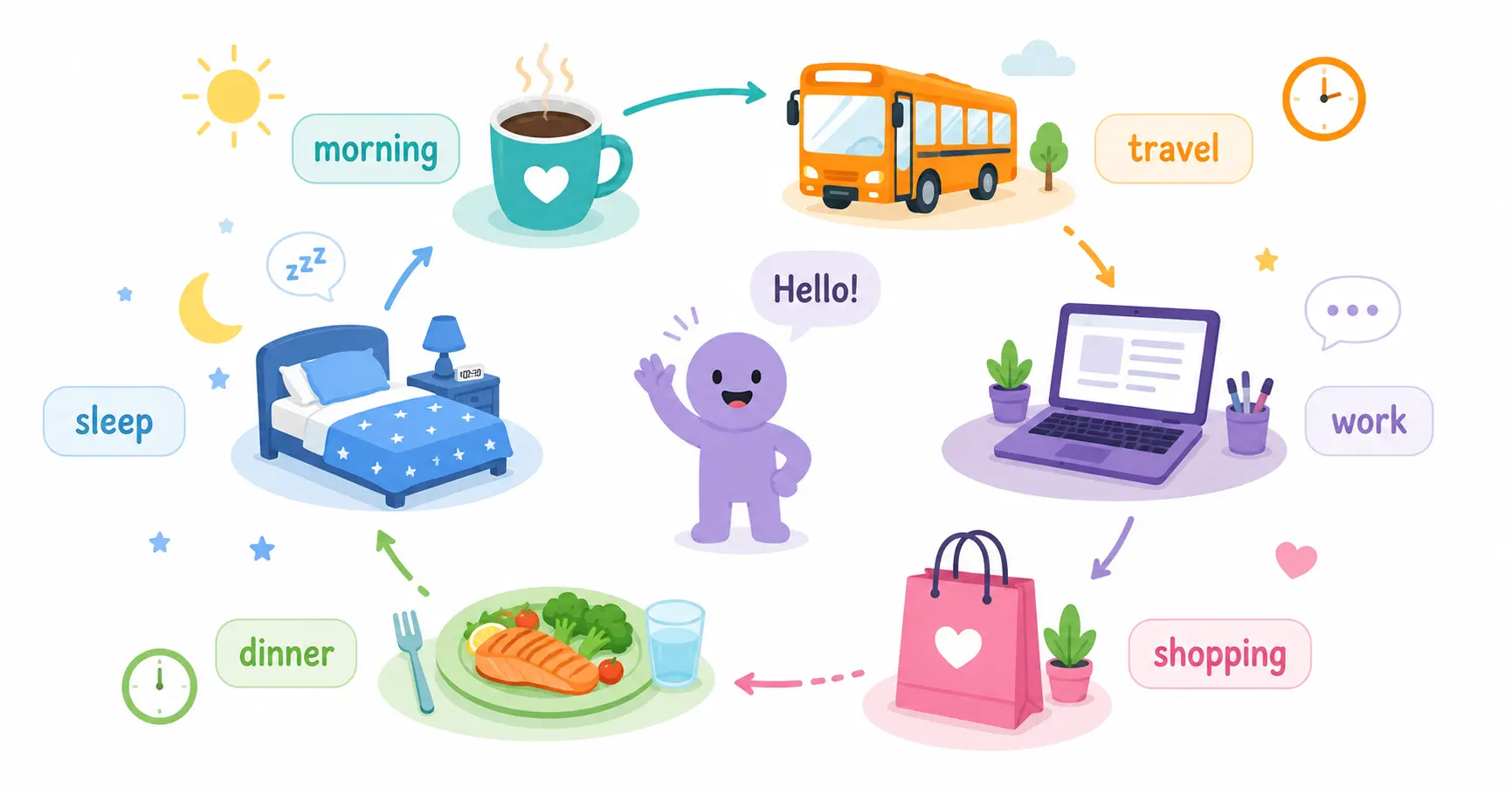
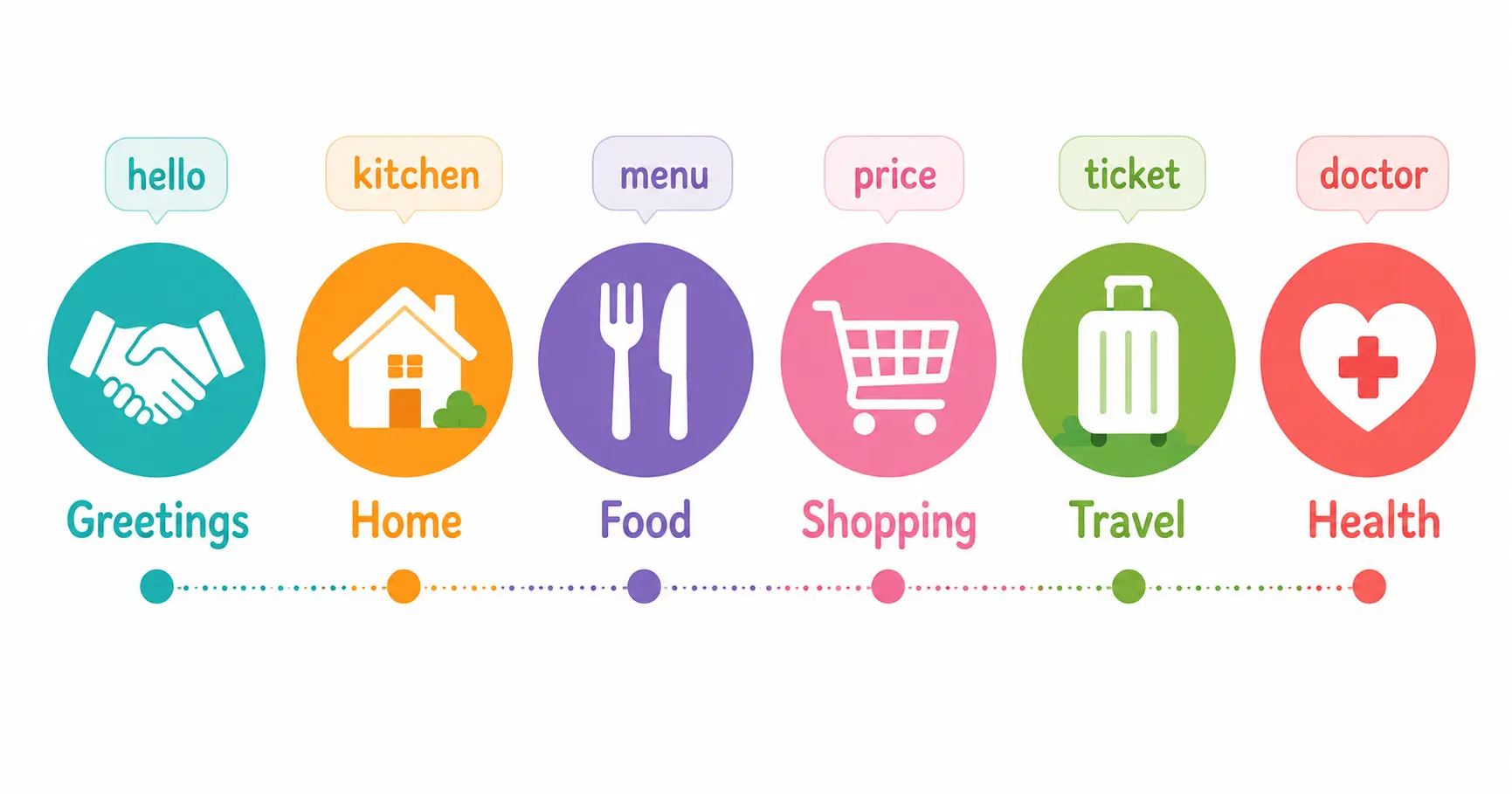
Instead of an alphabetical list (which is hard to use in practice), we organized words by daily life situations — the contexts where you will actually need them:
| Section | What It Covers | Words |
|---|---|---|
| Greetings & Small Talk | Meeting people, introductions | ~40 words |
| Home & Family | Household, daily routine, relatives | ~50 words |
| Food & Cooking | Meals, ingredients, restaurants | ~60 words |
| Shopping & Money | Stores, prices, transactions | ~40 words |
| Work & Office | Jobs, meetings, emails | ~50 words |
| Travel & Transportation | Directions, transport, hotels | ~50 words |
| Health & Body | Body parts, symptoms, doctors | ~50 words |
| Emotions & Opinions | Feelings, agreeing/disagreeing | ~40 words |
| Time & Numbers | Days, months, quantities | ~40 words |
| Technology & Communication | Devices, internet, social media | ~40 words |
| Weather & Nature | Climate, seasons, outdoors | ~30 words |
| Education & Learning | School, studying, exams | ~40 words |
Section 1: Greetings & Small Talk
These are the first words you use every day — meeting people, starting conversations, and basic social interaction.
Essential Greetings
| Word / Phrase | Meaning | Example |
|---|---|---|
| hello / hi | a greeting | Hi, how are you? |
| good morning | greeting before noon | Good morning, everyone. |
| good afternoon | greeting after noon | Good afternoon, may I help you? |
| good evening | greeting in the evening | Good evening, welcome to the restaurant. |
| goodbye / bye | leaving | Goodbye, see you tomorrow! |
| see you later | casual parting | See you later, have a good day! |
| how are you? | asking about someone’s state | How are you doing today? |
| fine | well; satisfactory | I’m fine, thanks for asking. |
| nice to meet you | first introduction | Nice to meet you, I’m Alex. |
| thank you / thanks | expressing gratitude | Thank you for your help. |
| please | polite request word | Can I have some water, please? |
| sorry | apology; getting attention | Sorry, could you repeat that? |
| excuse me | getting attention; passing by | Excuse me, where is the bathroom? |
Small Talk Essentials
| Word | Part of Speech | Meaning | Example |
|---|---|---|---|
| name | noun | what someone is called | What’s your name? |
| from | preposition | place of origin | Where are you from? |
| live | verb | to reside | I live in Tokyo. |
| work | verb / noun | to have a job; employment | I work at a tech company. |
| like | verb | to enjoy | I like reading and cooking. |
| friend | noun | someone you know and trust | She’s my best friend. |
| family | noun | a group of relatives | My family lives in Brazil. |
| busy | adjective | having a lot to do | Sorry, I’ve been really busy. |
| free | adjective | available; no cost | Are you free this weekend? |
| enjoy | verb | to take pleasure in | I enjoy walking in the park. |
| favorite | adjective | preferred above all others | What’s your favorite movie? |
| hobby | noun | an activity done for pleasure | My hobby is photography. |
| weekend | noun | Saturday and Sunday | What are your plans for the weekend? |
| holiday | noun | a day off; a vacation | We’re going on holiday next month. |
| fun | noun / adjective | enjoyment; entertaining | The party was really fun. |
| interesting | adjective | holding attention | That’s a very interesting idea. |
Section 2: Home & Family
Family Members
| Word | Meaning | Example |
|---|---|---|
| mother / mom | female parent | My mom is a teacher. |
| father / dad | male parent | My dad works from home. |
| parents | mother and father | My parents live in London. |
| brother | male sibling | I have an older brother. |
| sister | female sibling | My sister is 12 years old. |
| husband | male spouse | Her husband is a doctor. |
| wife | female spouse | His wife works at a bank. |
| children / kids | sons and daughters | They have three children. |
| son | male child | Their son starts school this year. |
| daughter | female child | Our daughter loves music. |
| grandparents | parents’ parents | I visit my grandparents every Sunday. |
| uncle | parent’s brother | My uncle lives in Canada. |
| aunt | parent’s sister | My aunt is coming to visit. |
| cousin | uncle/aunt’s child | I have 10 cousins. |
| neighbor | person living nearby | Our neighbor is very friendly. |
Home & Daily Routine
| Word | Part of Speech | Meaning | Example |
|---|---|---|---|
| house / home | noun | where you live | I’ll be home by 6 PM. |
| apartment | noun | a flat; a unit in a building | We rent a small apartment downtown. |
| room | noun | a space in a building | The living room is downstairs. |
| kitchen | noun | where food is prepared | She’s cooking in the kitchen. |
| bedroom | noun | where you sleep | The apartment has two bedrooms. |
| bathroom | noun | room with toilet and shower | The bathroom is on the left. |
| door | noun | entry to a room | Please close the door. |
| window | noun | an opening for light/air | Open the window — it’s hot. |
| key | noun | tool to open a lock | I forgot my keys at home. |
| clean | verb / adjective | to remove dirt; free of dirt | I clean the house every Saturday. |
| cook | verb | to prepare food | I usually cook dinner at 7. |
| wake up | verb | to stop sleeping | I wake up at 6:30 every morning. |
| sleep | verb / noun | to rest unconsciously | I need at least 7 hours of sleep. |
| shower | noun / verb | washing with water | I take a shower after the gym. |
| breakfast | noun | the first meal of the day | What did you have for breakfast? |
| lunch | noun | the midday meal | Let’s go out for lunch. |
| dinner | noun | the evening meal | Dinner is ready! |
Section 3: Food & Cooking
Common Foods
| Word | Category | Example |
|---|---|---|
| bread | grain | I buy fresh bread every morning. |
| rice | grain | Rice is the main dish in many countries. |
| pasta | grain | She made pasta with tomato sauce. |
| chicken | meat | We’re having chicken for dinner. |
| beef | meat | This beef stew is delicious. |
| fish | seafood | I eat fish twice a week. |
| egg | protein | I’ll have two eggs for breakfast. |
| milk | dairy | Do you want milk in your coffee? |
| cheese | dairy | This cheese is from France. |
| butter | dairy | Spread some butter on the bread. |
| apple | fruit | An apple a day keeps the doctor away. |
| banana | fruit | I had a banana for a snack. |
| orange | fruit | Would you like some orange juice? |
| tomato | vegetable | Add the tomatoes to the salad. |
| potato | vegetable | Baked potatoes are easy to make. |
| onion | vegetable | Chop the onion into small pieces. |
| salad | dish | I’ll have a salad for lunch. |
| soup | dish | Hot soup is perfect on cold days. |
| sugar | seasoning | How much sugar do you take? |
| salt | seasoning | The soup needs a little more salt. |
Eating Out
| Word / Phrase | Meaning | Example |
|---|---|---|
| menu | list of food options | Can I see the menu, please? |
| order | to request food/drinks | Are you ready to order? |
| waiter | restaurant server | The waiter brought our drinks. |
| bill / check | payment request | Could we have the bill, please? |
| tip | extra money for service | We left a 15% tip. |
| reservation | a booked table | I’d like to make a reservation for two. |
| delicious | very tasty | The food was absolutely delicious. |
| spicy | having strong, hot flavor | Is this dish very spicy? |
| fresh | recently made or picked | The vegetables are very fresh today. |
| hungry | needing food | I’m really hungry — let’s eat. |
| thirsty | needing a drink | I’m thirsty. Can I have some water? |
| full | having eaten enough | I’m full, I can’t eat any more. |
Section 4: Shopping & Money
| Word | Part of Speech | Meaning | Example |
|---|---|---|---|
| buy | verb | to purchase | I need to buy some groceries. |
| sell | verb | to exchange for money | They sell handmade jewelry. |
| pay | verb | to give money for something | Can I pay by card? |
| price | noun | the amount of money required | What’s the price of this jacket? |
| cost | verb / noun | to require payment; the expense | How much does this cost? |
| cheap | adjective | low in price | The food there is cheap and good. |
| expensive | adjective | high in price | This restaurant is too expensive. |
| free | adjective | costing nothing | Admission to the museum is free. |
| discount | noun | a price reduction | There’s a 20% discount this week. |
| sale | noun | a period of reduced prices | The store is having a big sale. |
| cash | noun | physical money | Do you accept cash? |
| card | noun | credit/debit card | I’ll pay by card, please. |
| change | noun | money returned; coins | Keep the change. |
| receipt | noun | proof of purchase | Can I have a receipt, please? |
| size | noun | how big something is | What size do you wear? |
| try on | phrasal verb | to test clothing | Can I try on this shirt? |
| return | verb | to bring back for a refund | I’d like to return this item. |
| shop / store | noun | a place to buy things | There’s a bookshop on the corner. |
| customer | noun | a person who buys | The customer is always right. |
| bag | noun | a container for carrying things | Do you need a bag? |
Section 5: Work & Office
| Word | Part of Speech | Meaning | Example |
|---|---|---|---|
| job | noun | paid work | She got a new job at Google. |
| career | noun | a long-term professional path | He’s building a career in finance. |
| company | noun | a business organization | The company has 500 employees. |
| office | noun | a workplace | I go to the office three days a week. |
| boss | noun | person in charge | My boss is very supportive. |
| colleague | noun | a coworker | I’m having lunch with a colleague. |
| meeting | noun | a group discussion | We have a meeting at 10 AM. |
| deadline | noun | a time limit | The deadline is next Friday. |
| project | noun | a planned piece of work | I’m working on a big project. |
| task | noun | a piece of work to be done | I have three tasks to finish today. |
| schedule | noun / verb | a timetable; to plan | Check my schedule for tomorrow. |
| salary | noun | monthly/yearly pay | The salary is competitive. |
| hire | verb | to employ | They plan to hire 20 people. |
| resign / quit | verb | to leave a job voluntarily | She resigned last week. |
| promote | verb | to give a higher position | He was promoted to manager. |
| apply | verb | to formally request (a job) | I applied for three positions. |
| interview | noun / verb | a formal conversation for a job | The interview went really well. |
| experience | noun | knowledge from doing something | She has 10 years of experience. |
| team | noun | a group working together | Our team has eight members. |
| noun / verb | electronic message | I’ll send you an email tonight. | |
| report | noun / verb | a formal document; to inform | The report is due tomorrow. |
| client | noun | a customer (professional) | We’re meeting an important client. |
Section 6: Travel & Transportation
| Word | Part of Speech | Meaning | Example |
|---|---|---|---|
| airport | noun | where planes depart/arrive | We need to be at the airport by 5 AM. |
| flight | noun | a journey by plane | The flight to London takes 7 hours. |
| ticket | noun | proof of travel payment | I booked a round-trip ticket. |
| passport | noun | international ID document | Don’t forget your passport. |
| luggage / baggage | noun | travel bags | My luggage is too heavy. |
| hotel | noun | a place to stay when traveling | We booked a hotel near the beach. |
| reservation | noun | a booking | I have a reservation under Smith. |
| check in | phrasal verb | to register at a hotel/airport | You can check in from 3 PM. |
| check out | phrasal verb | to leave a hotel; to look at | We need to check out by 11 AM. |
| train | noun | a rail vehicle | The train leaves at 8:15. |
| bus | noun | a large road vehicle | Take bus number 42 to the center. |
| taxi / cab | noun | a hired car | Let’s take a taxi to the restaurant. |
| subway / metro | noun | underground rail | The subway is faster than the bus. |
| station | noun | where trains/buses stop | The train station is nearby. |
| map | noun | a visual guide to a place | Can you show me on the map? |
| direction | noun | the way to go | Can you give me directions? |
| left / right | direction | Turn left at the traffic light. | | straight | adverb | without turning | Go straight for two blocks. | | near / far | adjective/adverb | close / distant | Is the hotel far from here? | | arrival | noun | the act of coming | Our arrival time is 3 PM. | | departure | noun | the act of leaving | Check the departure board. | | delay | noun / verb | being late; to make late | The flight has a 2-hour delay. | | cancel | verb | to call off | They cancelled the train due to weather. | | border | noun | the boundary between countries | We crossed the border at noon. |
Section 7: Health & Body
Body Parts
| Word | Meaning | Example |
|---|---|---|
| head | top of the body | I have a headache. |
| face | front of the head | She has a kind face. |
| eye | organ of sight | My eyes are tired from the screen. |
| ear | organ of hearing | I have an earache. |
| nose | organ of smell | My nose is running. |
| mouth | opening for eating/speaking | Open your mouth, please. |
| tooth / teeth | used for biting | I brush my teeth twice a day. |
| neck | connects head to body | My neck is stiff. |
| shoulder | top of the arm | He hurt his shoulder. |
| arm | upper limb | She broke her arm skiing. |
| hand | at the end of the arm | Wash your hands before eating. |
| finger | digit on the hand | I cut my finger chopping vegetables. |
| back | rear of the body | My back hurts from sitting all day. |
| stomach | digestive organ; belly area | I have a stomachache. |
| leg | lower limb | My legs are tired from running. |
| knee | middle joint of the leg | He injured his knee playing football. |
| foot / feet | at the end of the leg | My feet are sore from walking. |
Health & Medical
| Word | Part of Speech | Meaning | Example |
|---|---|---|---|
| sick / ill | adjective | not well | I feel sick today — I can’t go to work. |
| pain | noun | physical suffering | I have a sharp pain in my chest. |
| fever | noun | high body temperature | She has a high fever. |
| cold | noun | a common illness | I caught a cold last week. |
| cough | noun / verb | forcing air from the lungs | I’ve had this cough for a week. |
| medicine | noun | a substance for treating illness | Take this medicine twice a day. |
| doctor | noun | a medical professional | I need to see a doctor. |
| hospital | noun | a medical facility | He was taken to the hospital. |
| appointment | noun | a scheduled visit | I have a doctor’s appointment at 3. |
| prescription | noun | a doctor’s written order | The doctor gave me a prescription. |
| allergy | noun | a bad reaction to something | I have an allergy to peanuts. |
| rest | noun / verb | relaxation; to relax | You need rest — stay in bed. |
| healthy | adjective | in good health | Eating vegetables keeps you healthy. |
| exercise | noun / verb | physical activity | Regular exercise is important. |
Section 8: Emotions & Opinions
| Word | Part of Speech | Meaning | Example |
|---|---|---|---|
| happy | adjective | feeling joy | I’m happy to see you. |
| sad | adjective | feeling sorrow | The movie made me sad. |
| angry | adjective | feeling strong displeasure | She was angry about the delay. |
| afraid / scared | adjective | feeling fear | I’m afraid of spiders. |
| surprised | adjective | feeling unexpected shock | I was surprised by the news. |
| tired | adjective | needing rest | I’m so tired after work. |
| excited | adjective | feeling enthusiasm | I’m excited about the trip! |
| worried | adjective | feeling anxious | I’m worried about the exam. |
| bored | adjective | lacking interest | I’m bored — let’s do something. |
| confused | adjective | unable to understand | I’m confused by these instructions. |
| proud | adjective | feeling satisfaction | She’s proud of her daughter. |
| nervous | adjective | feeling anxiety | I’m nervous about the presentation. |
| grateful | adjective | feeling thankful | I’m grateful for your help. |
| lonely | adjective | feeling alone | He felt lonely in the new city. |
| hope | verb / noun | to wish for; a wish | I hope you feel better soon. |
| agree | verb | to share the same opinion | I agree with you completely. |
| disagree | verb | to have a different opinion | I respectfully disagree. |
| believe | verb | to accept as true | I believe you’re making the right choice. |
| prefer | verb | to like one thing more | I prefer coffee to tea. |
| recommend | verb | to suggest as good | I recommend the seafood pasta. |
| suggest | verb | to propose an idea | I suggest we leave early. |
| opinion | noun | a personal view | In my opinion, this plan is better. |
Section 9: Time & Numbers
Time Expressions
| Word / Phrase | Meaning | Example |
|---|---|---|
| today | this day | I have a meeting today. |
| tomorrow | the next day | Let’s talk tomorrow. |
| yesterday | the previous day | I saw her yesterday. |
| now | at the present moment | I’m busy right now. |
| later | at a future time | I’ll call you later. |
| soon | in the near future | The bus should arrive soon. |
| already | before now | I’ve already eaten. |
| still | continuing | Are you still at work? |
| yet | up to now (negatives/questions) | I haven’t finished yet. |
| always | at all times | She always arrives on time. |
| usually | most of the time | I usually wake up at 7. |
| sometimes | occasionally | Sometimes I work from home. |
| never | at no time | I never drink coffee after 6 PM. |
| early | before the expected time | We arrived early for the show. |
| late | after the expected time | Sorry I’m late — traffic was bad. |
| ago | in the past | I moved here two years ago. |
Numbers & Quantities
| Word | Meaning | Example |
|---|---|---|
| many | a large number (countable) | How many people are coming? |
| much | a large amount (uncountable) | How much time do we have? |
| few | a small number | Only a few seats are left. |
| little | a small amount | There’s very little milk left. |
| some | an unspecified amount | Would you like some water? |
| any | used in questions/negatives | Do you have any questions? |
| every / each | all of a group individually | Every student passed the exam. |
| all | the entire amount | All the tickets are sold out. |
| enough | as much as needed | We have enough food for everyone. |
| half | 50% of something | Half the class was absent. |
| both | two things together | Both options are good. |
| another | one more; a different one | Can I have another cup of coffee? |
Section 10: Technology & Communication
| Word | Part of Speech | Meaning | Example |
|---|---|---|---|
| phone | noun | a telephone device | I left my phone at home. |
| call | verb / noun | to contact by phone | I’ll call you after work. |
| message | noun | a written/spoken communication | I sent you a message. |
| internet | noun | the global network | The internet is down again. |
| website | noun | a set of web pages | Check our website for details. |
| app | noun | a mobile application | Download the app for free. |
| password | noun | a secret access code | I forgot my password. |
| search | verb / noun | to look for online | Search for “English vocabulary” on Google. |
| download | verb | to save from the internet | Download the file from your email. |
| upload | verb | to send to the internet | Upload the photo to the cloud. |
| screen | noun | the display | My screen is cracked. |
| charge | verb | to add power to a battery | I need to charge my phone. |
| update | verb / noun | to make current | Update the app to the latest version. |
| share | verb | to give access to others | Share the link with your team. |
| connect | verb | to join or link | I can’t connect to the Wi-Fi. |
| post | verb / noun | to publish online | She posted a photo on Instagram. |
| follow | verb | to subscribe to content | Follow us on social media. |
| online / offline | adjective/adverb | connected / not connected | The store is available both online and offline. |
Section 11: Weather & Nature
| Word | Part of Speech | Meaning | Example |
|---|---|---|---|
| weather | noun | atmospheric conditions | What’s the weather like today? |
| hot | adjective | high temperature | It’s very hot outside — over 35°C. |
| cold | adjective | low temperature | Dress warmly — it’s cold. |
| warm | adjective | pleasantly hot | It’s warm and sunny today. |
| cool | adjective | slightly cold | The evenings are getting cooler. |
| rain | noun / verb | water from clouds | It’s going to rain this afternoon. |
| snow | noun / verb | frozen precipitation | It snowed all night. |
| wind | noun | moving air | The wind is very strong today. |
| cloudy | adjective | covered with clouds | It’s cloudy but not raining. |
| sunny | adjective | bright with sunlight | It’s a beautiful sunny day. |
| storm | noun | severe weather | A big storm is coming tonight. |
| temperature | noun | degree of heat or cold | The temperature dropped to –5°C. |
| season | noun | a time of year | My favorite season is autumn. |
| spring | noun | the season after winter | The flowers bloom in spring. |
| summer | noun | the warmest season | We’re going to the beach this summer. |
| autumn / fall | noun | the season after summer | The leaves change color in autumn. |
| winter | noun | the coldest season | Winters here are long and cold. |
| sky | noun | the space above Earth | The sky is perfectly clear tonight. |
Section 12: Education & Learning
| Word | Part of Speech | Meaning | Example |
|---|---|---|---|
| school | noun | a place of education | My kids go to school nearby. |
| university | noun | a higher education institution | She studied medicine at university. |
| student | noun | a person who studies | There are 30 students in the class. |
| teacher | noun | a person who teaches | Our English teacher is from Australia. |
| class / lesson | noun | a teaching session | English class starts at 9 AM. |
| course | noun | a series of lessons | I’m taking an online course. |
| study | verb | to learn by reading/practice | I study English every day. |
| learn | verb | to gain knowledge | I want to learn Japanese next. |
| practice | verb / noun | to do repeatedly to improve | Practice makes perfect. |
| read | verb | to look at written words | I read for 30 minutes before bed. |
| write | verb | to put words on paper/screen | Write your name at the top. |
| speak | verb | to talk | Can you speak more slowly? |
| listen | verb | to pay attention to sound | Listen to the recording carefully. |
| understand | verb | to comprehend | I don’t understand this question. |
| exam / test | noun | a formal assessment | The final exam is next Monday. |
| homework | noun | work assigned for home | I have a lot of homework tonight. |
| mistake | noun | an error | Don’t be afraid of making mistakes. |
| improve | verb | to get better | My English has improved a lot. |
| vocabulary | noun | the set of words you know | Building your vocabulary takes time. |
| grammar | noun | rules of a language | English grammar can be confusing. |
| pronounce | verb | to say a word | How do you pronounce this word? |
| translate | verb | to convert between languages | Can you translate this for me? |
| dictionary | noun | a book of word definitions | Look it up in the dictionary. |
Vocabulary to Practice
Add these 25 high-frequency daily words to your Linglify dictionary for spaced repetition.
academy
noun
A place for study or training in a special subject.
Examples
- She graduated from the military academy with honors last spring.
- The film academy recognizes outstanding achievements in cinema each year.
achievable
adjective
Possible to be done or achieved; within reach.
Examples
- Setting achievable goals is important for maintaining motivation and confidence.
- The project timeline seems achievable if we work efficiently together.
adjective
noun
A word that describes or modifies a noun.
Examples
- In English grammar, an adjective describes or modifies a noun.
- The adjective 'beautiful' comes before the noun 'garden' in this sentence.
affordable
adjective
Able to be bought or reached at a reasonable price.
Examples
- The government is working to provide affordable housing for low-income families.
- This restaurant offers delicious and affordable meals for college students.
amount
noun
The total quantity or number of something.
Examples
- A small amount of sugar is needed to balance the acidity.
- The amount of homework assigned seems excessive for elementary school children.
assault
noun
A sudden, violent attack or act of violence.
Examples
- The army launched a fierce assault on the enemy fortress.
- The police arrested the man for assault and battery charges.
audience
noun
A group of people who watch or listen to a performance or event.
Examples
- Television shows depend on audience ratings to determine their success.
- The speaker engaged the audience with humor and interesting stories.
beam
noun
A long, sturdy piece of wood or metal used to support or carry weight.
Examples
- A beam of sunlight streamed through the window brightening the room.
- The wooden beam supports the weight of the ceiling above.
biotechnology
noun
The use of living organisms or systems to develop products or processes.
Examples
- Agricultural biotechnology helps create disease-resistant crop varieties.
- Biotechnology companies develop new medical treatments and therapies.
brewery
noun
A place where beer, cider, or other drinks are produced and sold.
Examples
- She works as a quality control manager at brewery.
- The local brewery offers tours every Saturday afternoon.
carelessness
noun
The quality of not being careful or paying attention, often causing mistakes.
Examples
- Her carelessness with money led to serious financial problems.
- The accident was caused by the pilot's carelessness during takeoff.
choose
verb
To select or prefer one thing over another.
Examples
- She will choose the dress that looks best for the wedding ceremony.
- Students must choose their courses carefully for next semester's schedule.
come
verb
To move closer or arrive at a place or event.
Examples
- Please come to the meeting at three o'clock this afternoon.
- Spring will come early this year according to weather predictions.
continent
noun
A large landmass on Earth, such as Africa or Asia.
curry
noun
A spicy mixture of ground meat and vegetables, usually eaten with rice or bread.
Examples
- Indian curry dishes use many different spices to create complex flavors.
- She prepared a delicious chicken curry with rice for dinner.
department store
noun
A store selling a variety of goods, often located in a shopping center.
Examples
- Holiday shopping at the department store can be crowded and stressful.
- The department store sells everything from clothing to electronics.
disco
noun
A type of dance music and social event popular in the 1970s and 1980s.
Examples
- Disco music became extremely popular during the nineteen seventies era.
- The disco was crowded with young people dancing to energetic music.
earth
noun
The planet we live on; the ground or soil of the world.
Examples
- Earth is the third planet from the sun in our solar system.
- Farmers plant seeds in rich earth to grow healthy crops.
exactly
adverb
Precisely; in a way that is exactly correct or true.
Examples
- That's exactly what I was thinking about this important situation too.
- The train arrived exactly on time at nine fifteen this morning.
firearm
noun
A noun for a weapon that shoots bullets or projectiles.
Examples
- Police officers receive extensive training in firearm safety and usage.
- The museum displays historical firearms from different time periods.
generous
adjective
Willing to give more than necessary or expected; kind and generous.
Examples
- She gave a generous portion of food to everyone at the dinner table.
- The generous donation will help fund scholarships for deserving students.
have to
verb
Must do something because of a rule or obligation.
Examples
- She doesn't have to work on weekends unless there's an emergency.
- Students have to complete their homework before coming to class tomorrow.
indirect
adjective
Not directly caused by or connected to something; not straightforward.
Examples
- His indirect criticism was subtle but everyone understood his meaning.
- The indirect route takes longer but avoids the heavy traffic areas.
know
verb
This verb describes being aware of facts or information.
Examples
- Do you know anyone who speaks fluent Spanish or Portuguese?
- I know the answer to that difficult mathematical question.
manner
noun
A way of doing or behaving; a style or method.
Examples
- Children learn proper table manners through family guidance and practice.
- She speaks in confident manner that commands attention and respect.
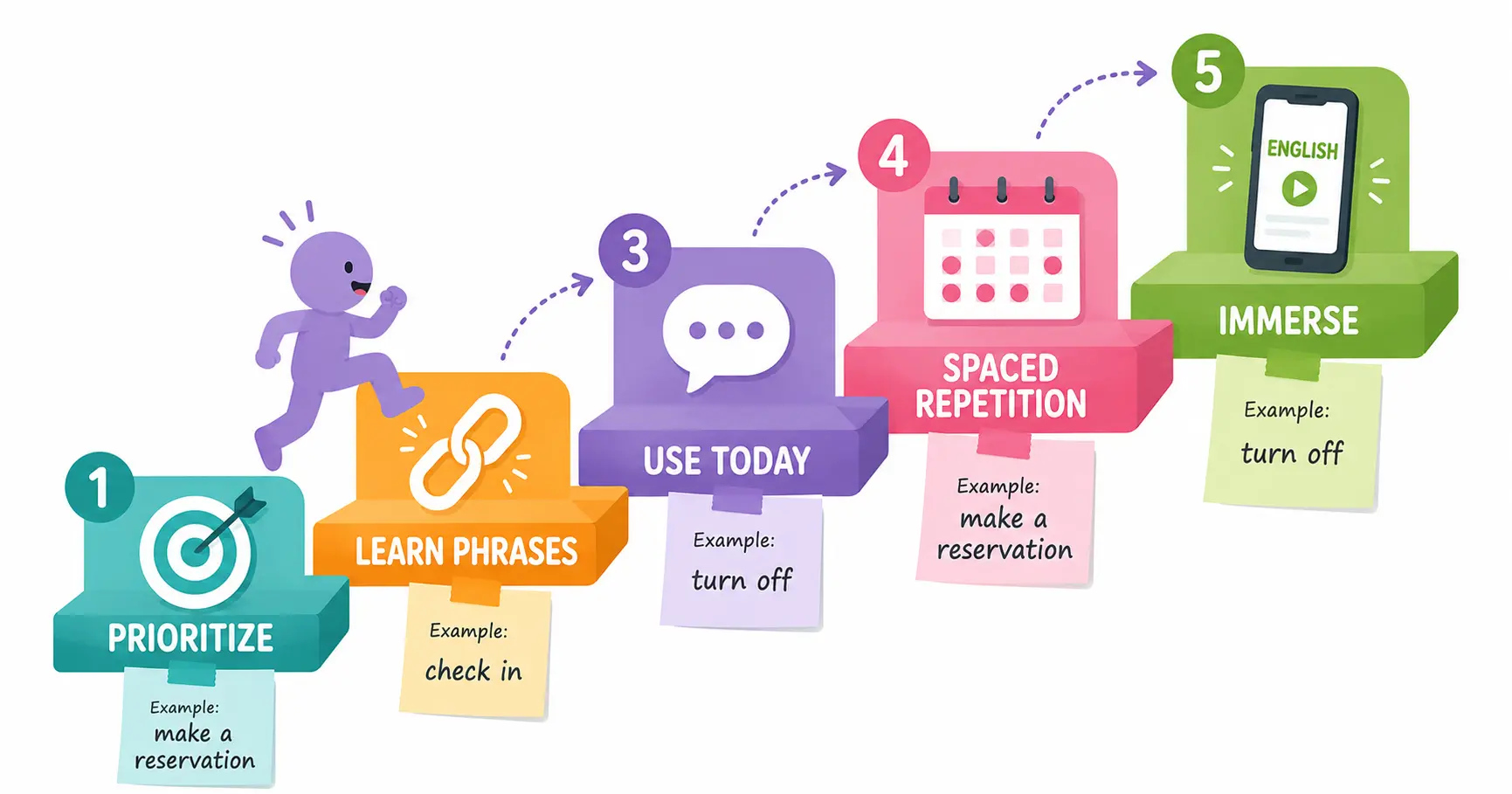
How to Learn Daily Vocabulary Effectively
1. Start with the words you actually need
If you work in an office, Section 5 is your priority. If you are traveling, Section 6 comes first. There is no point memorizing weather vocabulary when you cannot order food at a restaurant. Let your real life decide the order.
2. Learn in phrases, not single words
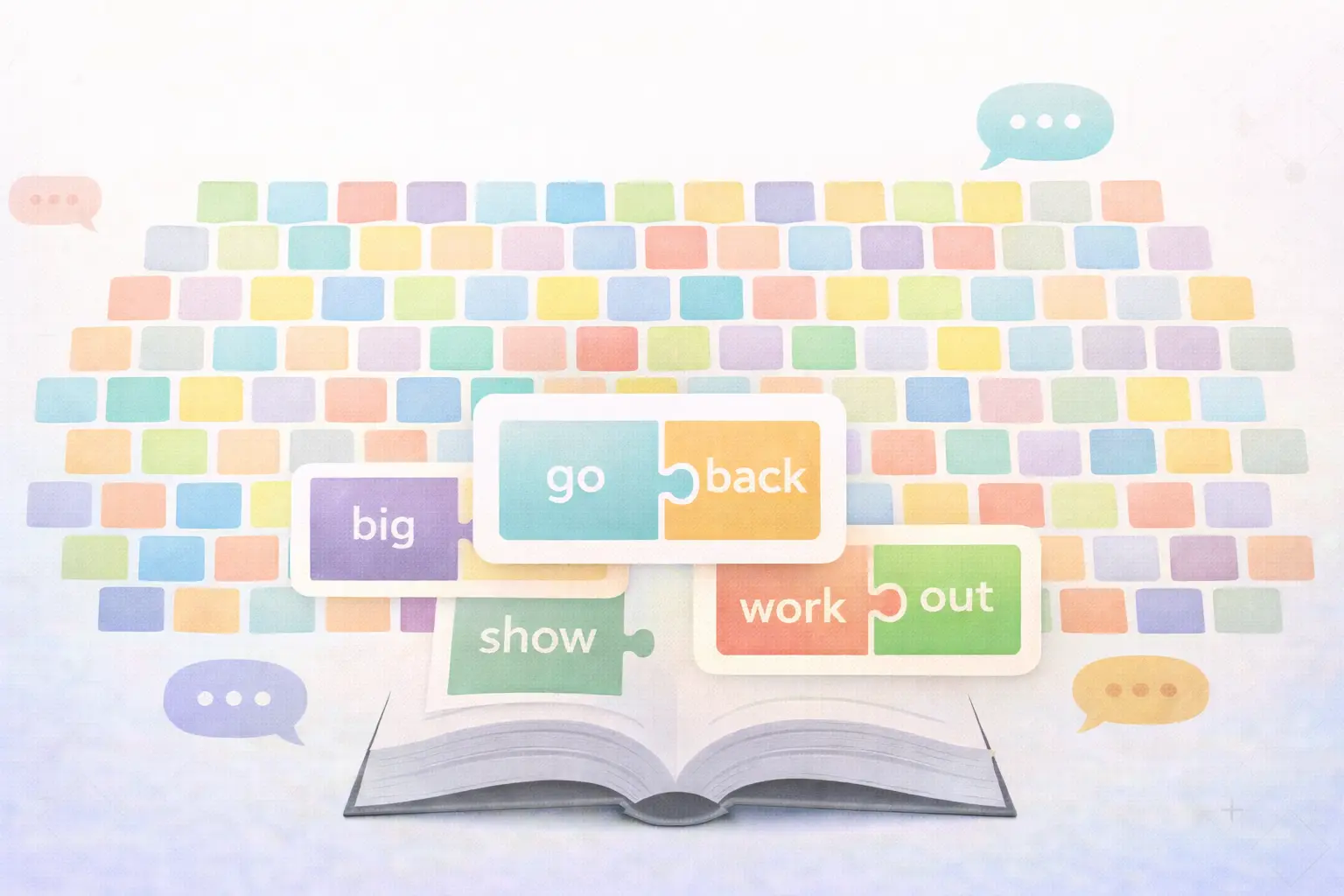
“Make a reservation” is more useful than “reservation” alone. Words exist in natural combinations called collocations, and learning them together helps both memory and fluency. See English Collocations: Master Natural Word Combinations for more.
3. Use each new word the same day
Say it in a sentence, write it in a message, or use it in your internal monologue. Research shows that using a word within 24 hours of learning it dramatically improves retention. For the full science behind this, see How to Memorize Vocabulary: Science-Backed Techniques.
4. Use spaced repetition
Add words to Linglify and let the system schedule reviews at optimal intervals. Start with 10–15 words a day from the section most relevant to your life.
5. Label your world
Put sticky notes on objects at home with their English names. Change your phone language to English. Follow English-language social media accounts about your interests. The more you see English words in context, the faster they stick.
What to Read Next
Vocabulary by level:
- 1000 Most Common English Words — the essential foundation
- 4000 Essential English Words — the full intermediate toolkit
- Advanced English Words: 300+ C1–C2 Vocabulary — when you are ready for the next step
- English Vocabulary by CEFR Level: A1 to C2 — words organized by proficiency level
Skills for everyday English:
- English Phrasal Verbs: Complete Guide — essential for natural conversation
- English Idioms: 500+ Common Expressions — understand native speakers
- English Collocations Guide — sound more natural
Learning strategies:
- How to Improve Your Vocabulary — the complete system
- How to Memorize Vocabulary — science-backed techniques
FAQ
How many English words do I need for daily conversation?
Research from linguistics shows that the most common 2,000–3,000 word families cover approximately 90–95% of everyday spoken English. For basic survival in an English-speaking country, 500–1,000 words are usually enough to handle common daily situations like shopping, ordering food, asking directions, and simple conversations. For comfortable fluency, 3,000–5,000 words is the practical target.
What are the most important English words to learn first?
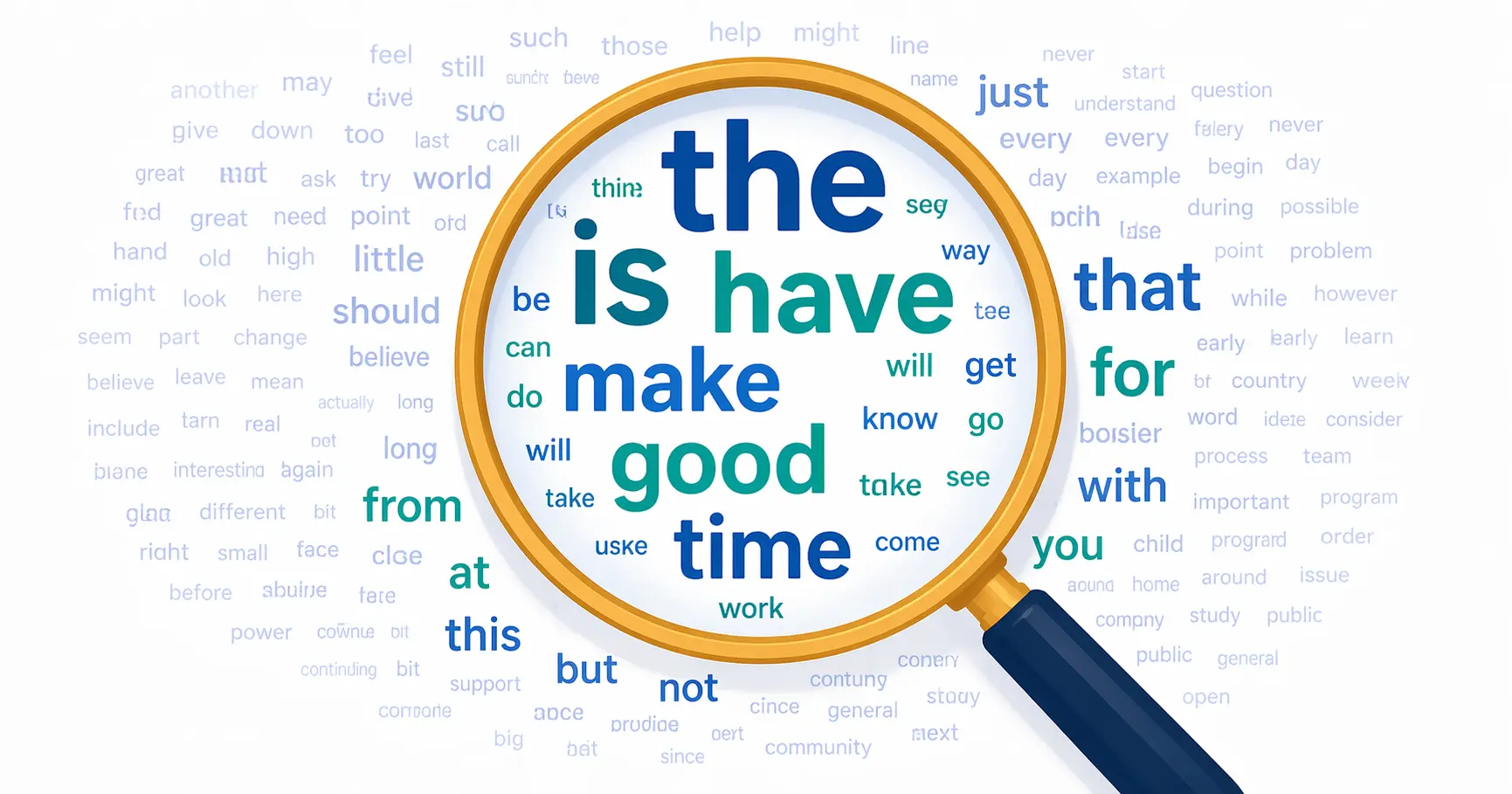
Function words (the, is, are, have, do, will, can) and basic nouns and verbs for daily needs: greetings (hello, thank you, sorry), people (friend, family, name), actions (go, come, want, need, like, have), time (today, tomorrow, now), and basic adjectives (good, bad, big, small, new, old). These 100–200 words form the skeleton of almost every English sentence.
How can I practice English words for daily use?
The most effective methods are: (1) Label objects in your home with English sticky notes; (2) Change your phone and social media to English; (3) Keep a daily vocabulary journal where you write 3–5 sentences using new words; (4) Talk to yourself in English (narrate your daily routine); (5) Use spaced repetition apps like Linglify to review words at optimal intervals.
What is the difference between “common words” and “daily use words”?
“Common words” refers to frequency — how often a word appears in written and spoken English overall. “Daily use words” are practical words you need for specific real-life situations (shopping, travel, health, etc.). There is significant overlap, but some very common words are abstract (e.g., “however,” “therefore”) and not immediately useful for daily conversation, while some daily use words (e.g., “luggage,” “prescription”) are not in the top frequency lists but are essential in specific situations.
Should I learn British English or American English words?
For daily use, the vast majority of words are identical. The differences are mainly in a few dozen everyday terms: flat (BrE) vs. apartment (AmE), boot vs. trunk, queue vs. line, chemist vs. pharmacy. Choose based on where you plan to live, work, or study. If you have no preference, American English vocabulary is more widely understood internationally due to media influence. Most importantly, be consistent — do not mix systems randomly.
How long does it take to learn 500 English words?
At a pace of 10 new words per day with regular review, you can learn 500 words in about 7–8 weeks. However, “learning” a word has stages: recognition (understanding it when you see/hear it) comes first and is fast; active use (using it correctly in your own sentences) takes longer. With spaced repetition, most learners can recognize 500 words within a month and use most of them actively within 2–3 months.