Food and Drink Vocabulary: English for Cooking, Restaurants, and More
Food is one of the first topics learners use in real life: at a supermarket, in a restaurant, while travelling, and when talking with friends. Instead of memorising one long list, learn food vocabulary by situation. You will remember ingredients better when you use them with recipe, chop, and fry.
This guide covers everyday food and drink words, cooking actions, restaurant language, and ways to describe flavour. For a full topic collection in Linglify, visit the food and drink vocabulary library.
- Level: A1–B2
- Focus: food groups, cooking, restaurants, drinks, taste, and texture
- Best practice: use the words to describe a meal you know well
Food, Meal, Dish, and Course
These words are related but not identical:
- food means things people eat in general;
- meal means an occasion when you eat, such as breakfast or dinner;
- dish means one prepared food item, such as curry or pasta;
- course means one part of a formal meal, such as a starter or dessert.
Fruit, Vegetables, and Everyday Ingredients
| Word | Meaning | Example sentence |
|---|---|---|
| apple | a round fruit with firm flesh | I usually take an apple to work. |
| banana | a long yellow fruit | Add a sliced banana to the cereal. |
| berry | a small, soft fruit | These berries are sweet and fresh. |
| lemon | a sour yellow citrus fruit | Put some lemon in the water. |
| potato | a starchy vegetable that grows underground | We had baked potatoes for dinner. |
| tomato | a red fruit often used as a vegetable in cooking | The salad needs more tomato. |
| onion | a round vegetable with a strong smell and taste | Chop the onion before you cook it. |
| carrot | a long orange root vegetable | Carrots are good in soup. |
| bean | a small seed used as food | This dish contains beans and rice. |
| mushroom | a soft fungus used in many dishes | She does not eat mushrooms. |
| herb | a leaf used to add flavour to food | Basil is a popular herb in Italian cooking. |
| spice | a dried seed, root, or powder used for flavour | This spice makes the sauce warmer and richer. |
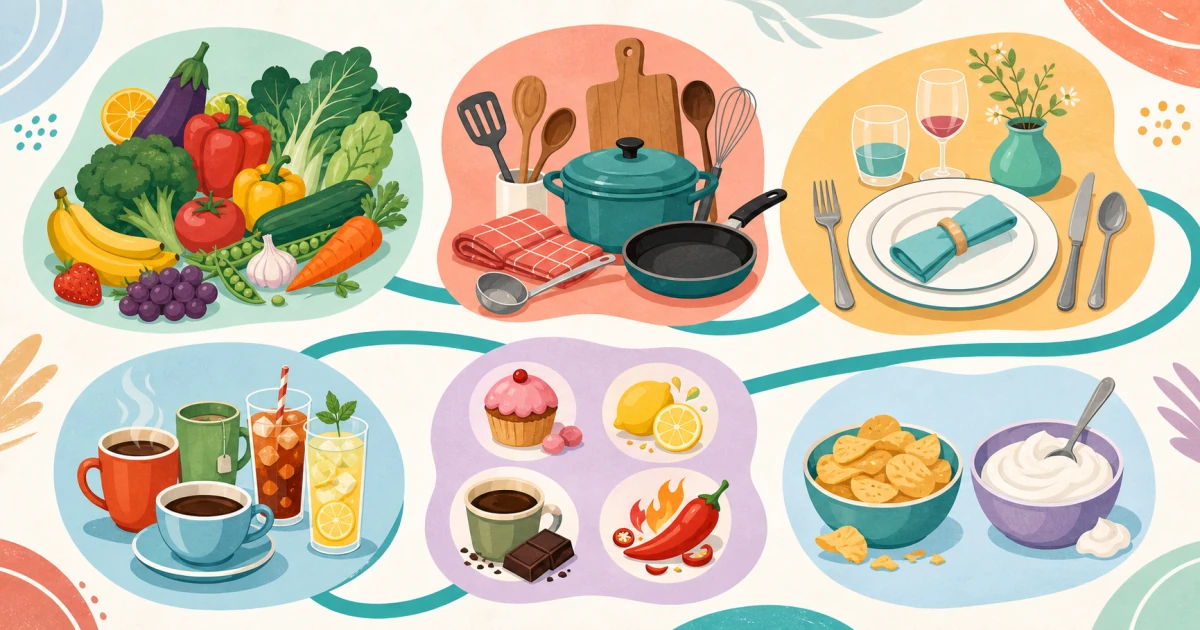
Cooking Verbs and Kitchen Vocabulary
| Word | Meaning | Example sentence |
|---|---|---|
| recipe | instructions for preparing a dish | This recipe takes only twenty minutes. |
| ingredient | one item used to make a dish | Check that you have all the ingredients. |
| chop | to cut food into small pieces | Chop the carrots into small pieces. |
| slice | to cut into thin flat pieces | Slice the bread carefully. |
| mix | to combine ingredients | Mix the eggs with the milk. |
| boil | to cook in very hot water | Boil the pasta for eight minutes. |
| fry | to cook in hot oil | Fry the onions until they are soft. |
| bake | to cook in an oven | We baked a cake for her birthday. |
| grill | to cook with heat from above or below | Grill the vegetables for ten minutes. |
| serve | to give food to people at a meal | The restaurant serves lunch from noon. |
At a Restaurant or Café
| Expression | Meaning or use | Example sentence |
|---|---|---|
| menu | the list of food and drinks available | Could I see the menu, please? |
| starter | a small first course | We shared a starter. |
| main course | the central dish of a meal | The fish is my main course. |
| dessert | a sweet final course | Would you like dessert? |
| bill / check | the amount you must pay | Could we have the bill, please? |
| reservation | an arrangement to have a table kept for you | I have a reservation for two at seven. |
| allergy | a harmful physical reaction to something | I have a nut allergy. |
| vegetarian | a person who does not eat meat | Is there a vegetarian option? |
| takeaway / takeout | food bought to eat elsewhere | Let’s order a takeaway tonight. |
| tip | extra money given for service | In some countries, leaving a tip is expected. |
Drinks, Taste, and Texture
| Word | Meaning | Example sentence |
|---|---|---|
| still water | water without bubbles | I would like still water, please. |
| sparkling water | water with bubbles | She prefers sparkling water with lunch. |
| juice | a drink made from fruit or vegetables | Is the orange juice freshly squeezed? |
| smoothie | a thick cold drink made by blending ingredients | He made a banana smoothie for breakfast. |
| bitter | having a sharp, not sweet taste | Black coffee can taste bitter. |
| sour | having an acid taste like lemon | The sauce is too sour for me. |
| sweet | tasting like sugar | This mango is very sweet. |
| spicy | containing hot spices | The curry is delicious but spicy. |
| crispy | pleasantly firm and breaking easily | The bread is warm and crispy. |
| creamy | smooth and rich like cream | The soup has a creamy texture. |
Say What You Want Clearly
Useful food language often appears in polite requests:
- Could I have …, please?
- I would like …
- Can I get this without …?
- Is this suitable for vegetarians?
- Could you make it less spicy?
Remember that I want is grammatically correct, but I would like is usually more polite in a restaurant.
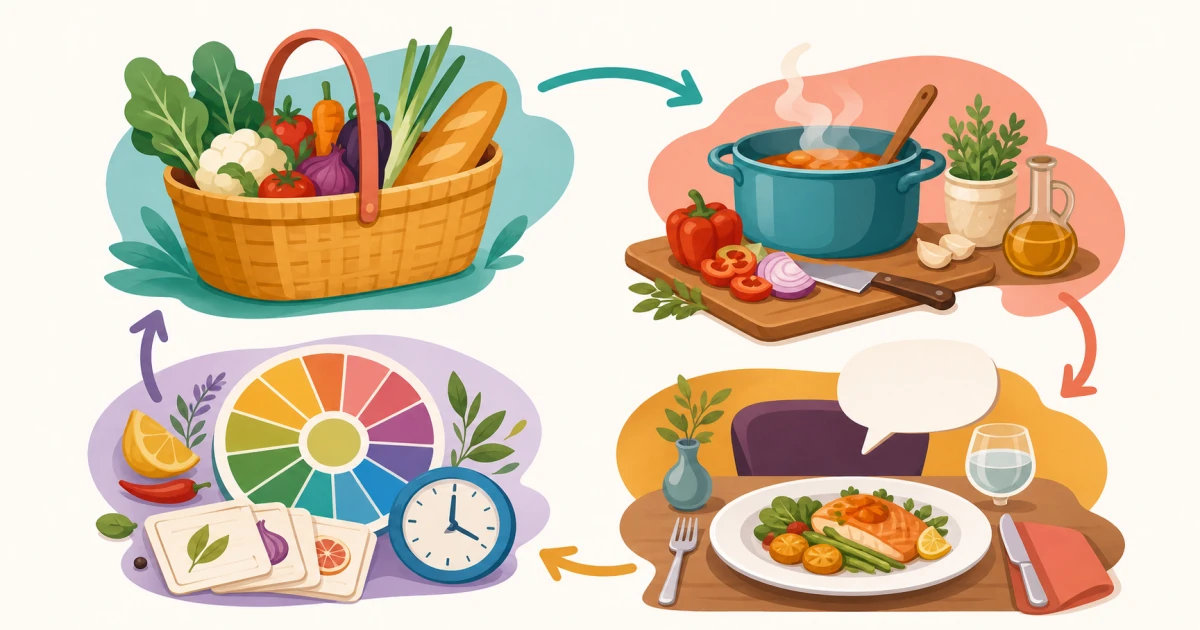
Learn Food Vocabulary Through Your Life
Choose one meal you eat often. Write the ingredients, the cooking actions, and three words for taste or texture. Then describe it aloud:
“For breakfast, I make oatmeal with banana and berries. I mix it with milk. It is warm, sweet, and creamy.”
This kind of personal practice is more memorable than translating forty unrelated food words.
Words to Practice
experience
noun
Knowledge or skill gained from doing or experiencing something.
Examples
- Her previous work experience made her an ideal candidate for the position.
- Traveling to different countries provides valuable cultural experience.
meeting
noun
An organized gathering of people for discussion or activity.
Examples
- The business meeting discussed budget plans for next fiscal year.
- Town meeting allows residents to voice concerns about local issues.
reply
noun
A short answer or reaction to a question or statement.
Examples
- Quick reply shows professional customer service quality.
- Written reply confirms agreement terms and conditions.
result
noun
A result or effect of an action or situation.
Examples
- Election result surprises political analysts and voters.
- Test result shows significant improvement in performance.
create
verb
To bring something into existence or make something new.
Examples
- Artists create beautiful works that inspire and move people emotionally.
- The new policy will create opportunities for economic growth.
mention
verb
To refer to or briefly talk about something.
Examples
- Please mention my name when you call about job opening.
- The report fails to mention important environmental concerns.
describe
verb
To give an account of or describe something in detail.
Examples
- Can you describe what the suspect looked like to police officers?
- The travel guide describes many interesting places to visit in Europe.
impact
noun
The effect or influence of one thing on another.
Examples
- Climate change has a significant impact on global weather patterns.
- The impact of the collision damaged both cars severely.
exam
noun
A short test to see how much someone knows or can do.
Examples
- Students study hard for weeks before taking their final exams.
- The driving exam tests both knowledge and practical skills behind wheel.
powerful
adjective
Having great strength, influence, or effect.
Examples
- Powerful computer processes data very quickly.
- Powerful speech moves audience to take action.
wonderful
adjective
Extremely good or enjoyable; causing pleasure.
Examples
- The restaurant serves wonderful food with excellent service.
- We had a wonderful time at the beach during summer vacation.
confident
adjective
Feeling sure of oneself and not uncertain about one's abilities or qualities.
Examples
- She felt confident about passing the difficult examination successfully.
- The confident speaker delivered an inspiring presentation to the audience.
favor
noun
Support or approval for someone or something.
Examples
- Could you do me a favor and pick up my dry cleaning?
- The proposal gained favor among the committee members after lengthy discussion.
ambition
noun
A strong desire to achieve something or succeed.
Examples
- Her ambition is to become a successful doctor and help people worldwide.
- Sometimes ambition can drive people to work too hard and neglect family.
tourist
noun
A noun for a person who travels to a place for pleasure or sightseeing.
Examples
- Foreign tourist visits famous landmarks and museums.
- Tourist season brings economic benefits to region.
student
noun
A person who is learning at a school or college.
Examples
- Diligent student completes homework assignments on time.
- Graduate student conducts research for doctoral degree.
relaxed
adjective
Feeling calm and not worried or tense.
Examples
- Relaxed atmosphere encourages open discussion among participants.
- Relaxed person handles pressure situations more effectively.
hot
adjective
Having a high temperature or feeling very warm.
Examples
- Summer weather is extremely hot in desert regions around the world.
- The coffee is too hot to drink right now - let it cool down.
cool
verb
To make something cooler in temperature or less warm.
orange
noun
A citrus fruit that is typically round, orange in color, and eaten raw.
Examples
- Fresh orange juice contains vitamin C and natural sugar.
- The sunset painted sky in beautiful shades of orange.
meat
noun
Flesh of animals used as food.
Examples
- Fresh meat should be stored in refrigerator for food safety.
- Vegetarians choose not to eat meat for ethical reasons.
football
noun
A sport played with a round ball on a large field, where players try to score goals.
Examples
- Football is the most popular sport in many countries around the world.
- The children play football in the school yard during their lunch break.
noun
A collection of written, printed, or digital messages sent or received, often through the postal system.
Examples
- Check mail every day for important bills and official documents.
- Electronic mail has largely replaced traditional postal letters today.
father
noun
A male parent of a child.
Examples
- His father taught him how to ride a bicycle in the park.
- The young father proudly carried his baby daughter in his arms.
rush
noun
A sudden movement forward, often with urgency or speed.
Examples
- Last-minute rush creates stress and mistakes often.
- Morning rush causes traffic jams in city.
What to Study Next
- Learn more themed words in English Vocabulary by Topic.
- Use food language in Simple English Sentences for Daily Use.
- Add food words to your review routine in the food and drink vocabulary library.
FAQ
Is “food” countable?
Usually, “food” is uncountable: There is some food in the kitchen. Use “foods” when you mean types of food: Asian foods are popular here.
What is the difference between dinner and supper?
“Dinner” is the main evening meal in most varieties of English. “Supper” is also used, especially in some regions, but it can mean a lighter evening meal.
How can I improve restaurant English?
Learn complete polite requests, practise reading menus, and role-play both customer and server. Focus first on the phrases you are most likely to need.
What is the difference between spicy and hot?
“Spicy” describes food containing strong spices. “Hot” can mean spicy, but it can also mean high temperature, so “spicy” is clearer when you mean flavour.
Should I learn food idioms with food vocabulary?
Learn them separately after basic food words. Idioms such as a piece of cake do not have their literal food meaning.