
Homonyms in English: 200+ Examples with Meanings and Sentences
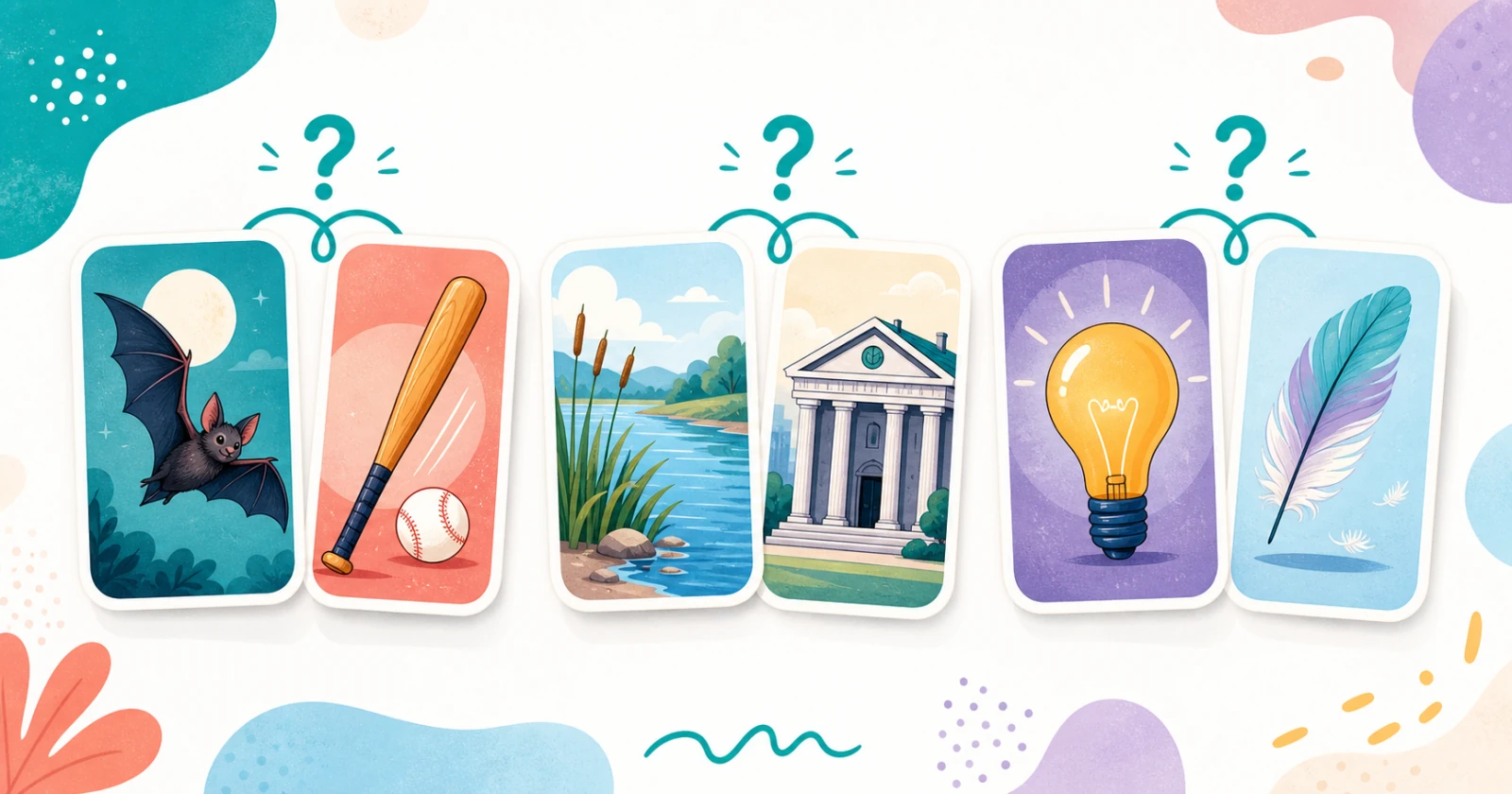
The word “bat” means a flying animal and a piece of sports equipment. “Bank” means a financial institution and the side of a river. “Light” means brightness and also means not heavy. These are homonyms — words that share the same spelling or pronunciation but have completely different meanings.
Homonyms are one of the trickiest aspects of English. You cannot guess which meaning is intended from the word alone; you need context. For learners, this creates constant confusion: you know the word, but you don’t know which meaning applies.
This guide lists 200+ of the most common English homonyms, organized by type. Each entry includes all major meanings and clear example sentences so you can see how context determines which meaning is being used.
- Total: 200+ homonyms
- Format: Word → Meanings → Example sentences
- Organized by: Type (true homonyms, homographs, homophones)
- Level: A2–C1
For a complete guide to homophones specifically, see English Homophones: Complete Guide with 300+ Examples.
What Are Homonyms?
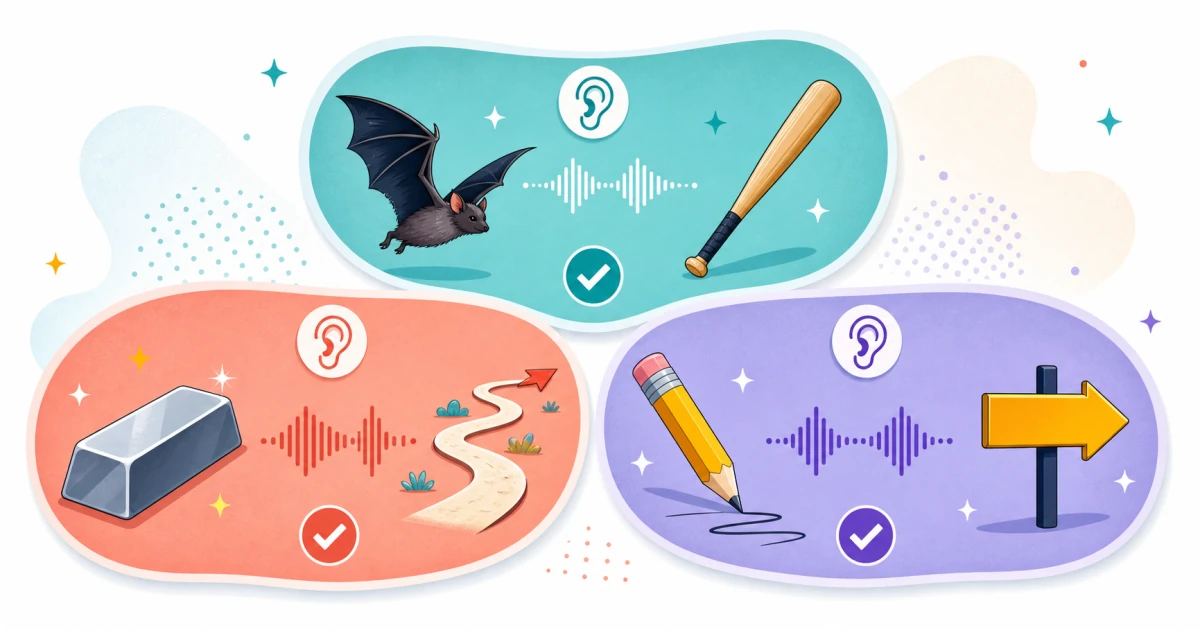
A homonym is a word that has the same spelling or pronunciation as another word but a different meaning. The term comes from Greek: homo (same) + onym (name).
There are three types:
| Type | Same Spelling? | Same Pronunciation? | Example |
|---|---|---|---|
| True Homonym | Yes | Yes | bat (animal) / bat (sports) |
| Homograph | Yes | No | lead (metal) / lead (to guide) |
| Homophone | No | Yes | write / right |
True homonyms are spelled the same AND pronounced the same, but have unrelated meanings. Homographs are spelled the same but pronounced differently. Homophones sound the same but are spelled differently.
In everyday use, people often call all three types “homonyms.” This guide covers all three, with the type indicated for each entry.
True Homonyms (Same Spelling + Same Pronunciation)
These are the classic homonyms: identical in both spelling and pronunciation, but with entirely different meanings.
A–D
| # | Word | Meaning 1 | Meaning 2 | Meaning 3 |
|---|---|---|---|---|
| 1 | arm | body part below the shoulder — She broke her arm. | weapon — The country armed its soldiers. | |
| 2 | ball | round object — Throw the ball! | formal dance — Cinderella went to the ball. | |
| 3 | band | group of musicians — The band played rock music. | strip of material — She wore a rubber band around her wrist. | |
| 4 | bank | financial institution — I went to the bank to deposit money. | side of a river — We sat on the bank of the Thames. | |
| 5 | bark | sound a dog makes — The dog barked at the stranger. | outer covering of a tree — The bark of the oak was rough. | |
| 6 | bat | flying mammal — Bats come out at night. | sports equipment — He swung the bat and hit the ball. | |
| 7 | bear | large animal — We saw a bear in the forest. | to carry or endure — I can’t bear the noise. | |
| 8 | bill | a piece of paper money — He paid with a $20 bill. | a statement of charges — The electricity bill was high. | beak of a bird — The duck’s bill was orange. |
| 9 | block | solid piece of material — a block of ice | to prevent — He blocked the entrance. | area between streets — Walk two blocks north. |
| 10 | board | flat piece of wood — She nailed the board to the wall. | to get on (a plane, bus) — We boarded the flight at 3 PM. | group of directors — The board approved the plan. |
| 11 | book | a written work — I’m reading a great book. | to reserve — I booked a hotel room. | |
| 12 | bow | front of a ship — The bow cut through the waves. | a knot with two loops — She tied a bow in her hair. | weapon for shooting arrows — He practiced with a bow and arrow. |
| 13 | bright | full of light — The room is very bright. | intelligent — She’s a bright student. | |
| 14 | can | metal container — a can of soup | to be able to — I can swim. | |
| 15 | capital | city where a government sits — Tokyo is the capital of Japan. | money/wealth — We need capital to start the business. | uppercase letter — Write your name in capitals. |
| 16 | change | to make different — I changed my mind. | coins — Do you have any change? | |
| 17 | chest | upper front of the body — He felt pain in his chest. | large strong box — The treasure chest was locked. | |
| 18 | club | organization — She joined the chess club. | heavy stick — a golf club | nightlife venue — We went to a club on Saturday. |
| 19 | coat | outer garment — Put on your coat — it’s cold. | layer of paint — Apply two coats of paint. | |
| 20 | cool | slightly cold — The water was cool and refreshing. | calm and composed — Stay cool under pressure. | trendy, impressive — That’s a cool jacket. |
| 21 | count | to calculate a number — Count the chairs in the room. | a nobleman — Count Dracula | |
| 22 | crane | a large bird — We saw a crane by the lake. | a machine for lifting — A crane lifted the steel beams. | |
| 23 | current | flow of water/electricity — The river current is strong. | happening now — The current situation is stable. | |
| 24 | date | day of the month — What’s today’s date? | a sweet fruit — I bought some dates at the market. | romantic outing — They went on a date. |
| 25 | deck | floor of a ship — We stood on the upper deck. | set of playing cards — Shuffle the deck. | |
| 26 | draft | preliminary version — This is the first draft of the essay. | flow of cool air — Close the window — there’s a draft. | to select for military service — He was drafted in 1942. |
| 27 | draw | to make a picture — She drew a portrait. | a tie in a game — The match ended in a draw. | to pull — Draw the curtains. |
| 28 | drop | a small amount of liquid — A drop of rain fell on my face. | to fall or let fall — I dropped my phone. | |
| 29 | duck | a waterbird — We fed the ducks in the park. | to lower your head quickly — Duck! The ball is coming! |
E–L
| # | Word | Meaning 1 | Meaning 2 | Meaning 3 |
|---|---|---|---|---|
| 30 | express | fast — an express train | to communicate — He expressed his concern. | |
| 31 | fair | just, reasonable — The decision was fair. | a public event with rides — We went to the county fair. | light-complexioned — She has fair skin. |
| 32 | fan | device for moving air — Turn on the fan. | an enthusiastic supporter — She’s a big fan of soccer. | |
| 33 | file | folder for documents — Put it in the file cabinet. | to smooth with a tool — She filed her nails. | to submit officially — He filed a complaint. |
| 34 | fine | of high quality — The wine was very fine. | money paid as punishment — He got a $100 fine for speeding. | acceptable — “How are you?” “I’m fine.” |
| 35 | fire | flames — The fire spread quickly. | to dismiss from a job — She was fired last week. | to shoot — The soldier fired his weapon. |
| 36 | flat | level surface — The land is flat. | apartment (British) — She lives in a flat in London. | deflated — I got a flat tire. |
| 37 | fly | an insect — A fly landed on my food. | to travel by air — We flew to Paris. | |
| 38 | foot | body part — My left foot hurts. | bottom of something — at the foot of the mountain | 12 inches — The room is 10 feet wide. |
| 39 | grave | burial place — They visited the grave. | very serious — This is a grave mistake. | |
| 40 | groom | man getting married — The groom looked nervous. | to clean/prepare an animal — She groomed the horse. | |
| 41 | ground | the surface of the earth — The ball hit the ground. | past tense of “grind” — She ground the coffee beans. | |
| 42 | jam | fruit preserve — strawberry jam | to become stuck — The printer jammed again. | traffic congestion — We’re stuck in a traffic jam. |
| 43 | key | device for opening locks — I lost my house key. | crucial, important — This is the key issue. | musical tone — The song is in the key of C. |
| 44 | kind | type, sort — What kind of music do you like? | generous and caring — She’s a very kind person. | |
| 45 | lap | one circuit of a track — He completed 10 laps. | flat area formed by thighs when seated — The cat sat on her lap. | |
| 46 | last | final — This is the last chance. | to continue — The meeting lasted two hours. | |
| 47 | lead | to guide — She led the team to victory. | a leash — Keep your dog on a lead. | |
| 48 | leaves | plural of “leaf” — The leaves turned brown. | departs — She leaves for work at 8 AM. | |
| 49 | letter | written message — I received a letter. | symbol of the alphabet — The letter ‘A’ is a vowel. | |
| 50 | lie | to recline — Lie down and rest. | to say something untrue — Don’t lie to me. | |
| 51 | light | brightness — Turn on the light. | not heavy — The bag is very light. | pale in color — She has light blue eyes. |
| 52 | line | a long mark — Draw a straight line. | a queue of people — There’s a long line outside. | text in a script — He forgot his lines. |
M–R
| # | Word | Meaning 1 | Meaning 2 | Meaning 3 |
|---|---|---|---|---|
| 53 | match | sports competition — We watched the football match. | small stick for lighting fire — He struck a match. | to correspond — The colors don’t match. |
| 54 | mean | to intend — What do you mean? | unkind — Don’t be so mean to your sister. | average — the mean temperature |
| 55 | mine | belonging to me — This book is mine. | underground excavation — a coal mine | |
| 56 | miss | to fail to hit or catch — I missed the bus. | a title for an unmarried woman — Miss Johnson | to feel the absence of — I miss my family. |
| 57 | mole | small burrowing animal — A mole dug up the garden. | dark spot on skin — She has a mole on her cheek. | unit in chemistry — One mole of water |
| 58 | nail | thin pointed metal — He hammered the nail. | hard covering on finger/toe — She painted her nails red. | |
| 59 | net | meshed material — a fishing net | remaining after deductions — net income | |
| 60 | note | written message — She left a note on the desk. | musical tone — He played a high note. | paper money — a ten-pound note |
| 61 | novel | a long fictional story — She wrote a novel. | new and unusual — That’s a novel approach. | |
| 62 | order | arrangement — Put them in alphabetical order. | to request — I ordered a pizza. | command — The officer gave an order. |
| 63 | organ | body part — The heart is a vital organ. | musical instrument — She plays the church organ. | |
| 64 | palm | inner surface of the hand — He placed the coin in her palm. | tropical tree — palm trees on the beach | |
| 65 | park | public green area — We walked in the park. | to leave a vehicle — I parked the car. | |
| 66 | patient | person receiving medical care — The patient is recovering. | able to wait calmly — Be patient — your turn will come. | |
| 67 | pen | writing instrument — Sign with a pen. | enclosure for animals — a sheep pen | |
| 68 | pick | to choose — Pick a card, any card. | to gather — We picked apples from the tree. | a pointed tool — an ice pick |
| 69 | pitch | playing field — a football pitch | to throw — She pitched the ball. | musical frequency — a high pitch |
| 70 | plant | living organism — Water the plants. | factory — a manufacturing plant | to put in the ground — We planted trees. |
| 71 | play | to engage in a game — The children played outside. | theatrical performance — We saw a play at the theater. | |
| 72 | point | sharp end — the point of a needle | purpose, idea — What’s your point? | to indicate direction — She pointed at the map. |
| 73 | pool | swimming pool — We swam in the pool. | shared resource — a car pool | billiards game — Let’s play pool. |
| 74 | pound | unit of weight — a pound of butter | British currency — It costs five pounds. | to hit heavily — He pounded on the door. |
| 75 | present | gift — She opened her birthday present. | current time — at the present moment | to show or introduce — He presented the report. |
| 76 | press | to push — Press the button. | news media — The press covered the event. | to iron — Press your shirt before the interview. |
| 77 | race | competition of speed — She won the race. | ethnic group — people of every race | |
| 78 | ring | circular band — a wedding ring | sound of a bell — The phone is ringing. | boxing area — The boxer entered the ring. |
| 79 | rock | hard stone — She sat on a rock. | music genre — rock and roll | to sway gently — She rocked the baby to sleep. |
| 80 | run | to move quickly — He runs every morning. | to manage — She runs a business. | to flow — The river runs through the valley. |
| 81 | ruler | measuring tool — Use a ruler to draw the line. | person who governs — the ruler of the kingdom |
S–Z
| # | Word | Meaning 1 | Meaning 2 | Meaning 3 |
|---|---|---|---|---|
| 82 | safe | free from danger — This neighborhood is safe. | a secure metal box — He kept the documents in a safe. | |
| 83 | scale | measuring device — Stand on the scale. | proportion or size — a large-scale project | thin plates on a fish — fish scales |
| 84 | seal | marine animal — We saw seals on the beach. | to close tightly — Seal the envelope. | official stamp — the government seal |
| 85 | second | after first — She finished second. | unit of time — Wait a second. | to support — I second that motion. |
| 86 | sentence | group of words — Write a complete sentence. | punishment from a court — He received a 5-year sentence. | |
| 87 | set | a group of things — a set of tools | to place down — Set the table for dinner. | to go down (sun) — The sun sets at 7 PM. |
| 88 | sharp | having a cutting edge — a sharp knife | exactly (time) — Be there at 3 o’clock sharp. | intelligent — She has a sharp mind. |
| 89 | sink | kitchen basin — Wash the dishes in the sink. | to go down below the surface — The ship sank. | |
| 90 | sole | only one — She was the sole survivor. | bottom of a shoe — The soles of my shoes are worn. | a type of fish — grilled sole |
| 91 | spring | season — Flowers bloom in spring. | source of water — a natural spring | coiled metal — a mattress spring | to jump — The cat sprang off the chair. | | 92 | stable | building for horses — The horses are in the stable. | steady, not changing — The patient is in stable condition. | | | 93 | staff | employees — The staff were very helpful. | a long stick — a wizard’s staff | | | 94 | stage | platform for performance — She walked onto the stage. | phase or period — the early stages of development | | | 95 | stake | pointed post — He drove a stake into the ground. | financial interest — He has a stake in the company. | | | 96 | star | celestial body — The stars are bright tonight. | famous person — She’s a movie star. | | | 97 | stick | a piece of wood — The dog fetched the stick. | to attach — Stick the poster on the wall. | | | 98 | story | narrative — She told a funny story. | floor of a building — a three-story building | | | 99 | suit | formal clothing — He wore a grey suit. | to be appropriate — Does Monday suit you? | legal action — She filed a suit against the company. | | 100 | tank | container for liquids — a fish tank | military vehicle — The army deployed tanks. | | | 101 | temple | place of worship — an ancient temple | side of the forehead — He rubbed his temples. | | | 102 | tender | soft, gentle — a tender touch | formal offer — They submitted a tender for the contract. | | | 103 | tie | neckwear — He wore a red tie. | equal result — The game ended in a tie. | to fasten — Tie your shoelaces. | | 104 | toast | heated bread — I had toast for breakfast. | a celebratory drink — Let’s raise a toast! | | | 105 | trip | a journey — a business trip | to stumble — She tripped on the step. | | | 106 | trunk | main stem of a tree — The trunk was three meters wide. | storage in a car (US) — Put the bags in the trunk. | elephant’s nose — The elephant used its trunk. | | 107 | type | kind, category — What type of music do you like? | to write on a keyboard — She typed the report. | | | 108 | vessel | a ship — a cargo vessel | container for liquids — a blood vessel | | | 109 | watch | a timepiece — a gold watch | to look at — Watch this video. | | | 110 | wave | ocean movement — The waves were huge. | to move your hand in greeting — She waved at us. | | | 111 | well | in good health — I feel well today. | a hole for water — They dug a well. | | | 112 | wind | moving air — The wind was strong. | to turn or twist — Wind the clock. (different pronunciation) | |
Common Homographs (Same Spelling, Different Pronunciation)
| # | Word | Pronunciation 1 | Pronunciation 2 |
|---|---|---|---|
| 113 | bass | /bæs/ — low musical sound — He plays bass guitar. | /bæs/ — a type of fish — We caught a bass. |
| 114 | bow | /baʊ/ — to bend forward — He bowed to the audience. | /boʊ/ — a weapon / ribbon — She tied a bow. |
| 115 | close | /kloʊz/ — to shut — Close the door. | /kloʊs/ — nearby — She lives close to the school. |
| 116 | content | /ˈkɒntent/ — what is contained — the content of the book | /kənˈtent/ — satisfied — She felt content with her life. |
| 117 | desert | /ˈdezərt/ — dry sandy area — the Sahara desert | /dɪˈzɜːrt/ — to abandon — He deserted his post. |
| 118 | dove | /dʌv/ — a bird — a white dove | /doʊv/ — past tense of dive — She dove into the pool. |
| 119 | lead | /liːd/ — to guide — She leads the team. | /led/ — a heavy metal — lead pipes |
| 120 | live | /lɪv/ — to exist — I live in Tokyo. | /laɪv/ — happening now — a live broadcast |
| 121 | minute | /ˈmɪnɪt/ — 60 seconds — Wait a minute. | /maɪˈnjuːt/ — extremely small — minute details |
| 122 | object | /ˈɒbdʒekt/ — a thing — a flying object | /əbˈdʒekt/ — to disagree — I object to this plan. |
| 123 | polish | /ˈpɒlɪʃ/ — to make shiny — Polish your shoes. | /ˈpoʊlɪʃ/ — from Poland — Polish cuisine |
| 124 | present | /ˈprezənt/ — a gift — a birthday present | /prɪˈzent/ — to show — He presented the report. |
| 125 | produce | /ˈprɒdjuːs/ — fresh food products — fresh produce | /prəˈdjuːs/ — to make — The factory produces cars. |
| 126 | project | /ˈprɒdʒekt/ — a planned task — a school project | /prəˈdʒekt/ — to estimate — They projected a 10% increase. |
| 127 | read | /riːd/ — present tense — I read books daily. | /red/ — past tense — She read the letter yesterday. |
| 128 | record | /ˈrekɔːrd/ — stored information — a world record | /rɪˈkɔːrd/ — to store information — Record the meeting. |
| 129 | refuse | /rɪˈfjuːz/ — to decline — She refused the offer. | /ˈrefjuːs/ — rubbish, waste — Refuse collection is on Mondays. |
| 130 | row | /roʊ/ — a line — a row of chairs | /raʊ/ — a noisy argument — They had a terrible row. |
| 131 | subject | /ˈsʌbdʒekt/ — topic — the subject of the essay | /səbˈdʒekt/ — to force to undergo — He was subjected to questioning. |
| 132 | tear | /tɪər/ — a drop from the eye — Tears rolled down her cheek. | /teər/ — to rip — She tore the paper in half. |
| 133 | wind | /wɪnd/ — moving air — The wind is strong today. | /waɪnd/ — to turn — Wind the handle clockwise. |
| 134 | wound | /wuːnd/ — an injury — a deep wound | /waʊnd/ — past tense of wind — She wound the thread around the spool. |
Common Homophones (Same Pronunciation, Different Spelling)
| # | Word 1 | Word 2 | Pronunciation | Meanings |
|---|---|---|---|---|
| 135 | write | right | /raɪt/ | to put words on paper / correct; direction |
| 136 | their | there / they’re | /ðeər/ | belonging to them / in that place / they are |
| 137 | to | too / two | /tuː/ | preposition / also; excessive / the number 2 |
| 138 | your | you’re | /jɔːr/ | belonging to you / you are |
| 139 | its | it’s | /ɪts/ | belonging to it / it is |
| 140 | know | no | /noʊ/ | to be aware / negative |
| 141 | hear | here | /hɪər/ | to perceive sound / in this place |
| 142 | sea | see | /siː/ | body of water / to perceive with eyes |
| 143 | son | sun | /sʌn/ | male child / the star |
| 144 | one | won | /wʌn/ | the number 1 / past tense of win |
| 145 | flower | flour | /flaʊər/ | a plant / powder for baking |
| 146 | meet | meat | /miːt/ | to encounter / animal flesh |
| 147 | piece | peace | /piːs/ | a part / absence of war |
| 148 | wait | weight | /weɪt/ | to stay / heaviness |
| 149 | break | brake | /breɪk/ | to damage / device for stopping |
| 150 | sail | sale | /seɪl/ | fabric on a boat / selling at lower price |
| 151 | tail | tale | /teɪl/ | animal appendage / a story |
| 152 | pair | pear / pare | /peər/ | two of something / a fruit / to peel |
| 153 | steal | steel | /stiːl/ | to take illegally / a metal |
| 154 | been | bean | /biːn/ | past participle of be / a vegetable |
| 155 | die | dye | /daɪ/ | to stop living / to color |
| 156 | heal | heel | /hiːl/ | to recover / back of the foot |
| 157 | knight | night | /naɪt/ | medieval warrior / time after sunset |
| 158 | threw | through | /θruː/ | past tense of throw / from one side to another |
| 159 | whole | hole | /hoʊl/ | complete / an opening |
| 160 | week | weak | /wiːk/ | seven days / not strong |
| 161 | which | witch | /wɪtʃ/ | what one? / magical woman |
| 162 | wood | would | /wʊd/ | material from trees / conditional verb |
| 163 | wear | where | /weər/ | to have on the body / in what place |
| 164 | made | maid | /meɪd/ | past tense of make / a female servant |
| 165 | waste | waist | /weɪst/ | to use carelessly / middle of the body |
| 166 | rain | reign | /reɪn/ | water from clouds / period of ruling |
| 167 | board | bored | /bɔːrd/ | flat piece of wood / feeling uninterested |
| 168 | cereal | serial | /ˈsɪriəl/ | breakfast grain / happening in a series |
| 169 | principal | principle | /ˈprɪnsəpəl/ | school leader / a fundamental rule |
| 170 | stationary | stationery | /ˈsteɪʃənəri/ | not moving / writing materials |
| 171 | affect | effect | /əˈfekt/ | to influence (verb) / a result (noun) |
| 172 | complement | compliment | /ˈkɒmplɪment/ | to complete / to praise |
| 173 | accept | except | /əkˈsept/ | to receive / not including |
| 174 | aloud | allowed | /əˈlaʊd/ | out loud / permitted |
| 175 | bare | bear | /beər/ | uncovered / large animal |
| 176 | cite | site / sight | /saɪt/ | to reference / location / ability to see |
| 177 | deer | dear | /dɪər/ | an animal / beloved; expensive |
| 178 | feat | feet | /fiːt/ | remarkable achievement / plural of foot |
| 179 | grown | groan | /ɡroʊn/ | past participle of grow / a sound of pain |
| 180 | hair | hare | /heər/ | on your head / a rabbit-like animal |
| 181 | hour | our | /aʊər/ | 60 minutes / belonging to us |
| 182 | knot | not | /nɒt/ | tied rope / negative |
| 183 | lesson | lessen | /ˈlesən/ | a class / to reduce |
| 184 | muscle | mussel | /ˈmʌsəl/ | body tissue / a shellfish |
| 185 | naval | navel | /ˈneɪvəl/ | relating to ships / belly button |
| 186 | passed | past | /pæst/ | went by / previous time |
| 187 | patience | patients | /ˈpeɪʃəns/ | ability to wait / people in medical care |
| 188 | profit | prophet | /ˈprɒfɪt/ | financial gain / religious leader |
| 189 | role | roll | /roʊl/ | a part played / to turn over; bread roll |
| 190 | scene | seen | /siːn/ | part of a play / past participle of see |
| 191 | sew | so / sow | /soʊ/ | to stitch / therefore / to plant seeds |
| 192 | stair | stare | /steər/ | a step / to look fixedly |
| 193 | toe | tow | /toʊ/ | foot digit / to pull a vehicle |
| 194 | vain | vein / vane | /veɪn/ | conceited / blood vessel / weather indicator |
| 195 | wary | weary | similar | cautious / tired |
| 196 | weather | whether | /ˈweðər/ | climate conditions / if |
| 197 | idle | idol | /ˈaɪdəl/ | not active / object of worship |
| 198 | morning | mourning | /ˈmɔːrnɪŋ/ | early part of day / grieving |
| 199 | council | counsel | /ˈkaʊnsəl/ | governing body / advice |
| 200 | dessert | desert | /dɪˈzɜːrt/ | sweet course / dry sandy area |
How to Master Homonyms
1. Always learn words in context. When you encounter “bank,” the sentence tells you whether it’s a financial institution or a riverside. Train yourself to read the full sentence, not individual words.
2. Pay attention to pronunciation. For homographs like “lead” and “wind,” pronunciation is the only way to distinguish meanings in speech. Practice both pronunciations.
3. Learn the most common meaning first. For “bat,” learn the sports equipment meaning first (it’s more common), then add the animal meaning later.
4. Use visual associations. For homophones like “write/right,” create a mental image that connects the spelling to the meaning: “write” has a ‘w’ like “word.”
5. Add to Linglify for spaced repetition practice with context sentences.
Words to Practice
boom
noun
A loud, deep sound or a sudden increase in activity or popularity.
Examples
- The boom of thunder echoed across the valley.
- The technology boom created many new millionaires.
cooperate
verb
To work together with others towards a common goal.
evaluate
verb
To judge or measure the value, quality, or importance of something.
Examples
- Companies evaluate job candidates based on experience, skills, and personality.
- Teachers evaluate student progress through tests, projects, and classroom participation.
graduate
verb
To complete a course of study at a school or university.
Examples
- She will graduate from university next year with a degree in engineering.
- Students must complete all requirements before they can graduate from high school.
horizon
noun
The line where the earth or the sky appears to meet in the distance.
Examples
- The sun disappeared behind the horizon as evening approached.
- Traveling broadens your horizon and exposes you to new cultures.
indispensable
adjective
Absolutely necessary; essential.
Examples
- Clean water is indispensable for human survival and good health.
- Her experience and skills make her indispensable to the research team.
jury
noun
A group of people who listen to evidence in a court and decide if someone is guilty.
Examples
- The jury deliberated for several hours before reaching a verdict.
- The talent show jury consisted of professional musicians and entertainers.
lifelong
adjective
Continuing for a very long time or for the whole life.
Examples
- Learning is a lifelong process that never truly ends.
- Their lifelong friendship began during elementary school years.
motivated
adjective
Feeling driven or inspired to do something because of a reason or goal.
Examples
- Motivated employee seeks additional responsibilities and challenges at work.
- Success requires being motivated even when facing difficult obstacles.
normally
adverb
Usually; under normal conditions.
Examples
- Heart normally beats between sixty and hundred times per minute.
- Students normally arrive at school before morning bell rings.
off
adjective
Describes something that is not fresh or is no longer suitable for eating, often used for food and drinks.
Examples
- Please turn off the lights before leaving the room.
- The dog ran off into the forest chasing wild rabbits.
prejudice
noun
Preconceived opinions or feelings, often negative, about a person or group.
Examples
- Education helps overcome prejudice and promotes understanding.
- Racial prejudice damages communities and individuals alike.
resolve
verb
To find a solution or answer to a problem or question.
Examples
- Mediator helps parties resolve dispute through negotiation.
- Technical team will resolve software problems quickly.
stress
verb
To feel mental or emotional pressure or worry; to emphasize or give importance to something.
Examples
- Heavy workload may stress employees beyond limits.
- Teacher will stress importance of homework completion.
total
adjective
An adjective describing something that is complete or whole, not divided or broken.
Examples
- Total cost includes all fees and expenses.
- Total silence fills room during meditation session.
tragedy
noun
An extremely sad or serious event that causes suffering or loss.
Examples
- Natural tragedy affects thousands of innocent people.
- Personal tragedy changes person's life perspective completely.
union
noun
A group of people or things joined together for a purpose.
Examples
- Labor union protects worker rights and interests.
- Marriage union joins two people in partnership.
voyage
noun
A long journey to a distant place, often by sea or air.
Examples
- Space exploration represents humanity's greatest voyage into the unknown.
- The ocean voyage from Europe to America took several weeks in the past.
candidate
noun
A person who is competing in an election or contest.
Examples
- Each presidential candidate presented their policy plans to voters.
- The job candidate impressed the interview panel with her experience.
discourage
verb
To try to make someone feel less confident or hopeful about something.
Examples
- Don't let one failure discourage you from pursuing your dreams.
- High prices discourage many people from buying organic food products.
donate
verb
To give something, especially money or goods, to help a cause or person.
Examples
- Many people donate money to charities that help homeless individuals.
- She decided to donate blood to help patients in emergency situations.
firmly
adverb
An adverb indicating a way of doing something with certainty or stability.
Examples
- Hold the rope firmly while climbing down the steep mountain slope.
- The manager firmly believed in treating all employees with respect.
guide
verb
To show or direct someone how to do something.
Examples
- Parents should guide their children to make responsible decisions.
- The experienced hiker will guide the group through the mountain trail safely.
humorous
adjective
Funny or amusing, often making people laugh.
Examples
- She writes humorous articles about everyday life and family experiences.
- The humorous speech made everyone laugh and lightened the serious mood.
admission
noun
The process or fact of being allowed to enter or join.
Examples
- Her admission to the prestigious medical school was the result of hard work.
- The museum offers free admission on the first Sunday of every month.
FAQ
What is a homonym? Give 5 examples.
A homonym is a word that has the same spelling or pronunciation as another word but a different meaning. Five examples: (1) bat — a flying animal / sports equipment, (2) bank — financial institution / river side, (3) light — brightness / not heavy, (4) ring — jewelry / a phone sound, (5) fair — just / a public event. The key is that context determines which meaning applies.
What is the difference between homonyms, homophones, and homographs?
Homonyms are spelled AND pronounced the same but have different meanings (bat/bat). Homophones are pronounced the same but spelled differently (write/right). Homographs are spelled the same but pronounced differently (*lead — the metal /led/ vs. lead — to guide /liːd/). “Homonym” is also used as an umbrella term for all three categories.
How many homonyms are there in English?
English has approximately 450–500 sets of true homonyms (same spelling + same pronunciation + different meaning), plus roughly 600+ homophone pairs and 150+ homograph pairs. The exact number depends on how strictly you define “different meaning” — some words have dozens of related meanings that shade into each other.
Why does English have so many homonyms?
English borrowed words from many languages — Latin, French, Norse, Germanic languages, Greek — over centuries. Words from different origins sometimes ended up with the same spelling or pronunciation. “Bank” (financial) comes from Italian banca (bench), while “bank” (riverside) comes from Old Norse banki. Their similarity is coincidental.
Are homonyms a problem for AI and machine translation?
Yes. Homonyms are one of the biggest challenges for natural language processing. When a machine reads “I went to the bank,” it must use surrounding context to determine whether “bank” means a financial institution or a riverside. Modern AI (like GPT models) handles this well using statistical context analysis, but errors still occur, especially with rarer meanings.


