Idiomatic Expressions in English: What They Are and How to Use Them
You can know every word in “She let the cat out of the bag” and still have no idea what the sentence means. That’s because it’s an idiomatic expression — a phrase whose meaning cannot be understood from the individual words. The sentence has nothing to do with cats or bags. It means “she revealed a secret.”
Idiomatic expressions are everywhere in English. Native speakers use them in every conversation, email, meeting, and text message — often without realizing it. For learners, this creates a frustrating gap: your grammar is correct, your vocabulary is solid, but half the things people say seem to make no sense.
This guide explains what idiomatic expressions actually are, how they work, what types exist, and — most importantly — how to learn and use them. It includes 100+ examples organized by type and topic, with clear meanings and natural sentences.
- What you’ll learn: definition, types, and structure of idiomatic expressions
- Examples included: 100+ idiomatic expressions with meanings
- Level: B1–C1
- For: understanding natural English, exam prep, conversation fluency
For a complete list of 500+ English idioms, see English Idioms: 500+ Common Expressions.
What Is an Idiomatic Expression?
An idiomatic expression (also called an idiom) is a phrase or sentence whose meaning is different from the literal meaning of its individual words.
| Expression | Literal Meaning | Actual (Idiomatic) Meaning |
|---|---|---|
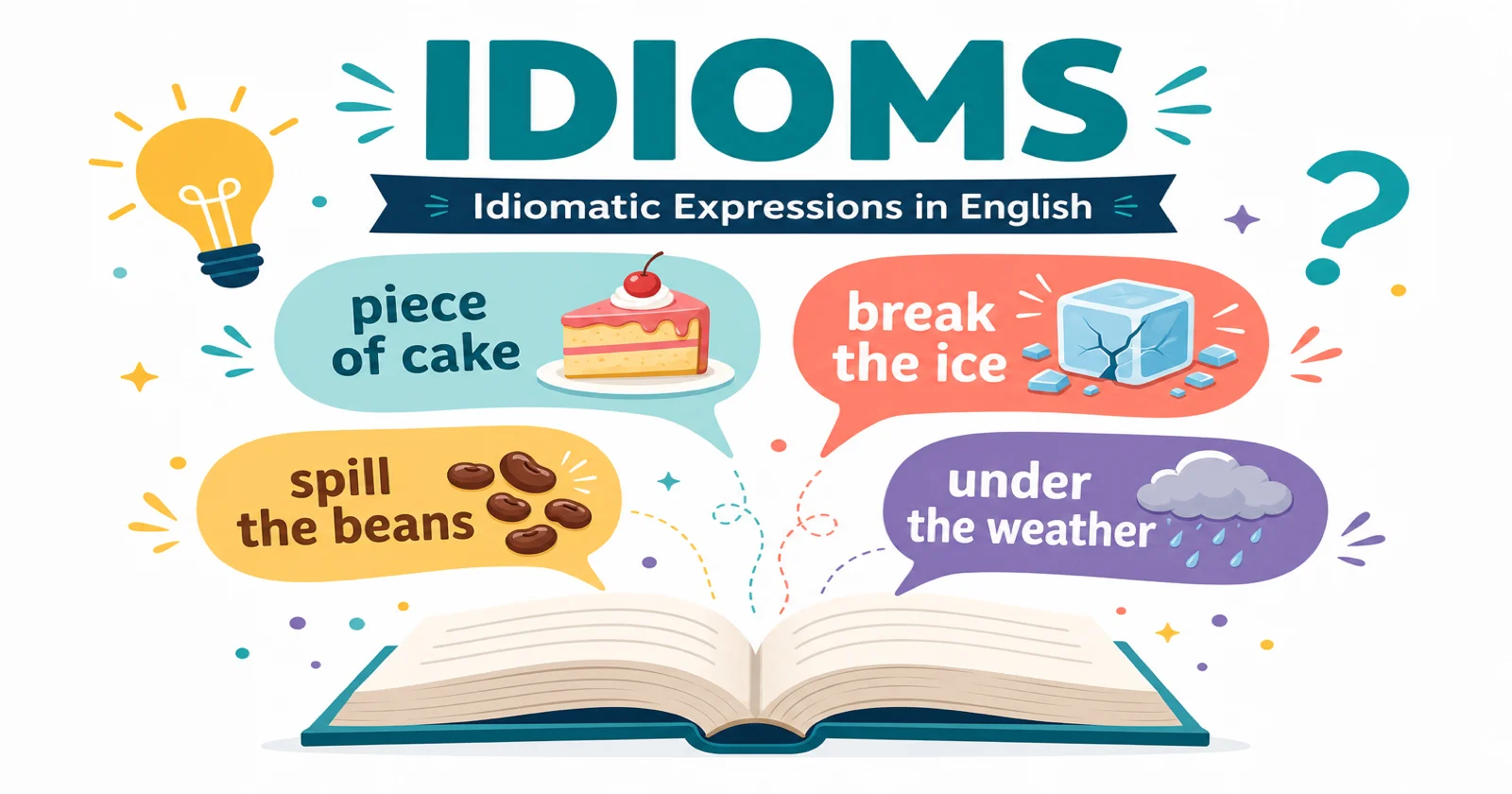
| break the ice | physically break ice | start a conversation in an awkward situation |
| hit the nail on the head | hammer a nail | say something exactly right |
| under the weather | beneath the weather | feeling sick |
| piece of cake | a slice of cake | something very easy |
| cost an arm and a leg | lose body parts as payment | be very expensive |
The key characteristic: you cannot guess the meaning from the words. If someone says “It’s a piece of cake,” they are not talking about dessert. If someone says “He kicked the bucket,” they are not talking about kicking anything — they mean he died.
This is what makes idioms different from other types of phrases. A phrase like “heavy rain” uses “heavy” metaphorically, but you can still guess the meaning. With idioms, guessing from the words is impossible.
Idiomatic vs. Literal Language
| Feature | Literal Language | Idiomatic Language |
|---|---|---|
| Meaning | matches the words | differs from the words |
| Predictable? | yes | no |
| Translatable? | word-for-word | must translate the meaning |
| Example | “She closed the door” | “She let the cat out of the bag” |
Why Do Idiomatic Expressions Exist?
Every language has idioms. They develop naturally over centuries for several reasons:
1. Efficiency. “He kicked the bucket” is shorter and more vivid than “He died.” Idioms compress complex ideas into compact phrases.
2. Shared cultural experience. Many idioms come from specific historical activities — farming (“separate the wheat from the chaff”), sailing (“learn the ropes”), sports (“move the goalposts”), or war (“bury the hatchet”). The original context fades, but the expression survives.
3. Emotional color. “I’m a bit tired” is neutral. “I’m running on empty” paints a picture. Idioms add emotional depth and personality to language.
4. Social bonding. Using idioms signals that you belong to a speech community. When a colleague says “Let’s not reinvent the wheel,” everyone who knows the idiom feels connected. Idioms are cultural passwords.
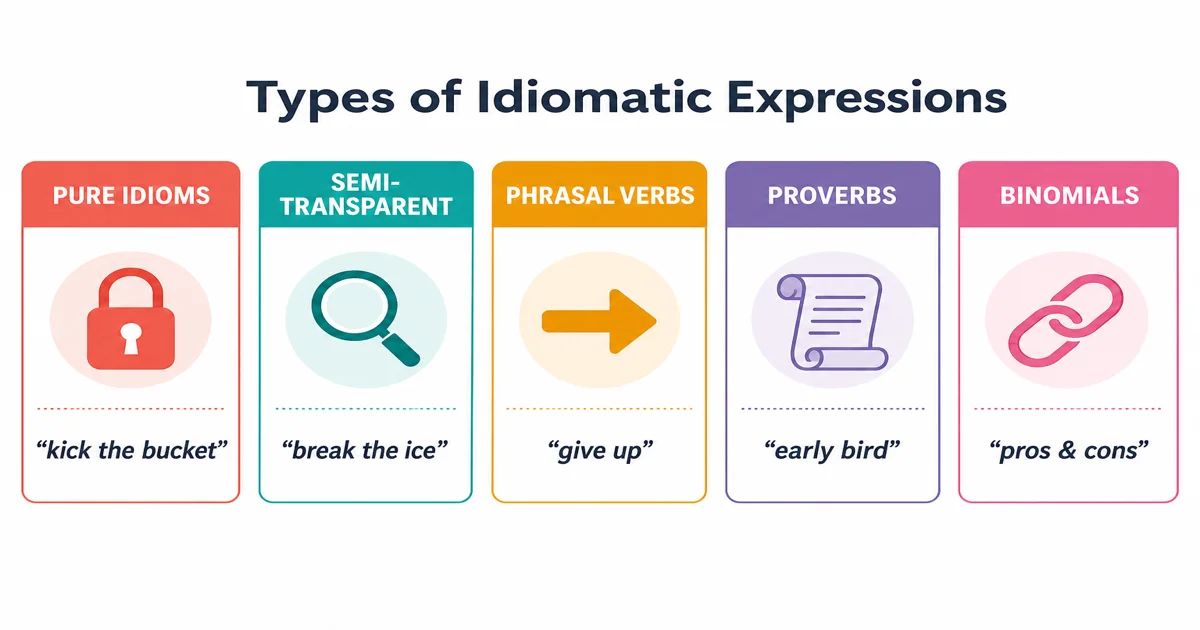
Types of Idiomatic Expressions
Not all idioms work the same way. Understanding the different types helps you recognize and learn them more efficiently.
1. Pure Idioms (Opaque)
The meaning has no connection to the literal words. You cannot guess the meaning at all.
| Idiom | Meaning |
|---|---|
| kick the bucket | die |
| spill the beans | reveal a secret |
| bite the bullet | endure something painful |
| break a leg | good luck |
| by the skin of your teeth | barely, just in time |
| once in a blue moon | very rarely |
| the whole nine yards | everything, the full amount |
| fly off the handle | become suddenly angry |
These are the hardest to learn because there is no logical bridge between the words and the meaning. You must memorize them.
2. Semi-Transparent Idioms
The meaning is partially guessable from the words. There is a metaphorical connection, but it’s not obvious.
| Idiom | Meaning | Why Semi-Transparent |
|---|---|---|
| break the ice | start a conversation | ice = social coldness/awkwardness |
| see eye to eye | agree completely | eyes meeting = mutual understanding |
| burn bridges | damage a relationship permanently | bridge = connection |
| light at the end of the tunnel | hope after difficulty | tunnel = dark period |
| turn over a new leaf | make a fresh start | leaf = page in a book |
| let sleeping dogs lie | don’t disturb a calm situation | sleeping = peaceful |
| hit the nail on the head | say something exactly right | nail = the point |
| beat around the bush | avoid the main topic | bush = the point |
These are easier to remember because the metaphor gives you a mental hook.
3. Phrasal Verb Idioms
Many phrasal verbs are idiomatic — their meaning cannot be guessed from the verb + particle combination.
| Phrasal Verb | Meaning |
|---|---|
| give up | stop trying |
| look up to | admire and respect |
| put up with | tolerate |
| get away with | avoid punishment |
| run into | meet unexpectedly |
| come across | find by chance |
| bring up | mention a topic; raise a child |
| figure out | understand after thinking |
For a deep dive into phrasal verbs, see Phrasal Verbs with GET and English Phrasal Verbs: Complete Guide.
4. Proverbs and Sayings
Proverbs are complete sentences that express a general truth or piece of advice. Many are idiomatic.
| Proverb | Meaning |
|---|---|
| Don’t put all your eggs in one basket. | Don’t risk everything on a single plan. |
| The early bird catches the worm. | Success comes to those who act first. |
| Every cloud has a silver lining. | Something good can come from a bad situation. |
| Don’t count your chickens before they hatch. | Don’t assume success before it happens. |
| Actions speak louder than words. | What you do matters more than what you say. |
| When in Rome, do as the Romans do. | Adapt to local customs. |
| The grass is always greener on the other side. | Other situations always seem better. |
| You can’t judge a book by its cover. | Appearances can be deceiving. |
5. Binomial Idioms (Pairs)
Two words joined by “and” or “or” in a fixed order.
| Binomial | Meaning |
|---|---|
| pros and cons | advantages and disadvantages |
| give and take | mutual compromise |
| now and then | occasionally |
| sick and tired | completely fed up |
| odds and ends | miscellaneous small items |
| by and large | generally, mostly |
| sooner or later | eventually |
| more or less | approximately |
The word order is fixed: “pros and cons” is correct; “cons and pros” sounds wrong.
100 Essential Idiomatic Expressions by Topic
Everyday Life
| # | Expression | Meaning | Example |
|---|---|---|---|
| 1 | a piece of cake | very easy | The test was a piece of cake. |
| 2 | break the ice | start a conversation | He told a joke to break the ice. |
| 3 | call it a day | stop working | We’ve done enough — let’s call it a day. |
| 4 | get out of hand | become uncontrollable | The party got out of hand quickly. |
| 5 | in the long run | over a long period of time | Exercise pays off in the long run. |
| 6 | on the same page | in agreement | Let’s make sure we’re all on the same page. |
| 7 | the last straw | the final problem that causes a reaction | His late arrival was the last straw. |
| 8 | at the end of the day | ultimately | At the end of the day, family matters most. |
| 9 | give it a shot | try | I’ve never done it, but I’ll give it a shot. |
| 10 | no-brainer | an easy decision | Accepting the scholarship was a no-brainer. |
Success and Failure
| # | Expression | Meaning | Example |
|---|---|---|---|
| 11 | hit the nail on the head | be exactly right | You hit the nail on the head with that analysis. |
| 12 | back to square one | start over | The plan failed, so we’re back to square one. |
| 13 | cut corners | do something cheaply or improperly | They cut corners on safety to save money. |
| 14 | go the extra mile | make more effort than required | She always goes the extra mile for her clients. |
| 15 | miss the boat | miss an opportunity | If you don’t apply now, you’ll miss the boat. |
| 16 | the ball is in your court | it’s your decision/turn | I’ve made my offer — the ball is in your court. |
| 17 | learn the ropes | learn the basics of a job | It took a month to learn the ropes. |
| 18 | throw in the towel | give up | After three failed attempts, he threw in the towel. |
| 19 | up in the air | uncertain, undecided | Our vacation plans are still up in the air. |
| 20 | ahead of the curve | more advanced than others | Their technology is ahead of the curve. |
Money and Business
| # | Expression | Meaning | Example |
|---|---|---|---|
| 21 | cost an arm and a leg | be very expensive | The repair cost an arm and a leg. |
| 22 | break the bank | be too expensive | A weekend trip doesn’t have to break the bank. |
| 23 | make ends meet | have just enough money | It’s hard to make ends meet on minimum wage. |
| 24 | penny for your thoughts | what are you thinking? | You look worried — penny for your thoughts? |
| 25 | get the ball rolling | start a process | Let’s get the ball rolling on this project. |
| 26 | in the red | in debt, losing money | The company has been in the red for two quarters. |
| 27 | bring to the table | contribute | What skills do you bring to the table? |
| 28 | think outside the box | be creative | We need to think outside the box to solve this. |
| 29 | the bottom line | the most important point | The bottom line is we need more revenue. |
| 30 | a ballpark figure | an approximate estimate | Give me a ballpark figure for the project cost. |
Emotions and Feelings
| # | Expression | Meaning | Example |
|---|---|---|---|
| 31 | on cloud nine | extremely happy | She’s been on cloud nine since the proposal. |
| 32 | under the weather | feeling sick | I’m feeling under the weather today. |
| 33 | over the moon | extremely happy | They were over the moon about the baby. |
| 34 | down in the dumps | sad, depressed | He’s been down in the dumps since the breakup. |
| 35 | butterflies in my stomach | nervous excitement | I always get butterflies before a presentation. |
| 36 | blow off steam | release stress or anger | I go for a run to blow off steam. |
| 37 | keep a stiff upper lip | remain calm under pressure | The British are famous for keeping a stiff upper lip. |
| 38 | lose your cool | become angry or upset | Try not to lose your cool during the interview. |
| 39 | get cold feet | become nervous before a big event | He got cold feet before the wedding. |
| 40 | have a heart of gold | be very kind and generous | Despite her tough exterior, she has a heart of gold. |
Communication
| # | Expression | Meaning | Example |
|---|---|---|---|
| 41 | beat around the bush | avoid the main topic | Stop beating around the bush and tell me the truth. |
| 42 | spill the beans | reveal a secret | Someone spilled the beans about the surprise party. |
| 43 | get straight to the point | talk about the main issue directly | I’ll get straight to the point — we need to cut costs. |
| 44 | speak your mind | say what you truly think | She’s not afraid to speak her mind. |
| 45 | read between the lines | understand the hidden meaning | You have to read between the lines of his email. |
| 46 | keep someone in the loop | inform someone regularly | Please keep me in the loop on any developments. |
| 47 | ring a bell | sound familiar | The name rings a bell, but I can’t place it. |
| 48 | word of mouth | information spread through conversation | The restaurant became famous through word of mouth. |
| 49 | take with a grain of salt | don’t believe everything | Take his claims with a grain of salt. |
| 50 | cut to the chase | get to the point | Let’s cut to the chase — what do you want? |
Relationships
| # | Expression | Meaning | Example |
|---|---|---|---|
| 51 | see eye to eye | agree completely | We don’t always see eye to eye on politics. |
| 52 | get along like a house on fire | become friends immediately | They got along like a house on fire. |
| 53 | stab in the back | betray someone | I can’t believe he stabbed me in the back. |
| 54 | give someone the cold shoulder | deliberately ignore someone | She gave him the cold shoulder after the argument. |
| 55 | bend over backwards | try very hard to help | She bent over backwards to make us comfortable. |
| 56 | bury the hatchet | make peace, end a conflict | It’s time to bury the hatchet and move on. |
| 57 | a shoulder to cry on | someone who listens to your problems | She’s always been a shoulder to cry on. |
| 58 | give someone the benefit of the doubt | trust someone despite uncertainty | I’ll give him the benefit of the doubt this time. |
| 59 | hit it off | immediately get along | We hit it off on our first date. |
| 60 | two-faced | insincere, hypocritical | She’s two-faced — nice to you, then talks behind your back. |
Time
| # | Expression | Meaning | Example |
|---|---|---|---|
| 61 | in the nick of time | just barely in time | We arrived at the airport in the nick of time. |
| 62 | once in a blue moon | very rarely | I only eat fast food once in a blue moon. |
| 63 | around the clock | 24 hours a day | The team worked around the clock to finish. |
| 64 | at the eleventh hour | at the last possible moment | The deal was saved at the eleventh hour. |
| 65 | time flies | time passes quickly | Time flies when you’re having fun. |
| 66 | kill time | do something while waiting | I killed time by reading a magazine. |
| 67 | behind the times | old-fashioned | His management style is behind the times. |
| 68 | stand the test of time | remain relevant or effective | Their friendship has stood the test of time. |
| 69 | ahead of time | earlier than expected | She finished the project ahead of time. |
| 70 | rain or shine | no matter what | We’ll be there, rain or shine. |
Knowledge and Learning
| # | Expression | Meaning | Example |
|---|---|---|---|
| 71 | learn the hard way | learn from painful experience | He learned the hard way not to trust strangers online. |
| 72 | a steep learning curve | difficult to learn at first | There’s a steep learning curve with this software. |
| 73 | know something inside out | know something thoroughly | She knows the industry inside out. |
| 74 | pick someone’s brain | ask for advice or information | Can I pick your brain about the marketing strategy? |
| 75 | food for thought | something to think about | Your proposal is food for thought. |
| 76 | in a nutshell | in summary | In a nutshell, we need more time and money. |
| 77 | get the hang of it | learn how to do something | It takes a few weeks to get the hang of it. |
| 78 | scratch the surface | deal with only a small part | We’ve barely scratched the surface of this topic. |
| 79 | do your homework | research before making a decision | Make sure you do your homework before investing. |
| 80 | the tip of the iceberg | only a small visible part | What we found is just the tip of the iceberg. |
Difficulty and Problems
| # | Expression | Meaning | Example |
|---|---|---|---|
| 81 | between a rock and a hard place | in a difficult situation with no good options | He’s between a rock and a hard place. |
| 82 | the elephant in the room | an obvious problem nobody mentions | The company’s debt is the elephant in the room. |
| 83 | at the end of your rope | at the limit of patience or endurance | I’m at the end of my rope with this project. |
| 84 | a can of worms | a complicated situation | That question opened a whole can of worms. |
| 85 | add fuel to the fire | make a bad situation worse | His comments only added fuel to the fire. |
| 86 | a blessing in disguise | something bad that turns out good | Losing that job was a blessing in disguise. |
| 87 | burn the midnight oil | work late into the night | Students burn the midnight oil before finals. |
| 88 | weather the storm | survive a difficult period | The company managed to weather the storm. |
| 89 | nip it in the bud | stop a problem early | Address the issue now — nip it in the bud. |
| 90 | turn a blind eye | deliberately ignore something | Management turned a blind eye to the violations. |
Actions and Decisions
| # | Expression | Meaning | Example |
|---|---|---|---|
| 91 | bite the bullet | endure something difficult | I bit the bullet and booked the dentist appointment. |
| 92 | pull someone’s leg | joke with someone | I’m just pulling your leg — I didn’t really quit. |
| 93 | let the cat out of the bag | reveal a secret | Who let the cat out of the bag about the surprise? |
| 94 | play it by ear | decide as you go | We don’t have a plan — let’s play it by ear. |
| 95 | sit on the fence | not make a decision | Stop sitting on the fence and choose a side. |
| 96 | take it with a pinch of salt | don’t fully believe it | Take online reviews with a pinch of salt. |
| 97 | bite off more than you can chew | take on too much | I think I bit off more than I could chew with this project. |
| 98 | jump on the bandwagon | follow a popular trend | Everyone’s jumping on the AI bandwagon. |
| 99 | cross that bridge when you come to it | deal with problems when they arise | Don’t worry about it now — cross that bridge when you come to it. |
| 100 | leave no stone unturned | search everywhere, try everything | The police left no stone unturned in their investigation. |
How Idiomatic Expressions Work in Grammar
Idioms follow specific grammatical rules. Understanding these rules helps you use idioms correctly — not just recognize them.
Fixed vs. Flexible Structure
Some idioms are completely fixed — you cannot change any word:
- Fixed: by and large, once in a blue moon, under the weather
- You CANNOT say: “under a weather” or “once in a red moon”
Others allow some grammatical changes (tense, pronoun):
- Flexible: break the ice → She broke the ice. / The ice was broken.
- Flexible: spill the beans → He spilled the beans. / Don’t spill the beans.
Separable vs. Inseparable
Some idiomatic phrasal verbs can be separated; others cannot:
| Type | Example | Separated Form |
|---|---|---|
| Separable | figure out | She figured it out. |
| Separable | bring up | He brought the topic up. |
| Inseparable | run into | I ran into her. (NOT: I ran her into.) |
| Inseparable | look up to | I look up to my teacher. |
Noun-Phrase Idioms
Some idioms function as nouns:
- It’s a piece of cake. (subject complement)
- That’s the tip of the iceberg. (subject complement)
- He’s a jack of all trades. (subject complement)
Common Mistakes with Idiomatic Expressions
| Mistake | Correct Form | Problem |
|---|---|---|
| “under weather” | under the weather | Missing article |
| “break the legs” | break a leg | Wrong article + wrong number |
| “it costs arm and leg” | it costs an arm and a leg | Missing articles |
| “I’m on the cloud nine” | I’m on cloud nine | Extra article |
| “by large” | by and large | Missing “and” |
| “He bit the dust” (= died) | He bit the dust | Not a mistake — but using death idioms casually is insensitive |
The most important rule: learn idioms as complete phrases, not word-by-word. Treat each idiom as a single vocabulary item.
How to Learn Idiomatic Expressions
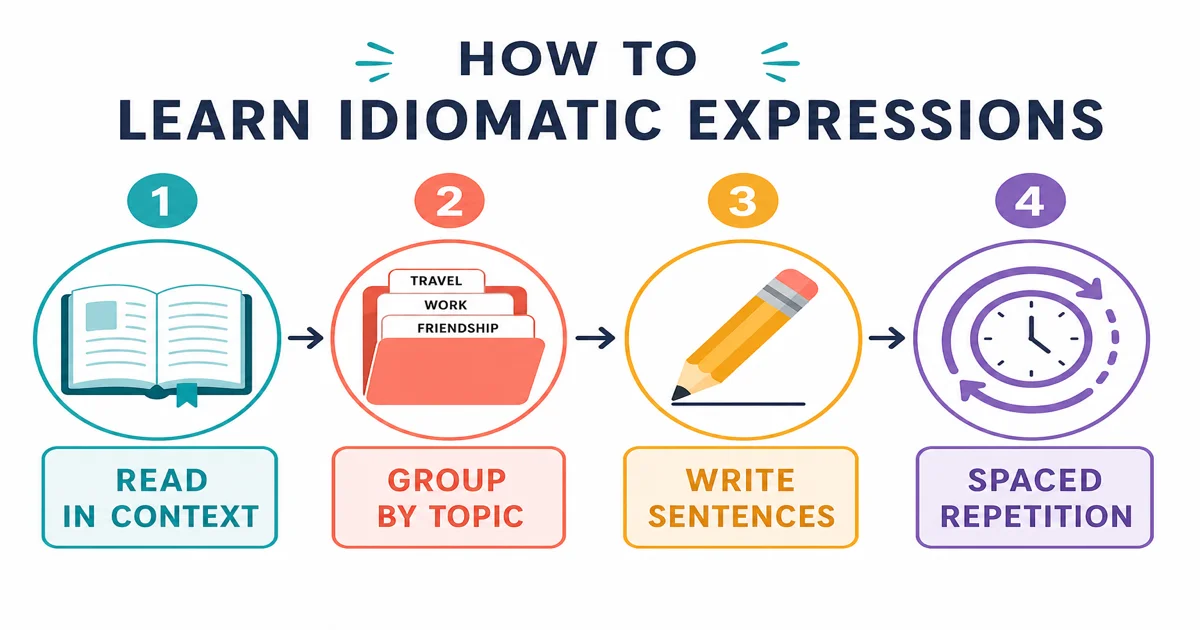
Step 1: Learn in Context
Never memorize idioms from isolated lists. Read them in articles, watch them in movies, listen for them in podcasts. When you encounter an idiom naturally, the context helps you remember both the meaning and the usage.
Step 2: Group by Topic
Learning “body idioms” together (break a leg, cold shoulder, heart of gold) is more effective than random lists. Your brain creates a mental category, and each new idiom reinforces the others.
Step 3: Create Example Sentences
For each idiom you learn, write 2–3 sentences about your own life. “I got butterflies in my stomach before my job interview” is personal and memorable. Generic examples fade quickly.
Step 4: Practice Active Use
Use idioms in conversation and writing deliberately. Start with safe ones (piece of cake, in the long run, at the end of the day) before moving to more colorful ones. If you never use an idiom actively, you will never own it.
Step 5: Use Spaced Repetition
Add idioms to your Linglify vocabulary. The system tests you at increasing intervals, moving idioms from short-term to long-term memory automatically.
Words to Practice
boom
noun
A loud, deep sound or a sudden increase in activity or popularity.
Examples
- The boom of thunder echoed across the valley.
- The technology boom created many new millionaires.
cooperate
verb
To work together with others towards a common goal.
evaluate
verb
To judge or measure the value, quality, or importance of something.
Examples
- Companies evaluate job candidates based on experience, skills, and personality.
- Teachers evaluate student progress through tests, projects, and classroom participation.
graduate
verb
To complete a course of study at a school or university.
Examples
- She will graduate from university next year with a degree in engineering.
- Students must complete all requirements before they can graduate from high school.
horizon
noun
The line where the earth or the sky appears to meet in the distance.
Examples
- The sun disappeared behind the horizon as evening approached.
- Traveling broadens your horizon and exposes you to new cultures.
indispensable
adjective
Absolutely necessary; essential.
Examples
- Clean water is indispensable for human survival and good health.
- Her experience and skills make her indispensable to the research team.
jury
noun
A group of people who listen to evidence in a court and decide if someone is guilty.
Examples
- The jury deliberated for several hours before reaching a verdict.
- The talent show jury consisted of professional musicians and entertainers.
lifelong
adjective
Continuing for a very long time or for the whole life.
Examples
- Learning is a lifelong process that never truly ends.
- Their lifelong friendship began during elementary school years.
motivated
adjective
Feeling driven or inspired to do something because of a reason or goal.
Examples
- Motivated employee seeks additional responsibilities and challenges at work.
- Success requires being motivated even when facing difficult obstacles.
normally
adverb
Usually; under normal conditions.
Examples
- Heart normally beats between sixty and hundred times per minute.
- Students normally arrive at school before morning bell rings.
off
adjective
Describes something that is not fresh or is no longer suitable for eating, often used for food and drinks.
Examples
- Please turn off the lights before leaving the room.
- The dog ran off into the forest chasing wild rabbits.
prejudice
noun
Preconceived opinions or feelings, often negative, about a person or group.
Examples
- Education helps overcome prejudice and promotes understanding.
- Racial prejudice damages communities and individuals alike.
resolve
verb
To find a solution or answer to a problem or question.
Examples
- Mediator helps parties resolve dispute through negotiation.
- Technical team will resolve software problems quickly.
stress
verb
To feel mental or emotional pressure or worry; to emphasize or give importance to something.
Examples
- Heavy workload may stress employees beyond limits.
- Teacher will stress importance of homework completion.
total
adjective
An adjective describing something that is complete or whole, not divided or broken.
Examples
- Total cost includes all fees and expenses.
- Total silence fills room during meditation session.
tragedy
noun
An extremely sad or serious event that causes suffering or loss.
Examples
- Natural tragedy affects thousands of innocent people.
- Personal tragedy changes person's life perspective completely.
union
noun
A group of people or things joined together for a purpose.
Examples
- Labor union protects worker rights and interests.
- Marriage union joins two people in partnership.
voyage
noun
A long journey to a distant place, often by sea or air.
Examples
- Space exploration represents humanity's greatest voyage into the unknown.
- The ocean voyage from Europe to America took several weeks in the past.
candidate
noun
A person who is competing in an election or contest.
Examples
- Each presidential candidate presented their policy plans to voters.
- The job candidate impressed the interview panel with her experience.
discourage
verb
To try to make someone feel less confident or hopeful about something.
Examples
- Don't let one failure discourage you from pursuing your dreams.
- High prices discourage many people from buying organic food products.
donate
verb
To give something, especially money or goods, to help a cause or person.
Examples
- Many people donate money to charities that help homeless individuals.
- She decided to donate blood to help patients in emergency situations.
firmly
adverb
An adverb indicating a way of doing something with certainty or stability.
Examples
- Hold the rope firmly while climbing down the steep mountain slope.
- The manager firmly believed in treating all employees with respect.
guide
verb
To show or direct someone how to do something.
Examples
- Parents should guide their children to make responsible decisions.
- The experienced hiker will guide the group through the mountain trail safely.
humorous
adjective
Funny or amusing, often making people laugh.
Examples
- She writes humorous articles about everyday life and family experiences.
- The humorous speech made everyone laugh and lightened the serious mood.
admission
noun
The process or fact of being allowed to enter or join.
Examples
- Her admission to the prestigious medical school was the result of hard work.
- The museum offers free admission on the first Sunday of every month.
What to Do Next
-
Start with 10 idioms. Pick 10 from the list above that you have heard before but never used. Write a sentence with each one.
-
Watch for idioms in real English. Next time you watch a movie or read an article, note any idiomatic expressions. Look up their meaning and add them to your collection.
-
Add idioms to Linglify for spaced repetition.
-
Explore the full idiom list — English Idioms: 500+ Common Expressions has idioms organized by 20 topic categories.
-
Learn idiom examples — Idiom Examples: 200+ with Meanings provides additional examples with context.
FAQ
What is the difference between an idiom and a phrase?
A phrase is any group of words that function together (“in the morning,” “very quickly,” “on the table”). An idiom is a specific type of phrase whose meaning cannot be understood from the literal words (“kick the bucket” = die, “spill the beans” = reveal a secret). All idioms are phrases, but not all phrases are idioms. The key difference is whether the meaning is figurative (idiom) or literal (regular phrase).
How many idiomatic expressions are there in English?
Estimates range from 5,000 to 25,000, depending on how broadly you define “idiom.” If you include phrasal verbs, proverbs, and slang expressions, the number is higher. For practical purposes, knowing 200–300 common idioms covers the vast majority of what you will encounter in everyday English, movies, and standard business communication.
Can I use idioms in formal writing?
It depends on the idiom and the context. Some idioms are acceptable in formal writing (“in the long run,” “at the end of the day,” “the bottom line”), while others are too casual (“piece of cake,” “no-brainer,” “kick the bucket”). For academic essays and legal documents, avoid idioms entirely. For business emails and presentations, use common, neutral idioms sparingly. For IELTS writing, one or two well-placed idioms can demonstrate vocabulary range.
Why are idioms so hard to translate?
Because idioms carry cultural meaning, not just linguistic meaning. “It’s raining cats and dogs” means “heavy rain” in English, but translating it literally into another language produces nonsense. Every language has its own idioms for the same concepts — French says “il pleut des cordes” (it’s raining ropes), Japanese says “土砂降り” (a downpour). You must translate the meaning, not the words.
What’s the fastest way to learn idiomatic expressions?
Three strategies work best: (1) Learn idioms in topic groups (all money idioms together, all time idioms together) so they reinforce each other. (2) Learn from real context — movies, podcasts, and books — not isolated lists. (3) Use spaced repetition to move idioms from recognition to active use. The biggest mistake is trying to memorize hundreds at once. Start with 30–50 common ones and use them actively before adding more.