IELTS Advanced Vocabulary: 200+ Words for Band 8–9 Scores
Band 8 and 9 on IELTS require vocabulary that most test-takers never learn — not because the words are impossibly difficult, but because they are impossibly precise. At Band 7, you demonstrate “flexibility and precision.” At Band 8, you use “a wide resource readily and flexibly” with “rare errors only in very unusual expressions.” At Band 9, your vocabulary is indistinguishable from an educated native speaker.
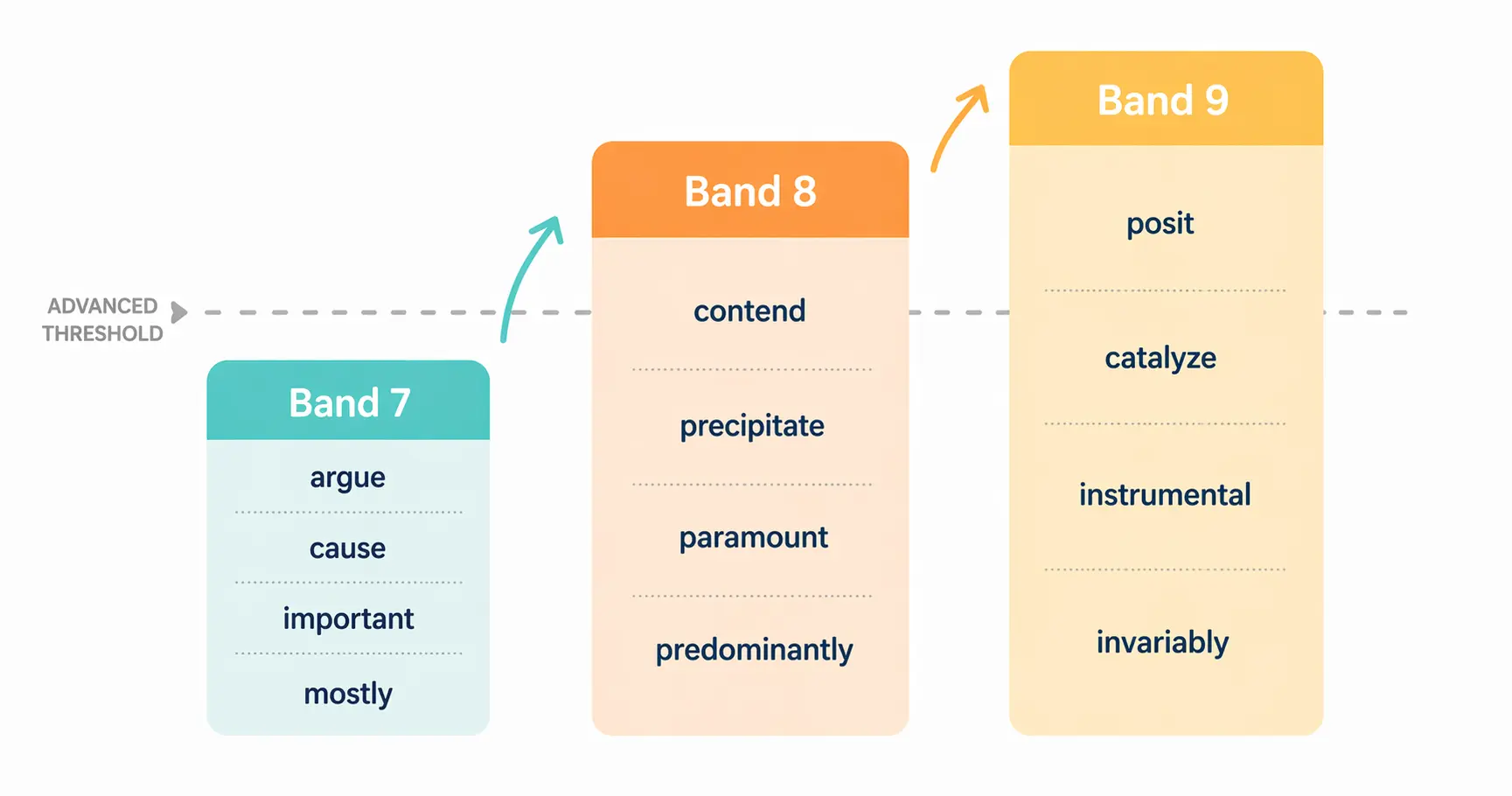
The practical difference: Band 7 candidates use appropriate vocabulary. Band 8–9 candidates use the exact right word in every context. They do not write “many problems” — they write “a proliferation of challenges.” They do not say “people disagree” — they say “opinion remains polarized.”
This guide gives you:
- 200+ words and collocations that separate Band 7 from Band 8–9,
- organized by IELTS section (Writing, Speaking, Reading),
- each word with meaning, collocation, and an IELTS-context example,
- direct Band 7 → Band 8 upgrade comparisons.
What Band 8–9 Vocabulary Actually Looks Like
The difference between Band 7 and Band 8 is not about using harder words. It is about three things:
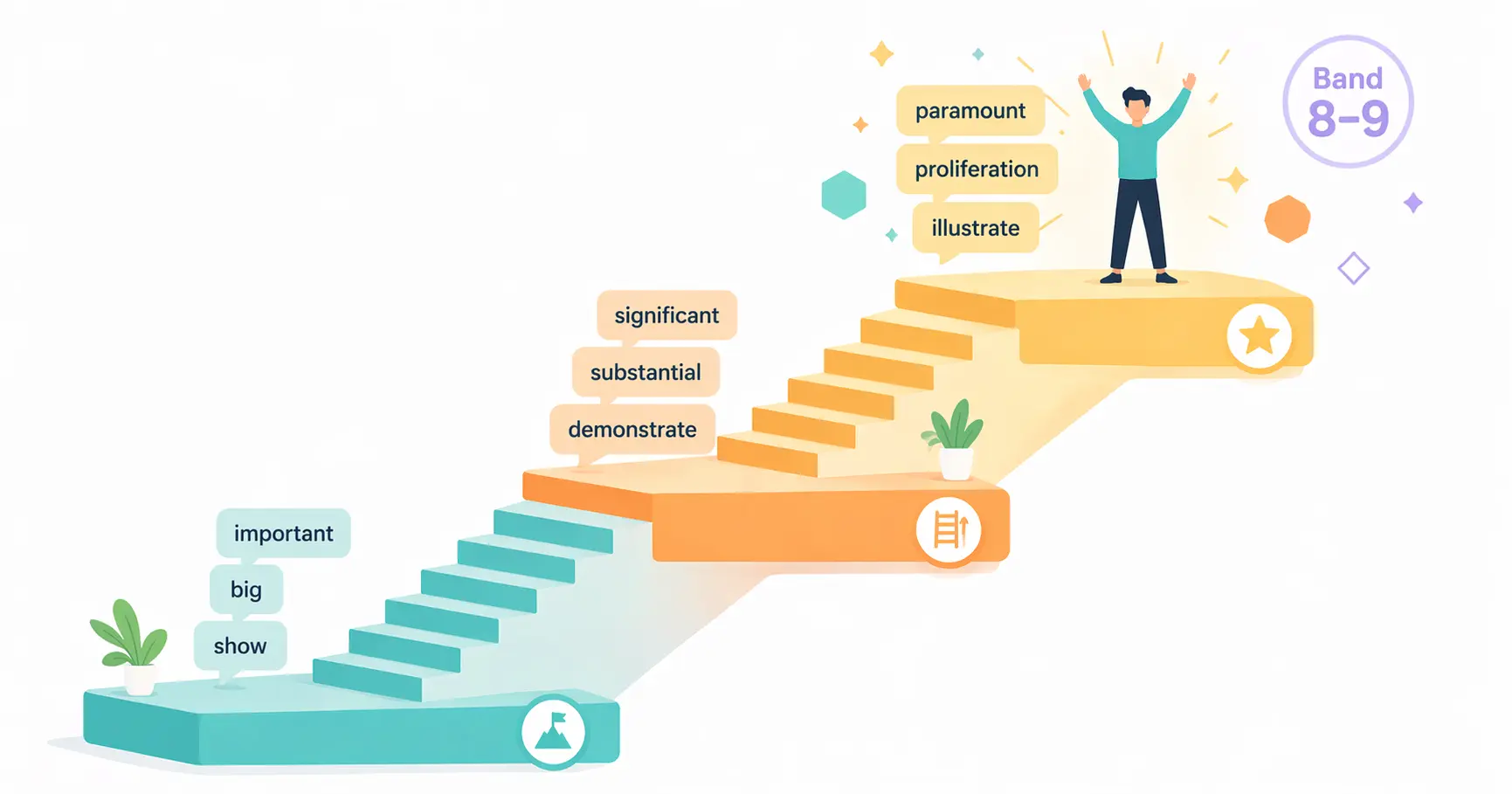
1. Precision. Band 7 uses “show” for everything. Band 8 uses “illustrate” for visuals, “demonstrate” for evidence, “reveal” for hidden information, and “indicate” for suggestions.
2. Collocation accuracy. Band 7 says “big problem.” Band 8 says “acute shortage” or “pressing concern” — because these words belong together in academic English.
3. Register control. Band 8–9 candidates shift smoothly between formal writing vocabulary and natural speaking vocabulary. They do not use essay words in conversation or slang in essays.
| Criterion | Band 7 | Band 8 | Band 9 |
|---|---|---|---|
| Range | Good range; some less common items | Wide range used readily | Full range, completely flexible |
| Precision | Generally appropriate word choice | Precise meaning consistently | Effortless precision |
| Collocation | Some awareness of collocations | Skillful use of collocations | Native-level collocation |
| Errors | Occasional errors that don’t impede | Rare errors in unusual items | No noticeable errors |
Writing Task 2: Advanced Essay Vocabulary
These words and collocations elevate an IELTS essay from competent (Band 7) to exceptional (Band 8–9). They are organized by the functions you need in every essay.
Presenting Arguments
| Word / Collocation | Meaning | Band 7 Equivalent | IELTS Example |
|---|---|---|---|
| contend that | to argue or assert firmly | argue that | Proponents contend that universal basic income would reduce inequality. |
| it is widely acknowledged that | most people accept this | many people think | It is widely acknowledged that climate change poses an existential threat. |
| the prevailing view | the most common opinion | the common opinion | The prevailing view among economists is that free trade benefits all parties. |
| a compelling argument | a strong, convincing argument | a good argument | There is a compelling argument for investing in renewable energy now rather than later. |
| to posit | to put forward as a basis for argument | to suggest | Some researchers posit that screen time has minimal impact on children’s development. |
| to refute | to prove a claim wrong | to disagree with | Recent evidence refutes the notion that economic growth always leads to higher emissions. |
| to concede | to admit that something is true, even reluctantly | to agree partly | Critics concede that the policy has reduced unemployment, but argue that it has increased debt. |
| an untenable position | a view that cannot be defended | a wrong opinion | The claim that fossil fuels have no environmental impact is an untenable position. |
Cause, Effect, and Consequence
| Word / Collocation | Meaning | Band 7 Equivalent | IELTS Example |
|---|---|---|---|
| precipitate (v.) | to cause something to happen suddenly | cause | The economic crisis precipitated a wave of emigration from rural areas. |
| exacerbate | to make a bad situation worse | make worse | Air pollution exacerbates respiratory conditions, particularly in densely populated cities. |
| mitigate | to make something less severe | reduce | Green spaces in cities help mitigate the effects of urban heat islands. |
| a ramification | a consequence, especially an indirect one | a result | The ramifications of artificial intelligence on employment are still poorly understood. |
| a catalyst for | something that accelerates change | a cause of | The pandemic was a catalyst for the widespread adoption of remote work. |
| to give rise to | to cause something to exist or happen | to lead to | Rapid urbanization gives rise to problems such as overcrowding and pollution. |
| to stem from | to originate from | to come from | Many behavioral problems in teenagers stem from a lack of parental supervision. |
| to have far-reaching implications | to affect many things in important ways | to have big effects | The ruling has far-reaching implications for data privacy across Europe. |
Degree and Extent
| Word / Collocation | Meaning | Band 7 Equivalent | IELTS Example |
|---|---|---|---|
| predominantly | mainly; for the most part | mostly | The workforce in nursing is predominantly female, although male representation is increasing. |
| disproportionately | to an unfairly large or small extent | unfairly/too much | Climate change disproportionately affects developing nations with fewer resources to adapt. |
| to a considerable extent | significantly | a lot | Academic performance depends, to a considerable extent, on the quality of teaching. |
| negligible | so small as to be meaningless | very small | The environmental benefit of banning plastic straws alone is negligible. |
| a proliferation of | a rapid increase in number | a lot of / many | The proliferation of social media platforms has fragmented public attention. |
| pervasive | existing everywhere; widespread and persistent | very common | The influence of advertising on consumer behavior is pervasive and often unconscious. |
| inherently | as a fundamental, unchangeable quality | naturally/basically | Competition is not inherently negative — it can drive innovation when properly regulated. |
Comparing, Contrasting, and Evaluating
| Word / Collocation | Meaning | Band 7 Equivalent | IELTS Example |
|---|---|---|---|
| in stark contrast to | completely different from | very different from | In stark contrast to urban schools, rural schools often lack basic laboratory equipment. |
| to outweigh | to be greater in importance or effect | to be more important | The benefits of childhood vaccination far outweigh the minimal risks involved. |
| to draw a parallel between | to show similarity between two things | to compare | One can draw a parallel between the industrial revolution and today’s AI revolution. |
| to reconcile | to make two ideas consistent with each other | to balance | It is difficult to reconcile economic growth with genuine environmental protection. |
| a nuanced view | a view that considers subtle differences | a detailed view | The issue of immigration requires a nuanced view, not a simplistic for-or-against stance. |
| paradoxically | in a way that seems contradictory but is true | surprisingly | Paradoxically, countries with the highest taxes often report the highest levels of happiness. |
Solutions and Recommendations
| Word / Collocation | Meaning | Band 7 Equivalent | IELTS Example |
|---|---|---|---|
| to implement | to put a plan or policy into action | to do/to start | Governments should implement stricter regulations on industrial waste disposal. |
| to allocate resources | to officially distribute money/time/effort | to spend money on | Schools should allocate more resources to mental health support for students. |
| a viable alternative | a realistic and workable option | a good option | Public transport must become a viable alternative to private car use. |
| to incentivize | to encourage with rewards | to encourage | Tax breaks can incentivize companies to invest in clean energy technology. |
| to foster | to encourage the development of something | to support | Universities should foster critical thinking rather than passive memorization. |
| a holistic approach | considering everything as a connected whole | a complete approach | Tackling obesity requires a holistic approach involving education, healthcare, and urban planning. |
Writing Task 1: Advanced Data Description Vocabulary
Task 1 has its own vocabulary demands. Band 8–9 in Task 1 requires precise language for describing data trends and visual information.
Trends and Movements
| Word / Collocation | Meaning | Band 7 Equivalent | IELTS Example |
|---|---|---|---|
| to plateau | to stay at a stable level after changing | to stay the same | After a decade of growth, female enrollment in engineering plateaued at 22%. |
| to fluctuate | to rise and fall irregularly | to go up and down | Oil prices fluctuated between $60 and $90 per barrel throughout 2024. |
| to surge | to increase suddenly and powerfully | to increase a lot | Online retail sales surged by 47% in the first quarter of 2020. |
| to plummet | to fall steeply and suddenly | to decrease a lot | Tourism revenue plummeted during the lockdown, reaching an all-time low. |
| a marginal increase | a very small increase | a small increase | There was only a marginal increase in exports, from 12.3% to 12.8%. |
| to remain stagnant | to stay the same without growth | to not change | Wages in the manufacturing sector remained stagnant for over a decade. |
| a marked decline | a noticeable and significant decrease | a big decrease | The chart shows a marked decline in newspaper circulation since 2005. |
| to peak at | to reach the highest point | to reach the maximum | Unemployment peaked at 11.2% in 2009 before falling steadily. |
Proportions and Comparisons
| Word / Collocation | Meaning | Band 7 Equivalent | IELTS Example |
|---|---|---|---|
| to comprise | to make up; to be composed of | to have/include | Renewable sources comprised just 8% of total energy production in 2010. |
| the lion’s share | the largest portion | most of | The lion’s share of the budget — nearly 60% — was allocated to defense. |
| to account for | to represent a certain proportion | to be / to make up | Asia accounted for roughly 40% of global carbon emissions. |
| a negligible proportion | an extremely small share | a very small part | Nuclear energy represented a negligible proportion of the energy mix in most African countries. |
| to overtake | to become larger or more important than | to become more than | India is projected to overtake China as the world’s most populous country. |
| conversely | in an opposite way | on the other hand | Oil consumption rose sharply; conversely, coal usage fell to a 50-year low. |
Speaking: Advanced Vocabulary for Parts 2 and 3
Band 8–9 in Speaking requires vocabulary that sounds natural, not rehearsed. These words work in spoken English — they are precise but do not sound like an essay.
Expressing Opinions with Precision
| Word / Expression | Meaning | Band 7 Equivalent | IELTS Example |
|---|---|---|---|
| I’m firmly of the view that | I strongly believe | I think | I’m firmly of the view that gap years are valuable for personal development. |
| on balance | considering everything | overall | On balance, I think the advantages of studying abroad outweigh the disadvantages. |
| it’s debatable whether | reasonable people disagree | I’m not sure if | It’s debatable whether technology has actually made us more productive or just busier. |
| to some extent | partly but not completely | a little bit | To some extent, parents are responsible, but schools also play a major role. |
| that’s a sweeping generalization | an oversimplified claim about all cases | that’s too simple | Saying all young people are addicted to phones — that’s a sweeping generalization. |
Describing Experiences and Events
| Word / Expression | Meaning | Band 7 Equivalent | IELTS Example |
|---|---|---|---|
| eye-opening | surprising and educational | interesting | Living in a rural village for a month was really eye-opening — it changed my perspective. |
| thought-provoking | causing you to think seriously about something | interesting | The documentary was thought-provoking — it made me reconsider my assumptions about poverty. |
| daunting | intimidating; making you feel nervous | scary/difficult | Starting university in a foreign country was daunting at first, but I adapted quickly. |
| rewarding | giving satisfaction; worthwhile | good | Teaching was the most rewarding job I’ve ever had — seeing students improve was incredible. |
| pivotal | extremely important; a turning point | very important | My internship was a pivotal experience — it completely changed my career direction. |
| a steep learning curve | having to learn a lot very quickly | hard at first | The first month at the company was a steep learning curve, but I learned more than in a year at university. |
Discussing Abstract Topics (Part 3)
| Word / Expression | Meaning | Band 7 Equivalent | IELTS Example |
|---|---|---|---|
| there’s a growing consensus that | more and more people agree | more people think | There’s a growing consensus that traditional education models need to be updated. |
| a paradigm shift | a fundamental change in approach or thinking | a big change | Remote work represents a paradigm shift in how companies think about productivity. |
| the status quo | the existing state of things | the way things are now | Many young people want to challenge the status quo rather than accept things as they are. |
| a vicious cycle | a series of problems where each one causes the next | a bad cycle | Poverty creates a vicious cycle — poor education leads to low income, which leads to poor education for the next generation. |
| to be a contentious issue | to be a topic that causes disagreement | to be a debated topic | Immigration continues to be a contentious issue in many Western democracies. |
| societal | relating to society as a whole | social | Obesity is not just an individual health problem — it’s a societal challenge. |
| unprecedented | never having happened before | new / the first time | We are living through an unprecedented period of technological change. |
Reading: Advanced Vocabulary You Must Recognize
You do not need to produce these words in Writing or Speaking, but you need to understand them instantly when they appear in Academic Reading passages. Band 8–9 readers process these words without pausing.
Academic and Scientific Contexts
| Word | Meaning | Common Reading Context |
|---|---|---|
| empirical | based on observation or experiment, not theory | The study provides empirical evidence that sleep quality affects learning. |
| hypothesis | a proposed explanation to be tested | The researchers tested the hypothesis that bilingualism delays cognitive decline. |
| correlation | a mutual relationship between two things | There is a strong correlation between income level and life expectancy. |
| longitudinal | studying the same subjects over a long period | The longitudinal study tracked 5,000 participants over 20 years. |
| replicate | to repeat an experiment to verify results | Other researchers failed to replicate the original findings. |
| methodology | a system of methods used in a study | The methodology section describes how participants were selected. |
| implications | possible future effects or consequences | The findings have significant implications for public health policy. |
| to corroborate | to confirm or support with evidence | Satellite data corroborated the ground-level temperature readings. |
Social and Historical Contexts
| Word | Meaning | Common Reading Context |
|---|---|---|
| to coincide with | to happen at the same time as | The decline in birth rates coincided with rising levels of female education. |
| to be attributed to | to be considered as caused by | The improvement in air quality was largely attributed to the new emissions regulations. |
| to undermine | to gradually weaken or damage | Corruption continues to undermine public trust in government institutions. |
| to encompass | to include or contain (a wide range) | The term “sustainability” encompasses environmental, social, and economic factors. |
| to scrutinize | to examine very carefully | Researchers scrutinized the data for any evidence of bias in the selection process. |
| to advocate | to publicly support a cause or policy | The report advocates for greater investment in early childhood education. |
| disparity | a significant difference, especially an unfair one | The disparity in healthcare access between urban and rural areas is widening. |
| to manifest | to show or display clearly | Stress can manifest as physical symptoms such as headaches and insomnia. |
Band 7 → Band 8 Upgrades: 30 Direct Replacements
The fastest way to move from Band 7 to Band 8 vocabulary is to replace specific overused words with more precise alternatives. Here are 30 upgrades that work in both Writing and Speaking.
Verbs
| Band 7 Word | Band 8–9 Upgrade | Context |
|---|---|---|
| show (data) | illustrate, demonstrate, reveal | Task 1 data description |
| cause | precipitate, trigger, give rise to | Task 2 cause/effect essays |
| reduce | mitigate, curtail, diminish | Task 2 solutions |
| increase | escalate, amplify, augment | Task 1 trends |
| affect | impact, influence, compromise | Task 2 consequences |
| improve | enhance, bolster, strengthen | Task 2 recommendations |
| stop | halt, cease, eradicate | Task 2 solutions |
| change | transform, reshape, overhaul | Task 2 reform topics |
| disagree | refute, challenge, dispute | Task 2 counterarguments |
| think (opinion) | contend, maintain, assert | Task 2 opinions |
Adjectives and Adverbs
| Band 7 Word | Band 8–9 Upgrade | Context |
|---|---|---|
| important | paramount, pivotal, instrumental | Task 2 emphasis |
| big (problem) | acute, pressing, formidable | Task 2 issues |
| common | prevalent, ubiquitous, pervasive | Task 2 descriptions |
| clear | evident, conspicuous, unequivocal | Task 1 observations |
| different | distinct, disparate, divergent | Task 2 comparisons |
| mainly | predominantly, primarily, principally | Task 1 proportions |
| very | considerably, markedly, substantially | Task 1 degree |
| quickly | rapidly, swiftly, precipitously (for decline) | Task 1 speed |
| slowly | gradually, incrementally, marginally | Task 1 pace |
| a lot | significantly, dramatically, exponentially | Task 1 magnitude |
Nouns and Phrases
| Band 7 Word | Band 8–9 Upgrade | Context |
|---|---|---|
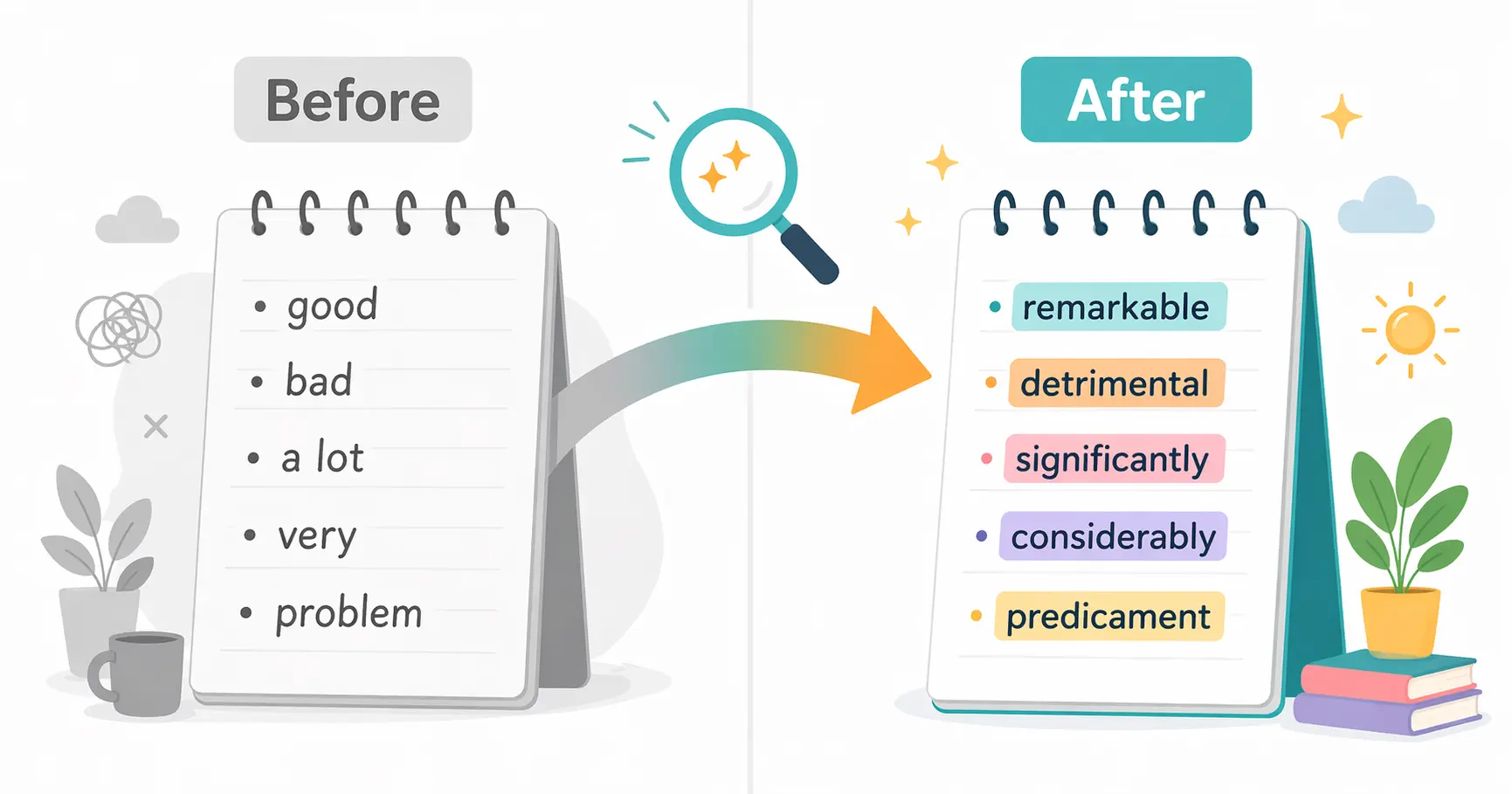
| problem | predicament, dilemma, impediment | Task 2 issues |
| solution | remedy, intervention, initiative | Task 2 conclusions |
| result | outcome, ramification, implication | Task 2 consequences |
| difference | disparity, discrepancy, divergence | Task 1 comparisons |
| opinion | stance, perspective, standpoint | Task 2 discussions |
| advantage | merit, virtue, incentive | Task 2 pros/cons |
| disadvantage | drawback, pitfall, downside | Task 2 pros/cons |
| topic | issue, phenomenon, subject matter | Task 2 introductions |
| trend | trajectory, pattern, tendency | Task 1 overview |
| growth | expansion, proliferation, upsurge | Task 1 increases |
Vocabulary to Practice
Add these 25 advanced words to your Linglify dictionary for spaced repetition — they are among the most useful high-band IELTS words.
uneven
adjective
Not level or smooth; uneven.
Examples
- Uneven ground makes walking difficult and dangerous.
- Uneven performance shows inconsistent skill level development.
mundane
adjective
Lacking excitement or interest; dull or ordinary.
Examples
- He found the routine mundane and boring.
- The job was too mundane for his taste.
drastic
adjective
Extremely severe or intense, often leading to significant change or damage.
Examples
- The government took drastic measures to control inflation.
- They made a drastic change to the plan.
fertile
adjective
Capable of producing offspring or crops; able to support life or growth.
Examples
- Fertile lands support abundant crops.
- The soil here is very fertile.
frail
adjective
Weak or delicate in health or appearance.
Examples
- Her frail appearance worried everyone.
- The frail old man needed assistance to walk.
substantially
adverb
To a large extent or degree; significantly.
Examples
- Her performance substantially improved after additional training and practice.
- Prices have increased substantially over the past few months.
acclaimed
adjective
Describing someone or something that has been publicly praised or recognized.
Examples
- His performance was acclaimed by critics.
- The acclaimed author received many awards for her novel.
lawyer
noun
A person trained to give legal advice and represent clients in court.
Examples
- Every person accused of crime has right to lawyer representation.
- The experienced lawyer provided excellent legal advice to her clients.
memorable
adjective
Causing a strong impression or worth remembering.
Examples
- Graduation day was memorable occasion for entire family.
- The memorable speech inspired students to pursue their dreams.
traditional
adjective
Following the customs or ways of the past; not new or different.
Examples
- Traditional cooking methods preserve authentic flavors perfectly.
- Traditional music reflects cultural history and values.
DJ
noun
A person who plays and mixes recorded music, A person who plays music or mixes sounds on a radio or at events.
Examples
- The DJ played my favorite song.
- The DJ took song requests all night.
privacy
noun
The right or ability to keep personal matters or information secret.
Examples
- Hotel guests expect privacy during their stay.
- Internet privacy becomes increasingly important issue nowadays.
scenic
adjective
Related to beautiful natural views or landscapes.
Examples
- Scenic overlook provides perfect spot for photographs.
- Scenic route takes longer but offers beautiful.
conservation
noun
The protection and preservation of natural resources or the environment.
Examples
- Water conservation becomes increasingly important during periods of severe drought.
- Wildlife conservation is essential for protecting endangered species from extinction.
heritage
noun
The traditions, achievements, and qualities of a particular group or nation.
Examples
- She inherited a rich heritage of family traditions from her grandparents.
- The ancient castle is an important part of our cultural heritage.
sustainable
adjective
This adjective describes something that can be maintained or continued without depleting resources.
Examples
- Company implements sustainable business model for long-term success.
- Sustainable farming practices protect soil and water resources.
serenity
noun
A state of calm, peacefulness, and mental clarity.
Examples
- She maintained her serenity despite the chaos.
- The serenity of the lake was calming.
indication
noun
A sign or signal that points to or suggests something.
Examples
- The indication of his illness was clear after the tests.
- There was no indication that she was unhappy.
leisure
noun
Free time when someone can relax or do leisure activities.
Examples
- People enjoy various leisure activities during weekends and holidays.
- Reading books is popular leisure pursuit for many educated people.
pollution
noun
The introduction of harmful substances into the environment.
Examples
- Air pollution affects public health in cities.
- Ocean pollution threatens marine life worldwide.
poetic
adjective
Relating to poetry or the qualities of poetry; expressive or imaginative in language.
Examples
- His speech had a poetic quality that moved everyone.
- The poem's poetic language captivated the audience.
discretion
noun
The ability to judge what is appropriate or prudent in a particular situation.
Examples
- He exercised discretion in his decisions.
- Use your discretion when sharing information.
cancellation
noun
The act of stopping or calling off an event, activity, or arrangement.
Examples
- Due to weather, the flight cancellation was inevitable.
- The concert's cancellation disappointed many fans.
commute
verb
To travel regularly between two places, especially to work.
Examples
- Public transportation helps people commute efficiently reducing traffic congestion.
- Workers commute daily between suburban homes and downtown offices.
broadcast
noun
A program or event of transmitting information or entertainment to a broad audience.
Examples
- Millions watched the live broadcast of the event.
- The news broadcast revealed shocking new information.
How to Study for Band 8–9 Vocabulary
1. Replace, do not add
Do not try to learn 200 new words. Instead, take vocabulary you already know and upgrade it. Every time you write “important,” ask yourself: is this paramount, pivotal, or instrumental in this context? Over time, the upgrades become automatic.
2. Study collocations, not isolated words
“Acute” alone is just a word. “Acute shortage,” “acute awareness,” “acute problem” — these are collocations that sound natural. For every new word, learn 2–3 collocations. Write them out, test yourself, and use them in practice essays.
3. Read the Economist, not textbooks
IELTS Academic Reading passages are written in a style similar to the Economist, New Scientist, and National Geographic. Reading these sources regularly exposes you to Band 8–9 vocabulary in natural contexts. When you encounter a word you half-know, look up its collocations and add it to your study list.
4. Record yourself speaking
For Speaking Band 8–9, vocabulary must sound natural. Record Part 2 and Part 3 practice answers. Listen back. If a word sounds forced or you pause unnaturally before it, you have not internalized it yet. Keep practicing until advanced words flow as naturally as basic ones.
5. Use spaced repetition
Add your target words to a spaced repetition system like Linglify. Research shows you need 8–12 exposures to a word before it enters your active vocabulary. Studying 10 words per day with spaced repetition is far more effective than reviewing 50 words once.
For a science-backed approach to vocabulary memorization, see our guide on how to memorize vocabulary.
What to Do Next
-
Make sure your Band 7 foundation is solid. Band 8–9 vocabulary is useless if Band 7 basics are not automatic. See our IELTS Band 7 vocabulary guide for the 300 words you need as a foundation.
-
Build your Band 6 base if needed. If you are currently scoring Band 6–6.5, start with the IELTS Band 6 vocabulary list and work up.
-
Add idioms for Speaking. Advanced vocabulary alone does not guarantee Band 8 in Speaking — you also need natural idiomatic language. See our Idioms for IELTS Speaking guide for 50 expressions that sound fluent.
-
Master paraphrasing. Band 8–9 in Writing requires constant paraphrasing. Our Synonyms for IELTS guide provides 200+ ready-to-use synonyms for the words IELTS candidates overuse most.
-
Expand your general advanced vocabulary. The IELTS words in this article are a subset of C1–C2 English. For a broader advanced vocabulary beyond IELTS, see our Advanced English Words: 300+ C1–C2 vocabulary.
-
Read the complete IELTS strategy. For vocabulary guidance across all four sections (Reading, Writing, Speaking, Listening), see our Complete IELTS Vocabulary Guide.
FAQ
What vocabulary level do I need for IELTS Band 8?
Band 8 requires C1-level vocabulary (approximately 8,000–10,000 word families) with strong collocation accuracy and register awareness. You need to use less common vocabulary “skillfully” and with “precision.” In practice, this means having a core of 150–200 advanced words that you can use correctly in the right contexts — not just knowing them passively.
What is the difference between Band 7 and Band 8 vocabulary?
Band 7 vocabulary is appropriate — you use the right kind of words for the context. Band 8 vocabulary is precise — you use the exact right word. For example, Band 7 might say “the number went up a lot.” Band 8 says “the figure surged by 47%.” The difference is specificity, collocation accuracy, and the ability to vary your word choice throughout a response.
Can I reach Band 9 by just learning vocabulary?
No. Band 9 requires near-native performance across all four criteria: Fluency and Coherence, Lexical Resource, Grammatical Range and Accuracy, and Pronunciation (for Speaking). Vocabulary is necessary but not sufficient. That said, vocabulary is often the criterion that candidates can improve most efficiently through targeted study.
How long does it take to go from Band 7 to Band 8?
For most learners, the jump from Band 7 to Band 8 takes 3–6 months of focused study. The main challenge is not learning new words but activating them — moving words from your passive to your active vocabulary. This requires regular practice with timed writing, recorded speaking, and spaced repetition review.
Should I use advanced vocabulary in every sentence?
No. Using advanced vocabulary in every sentence makes your writing or speech sound unnatural and forced — which actually lowers your score. Band 8–9 candidates use advanced words selectively where they add precision. A Band 8 essay might use 15–20 advanced collocations across 250–280 words, mixed naturally with simpler language. The skill is knowing when to upgrade and when simple is better.
Is this vocabulary the same as the Academic Word List (AWL)?
There is significant overlap. The Academic Word List (AWL) contains 570 word families common in academic texts, and many AWL words appear at Band 7–8 level. However, Band 8–9 IELTS vocabulary goes beyond the AWL — it includes topic-specific collocations, precise descriptive language for Task 1, and natural idiomatic expressions for Speaking that are not part of the AWL. Think of the AWL as the foundation and this guide as the next level.