
Idioms for IELTS Speaking: 50 Natural Expressions for Band 7+
Idioms are the fastest way to sound natural in IELTS Speaking — and the fastest way to sound ridiculous if you use them wrong. Examiners reward natural idiomatic language under the “Lexical Resource” criterion (25% of your Speaking score), but they penalize idioms that are forced, overused, or used incorrectly.
The key is using idioms the way native speakers actually use them: sparingly, in the right context, and without drawing attention to the fact that you are using one. Nobody in real life says “I would like to discuss the topic of hard work, and in that vein, let me say that I always burn the midnight oil.” They say: “I have a big deadline, so I have been burning the midnight oil lately.”
This guide gives you 50 idioms that work naturally in IELTS Speaking, organized by the topics that actually come up in the exam.
- Total idioms: 50
- Organized by: 10 IELTS Speaking topic areas
- Level: B2–C1 (upper-intermediate to advanced)
- Best for: IELTS Speaking Parts 1, 2, and 3; Band 7–9 preparation
How Examiners Score Idioms
Idioms fall under Lexical Resource, which is one of four scoring criteria in IELTS Speaking:
| Band | What Examiners Expect for Idioms |
|---|---|
| 5 | No idiomatic language; basic vocabulary only |
| 6 | Attempts idioms but often with errors or unnatural usage |
| 7 | Uses some idiomatic expressions naturally and appropriately |
| 8 | Uses idiomatic language fluently and precisely; rare errors |
| 9 | Full, flexible use of idiomatic language throughout; completely natural |
The jump from Band 6 to Band 7 often comes down to whether you can drop a few idioms naturally into your answers. You do not need 50 — learning 10–15 that you can use confidently is enough.
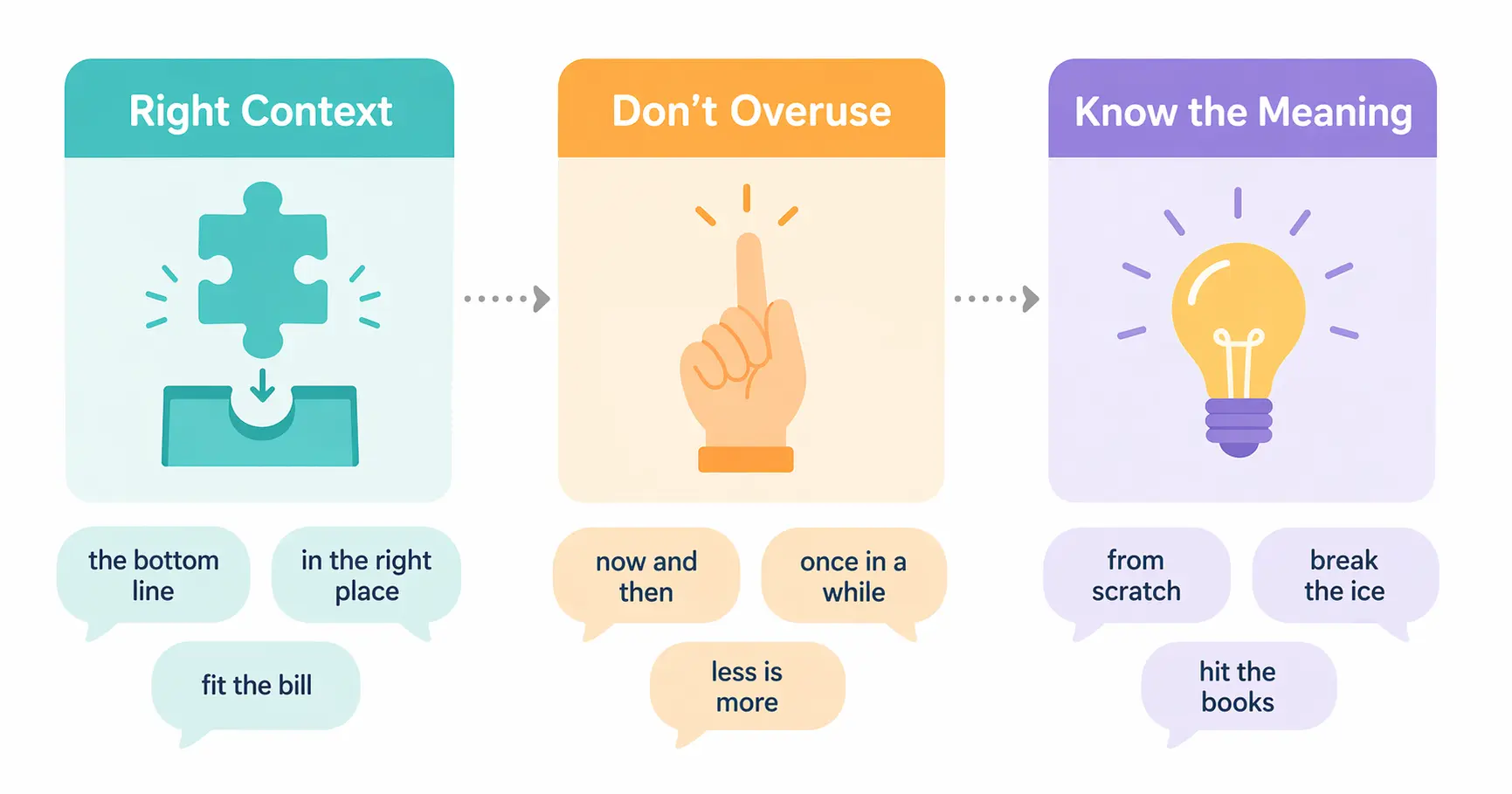
The Three Rules for Using Idioms in IELTS
Rule 1: Use idioms that fit the context. “It is raining cats and dogs” sounds rehearsed and cliché. “I had to learn the hard way” in a story about a personal experience sounds natural.
Rule 2: Do not overuse them. One or two idioms per answer is perfect. Five idioms in a 2-minute Part 2 response sounds like a memorized script.
Rule 3: Only use idioms you fully understand. Using an idiom with the wrong meaning is worse than not using one at all. If you are not 100% sure, use a simpler expression.
Opinions and Attitudes
These idioms help you express opinions in Part 3 discussions — the section where examiners probe your ability to discuss abstract ideas.
| # | Idiom | Meaning | IELTS Example |
|---|---|---|---|
| 1 | see eye to eye | to agree with someone | My parents and I don’t always see eye to eye on politics, but we respect each other’s views. |
| 2 | on the fence | undecided about something | I’m still on the fence about whether to study abroad or stay in my home country. |
| 3 | take something with a grain of salt | to not fully believe something | I take online reviews with a grain of salt — you never know if they’re genuine. |
| 4 | the bottom line | the most important point | The bottom line is that education should be accessible to everyone, regardless of income. |
| 5 | have mixed feelings | to feel both positive and negative about something | I have mixed feelings about social media — it connects people but also wastes a lot of time. |
How to use them in Part 3:
Examiner: Do you think young people and older people have similar views on technology?
Not really. I think the two generations rarely see eye to eye on this topic. Older people tend to be more cautious about new technology, while younger people embrace it. The bottom line is that both perspectives have value — it is just that they are coming from different experiences.
Learning and Education
IELTS Speaking frequently covers topics about school, university, studying, and learning from mistakes.
| # | Idiom | Meaning | IELTS Example |
|---|---|---|---|
| 6 | learn the hard way | to learn from a bad experience rather than from advice | I learned the hard way that you cannot leave all your revision until the night before the exam. |
| 7 | hit the books | to study intensively | Finals are next week, so I have been hitting the books every evening. |
| 8 | a steep learning curve | a situation where you must learn a lot very quickly | Starting a new job in a foreign country was a steep learning curve — I had to learn the language and the culture at the same time. |
| 9 | pick something up | to learn something informally or casually | I picked up a lot of practical skills during my internship that university never taught me. |
| 10 | go back to square one | to start again from the beginning | My computer crashed and I lost my dissertation draft, so I had to go back to square one. |
Work and Career
Common in Part 1 (your job) and Part 3 (discussing work-life balance, career choices, success).
| # | Idiom | Meaning | IELTS Example |
|---|---|---|---|
| 11 | burn the midnight oil | to work or study late into the night | Before the product launch, the whole team was burning the midnight oil for weeks. |
| 12 | a dead-end job | a job with no chance of promotion or progress | I quit my dead-end job at the supermarket and went back to university to retrain. |
| 13 | climb the career ladder | to advance in your profession | These days, young people don’t just want to climb the career ladder — they want meaningful work. |
| 14 | get the ball rolling | to start a process or activity | Once we got the ball rolling on the project, everything came together quickly. |
| 15 | pull your weight | to do your fair share of work | In group projects, it is frustrating when not everyone pulls their weight. |
Daily Life and Routines
Perfect for Part 1 questions about your habits, hometown, free time, and daily schedule.
| # | Idiom | Meaning | IELTS Example |
|---|---|---|---|
| 16 | a creature of habit | someone who likes routine | I’m a creature of habit — I go to the same café every morning and order the same thing. |
| 17 | under the weather | feeling slightly ill | I’ve been a bit under the weather this week, so I haven’t been to the gym. |
| 18 | the best of both worlds | the advantages of two different situations | Working from home gives me the best of both worlds — I save time on commuting but still collaborate with my team online. |
| 19 | a change of pace | a welcome difference in your routine | After months of desk work, hiking on the weekend was a nice change of pace. |
| 20 | 24/7 | all the time; constantly | In big cities like Tokyo, some shops are open 24/7, which is incredibly convenient. |
Experiences and Memories
Ideal for Part 2 cue cards that ask you to describe a past event, trip, or achievement.
| # | Idiom | Meaning | IELTS Example |
|---|---|---|---|
| 21 | once in a lifetime | extremely rare and special | Seeing the Northern Lights was a once-in-a-lifetime experience — I’ll never forget it. |
| 22 | the time of my life | an exceptionally enjoyable period | I had the time of my life during my exchange year in Spain. |
| 23 | a blessing in disguise | something bad that turns out to have good results | Losing my job was a blessing in disguise because it pushed me to start my own business. |
| 24 | ring a bell | to sound familiar | That name rings a bell — I think we might have met at the conference last year. |
| 25 | at the drop of a hat | immediately; without hesitation | My best friend would help me at the drop of a hat, no questions asked. |
Part 2 example (Describe a memorable trip):
I’d like to talk about my trip to Iceland last year. It was honestly the time of my life. The landscapes were unbelievable — volcanic fields, waterfalls, glaciers. And we were lucky enough to see the Northern Lights, which was really a once-in-a-lifetime experience. The trip was actually a blessing in disguise because I’d originally planned to go to Greece, but the flights were cancelled, and Iceland turned out to be far more memorable.
People and Relationships
For questions about friends, family, describing someone you admire, or discussing social dynamics.
| # | Idiom | Meaning | IELTS Example |
|---|---|---|---|
| 26 | get along like a house on fire | to become friends very quickly | When I met my university roommate, we got along like a house on fire — we had everything in common. |
| 27 | a people person | someone who enjoys social interaction | I’d say I’m a people person — I recharge by being around others rather than being alone. |
| 28 | down to earth | practical and friendly; not arrogant | My boss is surprisingly down to earth for someone in such a senior position. |
| 29 | go the extra mile | to make more effort than expected | Good teachers go the extra mile for their students — they don’t just teach the syllabus. |
| 30 | speak your mind | to say what you honestly think | I admire people who speak their mind respectfully, even when their opinion is unpopular. |
Technology and Modern Life
Increasingly common in IELTS Speaking Part 3 discussions about digital life, AI, and social media.
| # | Idiom | Meaning | IELTS Example |
|---|---|---|---|
| 31 | a double-edged sword | something with both advantages and disadvantages | Social media is a double-edged sword — it connects people but also creates unrealistic expectations. |
| 32 | keep up with | to stay informed about; to not fall behind | It is hard to keep up with the pace of technological change — new tools appear every month. |
| 33 | at your fingertips | easily available and accessible | These days, the whole world’s knowledge is at your fingertips thanks to the internet. |
| 34 | behind the times | outdated; not modern | Some schools are behind the times — they still don’t teach digital skills. |
| 35 | go viral | to spread rapidly online | That video went viral overnight and got 10 million views in a week. |
Health and Well-being
Common in questions about lifestyle, sports, diet, and mental health.
| # | Idiom | Meaning | IELTS Example |
|---|---|---|---|
| 36 | in the long run | over a long period of time | Regular exercise may feel boring, but in the long run it makes a huge difference to your health. |
| 37 | a wake-up call | an event that makes you realize you need to change | When my doctor told me my blood pressure was dangerously high, it was a real wake-up call. |
| 38 | run down | exhausted and in poor health from overwork | I was so run down from working 12-hour days that I caught every cold going around. |
| 39 | keep in shape | to maintain physical fitness | I try to keep in shape by cycling to work instead of driving. |
| 40 | take it easy | to relax; to not push yourself too hard | After the marathon, the doctor told me to take it easy for at least a week. |
Money, Success, and Ambition
For Part 3 discussions about wealth, goals, priorities, and what success means.
| # | Idiom | Meaning | IELTS Example |
|---|---|---|---|
| 41 | from scratch | from the very beginning, without using anything prepared | My grandfather built his business from scratch with no financial support. |
| 42 | make ends meet | to earn just enough money to cover basic expenses | Many families struggle to make ends meet when the cost of living keeps rising. |
| 43 | worth every penny | fully justifying the cost | The cooking course was expensive, but it was worth every penny — I use those skills every day. |
| 44 | cut corners | to do something cheaply or badly to save money/time | When companies cut corners on safety, the consequences can be devastating. |
| 45 | the bigger picture | the overall situation rather than small details | It is easy to get stressed about daily problems, but if you look at the bigger picture, life is pretty good. |
Environment, Travel, and Culture
For discussing travel experiences, cultural differences, and environmental issues.
| # | Idiom | Meaning | IELTS Example |
|---|---|---|---|
| 46 | off the beaten track | away from popular tourist areas | I prefer travelling off the beaten track — the best experiences happen in places tourists don’t usually visit. |
| 47 | broaden your horizons | to expand your knowledge and experience | Living abroad definitely broadened my horizons — it completely changed how I see the world. |
| 48 | the tip of the iceberg | only a small part of a much larger issue | The plastic in the ocean that we see is just the tip of the iceberg — most of it is on the sea floor. |
| 49 | a breath of fresh air | something refreshingly new and different | After years of living in a big city, moving to the countryside was a breath of fresh air. |
| 50 | leave a lasting impression | to have a strong, memorable effect on someone | The kindness of the local people left a lasting impression on me during my visit to Japan. |
Quick Reference: All 50 Idioms
| # | Idiom | Meaning | Best for |
|---|---|---|---|
| 1 | see eye to eye | agree | Part 3 — opinions |
| 2 | on the fence | undecided | Part 3 — opinions |
| 3 | take with a grain of salt | not fully believe | Part 3 — media, news |
| 4 | the bottom line | the main point | Part 3 — conclusions |
| 5 | have mixed feelings | both positive and negative | Part 1/3 — any topic |
| 6 | learn the hard way | learn from bad experience | Part 2/3 — education |
| 7 | hit the books | study hard | Part 1 — education |
| 8 | a steep learning curve | must learn fast | Part 2 — new experience |
| 9 | pick something up | learn casually | Part 1/2 — skills |
| 10 | go back to square one | start again | Part 2 — experience |
| 11 | burn the midnight oil | work/study late | Part 1/3 — work |
| 12 | a dead-end job | job with no future | Part 3 — work |
| 13 | climb the career ladder | advance professionally | Part 3 — ambition |
| 14 | get the ball rolling | start something | Part 2/3 — projects |
| 15 | pull your weight | do your fair share | Part 3 — teamwork |
| 16 | a creature of habit | likes routine | Part 1 — daily life |
| 17 | under the weather | slightly ill | Part 1 — health |
| 18 | the best of both worlds | two advantages at once | Part 1/3 — lifestyle |
| 19 | a change of pace | welcome difference | Part 1/2 — routine |
| 20 | 24/7 | all the time | Part 1 — modern life |
| 21 | once in a lifetime | extremely rare/special | Part 2 — experience |
| 22 | the time of my life | great fun | Part 2 — memory |
| 23 | a blessing in disguise | bad thing → good result | Part 2/3 — experience |
| 24 | ring a bell | sound familiar | Part 1 — any topic |
| 25 | at the drop of a hat | immediately | Part 2 — describing people |
| 26 | get along like a house on fire | become fast friends | Part 2 — people |
| 27 | a people person | enjoys social interaction | Part 1 — personality |
| 28 | down to earth | humble, practical | Part 2 — describing people |
| 29 | go the extra mile | do more than expected | Part 2/3 — admiration |
| 30 | speak your mind | say what you think | Part 3 — communication |
| 31 | a double-edged sword | pros and cons | Part 3 — technology |
| 32 | keep up with | stay informed/current | Part 3 — change |
| 33 | at your fingertips | easily accessible | Part 3 — technology |
| 34 | behind the times | outdated | Part 3 — institutions |
| 35 | go viral | spread rapidly online | Part 1/3 — media |
| 36 | in the long run | over a long period | Part 3 — health/plans |
| 37 | a wake-up call | event forcing change | Part 2/3 — experience |
| 38 | run down | exhausted from overwork | Part 1 — health |
| 39 | keep in shape | maintain fitness | Part 1 — exercise |
| 40 | take it easy | relax | Part 1 — lifestyle |
| 41 | from scratch | from the very beginning | Part 2/3 — achievement |
| 42 | make ends meet | just enough money | Part 3 — economy |
| 43 | worth every penny | good value | Part 2 — experience |
| 44 | cut corners | save by doing cheaply | Part 3 — business/ethics |
| 45 | the bigger picture | overall situation | Part 3 — perspective |
| 46 | off the beaten track | away from tourist spots | Part 2 — travel |
| 47 | broaden your horizons | expand experience | Part 3 — travel/education |
| 48 | the tip of the iceberg | small part of big issue | Part 3 — environment |
| 49 | a breath of fresh air | refreshingly new | Part 2 — change |
| 50 | leave a lasting impression | strongly memorable | Part 2 — experience |
Vocabulary to Practice
These 25 words appear frequently alongside idiomatic language in IELTS Speaking. Add them to your Linglify dictionary for spaced repetition practice.
serenity
noun
A state of calm, peacefulness, and mental clarity.
Examples
- She maintained her serenity despite the chaos.
- The serenity of the lake was calming.
demanding
adjective
Requiring a lot of effort, patience, or skill; often demanding more than expected.
Examples
- Medical school is very demanding and requires years of intensive study.
- She has a demanding boss who expects perfection in all tasks.
discretion
noun
The ability to judge what is appropriate or prudent in a particular situation.
Examples
- He exercised discretion in his decisions.
- Use your discretion when sharing information.
cancellation
noun
The act of stopping or calling off an event, activity, or arrangement.
Examples
- Due to weather, the flight cancellation was inevitable.
- The concert's cancellation disappointed many fans.
liaison
noun
A close working relationship or communication link between people or organizations.
Examples
- Military liaison officers coordinate operations between allied forces.
- She serves as liaison between different departments.
nutritious
adjective
Providing good health benefits and nutrition.
Examples
- Fresh vegetables are nutritious and support overall health.
- Nutritious breakfast provides energy for productive school day.
conservation
noun
The protection and preservation of natural resources or the environment.
Examples
- Water conservation becomes increasingly important during periods of severe drought.
- Wildlife conservation is essential for protecting endangered species from extinction.
pollution
noun
The introduction of harmful substances into the environment.
Examples
- Air pollution affects public health in cities.
- Ocean pollution threatens marine life worldwide.
heritage
noun
The traditions, achievements, and qualities of a particular group or nation.
Examples
- She inherited a rich heritage of family traditions from her grandparents.
- The ancient castle is an important part of our cultural heritage.
commute
verb
To travel regularly between two places, especially to work.
Examples
- Public transportation helps people commute efficiently reducing traffic congestion.
- Workers commute daily between suburban homes and downtown offices.
affordable
adjective
Able to be bought or reached at a reasonable price.
Examples
- The government is working to provide affordable housing for low-income families.
- This restaurant offers delicious and affordable meals for college students.
DJ
noun
A person who plays and mixes recorded music, A person who plays music or mixes sounds on a radio or at events.
Examples
- The DJ played my favorite song.
- The DJ took song requests all night.
indication
noun
A sign or signal that points to or suggests something.
Examples
- The indication of his illness was clear after the tests.
- There was no indication that she was unhappy.
leisure
noun
Free time when someone can relax or do leisure activities.
Examples
- People enjoy various leisure activities during weekends and holidays.
- Reading books is popular leisure pursuit for many educated people.
passionate
adjective
Having or showing strong feelings or enthusiasm.
Examples
- Passionate speech moves audience to take action.
- Passionate teacher inspires students to learn more.
memorable
adjective
Causing a strong impression or worth remembering.
Examples
- Graduation day was memorable occasion for entire family.
- The memorable speech inspired students to pursue their dreams.
scenic
adjective
Related to beautiful natural views or landscapes.
Examples
- Scenic overlook provides perfect spot for photographs.
- Scenic route takes longer but offers beautiful.
luxurious
adjective
Extremely comfortable, elegant, or opulent; very fancy.
Examples
- She dreams of owning luxurious car with leather seats and sunroof.
- The luxurious hotel suite includes marble bathroom and ocean view.
colour
noun
The way something appears to the eye, often related to hue or shade.
Examples
- She chose a bright colour for her dress.
- The colour of the sky was a deep blue.
traditional
adjective
Following the customs or ways of the past; not new or different.
Examples
- Traditional cooking methods preserve authentic flavors perfectly.
- Traditional music reflects cultural history and values.
poetic
adjective
Relating to poetry or the qualities of poetry; expressive or imaginative in language.
Examples
- His speech had a poetic quality that moved everyone.
- The poem's poetic language captivated the audience.
broadcast
noun
A program or event of transmitting information or entertainment to a broad audience.
Examples
- Millions watched the live broadcast of the event.
- The news broadcast revealed shocking new information.
sustainable
adjective
This adjective describes something that can be maintained or continued without depleting resources.
Examples
- Company implements sustainable business model for long-term success.
- Sustainable farming practices protect soil and water resources.
privacy
noun
The right or ability to keep personal matters or information secret.
Examples
- Hotel guests expect privacy during their stay.
- Internet privacy becomes increasingly important issue nowadays.
volunteer
verb
To offer to do a service or task willingly, often without being asked.
Examples
- Citizens volunteer time for community improvement projects.
- Students volunteer at local charity organizations regularly.
How to Study Idioms for IELTS Speaking
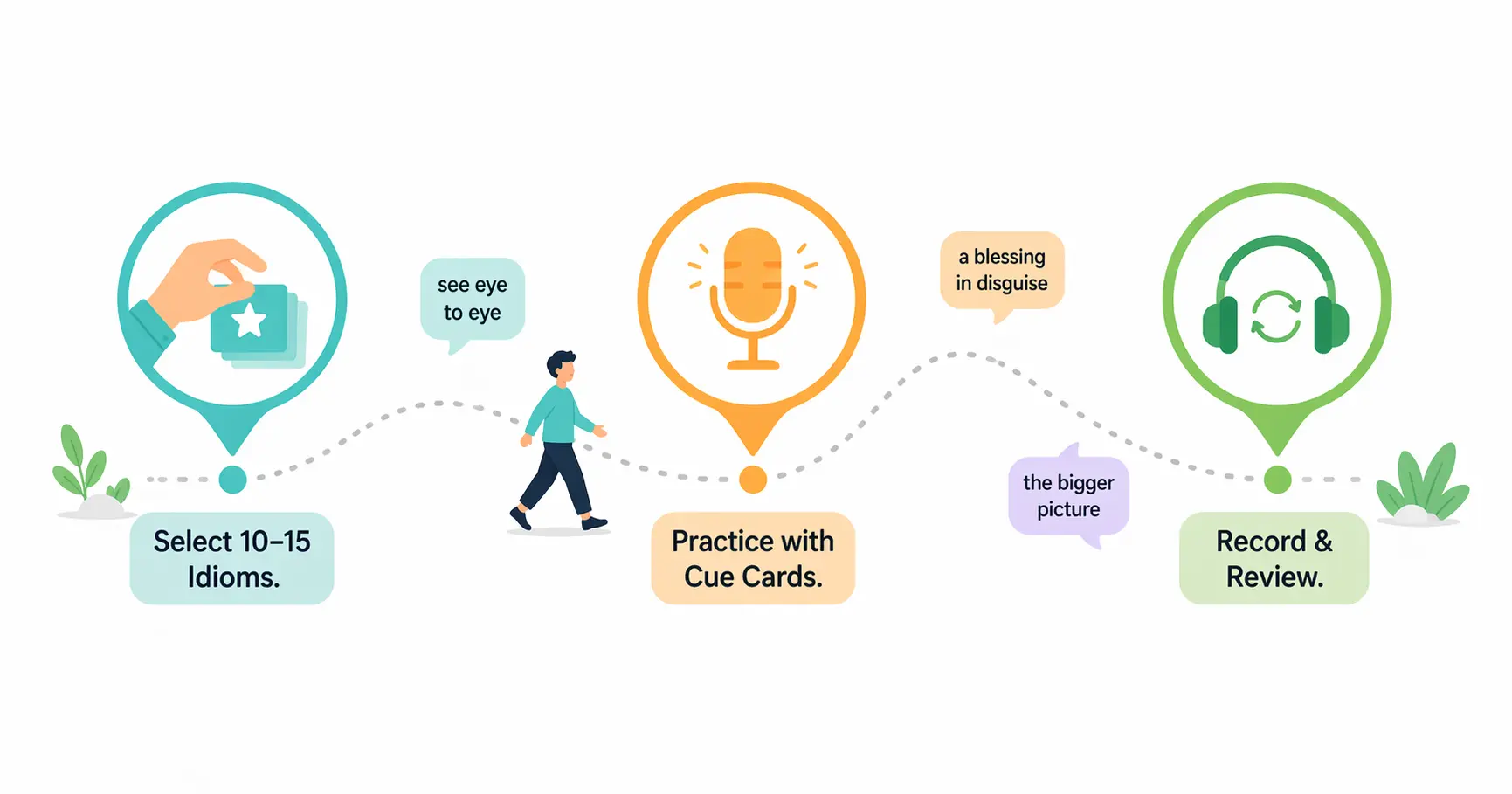
1. Choose 10–15 idioms that match your life. Do not try to memorize all 50. Pick the ones that fit topics you talk about naturally. If you never discuss work, skip the career idioms. If you love travel, focus on #46–#50.
2. Practice with real Part 2 cue cards. Take a cue card like “Describe a time you learned something new” and record a 2-minute answer that includes 1–2 idioms. Listen back — do they sound natural or forced?
3. Build topic connections. For each idiom you learn, write down 2–3 IELTS topics where it could naturally appear. For example, “a double-edged sword” works for technology, social media, globalization, and tourism.
4. Study collocations, not just meanings. “See eye to eye” is always used with a negative: “We don’t see eye to eye” or “We rarely see eye to eye.” “Burn the midnight oil” is always about work or study, never about socializing.
5. Listen for idioms in native speech. Podcasts, interviews, and TED talks use idioms naturally. When you hear one, note the context — that teaches you more about usage than any definition can.
For a complete vocabulary system, read our guide on how to improve your vocabulary.
Common Mistakes with Idioms in IELTS Speaking
Mistake 1: Using too many idioms
Bad: Well, it’s a double-edged sword, and at the end of the day, the bottom line is that we have to see eye to eye, because in the long run it’s just the tip of the iceberg.
Good: I think social media is a double-edged sword. It connects people, but it also creates unrealistic expectations. In the long run, I think we’ll find a better balance.
One or two idioms per answer is the sweet spot. More than that sounds memorized.
Mistake 2: Using idioms you do not fully understand
If you use “bite the bullet” thinking it means “to eat quickly” (it actually means “to face a difficult situation bravely”), the examiner will notice. Only use idioms you have practiced and are confident about.
Mistake 3: Using outdated or cliché idioms
Avoid: “Every cloud has a silver lining,” “Rome wasn’t built in a day,” “Actions speak louder than words.” These are so common that they feel like proverbs from a textbook, not natural speech. The 50 idioms in this guide are all commonly used in modern spoken English.
Mistake 4: Announcing the idiom
Bad: I’d like to use an idiom here — it was really once in a lifetime.
Good: It was a once-in-a-lifetime experience.
Never signal that you are about to use an idiom. Just use it naturally.
What to Do Next
-
Build your IELTS Speaking vocabulary. Idioms are just one part of Lexical Resource. Our IELTS Speaking vocabulary by topic covers natural expressions, word upgrades, and collocations for 10 exam topics.
-
Master paraphrasing. Examiners also score your ability to rephrase ideas. Our Synonyms for IELTS guide gives you 200+ ready-to-use synonyms organized by the words candidates overuse most.
-
Target your band score. For band-specific vocabulary, see:
- IELTS Band 6 vocabulary — the foundation
- IELTS Band 7 vocabulary — the leap
- For Band 8–9, advanced vocabulary beyond idioms is key
-
Read the complete IELTS guide. For a full vocabulary strategy across Reading, Writing, Speaking, and Listening, see our Complete IELTS Vocabulary Guide.
-
Strengthen your overall vocabulary. Idioms are most effective when your general vocabulary is already strong. Read our step-by-step vocabulary learning system for a daily study plan.
FAQ
How many idioms do I need for IELTS Band 7?
You need to use idiomatic language “naturally and appropriately” for Band 7. In practice, this means having 10–15 idioms you can use confidently in the right contexts. You do not need 50 — quality and naturalness matter far more than quantity. Focus on idioms that match the topics you are most likely to discuss.
Can I use idioms in IELTS Writing?
Use idioms very sparingly in Writing. In Task 2, one well-placed idiom (like “the bottom line” or “a double-edged sword”) can enhance your essay, but more than one or two feels informal. In Task 1, avoid idioms entirely — Task 1 requires formal, data-focused language. Idioms are primarily a Speaking strategy.
What is the difference between idioms and phrasal verbs?
Phrasal verbs are verb + particle combinations with a specific meaning: “give up” = quit. Idioms are fixed expressions whose meaning cannot be guessed from the individual words: “a piece of cake” = something easy. There is some overlap — “get the ball rolling” is both an idiom and contains a phrasal verb. For IELTS, both demonstrate Lexical Resource. See our 50 most common phrasal verbs for a complementary list.
Will the examiner know if I memorized idioms?
Yes — examiners are trained to detect memorized language. Signs include: using too many idioms, using them in the wrong context, pausing unnaturally before an idiom (as if recalling it), and using idioms that do not fit the conversation flow. The solution is to practice idioms in real speaking practice until they feel natural, not to memorize them as a list.
Are these idioms used in British and American English?
All 50 idioms in this guide are used in both British and American English. IELTS accepts both varieties, so there is no need to choose one set over the other. A few idioms have slight regional preferences — Americans tend to say “24/7” more than British speakers — but all 50 are universally understood.
Which IELTS Speaking part is best for using idioms?
Part 2 (the long turn) and Part 3 (the discussion) are the best opportunities. In Part 2, you have 2 minutes to tell a story — idioms fit naturally into narratives. In Part 3, idioms help you express opinions and generalizations. Part 1 answers are shorter, so limit yourself to one idiom at most. Never force an idiom where it does not fit.