
Phrasal Verbs Examples: 200 Sentences for Every Level
Definitions tell you what a phrasal verb means. Examples show you how it actually works. There is a reason every grammar textbook includes example sentences — seeing a phrasal verb in context reveals its grammar (separable or not?), its register (formal or casual?), and its natural collocations (which nouns and situations pair with it?).
This guide gives you 200 phrasal verb examples in complete, natural sentences. The sentences are organized by CEFR level — from A2 basics like “wake up” and “turn off” to C1 expressions like “play down” and “phase out.” Each entry includes the meaning, a clear sentence, and a usage note where helpful.
Use this as a reference when writing, a study list for building confidence, or a source of natural patterns to absorb. The more example sentences you read and repeat, the more naturally phrasal verbs will come to you.
- Total examples: 200 sentences
- Levels covered: A2, B1, B2, C1
- Format: Phrasal verb → meaning → example sentence
- Best for: learners who know definitions but struggle to use phrasal verbs naturally
For definitions and detailed explanations of each phrasal verb, see English Phrasal Verbs: Complete Guide. For phrasal verbs grouped by base verb, see Phrasal Verbs with GET or Phrasal Verbs with MAKE.
How to Use These Examples
Reading example sentences passively helps, but active practice builds real fluency. Here is how to get the most from this list:
- Read the sentence aloud. Pronunciation and rhythm matter. Phrasal verbs sound different from their individual words — “pick UP” has different stress than “pick” + “up” said separately.
- Cover the meaning, guess from context. Test yourself. If you can understand the sentence without the definition, you are making progress.
- Write your own version. Replace the nouns and details with your own life. “She turned down the job offer” → “I turned down the invitation to the party.” Personal sentences stick in memory.
- Notice the grammar. Is the object between the verb and particle (separable) or after (inseparable)? This tells you how to form your own sentences correctly.
A2 Level: Basic Phrasal Verbs (50 Examples)
These are the phrasal verbs every learner encounters first. They describe daily routines, basic actions, and simple interactions.
Daily Routines
| # | Phrasal Verb | Meaning | Example Sentence |
|---|---|---|---|
| 1 | wake up | stop sleeping | I wake up at 7 every morning, even on weekends. |
| 2 | get up | rise from bed | She got up immediately when the alarm rang. |
| 3 | put on | place clothing on your body | He put on his coat and went outside. |
| 4 | take off | remove clothing | Please take off your shoes at the door. |
| 5 | turn on | activate a device | Can you turn on the light? It’s getting dark. |
| 6 | turn off | deactivate a device | Turn off the TV — dinner is ready. |
| 7 | go out | leave the house | We usually go out on Friday evenings. |
| 8 | come back | return | She went to the store and came back in ten minutes. |
| 9 | sit down | take a seat | Please sit down. The meeting will start soon. |
| 10 | stand up | rise to a standing position | Everyone stood up when the teacher entered. |
Basic Actions
| # | Phrasal Verb | Meaning | Example Sentence |
|---|---|---|---|
| 11 | pick up | lift something from a surface | He picked up the phone and called his mother. |
| 12 | put down | place something on a surface | She put down her bag and sat on the sofa. |
| 13 | throw away | discard in the trash | Don’t throw away that box — I need it. |
| 14 | give back | return something to someone | Can you give back my pen when you’re finished? |
| 15 | look for | try to find | I’m looking for my keys. Have you seen them? |
| 16 | find out | discover information | I found out that the store closes at 9 PM. |
| 17 | write down | record on paper | Write down the address so you don’t forget it. |
| 18 | fill in | complete a form | Please fill in your name and email address. |
| 19 | hand in | submit | Students must hand in their homework by Friday. |
| 20 | try on | test clothing by wearing it | She tried on three dresses before choosing one. |
Communication and People
| # | Phrasal Verb | Meaning | Example Sentence |
|---|---|---|---|
| 21 | call back | return a phone call | He’s busy right now. Can he call you back in an hour? |
| 22 | hang up | end a phone call | She said goodbye and hung up. |
| 23 | look after | take care of | My neighbor looks after our cat when we travel. |
| 24 | get along | have a good relationship | The new employee gets along with everyone in the office. |
| 25 | grow up | become an adult | She grew up in a small town near the coast. |
| 26 | ask for | request | He asked for a glass of water. |
| 27 | talk about | discuss | We talked about the problem for over an hour. |
| 28 | wait for | stay until someone/something arrives | I waited for the bus for twenty minutes in the rain. |
| 29 | listen to | pay attention to sound | She listens to podcasts every morning on her commute. |
| 30 | belong to | be the property of | This laptop belongs to the company, not to me. |
Movement and Direction
| # | Phrasal Verb | Meaning | Example Sentence |
|---|---|---|---|
| 31 | come in | enter | Come in! The door is open. |
| 32 | go away | leave, depart | The headache went away after I took medicine. |
| 33 | get on | board (bus, train, plane) | We got on the bus at the Central Station stop. |
| 34 | get off | leave a vehicle | Get off at the next stop — that’s the city center. |
| 35 | get in | enter a car or taxi | She got in the taxi and told the driver the address. |
| 36 | get out | exit a car or small space | He got out of the car and walked to the building. |
| 37 | run away | escape by running | The cat ran away when it heard the thunder. |
| 38 | fall down | drop to the ground | The child fell down but got up without crying. |
| 39 | move in | begin living in a new place | They moved in last weekend and are still unpacking. |
| 40 | move out | leave your home permanently | He moved out of his parents’ house at 18. |
Time and Routine
| # | Phrasal Verb | Meaning | Example Sentence |
|---|---|---|---|
| 41 | hurry up | do something faster | Hurry up! The movie starts in five minutes. |
| 42 | slow down | reduce speed | The driver slowed down when he saw the school. |
| 43 | carry on | continue | Carry on reading — I didn’t mean to interrupt. |
| 44 | go on | continue, happen | What’s going on? I heard a loud noise. |
| 45 | end up | finally be in a situation | We got lost and ended up in the wrong part of town. |
| 46 | set up | prepare, arrange | They set up the chairs for the presentation. |
| 47 | clean up | make a place tidy | We need to clean up before the guests arrive. |
| 48 | use up | consume completely | We used up all the milk — someone needs to buy more. |
| 49 | run out | have no more of something | We ran out of coffee, so I’m drinking tea today. |
| 50 | show up | arrive, appear | He showed up 20 minutes late to the meeting. |
B1 Level: Intermediate Phrasal Verbs (50 Examples)
At B1, phrasal verbs become more abstract. The meanings are harder to guess from the individual words, and many have multiple senses.
Work and Productivity
| # | Phrasal Verb | Meaning | Example Sentence |
|---|---|---|---|
| 51 | take over | assume control | She took over as team leader when Mark resigned. |
| 52 | set up | establish, start (a business) | He set up his own company after years of working for others. |
| 53 | carry out | perform, complete (a task) | The researchers carried out experiments for six months. |
| 54 | deal with | handle, manage | She deals with customer complaints every day. |
| 55 | put off | postpone | They put off the decision until next week. |
| 56 | come up with | think of, invent | He came up with a brilliant idea during the meeting. |
| 57 | figure out | understand after thinking | I can’t figure out how to use this software. |
| 58 | keep up with | maintain the same pace as | It’s hard to keep up with all the changes in technology. |
| 59 | work out | calculate; exercise; succeed | We need to work out the total cost before signing the contract. |
| 60 | take on | accept (a responsibility) | She took on extra work to save money for the trip. |
Relationships and Social Life
| # | Phrasal Verb | Meaning | Example Sentence |
|---|---|---|---|
| 61 | break up | end a relationship | They broke up after three years together. |
| 62 | make up | reconcile after an argument | They argued all morning but made up before dinner. |
| 63 | get together | meet socially | Let’s get together for coffee this weekend. |
| 64 | look up to | admire, respect | She looks up to her grandmother as a role model. |
| 65 | let down | disappoint | I trusted him, and he let me down. |
| 66 | put up with | tolerate | I can’t put up with this noise anymore. |
| 67 | fall out | have an argument, stop being friends | They fell out over money and haven’t spoken since. |
| 68 | bring up | mention a topic; raise a child | Don’t bring up politics at the dinner table. |
| 69 | turn out | result, happen in the end | The party turned out to be much better than I expected. |
| 70 | cheer up | become happier, make someone happier | She bought him flowers to cheer him up after the bad news. |
Learning and Understanding
| # | Phrasal Verb | Meaning | Example Sentence |
|---|---|---|---|
| 71 | look up | search for information | I looked up the word in the dictionary. |
| 72 | find out | discover | She found out that her flight was canceled only at the airport. |
| 73 | go over | review, examine | Let’s go over the plan one more time before we start. |
| 74 | point out | draw attention to something | My teacher pointed out several errors in my essay. |
| 75 | make sense | be logical, understandable | This explanation doesn’t make sense to me at all. |
| 76 | pick up | learn informally | He picked up some Spanish while living in Barcelona. |
| 77 | catch on | begin to understand | The new system is complex, but most people catch on quickly. |
| 78 | mix up | confuse one thing with another | I always mix up “affect” and “effect.” |
| 79 | come across | find by chance | I came across an interesting article while browsing online. |
| 80 | think over | consider carefully | I need to think it over before making a decision. |
Life Changes and Decisions
| # | Phrasal Verb | Meaning | Example Sentence |
|---|---|---|---|
| 81 | give up | stop trying; quit a habit | He gave up smoking three years ago. |
| 82 | turn down | reject, refuse | She turned down the job offer because the salary was too low. |
| 83 | take up | start a new hobby or activity | I took up running during the pandemic and still do it. |
| 84 | drop out | leave school or a course | He dropped out of university to start a business. |
| 85 | sign up | register, enroll | Over 500 people signed up for the online course. |
| 86 | go ahead | proceed, start | The project was approved — we can go ahead with construction. |
| 87 | hold on | wait a moment | Hold on — I’ll check the schedule and call you back. |
| 88 | come up | arise, appear unexpectedly | Something came up at work, so I’ll be late tonight. |
| 89 | sort out | organize, resolve | We need to sort out the accommodation before the trip. |
| 90 | get over | recover from | It took her weeks to get over the flu this winter. |
Everyday Situations
| # | Phrasal Verb | Meaning | Example Sentence |
|---|---|---|---|
| 91 | run into | meet by chance | I ran into my old teacher at the supermarket yesterday. |
| 92 | look forward to | feel excited about a future event | I’m looking forward to the holiday — I need a break. |
| 93 | cut down on | reduce the amount | The doctor told him to cut down on sugar and salt. |
| 94 | get rid of | eliminate, throw away | We got rid of the old sofa and bought a new one. |
| 95 | put away | store in the correct place | Please put away your toys before dinner. |
| 96 | check in | register at a hotel or airport | We checked in at the hotel at around 3 PM. |
| 97 | check out | leave a hotel; examine | We need to check out by 11 AM tomorrow. |
| 98 | come along | make progress; accompany | How is your English coming along? |
| 99 | calm down | become less upset or excited | Calm down — getting angry won’t solve anything. |
| 100 | break down | stop functioning (machine) | Our car broke down on the highway during the trip. |
B2 Level: Upper-Intermediate Phrasal Verbs (50 Examples)
At B2, phrasal verbs become more idiomatic. Many of these have figurative meanings that differ sharply from the literal words.
Professional and Academic
| # | Phrasal Verb | Meaning | Example Sentence |
|---|---|---|---|
| 101 | draw up | prepare a formal document | The lawyers drew up a new contract with revised terms. |
| 102 | lay off | terminate employment | The company laid off 200 workers due to falling revenue. |
| 103 | take into account | consider as a factor | You need to take into account the cost of shipping when pricing products. |
| 104 | rule out | eliminate as a possibility | The police have not ruled out foul play in the investigation. |
| 105 | account for | explain; represent a proportion | Online sales account for 40% of the company’s revenue. |
| 106 | bring about | cause to happen | The new policy brought about significant changes in working conditions. |
| 107 | follow up | continue to investigate or pursue | I’ll follow up with the supplier next week about the delivery date. |
| 108 | come up against | encounter a difficulty | We came up against several technical problems during testing. |
| 109 | call off | cancel | They called off the outdoor event because of the storm warning. |
| 110 | hand over | transfer control or possession | She handed over her responsibilities to her replacement before leaving. |
Thinking and Decision-Making
| # | Phrasal Verb | Meaning | Example Sentence |
|---|---|---|---|
| 111 | narrow down | reduce options to a smaller list | We’ve narrowed down the candidates to three finalists. |
| 112 | weigh up | consider pros and cons | He spent days weighing up whether to accept the transfer. |
| 113 | talk into | persuade someone to do something | She talked me into running the marathon with her. |
| 114 | talk out of | persuade someone not to do something | His friends talked him out of quitting his job impulsively. |
| 115 | go through with | complete something despite difficulty | She was nervous but went through with the presentation anyway. |
| 116 | back out of | withdraw from a commitment | They backed out of the deal at the last minute. |
| 117 | look into | investigate | The manager promised to look into the customer’s complaint. |
| 118 | open up | become willing to share feelings | He finally opened up about the stress he’d been feeling at work. |
| 119 | come around | change your mind; regain consciousness | She was against the idea at first but eventually came around. |
| 120 | work through | deal with something systematically | They worked through their disagreements with the help of a mediator. |
Communication and Expression
| # | Phrasal Verb | Meaning | Example Sentence |
|---|---|---|---|
| 121 | speak up | talk louder; express an opinion | If you disagree, you should speak up during the meeting. |
| 122 | bring up | raise a topic in conversation | She brought up an interesting point about the budget. |
| 123 | get across | communicate successfully | He tried to get his point across, but nobody was listening. |
| 124 | brush off | dismiss as unimportant | She brushed off the criticism and continued with her plan. |
| 125 | turn to | seek help from | When things got difficult, she turned to her family for support. |
| 126 | pass on | share information with others | Could you pass on the message to everyone in the team? |
| 127 | take back | retract a statement | I take back what I said — you were completely right. |
| 128 | cut in | interrupt a conversation | He cut in before she could finish explaining her idea. |
| 129 | go into | discuss in detail | I won’t go into all the reasons now — we can talk later. |
| 130 | sum up | summarize | To sum up, we need to reduce costs and increase sales. |
Change and Development
| # | Phrasal Verb | Meaning | Example Sentence |
|---|---|---|---|
| 131 | build up | increase gradually | She built up her savings over five years before buying the apartment. |
| 132 | break through | achieve despite obstacles | After months of research, the team finally broke through with a solution. |
| 133 | set back | delay progress | The funding problem set the project back by three months. |
| 134 | cut back | reduce spending or consumption | The government cut back on education funding this year. |
| 135 | branch out | expand into new areas | The restaurant branched out into catering for corporate events. |
| 136 | phase in | introduce gradually | The company is phasing in a new remote work policy over six months. |
| 137 | wind down | gradually reduce activity; relax | The conference was winding down, and people started leaving. |
| 138 | step down | resign from a position | The CEO stepped down after 15 years leading the company. |
| 139 | scale up | increase in size or scope | They scaled up production to meet the sudden demand. |
| 140 | hold back | prevent progress; restrain | Fear of failure held her back from applying for the promotion. |
Emotions and Behavior
| # | Phrasal Verb | Meaning | Example Sentence |
|---|---|---|---|
| 141 | bottle up | suppress emotions | He bottles up his feelings and never talks about what’s bothering him. |
| 142 | lash out | attack verbally or physically | She lashed out at her colleague after a stressful morning. |
| 143 | pull through | survive a difficult situation | The patient was critical but pulled through after surgery. |
| 144 | burn out | become exhausted from overwork | She burned out after working 70-hour weeks for six months straight. |
| 145 | snap out of | force yourself out of a negative state | He told himself to snap out of it and focus on the solution. |
| 146 | live up to | meet expectations | The film didn’t live up to the hype — it was disappointing. |
| 147 | own up to | admit responsibility | Nobody owned up to breaking the window in the office. |
| 148 | play along | pretend to agree or cooperate | She didn’t believe his excuse but played along to avoid conflict. |
| 149 | wear off | gradually disappear (effect) | The excitement of the new job wore off after a few months. |
| 150 | get away with | avoid punishment | He was late every day and somehow got away with it for months. |
C1 Level: Advanced Phrasal Verbs (50 Examples)
These phrasal verbs appear in academic writing, professional contexts, and sophisticated speech. They mark you as a confident, nuanced English speaker.
Business and Strategy
| # | Phrasal Verb | Meaning | Example Sentence |
|---|---|---|---|
| 151 | buy out | purchase someone’s share of a business | The partners disagreed, so one bought the other out for $2 million. |
| 152 | bail out | rescue financially | The government bailed out the failing bank to prevent economic collapse. |
| 153 | cash in on | profit from a situation | Competitors were quick to cash in on the company’s PR disaster. |
| 154 | ramp up | increase rapidly | They ramped up marketing spending ahead of the product launch. |
| 155 | phase out | gradually discontinue | The manufacturer is phasing out the old model by the end of the year. |
| 156 | pencil in | schedule tentatively | Let’s pencil in Thursday for the review — we can confirm later. |
| 157 | hammer out | negotiate with difficulty | The two sides hammered out an agreement after twelve hours of talks. |
| 158 | sign off on | give formal approval | The director still hasn’t signed off on the revised budget. |
| 159 | factor in | include as a consideration | You need to factor in inflation when planning your retirement savings. |
| 160 | iron out | resolve small problems | We need to iron out the details before presenting to the board. |
Nuanced Communication
| # | Phrasal Verb | Meaning | Example Sentence |
|---|---|---|---|
| 161 | play down | make something seem less important | The spokesperson played down the severity of the data breach. |
| 162 | talk down to | speak condescendingly | She hated how her manager talked down to her in front of clients. |
| 163 | come out with | say something surprising | He came out with the most bizarre excuse anyone had ever heard. |
| 164 | own up | admit fault | After a week of denials, the politician finally owned up to the mistake. |
| 165 | water down | weaken, make less effective | Critics accused the government of watering down the environmental regulations. |
| 166 | gloss over | avoid discussing in detail | The report glossed over the safety concerns raised by engineers. |
| 167 | spell out | explain very clearly and simply | Let me spell out exactly what will happen if we miss the deadline. |
| 168 | fend off | defend against, resist | The company fended off a hostile takeover attempt from a larger rival. |
| 169 | put forward | propose, suggest formally | She put forward a radical plan to restructure the entire department. |
| 170 | touch on | mention briefly | The speaker touched on climate change but didn’t go into detail. |
Analysis and Reasoning
| # | Phrasal Verb | Meaning | Example Sentence |
|---|---|---|---|
| 171 | boil down to | reduce to the essential point | The whole argument boils down to one question: who pays? |
| 172 | stem from | originate, be caused by | Most of the delays stem from poor planning in the early stages. |
| 173 | hinge on | depend entirely on | The success of the project hinges on securing funding by March. |
| 174 | pan out | develop, turn out | We’ll have to wait and see how the new strategy pans out. |
| 175 | stack up | compare with something | How does our proposal stack up against the competition? |
| 176 | flesh out | add detail to an idea | The concept is good — now we need to flesh out the implementation plan. |
| 177 | zero in on | focus closely on one thing | The investigators zeroed in on a discrepancy in the financial records. |
| 178 | piece together | understand by combining fragments | Detectives pieced together what happened from CCTV footage and witness statements. |
| 179 | rule out | exclude as a possibility | Doctors ruled out serious illness but ordered further tests. |
| 180 | map out | plan in detail | She mapped out her career goals for the next five years. |
Society and Change
| # | Phrasal Verb | Meaning | Example Sentence |
|---|---|---|---|
| 181 | crack down on | enforce rules more strictly | The authorities cracked down on illegal parking near schools. |
| 182 | clamp down on | take strong action to stop | The platform clamped down on fake accounts spreading misinformation. |
| 183 | stand for | represent; tolerate | What does this abbreviation stand for? |
| 184 | stamp out | eliminate completely | The campaign aims to stamp out bullying in schools. |
| 185 | cave in | yield under pressure | After weeks of protests, the council caved in and reversed the decision. |
| 186 | opt out of | choose not to participate | More families are opting out of traditional schooling. |
| 187 | usher in | introduce, mark the beginning of | The invention of the internet ushered in a new era of communication. |
| 188 | die down | gradually become less intense | The controversy eventually died down after the company issued an apology. |
| 189 | crop up | appear suddenly and unexpectedly | Problems keep cropping up whenever we try to launch the feature. |
| 190 | fall through | fail to happen as planned | The acquisition fell through because the two companies couldn’t agree on price. |
Personal and Emotional (Advanced)
| # | Phrasal Verb | Meaning | Example Sentence |
|---|---|---|---|
| 191 | draw on | use as a resource | She drew on her years of experience to handle the crisis calmly. |
| 192 | measure up | meet a required standard | He constantly felt he didn’t measure up to his parents’ expectations. |
| 193 | see through | recognize deception | She saw through his apology immediately — it wasn’t sincere. |
| 194 | come to terms with | accept something difficult | It took him months to come to terms with the loss. |
| 195 | dwell on | think about something negative for too long | Don’t dwell on past mistakes — focus on what you can do now. |
| 196 | wear down | weaken resistance over time | Constant criticism from her boss gradually wore her down. |
| 197 | fall back on | rely on when nothing else works | If the business fails, at least he has his engineering degree to fall back on. |
| 198 | write off | dismiss as unimportant or hopeless | Critics wrote off the startup, but it’s now worth $500 million. |
| 199 | turn around | change from bad to good | The new CEO managed to turn the company around in just two years. |
| 200 | pay off | produce good results after effort | All those late nights studying finally paid off — she got the highest score. |
Patterns You Should Notice
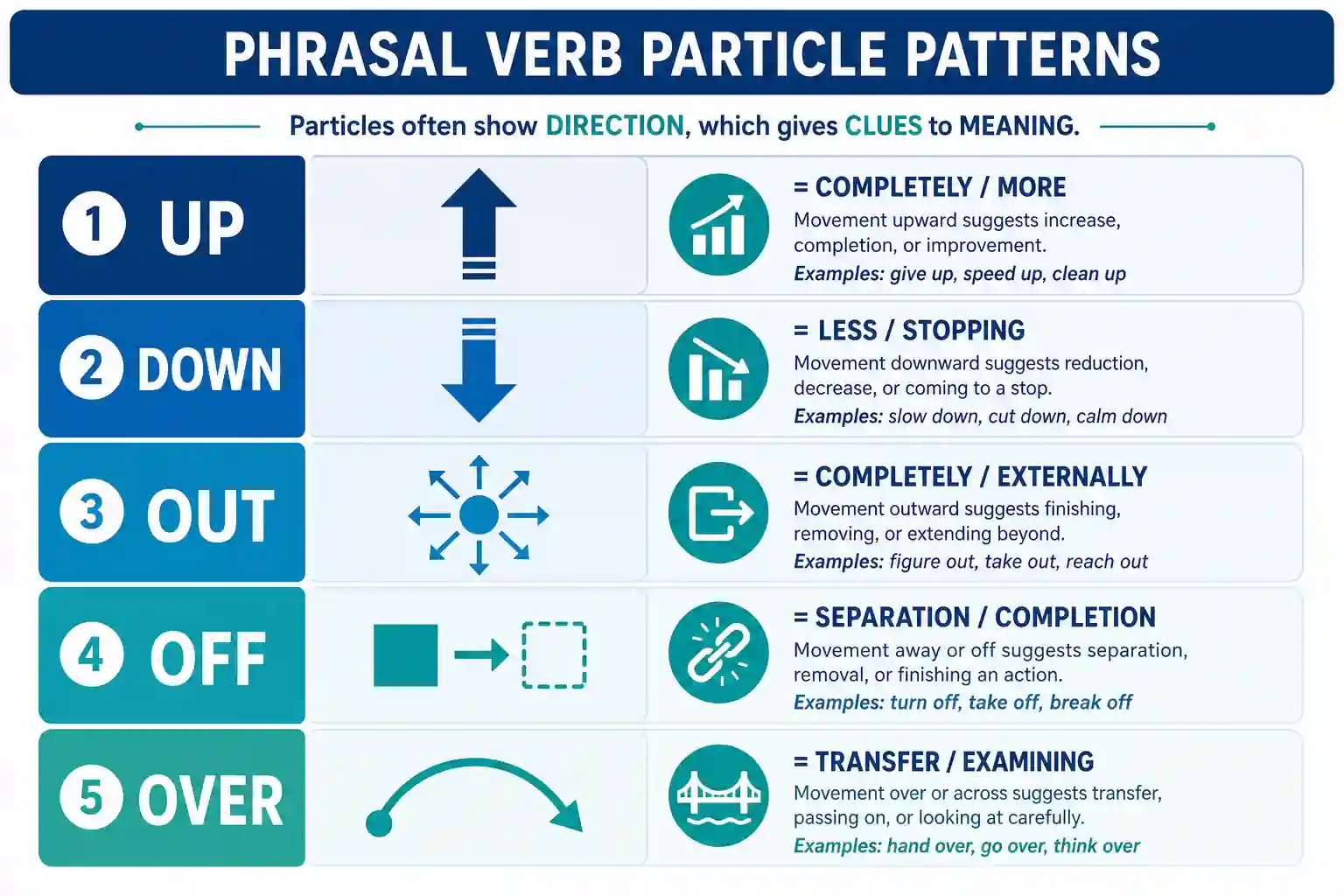
After reading 200 examples, certain patterns become clear. These patterns help you understand new phrasal verbs without looking them up.
UP Often Means “Completely” or “More”
| Phrasal Verb | What UP adds |
|---|---|
| clean up | clean completely |
| use up | use completely (nothing left) |
| build up | increase gradually |
| hurry up | increase speed |
| speak up | speak louder / more boldly |
DOWN Often Means “Less” or “Completely Stopping”
| Phrasal Verb | What DOWN adds |
|---|---|
| slow down | reduce speed |
| cut down | reduce amount |
| break down | stop functioning completely |
| calm down | become less agitated |
| wind down | gradually stop |
OUT Often Means “Completely” or “Externally”
| Phrasal Verb | What OUT adds |
|---|---|
| find out | discover (information comes out) |
| work out | solve completely |
| phase out | remove completely (over time) |
| spell out | explain completely, clearly |
| burn out | exhaust completely |
OFF Often Means “Separation” or “Completion”
| Phrasal Verb | What OFF adds |
|---|---|
| call off | cancel (separate from the plan) |
| pay off | achieve result (debt is cleared) |
| brush off | dismiss (push away) |
| wear off | disappear gradually |
| lay off | dismiss from employment |
OVER Often Means “Transfer” or “Examining”
| Phrasal Verb | What OVER adds |
|---|---|
| take over | transfer control |
| hand over | transfer possession |
| go over | examine carefully |
| think over | consider thoroughly |
| get over | move past (transfer beyond) |
Separable vs. Inseparable: Quick Reference
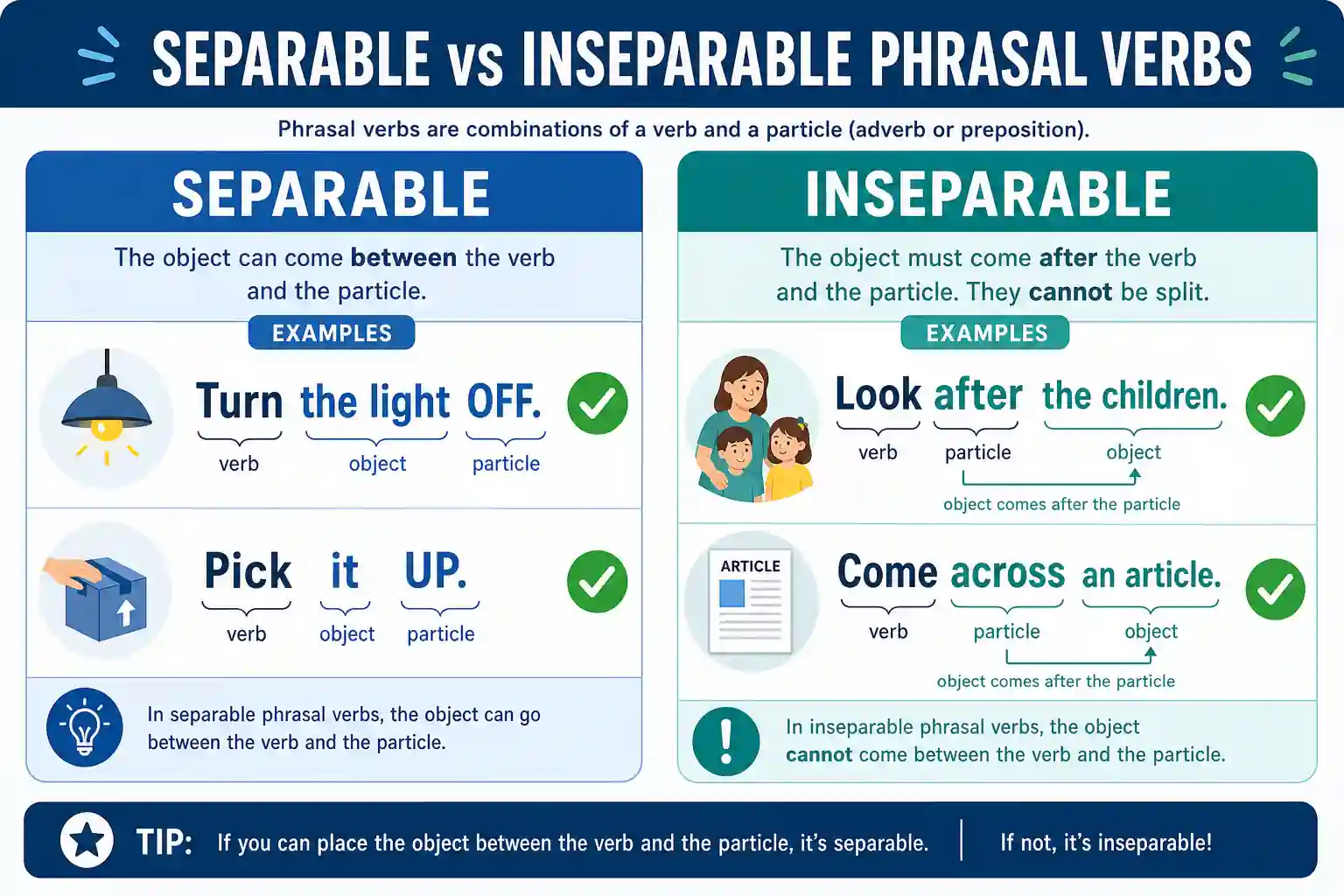
Many learners struggle with word order. Here is how to check if a phrasal verb is separable:
Separable — you can (and sometimes must) put the object between the verb and particle:
- Turn off the light → Turn the light off → Turn it off (with pronouns, separation is required)
- Pick up the book → Pick the book up → Pick it up
Inseparable — the verb and particle must stay together:
-
Look after the children →
Look the children after(wrong) -
Come across an article →
Come an article across(wrong)
Three-word phrasal verbs are always inseparable:
- Look forward to → I look forward to the trip
- Put up with → She put up with the noise
- Come up with → He came up with a plan
Words to Practice With
Here are 25 high-frequency verbs that form the base of most phrasal verbs in this article. Add them to your dictionary and practice combining them with different particles.
artery
noun
A blood vessel that carries blood away from the heart to the body.
Examples
- The blocked artery required immediate surgical intervention to save his life.
- This highway is a major artery connecting the city to surrounding areas.
coastal
adjective
Coastal describes areas near or along the coast.
Examples
- Coastal towns often depend on fishing and tourism for their economy.
- The coastal erosion threatens many beachfront properties and buildings.
cooperate
verb
To work together with others towards a common goal.
donate
verb
To give something, especially money or goods, to help a cause or person.
Examples
- Many people donate money to charities that help homeless individuals.
- She decided to donate blood to help patients in emergency situations.
evaluate
verb
To judge or measure the value, quality, or importance of something.
Examples
- Companies evaluate job candidates based on experience, skills, and personality.
- Teachers evaluate student progress through tests, projects, and classroom participation.
graduate
verb
To complete a course of study at a school or university.
Examples
- She will graduate from university next year with a degree in engineering.
- Students must complete all requirements before they can graduate from high school.
guide
verb
To show or direct someone how to do something.
Examples
- Parents should guide their children to make responsible decisions.
- The experienced hiker will guide the group through the mountain trail safely.
implication
noun
A suggestion or hint about something that is not directly stated.
Examples
- Scientists are studying the implications of climate change for future generations.
- The implication of his statement was that he disagreed with the policy.
candidate
noun
A person who is competing in an election or contest.
Examples
- Each presidential candidate presented their policy plans to voters.
- The job candidate impressed the interview panel with her experience.
prejudice
noun
Preconceived opinions or feelings, often negative, about a person or group.
Examples
- Education helps overcome prejudice and promotes understanding.
- Racial prejudice damages communities and individuals alike.
discourage
verb
To try to make someone feel less confident or hopeful about something.
Examples
- Don't let one failure discourage you from pursuing your dreams.
- High prices discourage many people from buying organic food products.
resolve
verb
To find a solution or answer to a problem or question.
Examples
- Mediator helps parties resolve dispute through negotiation.
- Technical team will resolve software problems quickly.
off
adjective
Describes something that is not fresh or is no longer suitable for eating, often used for food and drinks.
Examples
- Please turn off the lights before leaving the room.
- The dog ran off into the forest chasing wild rabbits.
tragedy
noun
An extremely sad or serious event that causes suffering or loss.
Examples
- Natural tragedy affects thousands of innocent people.
- Personal tragedy changes person's life perspective completely.
admission
noun
The process or fact of being allowed to enter or join.
Examples
- Her admission to the prestigious medical school was the result of hard work.
- The museum offers free admission on the first Sunday of every month.
boom
noun
A loud, deep sound or a sudden increase in activity or popularity.
Examples
- The boom of thunder echoed across the valley.
- The technology boom created many new millionaires.
horizon
noun
The line where the earth or the sky appears to meet in the distance.
Examples
- The sun disappeared behind the horizon as evening approached.
- Traveling broadens your horizon and exposes you to new cultures.
jury
noun
A group of people who listen to evidence in a court and decide if someone is guilty.
Examples
- The jury deliberated for several hours before reaching a verdict.
- The talent show jury consisted of professional musicians and entertainers.
lifelong
adjective
Continuing for a very long time or for the whole life.
Examples
- Learning is a lifelong process that never truly ends.
- Their lifelong friendship began during elementary school years.
motivated
adjective
Feeling driven or inspired to do something because of a reason or goal.
Examples
- Motivated employee seeks additional responsibilities and challenges at work.
- Success requires being motivated even when facing difficult obstacles.
total
adjective
An adjective describing something that is complete or whole, not divided or broken.
Examples
- Total cost includes all fees and expenses.
- Total silence fills room during meditation session.
humorous
adjective
Funny or amusing, often making people laugh.
Examples
- She writes humorous articles about everyday life and family experiences.
- The humorous speech made everyone laugh and lightened the serious mood.
indispensable
adjective
Absolutely necessary; essential.
Examples
- Clean water is indispensable for human survival and good health.
- Her experience and skills make her indispensable to the research team.
firmly
adverb
An adverb indicating a way of doing something with certainty or stability.
Examples
- Hold the rope firmly while climbing down the steep mountain slope.
- The manager firmly believed in treating all employees with respect.
normally
adverb
Usually; under normal conditions.
Examples
- Heart normally beats between sixty and hundred times per minute.
- Students normally arrive at school before morning bell rings.
What to Do Next
-
Choose your level. Find the section that matches your current ability and focus on those 50 examples first.
-
Write 5 of your own sentences. Pick 5 phrasal verbs from your level, and write sentences about your own life using them. Personal sentences are remembered much better than textbook examples.
-
Study by base verb. For detailed explanations of every meaning, explore our verb-specific guides: GET, MAKE, or 50 Most Common.
-
Practice with spaced repetition. Add phrasal verbs to your Linglify dictionary and review them at optimal intervals. Browse the full phrasal verb library for categorized lists.
-
Learn the rules. If separable vs. inseparable confuses you, read our Complete Phrasal Verbs Guide which explains the grammar in detail.
FAQ
What are phrasal verbs with examples?
Phrasal verbs are combinations of a verb + preposition or adverb that create a new meaning different from the original verb. For example: “give up” means to stop trying (not “give” + “up” literally), “run into” means to meet by chance, and “break down” means to stop functioning. English has thousands of phrasal verbs, and native speakers use them constantly in everyday speech.
How do you use phrasal verbs in sentences?
Use phrasal verbs exactly where you would use a regular verb. “She gave up smoking” works the same as “She quit smoking.” The key rule: with separable phrasal verbs, pronouns must go between the verb and particle (“Turn it off,” not “Turn off it”). With inseparable phrasal verbs, the object always follows the full phrase (“Look after the children,” not “Look the children after”).
What are 10 examples of phrasal verbs in sentences?
Here are 10 common ones: (1) I wake up at 7 AM. (2) Please turn off the light. (3) She gave up her job. (4) We ran out of time. (5) He came up with a great idea. (6) They broke up last month. (7) I’m looking forward to the weekend. (8) She turned down the offer. (9) The car broke down on the highway. (10) He picked up Spanish while living abroad.
How many phrasal verbs are there in English?
Estimates range from 5,000 to 10,000, depending on how you count different meanings. However, most native speakers regularly use about 200–300 in daily conversation. For learners, knowing the 100 most common phrasal verbs (covered in our 100 Phrasal Verbs guide) will handle the vast majority of situations you encounter.
What level are phrasal verbs?
Phrasal verbs span all levels. Basic ones like “wake up,” “turn on,” and “sit down” are A2 level. Most common ones like “give up,” “look forward to,” and “find out” are B1. More abstract ones like “bring about,” “rule out,” and “phase in” are B2. Highly idiomatic ones like “cash in on,” “boil down to,” and “play down” are C1. This article is organized by level to help you study systematically.


