
Phrasal Verbs with GET: All Meanings and Examples
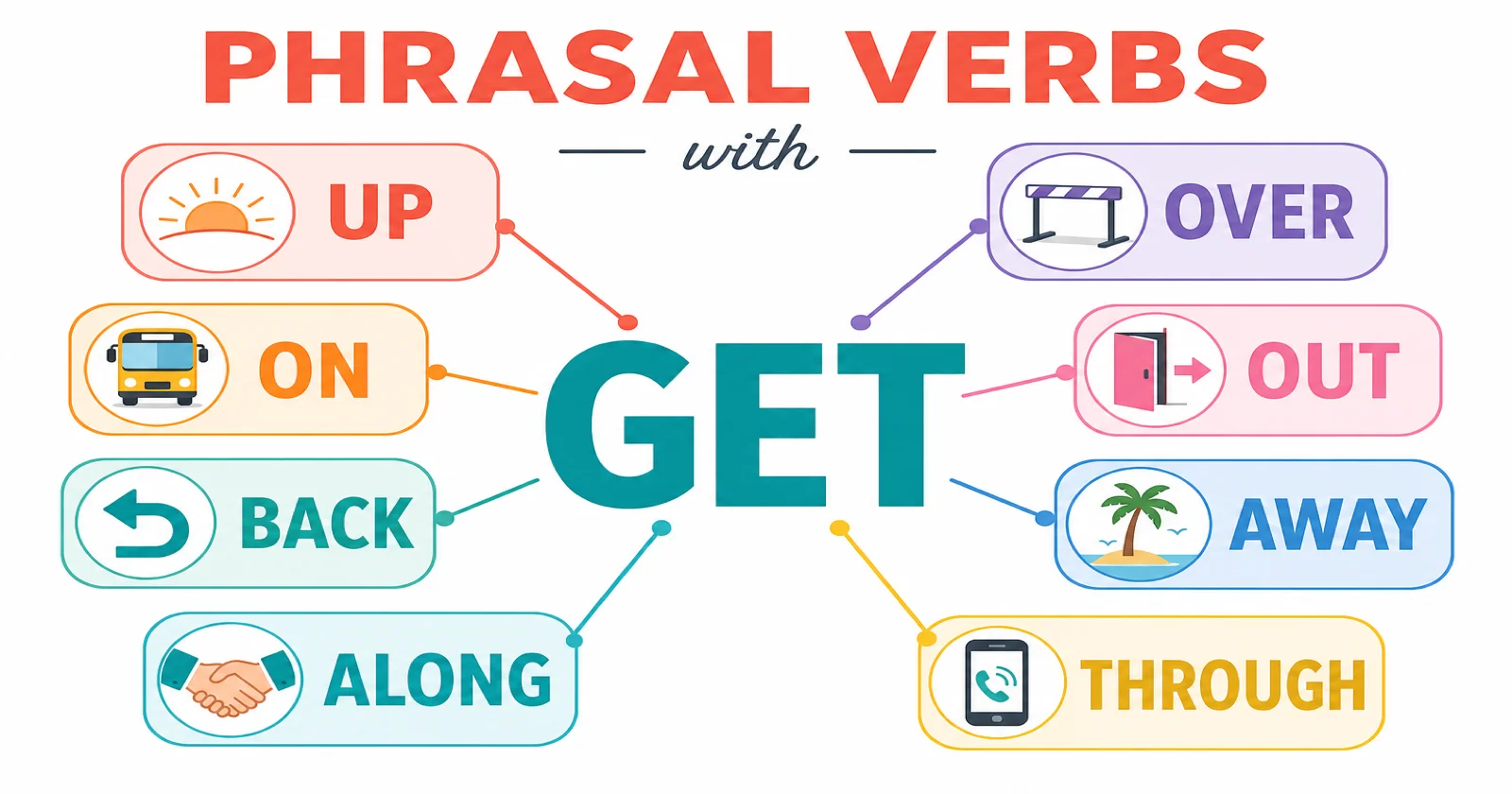
GET is the most versatile verb in English. On its own, it means “to obtain” or “to become.” But add a preposition — up, over, on, away, through, out, along, by — and the meaning changes completely. “Get over” can mean recover from an illness, climb over a wall, or move past heartbreak. “Get out” can mean leave a place, escape danger, or become public knowledge.
Native speakers use phrasal verbs with GET dozens of times per day, often without realizing it. For learners, this creates a gap: you understand every word in “She couldn’t get through to him,” but the sentence means something completely different from what the individual words suggest.
This guide covers every major phrasal verb with GET, organized by the particle (up, over, on, etc.). Each entry includes all meanings, real-life examples, formality notes, and common mistakes. By the end, GET phrasal verbs will feel intuitive — not confusing.
- Phrasal verbs covered: 25+
- Meanings explained: 60+
- Level: B1–C1 (intermediate to advanced)
- Focus: meanings, example sentences, usage notes, common mistakes
For the full guide to English phrasal verbs, see English Phrasal Verbs: Complete Guide.
GET UP — 3 Meanings
1. To rise from bed; to wake up
The most common meaning. Used every day by everyone.
I get up at 6:30 every morning. She got up early to catch the first train. What time do you usually get up on weekends?
2. To stand up from a sitting or lying position
He fell on the ice but got up quickly. The audience got up and applauded. She got up from her desk and stretched.
3. To organize or prepare (British English, informal)
They got up a petition to save the park. We should get up a group to visit the museum.
Common mistake: “I got up from the bed” — no article needed. Say “I got up” or “I got out of bed.”
GET OVER — 4 Meanings
1. To recover from (illness, shock, or emotional pain)
The most common meaning. Recovery takes time, and “get over” implies the process is complete.
It took her months to get over the flu. He still hasn’t gotten over his breakup. You need time to get over the shock.
2. To overcome (a problem or difficulty)
We need to get over this obstacle before moving forward. Once you get over the initial confusion, the software is easy to use.
3. To accept something surprising or hard to believe
Often used in the negative or with “can’t.”
I can’t get over how much the city has changed! She couldn’t get over the fact that she had actually won.
4. To cross or climb over a physical barrier
The cat managed to get over the fence. We need to get over this hill before sunset.
Common mistake: “Get over it” sounds dismissive in conversation. Use it carefully — it implies the person should stop complaining.
GET ON — 5 Meanings
1. To board (a bus, train, plane, or large vehicle)
We got on the bus at the wrong stop. Hurry — we need to get on the plane before they close the gate. She got on the train to London at 8 a.m.
2. To have a good relationship (British English: get on; American: get along)
Do you get on with your colleagues? They don’t get on very well — they argue constantly. I’ve always gotten on well with my neighbors.
3. To continue with a task; to make progress
Stop talking and get on with your work. Let’s get on with the meeting — we’re behind schedule. How are you getting on with the project?
4. To manage or cope (British English)
How’s your mother getting on these days? He’s getting on well after the surgery.
5. To grow old (informal)
She’s getting on in years, but she’s still very active. He’s getting on a bit — he’ll be 70 next month.
Common mistake: “Get on” for vehicles depends on size. Get ON a bus/train/plane (large). Get IN a car/taxi (small).
GET OFF — 4 Meanings
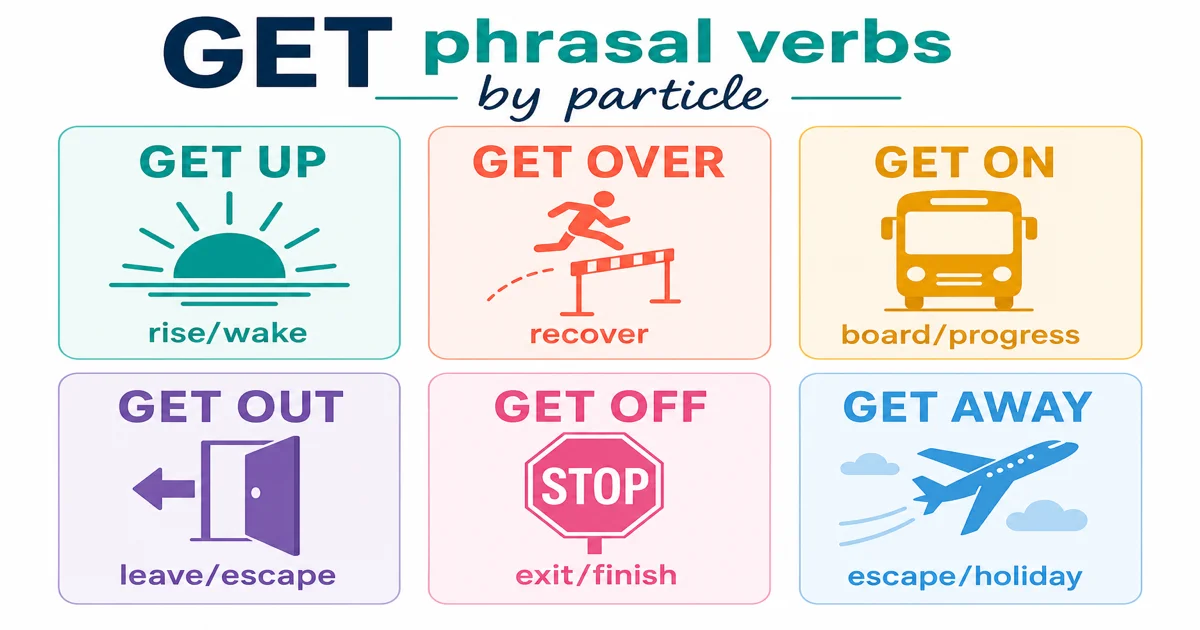
1. To leave or exit (a bus, train, or large vehicle)
The opposite of “get on.”
We get off at the next stop. She got off the train and walked to the office. Don’t forget to get off at Central Station.
2. To leave work; to finish for the day
What time do you get off work today? I get off at 5, so I can meet you at 5:30.
3. To avoid punishment or receive a light sentence
He got off with just a warning. The lawyer helped her get off the charges. He committed fraud but somehow got off scot-free.
4. To stop touching or holding (imperative)
Get off my phone! The sign said “Get off the grass.”
Common mistake: “Get off FROM the bus” — no “from” needed. Say “get off the bus.”
GET OUT — 4 Meanings
1. To leave a place
Get out of my house! We should get out of here before the storm hits. She got out of the car and slammed the door.
2. To escape
The prisoners tried to get out through a tunnel. How did the dog get out of the yard?
3. To become known (of information or secrets)
If this information gets out, there will be a scandal. Word got out that the company was closing.
4. To remove or extract something
I can’t get this stain out of my shirt. She got out her wallet and paid the bill.
GET AWAY — 3 Meanings
1. To escape or flee
The thieves got away before the police arrived. The bird got away from the cat.
2. To go on vacation; to leave for a break
We need to get away for a few days — I’m exhausted. They got away to the mountains for the weekend.
3. To avoid consequences (get away with)
He cheated on the test and got away with it. You can’t get away with lying to your boss forever. She always gets away with coming to work late.
Note: “Get away!” as an exclamation means “I don’t believe you!” (British informal) or “Leave!” (imperative).
GET ALONG — 2 Meanings
1. To have a friendly relationship
The American English equivalent of British “get on.” Very common in everyday speech.
Do you get along with your sister? The new employee gets along well with everyone. They didn’t get along at first, but now they’re good friends.
2. To manage or survive
How do you get along on such a small salary? We get along fine without a car.
GET THROUGH — 4 Meanings
1. To finish or complete (a task, period, or amount)
I got through all 500 pages in three days. How are we going to get through all this work by Friday? She finally got through the exam preparation.
2. To survive a difficult period
It was a tough year, but we got through it. Music helped me get through the lockdown.
3. To reach someone by phone
I’ve been trying to call her all day, but I can’t get through. I finally got through to customer service after 40 minutes.
4. To make someone understand
I tried to explain, but I couldn’t get through to him. How can I get through to my teenager about the importance of studying?
GET BACK — 3 Meanings
1. To return
What time did you get back from vacation? I’ll get back to London by Friday. She got back home late last night.
2. To recover or retrieve something
I got my money back after returning the product. Did you ever get back the book you lent him?
3. To take revenge (get back at)
He’s trying to get back at his ex-partner. She got back at him by revealing his secret.
GET IN — 3 Meanings
1. To enter a small vehicle (car, taxi)
The opposite of “get out of.”
Get in the car — we’re late! She got in a taxi and headed to the airport.
2. To arrive
What time does your flight get in? The train gets in at 9:15. He got in late last night.
3. To be accepted (to a school, program, or event)
She applied to five universities and got in to three. It’s a popular club — it’s hard to get in. Did you get in? I heard the competition was fierce.
GET INTO — 3 Meanings
1. To become interested or involved in
She’s really getting into photography lately. He got into cooking during the pandemic. I can’t get into this book — it’s too slow.
2. To enter (a school, program, or profession)
Getting into medical school is extremely competitive. How did you get into marketing?
3. To get in trouble
He keeps getting into fights at school. Don’t get into an argument with her — you won’t win. What has gotten into you today? You’re acting strange.
GET BY — 2 Meanings
1. To manage to survive with limited resources
It’s hard to get by on minimum wage. We don’t have much, but we get by. She gets by with a little help from her family.
2. To pass (physically move past someone)
Excuse me, could I get by? I need to reach the exit. The hallway is so narrow, it’s hard to get by.
GET DOWN — 3 Meanings
1. To make someone feel depressed or unhappy
The constant rain is really getting me down. Don’t let the criticism get you down.
2. To physically descend or lower yourself
Get down from that tree before you fall! She got down on her knees to search under the sofa.
3. To write down or record
Let me get that down before I forget. Did you get down her phone number?
GET AROUND — 3 Meanings
1. To travel from place to place
It’s easy to get around Tokyo by subway. How do you get around without a car?
2. To avoid or find a way past (a rule or problem)
There’s no way to get around this regulation. She always finds a way to get around the rules.
3. To become widely known (of news or information)
News gets around fast in a small town. Word got around that the company was being sold.
GET AHEAD — 1 Meaning
To make progress, especially in career or life
You need to work hard to get ahead in this industry. She’s determined to get ahead in her career. It’s difficult to get ahead when you’re always playing catch-up.
GET ACROSS — 1 Meaning
To communicate an idea successfully
I’m trying to get my point across, but nobody seems to understand. The teacher got the concept across using simple examples. How can I get this message across to the team?
GET RID OF — 1 Meaning
To remove, discard, or eliminate
One of the most useful phrases in English — used constantly in daily life.
We need to get rid of this old furniture. How do I get rid of these ants in the kitchen? She finally got rid of her cold after a week of rest.
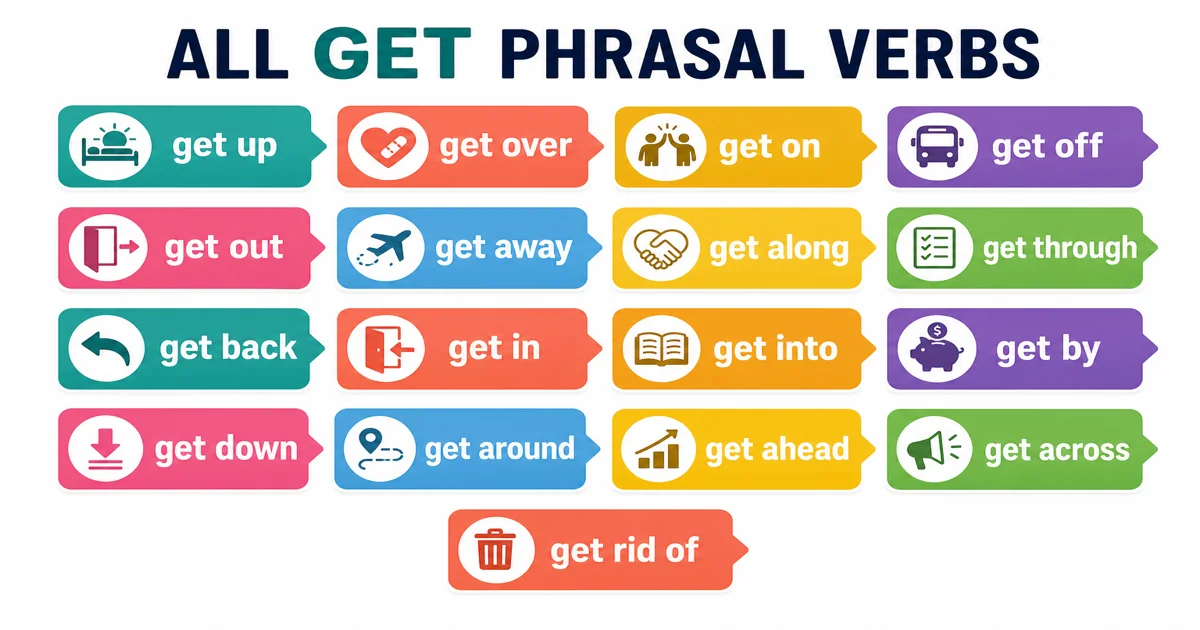
Quick Reference Table
| Phrasal Verb | Main Meaning | Example |
|---|---|---|
| get up | rise from bed | I get up at 7 every day. |
| get over | recover from | She got over the illness quickly. |
| get on | board; have a good relationship | Get on the bus. / We get on well. |
| get off | exit a vehicle; finish work | Get off at the next stop. |
| get out | leave; escape | Get out of here! |
| get away | escape; go on holiday | The thieves got away. |
| get along | have a friendly relationship | Do you get along with your boss? |
| get through | finish; survive; reach by phone | I can’t get through to her. |
| get back | return; retrieve | When did you get back? |
| get in | enter (car); arrive; be accepted | Get in the car. |
| get into | become interested in | She’s getting into yoga. |
| get by | manage to survive | We get by on a small budget. |
| get down | feel depressed; descend; write down | The news got me down. |
| get around | travel; avoid a rule | It’s easy to get around by bus. |
| get ahead | make progress | Work hard to get ahead. |
| get across | communicate an idea | I couldn’t get my point across. |
| get rid of | remove or discard | Get rid of the old files. |
GET IN vs. GET ON: Which Vehicles?
This confuses almost every learner. The rule is based on vehicle size:
| Use GET ON | Use GET IN |
|---|---|
| bus | car |
| train | taxi |
| plane | van (small) |
| ship | truck cab |
| bicycle | canoe |
| motorcycle | helicopter |
Pattern: GET ON = you can stand or walk inside. GET IN = you sit down into a small enclosed space.
Opposite: GET OFF (bus, train) / GET OUT OF (car, taxi).
Common Mistakes with GET Phrasal Verbs
| Mistake | Correct Form | Why |
|---|---|---|
|
|
get on the bus | No preposition after “get on” |
|
|
get off the train | No “from” needed |
|
|
I got up / I got out of bed | Either drop “bed” or use “get out of” |
|
|
get over an illness | No “from” after “get over” |
|
|
I can’t get through to her | Need “to” for phone/communication |
Practice Words
Add these essential phrasal verbs and related vocabulary to your Linglify dictionary.
boom
noun
A loud, deep sound or a sudden increase in activity or popularity.
Examples
- The boom of thunder echoed across the valley.
- The technology boom created many new millionaires.
cooperate
verb
To work together with others towards a common goal.
evaluate
verb
To judge or measure the value, quality, or importance of something.
Examples
- Companies evaluate job candidates based on experience, skills, and personality.
- Teachers evaluate student progress through tests, projects, and classroom participation.
graduate
verb
To complete a course of study at a school or university.
Examples
- She will graduate from university next year with a degree in engineering.
- Students must complete all requirements before they can graduate from high school.
horizon
noun
The line where the earth or the sky appears to meet in the distance.
Examples
- The sun disappeared behind the horizon as evening approached.
- Traveling broadens your horizon and exposes you to new cultures.
indispensable
adjective
Absolutely necessary; essential.
Examples
- Clean water is indispensable for human survival and good health.
- Her experience and skills make her indispensable to the research team.
jury
noun
A group of people who listen to evidence in a court and decide if someone is guilty.
Examples
- The jury deliberated for several hours before reaching a verdict.
- The talent show jury consisted of professional musicians and entertainers.
lifelong
adjective
Continuing for a very long time or for the whole life.
Examples
- Learning is a lifelong process that never truly ends.
- Their lifelong friendship began during elementary school years.
motivated
adjective
Feeling driven or inspired to do something because of a reason or goal.
Examples
- Motivated employee seeks additional responsibilities and challenges at work.
- Success requires being motivated even when facing difficult obstacles.
normally
adverb
Usually; under normal conditions.
Examples
- Heart normally beats between sixty and hundred times per minute.
- Students normally arrive at school before morning bell rings.
off
adjective
Describes something that is not fresh or is no longer suitable for eating, often used for food and drinks.
Examples
- Please turn off the lights before leaving the room.
- The dog ran off into the forest chasing wild rabbits.
prejudice
noun
Preconceived opinions or feelings, often negative, about a person or group.
Examples
- Education helps overcome prejudice and promotes understanding.
- Racial prejudice damages communities and individuals alike.
resolve
verb
To find a solution or answer to a problem or question.
Examples
- Mediator helps parties resolve dispute through negotiation.
- Technical team will resolve software problems quickly.
stress
verb
To feel mental or emotional pressure or worry; to emphasize or give importance to something.
Examples
- Heavy workload may stress employees beyond limits.
- Teacher will stress importance of homework completion.
total
adjective
An adjective describing something that is complete or whole, not divided or broken.
Examples
- Total cost includes all fees and expenses.
- Total silence fills room during meditation session.
tragedy
noun
An extremely sad or serious event that causes suffering or loss.
Examples
- Natural tragedy affects thousands of innocent people.
- Personal tragedy changes person's life perspective completely.
union
noun
A group of people or things joined together for a purpose.
Examples
- Labor union protects worker rights and interests.
- Marriage union joins two people in partnership.
voyage
noun
A long journey to a distant place, often by sea or air.
Examples
- Space exploration represents humanity's greatest voyage into the unknown.
- The ocean voyage from Europe to America took several weeks in the past.
candidate
noun
A person who is competing in an election or contest.
Examples
- Each presidential candidate presented their policy plans to voters.
- The job candidate impressed the interview panel with her experience.
discourage
verb
To try to make someone feel less confident or hopeful about something.
Examples
- Don't let one failure discourage you from pursuing your dreams.
- High prices discourage many people from buying organic food products.
donate
verb
To give something, especially money or goods, to help a cause or person.
Examples
- Many people donate money to charities that help homeless individuals.
- She decided to donate blood to help patients in emergency situations.
firmly
adverb
An adverb indicating a way of doing something with certainty or stability.
Examples
- Hold the rope firmly while climbing down the steep mountain slope.
- The manager firmly believed in treating all employees with respect.
guide
verb
To show or direct someone how to do something.
Examples
- Parents should guide their children to make responsible decisions.
- The experienced hiker will guide the group through the mountain trail safely.
humorous
adjective
Funny or amusing, often making people laugh.
Examples
- She writes humorous articles about everyday life and family experiences.
- The humorous speech made everyone laugh and lightened the serious mood.
admission
noun
The process or fact of being allowed to enter or join.
Examples
- Her admission to the prestigious medical school was the result of hard work.
- The museum offers free admission on the first Sunday of every month.
What to Do Next
-
Pick your weakest area. Read through the list above and identify which GET phrasal verbs you confuse or never use. Focus on those first.
-
Create sentences. For each phrasal verb, write 2–3 sentences about your own life. Personal connections make vocabulary stick.
-
Add to Linglify for spaced repetition. The system will test you at optimal intervals until these phrasal verbs become automatic.
-
Read the complete phrasal verb guide — English Phrasal Verbs: Complete Guide covers 200+ phrasal verbs across all base verbs.
-
Learn phrasal verbs with MAKE — Phrasal Verbs with MAKE follows the same format for another essential verb.
FAQ
What are the most common phrasal verbs with GET?
The five most frequently used are: get up (rise from bed), get on/along (have a good relationship), get over (recover from), get through (finish/survive), and get rid of (remove/discard). These appear in everyday conversation dozens of times per day. Native speakers use them automatically, so understanding them is essential for following natural English speech.
Why does GET have so many phrasal verbs?
GET is one of the oldest and most fundamental English verbs. Its core meaning — “to obtain” or “to become” — is extremely flexible, which allows it to combine with almost any preposition to create new meanings. Historically, phrasal verbs replaced longer Latin-origin words in everyday speech (e.g., “get over” replaced “recover,” “get rid of” replaced “eliminate”), making GET a natural base for dozens of combinations.
How do I know when to use GET IN vs. GET ON?
Use GET ON for large vehicles where you can stand and walk (bus, train, plane, ship). Use GET IN for small vehicles where you sit down into an enclosed space (car, taxi). The same pattern applies in reverse: GET OFF the bus, GET OUT OF the car. If you can walk around inside, it’s ON/OFF. If you have to bend down to enter, it’s IN/OUT.
Are GET phrasal verbs formal or informal?
Most GET phrasal verbs are neutral to informal and perfectly appropriate for everyday speech, emails, and general writing. In very formal academic or legal writing, Latin-origin verbs are preferred: recover instead of “get over,” eliminate instead of “get rid of,” comprehend instead of “get.” However, in business English, presentations, and most professional contexts, GET phrasal verbs are completely acceptable and natural.
How many meanings can one GET phrasal verb have?
Some have up to five distinct meanings. “Get on” can mean board a vehicle, have a relationship, make progress, manage/cope, or grow old. “Get through” means finish, survive, reach by phone, or communicate an idea. Context always determines the meaning — the words around the phrasal verb tell you which definition applies. This is why learning phrasal verbs with example sentences is much more effective than memorizing isolated definitions.


