
Synonyms for Common English Words: 200+ Powerful Upgrades
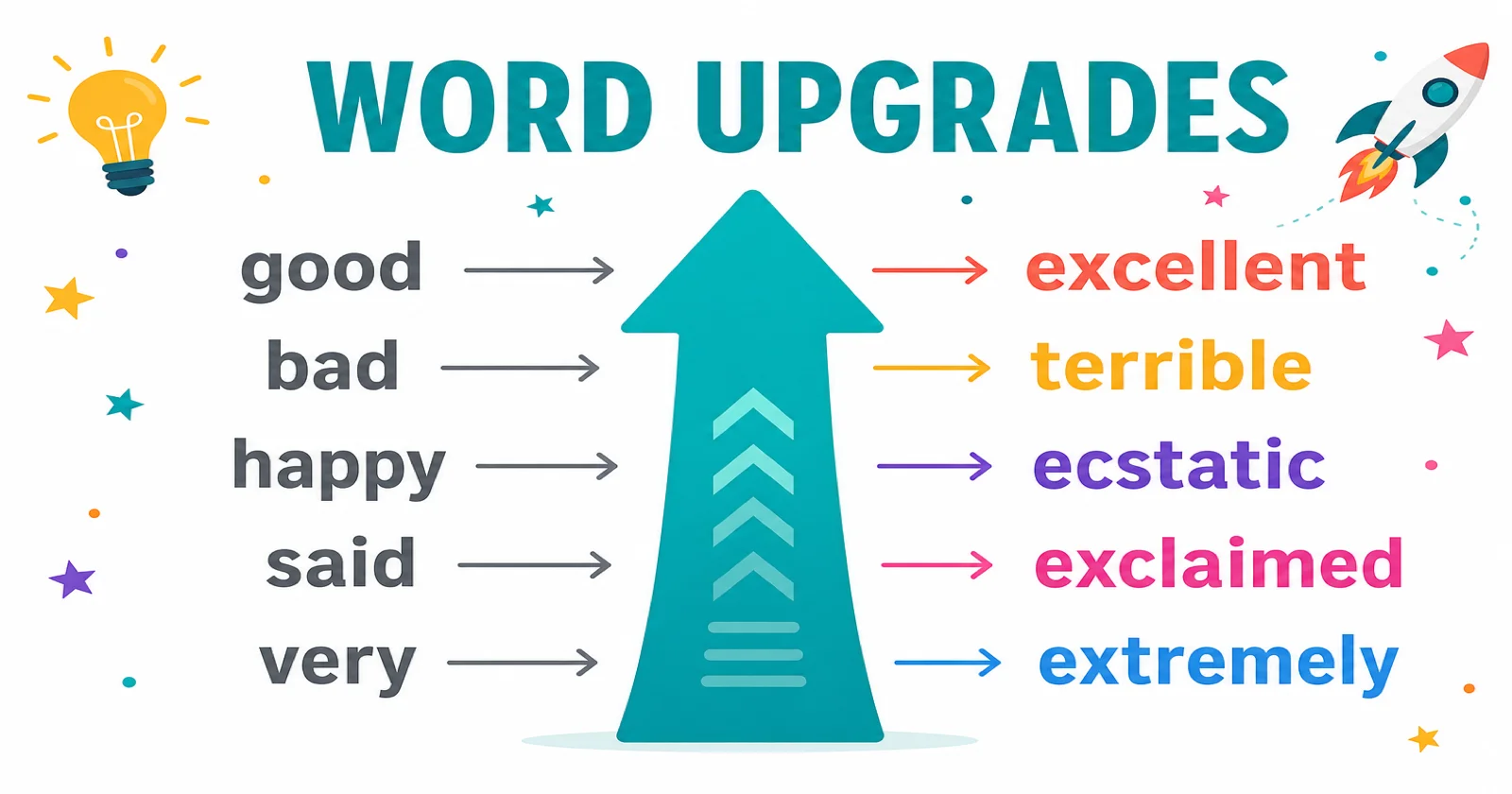
Every English learner reaches a point where they know enough words to communicate — but keep using the same ten words in every sentence. “Good,” “bad,” “nice,” “interesting,” “very,” “said.” These words work, but they make your English sound flat, repetitive, and vague.
The difference between basic English and fluent English is not grammar — it’s word choice. A student who writes “The movie was good” communicates meaning. A student who writes “The movie was gripping” communicates meaning and shows command of the language. In IELTS writing, this is the difference between Band 6 and Band 7+. In professional emails, it’s the difference between sounding competent and sounding polished.
This guide gives you 200+ synonyms for the 20 most overused English words. Each synonym includes a definition, formality level, and example sentence — so you know not just what to say, but when to say it.
- Total: 200+ synonym upgrades
- Organized by: 20 overused words
- Format: Synonym → Definition → Formality → Example
- Level: B1–C1
- For: writing improvement, IELTS/TOEFL prep, professional communication
For the full guide to synonyms and antonyms, see English Synonyms and Antonyms: Complete Guide.
How to Use This Guide
- Find the word you overuse — scan the table of contents below.
- Pick 2–3 synonyms that match your formality level (casual, neutral, or formal).
- Read the example sentences — context matters more than definitions.
- Practice immediately — use your new words in writing or conversation today.
Warning: Not all synonyms are interchangeable. “Big” and “enormous” overlap in meaning, but you can say “my big sister” — you cannot say “my enormous sister.” Always check the context before swapping words.
Synonyms for “Good”
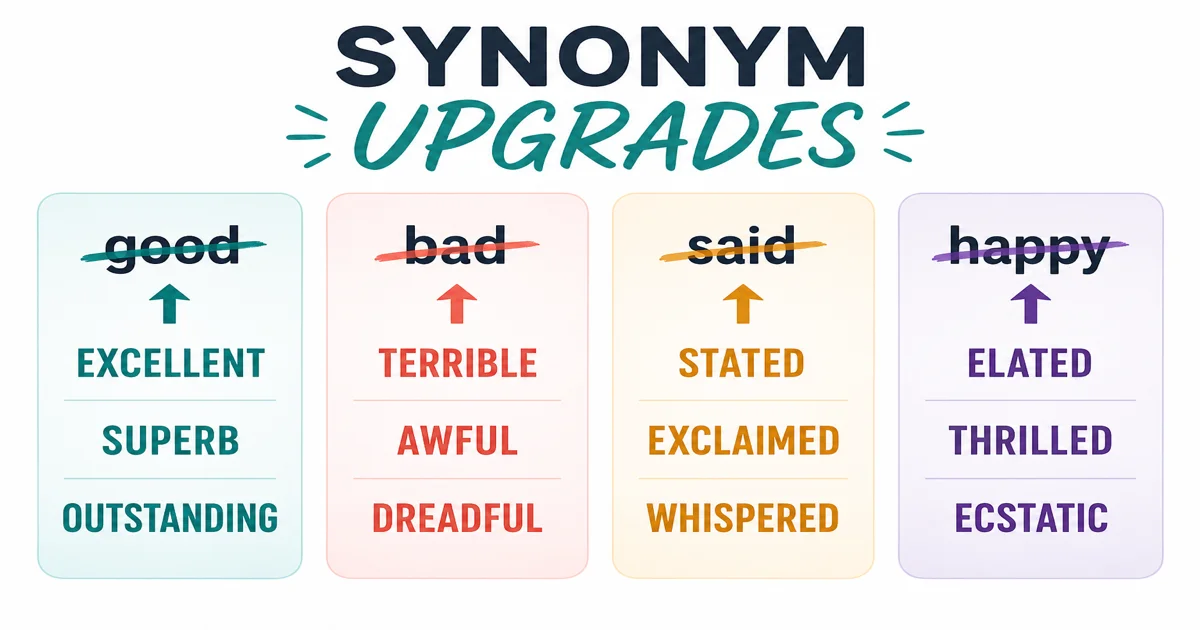
The most overused word in English. “Good” can mean anything — which means it says almost nothing.
| Synonym | Meaning | Tone | Example |
|---|---|---|---|
| excellent | extremely good | neutral | She did an excellent job on the report. |
| outstanding | exceptionally good | formal | His outstanding performance earned a promotion. |
| superb | impressively great | neutral | The restaurant has superb pasta. |
| remarkable | worthy of attention | formal | The team made remarkable progress this quarter. |
| wonderful | causing delight | neutral | We had a wonderful time at the party. |
| terrific | extremely good | casual | That’s a terrific idea — let’s try it! |
| fantastic | extraordinarily good | casual | The concert was fantastic from start to finish. |
| exceptional | unusually excellent | formal | She is an exceptional student. |
| admirable | deserving respect | formal | His dedication is truly admirable. |
| first-rate | of the highest quality | neutral | They provide first-rate customer service. |
| splendid | magnificent | formal | What a splendid view from this balcony! |
Synonyms for “Bad”
Another word that has been stretched to cover everything from “mildly disappointing” to “catastrophic.”
| Synonym | Meaning | Tone | Example |
|---|---|---|---|
| terrible | extremely bad | neutral | The weather has been terrible all week. |
| awful | very bad or unpleasant | casual | The movie was awful — we left early. |
| dreadful | causing great suffering or fear | formal | The living conditions were dreadful. |
| appalling | shockingly bad | formal | The error rate is appalling. |
| atrocious | horrifically bad | formal | The quality of work was atrocious. |
| inferior | lower in quality | formal | The cheaper model uses inferior materials. |
| mediocre | average, not good enough | neutral | The food was mediocre at best. |
| poor | below acceptable standard | neutral | She received poor marks on the exam. |
| substandard | below the expected level | formal | The construction was found to be substandard. |
| lousy | very poor quality | casual | I had a lousy day at work. |
Synonyms for “Happy”
“Happy” covers a spectrum from quiet contentment to overwhelming joy. Your synonym choice places the emotion precisely.
| Synonym | Meaning | Tone | Example |
|---|---|---|---|
| delighted | very pleased | neutral | I’m delighted to hear the news! |
| thrilled | extremely excited and pleased | neutral | She was thrilled to get the job offer. |
| ecstatic | overwhelmingly happy | neutral | The fans were ecstatic after the win. |
| content | peacefully satisfied | neutral | He felt content sitting by the fire. |
| elated | extremely happy and energized | formal | We were elated by the results. |
| overjoyed | extremely joyful | neutral | They were overjoyed at the birth of their child. |
| cheerful | noticeably happy and positive | neutral | She’s always cheerful in the morning. |
| blissful | supremely happy | formal | They spent a blissful week at the beach. |
| grateful | thankful and appreciative | neutral | I’m grateful for your help. |
| euphoric | intensely happy (often briefly) | formal | The crowd was euphoric after the announcement. |
Synonyms for “Sad”
| Synonym | Meaning | Tone | Example |
|---|---|---|---|
| unhappy | not happy | neutral | She seemed unhappy with the decision. |
| miserable | extremely unhappy | neutral | The cold rain made everyone miserable. |
| heartbroken | devastated emotionally | neutral | He was heartbroken when she left. |
| devastated | overwhelmed with grief | neutral | The community was devastated by the loss. |
| gloomy | dark and depressing | neutral | The gloomy weather matched her mood. |
| melancholy | deep, reflective sadness | formal | A melancholy tone runs through the novel. |
| sorrowful | full of grief | formal | She gave a sorrowful farewell speech. |
| downcast | feeling defeated or low | formal | He looked downcast after receiving the news. |
| despondent | in low spirits from loss of hope | formal | After months of rejection, she grew despondent. |
| dejected | sad and disappointed | formal | The team walked off the field dejected. |
Synonyms for “Interesting”
A word that tells the reader nothing specific. Why is it interesting?
| Synonym | Meaning | Tone | Example |
|---|---|---|---|
| fascinating | intensely interesting | neutral | She told a fascinating story about her travels. |
| captivating | holding attention completely | formal | The speaker gave a captivating presentation. |
| compelling | powerfully interesting | formal | The evidence is compelling. |
| engaging | holding attention pleasantly | neutral | The workshop was engaging and well-organized. |
| intriguing | arousing curiosity | neutral | That’s an intriguing idea — tell me more. |
| stimulating | encouraging thought or discussion | formal | The debate was intellectually stimulating. |
| thought-provoking | making you think deeply | neutral | The documentary was thought-provoking. |
| absorbing | holding complete attention | neutral | I found the book absolutely absorbing. |
| riveting | impossible to look away from | neutral | The trial was riveting from start to finish. |
| gripping | exciting and holding attention | neutral | The thriller was gripping — I read it in one sitting. |
Synonyms for “Important”
| Synonym | Meaning | Tone | Example |
|---|---|---|---|
| crucial | extremely important, decisive | neutral | Timing is crucial in this market. |
| essential | absolutely necessary | neutral | Sleep is essential for good health. |
| vital | critically important | neutral | Clean water is vital for survival. |
| significant | large enough to matter | formal | There was a significant increase in sales. |
| critical | of great importance at a key moment | neutral | This is a critical phase of the project. |
| fundamental | forming the base of everything | formal | Trust is fundamental to any relationship. |
| pivotal | turning point; central | formal | Her testimony was pivotal in the trial. |
| paramount | above all others in importance | formal | Safety is paramount in our industry. |
| indispensable | absolutely necessary | formal | She became indispensable to the team. |
| key | of primary importance | neutral | Education is key to reducing inequality. |
Synonyms for “Big”
| Synonym | Meaning | Tone | Example |
|---|---|---|---|
| enormous | extremely large in size | neutral | They live in an enormous house. |
| massive | very large and heavy | neutral | The storm caused massive flooding. |
| huge | extremely large | casual | That’s a huge difference in price. |
| vast | immensely large in area or amount | neutral | The Sahara is a vast desert. |
| immense | extremely large or great | formal | The project required immense effort. |
| substantial | large in size or value | formal | She received a substantial pay raise. |
| colossal | extraordinarily large | formal | The statue was colossal — visible from miles away. |
| tremendous | very great in amount | neutral | The team made tremendous progress. |
| gigantic | extremely large | neutral | They built a gigantic shopping mall. |
| considerable | notably large in amount | formal | There is considerable debate on this topic. |
Synonyms for “Small”
| Synonym | Meaning | Tone | Example |
|---|---|---|---|
| tiny | very small | neutral | She lives in a tiny apartment. |
| minute | extremely small | formal | There were minute differences between the two. |
| compact | small but efficient | neutral | The kitchen is compact but well-designed. |
| modest | relatively small or limited | neutral | They made a modest profit this year. |
| negligible | so small as to be meaningless | formal | The side effects are negligible. |
| slight | small in degree | neutral | There was a slight delay in shipping. |
| miniature | very small version of something | neutral | She collects miniature furniture. |
| petite | attractively small (people) | neutral | She’s petite but incredibly strong. |
| trivial | unimportant or minor | formal | Don’t waste time on trivial details. |
| marginal | very small, on the edge | formal | The marginal cost increase is acceptable. |
Synonyms for “Said”
In dialogue writing, “said” disappears — but in essays and narratives, varying it adds tone and precision.
| Synonym | Meaning | Tone | Example |
|---|---|---|---|
| stated | said formally | formal | The CEO stated that profits rose 12%. |
| mentioned | referred to briefly | neutral | She mentioned the meeting in her email. |
| declared | said firmly and publicly | formal | He declared his candidacy this morning. |
| explained | said while giving reasons | neutral | “The process takes two weeks,” she explained. |
| announced | said publicly or officially | neutral | The company announced a new product line. |
| argued | said while giving opposing reasons | neutral | Critics argued that the policy was flawed. |
| insisted | said firmly, refusing to back down | neutral | “I didn’t do it,” he insisted. |
| whispered | said very quietly | neutral | “Be careful,” she whispered. |
| exclaimed | said with sudden emotion | neutral | “That’s incredible!” he exclaimed. |
| muttered | said quietly and unclearly | neutral | He muttered something under his breath. |
Synonyms for “Very”
“Very” is a weak intensifier. Replace it with a stronger word or remove it entirely.
| Instead of… | Use | Example |
|---|---|---|
| very happy | ecstatic, thrilled | She was thrilled with the results. |
| very sad | devastated, heartbroken | He was devastated by the news. |
| very big | enormous, massive | The crowd was enormous. |
| very small | tiny, minute | A tiny crack appeared in the wall. |
| very tired | exhausted, drained | After the hike, we were exhausted. |
| very hungry | starving, ravenous | I’m starving — I haven’t eaten all day. |
| very cold | freezing, bitter | It’s freezing outside — grab a coat. |
| very hot | scorching, boiling | The sand was scorching under our feet. |
| very scared | terrified, petrified | She was terrified of the dark. |
| very angry | furious, livid | He was furious when he found out. |
| very beautiful | stunning, gorgeous | The view was absolutely stunning. |
| very ugly | hideous, grotesque | The building was hideous from every angle. |
Synonyms for “Nice”
Another word that says nothing specific. Nice weather? Nice person? Nice idea? Replace it.
| Synonym | Meaning | Tone | Example |
|---|---|---|---|
| pleasant | enjoyable and agreeable | neutral | We had a pleasant conversation. |
| lovely | beautiful and enjoyable | neutral | What a lovely surprise! |
| kind | generous and considerate | neutral | That was very kind of you. |
| charming | delightfully attractive | neutral | The village has a charming town center. |
| thoughtful | showing care for others | neutral | What a thoughtful gift! |
| gracious | courteous and kind | formal | She was gracious in accepting the award. |
| amiable | friendly and agreeable | formal | He’s an amiable colleague to work with. |
| agreeable | pleasant, easy to get along with | formal | The weather was agreeable for outdoor activities. |
| delightful | highly pleasing | neutral | The garden was absolutely delightful. |
| warm | friendly and welcoming | neutral | She gave us a warm welcome. |
Synonyms for “Difficult” / “Hard”
| Synonym | Meaning | Tone | Example |
|---|---|---|---|
| challenging | difficult in a stimulating way | neutral | The course was challenging but rewarding. |
| demanding | requiring great effort | neutral | Teaching is a demanding profession. |
| complex | having many interconnected parts | formal | The problem is more complex than it appears. |
| arduous | requiring sustained, hard effort | formal | The climb was long and arduous. |
| strenuous | requiring great physical effort | neutral | Avoid strenuous activity after surgery. |
| grueling | extremely tiring and difficult | neutral | The marathon was absolutely grueling. |
| formidable | inspiring fear or respect | formal | She is a formidable opponent. |
| taxing | physically or mentally draining | neutral | The negotiations were mentally taxing. |
| tough | difficult, requiring strength | casual | It’s been a tough year for everyone. |
| daunting | seeming difficult and intimidating | neutral | The task ahead looks daunting. |
Synonyms for “Beautiful”
| Synonym | Meaning | Tone | Example |
|---|---|---|---|
| stunning | extremely impressive or attractive | neutral | The sunset was absolutely stunning. |
| gorgeous | very beautiful | casual/neutral | She looked gorgeous at the event. |
| breathtaking | astonishingly beautiful | neutral | The mountain scenery was breathtaking. |
| magnificent | extremely beautiful and impressive | formal | The cathedral is truly magnificent. |
| exquisite | extremely beautiful and delicate | formal | The craftsmanship is exquisite. |
| elegant | gracefully beautiful | formal | She wore an elegant black dress. |
| radiant | shining with beauty or health | neutral | The bride looked radiant. |
| picturesque | visually charming (places) | neutral | The village is picturesque in autumn. |
| dazzling | blindingly beautiful or impressive | neutral | She gave a dazzling performance. |
| striking | attracting attention through being unusual | neutral | He has striking blue eyes. |
Synonyms for “Ugly”
| Synonym | Meaning | Tone | Example |
|---|---|---|---|
| unattractive | not pleasing to look at | neutral | The packaging was functional but unattractive. |
| unsightly | unpleasant to look at | neutral | The construction site left unsightly debris. |
| hideous | extremely ugly | neutral | The wallpaper was absolutely hideous. |
| grotesque | distorted, unnaturally ugly | formal | The mask had a grotesque face. |
| repulsive | causing extreme dislike | formal | The smell was repulsive. |
| ghastly | horrible to look at | formal | The color combination was ghastly. |
Synonyms for “Fast” / “Quick”
| Synonym | Meaning | Tone | Example |
|---|---|---|---|
| rapid | happening in a short time | neutral | There has been rapid growth in the sector. |
| swift | moving or happening quickly | formal | She made a swift decision. |
| prompt | done without delay | formal | Thank you for your prompt reply. |
| speedy | happening quickly | casual | We wish you a speedy recovery. |
| brisk | quick and energetic | neutral | They set a brisk pace through the park. |
| hasty | done too quickly (negative) | neutral | Don’t make a hasty decision. |
| immediate | happening right now | neutral | We need an immediate response. |
Synonyms for “Slow”
| Synonym | Meaning | Tone | Example |
|---|---|---|---|
| gradual | happening slowly over time | neutral | Recovery was gradual but steady. |
| sluggish | slower than normal | neutral | The economy remains sluggish. |
| leisurely | relaxed, without hurry | neutral | We took a leisurely walk along the river. |
| unhurried | calm and not rushed | neutral | She spoke in an unhurried tone. |
| prolonged | continuing for a long time | formal | Prolonged exposure can cause damage. |
| tedious | slow and boring | neutral | The process was tedious but necessary. |
Synonyms for “Show” / “Give”
| Synonym | Meaning | Tone | Example |
|---|---|---|---|
| demonstrate | show clearly | formal | The data demonstrates a clear trend. |
| illustrate | show with examples | formal | Let me illustrate my point with a chart. |
| reveal | make known something hidden | neutral | The report reveals surprising findings. |
| indicate | point to, suggest | formal | The evidence indicates a shift in behavior. |
| exhibit | show a quality or behavior | formal | The patient exhibited symptoms of fatigue. |
| display | show openly | neutral | She displayed remarkable patience. |
| convey | communicate a meaning or feeling | formal | His expression conveyed deep concern. |
| present | formally show or offer | formal | She presented the findings to the board. |
Synonyms for “Think” / “Believe”
| Synonym | Meaning | Tone | Example |
|---|---|---|---|
| consider | think carefully about | neutral | Please consider the alternatives. |
| assume | think without proof | neutral | I assumed he would be there. |
| suppose | think something is likely | neutral | I suppose we should start early. |
| reckon | think or calculate | casual | I reckon it’ll take about two hours. |
| contemplate | think deeply about | formal | She contemplated a career change. |
| speculate | think based on incomplete info | formal | Analysts speculate that prices will rise. |
| presume | assume to be true | formal | I presume you’ve read the report? |
| maintain | state firmly as one’s belief | formal | He maintains that the decision was correct. |
How to Choose the Right Synonym
Knowing 200+ synonyms is useless if you pick the wrong one. Three factors determine the right choice:
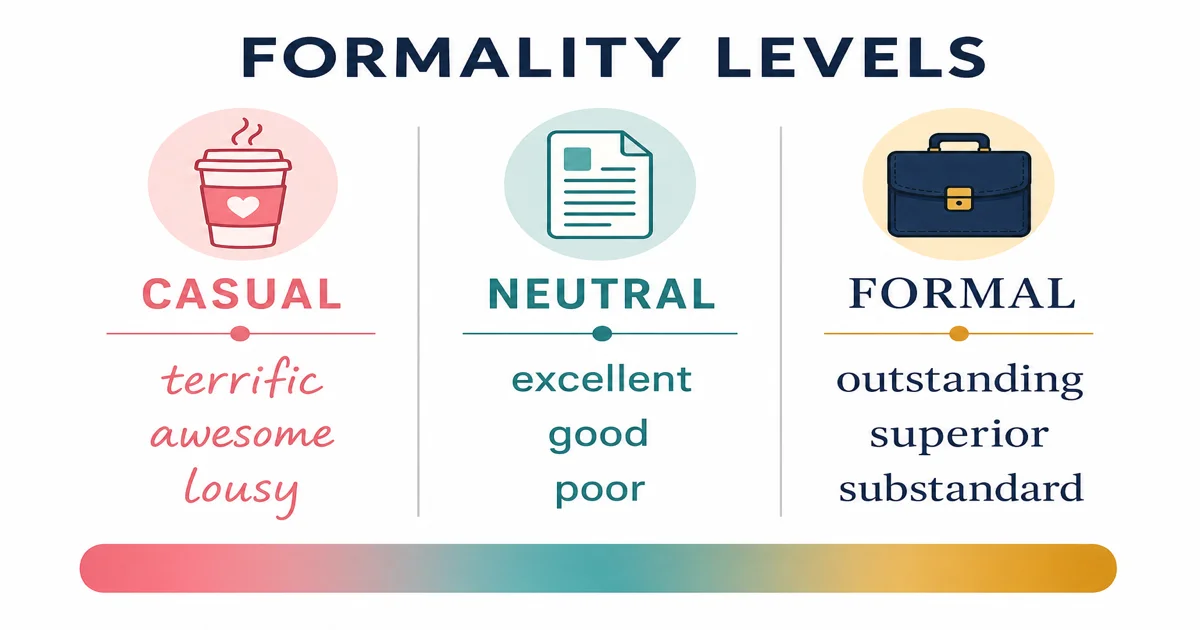
1. Formality level. “Furious” works in an email to a friend. “Incensed” works in a news article. “Livid” works anywhere. Match your audience.
2. Connotation (positive/negative/neutral). “Slim” and “skinny” both mean “thin,” but “slim” is a compliment and “skinny” can be an insult. Always check connotation, not just definition.
3. Collocations (word partners). “Heavy rain” is natural English. “Weighty rain” is not — even though “heavy” and “weighty” are synonyms. Learn words in their natural combinations.
| Test | Question to Ask | Example |
|---|---|---|
| Formality | Am I writing formally or casually? | Use “outstanding” in reports, “awesome” with friends |
| Connotation | Is this word positive, negative, or neutral? | “Childlike” (positive) vs. “childish” (negative) |
| Collocation | Does this word naturally go with the words around it? | “Make a decision” (correct) vs. “do a decision” (wrong) |
Practice Words
Add these essential synonyms to your Linglify dictionary for spaced repetition practice.
boom
noun
A loud, deep sound or a sudden increase in activity or popularity.
Examples
- The boom of thunder echoed across the valley.
- The technology boom created many new millionaires.
cooperate
verb
To work together with others towards a common goal.
evaluate
verb
To judge or measure the value, quality, or importance of something.
Examples
- Companies evaluate job candidates based on experience, skills, and personality.
- Teachers evaluate student progress through tests, projects, and classroom participation.
graduate
verb
To complete a course of study at a school or university.
Examples
- She will graduate from university next year with a degree in engineering.
- Students must complete all requirements before they can graduate from high school.
horizon
noun
The line where the earth or the sky appears to meet in the distance.
Examples
- The sun disappeared behind the horizon as evening approached.
- Traveling broadens your horizon and exposes you to new cultures.
prejudice
noun
Preconceived opinions or feelings, often negative, about a person or group.
Examples
- Education helps overcome prejudice and promotes understanding.
- Racial prejudice damages communities and individuals alike.
resolve
verb
To find a solution or answer to a problem or question.
Examples
- Mediator helps parties resolve dispute through negotiation.
- Technical team will resolve software problems quickly.
discourage
verb
To try to make someone feel less confident or hopeful about something.
Examples
- Don't let one failure discourage you from pursuing your dreams.
- High prices discourage many people from buying organic food products.
donate
verb
To give something, especially money or goods, to help a cause or person.
Examples
- Many people donate money to charities that help homeless individuals.
- She decided to donate blood to help patients in emergency situations.
firmly
adverb
An adverb indicating a way of doing something with certainty or stability.
Examples
- Hold the rope firmly while climbing down the steep mountain slope.
- The manager firmly believed in treating all employees with respect.
indispensable
adjective
Absolutely necessary; essential.
Examples
- Clean water is indispensable for human survival and good health.
- Her experience and skills make her indispensable to the research team.
jury
noun
A group of people who listen to evidence in a court and decide if someone is guilty.
Examples
- The jury deliberated for several hours before reaching a verdict.
- The talent show jury consisted of professional musicians and entertainers.
lifelong
adjective
Continuing for a very long time or for the whole life.
Examples
- Learning is a lifelong process that never truly ends.
- Their lifelong friendship began during elementary school years.
motivated
adjective
Feeling driven or inspired to do something because of a reason or goal.
Examples
- Motivated employee seeks additional responsibilities and challenges at work.
- Success requires being motivated even when facing difficult obstacles.
normally
adverb
Usually; under normal conditions.
Examples
- Heart normally beats between sixty and hundred times per minute.
- Students normally arrive at school before morning bell rings.
off
adjective
Describes something that is not fresh or is no longer suitable for eating, often used for food and drinks.
Examples
- Please turn off the lights before leaving the room.
- The dog ran off into the forest chasing wild rabbits.
stress
verb
To feel mental or emotional pressure or worry; to emphasize or give importance to something.
Examples
- Heavy workload may stress employees beyond limits.
- Teacher will stress importance of homework completion.
total
adjective
An adjective describing something that is complete or whole, not divided or broken.
Examples
- Total cost includes all fees and expenses.
- Total silence fills room during meditation session.
tragedy
noun
An extremely sad or serious event that causes suffering or loss.
Examples
- Natural tragedy affects thousands of innocent people.
- Personal tragedy changes person's life perspective completely.
union
noun
A group of people or things joined together for a purpose.
Examples
- Labor union protects worker rights and interests.
- Marriage union joins two people in partnership.
voyage
noun
A long journey to a distant place, often by sea or air.
Examples
- Space exploration represents humanity's greatest voyage into the unknown.
- The ocean voyage from Europe to America took several weeks in the past.
candidate
noun
A person who is competing in an election or contest.
Examples
- Each presidential candidate presented their policy plans to voters.
- The job candidate impressed the interview panel with her experience.
guide
verb
To show or direct someone how to do something.
Examples
- Parents should guide their children to make responsible decisions.
- The experienced hiker will guide the group through the mountain trail safely.
humorous
adjective
Funny or amusing, often making people laugh.
Examples
- She writes humorous articles about everyday life and family experiences.
- The humorous speech made everyone laugh and lightened the serious mood.
admission
noun
The process or fact of being allowed to enter or join.
Examples
- Her admission to the prestigious medical school was the result of hard work.
- The museum offers free admission on the first Sunday of every month.
What to Do Next
-
Pick your 3 most overused words. Be honest — most people overuse “good,” “very,” and “interesting.” Find them in this guide and select 2–3 replacements for each.
-
Write three sentences using your new synonyms right now. Immediate practice cements the learning.
-
Add synonyms to Linglify for spaced repetition. Tag them with the overused word they replace (“upgrade-good,” “upgrade-said”) so you can review them in focused sessions.
-
Read the full guide — English Synonyms and Antonyms: Complete Guide covers 1000+ pairs with antonyms included.
-
Learn opposite words too — 500+ Opposite Words in English complements synonym knowledge with antonym pairs.
FAQ
What are the best synonyms for “good”?
The best replacement depends on context. For quality: excellent, superb, outstanding. For moral character: virtuous, honorable, admirable. For food: delicious, tasty, superb. For performance: exceptional, remarkable, first-rate. Avoid using “good” when a more specific word exists. Instead of “a good movie,” say “a gripping movie” or “an entertaining movie” — these tell the reader how it’s good.
What’s the difference between synonyms and similar words?
True synonyms can replace each other in at least some contexts without changing meaning (couch/sofa, begin/start). Similar words share meaning but differ in connotation, formality, or usage (slim/skinny, house/home, ask/demand). Most so-called synonyms are actually similar words — they overlap in meaning but are not perfectly interchangeable. The key is understanding which contexts each word fits.
How do I choose between formal and casual synonyms?
Match your audience and medium. Academic papers and business reports need formal synonyms (considerable, substantial, significant). Emails to colleagues can be neutral (big, important, fast). Text messages and casual speech can be informal (huge, awesome, quick). When in doubt, choose neutral — it works in almost every context. The biggest mistake is using overly formal words in casual situations, which sounds unnatural.
How many synonyms should I learn for each word?
Start with 2–3 synonyms per overused word — that’s enough to eliminate repetition. For exam preparation (IELTS, TOEFL), expand to 5–6 per word to maximize your Lexical Resource score. Quality matters more than quantity: knowing when to use “essential” versus “crucial” versus “vital” is more valuable than memorizing twenty synonyms for “important.”
Will using synonyms improve my IELTS score?
Yes, directly. The IELTS Lexical Resource criterion (25% of writing and speaking scores) specifically rewards synonym use, varied vocabulary, and precise word choice. Examiners look for paraphrasing — restating ideas using different words. Replacing “important” with “crucial” in one paragraph and “essential” in the next demonstrates the vocabulary range that earns Band 7+.


