

TOEFL Vocabulary: Ultimate Word List and Study Strategy
TOEFL vocabulary is not a list of rare words to memorize in isolation. You need academic words that help you follow a lecture, understand an argument, explain an idea, and write a clear response. The same word is more useful when you can recognize it in Reading and Listening, then use it accurately in Speaking and Writing.
This TOEFL vocabulary guide gives you a practical core to start with.
- Focus: high-use academic vocabulary and common word partnerships
- Best for: learners building an active TOEFL word bank
- Use it for: Reading, Listening, Speaking, and Writing practice
- Study goal: learn a word, one common partner, and one personal sentence
Start by exploring words at the right difficulty in the TOEFL library. For a full preparation routine, see What Is TOEFL and How to Prepare.
How to Build a Useful TOEFL Word List
A useful TOEFL word has three jobs. It helps you understand an academic text, notice the same idea in a lecture, and express a response without using vague language such as thing, good, or bad.
Do not try to learn a single official “TOEFL list.” Topics and passages vary. Instead, build a flexible bank around recurring academic functions: describing a process, comparing evidence, explaining a cause, and evaluating a result.
| Learn | Add | Example |
|---|---|---|
| a word | a common partner | conduct research |
| a noun | its useful verb | analysis → analyse |
| a meaning | a sentence you can say | “The results indicate a change.” |
Research and Evidence Vocabulary
These words help you follow experiments, articles, and lecture explanations.
| Word | Meaning | Example |
|---|---|---|
| evidence | facts that support an idea | The article provides strong evidence for the claim. |
| research | careful study to find information | Scientists conduct research on sleep. |
| data | facts or numbers collected for study | The team compared the data from two groups. |
| method | a way of doing something | The researchers used a new method. |
| analysis | careful examination of information | Her analysis explains the pattern clearly. |
When you meet a new academic noun, look for its verb and adjective forms. For example, analyse data and analytical method are easier to remember as one family than as three separate entries. The Academic Word List is a useful next step for this kind of study.
Cause, Change, and Results
Academic passages often explain why something changes and what happens next.
| Word | Meaning | Example |
|---|---|---|
| factor | one thing that affects a result | Cost was an important factor in the decision. |
| affect | influence or change something | Weather can affect crop growth. |
| contribute | help cause a result | Stress may contribute to the problem. |
| increase | become or make larger | The new policy may increase access. |
| decline | become less or weaker | The population began to decline. |
Notice direction words when you listen: increase, decline, remain stable, and vary. They often carry the main point of a graph, study result, or lecturer’s conclusion.

Comparing Ideas and Making Arguments
In TOEFL tasks, you need language that shows relationships between ideas rather than a long list of facts.
| Word or phrase | Meaning | Example |
|---|---|---|
| indicate | show that something is true | The survey results indicate a preference for online study. |
| demonstrate | show clearly with facts or actions | The experiment demonstrates how heat changes the material. |
| contrast | show an important difference | The speaker contrasts two approaches. |
| significant | important enough to matter | There was a significant difference between the groups. |
| therefore | for that reason | The sample was small; therefore, the result is limited. |
For Speaking and Writing, choose one accurate connector and one precise verb. “The lecture contrasts two methods; therefore, the second example is easier to understand” is clearer than a sentence full of advanced words you cannot control.
Campus and Lecture Vocabulary
TOEFL content can use university and classroom situations as well as academic topics.
| Word | Meaning | Example |
|---|---|---|
| lecture | a talk given by a teacher or expert | I listened to a lecture about migration. |
| assignment | work a student must complete | The professor explained the final assignment. |
| semester | one half of an academic year | She will begin the course next semester. |
| approach | a way of dealing with something | The class discussed a practical approach. |
| requirement | something that is necessary | Attendance is a course requirement. |
Practise these words in short summaries. After a lecture or video, say: “The lecturer explained the main approach and gave evidence for it.” One sentence trains listening, recall, and speaking together.
Word Families and Academic Patterns
Academic vocabulary becomes easier to retrieve when you learn related forms together. Rather than keeping analyse, analysis, and analytical on separate cards, treat them as one useful family.
| Word family | Useful pattern | Example |
|---|---|---|
| analyse / analysis / analytical | analyse the data | The report includes an analysis of the data. |
| conclude / conclusion / conclusive | draw a conclusion | The evidence is not yet conclusive. |
| vary / variation / various | vary according to | Results vary according to the method. |
| respond / response / responsive | respond to a question | Her response was clear and direct. |
| require / requirement / required | meet a requirement | Attendance is required for the course. |
Also notice the grammar that travels with a word. You contribute to a result, differ from another idea, and result in an effect. A word remembered with its preposition or partner is much easier to use correctly under time pressure.
Turn Each Practice Passage into a Word Bank
Every Reading passage or lecture can give you a small, personal TOEFL list. Use this method after one short practice task instead of trying to copy every unfamiliar word.
- Underline five useful words or phrases. Prefer words that explain a cause, comparison, process, or conclusion.
- Keep the original sentence. It shows the word’s grammar and tone better than a translation alone.
- Add one partner. For example, write reach a conclusion, reliable evidence, or vary significantly.
- Make a shorter version in your own words. Say the idea aloud in one sentence using at least one target word.
- Review only the useful items. If a rare technical term belongs to one topic, understand it for the passage but do not automatically add it to your core bank.
This approach makes test practice double as vocabulary practice. You are not studying a detached list: you are meeting words in the same kind of context in which TOEFL asks you to understand and use them.
Common TOEFL Vocabulary Mistakes
- Memorizing translations without examples. A translation may be close, but it does not show whether a word is formal, countable, or normally followed by a preposition.
- Using a difficult word in every sentence. In Speaking and Writing, one accurate academic word is stronger than several forced ones.
- Ignoring related forms. If you know significant but cannot recognize significance or significantly, a passage may still feel harder than it needs to.
- Collecting too many new words at once. Five words used in a summary are more valuable than fifty words you never revisit.
A Four-Step TOEFL Vocabulary Routine
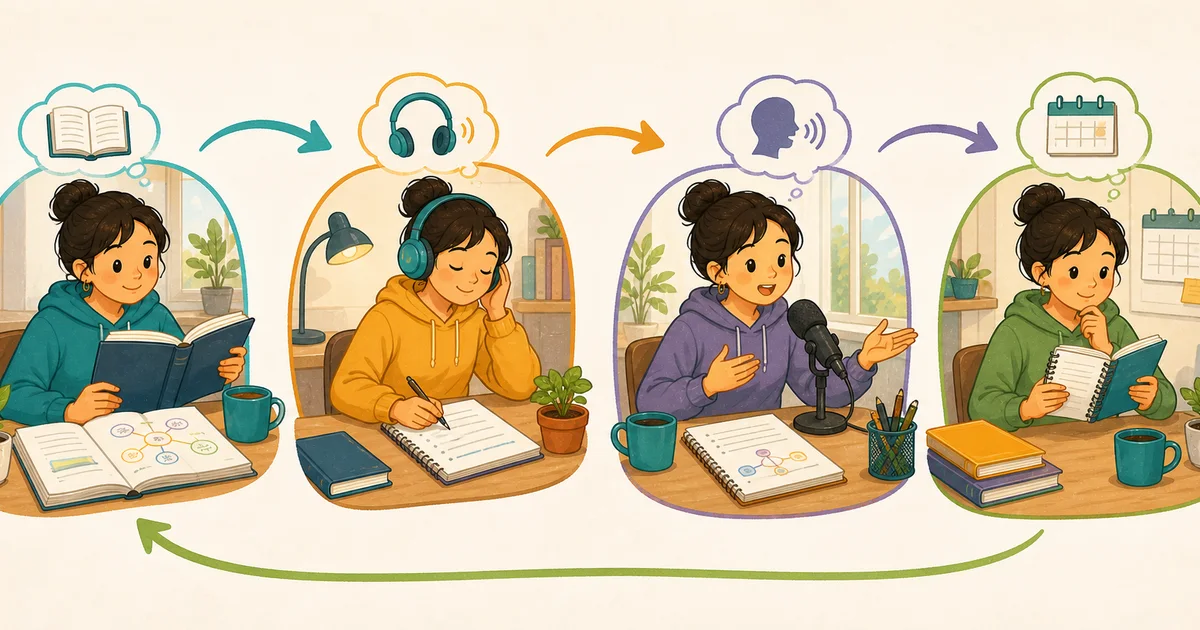
Use a small repeatable routine instead of collecting hundreds of unreviewed words.
- Choose five words from one theme. Do not mix ten unrelated topics in one session.
- Read and hear them in context. Find the word in a passage, video, or lecture note.
- Make a 20-second response. Explain one idea using two target words.
- Review after a delay. Add the words to Linglify and revisit them tomorrow and later in the week.
Use the TOEFL intermediate vocabulary list when you want a manageable practice set. When academic words feel comfortable, add more precision with C1 Advanced English Vocabulary.
Vocabulary to Practise
Save these words to your Linglify dictionary. Review the examples, then use two or three of the words in a summary of a lecture, article, or podcast.
agreement
noun
A formal statement of shared understanding or arrangement.
Examples
- The trade agreement will benefit both countries' economic development significantly.
- There was general agreement among the committee members about the proposed changes.
compliant
adjective
Ready to follow rules or instructions; compliant.
Examples
- Compliant children follow rules without constant supervision.
- The software is compliant with international security standards.
deadline
noun
A fixed point or time by which something must be done.
Examples
- Students often feel stressed when approaching assignment deadlines.
- The deadline for submitting applications is next Friday.
forecast
verb
To predict or estimate a future event based on current information.
Examples
- Experts forecast significant changes in technology over the next decade.
- Meteorologists forecast severe storms for the coastal regions tomorrow.
isle
noun
A small island, often used for pleasure or as a retreat.
Examples
- Poets often write about mystical isles shrouded in morning mist.
- The small isle can be reached only by boat or helicopter.
proposal
noun
An idea or plan suggested for consideration or discussion.
Examples
- Business proposal outlines project costs and benefits.
- Marriage proposal creates emotional moment for couples.
revenue
noun
The income that a government or organization gets from taxes, sales, or other sources.
Examples
- Company revenue increases significantly during holiday season.
- Government revenue funds public services and infrastructure.
schedule
noun
A plan of things to do and when to do them, often organized in a timetable.
Examples
- Train schedule shows departure times for passengers.
- Work schedule allows flexibility for family time.
budget
noun
An amount of money set aside for a specific purpose or period.
Examples
- Congress approved the new federal budget yesterday.
- The family budget allows for one vacation yearly.
contract
noun
A formal agreement or a legal document that is signed by two or more parties.
policy
noun
A set of rules or guidelines adopted by an organization or government.
Examples
- Company policy prohibits smoking in building.
- Insurance policy covers medical expenses completely.
negotiate
verb
To discuss or bargain in order to reach an agreement.
Examples
- Business partners negotiate contract terms before signing agreement.
- Diplomats negotiate peaceful solutions to international conflicts.
strategy
noun
A plan of action designed to achieve a long-term or overall aim.
Examples
- Chess strategy requires thinking several moves ahead.
- Marketing strategy targets specific customer demographics effectively.
requirement
noun
A thing that is needed or required, often officially or formally.
Examples
- Job requirement includes relevant experience and education.
- Safety requirement protects workers from dangerous workplace.
purchase
verb
To buy or obtain something, often after some effort.
Examples
- Family will purchase new car this summer.
- Online customers purchase items with credit cards.
manager
noun
A person who is in charge of a business or organization.
Examples
- Project managers coordinate teams and ensure deadlines are met successfully.
- The store manager handles customer complaints and employee scheduling issues.
employee
noun
A person who works for a company or organization.
Examples
- Every employee receives health insurance and vacation benefits from the company.
- The dedicated employee worked overtime to complete the important project deadline.
custom
noun
A traditional way of doing things that is specific to a community or society.
Examples
- It is a local custom to remove shoes before entering homes.
- The wedding ceremony followed traditional customs from their culture.
phenomenally
adverb
In a manner that is extraordinarily impressive or remarkable.
Examples
- Sales increased phenomenally after marketing campaign launch.
- Student performed phenomenally well on challenging examination.
pay
noun
To give money in exchange for goods or services.
Examples
- Equal pay ensures fairness in workplace compensation.
- Monthly pay covers basic living expenses adequately.
target
noun
A person or thing that is the focus of attention or effort, or an aim for achievement.
Examples
- Archery target requires precise aim and skill.
- Business target includes sales and profit goals.
performance
noun
A noun that refers to the way in which a person or thing acts or performs.
Examples
- Computer performance improves with memory upgrade.
- Evening performance received standing ovation from audience.
analysis
noun
The detailed examination of the parts or structure of something.
Examples
- Market analysis shows that consumer preferences are changing rapidly.
- The detailed analysis revealed several problems with the current system.
solution
noun
A way to find an answer or solution to a problem.
Examples
- Chemical solution contains dissolved substances in water.
- Creative solution resolves complex business problem effectively.
complaint
noun
A statement that expresses dissatisfaction or a problem.
Examples
- She filed a formal complaint with the consumer protection agency.
- The hotel manager addressed every guest complaint promptly and professionally.
What to Do Next
- Choose a level in the TOEFL vocabulary library and save five unfamiliar words.
- Read the TOEFL preparation guide to place vocabulary in a weekly plan.
- Build academic accuracy with the Academic Word List.
- Review your saved words tomorrow, then give a one-minute spoken summary using them.
FAQ
How many TOEFL vocabulary words do I need?
There is no fixed number that guarantees a result. Build a strong base of common academic words, then keep adding words from the passages and lectures you actually practise. Active use and review matter more than a large unchecked list.
Should I study TOEFL vocabulary by topic or alphabetically?
Study by function or topic. A group such as evidence, data, method, and analysis is easier to understand and reuse than four unrelated alphabetical entries.
Are difficult words always better in TOEFL Speaking and Writing?
No. Use a word only when its meaning, grammar, and register are right. A clear response with accurate vocabulary is stronger than a response with forced advanced words.
How can I remember academic vocabulary for longer?
Meet the word in several places: read it, hear it, say it in a summary, and review it later. Spaced repetition in Linglify makes those returns easier to plan.


