TOEIC Vocabulary: Essential Word List for Every Score Target
The TOEIC (Test of English for International Communication) measures your ability to use English in everyday business and workplace situations. It is the most widely used English proficiency test in the corporate world — over 7 million people take it every year across 160 countries, with Japan, South Korea, and France being the largest markets.
Unlike IELTS or TOEFL, the TOEIC does not test academic English. It tests whether you can understand a voicemail, read a business email, follow a meeting, or interpret a company memo. The vocabulary is practical, professional, and predictable — which means studying the right words gives you a significant score advantage.
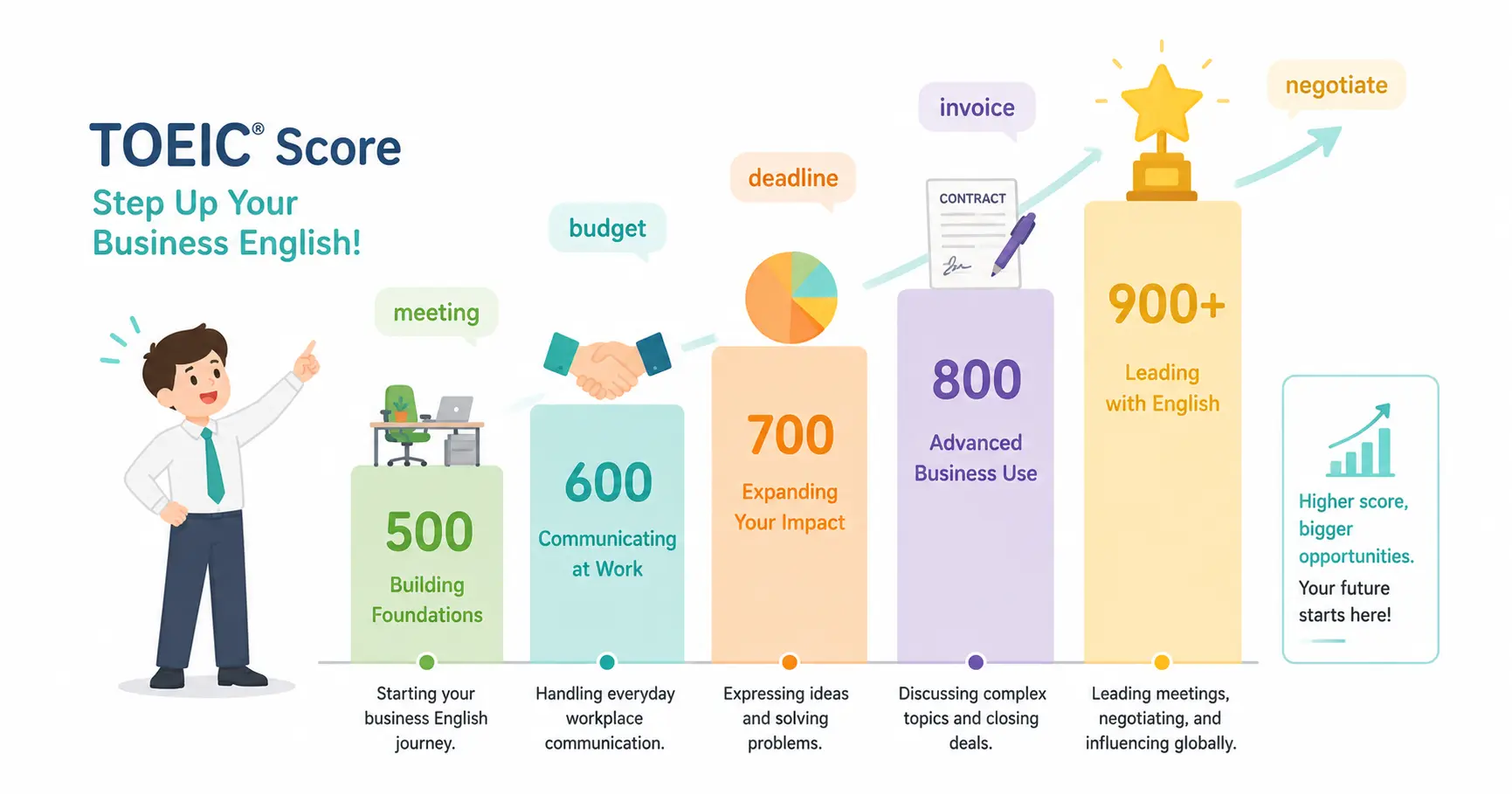
This guide organizes TOEIC vocabulary by score target. Whether you are aiming for 500, 600, 700, 800, or 900+, you will find the exact words you need, organized by the business contexts that appear most frequently on the test.
- Total words: 400+
- Organized by: score target (500 → 600 → 700 → 800 → 900+)
- Topics: office, meetings, travel, HR, finance, marketing, manufacturing, legal
- Best for: working professionals, job seekers, corporate English requirements
TOEIC Format: What You Need to Know
Before studying vocabulary, understand what the test actually looks like:
| Section | Part | Content | Questions | Time |
|---|---|---|---|---|
| Listening | Part 1 | Photographs | 6 | 45 min total |
| Part 2 | Question-Response | 25 | ||
| Part 3 | Conversations | 39 | ||
| Part 4 | Short Talks | 30 | ||
| Reading | Part 5 | Incomplete Sentences | 30 | 75 min total |
| Part 6 | Text Completion | 16 | ||
| Part 7 | Reading Comprehension | 54 | ||
| Total | 200 | 120 min |
- Total score: 10–990 (Listening 5–495 + Reading 5–495)
- No speaking or writing in the standard TOEIC L&R test
- No penalty for wrong answers — always answer every question
The vocabulary in this guide maps directly to the contexts that appear in Parts 3, 4, 5, 6, and 7.
How TOEIC Vocabulary Differs from General English
TOEIC vocabulary is distinct from what you learn in general English courses:
| Feature | General English | TOEIC English |
|---|---|---|
| Setting | Daily life, social | Office, business, corporate |
| Tone | Casual to formal | Professional, neutral |
| Topics | Hobbies, family, travel | Meetings, hiring, budgets, shipping |
| Word types | General adjectives, verbs | Business collocations, formal verbs |
| Examples | “Let’s hang out” | “Let’s schedule a meeting” |
You will not see slang, academic jargon, or literary language on TOEIC. The test uses the language of emails, memos, advertisements, news articles, and workplace conversations.
Score 500: Foundation Business Vocabulary
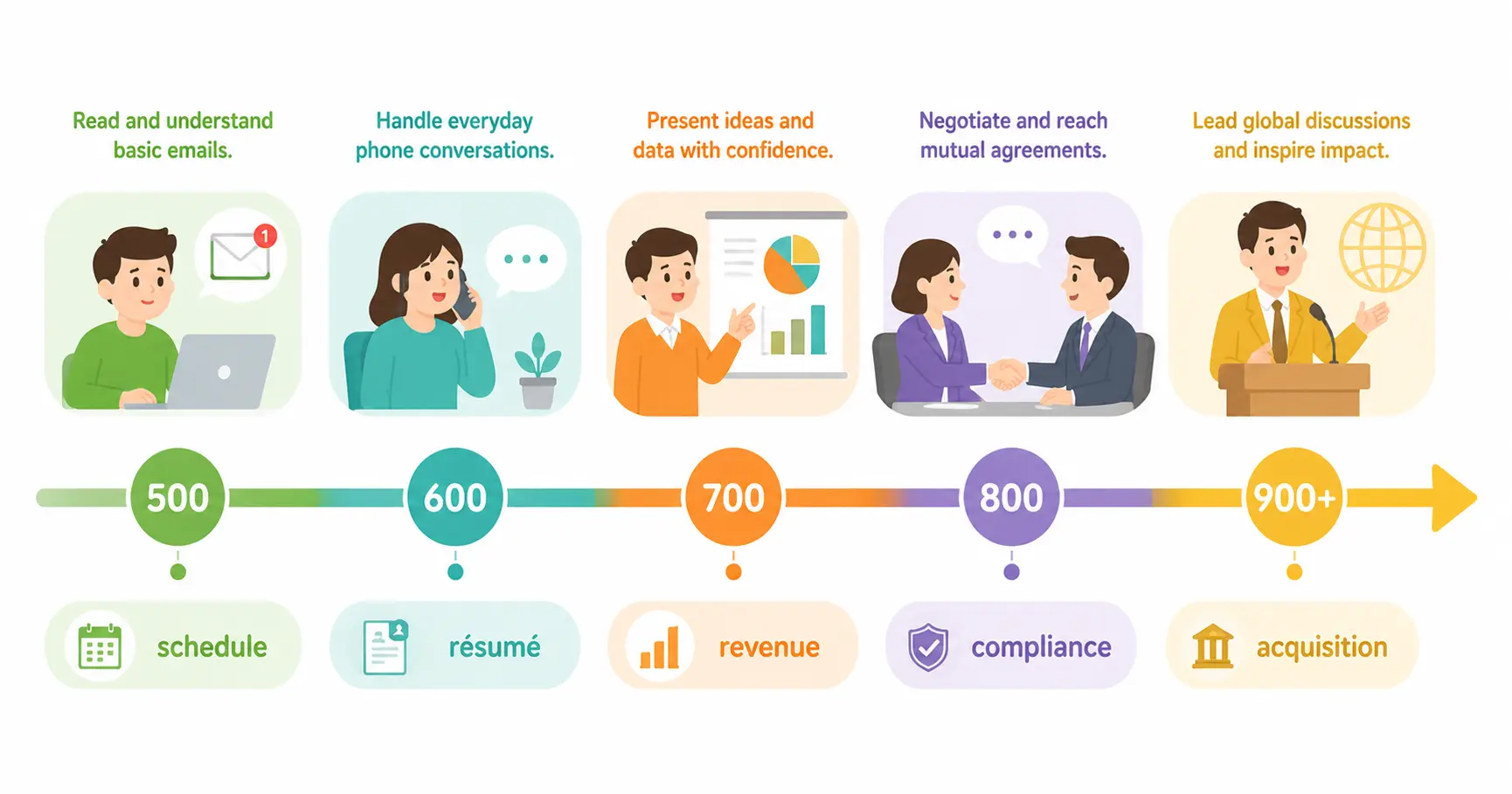
A score of 500 means you can handle basic workplace communication — short emails, simple instructions, common announcements. This is the starting tier.
Office and Workplace Basics
| Word | Meaning | Example (TOEIC context) |
|---|---|---|
| employee | a person who works for a company | All employees must attend the training. |
| manager | person who leads a team | The manager approved the vacation request. |
| department | division of a company | She works in the marketing department. |
| schedule | plan of activities with times | The schedule has been updated. |
| meeting | gathering to discuss business | The meeting starts at 2 PM. |
| office | place where people work | The office closes at 6 PM on Fridays. |
| appointment | arranged meeting at a specific time | I have an appointment with the dentist. |
| assistant | person who helps someone | The assistant prepared the documents. |
| colleague | person you work with | My colleague is on vacation this week. |
| customer | person who buys products/services | The customer asked for a refund. |
Common Workplace Actions
| Word | Meaning | Example |
|---|---|---|
| submit | to hand in / send for approval | Please submit your report by Friday. |
| confirm | to verify something is correct/agreed | Can you confirm the reservation? |
| attend | to be present at an event | All staff must attend the meeting. |
| order | to request a product/service | We need to order more supplies. |
| deliver | to bring something to a place | The package will be delivered tomorrow. |
| contact | to communicate with someone | Please contact the IT department. |
| update | to make something current | I’ll update you after the meeting. |
| approve | to officially agree to something | The budget was approved by the director. |
| replace | to put something new in place of old | We need to replace the printer. |
| cancel | to stop a planned event or order | The flight was cancelled due to weather. |
Places and Directions
| Word | Meaning | Example |
|---|---|---|
| lobby | entrance area of a building | Please wait in the lobby. |
| conference room | room for meetings | The conference room is on the 3rd floor. |
| reception | front desk area | Check in at reception when you arrive. |
| warehouse | building for storing goods | The goods are stored in the warehouse. |
| parking lot | area for leaving vehicles | The parking lot is behind the building. |
| entrance | way into a building | Use the main entrance. |
| floor | level of a building | HR is on the 5th floor. |
Score 600: Intermediate Business Vocabulary
A score of 600 means you can understand most workplace communication and follow conversations about schedules, projects, and procedures. This is the most common corporate requirement.
Human Resources and Employment
| Word | Meaning | Example |
|---|---|---|
| résumé / CV | document listing work experience | Please send your résumé to HR. |
| interview | meeting to assess a candidate | The interview is scheduled for Monday. |
| position | a job role | We have an open position in accounting. |
| salary | money paid for work | The salary is competitive for the industry. |
| benefits | extra compensation (insurance, etc.) | The benefits package includes health insurance. |
| hire | to employ someone | We plan to hire three new engineers. |
| resign | to voluntarily leave a job | He resigned to start his own company. |
| promotion | moving up to a higher position | She received a promotion to senior analyst. |
| qualified | having the right skills/experience | Only qualified applicants will be contacted. |
| reference | recommendation from a previous employer | Please provide two professional references. |
| temporary | not permanent | She has a temporary contract until December. |
| full-time / part-time | hours of work per week | The position is full-time, Monday to Friday. |
Business Communication
| Word | Meaning | Example |
|---|---|---|
| agenda | list of topics for a meeting | The agenda has been sent to all participants. |
| deadline | final date to complete something | The deadline for submissions is March 15. |
| proposal | formal plan or suggestion | The team submitted a project proposal. |
| memo | short internal message | A memo was sent about the policy change. |
| draft | preliminary version of a document | I’ll send the first draft by tomorrow. |
| attachment | file added to an email | Please see the attachment for details. |
| inquiry | a request for information | We received an inquiry about pricing. |
| notify | to inform someone officially | Employees will be notified by email. |
| postpone | to delay to a later time | The event has been postponed to next month. |
| regarding | about / concerning | I’m writing regarding your recent order. |
Travel and Accommodation (Business Context)
| Word | Meaning | Example |
|---|---|---|
| itinerary | detailed travel plan | Your itinerary is attached to this email. |
| reservation | booking for a hotel/flight/restaurant | I’d like to make a reservation for two nights. |
| check in / check out | arrival/departure at a hotel | Check-in time is 3 PM. |
| flight | airplane journey | The flight from Tokyo departs at 9 AM. |
| delay | arriving/starting later than planned | The train was delayed by 20 minutes. |
| luggage | bags for traveling | Your luggage will be delivered to your room. |
| boarding | getting on a plane/ship | Boarding begins 30 minutes before departure. |
| accommodation | a place to stay | The company arranged accommodation for the conference. |
| reimburse | to pay back expenses | Travel expenses will be reimbursed. |
Score 700: Upper-Intermediate Business Vocabulary
At 700, you can handle complex business situations — negotiations, project management, detailed reports. The vocabulary becomes more specific and formal.
Finance and Accounting
| Word | Meaning | Example |
|---|---|---|
| budget | planned allocation of money | The project budget is $150,000. |
| revenue | income earned by a company | Revenue increased by 12% this quarter. |
| profit | money remaining after expenses | Net profit was $2 million. |
| expense | cost incurred in business | Travel expenses exceeded the budget. |
| invoice | bill for goods or services | Please process the invoice by Friday. |
| audit | official inspection of financial records | The annual audit starts next week. |
| quarterly | every three months | The quarterly report is due on Monday. |
| forecast | prediction of future performance | The sales forecast looks positive. |
| asset | something valuable owned by a company | The company’s assets include 3 factories. |
| liability | financial obligation or debt | The company reduced its liabilities by 20%. |
| interest rate | cost of borrowing money | The interest rate on the loan is 4.5%. |
| investment | money put into something for profit | The investment paid off within two years. |
Marketing and Sales
| Word | Meaning | Example |
|---|---|---|
| launch | to introduce a new product | We’ll launch the product in September. |
| campaign | organized marketing effort | The ad campaign increased brand awareness. |
| survey | questionnaire to collect feedback | The customer survey had 500 responses. |
| target | intended audience or goal | The target audience is professionals aged 25–40. |
| brand | company name/identity | The brand is well-known in Asia. |
| consumer | person who uses a product | Consumers prefer eco-friendly packaging. |
| competitor | rival company | Our main competitor lowered their prices. |
| promotion | special offer to increase sales | There’s a buy-one-get-one-free promotion. |
| warranty | guarantee of product quality | The warranty covers 2 years of use. |
| feedback | opinions about a product/service | Customer feedback was overwhelmingly positive. |
Project Management
| Word | Meaning | Example |
|---|---|---|
| objective | goal or aim | The main objective is to reduce costs by 10%. |
| milestone | important stage in a project | We reached a major milestone this week. |
| progress | forward movement toward a goal | The project is making good progress. |
| implement | to put a plan into action | We’ll implement the new system in Q3. |
| outcome | result of an action | The outcome was better than expected. |
| allocate | to distribute resources | Funds were allocated to three departments. |
| prioritize | to rank tasks by importance | We need to prioritize urgent tasks. |
| delegate | to assign tasks to others | Good managers delegate effectively. |
| streamline | to make more efficient | We streamlined the approval process. |
| evaluate | to assess the value or quality | We’ll evaluate the results next month. |
Score 800: Advanced Business Vocabulary
A score of 800 demonstrates you can function independently in an English-speaking workplace. You understand nuance, implied meaning, and complex business documents.
Negotiations and Agreements
| Word | Meaning | Example |
|---|---|---|
| negotiate | to discuss terms to reach agreement | We’re negotiating a new contract with the supplier. |
| agreement | formal arrangement between parties | Both parties signed the agreement. |
| compromise | a settlement where each side gives up something | We reached a compromise on the price. |
| terms | conditions of an agreement | The terms of payment are net 30 days. |
| clause | specific section of a contract | Clause 5 addresses termination conditions. |
| binding | legally enforceable | This is a binding agreement. |
| dispute | disagreement between parties | The dispute was resolved through mediation. |
| comply | to follow rules or requirements | All vendors must comply with safety standards. |
| amendment | a change to an existing document | An amendment was added to the contract. |
| confidential | private, not to be shared | This information is strictly confidential. |
Manufacturing and Operations
| Word | Meaning | Example |
|---|---|---|
| inventory | stock of goods | We need to check the inventory levels. |
| shipment | goods being transported | The shipment arrives on Thursday. |
| manufacture | to produce goods in a factory | The parts are manufactured in Germany. |
| quality control | checking products meet standards | Quality control found defects in 3% of units. |
| assembly | putting parts together | The assembly line runs 24 hours a day. |
| specifications | detailed technical requirements | The product meets all specifications. |
| inspection | careful examination | The building passed the safety inspection. |
| defect | a flaw in a product | Any items with defects will be replaced. |
| supplier | company providing goods to another | Our main supplier is based in Taiwan. |
| logistics | planning the movement of goods | The logistics team coordinated the delivery. |
Real Estate and Facilities
| Word | Meaning | Example |
|---|---|---|
| lease | agreement to rent property | The office lease expires in June. |
| tenant | person/company renting a property | The tenant renewed for another year. |
| renovate | to repair and improve a building | The lobby will be renovated next month. |
| premises | the buildings and land of a business | Smoking is not allowed on the premises. |
| occupancy | the state of being occupied | Hotel occupancy reached 95% in July. |
| vacancy | an empty space available for rent | There’s a vacancy on the 4th floor. |
| utilities | electricity, water, gas services | Utilities are included in the rent. |
| maintenance | work to keep things in good condition | The maintenance team fixed the air conditioning. |
Score 900+: Expert-Level Vocabulary
At 900+, you understand subtle distinctions in meaning, handle complex multi-party negotiations, and interpret legal or regulatory business language.
Corporate Strategy and Leadership
| Word | Meaning | Example |
|---|---|---|
| acquisition | buying another company | The acquisition of the startup was completed. |
| merger | combining two companies into one | The merger will create the industry leader. |
| stakeholder | person with an interest in a company | Stakeholders were informed of the decision. |
| restructure | to reorganize a company’s structure | The company restructured to reduce costs. |
| diversify | to expand into new areas | The firm diversified into renewable energy. |
| benchmark | a standard for comparison | Industry benchmarks show we are above average. |
| scalable | able to grow without proportional cost increases | The business model is highly scalable. |
| sustainable | able to continue long-term | Sustainable growth is our primary goal. |
| leverage | to use something to maximum advantage | We can leverage our brand recognition in Asia. |
| unprecedented | never done or known before | The company saw unprecedented demand. |
Legal and Regulatory
| Word | Meaning | Example |
|---|---|---|
| regulation | an official rule | New regulations affect data storage. |
| compliance | following rules and laws | The company achieved full regulatory compliance. |
| intellectual property | legal rights to creations | The patent protects our intellectual property. |
| litigation | the process of taking legal action | The litigation could last several months. |
| liability | legal responsibility | The company denied liability for the defect. |
| jurisdiction | authority of a court or government | The contract falls under UK jurisdiction. |
| indemnify | to protect against loss or damage | The insurer will indemnify the company. |
| proprietary | owned exclusively by a company | This is proprietary technology. |
| disclosure | making information publicly available | Full disclosure is required by law. |
Financial Reporting
| Word | Meaning | Example |
|---|---|---|
| fiscal year | 12-month period for financial reporting | The fiscal year ends in March. |
| dividend | payment to shareholders from profits | The board declared a dividend of $1.20 per share. |
| depreciation | decrease in value over time | Equipment depreciation is $50,000 annually. |
| surplus | excess amount beyond what is needed | The budget surplus was reinvested in R&D. |
| deficit | amount by which spending exceeds income | The trade deficit widened this quarter. |
| equity | ownership value in a company | She has 15% equity in the startup. |
| portfolio | collection of investments | We diversified the investment portfolio. |
| amortize | to spread costs over time | The loan is amortized over 10 years. |
TOEIC Vocabulary by Test Section
Different parts of TOEIC emphasize different vocabulary. Here is where each word category appears most:
| Vocabulary Category | Listening (Parts 1–4) | Reading (Parts 5–7) |
|---|---|---|
| Office / workplace | ★★★ | ★★ |
| Travel / transportation | ★★★ | ★★ |
| Shopping / dining | ★★★ | ★ |
| Schedules / appointments | ★★★ | ★★★ |
| HR / employment | ★★ | ★★★ |
| Finance / accounting | ★ | ★★★ |
| Marketing / sales | ★ | ★★★ |
| Manufacturing / shipping | ★ | ★★★ |
| Legal / contracts | — | ★★★ |
Listening favors everyday workplace conversations: scheduling, giving directions, making requests, travel logistics.
Reading favors formal business documents: emails, reports, advertisements, articles, contracts.
Words to Practice
These 25 TOEIC-relevant business vocabulary words are organized from foundation to advanced. Add them to your Linglify dictionary for spaced repetition.
adjective
noun
A word that describes or modifies a noun.
Examples
- In English grammar, an adjective describes or modifies a noun.
- The adjective 'beautiful' comes before the noun 'garden' in this sentence.
affordable
adjective
Able to be bought or reached at a reasonable price.
Examples
- The government is working to provide affordable housing for low-income families.
- This restaurant offers delicious and affordable meals for college students.
although
conjunction
Even though; despite the fact that.
Examples
- Although it was raining heavily, the soccer game continued as planned.
- She passed the exam although she had very little time to study.
antibacterial
adjective
Designed to kill or prevent bacteria from growing.
Examples
- Antibacterial soap helps prevent the spread of germs and infections.
- Hospitals use antibacterial cleaning products to maintain sterile environments.
arm
noun
The part of the body at the end of the arm, used for holding or lifting.
Examples
- She broke her arm while skiing on the steep mountain slope.
- The long arm of the law eventually catches up with criminals.
attached
adjective
Describes something that is joined or connected to something else.
Examples
- She's very attached to her childhood teddy bear and won't give it up.
- You'll find the attached document contains all the necessary information.
backpacking
noun
Travel or hiking with a backpack, often staying in different places.
Examples
- Backpacking through the mountains requires good physical fitness and preparation.
- She spent her gap year backpacking around Southeast Asia.
bathe
verb
To wash oneself or another with water, often for cleaning.
Examples
- Ocean waves gently bathe the sandy shore throughout the day.
- Parents bathe their young children every evening before bedtime.
betray
verb
To reveal or make known something secret or untrue.
Examples
- He would never betray his friends' trust and confidence.
- The spy was caught trying to betray classified information.
blonde
adjective
Having light-colored hair, often golden or pale.
Examples
- She dyed her hair blonde for the summer season.
- The little girl has beautiful blonde curls.
bra
noun
A piece of clothing worn around the upper part of the body, often made of fabric.
Examples
- She bought a comfortable sports bra for her workouts.
- The store specializes in selling quality bras and lingerie.
build
noun
To construct or assemble something by putting parts together.
Examples
- He has an athletic build from years training.
- This is the latest build of software.
calculate
verb
To find an answer or a result by using numbers or mathematical methods.
Examples
- She used a calculator to calculate the total cost of groceries.
- The engineer needs to calculate the exact measurements for the bridge design.
cartoon
noun
A drawing made to be funny or entertaining, often animated and used in entertainment.
Examples
- The children watched their favorite cartoon on Saturday morning television.
- The newspaper published a political cartoon about the election campaign.
chapter
noun
A division of a book or document focusing on a particular topic.
Examples
- Graduating from college marked the end of one chapter in her life.
- The first chapter of the book introduces the main characters and setting.
circuit
noun
An electrical or mechanical device consisting of interconnected parts to form a complete loop or system.
Examples
- Formula One drivers race on various circuits around the world annually.
- The electrical circuit was damaged during the severe thunderstorm last night.
coherent
adjective
Coherent describes something that is logical, clear, and well-organized.
Examples
- After the accident, he wasn't coherent enough to answer police questions.
- The professor gave a coherent explanation of the complex scientific theory.
complexity
noun
The quality of being complicated or difficult to understand or analyze.
Examples
- Scientists are studying the complexity of climate change and its global effects.
- The complexity of the legal system makes it difficult for ordinary people to understand.
considerably
adverb
To a great extent or degree; substantially.
Examples
- Prices have increased considerably since the beginning of this year.
- The new medicine improved his condition considerably within just a few weeks.
coral
noun
A hard, colorful substance formed by tiny sea animals' skeletons, often used in jewelry or decorations.
crime
noun
An act or instance of doing something illegal or wrong.
Examples
- The police are investigating the crime that occurred downtown.
- Violent crime rates have decreased in many major cities.
dancing
noun
The activity of moving rhythmically to music.
Examples
- Dancing is excellent exercise that improves coordination and fitness.
- The wedding reception featured hours of dancing and celebration.
definite article
noun
A word used before a noun to specify it as something known or particular.
Examples
- In English, 'the' is the definite article used before specific nouns.
- Students learning English must understand when to use the definite article.
detail
noun
A small part of a larger whole, often used to describe specific details.
Examples
- Attention to detail is crucial when working in scientific research fields.
- The witness provided every detail about what she saw during the incident.
discipline
noun
A way of training someone’s behavior or mind through practice and rules.
Examples
- Biology is a scientific discipline that studies living organisms and systems.
- Military discipline requires following orders without question or hesitation.
Study Plan: How to Prepare TOEIC Vocabulary
For Score 500 (4–6 weeks)
| Week | Focus | Words/Day |
|---|---|---|
| 1–2 | Office basics, common actions | 10 |
| 3–4 | Places, schedules, simple business communication | 10 |
| 5–6 | Review + practice with Part 5 questions | Review |
For Score 600 (6–8 weeks)
| Week | Focus | Words/Day |
|---|---|---|
| 1–2 | All 500-level words (if not already known) | 15 |
| 3–4 | HR, employment, business communication | 15 |
| 5–6 | Travel, accommodation, formal verbs | 15 |
| 7–8 | Review + full practice tests | Review |
For Score 700 (8–10 weeks)
| Week | Focus | Words/Day |
|---|---|---|
| 1–3 | Finance, accounting, marketing | 15 |
| 4–6 | Project management, formal business language | 15 |
| 7–8 | Part 7 practice (complex reading passages) | 10 + reading |
| 9–10 | Full practice tests + weak area review | Review |
For Score 800+ (10–12 weeks)
| Week | Focus | Words/Day |
|---|---|---|
| 1–3 | Negotiations, legal, contracts | 15 |
| 4–6 | Manufacturing, operations, real estate | 15 |
| 7–9 | Corporate strategy, financial reporting | 10 + reading |
| 10–12 | Full practice tests + advanced collocations | Review |
Daily Study Routine (30 minutes)
- 5 min — Review yesterday’s words with spaced repetition
- 10 min — Study 10–15 new words with example sentences
- 10 min — Practice with TOEIC-style questions (Part 5 fill-in-the-blank)
- 5 min — Listen to a short business dialogue (Part 3/4 practice)
TOEIC vs IELTS vs TOEFL: Key Differences
| Feature | TOEIC | IELTS | TOEFL |
|---|---|---|---|
| Focus | Business / workplace | Academic + general | Academic |
| Vocabulary | Professional, corporate | Academic + everyday | Academic, campus |
| Sections | Listening + Reading | L + R + W + S | L + R + W + S |
| Score range | 10–990 | 1.0–9.0 | 0–120 |
| Main users | Companies, Japan/Korea | Universities worldwide | US/Canada universities |
| Duration | 2 hours | 2 hr 45 min | 2 hours |
| Speaking test | Separate (TOEIC S&W) | Included | Included |
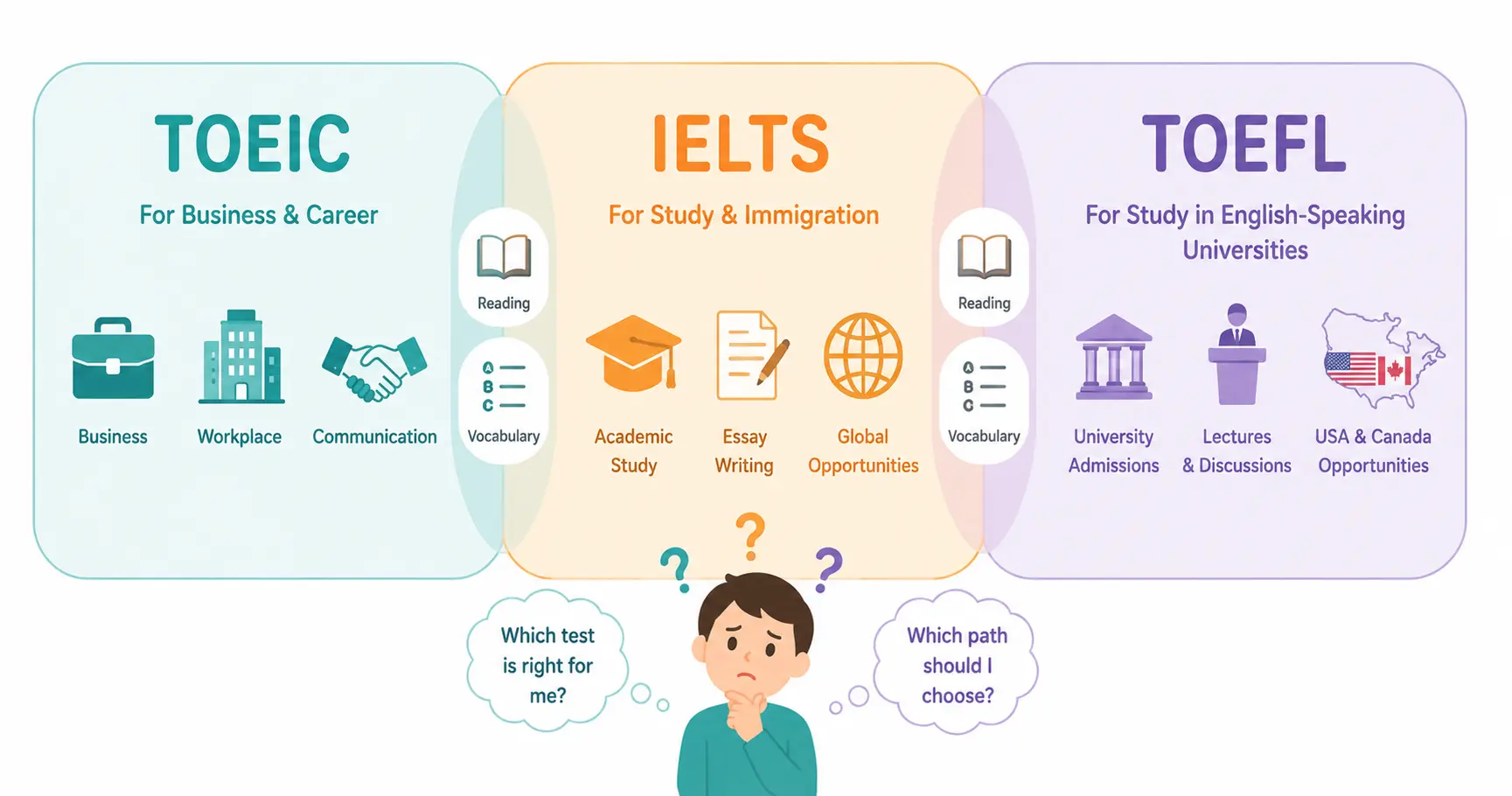
If you need help choosing the right exam, consider: TOEIC for corporate/workplace requirements (especially in Japan and Korea), IELTS for university admissions and immigration, TOEFL for American and Canadian universities.
For IELTS preparation, see our complete IELTS vocabulary guide. For TOEFL, see our TOEFL exam preparation guide.
Tips for TOEIC Vocabulary Success
1. Learn business collocations, not isolated words
TOEIC tests collocations — words that naturally go together. It is not enough to know “submit”; you need to know “submit a report,” “submit an application,” “submit a proposal.” Pay attention to which nouns pair with which verbs.
2. Focus on context, not translation
Every word in this guide has an example sentence from a business context. When you study, read the example sentence first, then check the meaning. This trains you to understand words the way TOEIC tests them — in context.
3. Listen to business English daily
TOEIC Listening is 50% of your score. Listen to business podcasts, news programs (BBC Business Daily, NPR Marketplace), or watch business presentations on YouTube. The goal is to train your ear for professional English — speed, tone, and vocabulary.
4. Practice Part 5 relentlessly
Part 5 (Incomplete Sentences) is the most vocabulary-dependent section. You can improve your score significantly by mastering word forms (noun/verb/adjective/adverb), prepositions, and conjunctions. Practice 10–20 Part 5 questions daily.
5. Take timed practice tests
TOEIC is a speed test — 200 questions in 120 minutes. Vocabulary knowledge only helps if you can recall words quickly. Practice under timed conditions to build speed. If you run out of time on the real test, guess on remaining questions (there is no penalty for wrong answers).
Building Your Vocabulary Foundation
Strong TOEIC vocabulary is built on a solid general English foundation. Here are the resources to strengthen your base:
-
Start with high-frequency words. The 1000 most common English words cover 85% of everyday English. If you do not know these, start here before studying TOEIC-specific vocabulary.
-
Learn words by topic. TOEIC tests topic-based vocabulary. Our English vocabulary by topic guide covers 20+ themes — many overlap with TOEIC contexts (business, travel, health, technology).
-
Build to 4,000 words. Research shows 4,000 word families cover 95% of general English. Our 4000 essential words guide gives you a systematic plan.
-
Master everyday vocabulary first. The English words for daily use guide covers 500+ practical words that also appear in TOEIC Listening.
-
Use effective memorization. Spaced repetition is the most efficient way to retain vocabulary. Learn the science behind it in our vocabulary memorization guide.
FAQ
What TOEIC score do most companies require?
Requirements vary by company and position. Entry-level positions typically require 500–600. Mid-level professional roles often require 700–800. International positions, management roles, and companies like Samsung, Toyota, and Rakuten may require 800–900+. In Japan, the average corporate requirement is 600, while top companies target 730+. Always check the specific requirement for your target company.
How many vocabulary words do I need for TOEIC 700?
Research suggests you need approximately 4,000–5,000 word families to consistently score 700+ on TOEIC. This includes about 2,000 general high-frequency English words plus 2,000–3,000 business-specific terms. The word lists in this guide cover the most important business vocabulary — start with the 500 and 600 tiers, then add the 700 tier.
How long does it take to improve my TOEIC score?
With focused study (30–60 minutes daily), most learners improve 50–100 points in 6–8 weeks. Going from 500 to 600 is typically faster (4–6 weeks) because the vocabulary at this level is more common. Jumping from 700 to 800 takes longer (8–12 weeks) because the vocabulary becomes more specialized and nuanced. Consistency matters more than hours — daily 30-minute sessions beat weekly 3-hour sessions.
Is TOEIC vocabulary different from IELTS vocabulary?
Yes, significantly. TOEIC focuses on business and workplace English — meetings, HR, shipping, finance, corporate communication. IELTS focuses on academic English — research, essays, lectures, social issues. There is some overlap in general vocabulary, but the specialized terms are different. If your company requires TOEIC but your university requires IELTS, you need to study different word lists for each.
Can I prepare for TOEIC without a textbook?
Yes. The most effective TOEIC preparation combines three free resources: (1) business vocabulary lists like this one, with spaced repetition for retention; (2) TOEIC-style practice questions, available free on many websites; and (3) daily exposure to business English through podcasts, news, and company websites. A textbook is helpful but not necessary if you follow a structured study plan like the one in this guide.
What is the “600 Essential Words for TOEIC”?
It refers to a popular vocabulary book by Dr. Lin Lougheed (published by Barron’s) that lists 600 frequently tested TOEIC words. These 600 words represent the core business vocabulary that appears most often on the exam. The word lists in this guide cover these essential words and more, organized by score target so you can study systematically from foundation to advanced.