
Unfamiliar English Words: Meanings, Examples, and Natural Use
Unfamiliar English words can make a text feel difficult, but they are often more useful than they first appear. Words such as feasible, nuanced, and substantial let you express an exact idea in a compact way. The goal is not to sound impressive for its own sake. It is to understand these words when you read them and use them when they are the most accurate choice.
This guide introduces advanced but practical vocabulary for strong B2, C1, and C2 learners. Each group is organized by function, because that is how you need words in real communication: to evaluate an idea, explain a change, discuss evidence, or make a careful recommendation. Add a small set to the C1 vocabulary library and practise them in context.
- Level: upper-intermediate to advanced (B2–C2)
- Focus: precise words for discussion, reading, writing, and work
- Best for: learners who meet unfamiliar words in articles, classes, and professional messages
- Study goal: learn the meaning, common partners, and an appropriate situation
If you need a broader reference for difficult spelling, pronunciation, and meaning, visit Hard English Words. This article focuses on unfamiliar words that are valuable because they do a clear communicative job.
What Makes a Word Worth Learning?
An unfamiliar word is worth your attention when it meets three tests. First, you see it repeatedly in reliable reading or listening. Second, it expresses something that basic English cannot express as precisely. Third, you can imagine a real sentence where you might use it.
For example, important is useful, but substantial tells your listener that the amount, change, or effect is large and meaningful. Different is useful, but ambiguous says that something has more than one possible meaning. These are not decorative upgrades; they change the message.
Before adding a word to your active vocabulary, ask:
- What question does this word answer?
- Which nouns, verbs, or prepositions usually go with it?
- Is it common in conversation, formal writing, or both?
- Can I make a true sentence about my work, study, or interests?
That last question matters. You do not need to force every advanced word into a casual chat. Accuracy and register are more important than rarity.
Words for Clear Thinking and Careful Evaluation
Use these words when an idea needs more than a simple “good,” “bad,” or “unclear.”
| Word | Meaning | Natural phrase | Example sentence |
|---|---|---|---|
| ambiguous | open to more than one meaning | an ambiguous answer | Her answer was ambiguous, so we asked for clarification. |
| compelling | very convincing or interesting | compelling evidence | The report provides compelling evidence for change. |
| concise | brief but complete | a concise summary | Please give a concise summary of the issue. |
| detrimental | causing harm | detrimental effect | Lack of sleep can have a detrimental effect on memory. |
| feasible | possible and practical | a feasible solution | We need a solution that is feasible within our budget. |
| inevitable | certain to happen | an inevitable result | Some delays were inevitable during the move. |
| nuanced | showing small but important differences | a nuanced view | The article gives a nuanced view of the problem. |
| plausible | seeming reasonable or likely | a plausible explanation | That is a plausible explanation, but we need more data. |
| substantial | large in size, amount, or importance | substantial progress | The team made substantial progress this month. |
| tentative | not final or certain | a tentative plan | We have a tentative plan for next week. |
| viable | able to work successfully | a viable option | Remote training is a viable option for this group. |
| worthwhile | useful or valuable enough to justify effort | a worthwhile investment | Learning the system is a worthwhile investment of time. |
The difference between plausible and true is important. A plausible explanation may sound reasonable, but it still needs evidence. Use it when you are being careful about what you know.
Words for Explaining Change, Cause, and Effect
These verbs make explanations more exact. They are common in news articles, reports, lectures, and thoughtful conversations.
| Word | Meaning | Natural phrase | Example sentence |
|---|---|---|---|
| alleviate | make a problem less serious | alleviate pressure | A clearer process could alleviate pressure on staff. |
| exacerbate | make a problem worse | exacerbate a problem | Poor communication may exacerbate the conflict. |
| facilitate | make something easier | facilitate learning | Short reviews facilitate long-term learning. |
| hinder | make progress difficult | hinder progress | Technical problems hindered the presentation. |
| mitigate | reduce the harmful effect of something | mitigate risk | The backup plan will mitigate the risk. |
| prompt | cause someone to do something | prompt a response | The message prompted an immediate response. |
| reinforce | make an idea or feeling stronger | reinforce a point | The example reinforces the main point. |
| trigger | cause something to begin | trigger a change | The update triggered several questions. |
| undermine | make something weaker gradually | undermine confidence | Repeated errors can undermine trust. |
| yield | produce a result | yield results | The new approach has yielded positive results. |
Avoid treating these as direct synonyms. Alleviate and mitigate both reduce harm, but alleviate often focuses on relief from a problem while mitigate is especially common with risks and negative effects. Keep the phrase, not just the dictionary definition.
Words for Evidence, Research, and Explanations
Advanced vocabulary is especially useful when you need to describe how certain an idea is. These words help you avoid sounding either too vague or too certain.
| Word | Meaning | Natural phrase | Example sentence |
|---|---|---|---|
| coherent | clear, logical, and well connected | a coherent argument | Your argument is coherent and easy to follow. |
| discern | notice or recognize something difficult to see | discern a pattern | It is hard to discern a pattern from one example. |
| explicit | stated clearly and directly | explicit instructions | The guide gives explicit instructions for each step. |
| inherent | existing as a natural part of something | inherent risk | There is an inherent risk in any investment. |
| meticulous | extremely careful about details | meticulous research | Her meticulous research improved the final report. |
| pervasive | present in many places | a pervasive problem | Misinformation is a pervasive problem online. |
| prevalent | common at a particular time or place | a prevalent view | This is a prevalent view among new users. |
| rigorous | careful, thorough, and exact | rigorous testing | The product needs rigorous testing before release. |
| substantiate | support a claim with evidence | substantiate a claim | Can you substantiate that claim with a source? |
| valid | based on good reasoning or facts | a valid concern | That is a valid concern, and we should address it. |
In academic or professional writing, a useful sequence is: make a claim, qualify it if necessary, give evidence, then explain the consequence. For example: “The concern is valid. The survey data substantiate it, although the sample is limited.”
Words for Decisions, Change, and Possibility
These words are valuable whenever you compare options or plan ahead. They help you describe a process without using vague phrases such as “things changed a lot.”
| Word | Meaning | Natural phrase | Example sentence |
|---|---|---|---|
| adapt | change to fit a new situation | adapt to change | Small businesses must adapt to changing demand. |
| contingent | depending on something else | contingent on approval | The launch is contingent on final approval. |
| elusive | difficult to find, achieve, or understand | an elusive goal | A perfect balance can be elusive. |
| obsolete | no longer used because something better exists | obsolete technology | The company replaced obsolete equipment. |
| pragmatic | practical and realistic | a pragmatic approach | We need a pragmatic approach, not a perfect one. |
| resilient | able to recover after difficulty | a resilient system | We need a more resilient system for busy periods. |
| sustainable | able to continue for a long time | sustainable growth | The plan must support sustainable growth. |
| versatile | useful in many different ways | a versatile tool | A notebook is a versatile tool for study. |
| voluntary | done by choice | voluntary participation | Participation in the survey is voluntary. |
| widespread | existing in many places or among many people | widespread support | The proposal received widespread support. |
Feasible, viable, and pragmatic often appear together, but they answer different questions. Is it possible and practical? It is feasible. Can it work over time? It is viable. Is it sensible in the real situation? It is pragmatic.
Words for Discussion and Professional Communication
These words can make your speaking and writing more diplomatic. Use them to present an idea, accept a limit, or ask another person to make their meaning clearer.
| Word | Meaning | Natural phrase | Example sentence |
|---|---|---|---|
| acknowledge | accept that something is true | acknowledge a limitation | We should acknowledge the limitations of the data. |
| articulate | express an idea clearly | articulate a concern | He articulated his concern calmly. |
| clarify | make something easier to understand | clarify a point | Could you clarify what you mean by “urgent”? |
| concede | admit that something is true | concede that | I concede that the first option is faster. |
| elaborate | give more detail | elaborate on an idea | Could you elaborate on that suggestion? |
| emphasise | show that something is especially important | emphasise the need | The speaker emphasised the need for patience. |
| negotiate | discuss to reach an agreement | negotiate terms | They are negotiating the contract terms. |
| perspective | a particular way of seeing something | from a different perspective | Try to view the issue from the customer’s perspective. |
| relevant | connected with the subject | relevant experience | Please include only relevant experience. |
| transparent | open and easy to understand | a transparent process | We need a transparent process for decisions. |
Choose the register carefully. Could you clarify that point? is useful in a meeting or class. With a friend, What do you mean? may be more natural. Advanced vocabulary is about having options, not replacing every simple phrase.
Learn Unfamiliar Words Without Forcing Them
The fastest route from recognition to use is a short, repeated routine. Do not collect 50 unfamiliar words from one article and expect them all to stay. Choose six to eight words that solve a language problem you actually have.
Try this four-step practice cycle:
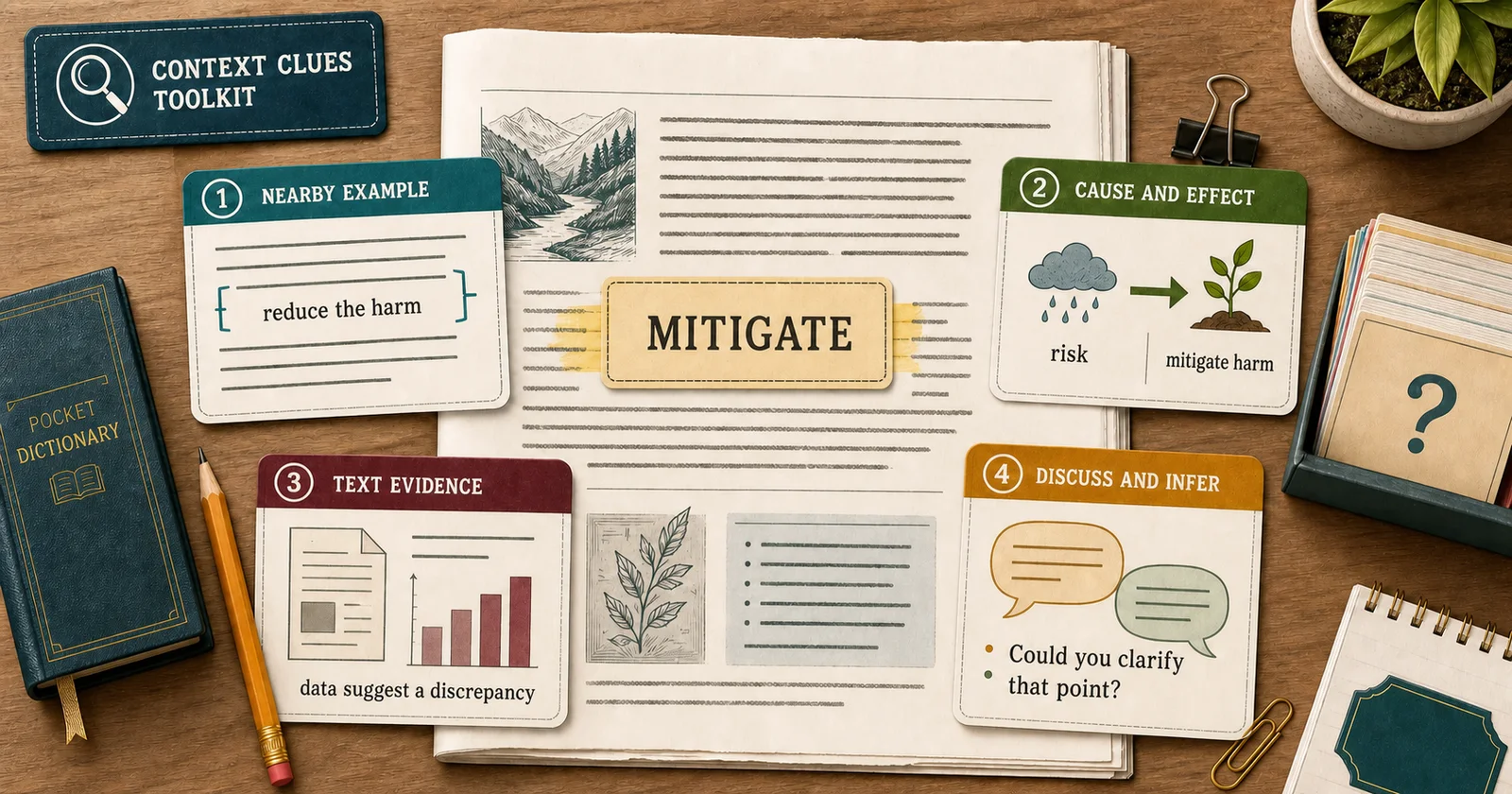
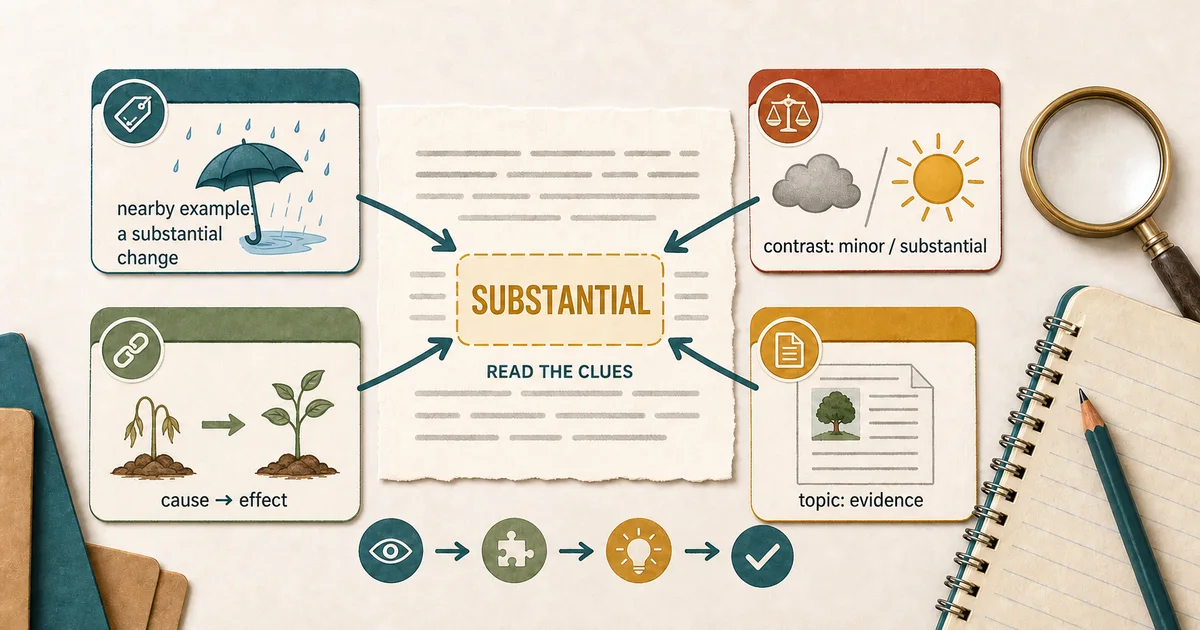
- Read in context. Underline the sentence around the word. Look for a contrast word, an example, or a definition nearby.
- Make a word family. For substantial, note substantially and the phrase a substantial increase.
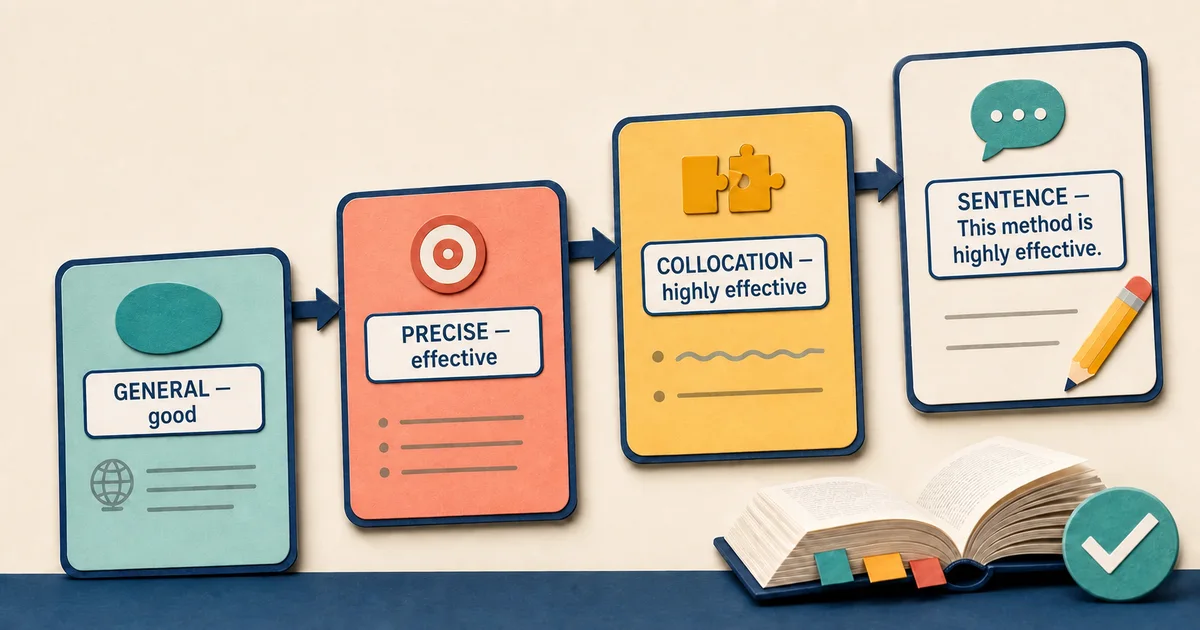
- Compare choices. Write a basic sentence, then improve it only if the advanced word adds a real difference: “The change was big” → “The change was substantial.”
- Reuse on another day. Add the word to Linglify, then make a fresh sentence after a day or two. If you cannot use it naturally, keep it in your passive reading vocabulary for now.
Reading is an excellent source of unfamiliar English words, but context matters more than a long definition. For a structured advanced bank, pair this guide with C1 English Vocabulary and Advanced English Words.
Vocabulary to Practise
Add a focused selection to your Linglify dictionary. Review the cards, then use each word in a sentence about a real plan, text, discussion, or decision.
alleviate
verb
To make something less severe or painful.
Examples
- Government programs aim to alleviate poverty in rural communities.
- The medication will alleviate pain and reduce inflammation significantly.
ambiguous
adjective
Having more than one possible meaning or interpretation.
Examples
- The politician's ambiguous statement confused voters about his actual position.
- The test question was ambiguous and could be interpreted in multiple ways.
articulate
adjective
Able to express ideas clearly and effectively.
Examples
- She's very articulate and can express her thoughts clearly.
- The articulate speaker explained complex ideas in simple terms.
coherent
adjective
Coherent describes something that is logical, clear, and well-organized.
Examples
- After the accident, he wasn't coherent enough to answer police questions.
- The professor gave a coherent explanation of the complex scientific theory.
concede
verb
To admit that something is true or valid, often reluctantly.
Examples
- He had to concede that his opponent made some valid points during the debate.
- The candidate decided to concede defeat after losing the election clearly.
tycoon
noun
A wealthy, influential person who dominates a particular industry or field.
Examples
- Media tycoon owns newspapers and television stations worldwide.
- Oil tycoon donated millions to educational and charitable causes.
detest
verb
To intensely dislike or hate something or someone.
Examples
- Many people detest the sound of nails scratching on chalkboard.
- She absolutely detests dishonesty and deception in any form.
portrayal
noun
The act of representing or describing someone or something visually or in words.
Examples
- Critic praised actor's nuanced portrayal of troubled protagonist.
- Film's portrayal of war emphasizes human cost over glory.
fury
noun
Intense anger or rage.
Examples
- His fury was evident after hearing the news.
- She lost her fury when she saw the damage.
grumpy
adjective
Having a bad mood and often complaining or being unfriendly.
Examples
- His grumpy attitude made it hard to work with him.
- She looked grumpy after waking up late.
superficial
adjective
Lacking depth or significance; shallow.
Examples
- His knowledge of the subject was superficial and incomplete.
- The wound appeared serious but was actually quite superficial.
impeccable
adjective
Describes something of perfect or faultless quality, especially in manners or appearance.
Examples
- Hotel provides impeccable service ensuring guest satisfaction and comfort.
- Professional maintains impeccable reputation for honesty and integrity.
precaution
noun
A noun that refers to an action taken as a safeguard against potential danger or harm.
Examples
- Take the necessary precautions before starting.
- Wearing a helmet is a safety precaution.
insular
adjective
Isolated or narrow-minded, often lacking awareness of wider perspectives.
Examples
- His insular thinking prevents him from considering alternative perspectives.
- Insular community rarely interacts with outside world effectively.
plausible
adjective
Believable or reasonable enough to be accepted.
Examples
- His explanation sounds plausible but lacks supporting evidence.
- Scientists seek plausible theories to explain observed phenomena.
reconstruction
noun
The process of rebuilding or repairing a building or area.
Examples
- Historical reconstruction helps us understand the past.
- The reconstruction of the building took two years.
enterprising
adjective
Having initiative and resourcefulness; willing to undertake new projects.
Examples
- Enterprising entrepreneur identified market gap and created innovative solution.
- Enterprising students organize fundraising events for school improvement projects.
substantial
adjective
Important or large enough to have a noticeable effect.
Examples
- Substantial improvement shows in student test scores.
- Substantial investment creates new business opportunities today.
subtle
adjective
Having a very slight difference that is not obvious or easy to notice.
Examples
- Subtle flavor enhances dish without overpowering taste.
- Subtle hint suggests solution without direct statement.
verify
verb
To establish the truth or correctness of something through evidence or proof.
Examples
- Please verify the information before publishing.
- They need to verify the results of the experiment.
occupant
noun
A person who occupies a place or building, especially temporarily.
Examples
- Building occupant reported strange noises during night hours.
- Car crash injured both driver and passenger occupants.
tell sb/sth apart
Phrasal Verbs
to distinguish two similar people or things
Examples
- It's hard to tell the twins apart.
- Can you tell the difference between these two paintings?
What to Do Next
- Start with ten words in the C1 vocabulary library.
- Strengthen precise academic language with Academic Word List.
- Move on to C2 Proficiency Vocabulary when C1 words feel natural in your own sentences.
- Revisit 20 Common Idioms to balance formal vocabulary with natural everyday expression.
Frequently Asked Questions
What are unfamiliar English words?
They are words you do not yet recognize or do not fully understand in context. For advanced learners, they are often precise words used in articles, reports, lectures, and professional discussions rather than rare words used only to impress people.
Should I use advanced words in every conversation?
No. Choose an advanced word when it is the clearest and most natural option for the audience and situation. Simple English is often better in a quick message or casual chat.
How many unfamiliar words should I learn per week?
Ten to twenty words is a realistic active target if you review and use them. You can read many more passively, but active vocabulary needs repeated practice with phrases and sentences.
What is the difference between feasible and viable?
Feasible means possible and practical to do now. Viable means able to work or succeed over time; a plan can be feasible today but not viable in the long term.
How do I remember unfamiliar English words?
Link each word to a meaningful phrase, a contrast, and a personal example. Then review it with spaced repetition and meet it again in real reading or listening.


