Vocabulary Flashcards: How to Create and Use Them Effectively
Flashcards are the most popular vocabulary study tool in the world — and also the most misused. Millions of learners write a word on one side, a translation on the other, flip through the stack once, and wonder why they forget everything within a week.
The problem is not flashcards themselves. The problem is how most people make and use them. A well-designed flashcard with context, spaced repetition, and active recall is one of the most efficient learning tools science has ever validated. A poorly designed card — a single word with a single translation — is barely better than not studying at all.
This guide covers everything: what makes a flashcard effective, how to design cards that stick, common mistakes that waste your time, paper vs. digital trade-offs, and how to combine flashcards with a broader vocabulary system.
- What you’ll learn: How to create, organize, and review flashcards for maximum retention
- Science behind it: Spaced repetition, active recall, dual coding theory
- Best for: Any language learner (A2–C2), exam preparation, building active vocabulary
- Time investment: 15–20 minutes/day produces measurable results within 2 weeks
For the broader memorization system that flashcards plug into, see How to Memorize Vocabulary: Science-Backed Techniques.
Why Flashcards Work (The Science)
Flashcards are effective because they combine three proven cognitive principles at once:
1. Active Recall
When you look at the front of a flashcard and try to remember the answer, you are performing active recall — retrieving information from memory rather than passively re-reading it. Cognitive scientists call this the “testing effect”: the act of trying to remember something strengthens the memory more than seeing the information again.
Studies show active recall improves retention by 50–100% compared to passive review methods like re-reading notes or highlighting textbooks.
2. Spaced Repetition
The best flashcard systems do not show you every card every day. They calculate the optimal time to review each card — just before you would forget it. Cards you know well appear rarely. Cards you struggle with appear frequently. This is spaced repetition, and it is the single most efficient way to move information into long-term memory.
Without spacing, you review easy words too often (wasted time) and hard words too rarely (forgotten). With spacing, every review session is maximally productive.
3. Dual Coding
When flashcards include both verbal (words, definitions) and visual information (images, diagrams, example sentences that create mental pictures), they engage two separate memory systems. This is dual coding theory — information stored in two formats is recalled better than information stored in one.
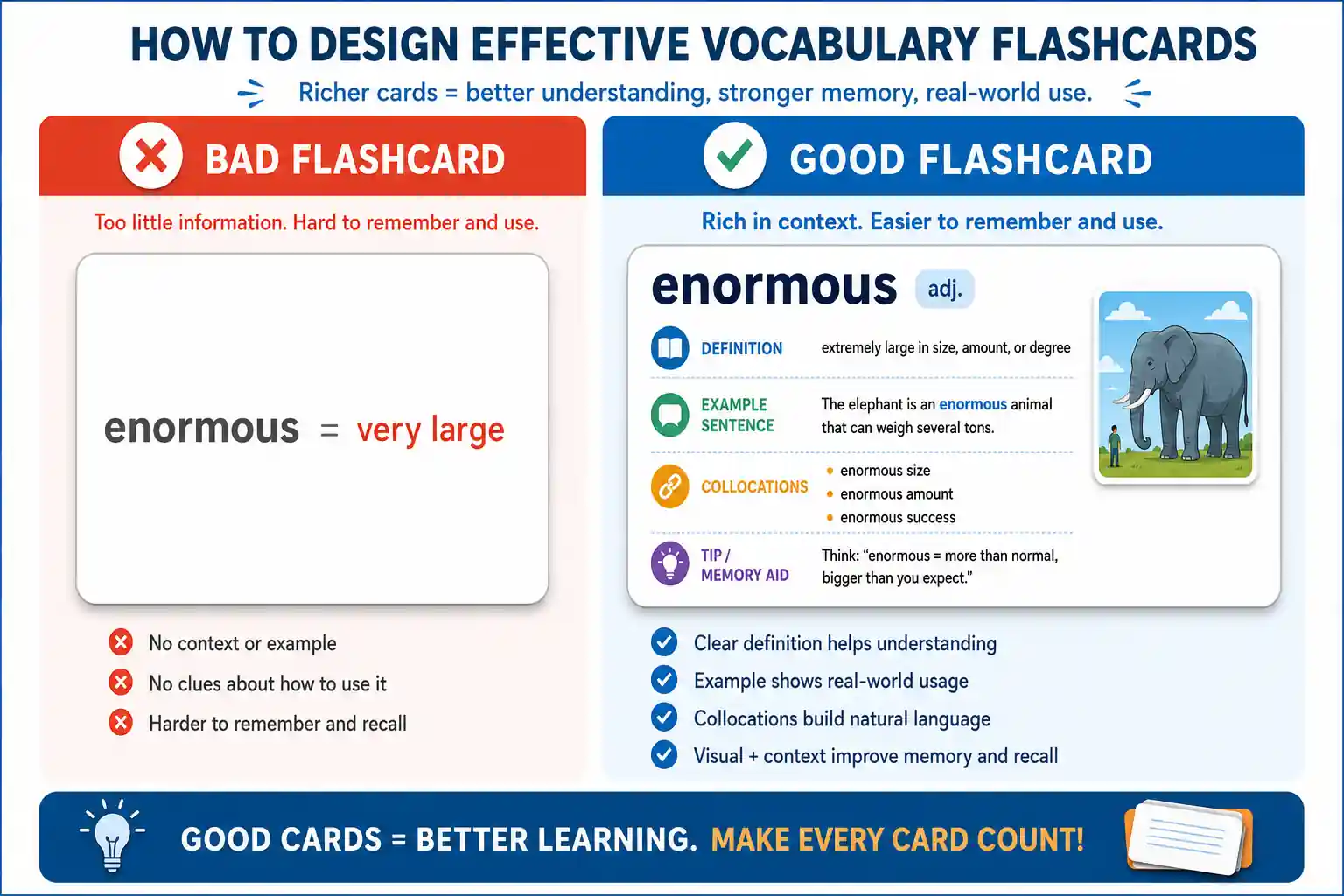
A flashcard with “enormous” → “very large” is weaker than a flashcard with “enormous” → image of a whale next to a tiny boat + “The enormous building dominated the entire skyline.“
What Makes a Good Vocabulary Flashcard
Not all flashcards are equal. The difference between an effective card and a useless one comes down to these principles:
The Front (Question Side)
The front should trigger recall effort. Good options:
| Front Format | Example | Best For |
|---|---|---|
| Word only | reluctant | Quick review of known words |
| Word + part of speech | reluctant (adj) | Avoiding confusion with similar words |
| Sentence with gap | She was _ to speak at the meeting. | Testing production ability |
| Definition in English | Unwilling to do something | Building English-to-English thinking |
| Image / situation | Photo of someone hesitating | Advanced learners; building intuition |
The Back (Answer Side)
The back should confirm and reinforce. Include multiple elements:
| Element | Why It Matters |
|---|---|
| Definition in English | Builds English-only thinking |
| Translation (optional) | Quick confirmation for beginners |
| Example sentence | Shows grammar, register, collocations |
| Pronunciation | Prevents fossilized mispronunciation |
| Collocations | Shows natural word partnerships |
| Image (optional) | Creates visual memory anchor |
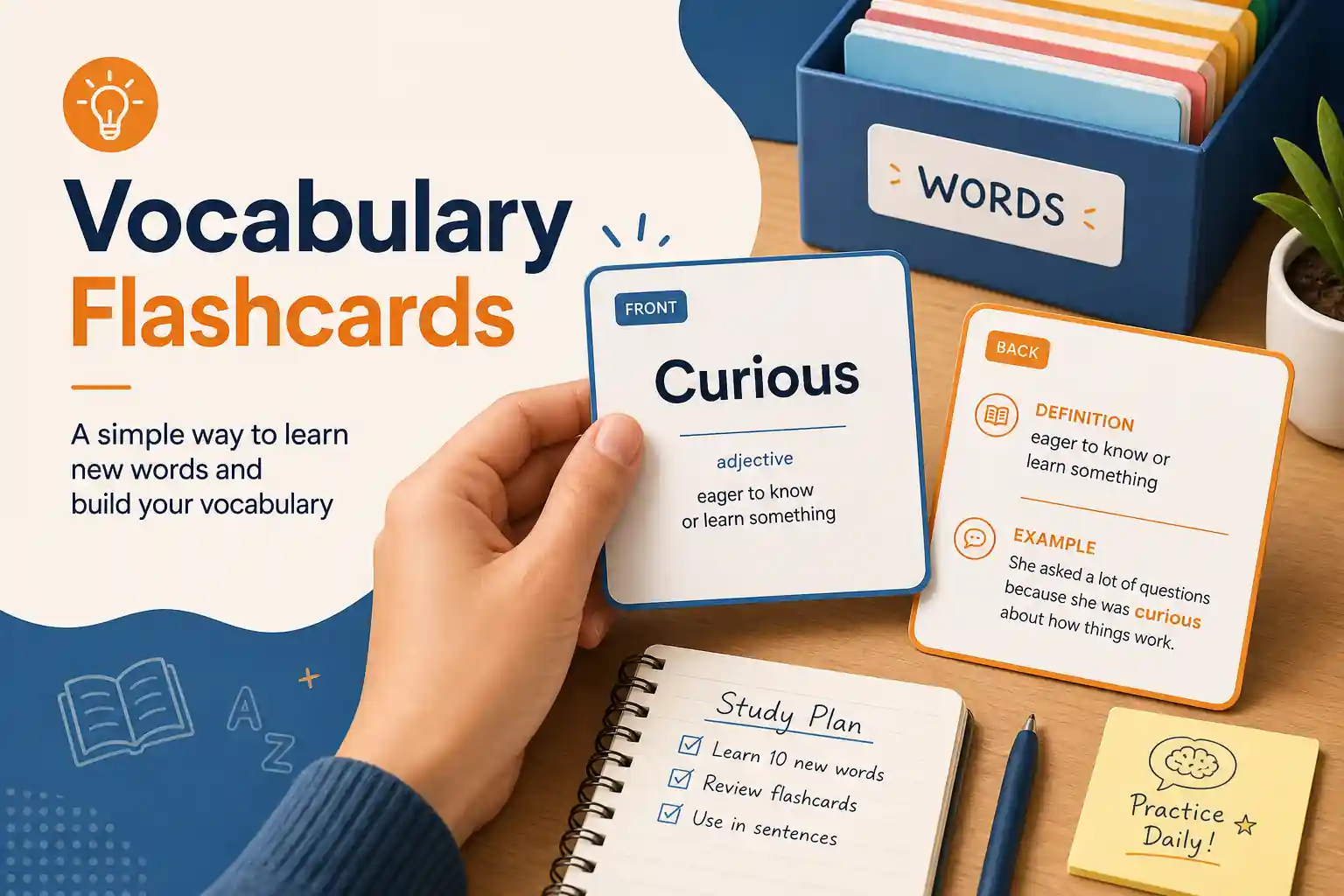
Example of a Well-Designed Card
Front:
reluctant (adj) She was reluctant to _.
Back:
Meaning: Unwilling to do something; hesitating because you don’t want to
Pronunciation: /rɪˈlʌktənt/
Example: She was reluctant to speak at the meeting because she hadn’t prepared.
Collocations: reluctant + to do something, reluctant participant, reluctant agreement
Related: reluctance (n), reluctantly (adv)
This card tests production (fill the gap), provides context, pronunciation, collocations, and word family. It engages multiple memory pathways — far more effective than “reluctant = неохотный” alone.
How to Create Effective Vocabulary Flashcards
Step 1: Choose the Right Words
Do not flashcard every new word you encounter. Be selective:
- Priority 1: Words you encounter frequently but cannot produce (passive → active vocabulary)
- Priority 2: Words from your current CEFR level that fill gaps in your communication
- Priority 3: Exam-specific vocabulary (IELTS, TOEFL, etc.)
- Skip: Extremely rare words, highly technical words outside your field, words you can already use naturally
A focused deck of 200 high-frequency words you actually learn beats a deck of 2,000 words you flip through passively.
Step 2: Use the “One Card, One Fact” Rule
Each card should test exactly one piece of knowledge. If you put three definitions on one card, you cannot know which one you actually remember and which ones you are guessing.
Wrong (too much on one card):
Front: run Back: 1. move fast 2. manage a business 3. operate (machine) 4. flow (water) 5. last (time)
Right (separate cards for separate meanings):
Card 1 — Front: Who runs this company? → Back: run = manage, be in charge of Card 2 — Front: The tap is running. → Back: run = flow (water) Card 3 — Front: The show ran for three years. → Back: run = last, continue for a period
Step 3: Always Include Context
A word without context is almost useless. Your brain stores words in networks of associated information — context gives the word somewhere to connect.
| Element | Example for “breakthrough” |
|---|---|
| Part of speech | noun (countable) |
| Example sentence | Scientists made a major breakthrough in cancer treatment. |
| Collocations | make a breakthrough, a major/significant breakthrough, a scientific breakthrough |
| Register | Neutral — used in both spoken and written English |
| Word family | break through (verb), breakthrough (noun/adjective) |
Step 4: Add Personal Connections
Cards connected to your life are remembered 2–3× better than generic examples. After writing the “textbook” example, add one personal connection:
Generic: She made a breakthrough in her research. Personal: My breakthrough moment in English was when I understood a movie without subtitles.
Step 5: Include Both Recognition and Production Cards
Most learners only test recognition (see English word → remember meaning). But active vocabulary requires production (have meaning → produce the word). Create both types:
| Card Type | Front | Back | Tests |
|---|---|---|---|
| Recognition | ubiquitous | “present everywhere; found in all places” | Can you understand this word? |
| Production | “present everywhere, impossible to avoid” | ubiquitous | Can you produce this word? |
Production cards are harder — and that difficulty is what builds active vocabulary.
Common Flashcard Mistakes (And How to Fix Them)
Mistake 1: Too Many Cards, Too Little Depth
Problem: Adding 50 new cards per day and never properly learning any of them.
Fix: Add 5–10 new cards per day maximum. Spend time on card quality. A smaller deck with rich cards beats a huge deck with bare-bones translations.
Mistake 2: Word → Translation Only
Problem: beautiful = красивый. No context, no sentence, no pronunciation. This builds fragile recognition memory that fades quickly.
Fix: Follow the card design principles above. Every card needs at least one example sentence and the word’s main collocations.
Mistake 3: Reviewing Without Thinking
Problem: Flipping cards automatically and marking “correct” without actually testing recall. If you see the answer 0.5 seconds after seeing the front, your brain did not work — and no memory was strengthened.
Fix: Force yourself to produce the answer (say it out loud or write it down) BEFORE flipping. If you cannot recall after 10 seconds of effort, mark it as forgotten — even if you “sort of” knew it.
Mistake 4: Never Deleting Cards
Problem: Your deck grows forever. Cards you learned months ago still appear, wasting review time.
Fix: Retire cards that you consistently answer correctly after 6+ months. If you can recall a word instantly and use it in conversation, you do not need the flashcard anymore. Move it to an “archive” deck that you review monthly instead of daily.
Mistake 5: Ignoring Pronunciation
Problem: You can read the word, you know the meaning, but you mispronounce it. Silent flashcard review does not fix this.
Fix: Say every word out loud during review. Include phonetic transcription on the back of each card. For digital flashcards, use text-to-speech or audio recordings.
Mistake 6: Studying Only Before Exams
Problem: Cramming 500 cards the week before IELTS. This creates short-term recognition that disappears within days.
Fix: 15 minutes daily beats 3 hours weekly. Flashcards work through cumulative small sessions, not marathon cram sessions. Start your flashcard habit now — not the week before your exam.
Paper vs. Digital Flashcards
Both formats work. The best choice depends on your situation:
Paper Flashcards
| Advantage | Why It Matters |
|---|---|
| Physical writing improves memory encoding | Handwriting activates motor memory pathways |
| No screen distractions | No notifications, no temptation to switch apps |
| Tactile sorting possible | Physically move cards between “know” / “don’t know” piles |
| Works anywhere without battery | Study on the bus, in a waiting room, at a park |
| Disadvantage | Impact |
|---|---|
| No automatic spaced repetition | You must manage review intervals manually |
| Difficult to reorganize | Cards are in fixed physical order unless you shuffle constantly |
| No audio or images | Limited to text (unless you draw) |
| Easy to lose | One lost stack = dozens of hours wasted |
Best for: Learners who need focus and enjoy the physical process of writing.
Digital Flashcards
| Advantage | Why It Matters |
|---|---|
| Automatic spaced repetition | Algorithms calculate optimal review timing |
| Audio and images possible | Dual coding; pronunciation feedback |
| Always with you | On your phone, available in any 5-minute gap |
| Progress tracking | You can see retention rates, weak spots, trends |
| Impossible to lose | Cloud-synced across devices |
| Disadvantage | Impact |
|---|---|
| Screen fatigue | Adds to daily screen time |
| Distraction risk | Notifications pull attention away |
| Passive tapping risk | Easy to mark “correct” without truly thinking |
| Initial setup takes time | Formatting rich cards is slower than writing |
Best for: Learners who want efficiency, data tracking, and spaced repetition without manual scheduling.
The Hybrid Approach
Many successful learners use both:
- Create cards on paper — the act of writing reinforces initial encoding
- Review digitally — use spaced repetition algorithms to schedule reviews optimally
- Use Linglify’s built-in system — add words to your dictionary and the app handles the review scheduling, so you focus on actually learning rather than managing card logistics
How to Organize Your Flashcard Deck
A messy deck wastes time and causes confusion. Here is how to organize:
By CEFR Level
| Deck | Content | Daily New Cards |
|---|---|---|
| A2–B1 | Everyday vocabulary, basic phrasal verbs | 8–10 |
| B2 | Abstract concepts, work vocabulary, idiomatic expressions | 5–7 |
| C1 | Academic vocabulary, nuanced synonyms, collocations | 3–5 |
By Topic
Create sub-decks by theme: Work, Travel, Health, Technology, Relationships, etc. This mirrors how your brain naturally organizes vocabulary and makes each study session contextually coherent.
By Source
Tag cards based on where you encountered the word: reading, conversation, exam prep, lesson. This helps you identify which learning activities are most productive.
Tagging System
If using digital flashcards, tag each card with:
- Level: A2, B1, B2, C1
- Source: reading, class, exam-list, conversation
- Type: noun, verb, adjective, phrasal verb, collocation
- Status: new, learning, known
Daily Flashcard Routine
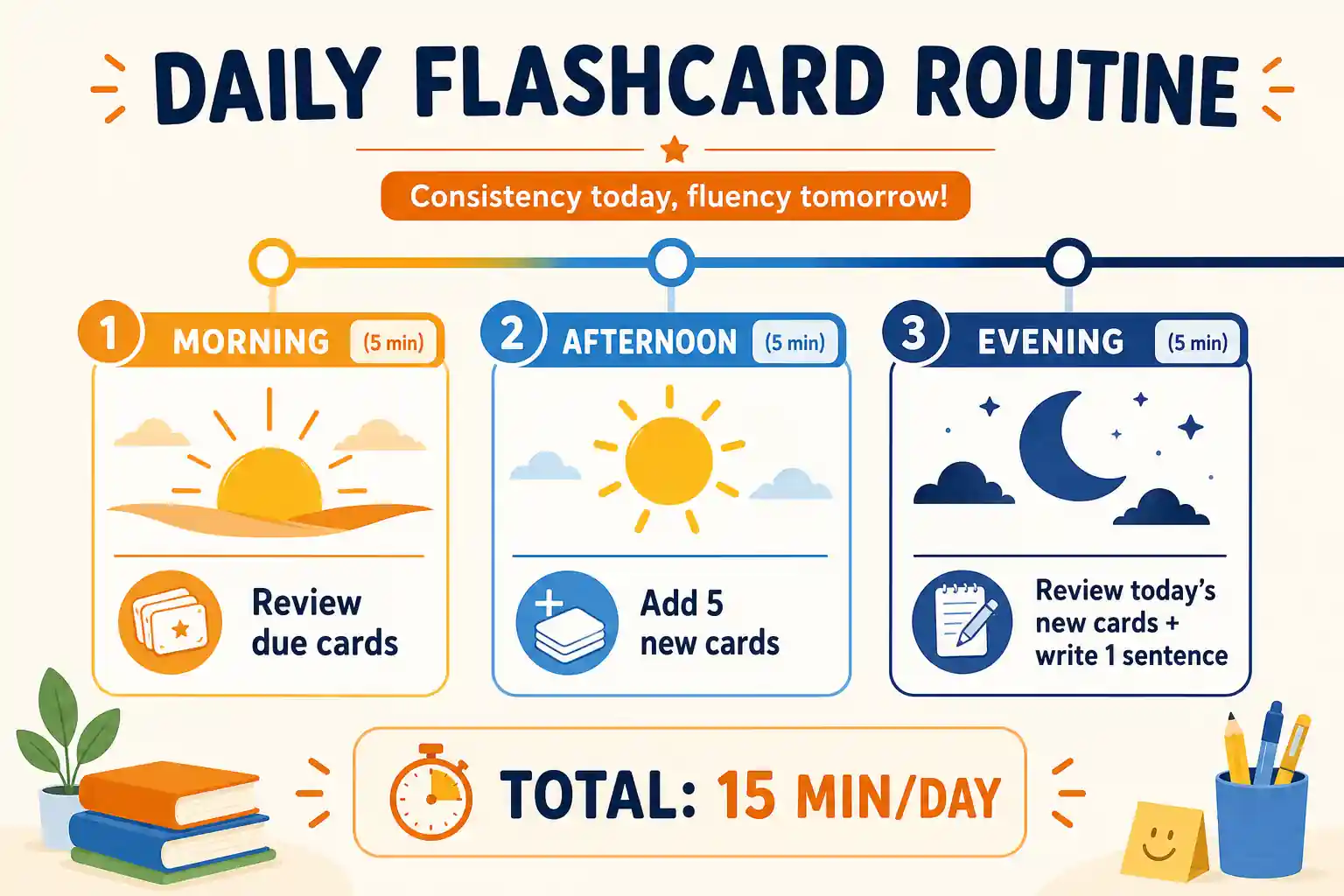
Here is a 15-minute daily routine that produces consistent results:
Morning (5 minutes)
- Open your deck. Review cards due today (spaced repetition cards that appeared in your queue).
- For each card: look at the front, try to produce the answer, check the back.
- Mark honestly: “knew it” or “forgot it.” Do not cheat — failed cards are the most valuable because they reveal gaps.
Afternoon (5 minutes)
- Add 5 new cards from your current study material (book, app, class notes).
- For each new card: read it carefully, say the word aloud, read the example sentence, close your eyes and try to recall the word.
Evening (5 minutes)
- Review new cards from today’s afternoon session (first repetition within 24 hours — critical for the forgetting curve).
- Write one sentence using any word that felt difficult today.
Weekly total: ~100 minutes (less than 2 hours) for approximately 35 new words learned properly + continued maintenance of existing vocabulary.
How Many Flashcards Should You Have?
| Learner Type | Active Deck Size | New Cards/Day | Monthly Growth |
|---|---|---|---|
| Casual (15 min/day) | 100–200 | 3–5 | 90–150 |
| Regular (20 min/day) | 200–400 | 5–8 | 150–240 |
| Intensive (30+ min/day) | 400–600 | 8–12 | 240–360 |
| Exam prep (60 min/day) | 600–1000 | 12–20 | 360–600 |
These numbers assume you retire mastered cards regularly. A deck of 400 active cards with an 80% retention rate means you know approximately 320 words well enough to use them.
Flashcards for Specific Purposes
IELTS/TOEFL Vocabulary
For exam preparation, flashcards should include:
- Academic word list entries (see Academic Word List)
- Paraphrasing synonyms (Synonyms for IELTS)
- Topic-specific vocabulary for speaking/writing
- Collocations over single words
Phrasal Verbs
Phrasal verb flashcards need special treatment because one verb can have 5+ meanings:
- Make one card per meaning, not one card per phrasal verb
- Use gapped sentences on the front (test production, not just recognition)
- Include the particle pattern: separable/inseparable
See 200 Phrasal Verb Examples for sentences to use on your cards.
Collocations
Collocation cards test word partnerships rather than individual word meanings:
- Front: make / do / take a decision? → Back: make a decision
- Front: heavy _ (not “strong”) → Back: heavy rain, heavy traffic
- Include 3–4 examples of the same collocation pattern
Idioms
Idiom cards benefit from images and situations:
- Front: situation description or image of the literal meaning
- Back: idiom + figurative meaning + example
- Never learn idioms as isolated definitions — always with full context
Words to Practice With
Here are 25 B1–B2 words that work perfectly as flashcard material. Add them to your dictionary — each one has clear collocations, example sentences, and is useful across multiple contexts.
candidate
noun
A person who is competing in an election or contest.
Examples
- Each presidential candidate presented their policy plans to voters.
- The job candidate impressed the interview panel with her experience.
evaluate
verb
To judge or measure the value, quality, or importance of something.
Examples
- Companies evaluate job candidates based on experience, skills, and personality.
- Teachers evaluate student progress through tests, projects, and classroom participation.
cooperate
verb
To work together with others towards a common goal.
humorous
adjective
Funny or amusing, often making people laugh.
Examples
- She writes humorous articles about everyday life and family experiences.
- The humorous speech made everyone laugh and lightened the serious mood.
motivated
adjective
Feeling driven or inspired to do something because of a reason or goal.
Examples
- Motivated employee seeks additional responsibilities and challenges at work.
- Success requires being motivated even when facing difficult obstacles.
tragedy
noun
An extremely sad or serious event that causes suffering or loss.
Examples
- Natural tragedy affects thousands of innocent people.
- Personal tragedy changes person's life perspective completely.
prejudice
noun
Preconceived opinions or feelings, often negative, about a person or group.
Examples
- Education helps overcome prejudice and promotes understanding.
- Racial prejudice damages communities and individuals alike.
donate
verb
To give something, especially money or goods, to help a cause or person.
Examples
- Many people donate money to charities that help homeless individuals.
- She decided to donate blood to help patients in emergency situations.
discourage
verb
To try to make someone feel less confident or hopeful about something.
Examples
- Don't let one failure discourage you from pursuing your dreams.
- High prices discourage many people from buying organic food products.
graduate
verb
To complete a course of study at a school or university.
Examples
- She will graduate from university next year with a degree in engineering.
- Students must complete all requirements before they can graduate from high school.
union
noun
A group of people or things joined together for a purpose.
Examples
- Labor union protects worker rights and interests.
- Marriage union joins two people in partnership.
horizon
noun
The line where the earth or the sky appears to meet in the distance.
Examples
- The sun disappeared behind the horizon as evening approached.
- Traveling broadens your horizon and exposes you to new cultures.
off
adjective
Describes something that is not fresh or is no longer suitable for eating, often used for food and drinks.
Examples
- Please turn off the lights before leaving the room.
- The dog ran off into the forest chasing wild rabbits.
lifelong
adjective
Continuing for a very long time or for the whole life.
Examples
- Learning is a lifelong process that never truly ends.
- Their lifelong friendship began during elementary school years.
boom
noun
A loud, deep sound or a sudden increase in activity or popularity.
Examples
- The boom of thunder echoed across the valley.
- The technology boom created many new millionaires.
stress
verb
To feel mental or emotional pressure or worry; to emphasize or give importance to something.
Examples
- Heavy workload may stress employees beyond limits.
- Teacher will stress importance of homework completion.
guide
verb
To show or direct someone how to do something.
Examples
- Parents should guide their children to make responsible decisions.
- The experienced hiker will guide the group through the mountain trail safely.
admission
noun
The process or fact of being allowed to enter or join.
Examples
- Her admission to the prestigious medical school was the result of hard work.
- The museum offers free admission on the first Sunday of every month.
jury
noun
A group of people who listen to evidence in a court and decide if someone is guilty.
Examples
- The jury deliberated for several hours before reaching a verdict.
- The talent show jury consisted of professional musicians and entertainers.
voyage
noun
A long journey to a distant place, often by sea or air.
Examples
- Space exploration represents humanity's greatest voyage into the unknown.
- The ocean voyage from Europe to America took several weeks in the past.
total
adjective
An adjective describing something that is complete or whole, not divided or broken.
Examples
- Total cost includes all fees and expenses.
- Total silence fills room during meditation session.
indispensable
adjective
Absolutely necessary; essential.
Examples
- Clean water is indispensable for human survival and good health.
- Her experience and skills make her indispensable to the research team.
firmly
adverb
An adverb indicating a way of doing something with certainty or stability.
Examples
- Hold the rope firmly while climbing down the steep mountain slope.
- The manager firmly believed in treating all employees with respect.
normally
adverb
Usually; under normal conditions.
Examples
- Heart normally beats between sixty and hundred times per minute.
- Students normally arrive at school before morning bell rings.
resolve
verb
To find a solution or answer to a problem or question.
Examples
- Mediator helps parties resolve dispute through negotiation.
- Technical team will resolve software problems quickly.
What to Do Now
-
Pick 5 words you learned recently — words from your last lesson, a book you read, or an article you studied.
-
Create one flashcard for each using the format above: word + part of speech + definition + example sentence + collocations. Spend 2 minutes per card — quality matters more than speed.
-
Review tomorrow morning. Set an alarm or notification. The first review within 24 hours is the most critical for long-term retention.
-
Choose your tool. Paper is fine for starting. For spaced repetition, add words to your Linglify dictionary — the system calculates review intervals automatically.
-
Build the habit. 15 minutes daily for two weeks. After that, it becomes automatic — and you will notice words sticking in a way they never did before.
FAQ
How to make vocabulary flashcards?
Write the target word and a gapped sentence on the front. On the back, include: the definition in English, a full example sentence, pronunciation, main collocations, and (optionally) a translation. The key principle is “one card, one fact” — separate meanings get separate cards. Always include context; a word without a sentence is barely worth learning.
Are flashcards a good way to learn vocabulary?
Yes — when used correctly. Research consistently shows that flashcards combined with spaced repetition and active recall produce 50–100% better retention than passive methods like re-reading or highlighting. The critical factor is card quality: rich cards with context, examples, and collocations work far better than simple word-translation pairs.
How many vocabulary flashcards should I study per day?
For most learners, 5–10 new cards per day plus review of existing cards (15–20 minutes total) is optimal. This produces approximately 150–270 permanently learned words per month. Going above 15 new cards daily usually decreases retention — you spend all your time reviewing and never truly learn any card deeply.
Digital or paper flashcards — which is better?
Both work, but for different reasons. Paper flashcards benefit from the handwriting encoding effect (physical writing strengthens initial memory). Digital flashcards benefit from automatic spaced repetition algorithms (no manual scheduling). The ideal approach is creating cards by hand (for encoding) then reviewing digitally (for optimal spacing). If you choose only one, digital with spaced repetition has a stronger evidence base for long-term retention.
How long should I keep vocabulary flashcards?
Retire cards that you answer correctly for 6+ consecutive months. At that point, the word is in long-term memory and the flashcard is consuming review time without adding value. Move retired cards to a monthly review archive. If you encounter the word in real life and can use it without hesitation, it no longer needs active flashcard support.
Can flashcards teach me to speak, or just recognize words?
Standard flashcards (see word → recall meaning) primarily build recognition. To build production ability — the ability to use words in speech — you need production cards: see a definition or situation on the front, produce the English word on the back. Also add a “use in a sentence” step to your review routine: after recalling the word, immediately say a sentence using it. This bridges the gap between knowing a word and using it.