
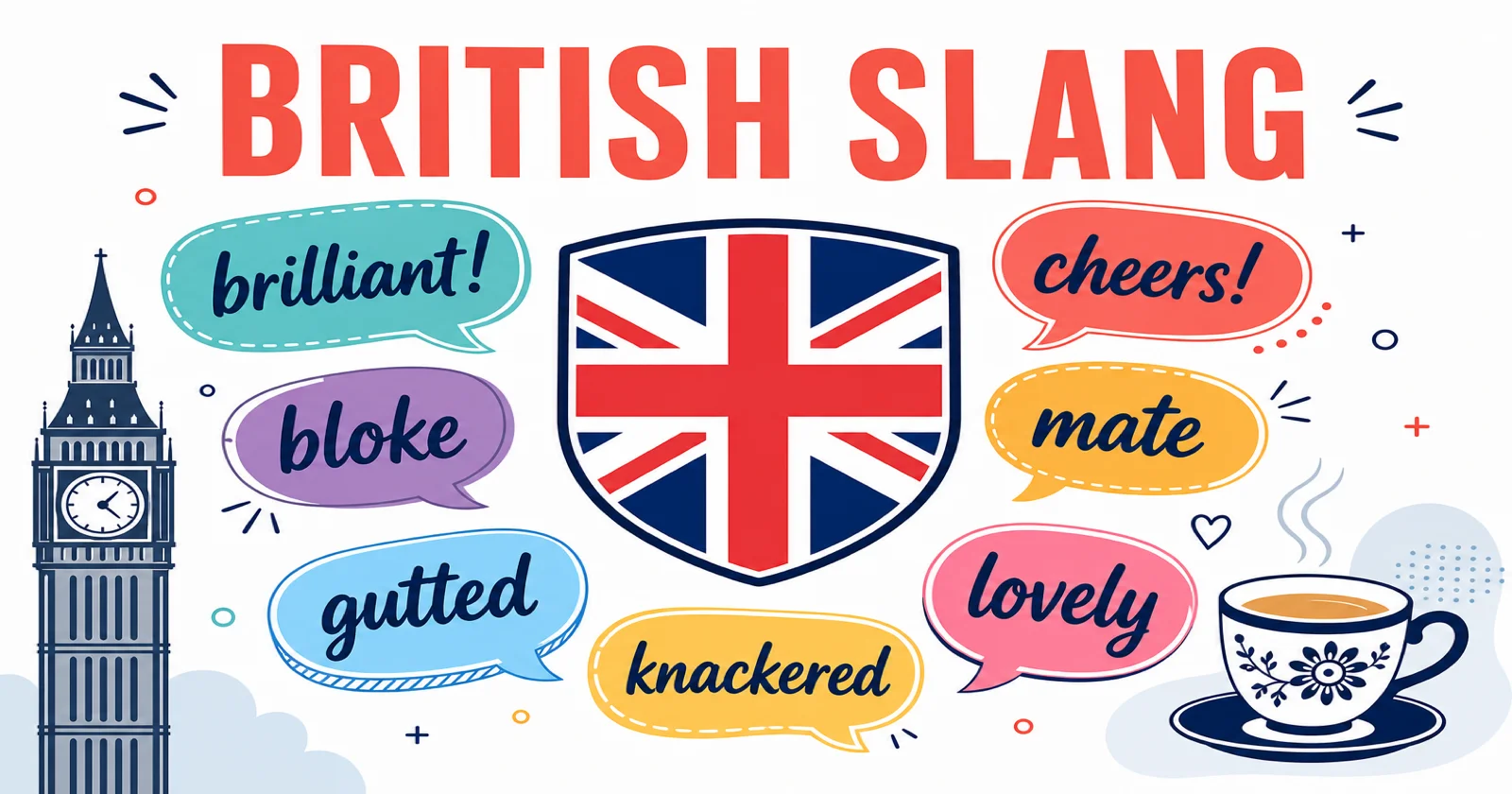
英國俚語單字:200+個你需要知道的表達
如果你從美式英語教材學英語,然後看了一部英國電視劇,你可能理解了其中約70%的內容。不是因為口音——而是因為詞彙。當英國人說「I’m absolutely knackered after that dodgy kebab, and now I need to pop to the chemist before I go to my mate’s gaff」時,每個單字都是英語,但對任何學過美式英語的人來說,這個句子幾乎就像外語。
英式英語有其大量自己的俚語、非正式單字和表達,很少出現在教科書中。其中一些單字在整個英國通用;其他的特定於倫敦、北部或蘇格蘭。許多已經存在了幾個世紀;其他的是去年出現的。
本指南涵蓋200+個最有用的英國俚語單字和表達,按類別分類。每個單字都包括定義、例句,以及關於使用範圍的說明。無論你是計劃在英國生活、看英國電視,還是只是想理解你的英國朋友實際在說什麼——這就是你的參考。
- 總計:200+個英國俚語單字
- 分類方式:10個類別
- 格式:單字 → 含義 → 例句
- 程度:B1–C2
- 適合:理解英式英語、旅行準備、文化素養
人物和關係
| # | 單字/表達 | 含義 | 例句 |
|---|---|---|---|
| 1 | bloke | 男人、傢伙 | He’s a nice bloke — you’d like him. |
| 2 | mate | 朋友;也用作隨意打招呼 | Alright, mate? How’s it going? |
| 3 | lad | 男孩、年輕男性 | The lads are going to the pub tonight. |
| 4 | lass | 女孩、年輕女性(北部) | She’s a lovely lass from Yorkshire. |
| 5 | chap | 男人(略老式,禮貌) | He’s a decent chap, that one. |
| 6 | missus / Mrs | 妻子或女朋友 | I need to check with the missus first. |
| 7 | geezer | 男人(倫敦) | Some geezer just knocked on the door. |
| 8 | bruv | 兄弟、朋友(倫敦) | Thanks, bruv — I owe you one. |
| 9 | muppet | 愚蠢的人 | He forgot his passport — what a muppet! |
| 10 | plonker | 愚蠢的人 | Don’t be such a plonker, Rodney! |
| 11 | nutter | 瘋狂的人 | He jumped in the river — absolute nutter. |
| 12 | numpty | 愚蠢或無能的人(蘇格蘭) | Some numpty parked across two spaces. |
| 13 | bairn | 孩子(蘇格蘭/北部) | She’s got three bairns under five. |
| 14 | love / luv | 稱呼(如「親愛的」) | What can I get you, love? |
| 15 | posh | 上層階級、高檔 | She went to a posh school in Surrey. |
| 16 | punter | 顧客;普通人 | The punters seemed happy with the show. |
正面感受和認可
| # | 單字/表達 | 含義 | 例句 |
|---|---|---|---|
| 17 | brilliant | 很棒、精彩 | “How was the concert?” “Brilliant!” |
| 18 | lovely | 很好、令人愉快 | That was a lovely meal — thank you. |
| 19 | smashing | 出色、精彩 | We had a smashing time at the festival. |
| 20 | cracking | 極好、非常好 | She’s done a cracking job on this report. |
| 21 | proper | 真實、真正的(強調詞) | That’s a proper cup of tea. |
| 22 | well | 非常(強調詞) | That film was well good. |
| 23 | dead | 非常(強調詞,北部) | She’s dead funny when she wants to be. |
| 24 | mint | 出色(北部) | “How was the match?” “Mint!” |
| 25 | sound | 好、可靠;也表示「好的」 | He’s a sound bloke. / “I’ll be there at 7.” “Sound.” |
| 26 | chuffed | 非常高興、自豪 | She was chuffed to bits with her exam results. |
| 27 | over the moon | 極度快樂 | He was over the moon when he got the job. |
| 28 | buzzing | 非常興奮 | I’m absolutely buzzing about the trip. |
| 29 | gobsmacked | 驚訝、震驚 | I was gobsmacked when I heard the news. |
| 30 | ace | 很棒、出色 | “How was the party?” “Ace!” |
| 31 | wicked | 很棒、酷(非正式) | That trick was wicked! |
| 32 | lush | 可愛、迷人(威爾士) | The cake was absolutely lush. |
| 33 | fit | 有魅力(關於人) | She’s well fit, isn’t she? |
| 34 | belting | 出色(北部) | We had a belting night out. |
| 35 | boss | 出色(利物浦) | That goal was boss! |
負面感受和不認可
| # | 單字/表達 | 含義 | 例句 |
|---|---|---|---|
| 36 | rubbish | 廢話;品質差 | “He said he’ll be on time.” “That’s rubbish.” |
| 37 | naff | 不時髦、無聊 | That jumper is a bit naff, isn’t it? |
| 38 | pants | 糟糕透頂 | The film was absolutely pants. |
| 39 | dodgy | 可疑、不可靠、有風險 | That kebab looks a bit dodgy. |
| 40 | grim | 令人不快、令人沮喪 | The weather’s been grim all week. |
| 41 | manky | 噁心、髒 | The kitchen was absolutely manky. |
| 42 | rank | 噁心 | That milk smells rank — throw it out. |
| 43 | gutted | 非常失望 | I was gutted when they cancelled the concert. |
| 44 | miffed | 稍微惱怒 | She was a bit miffed about not being invited. |
| 45 | narked | 惱怒、煩躁 | He was well narked about the traffic. |
| 46 | daft | 愚蠢、笨 | Don’t be daft — of course I’ll help. |
| 47 | barmy | 瘋狂、發瘋 | You want to swim in January? You’re barmy! |
| 48 | bonkers | 瘋狂 | The housing prices in London are bonkers. |
| 49 | knackered | 極度疲憊 | I’m absolutely knackered after that shift. |
| 50 | shattered | 筋疲力竭 | We walked 20 miles — I’m shattered. |
| 51 | fed up | 厭倦了、沮喪 | I’m fed up with this rain. |
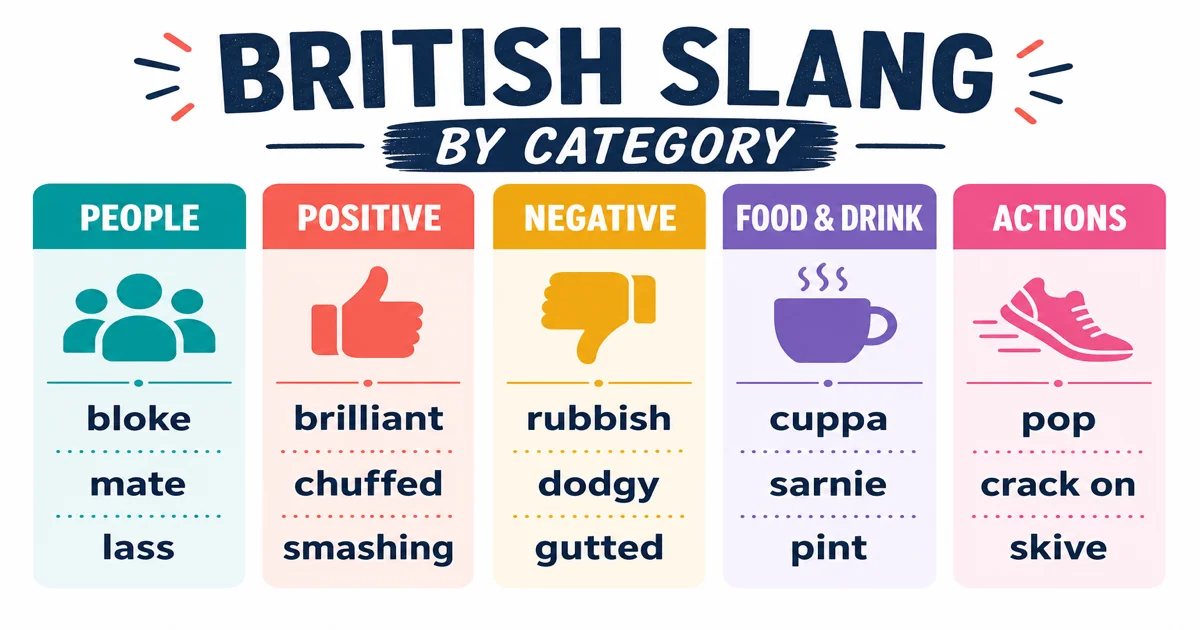
食物和飲料
| # | 單字/表達 | 含義 | 例句 |
|---|---|---|---|
| 52 | cuppa | 一杯茶 | Fancy a cuppa? |
| 53 | brew | 一杯茶 | Put the kettle on — I need a brew. |
| 54 | biscuit | 餅乾(美式英語中的cookie) | Would you like a biscuit with your tea? |
| 55 | chips | 薯條(美式英語的french fries) | Fish and chips, please. |
| 56 | crisps | 洋芋片(美式英語的chips) | Pass me the crisps — salt and vinegar. |
| 57 | sarnie | 三明治 | I’ll grab a bacon sarnie for lunch. |
| 58 | butty | 三明治(北部) | A chip butty is a Northern classic. |
| 59 | nosh | 食物;吃東西 | Let’s grab some nosh before the film. |
| 60 | peckish | 稍微有點餓 | I’m a bit peckish — got any snacks? |
| 61 | starving | 非常餓(誇張) | I’m starving — can we eat soon? |
| 62 | brekkie | 早餐 | What are you having for brekkie? |
| 63 | tea | 晚餐(北部) | “What’s for tea, Mum?” |
| 64 | pint | 一杯啤酒 | Let’s grab a pint after work. |
| 65 | bladdered / trolleyed | 喝醉 | He was absolutely bladdered by 9 o’clock. |
| 66 | legless | 喝得爛醉 | She was legless after three cocktails. |
| 67 | pissed | 喝醉(不是憤怒,與美式英語不同) | He got pissed at the office Christmas party. |
日常動作
| # | 單字/表達 | 含義 | 例句 |
|---|---|---|---|
| 68 | pop | 快速去 | I’m just going to pop to the shops. |
| 69 | nip | 快速去(北部) | I’ll nip out for some milk. |
| 70 | crack on | 開始、繼續工作 | Right, let’s crack on with the meeting. |
| 71 | faff about | 浪費時間、擺弄 | Stop faffing about and get ready! |
| 72 | have a go | 嘗試 | I’ve never tried it, but I’ll have a go. |
| 73 | sort it | 解決、安排 | Don’t worry — I’ll sort it. |
| 74 | suss out | 弄清楚、調查 | I need to suss out the best route. |
| 75 | take the mickey / take the mick | 取笑某人 | Are you taking the mick? |
| 76 | wind someone up | 故意惹怒或取笑某人 | He loves winding his sister up. |
| 77 | leg it | 快速跑掉 | We saw the security guard and legged it. |
| 78 | skive | 逃避工作或學校 | He skived off school to go to the cinema. |
| 79 | kip | 小睡;睡覺 | I need a quick kip before we go out. |
| 80 | bog / loo | 廁所(bog非正式;loo禮貌) | Excuse me, where’s the loo? |
| 81 | ring / give a bell | 打電話 | Give me a bell when you arrive. |
| 82 | nick | 偷;也指「警察局」或「監獄」 | Someone nicked my bike! |
| 83 | chuck | 扔;也指「結束關係」 | Chuck that in the bin. |
地點和事物
| # | 單字/表達 | 含義 | 例句 |
|---|---|---|---|
| 84 | gaff | 房子、家 | Come round to my gaff tonight. |
| 85 | flat | 公寓 | She lives in a flat in Notting Hill. |
| 86 | the tube | 倫敦地鐵 | Take the tube to Piccadilly Circus. |
| 87 | chemist | 藥局 | I need to pop to the chemist for some paracetamol. |
| 88 | boot | 汽車後車廂 | Put the bags in the boot. |
| 89 | bonnet | 汽車引擎蓋 | Open the bonnet — something’s rattling. |
| 90 | lorry | 卡車 | A lorry broke down on the M25. |
| 91 | motorway | 高速公路 | Take the motorway — it’s faster. |
| 92 | pavement | 人行道 | Walk on the pavement, not the road. |
| 93 | queue | 排隊等候的人龍 | There’s a massive queue outside the shop. |
| 94 | telly | 電視 | What’s on the telly tonight? |
| 95 | mobile | 手機 | What’s your mobile number? |
| 96 | quid | 一英鎊(£1) | That’ll be five quid, mate. |
| 97 | fiver | £5紙鈔 | Have you got a fiver I can borrow? |
| 98 | tenner | £10紙鈔 | It only costs a tenner to get in. |
| 99 | brolly | 雨傘 | Grab your brolly — it’s going to rain. |
| 100 | jumper | 毛衣 | Put a jumper on — it’s freezing. |
對話片語
| # | 單字/表達 | 含義 | 例句 |
|---|---|---|---|
| 101 | alright? | 你好嗎? | “Alright, mate?” “Yeah, not bad.” |
| 102 | cheers | 謝謝;也是乾杯 | Cheers for helping me with that. |
| 103 | ta | 謝謝(非常非正式) | “Here’s your change.” “Ta!” |
| 104 | sorted | 完成、安排好 | “Is everything ready?” “Yeah, sorted.” |
| 105 | fair enough | 這很合理,我接受 | “I can’t come tonight.” “Fair enough.” |
| 106 | innit | 不是嗎?(倫敦) | Cold today, innit? |
| 107 | you what? | 什麼?(驚訝或不信) | “I’m moving to Australia.” “You what?!” |
| 108 | blimey | 驚訝的表達 | Blimey, that was quick! |
| 109 | bloody hell | 驚訝或沮喪的表達 | Bloody hell, look at the time! |
| 110 | bob’s your uncle | 就是這樣(=完成了) | Put it in the oven for 20 minutes, and Bob’s your uncle. |
| 111 | easy peasy | 非常容易 | “Is it hard to make?” “No, easy peasy.” |
| 112 | spot on | 完全正確 | Your prediction was spot on. |
| 113 | not my cup of tea | 不是我喜歡的東西 | Horror films aren’t my cup of tea. |
| 114 | you’re having a laugh | 你一定在開玩笑 | £200 for a parking fine? You’re having a laugh! |
| 115 | get in! | 太棒了!(慶祝) | “We won the match!” “Get in!” |
工作和金錢
| # | 單字/表達 | 含義 | 例句 |
|---|---|---|---|
| 116 | sack / get the sack | 解雇/被解雇 | He got the sack for being late too often. |
| 117 | cushy | 輕鬆舒適(工作) | He’s got a cushy job in the city. |
| 118 | doddle | 非常容易的事 | The exam was an absolute doddle. |
| 119 | skint | 沒錢 | I’m skint until payday. |
| 120 | loaded | 非常富有 | Her parents are absolutely loaded. |
| 121 | splash out | 花很多錢 | We splashed out on a fancy dinner. |
| 122 | rip-off | 價格虛高的東西 | £8 for a coffee? What a rip-off! |
| 123 | a steal | 便宜貨 | That coat was a steal at £30. |
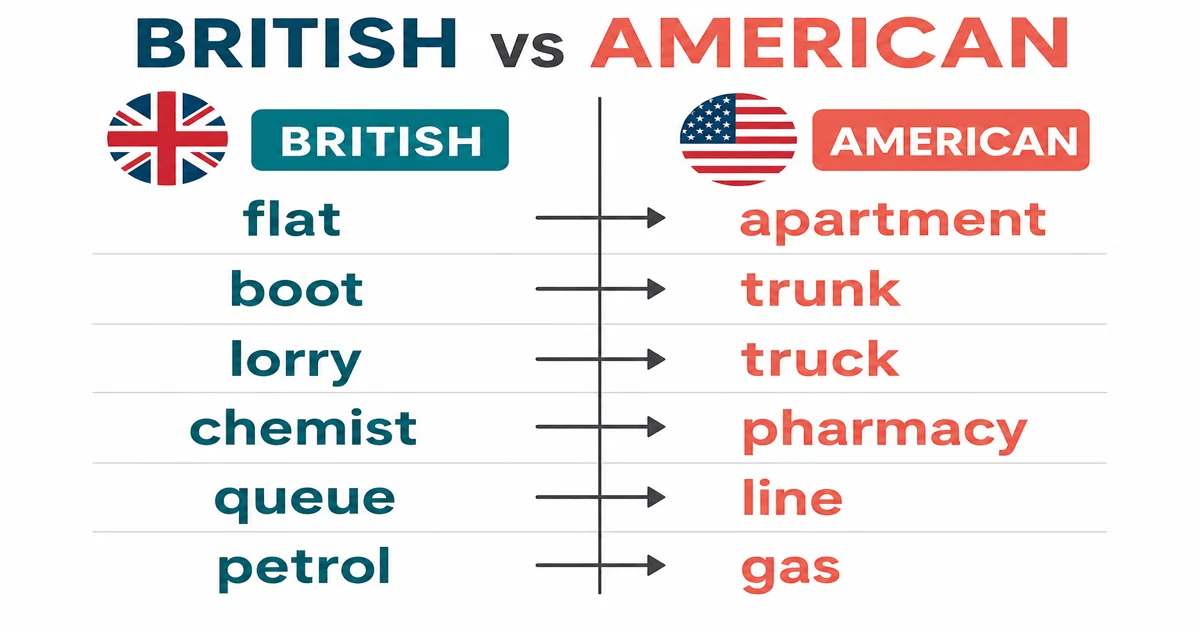
英式英語 vs 美式英語:主要差異
這些不是俚語——而是與美式英語不同的標準英式英語。
| 英式 | 美式 | 含義 |
|---|---|---|
| flat | apartment | 一樓層的住宅 |
| lift | elevator | 垂直交通工具 |
| boot | trunk | 汽車後部 |
| bonnet | hood | 汽車前部 |
| lorry | truck | 大型車輛 |
| petrol | gas/gasoline | 燃料 |
| post | 信件和包裹 | |
| torch | flashlight | 手提燈 |
| holiday | vacation | 休假 |
| queue | line | 等待的人 |
| bin | trash can | 垃圾桶 |
| rubber | eraser | 橡皮擦 |
| autumn | fall | 秋天 |
| football | soccer | 足球運動 |
| trousers | pants | 長褲 |
| pants | underwear | 內褲 |
| trainers | sneakers | 運動鞋 |
警告:「Pants」在英式英語中意思是內褲。對英國人說「nice pants」會得到與在美國截然不同的反應。
地區差異
英國俚語因地區差異很大:
| 地區 | 獨特俚語 | 例子 |
|---|---|---|
| 倫敦 | 科克尼押韻俚語 | dog and bone(電話)、plates of meat(腳) |
| 曼徹斯特 | 曼徹斯特方言 | mint(很棒)、our kid(兄弟姐妹/親密朋友) |
| 利物浦 | 利物浦口音 | boss(很棒)、la(小伙子、朋友) |
| 紐卡斯爾 | 喬蒂口音 | canny(好)、gan(去)、howay(快來) |
| 蘇格蘭 | 蘇格蘭語 | braw(好)、wee(小)、ken(知道) |
| 威爾士 | 威爾士英語 | lush(可愛)、tidy(好)、tamping(非常生氣) |
如何理解英國俚語
1. 看英國電視。 像 Peep Show、The Inbetweeners、Derry Girls 和 Top Boy 這樣的節目是真實英國俚語語境的寶庫。
2. 聆聽語境。 即使你不知道一個單字,語氣和周圍的單字通常會透露它是正面還是負面的。
3. 詢問。 英國人喜歡解釋他們的俚語。「What does ‘chuffed’ mean?」是一個完全正常的問題。
4. 開始謹慎使用。 從普遍理解的單字開始,如「brilliant」、「cheers」、「mate」和「lovely」。在你理解社會語境之前,避免使用地區性或可能冒犯性的俚語。
5. 加入 Linglify。 將英國俚語加入你的詞彙,進行間隔重複練習。
練習詞彙
boom
名詞
繁榮
範例
- The boom of thunder echoed across the valley.
- The technology boom created many new millionaires.
cooperate
動詞
合作
evaluate
動詞
評估, 估價
範例
- Companies evaluate job candidates based on experience, skills, and personality.
- Teachers evaluate student progress through tests, projects, and classroom participation.
graduate
動詞
畢業
範例
- She will graduate from university next year with a degree in engineering.
- Students must complete all requirements before they can graduate from high school.
horizon
名詞
地平線
範例
- The sun disappeared behind the horizon as evening approached.
- Traveling broadens your horizon and exposes you to new cultures.
indispensable
形容詞
不可或缺的
範例
- Clean water is indispensable for human survival and good health.
- Her experience and skills make her indispensable to the research team.
jury
名詞
陪審團
範例
- The jury deliberated for several hours before reaching a verdict.
- The talent show jury consisted of professional musicians and entertainers.
lifelong
形容詞
終身的
範例
- Learning is a lifelong process that never truly ends.
- Their lifelong friendship began during elementary school years.
motivated
形容詞
有動力的
範例
- Motivated employee seeks additional responsibilities and challenges at work.
- Success requires being motivated even when facing difficult obstacles.
normally
副詞
通常, 平常
範例
- Heart normally beats between sixty and hundred times per minute.
- Students normally arrive at school before morning bell rings.
off
形容詞
去除
範例
- Please turn off the lights before leaving the room.
- The dog ran off into the forest chasing wild rabbits.
prejudice
名詞
偏見
範例
- Education helps overcome prejudice and promotes understanding.
- Racial prejudice damages communities and individuals alike.
resolve
動詞
解決
範例
- Mediator helps parties resolve dispute through negotiation.
- Technical team will resolve software problems quickly.
stress
動詞
使緊張
範例
- Heavy workload may stress employees beyond limits.
- Teacher will stress importance of homework completion.
total
形容詞
全部的
範例
- Total cost includes all fees and expenses.
- Total silence fills room during meditation session.
tragedy
名詞
悲劇
範例
- Natural tragedy affects thousands of innocent people.
- Personal tragedy changes person's life perspective completely.
union
名詞
聯盟
範例
- Labor union protects worker rights and interests.
- Marriage union joins two people in partnership.
voyage
名詞
航程
範例
- Space exploration represents humanity's greatest voyage into the unknown.
- The ocean voyage from Europe to America took several weeks in the past.
candidate
名詞
候選人
範例
- Each presidential candidate presented their policy plans to voters.
- The job candidate impressed the interview panel with her experience.
discourage
動詞
使灰心, 洩氣
範例
- Don't let one failure discourage you from pursuing your dreams.
- High prices discourage many people from buying organic food products.
donate
動詞
捐贈
範例
- Many people donate money to charities that help homeless individuals.
- She decided to donate blood to help patients in emergency situations.
firmly
副詞
堅定地
範例
- Hold the rope firmly while climbing down the steep mountain slope.
- The manager firmly believed in treating all employees with respect.
guide
動詞
指導, 引導
範例
- Parents should guide their children to make responsible decisions.
- The experienced hiker will guide the group through the mountain trail safely.
humorous
形容詞
幽默的, 風趣的
範例
- She writes humorous articles about everyday life and family experiences.
- The humorous speech made everyone laugh and lightened the serious mood.
admission
名詞
入學許可
範例
- Her admission to the prestigious medical school was the result of hard work.
- The museum offers free admission on the first Sunday of every month.
接下來做什麼
-
從這份清單中選10個單字,你以前聽過但從未使用過的。把它們和含義一起寫下來。
-
看一部英國電視劇,聆聽這些單字。注意它們在真實對話中如何使用。
-
將英國俚語加入 Linglify,進行間隔重複練習。
-
也要學習英國慣用語——英語慣用語:500+常見表達 包括許多英國特有的慣用語。
-
與美式英語比較——理解差異將防止令人尷尬的混淆(尤其是「pants」)。
常見問題
最常見的英國俚語單字有哪些?
在所有地區廣泛使用的有:mate(朋友)、brilliant(很棒)、cheers(謝謝)、lovely(好)、rubbish(廢話/差)、knackered(疲憊)、quid(英鎊)、dodgy(可疑)、sorted(安排好)和 bloke(男人)。這些單字在整個英國都能理解,在大多數非正式場合都可以安全使用。
英國俚語被認為是粗魯的嗎?
這取決於單字和語境。像「brilliant」、「lovely」、「cheers」和「mate」這樣的單字完全有禮貌。像「bloody」、「pissed」和「sod off」這樣的單字略微粗魯。像「tosser」和更強烈的詞彙是冒犯性的,應該在有禮貌的環境中避免使用。
所有英國人都使用相同的俚語嗎?
不。英國俚語因地區、年齡和社會階層差異很大。倫敦的青少年使用的俚語與約克郡的農民或愛丁堡的學生非常不同。有些單字是通用的(「cheers」、「mate」),而其他的立即標誌著你來自特定地區(「boss」= 利物浦,「mint」= 曼徹斯特,「braw」= 蘇格蘭)。
我可以在IELTS或正式場合使用英國俚語嗎?
不可以。IELTS考官和正式場合需要標準英語。在學術寫作、商務演講或工作面試中使用俚語會損害你的可信度。英國俚語用於非正式對話、發訊息和社交情況。在IELTS口語測試中,非常常見的單字如「brilliant」或「lovely」是可以接受的,但大量俚語如「gutted」或「well fit」則不可以。
英國俚語和美國俚語有什麼不同?
英美俚語從不同的文化影響中獨立演變。主要差異包括:「pissed」(英式:喝醉 / 美式:生氣)、「pants」(英式:內褲 / 美式:長褲)、「chips」(英式:薯條 / 美式:洋芋片)、「fit」(英式:有魅力 / 美式:身體健康)。許多英國俚語單字在美式英語中根本沒有對應詞(「chuffed」、「gobsmacked」、「knackered」),反之亦然。


