

The Complete IELTS Vocabulary Guide: Words You Need for Every Band Score
Vocabulary is not a separate section on IELTS — but it affects every section of the exam. Your reading comprehension depends on it. Your writing score depends on it. In Speaking, examiners directly assess your “Lexical Resource,” which counts for 25% of that score. In short: vocabulary is the single skill that runs through all four parts of IELTS.
This guide covers:
- how IELTS scores vocabulary across all four sections,
- which words you actually need for Band 5, 6, 7, 8, and 9,
- how to organize your study by section and topic,
- a realistic system to build vocabulary without memorizing random lists.
How IELTS Scores Your Vocabulary
IELTS does not test vocabulary in isolation. There is no “vocabulary section.” Instead, vocabulary is woven into the scoring criteria for Writing and Speaking, and it determines how well you understand Reading and Listening passages.
Writing and Speaking: Lexical Resource
In both Writing and Speaking, examiners use a criterion called Lexical Resource. It accounts for 25% of your score in each section. Here is what each band level expects:
| Band | What Examiners Look For |
|---|---|
| 5 | Limited vocabulary, frequent errors, repetitive word choice |
| 6 | Adequate vocabulary for the task, some errors in word choice and spelling |
| 7 | Sufficient range to discuss topics with flexibility, occasional errors |
| 8 | Wide range of vocabulary used fluently with rare errors, good command of style |
| 9 | Full flexibility and precision, natural and sophisticated word choice |
The key takeaway: moving from Band 6 to Band 7 requires not just more words, but more accurate and flexible word use. You need to paraphrase, avoid repetition, and use topic-appropriate vocabulary.
Reading and Listening: Passive Recognition
In Reading and Listening, vocabulary is not scored directly — but it determines whether you understand the passage. IELTS Reading texts use academic English, and the questions often test your ability to recognize synonyms and paraphrases. If you only know one word for “increase,” you will miss answers that use “surge,” “rise,” or “escalate.”
IELTS Vocabulary by Band Score
Not all words carry the same weight on IELTS. Band 5 requires functional everyday vocabulary. Band 7 requires precise academic vocabulary. Band 9 requires nuanced, sophisticated language. Here is how the vocabulary maps to band scores.

Band 5–6: Solid Foundations
At this level, you need approximately 4,000–5,000 words. The focus is on:
- Everyday English: words for daily life, common topics, basic academic terms
- High-frequency verbs: establish, achieve, require, provide, suggest
- Common collocations: make a decision, take responsibility, reach a conclusion
These words cover CEFR levels A2–B1 and form the base you need before targeting higher bands.
→ Practice Band 6 Vocabulary on Linglify → Read the full Band 6 word list with examples
Band 7: The Academic Shift
Band 7 is where vocabulary becomes a real differentiator. You need 6,000–8,000 words, and the new additions are mostly academic and abstract:
- Academic verbs: demonstrate, evaluate, facilitate, implement, constitute
- Abstract nouns: perspective, implication, phenomenon, proportion, infrastructure
- Precise adjectives: substantial, comprehensive, inevitable, sustainable, coherent
At Band 7, it is not enough to know these words passively. You must use them in your Writing and Speaking with correct collocations and natural context.
→ Practice Band 7 Vocabulary on Linglify → Read the full Band 7 word list
Band 8–9: Precision and Nuance
For Band 8 and above, you need 8,000–10,000+ words. The difference at this level is not just quantity — it is precision:
- Nuanced alternatives: “important” → pivotal, paramount, indispensable
- Low-frequency academic words: scrutinize, diminish, fluctuate, paradigm, deteriorate
- Sophisticated collocations: exert influence, draw a distinction, pose a challenge
- Register awareness: knowing when to use formal vs. neutral vocabulary
→ Practice Band 8 Vocabulary on Linglify → Practice Band 9 Vocabulary on Linglify
IELTS Vocabulary by Section
Each IELTS section demands vocabulary in a different way. Studying “vocabulary” as one block is less effective than preparing for each section’s specific demands.
Writing Task 1 Vocabulary
Writing Task 1 requires vocabulary for describing data — charts, graphs, tables, maps, and processes. The key categories are:
- Trend verbs: rose, fell, surged, plummeted, fluctuated, plateaued
- Comparison language: exceeded, surpassed, outnumbered, was comparable to
- Proportion words: the majority of, a significant proportion, roughly a quarter
- Introduction verbs: illustrates, depicts, presents, compares, outlines
The biggest mistake in Task 1 is repeating “increased” and “decreased.” Examiners want to see variety: “rose sharply,” “experienced a dramatic surge,” “climbed steadily.” You also need both verb forms (sales rose sharply) and noun forms (there was a sharp rise in sales).
→ Read the full Writing Task 1 vocabulary guide
Writing Task 2 Vocabulary
Writing Task 2 is where vocabulary has the most direct impact on your score. You need three categories of words:
1. Functional language — words that structure your essay:
- Giving opinions: arguably, from my perspective, it is widely believed
- Contrasting: nevertheless, on the other hand, whereas, despite
- Cause and effect: consequently, as a result, thereby, hence
- Adding information: furthermore, moreover, in addition, likewise
- Concluding: in conclusion, to summarize, ultimately
2. Academic topic vocabulary — words for common essay topics:
- Education: curriculum, pedagogy, academic achievement, literacy
- Environment: sustainability, carbon emissions, biodiversity, renewable energy
- Technology: digital literacy, automation, artificial intelligence, data privacy
- Health: well-being, mental health, pandemic, life expectancy
- Society: inequality, globalization, cultural diversity, urbanization
3. Precision upgrades — replacing basic words with Band 7+ alternatives:
| Basic Word | Band 7+ Alternative |
|---|---|
| good | beneficial, advantageous, favorable |
| bad | detrimental, adverse, harmful |
| important | crucial, essential, pivotal |
| many | numerous, a substantial number of |
| show | demonstrate, illustrate, reveal |
| think | argue, contend, maintain |
| big | considerable, significant, substantial |
→ Read the full Writing Task 2 vocabulary guide → See 200+ synonyms for IELTS Writing and Speaking
Speaking Vocabulary
In Speaking, vocabulary must sound natural. Examiners notice when candidates force academic words into casual conversation. The key is to have topic-ready vocabulary sets that feel authentic.
Common Speaking topics and useful vocabulary:
- Work and careers: rewarding, demanding, freelance, entrepreneurial, work-life balance
- Technology: cutting-edge, user-friendly, addictive, digital detox, social media
- Environment: eco-friendly, climate change, pollution, conservation, waste reduction
- Health: fitness routine, nutritious, sedentary lifestyle, mental well-being
- Education: home-schooling, self-taught, degree, lifelong learning, scholarship
Idiomatic expressions (use 1–2 per answer, not more):
- “a blessing in disguise” — something that seems bad but turns out positive
- “broaden my horizons” — gain new experiences
- “have a knack for” — be naturally good at something
→ Read the full Speaking vocabulary guide
Reading Vocabulary
You cannot predict exactly which words will appear in IELTS Reading. But you can prepare for the types of vocabulary used:
- Academic Word List (AWL): 570 word families that appear frequently in academic texts. Knowing these gives you a significant advantage.
- Synonym recognition: IELTS Reading answers are almost never word-for-word matches. You need to recognize that “mitigate” means “reduce,” that “commence” means “begin.” Our Synonyms for IELTS guide covers 200+ paraphrasing words organized by the words candidates overuse most.
- Context clues: Learn to guess meaning from surrounding words, prefixes, suffixes, and sentence structure.
Listening Vocabulary
Listening vocabulary is about recognition speed. You need to:
- Understand words spoken at natural pace, with accents (British, Australian, American)
- Recognize numbers, dates, addresses, and spelling
- Catch signal words: “however,” “on the other hand,” “for instance” — these mark where answers appear
How to Study IELTS Vocabulary Effectively
Random word lists do not work. Research shows that vocabulary is retained best when learned in context, reviewed at spaced intervals, and actively used.
The 4-Step System
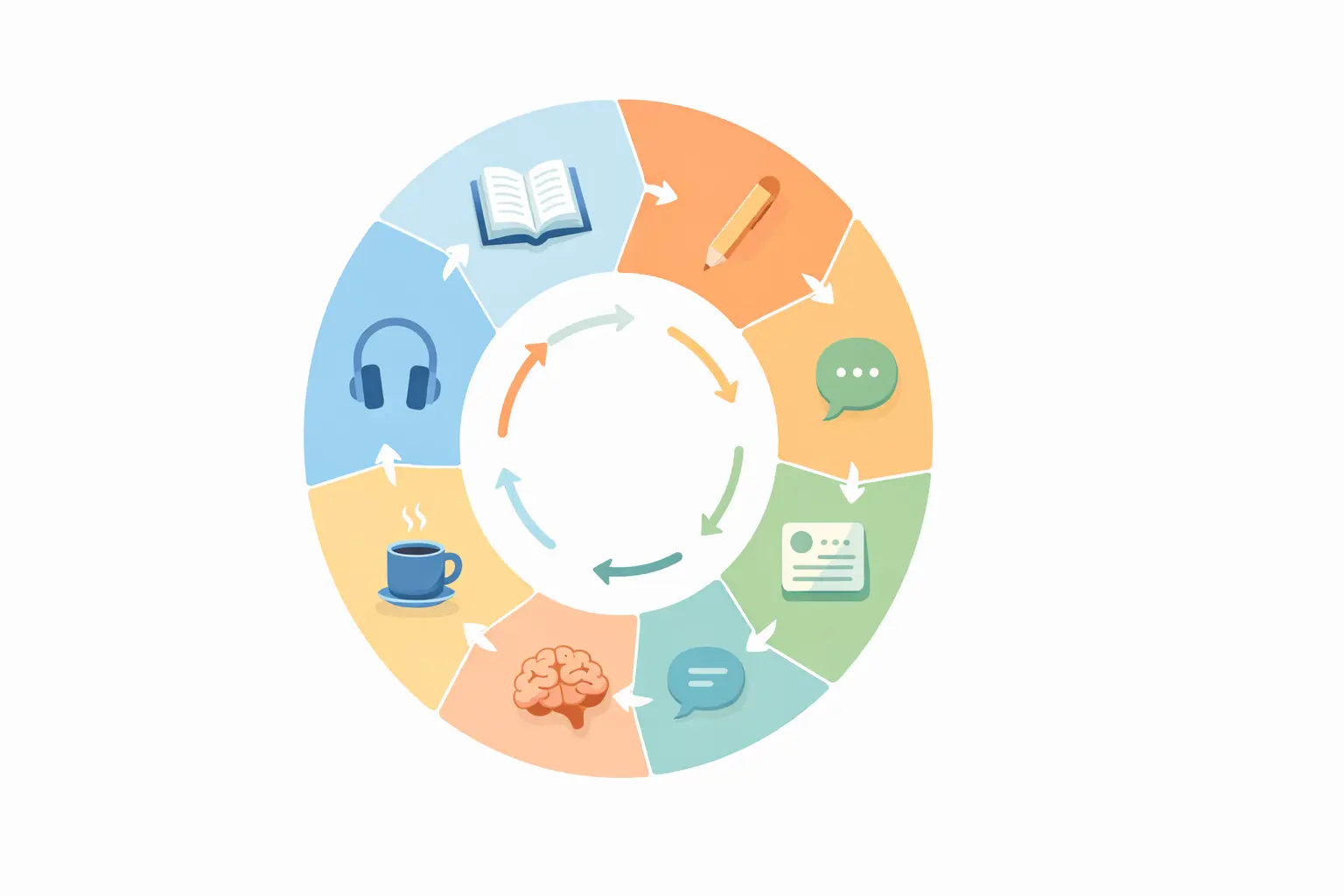
Step 1: Learn in context. Do not memorize isolated words. Read them in sentences. See them in IELTS practice passages. Hear them in listening exercises.
Step 2: Save and organize. Add words to your Linglify dictionary. Tag them by IELTS band level or topic. This builds a personalized word bank.
Step 3: Review with spaced repetition. Review words at increasing intervals — 1 day, 3 days, 7 days, 14 days. Linglify handles the scheduling automatically.
Step 4: Use actively. Write practice essays using your target words. Record yourself answering Speaking questions. Active use moves words from passive to active vocabulary.
Weekly Plan
| Day | Activity | Time |
|---|---|---|
| Monday | Read an IELTS passage, save 10 unknown words | 30 min |
| Tuesday | Review saved words, write 3 sentences with each | 20 min |
| Wednesday | Practice Writing Task 2 using target vocabulary | 40 min |
| Thursday | Listen to IELTS audio, note new vocabulary | 30 min |
| Friday | Speaking practice: answer 3 topics using new words | 20 min |
| Saturday | Full vocabulary review in Linglify | 15 min |
| Sunday | Rest or light reading | — |
Vocabulary Snippet — Start Building Your IELTS Word Bank
Save these essential IELTS words to your Linglify dictionary with one click. This selection covers words from Band 6 through Band 9.
significant
adjective
Having a lot of importance or meaning; not minor.
Examples
- Significant improvement shows in student test scores.
- Significant investment required for business expansion plan.
fundamental
adjective
Essential or basic; forming the foundation of something.
Examples
- Reading and writing are fundamental skills for academic success.
- There are fundamental differences between the two political parties' policies.
sustainable
adjective
This adjective describes something that can be maintained or continued without depleting resources.
Examples
- Company implements sustainable business model for long-term success.
- Sustainable farming practices protect soil and water resources.
innovation
noun
The act of creating new ideas, methods, or products.
Examples
- Technological innovation has transformed the way we communicate and work.
- The company's latest innovation will revolutionize the healthcare industry.
consequently
adverb
As a result; therefore.
Examples
- He missed several classes and consequently fell behind in his studies.
- The weather was terrible, and consequently the outdoor concert was cancelled.
demonstrate
verb
To show or prove something clearly, often by giving examples or evidence.
Examples
- Protesters demonstrate outside the government building every Friday afternoon.
- The teacher will demonstrate the proper technique for the science experiment.
eliminate
verb
To remove or get rid of something completely, often by stopping it from existing.
Examples
- Regular exercise can help eliminate stress and improve mental health.
- The competition will eliminate half of the contestants each week.
enhance
verb
To improve or make something better.
Examples
- New software will enhance the computer's performance and processing speed.
- Regular exercise can enhance both physical health and mental wellbeing.
enormous
adjective
Extremely large in size or amount.
Examples
- She has an enormous collection of books from around the world.
- The enormous elephant walked slowly through the African savanna grasslands.
environment
noun
The surroundings or conditions in which a person, animal, or plant lives.
Examples
- Protecting the environment is essential for future generations of people.
- The classroom environment affects how well students learn and behave.
establish
verb
To start or create something, such as a system, organization, or idea.
Examples
- Police work to establish the facts about what happened during incidents.
- The university will establish a new research center for medical studies.
evaluate
verb
To judge or measure the value, quality, or importance of something.
Examples
- Companies evaluate job candidates based on experience, skills, and personality.
- Teachers evaluate student progress through tests, projects, and classroom participation.
evidence
noun
Information or proof that shows something is true or exists.
Examples
- Scientific evidence supports the theory that exercise improves mental health significantly.
- The police collected evidence from the crime scene for investigation.
illustrate
verb
To make something clearer or easier to understand by giving examples or pictures.
Examples
- The children's book uses colorful pictures to illustrate the story.
- This example will illustrate how the new system works in practice.
implement
verb
To put a plan, decision, or law into effect or action.
Examples
- It takes time and effort to implement significant changes successfully.
- The company will implement new security measures next month.
implication
noun
A suggestion or hint about something that is not directly stated.
Examples
- Scientists are studying the implications of climate change for future generations.
- The implication of his statement was that he disagreed with the policy.
inevitable
adjective
Certain to happen and cannot be avoided.
Examples
- Change is inevitable in life, and we must learn to adapt.
- The inevitable result of poor planning is confusion and failure.
perspective
noun
A noun for a particular way of looking at or thinking about something.
Examples
- Different perspective helps solve complex problems creatively.
- Historical perspective reveals patterns in human behavior.
phenomenon
noun
A noun for an unusual or observable event or fact that can be studied.
Examples
- Aurora borealis is beautiful natural phenomenon.
- Social media phenomenon changes how people communicate.
priority
noun
The importance or urgency given to something in planning or decision-making.
Examples
- Family safety is top priority during emergency.
- Student education should be national funding priority.
proportion
noun
A part or share of a whole, often expressed as a ratio or fraction.
Examples
- Large proportion of students choose science majors.
- Recipe requires proper proportion of ingredients for taste.
revolution
noun
A complete change in the way people think about or do something, often involving new ideas or methods.
Examples
- Digital revolution changes how people communicate and.
- Industrial revolution transformed society and economy completely.
strategy
noun
A plan of action designed to achieve a long-term or overall aim.
Examples
- Chess strategy requires thinking several moves ahead.
- Marketing strategy targets specific customer demographics effectively.
substantial
adjective
Important or large enough to have a noticeable effect.
Examples
- Substantial improvement shows in student test scores.
- Substantial investment creates new business opportunities today.
transform
verb
To change the form or appearance of something into a different one.
Examples
- Education can transform person's life opportunities completely.
- Technology will transform how people work communicate.
undertake
verb
To take on a task or responsibility, often involving effort or risk.
Examples
- Company will undertake major expansion project next.
- Students undertake research projects during final semester.
If you are not signed in, Linglify will redirect you to create an account first, then complete the save automatically.
Common IELTS Vocabulary Mistakes
- Memorizing words without collocations. Knowing “significant” is not enough — you need “a significant impact,” “significant improvement,” “significant proportion.”
- Using informal words in Writing. Avoid “lots of,” “gonna,” “things.” Use “numerous,” “a considerable number of,” “factors.”
- Overusing big words in Speaking. If every sentence has a C2 word, it sounds unnatural. Mix levels.
- Ignoring word forms. Learn all forms: significance (noun), significant (adjective), significantly (adverb). IELTS tests this in Reading and Listening.
- Studying all words equally. Prioritize high-frequency words first. Band 6 words appear 10x more often than Band 9 words.
What to Do Next
- Pick your target band score and open the matching word list:
- Add 10 words from the snippet above to your Linglify dictionary.
- Read one of the focused guides below to prepare for your weakest section.
All IELTS Vocabulary Articles
- IELTS Band 6 Vocabulary List with Examples
- IELTS Band 7 Vocabulary: 300 Words That Make the Difference
- IELTS Writing Task 1 Vocabulary: Words for Charts, Graphs, and Maps
- IELTS Writing Task 2 Vocabulary: Academic Words That Score High
- IELTS Speaking Vocabulary: Topic-Based Word Lists
- Synonyms for IELTS: 200+ Paraphrasing Words for Band 7–9
FAQ
How many words do I need to know for IELTS?
There is no official number. For Band 6, approximately 5,000 words is a solid base. For Band 7, aim for 6,000–8,000. For Band 8+, you need 8,000–10,000+ words, with strong active command of academic vocabulary.
Should I memorize word lists for IELTS?
Not as your primary strategy. Word lists are useful as a reference, but vocabulary sticks when you learn words in context and review them regularly. Use lists to identify which words to learn, then practice with reading, writing, and speaking.
What is the best way to learn IELTS vocabulary fast?
Combine three techniques: read IELTS-level texts daily (to see words in context), save unknown words to a spaced repetition system (to retain them), and write or speak using them (to activate them). This cycle is more effective than any single method.
Is academic vocabulary the same for IELTS and TOEFL?
There is significant overlap — both tests use academic English. However, IELTS includes more British English and tests both academic and general vocabulary, while TOEFL focuses exclusively on North American academic contexts.
Does vocabulary matter more for Writing or Speaking?
Both sections weight vocabulary at 25% through the Lexical Resource criterion. However, Writing demands more formal and precise vocabulary, while Speaking rewards natural, flexible word use. You need different vocabulary strategies for each.
Can I get Band 7 with only basic vocabulary?
It is very unlikely. Band 7 specifically requires “sufficient range of vocabulary to allow some flexibility and precision.” If you rely on basic words like “good,” “bad,” “important,” and “many,” examiners will cap your Lexical Resource score at Band 6.