
How to Learn English Vocabulary: A Step-by-Step System That Works
Most people try to learn English vocabulary by reading word lists and hoping something sticks. A few words survive. Most disappear within days. The problem is not effort — it is the lack of a system.
This guide gives you a complete, step-by-step vocabulary learning system. Follow these 7 stages in order, and you will build a reliable process that works whether you are a beginner, an advanced learner, or preparing for IELTS. No paid apps required — this system works with free tools and resources.
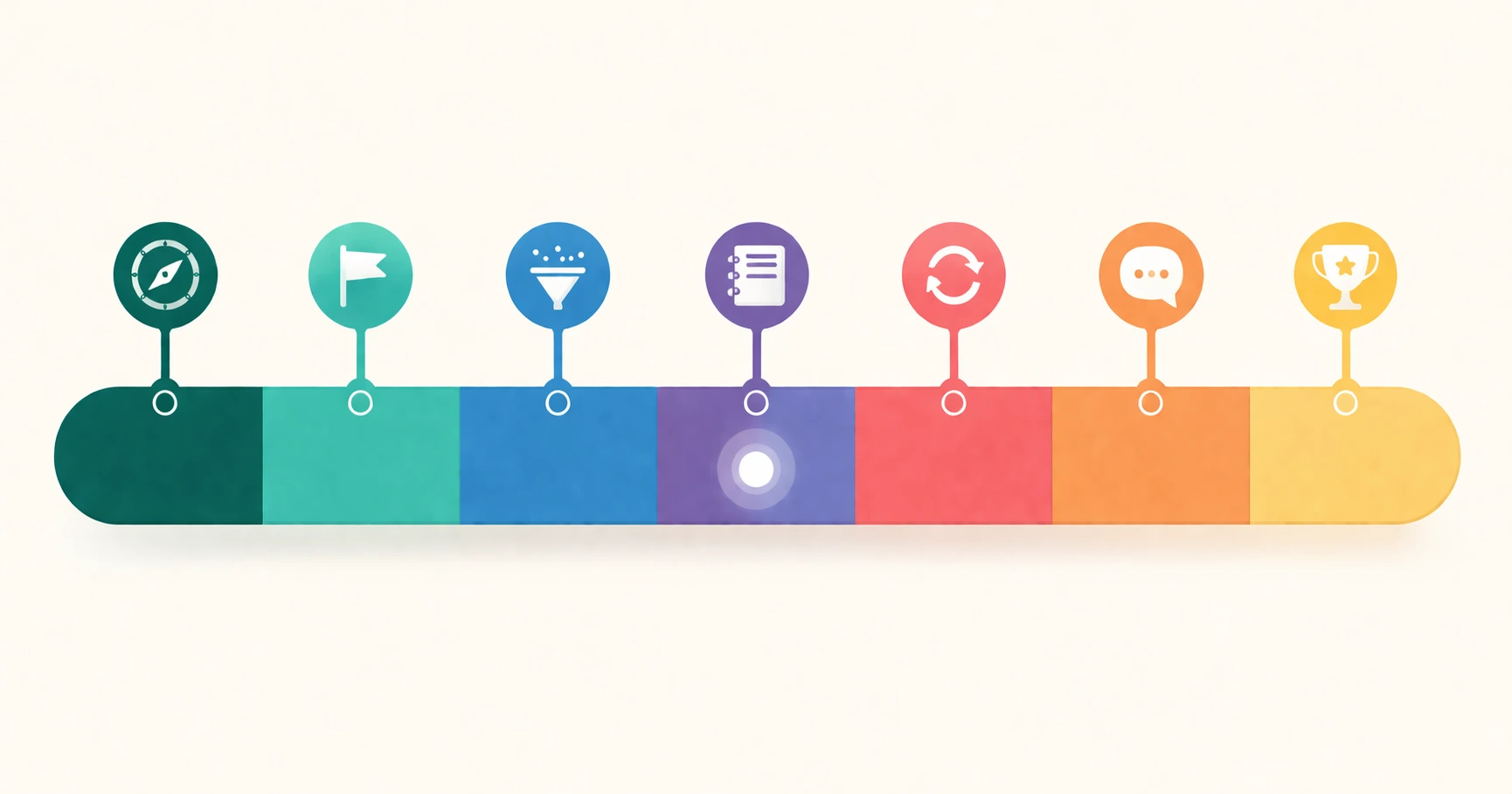
Here are the 7 stages:
- Assess your starting point
- Set a specific vocabulary goal
- Choose the right words to learn
- Study each word properly
- Review with spaced repetition
- Use words in real situations
- Test and measure your progress
Stage 1: Assess Your Starting Point
You cannot plan a journey without knowing where you start. Before learning new words, figure out your current vocabulary level.
Quick self-assessment:
| If you can… | Your approximate level | Active vocabulary |
|---|---|---|
| Introduce yourself and order food | A1–A2 | ~500–1,000 words |
| Have a basic conversation about daily life | B1 | ~2,000–3,000 words |
| Discuss abstract topics and give opinions | B2 | ~4,000–6,000 words |
| Understand most texts and speak fluently | C1+ | ~8,000–12,000 words |
How to get a more accurate number:
- Take the free vocabulary size test at testyourvocab.com
- Browse Linglify’s word lists by level — start at A2 and move up until words become unfamiliar
- Note which CEFR level feels like “I know about half of these words” — that is your working level
Write down your result. You will use it in the next step.
Stage 2: Set a Specific Vocabulary Goal
“I want to learn more words” is not a goal. “I want to learn 500 B1-level words in 3 months” is a goal. The difference matters because a specific goal tells you exactly what to do each week.
How to set your goal:
- Choose your target level — one level above your current one (A2 → B1, B1 → B2)
- Estimate the word gap — roughly 1,000–2,000 words between each CEFR level
- Set a timeline — 3 months is realistic for 500–1,000 words
- Calculate your daily target — divide total words by the number of days
Example goals by situation:
| Situation | Goal | Daily target | Timeline |
|---|---|---|---|
| Beginner wanting conversational English | 500 A2 words | 5 words/day | 3 months |
| Intermediate preparing for travel | 300 B1 topic words | 3 words/day | 3 months |
| Advanced preparing for IELTS Band 7 | 800 B2–C1 words | 8 words/day | 3 months |
| Adult learner for work | 400 business words | 5 words/day | 3 months |
Important: 5 new words per day is the sweet spot for most learners. Going above 10 per day usually leads to forgetting most of them unless you have 45+ minutes available for review.
Stage 3: Choose the Right Words to Learn
Not all English words are worth your time. Learning “serendipity” before you know “appointment” wastes effort. The words you choose should match your level, your goals, and how often you will actually use them.
Where to find the right words:
For beginners (A1–A2):
- A2 vocabulary lists on Linglify — the most practical everyday words
- High-frequency word lists (the 1,000 most common English words cover ~85% of daily speech)
For intermediate learners (B1–B2):
- B1 and B2 word lists — organized by frequency and topic
- Topic-based vocabulary: technology, work, travel
- Words you encounter while reading news, watching videos, or talking to people
For exam preparation (IELTS/TOEFL):
- IELTS vocabulary guide — band-specific word lists
- Academic vocabulary lists — words that appear frequently in exam texts
- Verb forms — irregular verbs are tested heavily in grammar sections
For free vocabulary sources:
- Linglify’s entire library is free to browse and study
- News websites (BBC, The Guardian) — read and mark unfamiliar words
- YouTube channels with English subtitles — pause and note new vocabulary
- Podcasts with transcripts — listen and read simultaneously
Stage 4: Study Each Word Properly
This is where most learners fail. They see a word, read the translation, and move on. That is not learning — that is skimming.
To truly learn a vocabulary word, use this 5-point method for every new word:
The 5-Point Word Method:
- Read the definition in English (not just a translation)
- Read 2–3 example sentences to see how the word is used
- Notice the word’s grammar — part of speech, word forms, collocations
- Write your own sentence using the word in a real context from your life
- Say the word out loud — pronunciation matters for speaking and listening
Example — learning the word “specific”:
| Point | What you do |
|---|---|
| Definition | Clearly defined; not general or vague |
| Examples | Can you give me a specific example? / The instructions were very specific. |
| Grammar | Adjective. Collocations: specific example, specific information, specific reason |
| Your sentence | My teacher asked me to give a specific answer, not a general one. |
| Pronunciation | /spəˈsɪfɪk/ — stress on the second syllable |
This takes about 2–3 minutes per word. At 5 words per day, that is only 15 minutes. But each word is learned properly — not just glanced at.
Stage 5: Review with Spaced Repetition
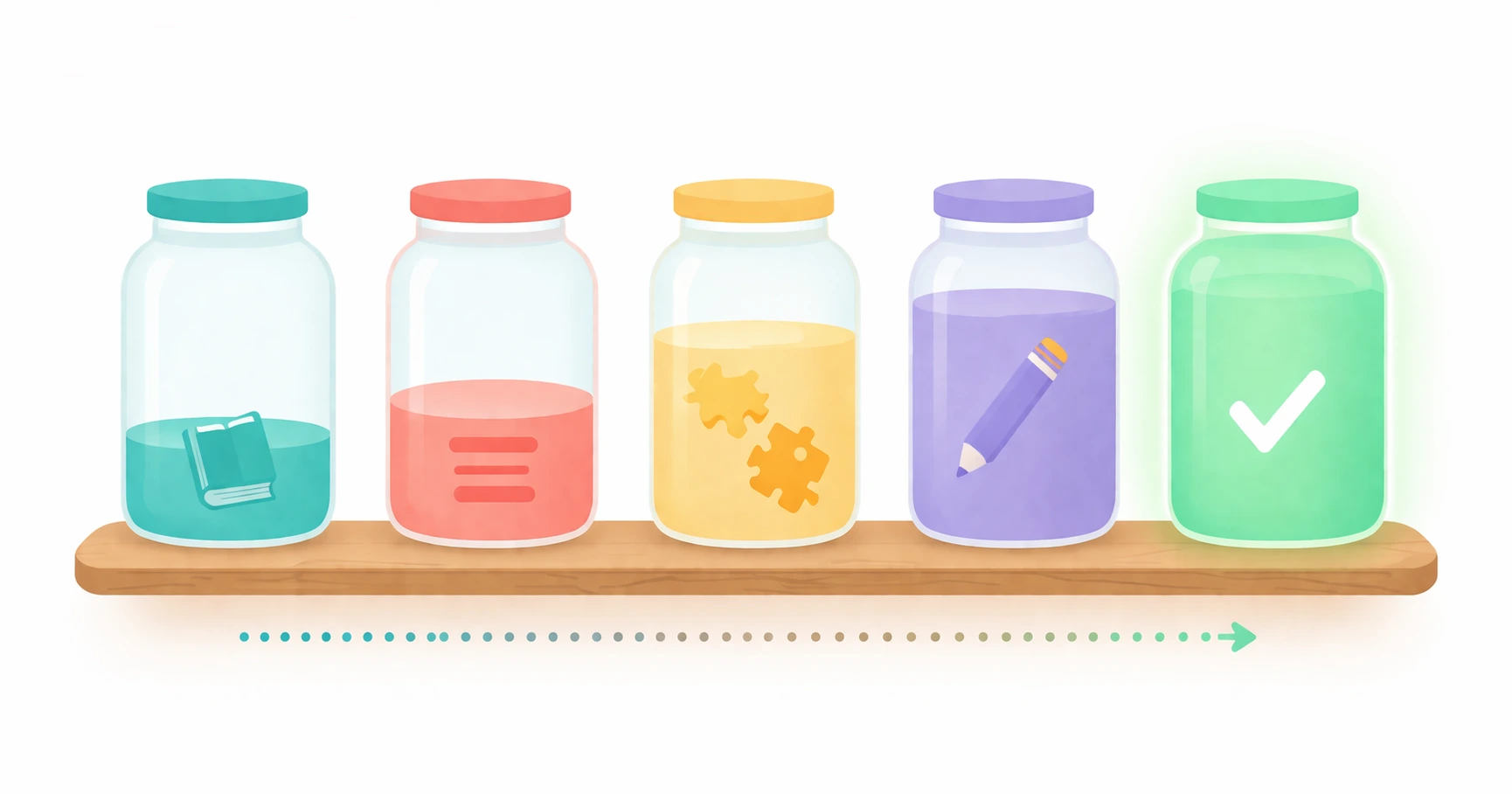
Learning a word once is not enough. Without review, your brain forgets about 70% of new information within 24 hours. Spaced repetition solves this by scheduling reviews at optimal intervals.
The review schedule:
| Review # | When | What happens |
|---|---|---|
| 1st | 1 day after learning | You remember most words; a few need extra attention |
| 2nd | 3 days later | The weaker words start sticking |
| 3rd | 7 days later | You can recall most words without hints |
| 4th | 14 days later | Words feel more natural |
| 5th | 30 days later | Words move to long-term memory |
How to do it:
- Easiest method: Add words to your Linglify dictionary — the app schedules reviews automatically
- Manual method: Use a notebook with three columns: “New” (today’s words), “Review” (words from previous days), “Known” (words you recall easily 3 times in a row)
- Flashcard apps: Anki or Quizlet with spaced repetition mode
The key is consistency. Reviewing for 5 minutes every day is far better than reviewing for 30 minutes once a week. Your brain needs repeated, spaced exposure — there are no shortcuts.
Stage 6: Use Words in Real Situations
Knowing a word in your notebook is different from using it in conversation. Stage 6 bridges this gap — you take words from “I recognize this” to “I use this naturally.”
Daily practice ideas (pick 2–3):
- Write a daily journal entry (5–10 sentences) using 3–5 new words
- Describe your day out loud in English for 2 minutes, using new vocabulary
- Send a message to a friend or language partner using 2 new words
- Comment on social media in English with new vocabulary
- Rewrite a paragraph from a news article using your own words
For speaking practice:
- Talk to yourself in English while doing chores (no one is judging)
- Use new words in online language exchanges
- Record voice memos and listen back — notice which words feel natural and which feel forced
For exam preparation:
- Write IELTS-style essays using 5–10 target words
- Practice IELTS Speaking Part 2 responses with new vocabulary
- Describe graphs and charts using academic vocabulary
The rule is simple: every word you learn should be used at least 3 times in your own speech or writing within the first week. Words that stay passive (recognition only) will fade.
Stage 7: Test and Measure Your Progress
Without measurement, you do not know if your system is working. Testing also strengthens memory — the act of trying to recall a word makes you remember it better next time.
Weekly test (every Sunday, 10 minutes):
- Pick 20 words from this week’s study list
- Cover the definitions and try to recall each one
- Write a sentence for each word (no looking at examples)
- Score yourself: how many could you define? How many could you use in a sentence?
Monthly milestone check:
| Metric | How to check |
|---|---|
| Words learned this month | Count entries in your vocabulary journal or Linglify dictionary |
| Retention rate | Test yourself on 30 random words from past months — aim for 80%+ |
| Active usage | How many new words did you actually use in conversation or writing? |
| Level progress | Re-take the vocabulary size test from Stage 1 |
What good progress looks like:
- 5 words/day × 80% retention = ~120 new words per month
- After 3 months: ~360 solid words you can recognize AND use
- After 6 months: ~700 words — enough to move up one full CEFR level
If your retention rate drops below 60%, you are learning too many words too fast. Slow down, review more.
Your Weekly Vocabulary Learning Schedule
Here is how the 7 stages fit into a real week. Total time: about 20 minutes per day.
| Day | Activity | Stage | Time |
|---|---|---|---|
| Monday | Learn 5 new words using the 5-Point Method | Stage 4 | 15 min |
| Tuesday | Review yesterday’s words + learn 5 new ones | Stage 4 + 5 | 20 min |
| Wednesday | Use 5 words in a journal entry or conversation | Stage 6 | 15 min |
| Thursday | Learn 5 new words + review Monday’s words | Stage 4 + 5 | 20 min |
| Friday | Practice: write a paragraph using 10 words from this week | Stage 6 | 15 min |
| Saturday | Spaced review of all words from past 2 weeks | Stage 5 | 15 min |
| Sunday | Weekly test: 20 words, score yourself | Stage 7 | 10 min |
Vocabulary to Start Practicing Now
Here are 25 practical A2–B1 words to begin your vocabulary journey. Click any word to see its definition, examples, and pronunciation. Add them to your dictionary and the review schedule starts automatically.
attention
noun
The mental focus or concentration on something.
Examples
- Please pay attention to the safety instructions before takeoff.
- The injured animal received immediate medical attention from veterinarians.
specific
adjective
Clear and exact; not general or vague.
Examples
- Specific instructions help workers complete tasks correctly.
- Specific medication treats particular disease symptoms effectively.
exercise
noun
Physical or mental activity that you do to stay healthy or develop skills.
Examples
- Regular exercise improves physical health and mental wellbeing significantly over time.
- Students complete grammar exercises to practice new language structures effectively.
consist
verb
To be made up of or composed of parts or elements.
continue
verb
To keep going or stay in the same state without stopping.
repair
verb
To mend or fix something that is broken or damaged.
Examples
- Mechanic can repair car engine problems effectively.
- Tailor will repair torn clothing for customer.
crowded
adjective
Having many people or things in a small space, making it crowded.
Examples
- The crowded subway car made the commute very uncomfortable.
- They avoided the crowded shopping mall during holiday season.
serve
verb
To give service or assistance; to provide for others.
Examples
- Restaurant must serve food at proper temperature.
- Soldier will serve country with honor and.
step
verb
To move the foot forward to step in a particular direction.
Examples
- Careful hiker will step over fallen tree.
- Leader must step forward during crisis situations.
fancy
adjective
Having a special liking or desire for something; imaginative or whimsical.
Examples
- The hotel lobby was decorated with fancy furniture and expensive artwork.
- They ate dinner at a fancy restaurant for their wedding anniversary.
winner
noun
A person who wins a competition or contest.
Examples
- She is always a winner in everything she attempts.
- The winner of the race received a gold medal.
increase
noun
To become larger or greater in size, amount, or degree.
Examples
- The salary increase will help employees cope with rising living costs.
- There has been a significant increase in online shopping during recent years.
preparation
noun
The act of getting ready or making arrangements for something.
Examples
- Exam preparation requires consistent study schedule daily.
- Meal preparation takes time but ensures healthy eating.
region
noun
An area of land with defined borders, often smaller than a country.
Examples
- Economic development varies across different geographical regions.
- Mountain region attracts tourists during winter season.
critic
noun
A person who expresses opinions or judgments about art, literature, or performances.
Examples
- Even his harshest critic admitted that the plan had merit.
- The restaurant critic wrote a positive review of the new establishment.
solid
adjective
Having a firm shape or form; not soft or yielding.
Examples
- Solid evidence proves defendant's guilt in court.
- Solid foundation supports heavy building structure safely.
guess
verb
This verb means to form an opinion or make a judgment about something without having complete information.
Examples
- Can you guess the answer to this riddle without looking it up?
- I guess she's probably running late because of the heavy traffic.
cruel
adjective
Unkind or harsh treatment that causes pain or suffering.
Examples
- It would be cruel to abandon the injured animal in the forest.
- The cruel winter weather made life difficult for homeless people.
alike
adjective
Similar in appearance, nature, or character.
Examples
- Students and teachers alike enjoyed the special assembly program.
- The twin sisters look so alike that people often confuse them.
fluently
adverb
In a way that shows the ability to speak or write a language easily and smoothly.
Examples
- He speaks English fluently despite learning it as an adult.
- The pianist played the difficult piece fluently without any mistakes.
tempt
verb
To try to make someone do something by making it seem attractive.
Examples
- Delicious food may tempt person to overeat.
- High salary can tempt employee to change.
drag
verb
To pull or drag something along the ground or other surface.
Examples
- Please don't drag your feet when walking on the clean floor.
- Time seems to drag when you're waiting for important news.
nod
verb
To move the head quickly downward to show agreement or acknowledgment.
Examples
- Polite person will nod greeting when meeting neighbor.
- Students nod agreement when teacher explains important concept.
hunger
noun
A feeling of needing food because the body is empty or weak.
Examples
- His hunger for knowledge led him to read books constantly.
- World hunger remains a serious problem that affects millions of people.
conclusively
adverb
In a way that provides a definite conclusion or proof.
Examples
- He proved his point conclusively.
- The report was conclusively in favor of the new policy.
5 Common Mistakes That Slow Learners Down
1. Learning words without a system. Random studying leads to random results. Follow the 7 stages in order — each one builds on the previous.
2. Skipping the review stage. Learning 10 words and never reviewing them means you learned 0 words. Spaced repetition is not optional; it is the core of the system.
3. Only learning translations. A single translation tells you almost nothing. Learn the definition, collocations, grammar, and pronunciation — the full picture.
4. Waiting until you “know enough” to start using words. Start using new words on day one. Mistakes are part of the learning process. Waiting for perfection means waiting forever.
5. Comparing yourself to others. Everyone learns at a different speed. A consistent 5 words per day beats an inconsistent 20. Focus on your own streak, not someone else’s word count.
What to Do Right Now
-
Take the level assessment. Browse our A2 and B1 vocabulary lists. Find the level where you know about half the words — that is your starting point.
-
Set your first goal. Pick a number: 100, 300, or 500 words. Give yourself 3 months. Calculate your daily target.
-
Start with the snippet above. Add 5 words to your Linglify dictionary right now. Tomorrow, review them and add 5 more. The system begins today.
-
Read the companion guide. For 10 specific methods you can add to this system, see How to Improve Your Vocabulary: 10 Proven Methods.
-
Follow the 4,000-word plan. Our 4000 Essential English Words study guide breaks down exactly which words to learn at each level, with a 6-month schedule.
FAQ
How can I learn vocabulary fast?
The fastest approach is the 5-Point Method (Stage 4) combined with spaced repetition (Stage 5). Learning 5 words properly takes 15 minutes. Reviewing them over the next 30 days takes another 5 minutes per session. This is faster than learning 30 words in an hour and forgetting 25 of them by next week. Speed comes from retention, not volume.
How to learn vocabulary for beginners?
Start with Stage 1 — assess where you are. Then focus on the 500 most common English words. Use Linglify’s A2 vocabulary lists as your source. Learn 3 words per day (not more — beginners need more review time). Follow the 5-Point Method for each word. At 3 words per day, you will learn 270 words in 3 months — enough for basic conversations.
How can I learn vocabulary for free?
This entire system is free. Linglify’s vocabulary library is free to browse and study. Free word sources include news websites (BBC Learning English), YouTube with English subtitles, podcasts with transcripts, and public domain books. You can use a simple notebook for your vocabulary journal and set phone reminders for spaced repetition reviews.
How to learn vocabulary for IELTS?
Follow the same 7-stage system, but adjust Stage 3 (word selection). Focus on: academic vocabulary for Writing Tasks, topic-based vocabulary for Speaking, and synonyms for paraphrasing. Use our IELTS vocabulary guide for band-specific word lists. For Band 7+, target 800–1,000 B2–C1 level words over 3 months.
What is the difference between active and passive vocabulary?
Passive vocabulary is words you recognize when reading or listening. Active vocabulary is words you can use correctly in speaking and writing. Most learners have 2–3 times more passive words than active ones. Stage 6 of this system specifically targets converting passive vocabulary into active vocabulary through daily speaking and writing practice.
How many words do I need to know for fluency?
For basic conversational fluency: ~3,000 words (B1 level). For comfortable fluency in most situations: ~5,000–6,000 words (B2 level). For near-native level: ~10,000+ words (C1–C2). The 3,000 most common English words cover about 95% of everyday speech, so reaching B1–B2 gives you the most practical return on effort.