
500+ Palabras Opuestas en Inglés: Lista de Antónimos de la A a la Z
Conocer el contrario de una palabra duplica tu poder de vocabulario. Cuando aprendes «brave», aprender «cowardly» al mismo tiempo te da dos palabras en lugar de una — y construye un mapa mental de significado que hace que ambas palabras se queden grabadas. No es solo teoría: la investigación muestra que aprender palabras en pares (sinónimos y antónimos juntos) mejora la retención en un 30–40% en comparación con aprender palabras de forma aislada.
Esta lista te ofrece más de 500 pares de palabras opuestas en inglés, organizadas alfabéticamente. Cada par incluye una oración de ejemplo sencilla que muestra ambas palabras en contexto. Úsala como referencia de estudio, un recurso de preparación para exámenes, o una herramienta de escritura cuando necesites el antónimo perfecto.
- Total: más de 500 pares de palabras opuestas
- Formato: Palabra ↔ Opuesto + Ejemplo
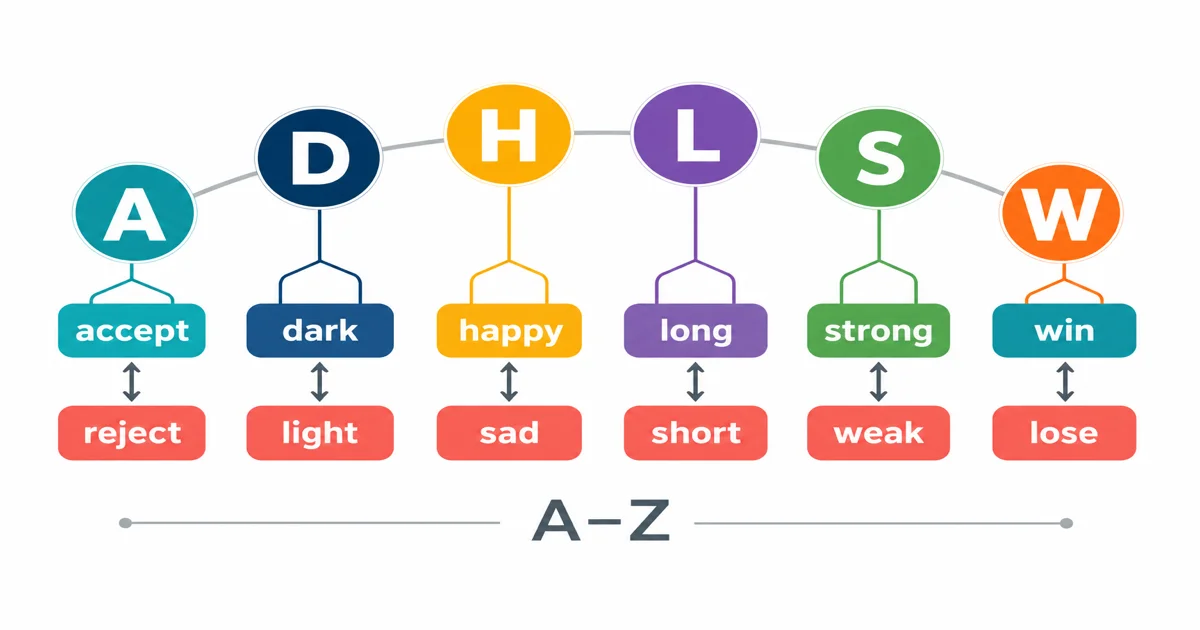
- Organizado por: orden alfabético A–Z
- Nivel: A1–C1
- Para: enriquecer vocabulario, preparación para IELTS/TOEFL, escritura de ensayos, fluidez cotidiana
¿Qué son los antónimos?
Un antónimo es una palabra con el significado opuesto a otra palabra. El término proviene del griego: anti- (contra) + onoma (nombre) — literalmente «nombre opuesto».
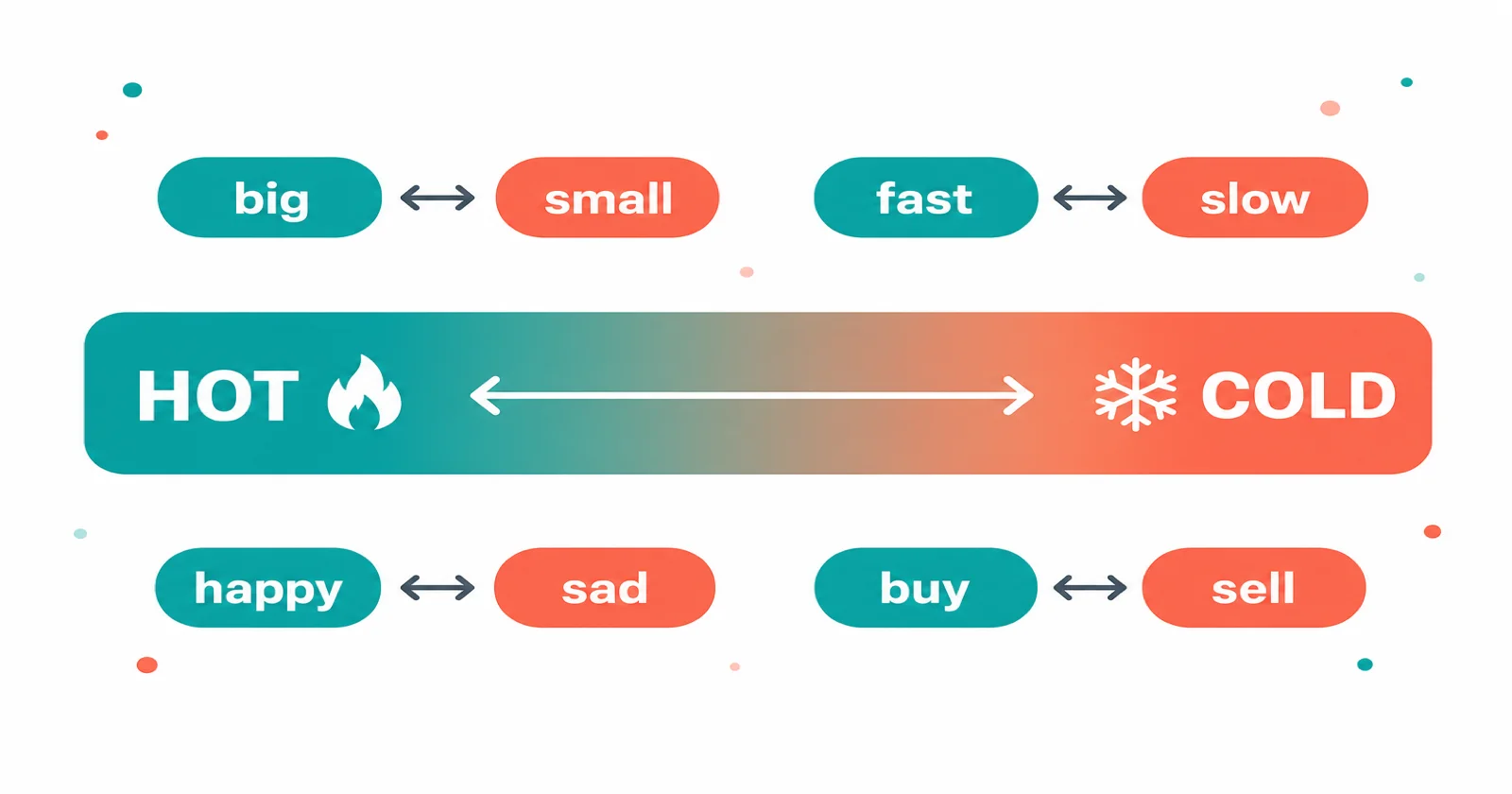
| Palabra | Antónimo |
|---|---|
| hot | cold |
| big | small |
| fast | slow |
| happy | sad |
| begin | end |
Tres tipos de antónimos
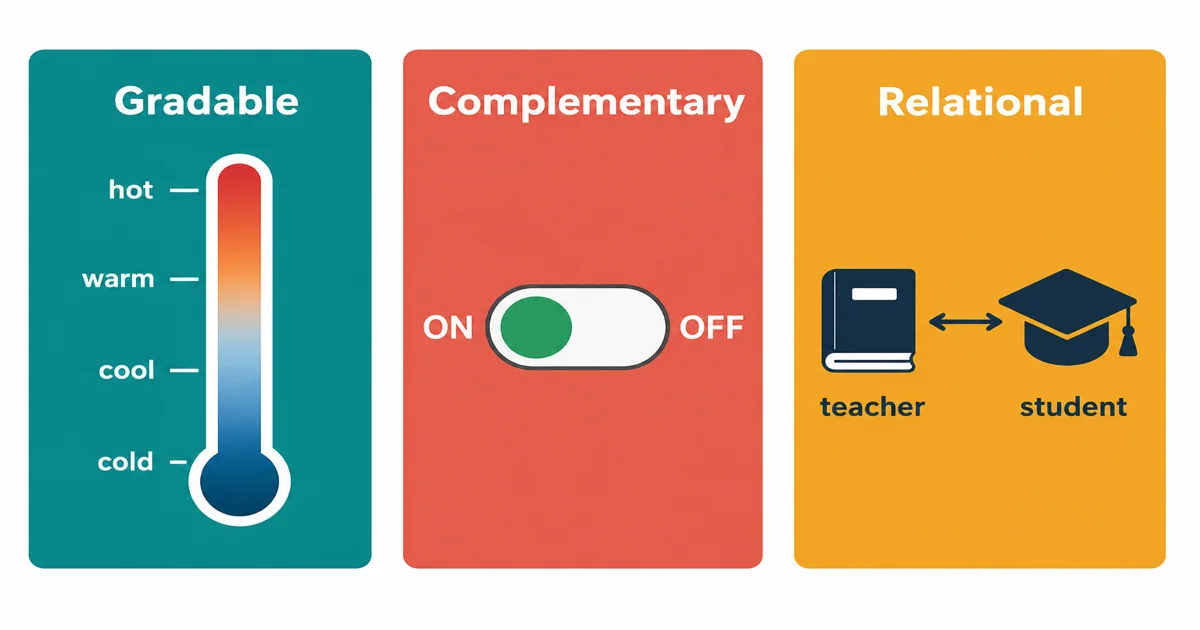
| Tipo | Descripción | Ejemplos |
|---|---|---|
| Graduables | Opuestos en una escala; los grados son posibles | hot–cold, big–small, fast–slow |
| Complementarios | Uno u otro; no hay término medio | alive–dead, true–false, on–off |
| Relacionales | Cada palabra implica la otra | teacher–student, buy–sell, parent–child |
La mayoría de los antónimos de esta lista son graduables — representan los dos extremos de un espectro con muchos puntos intermedios («warm» se sitúa entre «hot» y «cold»).
Palabras opuestas: A–B
| # | Palabra | Opuesto | Ejemplo |
|---|---|---|---|
| 1 | above | below | The painting hangs above the fireplace; the shoes are below the bench. |
| 2 | absent | present | Three students were absent; the rest were present. |
| 3 | abstract | concrete | Abstract ideas need concrete examples to be understood. |
| 4 | accept | reject | She decided to accept the offer rather than reject it. |
| 5 | accurate | inaccurate | The report was accurate, but the summary was inaccurate. |
| 6 | active | passive | An active learner asks questions; a passive learner just listens. |
| 7 | add | subtract | Add the tax, then subtract the discount. |
| 8 | admit | deny | He admitted the mistake instead of denying it. |
| 9 | advance | retreat | The army advanced in the morning and retreated by evening. |
| 10 | after | before | The meeting is after lunch, not before. |
| 11 | agree | disagree | I agree with the first point but disagree with the conclusion. |
| 12 | alive | dead | The plant looked dead, but it was still alive. |
| 13 | allow | forbid | The school allows casual clothes on Fridays but forbids them on exam days. |
| 14 | always | never | She always arrives early; he never does. |
| 15 | ancient | modern | Ancient ruins stand next to modern skyscrapers. |
| 16 | appear | disappear | Stars appear at night and disappear at dawn. |
| 17 | approve | disapprove | The board approved the budget but disapproved the staffing plan. |
| 18 | arrive | depart | Guests arrive at 6 PM and depart by 10 PM. |
| 19 | artificial | natural | The flowers looked real but were artificial, not natural. |
| 20 | ascend | descend | We ascended the mountain in the morning and descended before dark. |
| 21 | asleep | awake | The baby was asleep, but the dog was wide awake. |
| 22 | attack | defend | The lawyer attacked the claim, and the witness tried to defend it. |
| 23 | attractive | unattractive | The package design was attractive; the old one was unattractive. |
| 24 | backward | forward | Take one step backward, then two steps forward. |
| 25 | bad | good | The food was bad at that restaurant, but the service was good. |
| 26 | beautiful | ugly | The sunset was beautiful; the building next to it was ugly. |
| 27 | begin | end | Classes begin in September and end in June. |
| 28 | beneficial | harmful | Exercise is beneficial to health; smoking is harmful. |
| 29 | big | small | She lives in a big house; I live in a small apartment. |
| 30 | bitter | sweet | The coffee was bitter without sugar; add some to make it sweet. |
| 31 | bold | timid | She gave a bold speech; he was too timid to speak at all. |
| 32 | boring | exciting | The first half was boring, but the second half was exciting. |
| 33 | bottom | top | The heaviest items go at the bottom; the lightest at the top. |
| 34 | brave | cowardly | The brave firefighter ran in; the cowardly bystander ran away. |
| 35 | break | fix | He managed to break the machine, and she managed to fix it. |
| 36 | bright | dim | The living room was bright; the hallway was dim. |
| 37 | broad | narrow | The river is broad at the delta but narrow near the source. |
| 38 | build | destroy | It takes years to build trust and seconds to destroy it. |
| 39 | busy | free | I’m busy on Monday, but I’m free on Tuesday. |
| 40 | buy | sell | I want to buy a car; she wants to sell hers. |
Palabras opuestas: C–D
| # | Palabra | Opuesto | Ejemplo |
|---|---|---|---|
| 41 | calm | anxious | She remained calm while everyone else was anxious. |
| 42 | capable | incapable | He’s capable of running the department; the other candidate is incapable. |
| 43 | careful | careless | A careful driver avoids accidents; a careless one causes them. |
| 44 | cheap | expensive | The generic brand is cheap; the designer version is expensive. |
| 45 | cheerful | gloomy | Her cheerful attitude brightened the gloomy office. |
| 46 | clean | dirty | The kitchen was clean this morning but dirty by evening. |
| 47 | clever | foolish | A clever strategy beats a foolish one every time. |
| 48 | cold | hot | The soup was too cold; the tea was too hot. |
| 49 | comfort | discomfort | The new chair provides comfort; the old one caused discomfort. |
| 50 | common | rare | Pigeons are common in the city; eagles are rare. |
| 51 | complex | simple | The tax code is complex; the instructions should be simple. |
| 52 | confident | insecure | She seems confident in meetings, but she feels insecure inside. |
| 53 | conscious | unconscious | He was still conscious after the fall but later became unconscious. |
| 54 | continue | stop | Continue reading if you enjoy it; stop if you don’t. |
| 55 | correct | incorrect | Your first answer was correct; the second was incorrect. |
| 56 | courageous | cowardly | A courageous leader speaks up; a cowardly one stays silent. |
| 57 | create | destroy | Artists create; wars destroy. |
| 58 | cruel | kind | The villain was cruel; the hero was kind. |
| 59 | dangerous | safe | The old bridge is dangerous; the new one is safe. |
| 60 | dark | light | The basement was dark, but the attic was full of light. |
| 61 | deep | shallow | The ocean is deep in the center and shallow near the shore. |
| 62 | defeat | victory | After years of defeat, they finally tasted victory. |
| 63 | definite | indefinite | We need a definite answer, not an indefinite “maybe.” |
| 64 | demand | supply | When demand exceeds supply, prices rise. |
| 65 | different | similar | The twins look similar but have very different personalities. |
| 66 | difficult | easy | The first question was easy; the last one was difficult. |
| 67 | divide | unite | Conflict divides people; shared goals unite them. |
| 68 | doubt | trust | I doubt his intentions, but I trust his ability. |
| 69 | dry | wet | The towel was dry this morning and wet by afternoon. |
| 70 | dull | sharp | A dull knife is more dangerous than a sharp one. |
Palabras opuestas: E–F
| # | Palabra | Opuesto | Ejemplo |
|---|---|---|---|
| 71 | early | late | I arrived early; he arrived late. |
| 72 | easy | hard | The first part was easy, but the second was hard. |
| 73 | efficient | inefficient | The new system is efficient; the old one was inefficient. |
| 74 | empty | full | The glass was empty; I filled it until it was full. |
| 75 | encourage | discourage | Good teachers encourage students; bad feedback can discourage them. |
| 76 | enemy | friend | Yesterday’s enemy can become tomorrow’s friend. |
| 77 | enjoy | hate | I enjoy cooking, but I hate cleaning up. |
| 78 | enormous | tiny | The cathedral was enormous; the chapel was tiny. |
| 79 | equal | unequal | All employees deserve equal treatment, not unequal pay. |
| 80 | expand | contract | Metals expand when heated and contract when cooled. |
| 81 | export | import | Japan exports cars and imports oil. |
| 82 | fact | fiction | It’s hard to tell fact from fiction in the news. |
| 83 | fail | succeed | You may fail ten times before you succeed once. |
| 84 | fair | unfair | The decision seemed fair to some but unfair to others. |
| 85 | fake | genuine | The painting was fake; the signature was genuine. |
| 86 | familiar | unfamiliar | The route was familiar to locals but unfamiliar to tourists. |
| 87 | famous | unknown | She went from unknown to famous in a single year. |
| 88 | far | near | The airport is far from the city, but the train station is near. |
| 89 | fast | slow | Internet in the office is fast; at home it’s slow. |
| 90 | final | initial | The final draft was much better than the initial one. |
| 91 | flexible | rigid | The company has a flexible schedule, not a rigid one. |
| 92 | formal | informal | The dinner is formal; the lunch is informal. |
| 93 | fresh | stale | The bread was fresh in the morning and stale by night. |
| 94 | full | empty | The restaurant was full at 7 PM and empty by 10 PM. |
Palabras opuestas: G–I
| # | Palabra | Opuesto | Ejemplo |
|---|---|---|---|
| 95 | generous | selfish | She’s generous with her time; he’s selfish with his. |
| 96 | gentle | rough | Handle the glass with gentle hands, not rough ones. |
| 97 | give | take | It’s better to give than to take. |
| 98 | global | local | The company has both global and local operations. |
| 99 | good | bad | The news was good in the morning and bad in the evening. |
| 100 | grateful | ungrateful | Be grateful for what you have, not ungrateful for what you lack. |
| 101 | grow | shrink | The economy grew last year but may shrink this year. |
| 102 | guilty | innocent | The jury found him guilty, though he claimed to be innocent. |
| 103 | happiness | sadness | Happiness and sadness are both part of life. |
| 104 | hard | soft | The mattress was too hard; I prefer a softer one. |
| 105 | harm | help | Pollution harms the environment; recycling helps it. |
| 106 | harsh | mild | The winter was harsh; the spring was mild. |
| 107 | hate | love | Some people hate mornings; others love them. |
| 108 | healthy | unhealthy | A balanced diet is healthy; fast food daily is unhealthy. |
| 109 | heavy | light | The suitcase was heavy; the backpack was light. |
| 110 | high | low | Prices are high in the city and low in the countryside. |
| 111 | hire | fire | The company plans to hire 50 people this year, not fire anyone. |
| 112 | honest | dishonest | An honest answer is always better than a dishonest one. |
| 113 | humble | arrogant | The best leaders are humble, not arrogant. |
| 114 | hungry | full | I was hungry before lunch and full afterward. |
| 115 | imaginary | real | The threat turned out to be imaginary, not real. |
| 116 | impossible | possible | What seems impossible today may be possible tomorrow. |
| 117 | improve | worsen | The situation will improve if we act; it will worsen if we don’t. |
| 118 | include | exclude | The price includes breakfast but excludes dinner. |
| 119 | increase | decrease | Sales increased in Q1 and decreased in Q2. |
| 120 | inferior | superior | The cheap version is inferior; the premium version is superior. |
| 121 | inside | outside | It’s warm inside but freezing outside. |
| 122 | intelligent | stupid | An intelligent decision saves time; a stupid one wastes it. |
| 123 | intentional | accidental | The damage was accidental, not intentional. |
Palabras opuestas: J–L
| # | Palabra | Opuesto | Ejemplo |
|---|---|---|---|
| 124 | joy | sorrow | Life is a balance of joy and sorrow. |
| 125 | junior | senior | She started as a junior developer and became a senior in three years. |
| 126 | kind | cruel | A kind word heals; a cruel one wounds. |
| 127 | knowledge | ignorance | Knowledge leads to understanding; ignorance leads to fear. |
| 128 | large | small | We ordered a large pizza, not a small one. |
| 129 | lazy | hardworking | He’s too lazy to study; his sister is incredibly hardworking. |
| 130 | lead | follow | Some people lead; others prefer to follow. |
| 131 | legal | illegal | Driving at 60 mph is legal here; 90 is illegal. |
| 132 | less | more | Spend less time worrying and more time acting. |
| 133 | long | short | The movie was too long; the trailer was too short. |
| 134 | loose | tight | The shirt was too loose; the jeans were too tight. |
| 135 | loud | quiet | The music was loud downstairs and quiet upstairs. |
| 136 | love | hate | Thin line between love and hate, they say. |
| 137 | loyal | disloyal | A loyal friend stays; a disloyal one leaves. |
Palabras opuestas: M–O
| # | Palabra | Opuesto | Ejemplo |
|---|---|---|---|
| 138 | major | minor | The major issues are fixed; only minor ones remain. |
| 139 | majority | minority | The majority agreed; the minority dissented. |
| 140 | many | few | Many applied, but few were selected. |
| 141 | mature | immature | A mature response helps; an immature one escalates conflict. |
| 142 | maximum | minimum | The maximum speed is 120 km/h; the minimum is 60. |
| 143 | messy | neat | His desk is messy; hers is neat. |
| 144 | modern | traditional | The design blends modern elements with traditional ones. |
| 145 | negative | positive | A negative attitude produces negative results; a positive one attracts opportunities. |
| 146 | new | old | The new policy replaces the old one. |
| 147 | noisy | quiet | The restaurant was noisy downstairs but quiet on the terrace. |
| 148 | normal | abnormal | The test results were normal, not abnormal. |
| 149 | obey | disobey | Children who obey rules learn discipline; those who disobey learn consequences. |
| 150 | obvious | hidden | The answer was obvious to some but hidden from others. |
| 151 | open | closed | The shop is open on weekdays and closed on Sundays. |
| 152 | optimistic | pessimistic | She’s optimistic about the future; he’s pessimistic. |
| 153 | order | chaos | The system brought order to what was previously chaos. |
| 154 | ordinary | extraordinary | What seemed like an ordinary day became an extraordinary one. |
| 155 | over | under | The bridge goes over the river; the tunnel goes under it. |
Palabras opuestas: P–R
| # | Palabra | Opuesto | Ejemplo |
|---|---|---|---|
| 156 | part | whole | You only see part of the picture, not the whole thing. |
| 157 | pass | fail | She managed to pass the exam, while many others failed. |
| 158 | patient | impatient | A patient teacher gets better results than an impatient one. |
| 159 | peace | war | Nations choose between peace and war. |
| 160 | permanent | temporary | The fix is temporary; we need a permanent solution. |
| 161 | polite | rude | A polite email gets a better response than a rude one. |
| 162 | poor | rich | The gap between poor and rich continues to widen. |
| 163 | powerful | weak | A powerful argument beats a weak one. |
| 164 | praise | criticize | It’s easy to criticize and hard to praise. |
| 165 | private | public | The meeting was private; the announcement was public. |
| 166 | problem | solution | Every problem has a solution. |
| 167 | profit | loss | The first year showed a profit; the second showed a loss. |
| 168 | proud | ashamed | She was proud of her work; he was ashamed of his. |
| 169 | push | pull | Push the door to open it; pull to close it. |
| 170 | quick | slow | Send a quick reply — don’t be slow. |
| 171 | raise | lower | Raise your hand to ask a question; lower it when done. |
| 172 | real | fake | Is the diamond real or fake? |
| 173 | reduce | increase | We need to reduce costs and increase efficiency. |
| 174 | reliable | unreliable | The old system was unreliable; the new one is much more reliable. |
| 175 | remember | forget | Remember your password — don’t forget it again. |
| 176 | reward | punish | Reward good behavior and punish rule violations. |
| 177 | right | wrong | There’s a right way and a wrong way to apologize. |
| 178 | rise | fall | Prices rise in summer and fall in winter. |
| 179 | rough | smooth | The surface was rough on one side and smooth on the other. |
| 180 | rural | urban | Life in rural areas differs greatly from urban areas. |
Palabras opuestas: S–T
| # | Palabra | Opuesto | Ejemplo |
|---|---|---|---|
| 181 | sad | happy | She looked sad in the morning but happy by afternoon. |
| 182 | safe | dangerous | The neighborhood is safe during the day but dangerous at night. |
| 183 | same | different | We have the same goal but very different methods. |
| 184 | serious | playful | He’s always serious; she’s naturally playful. |
| 185 | sharp | blunt | A sharp pencil writes well; a blunt one does not. |
| 186 | short | tall | The short child stood next to the tall teenager. |
| 187 | significant | insignificant | The change was significant, not insignificant. |
| 188 | simple | complicated | The idea is simple, but the execution is complicated. |
| 189 | slow | fast | The download was slow; the upload was fast. |
| 190 | social | antisocial | She’s very social; her brother is somewhat antisocial. |
| 191 | speak | listen | A good leader knows when to speak and when to listen. |
| 192 | start | finish | Let’s start now so we can finish early. |
| 193 | strength | weakness | Knowing your strengths and weaknesses is key to growth. |
| 194 | strict | lenient | The new teacher is strict; the old one was lenient. |
| 195 | strong | weak | The coffee was strong in the morning and weak by the afternoon. |
| 196 | succeed | fail | If you prepare, you will succeed; if not, you may fail. |
| 197 | success | failure | Success teaches confidence; failure teaches resilience. |
| 198 | sweet | sour | The fruit was sweet on the outside and sour on the inside. |
| 199 | tall | short | The tall buildings blocked the view of the short ones. |
| 200 | temporary | permanent | This is a temporary fix; we need a permanent solution. |
| 201 | transparent | opaque | Glass is transparent; wood is opaque. |
| 202 | true | false | Is the statement true or false? |
| 203 | trust | distrust | There’s a deep distrust in politics where there should be trust. |
Palabras opuestas: U–Z
| # | Palabra | Opuesto | Ejemplo |
|---|---|---|---|
| 204 | ugly | beautiful | The caterpillar was ugly; the butterfly was beautiful. |
| 205 | under | over | The cat is under the table; the lamp is over it. |
| 206 | unique | common | This design is unique; the other is common. |
| 207 | unite | divide | Great leaders unite; poor leaders divide. |
| 208 | useful | useless | A sharp knife is useful; a broken one is useless. |
| 209 | vague | precise | Your instructions were vague — please be more precise. |
| 210 | valuable | worthless | The painting is valuable; the frame is worthless. |
| 211 | victory | defeat | They celebrated victory while we accepted defeat. |
| 212 | visible | invisible | The moon was visible last night; tonight it’s invisible behind clouds. |
| 213 | warm | cool | The coffee was warm; the juice was cool. |
| 214 | wealth | poverty | Wealth without purpose feels like poverty of the soul. |
| 215 | wet | dry | Hang the wet clothes outside until they’re dry. |
| 216 | wide | narrow | The highway is wide; the side street is narrow. |
| 217 | wild | tame | The horse was wild at first but became tame after training. |
| 218 | win | lose | You win some, you lose some. |
| 219 | wise | foolish | A wise investment grows; a foolish one shrinks. |
| 220 | wrong | right | If something feels wrong, it probably isn’t right. |
Antónimos formados con prefijos
Muchos antónimos en inglés se crean añadiendo un prefijo a la palabra original. Aprender estos prefijos te permite generar antónimos automáticamente.
un-
| Palabra | Antónimo | Ejemplo |
|---|---|---|
| happy | unhappy | The results made everyone unhappy. |
| fair | unfair | The decision was unfair. |
| comfortable | uncomfortable | The seats were uncomfortable. |
| likely | unlikely | A comeback seems unlikely. |
| certain | uncertain | The outcome remains uncertain. |
in-/im-/il-/ir-
| Palabra | Antónimo | Ejemplo |
|---|---|---|
| possible | impossible | Finishing by Friday is impossible. |
| polite | impolite | Interrupting is impolite. |
| legal | illegal | Parking here is illegal. |
| responsible | irresponsible | That was an irresponsible decision. |
| accurate | inaccurate | The data was inaccurate. |
dis-
| Palabra | Antónimo | Ejemplo |
|---|---|---|
| agree | disagree | I completely disagree. |
| appear | disappear | The fog made the bridge disappear. |
| honest | dishonest | His answers were dishonest. |
| connect | disconnect | Please disconnect the cable. |
| advantage | disadvantage | The main disadvantage is the cost. |
mis-
| Palabra | Antónimo | Ejemplo |
|---|---|---|
| understand | misunderstand | Don’t misunderstand my intention. |
| lead | mislead | The headline was misleading. |
| inform | misinform | Social media can misinform the public. |
Cómo aprender antónimos de forma eficaz
Aprende siempre en pares
Nunca aprendas una palabra de forma aislada. Cuando añadas «generous» a tu vocabulario, añade «selfish» al mismo tiempo. Tu cerebro almacena conceptos conectados con más eficiencia que los aislados.
Usa la estrategia de prefijos
Una vez que conozcas un-, in-/im-, dis- y mis-, puedes generar antónimos para cientos de palabras sin memorizarlos individualmente. Practica esto: tapa la columna de antónimos de arriba e intenta producir el opuesto usando prefijos.
Practica con «oraciones opuestas»
Toma cualquier oración y reescríbela con el significado opuesto:
- The meeting was long and boring. → The meeting was short and exciting.
- She always arrives early. → She never arrives late.
Este ejercicio te obliga a pensar en pares de antónimos, lo que aumenta la velocidad de recuperación.
Añade a la repetición espaciada
Añade pares de palabras a tu diccionario de Linglify. Etiquétalos como «antónimos» para poder repasarlos como un conjunto. Ver ambas palabras juntas durante el repaso refuerza la conexión.
Palabras para practicar
Estas 25 palabras aparecen con frecuencia junto a antónimos en inglés natural. Añádelas a tu diccionario de Linglify para la repetición espaciada.
boom
sustantivo
auge, explosión
Ejemplos
- The boom of thunder echoed across the valley.
- The technology boom created many new millionaires.
cooperate
verbo
colaborar, trabajar juntos
evaluate
verbo
evaluar, valor, valoración
Ejemplos
- Companies evaluate job candidates based on experience, skills, and personality.
- Teachers evaluate student progress through tests, projects, and classroom participation.
graduate
verbo
graduar
Ejemplos
- She will graduate from university next year with a degree in engineering.
- Students must complete all requirements before they can graduate from high school.
horizon
sustantivo
horizonte, línea de visión, línea de horizonte
Ejemplos
- The sun disappeared behind the horizon as evening approached.
- Traveling broadens your horizon and exposes you to new cultures.
indispensable
adjetivo
indispensable, esencial, necesario
Ejemplos
- Clean water is indispensable for human survival and good health.
- Her experience and skills make her indispensable to the research team.
jury
sustantivo
jurado
Ejemplos
- The jury deliberated for several hours before reaching a verdict.
- The talent show jury consisted of professional musicians and entertainers.
lifelong
adjetivo
de por vida, para siempre
Ejemplos
- Learning is a lifelong process that never truly ends.
- Their lifelong friendship began during elementary school years.
motivated
adjetivo
motivado, inspirado, entusiasmado
Ejemplos
- Motivated employee seeks additional responsibilities and challenges at work.
- Success requires being motivated even when facing difficult obstacles.
normally
adverbio
normalmente
Ejemplos
- Heart normally beats between sixty and hundred times per minute.
- Students normally arrive at school before morning bell rings.
off
adjetivo
fuera, apagado, desactivado
Ejemplos
- Please turn off the lights before leaving the room.
- The dog ran off into the forest chasing wild rabbits.
prejudice
sustantivo
prejuicio, sesgo
Ejemplos
- Education helps overcome prejudice and promotes understanding.
- Racial prejudice damages communities and individuals alike.
resolve
verbo
resolver, solucionar, determinar
Ejemplos
- Mediator helps parties resolve dispute through negotiation.
- Technical team will resolve software problems quickly.
stress
verbo
estresar, tensar, presionar
Ejemplos
- Heavy workload may stress employees beyond limits.
- Teacher will stress importance of homework completion.
total
adjetivo
total, completo, global
Ejemplos
- Total cost includes all fees and expenses.
- Total silence fills room during meditation session.
tragedy
sustantivo
tragedia, catástrofe, desgracia
Ejemplos
- Natural tragedy affects thousands of innocent people.
- Personal tragedy changes person's life perspective completely.
union
sustantivo
sindicato, asociación, alianza
Ejemplos
- Labor union protects worker rights and interests.
- Marriage union joins two people in partnership.
voyage
sustantivo
viaje, excursión, trayecto
Ejemplos
- Space exploration represents humanity's greatest voyage into the unknown.
- The ocean voyage from Europe to America took several weeks in the past.
candidate
sustantivo
candidato
Ejemplos
- Each presidential candidate presented their policy plans to voters.
- The job candidate impressed the interview panel with her experience.
discourage
verbo
desalentar
Ejemplos
- Don't let one failure discourage you from pursuing your dreams.
- High prices discourage many people from buying organic food products.
donate
verbo
donar, contribuir
Ejemplos
- Many people donate money to charities that help homeless individuals.
- She decided to donate blood to help patients in emergency situations.
firmly
adverbio
firmemente, con firmeza
Ejemplos
- Hold the rope firmly while climbing down the steep mountain slope.
- The manager firmly believed in treating all employees with respect.
guide
verbo
guiar, dirigir, orientar
Ejemplos
- Parents should guide their children to make responsible decisions.
- The experienced hiker will guide the group through the mountain trail safely.
humorous
adjetivo
gracioso, humorístico, cómico
Ejemplos
- She writes humorous articles about everyday life and family experiences.
- The humorous speech made everyone laugh and lightened the serious mood.
admission
sustantivo
admisión, entrada
Ejemplos
- Her admission to the prestigious medical school was the result of hard work.
- The museum offers free admission on the first Sunday of every month.
Qué hacer a continuación
-
Ponte a prueba. Tapa la columna «Opuesto» e intenta producir el antónimo de memoria. Comprueba tus respuestas después de cada sección.
-
Aprende los patrones de prefijos. Conocer un-, in-/im-/il-/ir-, dis- y mis- te permite generar antónimos para cientos de palabras. Practica con 10 palabras nuevas al día.
-
Añade pares a Linglify para la repetición espaciada. Repasar palabras en pares (palabra + opuesto) refuerza ambas palabras simultáneamente.
-
Usa antónimos en la escritura. En los ensayos del IELTS y el TOEFL, los antónimos te ayudan a expresar contraste con claridad: «While urban areas are densely populated, rural areas remain sparsely populated.»
Preguntas frecuentes
¿Qué es un antónimo? Pon 5 ejemplos.
Un antónimo es una palabra que significa lo contrario de otra. Cinco ejemplos comunes: (1) hot–cold, (2) big–small, (3) fast–slow, (4) happy–sad, (5) buy–sell. Los antónimos se presentan en tres tipos: graduables (en una escala, como hot–cold), complementarios (uno u otro, como alive–dead) y relacionales (roles emparejados, como teacher–student).
¿Cómo se forman los antónimos con prefijos?
Los cuatro prefijos de antónimos más comunes son: un- (happy → unhappy), in-/im-/il-/ir- (possible → impossible, legal → illegal, responsible → irresponsible), dis- (agree → disagree) y mis- (understand → misunderstand). Qué prefijo toma una palabra depende de su origen y fonética — no hay una regla universal, así que necesitas aprender cada uno. Sin embargo, «un-» funciona con la mayoría de los adjetivos como opción predeterminada segura.
¿Los antónimos son siempre contrarios exactos?
No siempre. Muchos antónimos son «graduables» — representan los dos extremos de una escala con grados intermedios. «Hot» y «cold» son antónimos, pero entre ellos están «warm», «cool», «lukewarm» y «tepid». Solo los antónimos «complementarios» son verdaderos opuestos excluyentes: alive–dead, true–false, on–off.
¿Por qué debo aprender antónimos para el IELTS y el TOEFL?
Tanto el IELTS como el TOEFL recompensan la variedad de vocabulario. Conocer antónimos ayuda de tres maneras: (1) Puedes parafrasear preguntas sin repetir palabras. (2) Puedes expresar contraste, esencial para los ensayos de comparación. (3) Los textos de comprensión lectora a menudo comprueban si puedes identificar significados opuestos en contexto.


