
100 Verbos Frasales en Inglés con Significado y Ejemplos: La Lista Esencial
Los verbos frasales son la parte más difícil del vocabulario inglés para los hablantes no nativos. Los hablantes nativos los usan en cada conversación, cada correo y cada mensaje de texto, pero son casi imposibles de adivinar a partir de las palabras individuales. «Put up with» no significa «put» + «up» + «with». Significa «tolerar».
Esta lista reúne los 100 verbos frasales más comunes del inglés, cada uno con un significado claro y un ejemplo real. Están organizados por tema para que puedas aprender primero los que más necesitas y encontrarlos rápidamente como referencia.
- Total de verbos frasales: 100
- Nivel: A2–B2 (elemental a intermedio-alto)
- Ideal para: fluidez general en inglés, preparación para el IELTS, práctica de conversación, comunicación cotidiana
Cómo se seleccionaron estos verbos frasales
Analizamos los verbos frasales más frecuentes en corpus de inglés hablado y escrito (el British National Corpus y el Corpus of Contemporary American English). Los 100 de esta lista cumplen tres criterios:
- Alta frecuencia — aparecen entre los 200 verbos frasales más usados del inglés
- Gran utilidad — funcionan en conversación diaria, inglés académico y contextos profesionales
- Relevancia en exámenes — todos aparecen en materiales de IELTS, Cambridge y TOEFL
Si aprendes los 100, comprenderás la gran mayoría de los verbos frasales que encuentres en películas, pódcasts, artículos de noticias y conversaciones cotidianas.
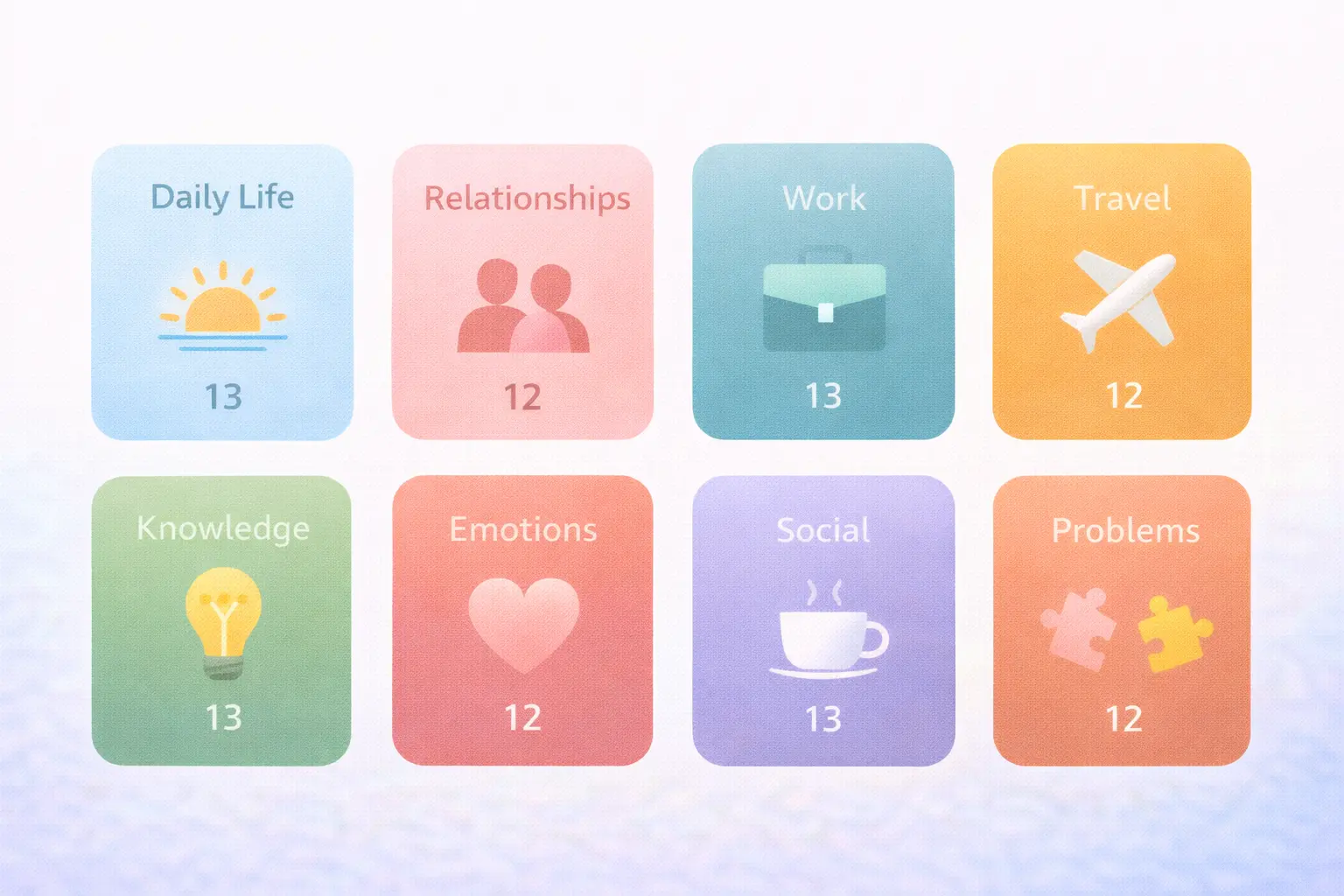
Vida diaria y rutinas
Estos verbos frasales describen acciones que realizas cada día, desde que te despiertas hasta que te vas a dormir.
| # | Verbo frasal | Significado | Ejemplo |
|---|---|---|---|
| 1 | wake up | dejar de dormir | I usually wake up at 7 AM, but on weekends I sleep until 9. |
| 2 | get up | levantarse de la cama; ponerse de pie | He got up, stretched, and walked to the kitchen. |
| 3 | turn on | encender un aparato o máquina | Can you turn on the light? It is too dark in here. |
| 4 | turn off | apagar un aparato o máquina | Please turn off your phone before the movie starts. |
| 5 | put on | ponerse una prenda de ropa | She put on her coat and left the house. |
| 6 | take off | quitarse ropa; (de un avión) despegar | Take off your shoes before entering the house. |
| 7 | throw away | tirar; poner en la basura | Do not throw away that box — I need it for the move. |
| 8 | clean up | ordenar y limpiar un lugar | We spent the whole afternoon cleaning up after the party. |
| 9 | put away | devolver algo a su lugar | The kids never put away their toys without being asked. |
| 10 | lie down | tumbarse para descansar | I need to lie down for a few minutes — I have a headache. |
| 11 | use up | consumir completamente; agotar un suministro | We used up all the milk, so I need to go to the store. |
| 12 | run out of | quedarse sin algo | We have run out of coffee — can you buy some on the way home? |
| 13 | tidy up | ordenar y organizar | Tidy up your room before your grandparents arrive. |
Comunicación y relaciones
Verbos frasales para hablar con personas, mantener relaciones e interaccionar socialmente.
| # | Verbo frasal | Significado | Ejemplo |
|---|---|---|---|
| 14 | get along with | llevarse bien con alguien | I get along with all my colleagues, but especially with my team lead. |
| 15 | break up | terminar una relación romántica | They broke up after three years together. |
| 16 | make up | reconciliarse tras una discusión | They argued on Monday but made up by Wednesday. |
| 17 | bring up | mencionar un tema en la conversación; criar a un niño | She brought up an interesting point about the budget. |
| 18 | catch up with | alcanzar el mismo nivel; quedar con alguien después de mucho tiempo | Let us meet for coffee this weekend — I want to catch up with you. |
| 19 | fall out with | tener un desacuerdo que daña una relación | He fell out with his brother over money. |
| 20 | ask out | invitar a alguien a una cita | He finally asked her out after months of hesitation. |
| 21 | let down | decepcionar a alguien | I promised to help and I do not want to let you down. |
| 22 | put up with | tolerar algo desagradable | I cannot put up with this noise any longer. |
| 23 | look after | cuidar a alguien o algo | Can you look after the dog while I am on holiday? |
| 24 | grow up | crecer; madurar | She grew up in a small town in northern England. |
| 25 | hang out | pasar el tiempo con alguien de forma informal | We usually hang out at the park on Saturday afternoons. |
Trabajo, estudio y productividad
Verbos frasales que necesitas en la oficina, el aula y para sacar las cosas adelante.
| # | Verbo frasal | Significado | Ejemplo |
|---|---|---|---|
| 26 | set up | organizar o preparar algo; iniciar un sistema | She set up a meeting for next Tuesday at 10 AM. |
| 27 | carry out | realizar o completar una tarea | The team carried out the experiment over three weeks. |
| 28 | fill in | rellenar un formulario o documento | Please fill in the application form and submit it online. |
| 29 | hand in | entregar un trabajo o documento | You need to hand in your essay by Friday afternoon. |
| 30 | take on | aceptar una tarea, responsabilidad o trabajo | She took on extra work to cover for her absent colleague. |
| 31 | put off | posponer para más tarde | Do not put off your homework — do it now and relax later. |
| 32 | call off | cancelar un evento planificado | The meeting was called off because the manager was sick. |
| 33 | keep up with | mantener el mismo ritmo o nivel | It is hard to keep up with the workload during exam season. |
| 34 | come up with | pensar en una idea o plan | The marketing team came up with a brilliant campaign. |
| 35 | work out | hacer ejercicio; resolver un problema; calcular | I work out three times a week at the gym. |
| 36 | go ahead | continuar; empezar o seguir adelante | The project was approved — we can go ahead with the plan. |
| 37 | take over | asumir el control de algo | When the CEO retired, his daughter took over the company. |
| 38 | drop out | abandonar un curso, la escuela o una competición | He dropped out of university in his second year to start a business. |
Los primeros 50: Movimiento y viajes
Verbos frasales para desplazarse: a pie, en coche, en autobús o en avión.
| # | Verbo frasal | Significado | Ejemplo |
|---|---|---|---|
| 39 | get on | subir a un autobús, tren o avión | We got on the train just before the doors closed. |
| 40 | get off | bajar de un autobús, tren o avión | Get off at the next stop — the museum is right there. |
| 41 | get in | entrar en un coche o taxi | She got in the taxi and gave the driver her address. |
| 42 | get out | salir de un coche o espacio cerrado | He got out of the car and slammed the door. |
| 43 | pick up | recoger a alguien; levantar algo de una superficie | I will pick you up at the airport at 6 PM. |
| 44 | drop off | llevar a alguien a un lugar y dejarlo allí | Can you drop me off at the train station on your way to work? |
| 45 | set off | emprender un viaje | We set off at dawn to avoid the traffic. |
| 46 | check in | registrarse en un hotel o aeropuerto | We checked in at the hotel and went straight to the pool. |
| 47 | check out | dejar un hotel; examinar algo | You need to check out before 11 AM. |
| 48 | head out | salir; partir | I am heading out now — see you at the restaurant. |
| 49 | pull over | detener un vehículo en el arcén | The police officer signaled the driver to pull over. |
| 50 | slow down | reducir la velocidad | Slow down — there is a school zone ahead. |
Ya has llegado a 50 verbos frasales, la mitad del camino. Si tienes poco tiempo, céntrate en estos primeros 50 para el inglés cotidiano. Cubren la vida diaria, las relaciones, el trabajo y los viajes. Los siguientes 50 añaden profundidad en el pensamiento, las emociones, las situaciones sociales y la resolución de problemas.
Conocimiento, descubrimiento y pensamiento
Verbos frasales para aprender, investigar y comprender.
| # | Verbo frasal | Significado | Ejemplo |
|---|---|---|---|
| 51 | find out | descubrir nueva información | I just found out that the concert is sold out. |
| 52 | look up | buscar información (en un libro o en internet) | If you do not know the word, look it up in a dictionary. |
| 53 | go through | examinar algo con detenimiento | The accountant went through every receipt from the past year. |
| 54 | figure out | resolver o entender algo | It took me an hour to figure out how to use the new software. |
| 55 | sort out | organizar o resolver un problema | We need to sort out the schedule before the conference. |
| 56 | point out | llamar la atención sobre algo | She pointed out several errors in the report. |
| 57 | turn out | tener un resultado concreto; resultar ser | The project turned out to be much harder than expected. |
| 58 | come across | encontrar algo por casualidad | I came across an old photo album while cleaning the attic. |
| 59 | look into | investigar o examinar | The police are looking into the cause of the accident. |
| 60 | make out | ver, oír o entender con dificultad | The writing was so small I could barely make out the words. |
| 61 | stand for | representar; significar | “UN” stands for “United Nations.” |
| 62 | rule out | descartar como posibilidad | Doctors have ruled out any serious illness. |
| 63 | think over | considerar algo con cuidado antes de decidir | I need a few days to think over your offer. |
Emociones y actitudes
Verbos frasales sobre cómo te sientes, reaccionas y te enfrentas a las cosas.
| # | Verbo frasal | Significado | Ejemplo |
|---|---|---|---|
| 64 | give up | dejar de intentarlo; rendirse | Do not give up — you are so close to finishing. |
| 65 | cheer up | animarse; animar a alguien | Cheer up — the exam is over and you did your best. |
| 66 | calm down | calmarse; tranquilizarse | Take a deep breath and calm down before you respond. |
| 67 | freak out | ponerse muy ansioso o alterado (informal) | She freaked out when she realized she lost her passport. |
| 68 | look forward to | tener ganas de algo futuro | I am looking forward to the summer holidays. |
| 69 | get over | recuperarse de una enfermedad, un shock o una mala experiencia | It took her months to get over the breakup. |
| 70 | hold on | esperar un momento | Hold on — let me grab my keys before we leave. |
| 71 | count on | depender de; confiar en | You can always count on Maria — she never lets anyone down. |
| 72 | show off | presumir para impresionar a los demás | He was showing off his new car to everyone at the party. |
| 73 | end up | llegar finalmente a una situación o lugar | We got lost and ended up on the wrong side of town. |
| 74 | burn out | agotarse por exceso de trabajo | After working 80-hour weeks for a year, she completely burned out. |
| 75 | back up | apoyar a alguien; hacer una copia de datos | My whole team backed me up during the disagreement. |
Situaciones sociales y actividades cotidianas
Verbos frasales para salir, ir de compras y la vida social diaria.
| # | Verbo frasal | Significado | Ejemplo |
|---|---|---|---|
| 76 | show up | llegar; aparecer | He showed up 30 minutes late with no explanation. |
| 77 | turn up | llegar (a menudo inesperadamente); subir el volumen | She turned up at the party without an invitation. |
| 78 | come over | visitar a alguien en su casa | Why do you not come over for dinner on Saturday? |
| 79 | eat out | comer en un restaurante | We eat out at least twice a week — cooking every day is exhausting. |
| 80 | dress up | vestirse de forma elegante o formal | You need to dress up for the company gala. |
| 81 | try on | probarse ropa en una tienda | She tried on five dresses before choosing one. |
| 82 | give back | devolver algo a su dueño | I need to give back the book I borrowed from the library. |
| 83 | pay back | devolver dinero prestado | I will pay you back on Friday when I get paid. |
| 84 | save up | acumular dinero con el tiempo | They are saving up to buy their first apartment. |
| 85 | cut down on | reducir la cantidad de algo | The doctor told him to cut down on sugar and salt. |
| 86 | go on | continuar; ocurrir | Please go on — I am listening. |
| 87 | join in | participar en una actividad con otros | Everyone was dancing, so I decided to join in. |
| 88 | take back | devolver un artículo a una tienda | These shoes do not fit — I need to take them back. |
Problemas, desafíos y situaciones
Verbos frasales para afrontar eventos inesperados y dificultades.
| # | Verbo frasal | Significado | Ejemplo |
|---|---|---|---|
| 89 | deal with | manejar; gestionar un problema | I do not know how to deal with this situation. |
| 90 | look out | tener cuidado; estar alerta ante un peligro | Look out! There is a car coming. |
| 91 | break down | dejar de funcionar; derrumbarse emocionalmente | The car broke down on the highway and we had to call for help. |
| 92 | blow up | explotar; enfadarse de repente | He blew up at his assistant for losing the files. |
| 93 | run into | encontrarse con alguien por casualidad; toparse con un problema | I ran into my old teacher at the supermarket yesterday. |
| 94 | come up | surgir; mencionarse | Something has come up at work — I will be home late. |
| 95 | hold up | retrasar; causar un retraso | The flight was held up for two hours because of fog. |
| 96 | mix up | confundir una cosa con otra | I always mix up “affect” and “effect.” |
| 97 | make up for | compensar algo malo | He bought her flowers to make up for forgetting her birthday. |
| 98 | pass out | perder el conocimiento; desmayarse | It was so hot in the room that one of the students passed out. |
| 99 | shut down | cerrar definitivamente; apagar del todo | The factory shut down last year, and 200 people lost their jobs. |
| 100 | take apart | desmontar en piezas | He took apart the old radio to see how it worked. |
Vocabulario para practicar
Estas 25 palabras aparecen frecuentemente junto a los verbos frasales anteriores. Haz clic en cualquier palabra para ver su definición, pronunciación y ejemplos.
finance
verbo
financiar, costear
Ejemplos
- Many students need loans to finance their college education expenses.
- The bank agreed to finance the construction of the new shopping center.
executive
adjetivo
ejecutivo, directivo, gerente
Ejemplos
- Executive decisions require careful consideration of multiple factors and consequences.
- The executive branch of government is responsible for implementing laws.
valid
adjetivo
válido, justo
Ejemplos
- Valid argument supports logical reasoning and conclusion.
- Valid passport allows international travel without problems.
flexible
adjetivo
flexible, maleable, adaptable
Ejemplos
- Flexible working arrangements help employees balance work and family life.
- The flexible plastic tube can bend without breaking or cracking.
culmination
sustantivo
culminación
Ejemplos
- The graduation ceremony was the culmination of four years of hard study.
- Winning the championship represented the culmination of the team's efforts.
transmit
verbo
transmitir, difundir, emitir
Ejemplos
- Disease may transmit through contact with surfaces.
- Satellites transmit signals across vast distances effectively.
gulp
verbo
beber, tragar
Ejemplos
- She had to gulp nervously before giving her presentation to the board.
- The thirsty runner gulped down an entire bottle of cold water.
cherished
adjetivo
valorado, querido
Ejemplos
- His cherished dream of becoming a pilot finally came true.
- The old photograph was her most cherished possession from childhood.
fate
sustantivo
destino, suerte, fatum
Ejemplos
- She believes that fate brought them together at the right moment.
- The explorer's fate remained unknown after he disappeared in the jungle.
spellbound
adjetivo
absorto, hipnotizado, fascinado
Ejemplos
- Audience sits spellbound during magical performance tonight.
- Children remain spellbound by storyteller's fascinating tales.
pet
adjetivo
pequeño, chico, menudo
Ejemplos
- Pet project receives extra attention and resources.
- Pet theory explains professor's research focus area.
master
sustantivo
maestro, experto, jefe
Ejemplos
- Apprentices learn traditional crafts from experienced master craftsmen.
- The chess master defeated opponents using brilliant strategic moves.
payable
adjetivo
pagadero, a pagar, de pago
Ejemplos
- All dues are payable at the end of the month.
- The invoice is payable within 30 days.
serenity
sustantivo
serenidad, tranquilidad, calma
Ejemplos
- She maintained her serenity despite the chaos.
- The serenity of the lake was calming.
classy
adjetivo
elegante, clase, distinguido
Ejemplos
- Classy restaurant serves gourmet food in elegant dining atmosphere.
- Her classy appearance impressed everyone at formal business meeting.
revolt
verbo
rebelarse, levantarse, revoltarse
Ejemplos
- A revolt broke out in the city center last night.
- The workers decided to revolt against the unfair conditions.
rethink
verbo
repensar, reconsiderar, reflexionar
Ejemplos
- He decided to rethink his position on the issue.
- We need to rethink our strategy for the project.
gypsy
sustantivo
gitano, romani, nómada
Ejemplos
- Traditional gypsy music features violin and passionate vocals.
- Wandering gypsy caravan traveled through European countryside.
buffoon
sustantivo
bufón, payaso
Ejemplos
- Court buffoon entertained royal family with silly performances.
- Don't act like buffoon during important business presentation.
execution
sustantivo
ejecución, cumplimiento, desempeño
Ejemplos
- Perfect execution of the dance routine impressed judges and audience members.
- The execution of the business plan requires careful coordination and timing.
territory
sustantivo
territorio, zona
Ejemplos
- Animal territory provides food and shelter resources.
- National territory requires protection from foreign invasion.
tribe
sustantivo
tribu, clan, pueblo
Ejemplos
- Ancient tribe lived in harmony with nature.
- Indigenous tribe preserves traditional customs and languages.
resolve
verbo
resolver, solucionar, determinar
Ejemplos
- Mediator helps parties resolve dispute through negotiation.
- Technical team will resolve software problems quickly.
Cómo estudiar los verbos frasales de forma eficaz
1. Aprende por categoría, no alfabéticamente. Las tablas de arriba están diseñadas para esto. Cuando aprendes «get on», «get off», «get in» y «get out» juntos, los patrones se vuelven evidentes y se fijan más rápido.
2. Aprende la frase completa, no solo el verbo. «Put up with» es una unidad. Si memorizas solo «put» + «up», nunca producirás la frase correcta en la conversación. Aprende siempre los verbos frasales como bloques completos.
3. Úsalos el mismo día. Después de aprender 5 verbos frasales nuevos, escribe un párrafo corto o mantén una conversación utilizándolos todos. La producción activa en las primeras 24 horas es la técnica de memorización más potente.
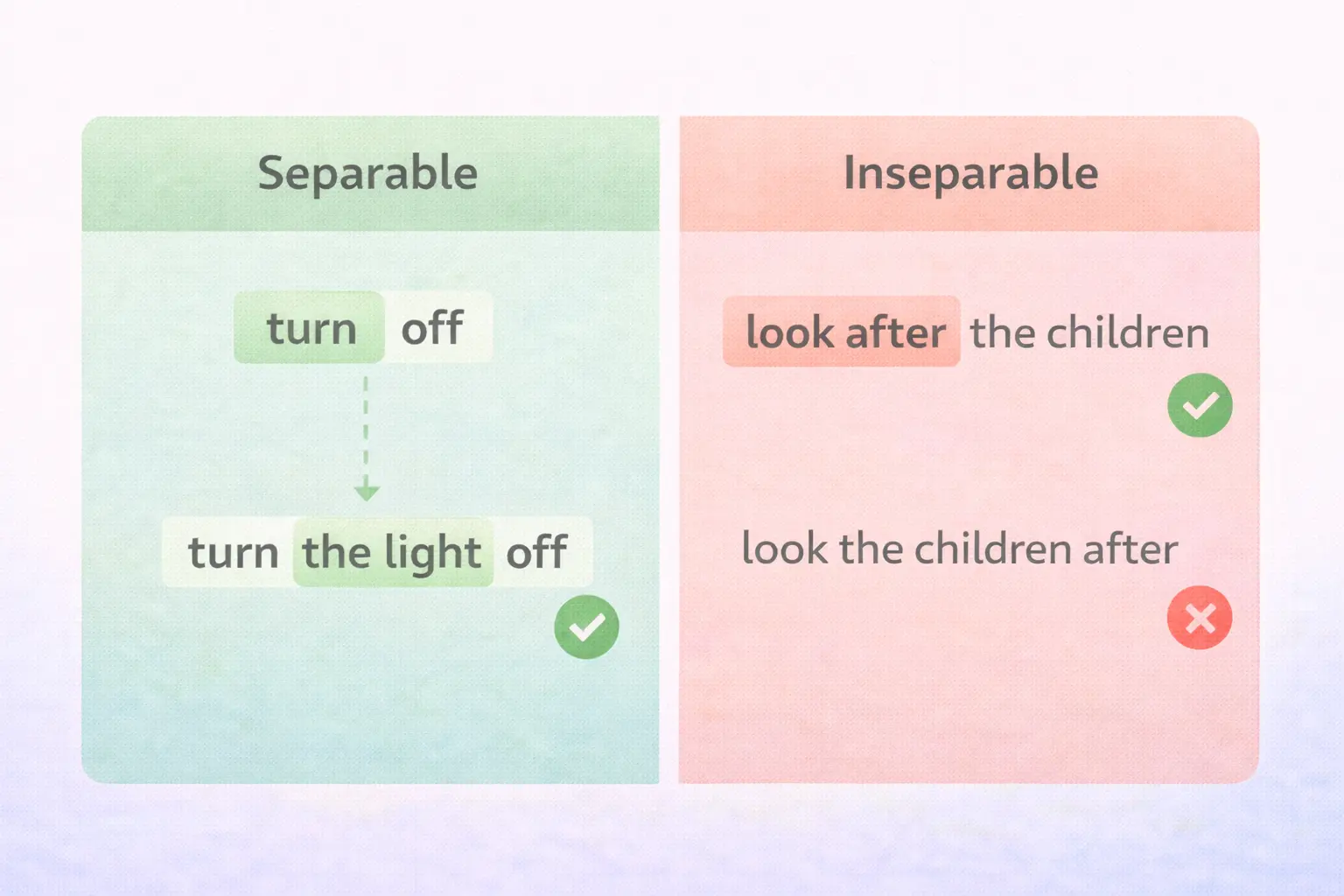
4. Presta atención a separables vs. inseparables. Algunos verbos frasales pueden separarse: «turn the light off» = «turn off the light». Otros no: «look after the children» (no «look the children after»). En caso de duda, mantén el verbo y la partícula juntos.
5. Repasa con repetición espaciada. Añade los verbos frasales a tu diccionario de Linglify y repásalos a intervalos crecientes. Diez minutos al día es más eficaz que una hora a la semana.
Para un sistema de estudio completo, lee nuestra guía sobre cómo mejorar tu vocabulario.
Qué hacer a continuación
-
Empieza con los 50 primeros. Si 100 te parece mucho, empieza con nuestros 50 verbos frasales más comunes, organizados por verbo base con explicaciones de patrones que los hacen más fáciles de recordar.
-
Sube al nivel avanzado. Cuando te sientas cómodo con esta lista, pasa a nuestra guía de verbos frasales avanzados, con más de 60 verbos de nivel C1–C2 para contextos académicos y profesionales.
-
Aprende por grupo verbal. Para profundizar en todos los verbos frasales construidos a partir de un solo verbo, empieza con verbos frasales con MAKE, el conjunto más versátil.
-
Explora contextos de negocios. Si trabajas en inglés, nuestra guía de verbos frasales de negocios cubre más de 60 expresiones profesionales para reuniones, correos y negociaciones.
-
Crea un hábito de estudio diario. Sigue nuestro sistema de aprendizaje de vocabulario paso a paso para convertir estos 100 verbos frasales en vocabulario activo en pocas semanas.
Preguntas frecuentes
¿Cuáles son los 50 verbos frasales más importantes?
Los primeros 50 verbos frasales de este artículo (#1–#50) son los más usados en el inglés cotidiano. Cubren las rutinas diarias (wake up, turn on, put on), las relaciones (get along with, break up, make up), el trabajo (set up, carry out, hand in) y los viajes (get on, pick up, check in). Si solo aprendes 50, céntrate en estos, o consulta nuestra guía de los 50 verbos frasales más comunes organizada por verbo base para memorizarlos mejor.
¿Cuántos verbos frasales hay en inglés?
Hay más de 10.000 combinaciones de verbos frasales en inglés, pero solo unas 200–300 son de uso común. Los 100 de esta lista cubren los más frecuentes. No necesitas aprender miles: dominar esta lista te pone por delante de la mayoría de los hablantes no nativos.
¿Cuál es la forma más rápida de aprender verbos frasales?
Apréndelos en grupos temáticos (viajes, trabajo, emociones), no alfabéticamente. Escribe tus propios ejemplos con situaciones reales de tu vida. Repasa con repetición espaciada. Lo más importante: úsalos activamente en conversación y escritura; la memorización pasiva no funciona con los verbos frasales.
¿Se usan los verbos frasales en inglés formal?
Muchos verbos frasales son apropiados para el inglés formal: «carry out» (realizar), «set up» (establecer), «point out» (señalar), «rule out» (descartar). Otros son informales: «hang out», «freak out», «blow up». La formalidad depende del verbo frasal concreto, no de la categoría en general. Nuestra guía de verbos frasales avanzados se centra en opciones formales y académicas.
¿Necesito verbos frasales para el IELTS?
Sí. Los examinadores del IELTS valoran el uso natural de los verbos frasales en el Speaking (demuestra fluidez) y el uso apropiado en el Writing (demuestra amplitud de vocabulario). Sin embargo, en el Writing Task 2, limítate a verbos frasales formales: «account for», «bring about», «carry out». En el Speaking, verbos más informales como «hang out» y «catch up with» suenan naturales y auténticos. Consulta nuestra guía de vocabulario para el IELTS para estrategias específicas por banda.
¿Cuál es la diferencia entre verbos frasales y modismos?
Los verbos frasales son combinaciones de verbo + partícula cuyo significado difiere de las palabras individuales: «give up» = rendirse. Los modismos son expresiones fijas que no siguen las reglas gramaticales de forma literal: «it is raining cats and dogs» = está lloviendo a cántaros. Los verbos frasales siempre funcionan como verbos. Los modismos pueden ser cualquier parte de una oración. Existe cierto solapamiento: «let the cat out of the bag» es un modismo, mientras que «give up» es un verbo frasal.