Phrasal Verb dengan MAKE: Daftar Lengkap dengan Arti dan Contoh
MAKE adalah salah satu kata kerja paling serbaguna dalam bahasa Inggris. Tambahkan preposisi atau kata keterangan—up, out, off, for—dan artinya berubah sepenuhnya. “Make up” saja memiliki lima arti berbeda bergantung pada konteks, dan itu hanya satu kombinasi.
Panduan ini membahas setiap phrasal verb utama dengan MAKE, yang disusun menurut kelompok makna. Setiap entri mencakup definisi yang jelas, contoh kalimat sehari-hari, dan catatan formalitas. Baik Anda sedang mempersiapkan IELTS, belajar bahasa Inggris bisnis, atau hanya ingin terdengar lebih alami—inilah referensi yang Anda perlukan.
- Phrasal verb yang dibahas: 20+
- Level: B1–B2 (menengah hingga menengah atas)
- Fokus: arti, contoh kalimat, catatan penggunaan, kesalahan umum
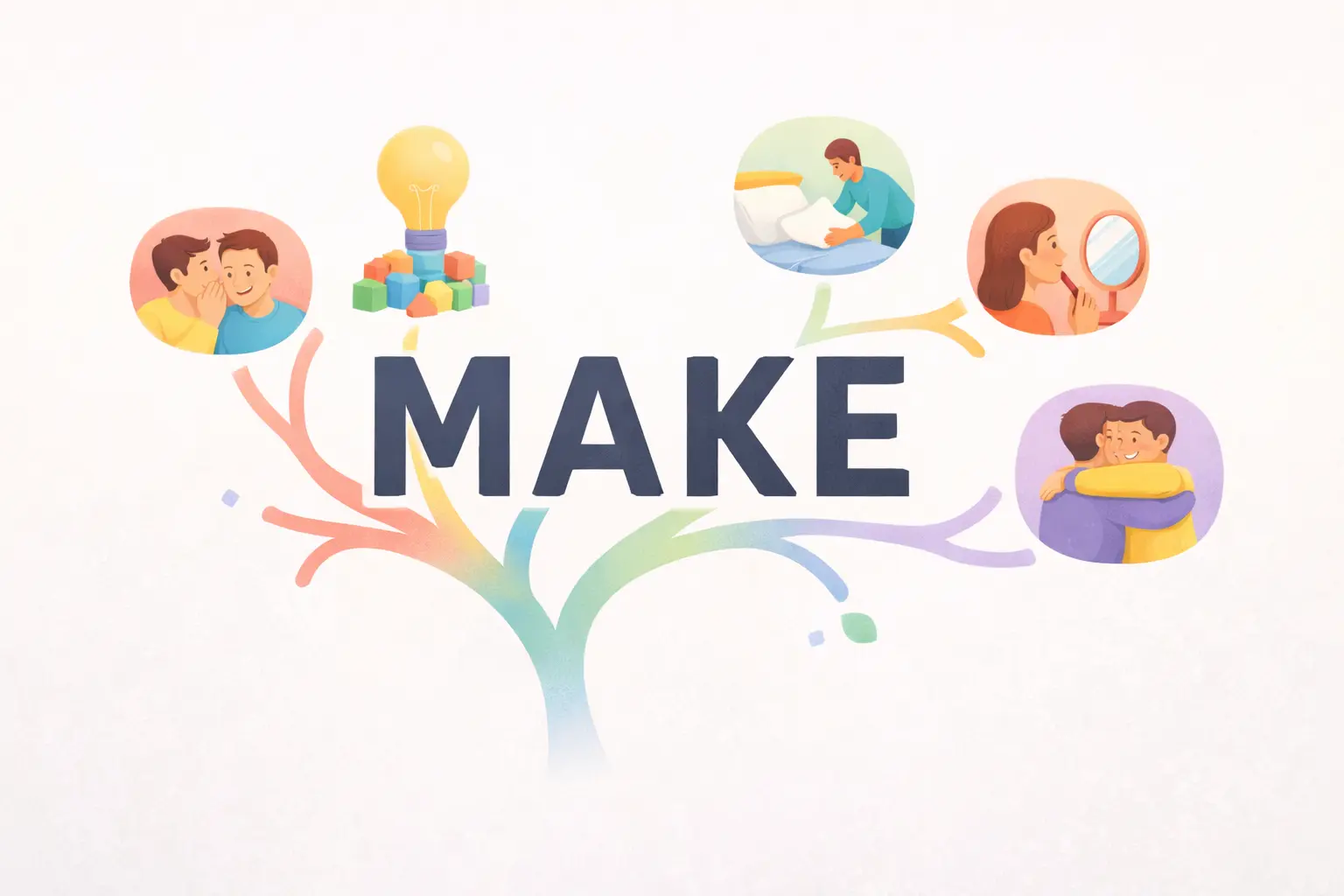
MAKE UP — Yang Paling Umum (5 Arti)
“Make up” adalah phrasal verb dengan MAKE yang paling banyak dicari—dan ada alasannya. Kata ini memiliki lima arti berbeda, dan mencampuradukkannya merupakan salah satu kesalahan paling umum yang dibuat pelajar.
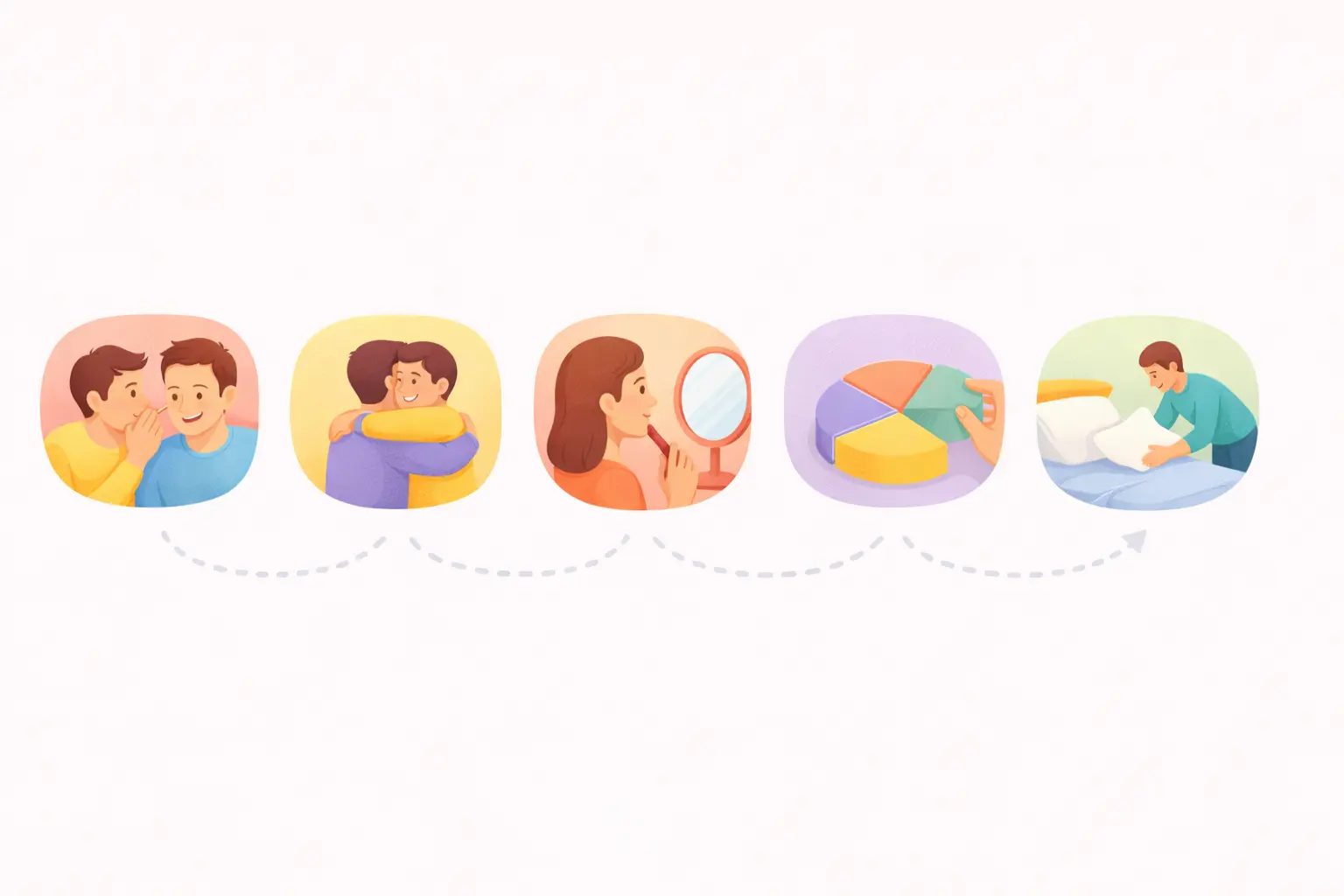
1. Mengarang (cerita, alasan, atau kebohongan)
Menciptakan sesuatu yang tidak benar atau fiktif.
She made up an excuse for being late to the meeting. Children love making up stories about imaginary friends. Don’t believe him — he made the whole thing up.
2. Berdamai setelah bertengkar
Menjadi berteman lagi setelah perselisihan.
They argued about money but made up the next day. Life is short — make up with your sister before it is too late.
3. Memakai kosmetik
Memakai riasan (kosmetik untuk wajah).
She usually makes herself up before video calls. The actress was made up to look 20 years older for the role.
4. Menyusun atau membentuk keseluruhan
Menjadi bagian-bagian yang membentuk sesuatu.
Women make up 52% of the company’s workforce. Three short stories make up the second part of the book.
5. Menyiapkan atau menata
Menyiapkan sesuatu (tempat tidur, ruangan, paket).
Could you make up the guest room? We have visitors arriving tonight. The pharmacist made up the prescription while I waited.
Kiat mengingat: Konteks selalu memberi tahu arti yang dimaksud. Perhatikan subjek dan objeknya: person + excuse = mengarang, two people = berdamai, percentage + group = membentuk.
MAKE OUT — 4 Arti
Phrasal verb lain yang banyak dicari dengan beberapa arti.
1. Melihat, mendengar, atau memahami dengan kesulitan
Hanya nyaris berhasil menangkap atau memahami sesuatu.
I could not make out what the sign said from that distance. The handwriting was so bad I could barely make out the words. Can you make out what he is saying? The audio is terrible.
2. Mengklaim atau menyiratkan
Menegaskan sesuatu, sering kali menyiratkan keraguan apakah hal itu benar.
He makes out that he is an expert, but he only started learning last month. The article makes out that the problem is simple, but it is not.
3. Menulis (cek, kuitansi, atau dokumen)
Mengisi atau menulis dokumen resmi.
Please make the cheque out to “Smith & Associates.” I will make out a receipt for your records.
4. Berhasil atau bernasib
Berbuat atau tampil dengan cara tertentu (informal, terutama bahasa Inggris Amerika).
How did you make out at the job interview? We made out pretty well on the sale — doubled our investment.
MAKE FOR — Bergerak Menuju atau Berkontribusi pada Sesuatu
Dua arti yang saling berkaitan tetapi berbeda.
1. Bergerak menuju suatu tempat
Menuju ke arah sesuatu.
When the fire alarm went off, everyone made for the exit. After lunch, we made for the coast and arrived by sunset.
2. Berkontribusi pada atau menghasilkan
Menciptakan kondisi yang mengarah pada sesuatu.
Good lighting and comfortable chairs make for a productive workspace. Mixing experienced and junior team members makes for better results.
MAKE OFF / MAKE OFF WITH — Melarikan Diri dan Mencuri
Make off
Pergi dengan cepat, khususnya untuk melarikan diri.
The thieves made off before the police arrived. He made off through the back door when he heard the sirens.
Make off with
Mencuri sesuatu dan melarikan diri dengannya.
Someone made off with my laptop while I was getting coffee. The hackers made off with millions in cryptocurrency.
MAKE UP FOR — Mengompensasi
Mengompensasi sesuatu yang hilang, terlewat, atau kesalahan yang dilakukan.
He worked overtime to make up for the days he missed. The beautiful scenery more than made up for the long drive. She bought him dinner to make up for forgetting his birthday.
Ini berbeda dari “make up” (berdamai). “Make up for” selalu melibatkan kompensasi—menggantikan sesuatu yang negatif dengan sesuatu yang positif.
MAKE DO (WITH) — Bertahan dengan Lebih Sedikit
Mengelola diri dengan apa pun yang tersedia, meski tidak ideal.
We do not have a projector, so we will have to make do with a laptop screen. During the crisis, families had to make do with very little. There is no fresh bread — we will have to make do with what is in the freezer.
Catatan: Phrasal verb ini menggunakan “do,” bukan “due.” Kesalahan ejaan yang umum adalah menulis “make due with.”
MAKE INTO — Transformasi
Mengubah atau mentransformasikan sesuatu menjadi sesuatu yang berbeda.
They made the old warehouse into a modern art gallery. The book was made into a film in 2024. With some paint and new furniture, we can make this room into a proper office.
MAKE OF — Menafsirkan atau Memahami
Memikirkan atau menafsirkan sesuatu. Sering digunakan dalam pertanyaan.
What do you make of the new proposal? I do not know what to make of his behavior lately. What did you make of the film? I thought it was brilliant.
Phrasal Verb Lengkap dengan MAKE — Referensi Cepat
Berikut setiap phrasal verb dengan MAKE dalam satu tabel untuk pencarian cepat.
| Phrasal Verb | Arti | Level | Contoh |
|---|---|---|---|
| make up | mengarang (cerita/alasan) | B1 | He made up the story. |
| make up | berdamai | B1 | They made up after the fight. |
| make up | memakai kosmetik | B1 | She made herself up for the party. |
| make up | menyusun / membentuk | B2 | Imports make up 60% of supply. |
| make up | menyiapkan (tempat tidur/ruangan) | B2 | Can you make up the spare room? |
| make out | menangkap dengan kesulitan | B2 | I can’t make out the writing. |
| make out | mengklaim / menyiratkan | B2 | He makes out he’s innocent. |
| make out | menulis (cek/kuitansi) | B2 | Make the cheque out to me. |
| make out | berhasil / bernasib | B2 | How did you make out? |
| make for | bergerak menuju | B2 | We made for the nearest exit. |
| make for | berkontribusi pada / menghasilkan | B2 | This makes for good reading. |
| make off | melarikan diri dengan cepat | B2 | The thief made off on foot. |
| make off with | mencuri dan melarikan diri | B2 | He made off with the cash. |
| make up for | mengompensasi | B1 | She made up for lost time. |
| make do (with) | bertahan dengan lebih sedikit | B2 | We’ll make do with what we have. |
| make into | mengubah | B2 | They made it into a museum. |
| make of | menafsirkan / memikirkan | B2 | What do you make of this? |
| make over | merenovasi / mengubah penampilan | B2 | They made over the entire shop. |
| make towards | bergerak ke arah | B2 | She made towards the door. |
| make it | berhasil / tiba tepat waktu | B1 | We barely made it to the airport. |
Kosakata untuk Dilatih
Perkuat bahasa Inggris umum Anda bersama phrasal verb ini. Klik kata apa pun untuk melihat definisi, pelafalan, dan contohnya.
worthless
adjektiva
tak berharga, tidak berguna
Contoh
- Don't let anyone make you feel worthless or unimportant.
- The broken watch became completely worthless and couldn't be repaired.
formally
adverbia
secara formal, secara resmi, dengan sopan
Contoh
- Students must formally register for classes before the semester begins.
- The new president will be formally inaugurated next month in the capital.
border
nomina
perbatasan, batas
Contoh
- The garden had a beautiful flower border along the path.
- They crossed the border between France and Germany.
unload
verba
membongkar muatan, menurunkan muatan, meringankan beban
Contoh
- Ship crew must unload containers at port.
- Workers unload cargo from delivery truck efficiently.
stress
verba
merasa tertekan, menekankan
Contoh
- Heavy workload may stress employees beyond limits.
- Teacher will stress importance of homework completion.
willingly
adverbia
dengan senang hati, secara sukarela
Contoh
- He willingly shared his knowledge with younger students.
- The volunteers worked willingly without expecting any payment.
prospect
nomina
prospek, kemungkinan
Contoh
- Economic prospect looks optimistic for next year.
- Job prospect improves with additional education training.
willingness
nomina
kesediaan, kemauan
Contoh
- Her willingness to learn impressed all the teachers.
- The company values employees' willingness to work as a team.
timeliness
nomina
ketepatan waktu
Contoh
- Project timeliness determines success in competitive business environment.
- Report timeliness affects decision making processes significantly.
calm
adjektiva
tenang, tenteram
Contoh
- She remained calm despite the stressful situation at work.
- The calm ocean reflected the beautiful colors of the sunset.
bewilderment
nomina
kebingungan
Contoh
- She stared in bewilderment at the unexpected test results.
- The tourist's bewilderment was obvious when he got lost downtown.
brick
nomina
batu bata
Contoh
- He's been a real brick during this crisis.
- The house was built with traditional red brick.
revise
verba
merevisi, memperbaiki
Contoh
- Author must revise manuscript before publication deadline.
- Student will revise lessons before final examination.
lap
nomina
pangkuan
Contoh
- The cat curled up comfortably on her lap while reading.
- The runner completed another lap around the track successfully.
transfer
verba
memindahkan, mengalihkan
Contoh
- Bank will transfer money between accounts quickly.
- Student may transfer to different university program.
max
nomina
nama panggilan
Contoh
- Students can borrow max of five books from library.
- The speed limit max on highway is seventy miles per hour.
exhausted
adjektiva
sangat lelah, kelelahan
Contoh
- After running the marathon, she felt completely exhausted and needed to rest.
- The exhausted workers finally finished their twelve-hour shift at the factory.
diligent
adjektiva
tekun, rajin
Contoh
- Diligent students typically achieve better grades through consistent hard work.
- The diligent researcher spent years collecting data for the scientific study.
independent
adjektiva
mandiri
Contoh
- She's very independent and prefers to solve problems on her own.
- The independent research confirmed the results of the original study.
impolitely
adverbia
secara tidak sopan
Contoh
- He spoke impolitely to the waiter and made everyone uncomfortable.
- She impolitely refused to answer the reporter's questions.
characterize
verba
menggambarkan, mencirikan
Contoh
- Honesty and integrity characterize his approach to business dealings.
- The report characterizes the current economic situation as generally stable.
yell
verba
berteriak, menjerit
Contoh
- Don't yell at the children when they make innocent mistakes.
- The coach had to yell instructions over the crowd noise.
aggressive
adjektiva
agresif, konfrontatif
Contoh
- Some drivers become aggressive when stuck in heavy traffic for hours.
- The aggressive marketing campaign helped increase sales by thirty percent last quarter.
alphabet
nomina
abjad, alfabet
Contoh
- Children learn the alphabet before they can read complete sentences.
- The English alphabet has twenty-six letters from A to Z.
Cara Berlatih Phrasal Verb dengan MAKE
1. Mulai dari 5 teratas. Jangan mencoba menghafal semua 20 sekaligus. Mulailah dengan make up (mengarang), make out (memahami), make for (bergerak menuju), make up for (mengompensasi), dan make do with (mengelola). Kelimanya mencakup 80% penggunaan di dunia nyata.
2. Tulis kalimat Anda sendiri. Untuk setiap phrasal verb, tulis 2–3 kalimat tentang kehidupan Anda sendiri. “I made up an excuse when I was late to work” lebih mudah diingat daripada membaca contoh orang lain.
3. Perhatikan dalam konteks. Podcast bisnis, acara TV, dan artikel berita penuh dengan phrasal verb MAKE. Ketika mendengarnya, berhentilah sejenak dan kenali arti mana yang digunakan.
4. Uji diri dengan petunjuk konteks. Tutupi kolom “arti” dalam tabel di atas dan cobalah menebak hanya dari contoh kalimatnya. Ini membangun kemampuan memahami phrasal verb dari konteks—persis yang Anda perlukan dalam percakapan dan ujian.
Untuk sistem belajar kosakata lengkap, lihat panduan langkah demi langkah untuk membangun kosakata Anda.

Kesalahan Umum dengan Phrasal Verb MAKE
1. Mencampuradukkan arti “make up.” “We made up” (berdamai) vs. “We made it up” (mengarangnya). Kata ganti “it” mengubah arti sepenuhnya. Tanpa objek, “make up” biasanya berarti berdamai. Dengan objek khusus, artinya mengarang.
2. Menulis “make due” alih-alih “make do.” Ini adalah salah satu kesalahan ejaan paling umum. Frasa yang benar adalah “make do with”—jangan pernah “make due with.”
3. Mencampuradukkan “make out” dan “find out.” “Make out” = menangkap dengan kesulitan (“I can’t make out the text”). “Find out” = menemukan informasi (“I found out the truth”). Keduanya tidak dapat dipertukarkan.
4. Melupakan “for” dalam “make up for.” “I’ll make up the lost time” (ambigu—bisa berarti “menyusun”). “I’ll make up for the lost time” (jelas berarti mengompensasi). Preposisi “for” sangat penting.
5. Menggunakan “make of” ketika yang dimaksud “make from.” “What do you make of this?” = Apa pendapat Anda? “What is this made from?” = Terbuat dari bahan apa? Ini adalah dua pertanyaan yang sama sekali berbeda.
Bacaan Berikutnya
-
Pelajari 100 phrasal verb penting. Untuk daftar lengkap phrasal verb paling umum dalam semua topik, lihat 100 phrasal verb dengan arti dan kalimat kami.
-
Phrasal verb lainnya. Untuk phrasal verb C1–C2 lanjutan di semua konteks, lihat panduan phrasal verb lanjutan kami.
-
Phrasal verb untuk kerja. Jika Anda menggunakan bahasa Inggris secara profesional, panduan phrasal verb bisnis kami membahas 60+ frasa khusus tempat kerja.
-
Berlatih phrasal verb. Jelajahi perpustakaan phrasal verb kami untuk latihan interaktif dengan flashcard dan kuis.
-
Tingkatkan kosakata Anda. Baca panduan kami tentang cara meningkatkan kosakata Anda dengan 10 metode terbukti.
FAQ
Berapa banyak phrasal verb yang dimiliki MAKE?
MAKE memiliki sekitar 20 phrasal verb berbeda, tetapi beberapa di antaranya—terutama “make up” dan “make out”—memiliki banyak arti. Secara total, MAKE menghasilkan lebih dari 30 kombinasi makna berbeda, menjadikannya salah satu kata kerja paling produktif untuk pembentukan phrasal verb dalam bahasa Inggris.
Apa perbedaan antara “make up” dan “make up for”?
“Make up” berarti berdamai (“They made up after arguing”), mengarang (“She made up a story”), atau menyusun (“Water makes up 70% of the body”). “Make up for” selalu berarti mengompensasi—menggantikan sesuatu yang negatif dengan sesuatu yang positif: “He made up for his mistake by working extra hours.”
Apa arti “make out”?
“Make out” memiliki empat arti utama: (1) melihat atau memahami dengan kesulitan—“I can’t make out the writing on the sign”; (2) mengklaim atau menyiratkan—“He makes out that he’s rich”; (3) menulis dokumen resmi—“Make the cheque out to my company”; (4) berhasil atau bernasib—“How did you make out at the interview?”
Apakah phrasal verb dengan MAKE formal atau informal?
Kebanyakan netral dan sesuai untuk bahasa Inggris lisan maupun tulisan. “Make for” (berkontribusi pada), “make up” (menyusun), dan “make out” (menulis dokumen) bekerja baik dalam tulisan formal. “Make off with” (mencuri) dan “make out” (berhasil/bernasib) lebih informal dan lebih cocok untuk percakapan.
Apa cara terbaik untuk menghafal phrasal verb dengan MAKE?
Fokus pada satu kelompok makna setiap kali. Mulailah dari lima arti “make up” karena paling umum. Tulis contoh kalimat tentang pengalaman Anda sendiri, lalu berlatih menggunakannya dalam percakapan dalam 24 jam. Pengulangan berjarak—meninjau pada interval yang makin panjang—memasukkannya ke memori jangka panjang. Anda dapat berlatih dengan sistem pengulangan berjarak Linglify.