
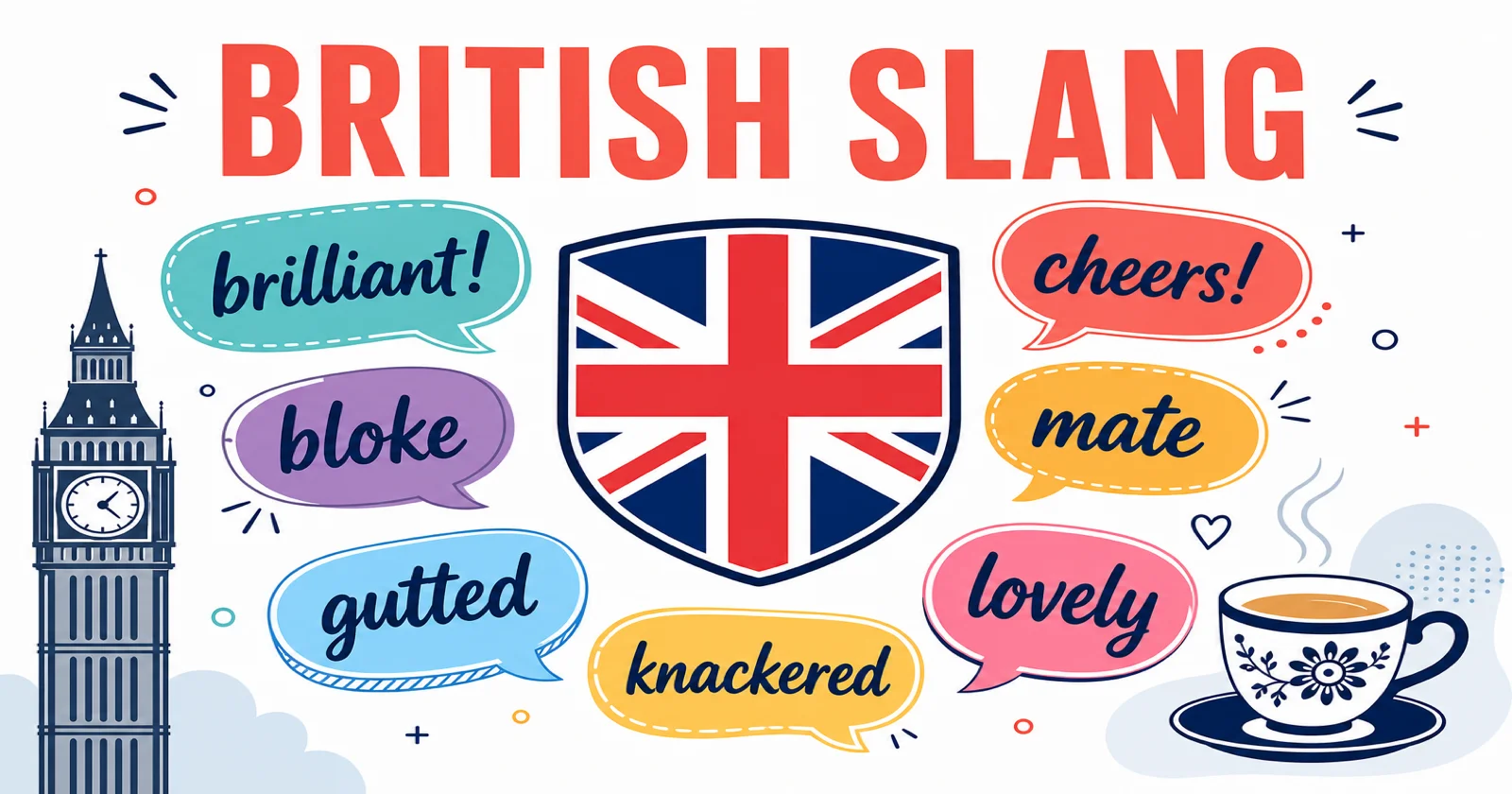
영국 속어 200개 이상: 알아 두면 좋은 표현
미국 교재로 영어를 배운 뒤 영국 TV 프로그램을 보았다면 내용의 70% 정도밖에 이해하지 못했을 수도 있습니다. 발음 때문이 아니라 어휘 때문입니다. 영국 사람이 “I’m absolutely knackered after that dodgy kebab, and now I need to pop to the chemist before I go to my mate’s gaff”라고 말하면 모든 단어가 영어인데도 미국식 영어를 배운 사람에게는 외국어처럼 들릴 수 있습니다.
영국 영어에는 속어와 비격식 단어, 표현이 아주 많으며 교재에는 거의 나오지 않습니다. 영국 전역에서 쓰이는 단어도 있고, 런던이나 북부, 스코틀랜드에서만 쓰이는 말도 있습니다. 수백 년 동안 사용된 단어가 있는가 하면 작년에 생긴 표현도 있습니다.
이 가이드에서는 가장 유용한 영국 속어와 표현 200개 이상을 범주별로 살펴봅니다. 각 항목에 뜻과 예문, 사용 범위에 관한 설명을 담았습니다. 영국에 살 계획이 있거나 영국 TV를 보거나, 영국인 친구들이 실제로 하는 말을 이해하고 싶다면 이 자료를 참고하세요.
- 전체: 영국 속어 200개 이상
- 분류: 10개 범주
- 구성: 단어 → 뜻 → 예문
- 수준: B1–C2
- 추천 대상: 영국 영어 이해, 여행 준비, 문화 이해
사람과 인간관계
| 번호 | 단어/표현 | 뜻 | 예문 |
|---|---|---|---|
| 1 | bloke | 남자; 친구, 녀석 | He’s a nice bloke — you’d like him. |
| 2 | mate | 친구; 편하게 부르는 인사말로도 사용 | Alright, mate? How’s it going? |
| 3 | lad | 소년; 젊은 남자 | The lads are going to the pub tonight. |
| 4 | lass | 소녀; 젊은 여성 (북부) | She’s a lovely lass from Yorkshire. |
| 5 | chap | 남자 (약간 옛스럽고 정중한 표현) | He’s a decent chap, that one. |
| 6 | bird | 여성; 여자친구 (비격식이며 모욕적으로 들릴 수 있음) | He’s been seeing some bird from Manchester. |
| 7 | missus / Mrs | 아내 또는 여자친구 | I need to check with the missus first. |
| 8 | geezer | 남자 (런던) | Some geezer just knocked on the door. |
| 9 | bruv | 형제; 친구 (런던) | Thanks, bruv — I owe you one. |
| 10 | muppet | 어리석은 사람 | He forgot his passport — what a muppet! |
| 11 | plonker | 멍청한 사람 | Don’t be such a plonker, Rodney! |
| 12 | nutter | 미친 사람 | He jumped in the river — absolute nutter. |
| 13 | tosser | 불쾌하거나 경멸할 만한 사람 | The boss is a complete tosser. |
| 14 | numpty | 어리석거나 무능한 사람 (스코틀랜드) | Some numpty parked across two spaces. |
| 15 | bairn | 아이 (스코틀랜드/북부) | She’s got three bairns under five. |
| 16 | love / luv | “dear”처럼 상대를 부르는 말 | What can I get you, love? |
| 17 | darling | 애정을 담아 부르는 말 (남부에서 일상적으로 사용) | Thanks, darling — that’s very kind. |
| 18 | posh | 상류층의; 고급스러운 | She went to a posh school in Surrey. |
| 19 | chav | 하층 계급이고 공격적이라고 여겨지는 사람을 낮춰 부르는 말 | The media loves stereotyping chavs. |
| 20 | punter | 손님; 평범한 사람 | The punters seemed happy with the show. |
긍정적인 감정과 호감 표현
| 번호 | 단어/표현 | 뜻 | 예문 |
|---|---|---|---|
| 21 | brilliant | 훌륭한; 멋진 | “How was the concert?” “Brilliant!” |
| 22 | lovely | 훌륭한; 멋진; 기분 좋은 | That was a lovely meal — thank you. |
| 23 | smashing | 훌륭한; 멋진 | We had a smashing time at the festival. |
| 24 | cracking | 아주 좋은; 훌륭한 | She’s done a cracking job on this report. |
| 25 | proper | 진짜의; 제대로 된 (강조어) | That’s a proper cup of tea. |
| 26 | well | 매우 (강조어) | That film was well good. |
| 27 | dead | 매우 (강조어, 북부) | She’s dead funny when she wants to be. |
| 28 | mint | 훌륭한 (북부) | “How was the match?” “Mint!” |
| 29 | sound | 좋은; 믿을 만한; “괜찮아”라는 뜻으로도 사용 | He’s a sound bloke. / “I’ll be there at 7.” “Sound.” |
| 30 | chuffed | 매우 기쁜; 자랑스러운 | She was chuffed to bits with her exam results. |
| 31 | over the moon | 몹시 행복한 | He was over the moon when he got the job. |
| 32 | buzzing | 무척 신이 난 | I’m absolutely buzzing about the trip. |
| 33 | gobsmacked | 깜짝 놀란; 충격받은 | I was gobsmacked when I heard the news. |
| 34 | ace | 훌륭한; 멋진 | “How was the party?” “Ace!” |
| 35 | wicked | 멋진; 굉장한 (비격식) | That trick was wicked! |
| 36 | lush | 멋진; 매력적인 (웨일스) | The cake was absolutely lush. |
| 37 | fit | 매력적인 (사람에 대해) | She’s well fit, isn’t she? |
| 38 | tidy | 좋은; 깔끔한 (웨일스) | “How was the gig?” “Tidy!” |
| 39 | belting | 아주 훌륭한 (북부) | We had a belting night out. |
| 40 | boss | 훌륭한 (리버풀) | That goal was boss! |
부정적인 감정과 불만
| 번호 | 단어/표현 | 뜻 | 예문 |
|---|---|---|---|
| 41 | rubbish | 터무니없는 말; 질이 나쁜 | “He said he’ll be on time.” “That’s rubbish.” |
| 42 | naff | 유행에 뒤처진; 별로인 | That jumper is a bit naff, isn’t it? |
| 43 | pants | 끔찍한; 형편없는 | The film was absolutely pants. |
| 44 | dodgy | 수상한; 믿을 수 없는; 위험한 | That kebab looks a bit dodgy. |
| 45 | grim | 불쾌한; 우울한 | The weather’s been grim all week. |
| 46 | manky | 역겹고 더러운 | The kitchen was absolutely manky. |
| 47 | rank | 역겨운 | That milk smells rank — throw it out. |
| 48 | gutted | 몹시 실망한 | I was gutted when they cancelled the concert. |
| 49 | miffed | 약간 짜증이 난 | She was a bit miffed about not being invited. |
| 50 | narked | 짜증이 난; 신경이 거슬린 | He was well narked about the traffic. |
| 51 | minging | 못생긴; 역겨운 | That toilet was absolutely minging. |
| 52 | bog-standard | 평범한; 기본적인 | It’s just a bog-standard laptop — nothing special. |
| 53 | daft | 어리석은; 바보 같은 | Don’t be daft — of course I’ll help. |
| 54 | barmy | 미친; 제정신이 아닌 | You want to swim in January? You’re barmy! |
| 55 | bonkers | 미친; 터무니없는 | The housing prices in London are bonkers. |
| 56 | mental | 미친 (비격식) | The traffic was mental this morning. |
| 57 | knackered | 몹시 피곤한 | I’m absolutely knackered after that shift. |
| 58 | shattered | 기진맥진한 | We walked 20 miles — I’m shattered. |
| 59 | cream-crackered | knackered와 같은 뜻 (코크니 운율 속어) | I’m cream-crackered — need a kip. |
| 60 | fed up | 지친; 불만이 쌓인 | I’m fed up with this rain. |
음식과 음료
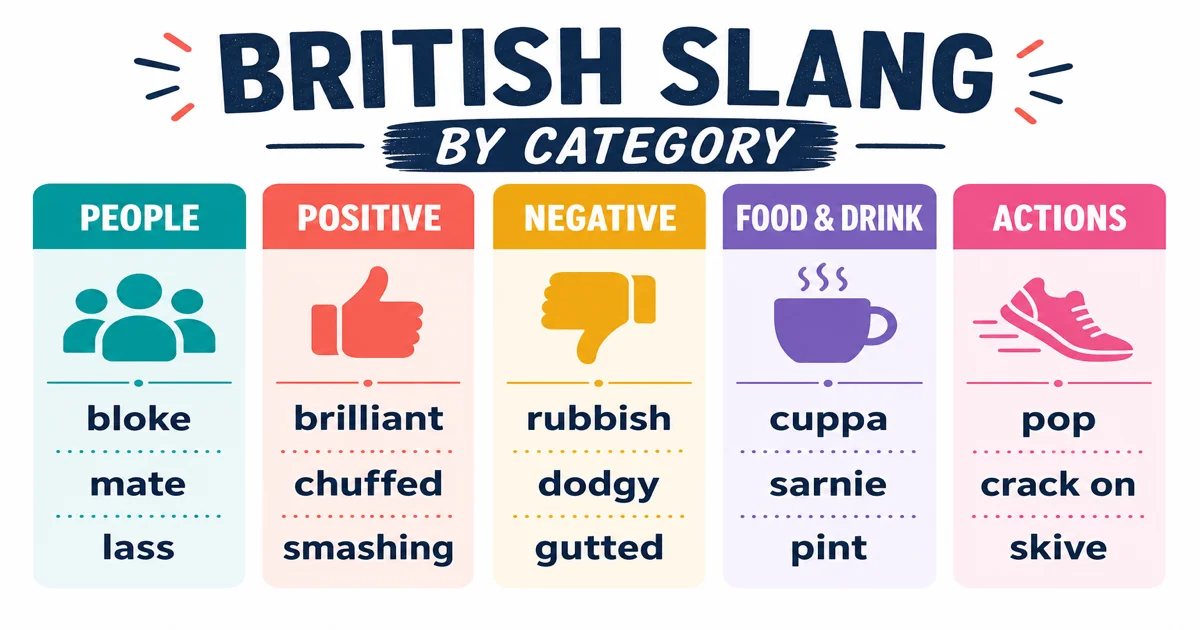
| 번호 | 단어/표현 | 뜻 | 예문 |
|---|---|---|---|
| 61 | cuppa | 차 한 잔 | Fancy a cuppa? |
| 62 | brew | 차 한 잔 | Put the kettle on — I need a brew. |
| 63 | biscuit | 쿠키 (미국 영어) | Would you like a biscuit with your tea? |
| 64 | chips | 감자튀김 | Fish and chips, please. |
| 65 | crisps | 감자칩 | Pass me the crisps — salt and vinegar. |
| 66 | sarnie | 샌드위치 | I’ll grab a bacon sarnie for lunch. |
| 67 | butty | 샌드위치 (북부) | A chip butty is a Northern classic. |
| 68 | nosh | 음식; 먹다 | Let’s grab some nosh before the film. |
| 69 | scran | 음식 (북부/군대) | What’s for scran tonight? |
| 70 | peckish | 약간 배고픈 | I’m a bit peckish — got any snacks? |
| 71 | starving | 몹시 배고픈 (과장) | I’m starving — can we eat soon? |
| 72 | brekkie | 아침 식사 | What are you having for brekkie? |
| 73 | tea | 저녁 식사 (북부) | “What’s for tea, Mum?” |
| 74 | gaffer tape | 덕트 테이프 | Fix it with gaffer tape — that’ll do. |
| 75 | ploughman’s | 빵과 치즈, 피클로 구성된 차가운 점심 식사 | I’ll have the ploughman’s, please. |
| 76 | pint | 맥주 한 잔 | Let’s grab a pint after work. |
| 77 | off-licence | 술을 파는 가게 | Pop to the off-licence and grab some wine. |
| 78 | bladdered / trolleyed | 몹시 취한 | He was absolutely bladdered by 9 o’clock. |
| 79 | legless | 만취한 | She was legless after three cocktails. |
| 80 | pissed | 취한 (미국 영어처럼 화난 상태가 아님) | He got pissed at the office Christmas party. |
일상 행동
| 번호 | 단어/표현 | 뜻 | 예문 |
|---|---|---|---|
| 81 | pop | 잠깐 다녀오다 | I’m just going to pop to the shops. |
| 82 | nip | 잠깐 다녀오다 (북부) | I’ll nip out for some milk. |
| 83 | crack on | 시작하다; 일을 계속하다 | Right, let’s crack on with the meeting. |
| 84 | faff about | 시간을 낭비하다; 꾸물대다 | Stop faffing about and get ready! |
| 85 | have a go | 시도해 보다 | I’ve never tried it, but I’ll have a go. |
| 86 | sort it | 고치다; 정리하다 | Don’t worry — I’ll sort it. |
| 87 | suss out | 알아내다; 조사하다 | I need to suss out the best route. |
| 88 | take the mickey / take the mick | 놀리다; 비웃다 | Are you taking the mick? |
| 89 | wind someone up | 일부러 짜증 나게 하거나 놀리다 | He loves winding his sister up. |
| 90 | leg it | 급히 도망치다 | We saw the security guard and legged it. |
| 91 | skive | 일이나 학교를 빼먹다 | He skived off school to go to the cinema. |
| 92 | bunk off | 학교나 일을 빠지다 | We used to bunk off on Fridays. |
| 93 | chat up | 추파를 던지다; 꼬시려 하다 | He was trying to chat up the barmaid. |
| 94 | kip | 낮잠; 자다 | I need a quick kip before we go out. |
| 95 | bog | 화장실 | Where’s the bog? I need a wee. |
| 96 | loo | 화장실 (정중한 표현) | Excuse me, where’s the loo? |
| 97 | ring / give a bell | 전화하다 | Give me a bell when you arrive. |
| 98 | nick | 훔치다; 경찰서나 감옥을 뜻하기도 함 | Someone nicked my bike! |
| 99 | grass | 누군가를 밀고하다; 고자질하다 | Don’t grass on your mates. |
| 100 | chuck | 던지다; 연인과 헤어지다라는 뜻으로도 사용 | Chuck that in the bin. / She chucked him last week. |
장소와 사물
| 번호 | 단어/표현 | 뜻 | 예문 |
|---|---|---|---|
| 101 | gaff | 집; 거처 | Come round to my gaff tonight. |
| 102 | flat | 아파트 | She lives in a flat in Notting Hill. |
| 103 | the tube | 런던 지하철 | Take the tube to Piccadilly Circus. |
| 104 | chemist | 약국 | I need to pop to the chemist for some paracetamol. |
| 105 | off-licence | 주류 판매점 | Grab a bottle from the off-licence. |
| 106 | boot | 자동차 트렁크 | Put the bags in the boot. |
| 107 | bonnet | 자동차 보닛 | Open the bonnet — something’s rattling. |
| 108 | lorry | 대형 트럭 | A lorry broke down on the M25. |
| 109 | motorway | 고속도로 | Take the motorway — it’s faster. |
| 110 | pavement | 인도 | Walk on the pavement, not the road. |
| 111 | zebra crossing | 횡단보도 | Use the zebra crossing to get across. |
| 112 | roundabout | 로터리; 회전 교차로 | Take the third exit at the roundabout. |
| 113 | queue | 줄; 대기 행렬 | There’s a massive queue outside the shop. |
| 114 | telly | 텔레비전 | What’s on the telly tonight? |
| 115 | mobile | 휴대전화 | What’s your mobile number? |
| 116 | quid | 파운드 (£1) | That’ll be five quid, mate. |
| 117 | fiver | 5파운드 지폐 | Have you got a fiver I can borrow? |
| 118 | tenner | 10파운드 지폐 | It only costs a tenner to get in. |
| 119 | brolly | 우산 | Grab your brolly — it’s going to rain. |
| 120 | jumper | 스웨터; 풀오버 | Put a jumper on — it’s freezing. |
대화 표현
| 번호 | 단어/표현 | 뜻 | 예문 |
|---|---|---|---|
| 121 | alright? | 안녕; 잘 지내? | “Alright, mate?” “Yeah, not bad.” |
| 122 | cheers | 고마워; 건배할 때도 사용 | Cheers for helping me with that. |
| 123 | ta | 고마워 (매우 비격식) | “Here’s your change.” “Ta!” |
| 124 | sorted | 끝난; 정리된; 해결된 | “Is everything ready?” “Yeah, sorted.” |
| 125 | no worries | 괜찮아; 걱정하지 마 | “Sorry I’m late.” “No worries.” |
| 126 | fair enough | 그럴 만하네; 납득할게 | “I can’t come tonight.” “Fair enough.” |
| 127 | innit | 그렇지? (런던) | Cold today, innit? |
| 128 | you what? | 뭐라고? 다시 말해 줄래? (놀라거나 믿기 어려울 때) | “I’m moving to Australia.” “You what?!” |
| 129 | blimey | 놀라움을 나타내는 감탄사 | Blimey, that was quick! |
| 130 | bloody hell | 놀람이나 짜증을 나타내는 감탄사 | Bloody hell, look at the time! |
| 131 | crikey | 놀라움을 나타내는 감탄사 (옛스러운 표현) | Crikey, the prices have gone up! |
| 132 | cor blimey | 강한 놀라움을 나타내는 감탄사 | Cor blimey, that’s expensive! |
| 133 | bob’s your uncle | 자, 됐다; 그러면 끝이다라는 뜻 | Put it in the oven for 20 minutes, and Bob’s your uncle. |
| 134 | easy peasy | 아주 쉬운 | “Is it hard to make?” “No, easy peasy.” |
| 135 | spot on | 정확한; 완벽한 | Your prediction was spot on. |
| 136 | not my cup of tea | 내가 좋아하는 것이 아닌 | Horror films aren’t my cup of tea. |
| 137 | taking the biscuit | 도가 지나친; 터무니없는 | Arriving two hours late really takes the biscuit. |
| 138 | you’re having a laugh | 농담하는 거겠지; 말도 안 돼 | £200 for a parking fine? You’re having a laugh! |
| 139 | do one | 꺼져 (무례한 표현) | Tell him to do one. |
| 140 | get in! | 좋아!; 해냈다! (축하할 때) | “We won the match!” “Get in!” |
날씨와 기분
| 번호 | 단어/표현 | 뜻 | 예문 |
|---|---|---|---|
| 141 | chilly | 춥지만 얼 정도는 아닌 | It’s a bit chilly out — grab a jacket. |
| 142 | nippy | 추운 | It’s nippy this morning! |
| 143 | brass monkeys | 몹시 추운 | It’s brass monkeys outside — stay in. |
| 144 | bucketing down | 비가 억수같이 쏟아지는 | It’s absolutely bucketing down out there. |
| 145 | drizzle | 보슬비; 이슬비 | It’s just a drizzle — you don’t need a brolly. |
| 146 | scorching | 매우 더운; 타는 듯한 | It’s scorching today — 35 degrees! |
| 147 | muggy | 덥고 습한 | It’s so muggy — I can barely breathe. |
| 148 | miserable | (날씨가) 불쾌한 | What miserable weather we’re having. |
| 149 | moody | 변덕스럽고 예측하기 어려운 | The weather’s been dead moody this week. |
| 150 | right | 매우; 완전히 (강조어) | He’s a right laugh. / It’s a right mess. |
직장과 돈
| 번호 | 단어/표현 | 뜻 | 예문 |
|---|---|---|---|
| 151 | sack / get the sack | 해고하다 / 해고당하다 | He got the sack for being late too often. |
| 152 | make redundant | 정리 해고하다 | They made 200 workers redundant. |
| 153 | do overtime | 초과 근무하다 | I’ve been doing overtime all month. |
| 154 | cushy | 쉽고 편한 (직업) | He’s got a cushy job in the city. |
| 155 | doddle | 아주 쉬운 일 | The exam was an absolute doddle. |
| 156 | skint | 돈이 하나도 없는 | I’m skint until payday. |
| 157 | loaded | 아주 부유한 | Her parents are absolutely loaded. |
| 158 | splash out | 돈을 많이 쓰다 | We splashed out on a fancy dinner. |
| 159 | rip-off | 바가지를 씌우는 물건이나 서비스 | £8 for a coffee? What a rip-off! |
| 160 | a steal | 아주 싸게 산 물건; 득템 | That coat was a steal at £30. |
영국식 영어와 미국식 영어: 주요 차이
아래 단어들은 속어가 아니라 미국식 영어와 다른 표준 영국식 영어입니다.
| 영국식 표현 | 미국식 표현 | 뜻 |
|---|---|---|
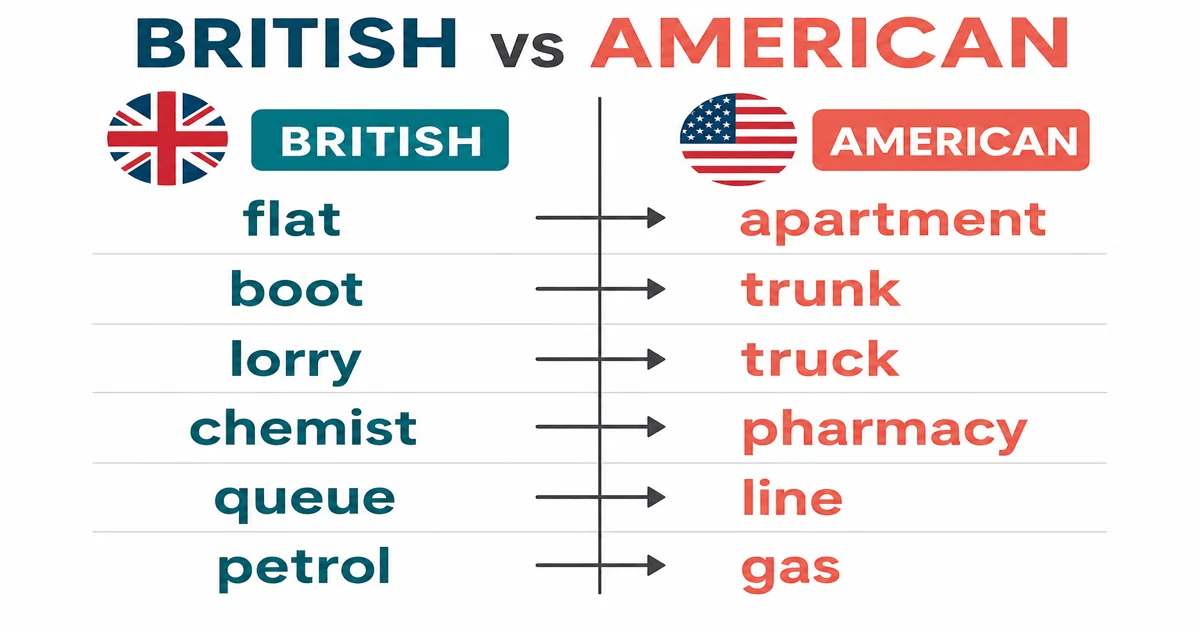
| flat | apartment | 한 층에 있는 주거 공간 |
| lift | elevator | 위아래로 이동하는 승강기 |
| boot | trunk | 자동차 뒤쪽 짐칸 |
| bonnet | hood | 자동차 앞부분의 덮개 |
| lorry | truck | 대형 차량 |
| petrol | gas/gasoline | 연료 |
| nappy | diaper | 아기 기저귀 |
| dummy | pacifier | 아기 공갈 젖꼭지 |
| cot | crib | 아기 침대 |
| post | 편지와 소포 | |
| torch | flashlight | 휴대용 조명 |
| holiday | vacation | 휴가 |
| queue | line | 기다리는 사람들의 줄 |
| bin | trash can | 쓰레기통 |
| rubber | eraser | 연필 자국을 지우는 도구 |
| autumn | fall | 가을 |
| football | soccer | 축구 |
| trousers | pants | 다리를 덮는 옷; 바지 |
| pants | underwear | 속옷 |
| trainers | sneakers | 운동화 |
주의: 영국 영어에서 “Pants”는 속옷을 뜻합니다. 영국인에게 “nice pants”라고 하면 미국에서와는 전혀 다른 반응을 얻을 수 있습니다.
지역별 표현 차이
영국 속어는 지역에 따라 차이가 아주 큽니다.
| 지역 | 고유한 속어 | 예시 |
|---|---|---|
| 런던 | 코크니 운율 속어 | dog and bone (전화기), plates of meat (발) |
| 맨체스터 | 맨쿠니 방언 | mint (훌륭한), our kid (형제자매/가까운 친구) |
| 리버풀 | 스카우스 방언 | boss (훌륭한), la (친구, 젊은 남자) |
| 뉴캐슬 | 조디 방언 | canny (좋은), gan (가다), howay (자, 어서) |
| 버밍엄 | 브러미 방언 | bostin (훌륭한), bab (자기야, 애칭) |
| 요크셔 | 요크셔 방언 | reyt (맞는/매우), nowt (아무것도), summat (무언가) |
| 스코틀랜드 | 스코츠어 | braw (괜찮은, 좋은), wee (작은), ken (알다) |
| 웨일스 | 웨일스 영어 | lush (멋진), tidy (좋은), tamping (몹시 화난) |
영국 속어 이해하기
1. 영국 TV를 보세요. Peep Show, The Inbetweeners, Derry Girls, Top Boy 같은 프로그램에는 실제 문맥에서 사용되는 영국 속어가 풍부합니다.
2. 문맥을 들으세요. 단어를 모르더라도 말투와 주변 단어를 보면 긍정적인 뜻인지 부정적인 뜻인지 대체로 알 수 있습니다.
3. 물어보세요. 영국 사람들은 자신들의 속어를 설명해 주는 것을 좋아합니다. “What does ‘chuffed’ mean?”이라고 묻는 것은 아주 자연스러운 질문입니다.
4. (조심해서) 직접 사용해 보세요. “brilliant”, “cheers”, “mate”, “lovely”처럼 어디서나 통하는 단어부터 시작하세요. 사회적 문맥을 이해할 때까지 지역 표현이나 모욕적인 표현은 피하세요.
5. Linglify에 추가하세요. 간격 반복으로 연습할 수 있도록 영국 속어를 어휘 목록에 추가하세요.
연습할 단어
boom
명사
-
예문
- The boom of thunder echoed across the valley.
- The technology boom created many new millionaires.
cooperate
동사
-
evaluate
동사
-
예문
- Companies evaluate job candidates based on experience, skills, and personality.
- Teachers evaluate student progress through tests, projects, and classroom participation.
graduate
동사
-
예문
- She will graduate from university next year with a degree in engineering.
- Students must complete all requirements before they can graduate from high school.
horizon
명사
-
예문
- The sun disappeared behind the horizon as evening approached.
- Traveling broadens your horizon and exposes you to new cultures.
indispensable
형용사
-
예문
- Clean water is indispensable for human survival and good health.
- Her experience and skills make her indispensable to the research team.
jury
명사
-
예문
- The jury deliberated for several hours before reaching a verdict.
- The talent show jury consisted of professional musicians and entertainers.
lifelong
형용사
-
예문
- Learning is a lifelong process that never truly ends.
- Their lifelong friendship began during elementary school years.
motivated
형용사
-
예문
- Motivated employee seeks additional responsibilities and challenges at work.
- Success requires being motivated even when facing difficult obstacles.
normally
부사
-
예문
- Heart normally beats between sixty and hundred times per minute.
- Students normally arrive at school before morning bell rings.
off
동사
-
예문
- Please turn off the lights before leaving the room.
- The dog ran off into the forest chasing wild rabbits.
prejudice
명사
-
예문
- Education helps overcome prejudice and promotes understanding.
- Racial prejudice damages communities and individuals alike.
resolve
동사
-
예문
- Mediator helps parties resolve dispute through negotiation.
- Technical team will resolve software problems quickly.
stress
동사
-
예문
- Heavy workload may stress employees beyond limits.
- Teacher will stress importance of homework completion.
total
형용사
-
예문
- Total cost includes all fees and expenses.
- Total silence fills room during meditation session.
tragedy
명사
-
예문
- Natural tragedy affects thousands of innocent people.
- Personal tragedy changes person's life perspective completely.
union
명사
-
예문
- Labor union protects worker rights and interests.
- Marriage union joins two people in partnership.
voyage
명사
-
예문
- Space exploration represents humanity's greatest voyage into the unknown.
- The ocean voyage from Europe to America took several weeks in the past.
candidate
명사
-
예문
- Each presidential candidate presented their policy plans to voters.
- The job candidate impressed the interview panel with her experience.
discourage
동사
-
예문
- Don't let one failure discourage you from pursuing your dreams.
- High prices discourage many people from buying organic food products.
donate
동사
-
예문
- Many people donate money to charities that help homeless individuals.
- She decided to donate blood to help patients in emergency situations.
firmly
부사
-
예문
- Hold the rope firmly while climbing down the steep mountain slope.
- The manager firmly believed in treating all employees with respect.
guide
동사
-
예문
- Parents should guide their children to make responsible decisions.
- The experienced hiker will guide the group through the mountain trail safely.
humorous
형용사
-
예문
- She writes humorous articles about everyday life and family experiences.
- The humorous speech made everyone laugh and lightened the serious mood.
admission
명사
-
예문
- Her admission to the prestigious medical school was the result of hard work.
- The museum offers free admission on the first Sunday of every month.
다음 단계
-
단어 10개를 고르세요. 들어 본 적은 있지만 한 번도 사용하지 않은 단어를 골라 뜻과 함께 적으세요.
-
영국 TV 프로그램을 보세요. 이 단어들이 나오는지 듣고 실제 대화에서 쓰이는 방식을 기록하세요.
-
영국 속어를 Linglify에 추가하세요. 간격 반복으로 연습할 수 있습니다.
-
영국 관용구도 익히세요. 영어 관용구: 흔히 쓰는 표현 500개 이상에는 영국에서만 쓰이는 표현도 많이 포함되어 있습니다.
-
미국식 영어와 비교하세요. 차이를 알면 특히 “pants”처럼 난처한 오해를 막을 수 있습니다.
자주 묻는 질문
가장 흔히 쓰이는 영국 속어에는 어떤 것이 있나요?
지역에 상관없이 널리 쓰이는 표현은 mate (친구), brilliant (훌륭한), cheers (고마워), lovely (좋은), rubbish (터무니없는 말/형편없는), knackered (몹시 피곤한), quid (파운드), dodgy (수상한), sorted (정리된), bloke (남자)입니다. 영국 전역에서 이해되며 대부분의 비격식 상황에서 안심하고 사용할 수 있습니다.
영국 속어는 무례한 표현인가요?
단어와 문맥에 따라 다릅니다. “brilliant”, “lovely”, “cheers”, “mate”는 전혀 무례하지 않습니다. “bloody”, “pissed”, “sod off”는 약간 무례한 표현입니다. “tosser” 같은 단어나 더 강한 표현은 모욕적이므로 예의가 필요한 자리에서는 피해야 합니다. 일반적으로 할머니 앞에서 쓰지 않을 단어라면 모르는 사람에게도 쓰지 마세요.
영국 사람들은 모두 같은 속어를 사용하나요?
아니요. 영국 속어는 지역과 나이, 사회 계층에 따라 크게 달라집니다. 런던의 십 대가 쓰는 표현은 요크셔의 농부나 에든버러의 학생이 사용하는 말과 아주 다를 수 있습니다. “cheers”와 “mate”처럼 어디서나 쓰이는 단어가 있는 반면, “boss”는 리버풀, “mint”는 맨체스터, “braw”는 스코틀랜드 출신임을 바로 드러내는 말도 있습니다.
IELTS나 격식 있는 상황에서 영국 속어를 사용해도 되나요?
아니요. IELTS 시험관과 격식 있는 상황에서는 표준 영어를 사용해야 합니다. 학술 글쓰기와 비즈니스 발표, 면접에서 속어를 쓰면 신뢰도에 악영향을 줄 수 있습니다. 영국 속어는 비격식 대화와 문자, 사교 상황에서 쓰세요. IELTS Speaking 시험에서는 “brilliant”나 “lovely”처럼 흔한 표현은 괜찮지만 “gutted”나 “well fit”처럼 강한 속어는 적절하지 않습니다.
영국 속어는 미국 속어와 어떻게 다른가요?
영국과 미국의 속어는 서로 다른 문화의 영향을 받아 각각 발전했습니다. 대표적인 차이는 “pissed”(영국: 취한 / 미국: 화난), “pants”(영국: 속옷 / 미국: 바지), “chips”(영국: 감자튀김 / 미국: 감자칩), “fit”(영국: 매력적인 / 미국: 건강한)입니다. chuffed, gobsmacked, knackered처럼 미국식 표현으로 정확히 옮기기 어려운 영국 속어가 많으며, 그 반대도 마찬가지입니다.


