
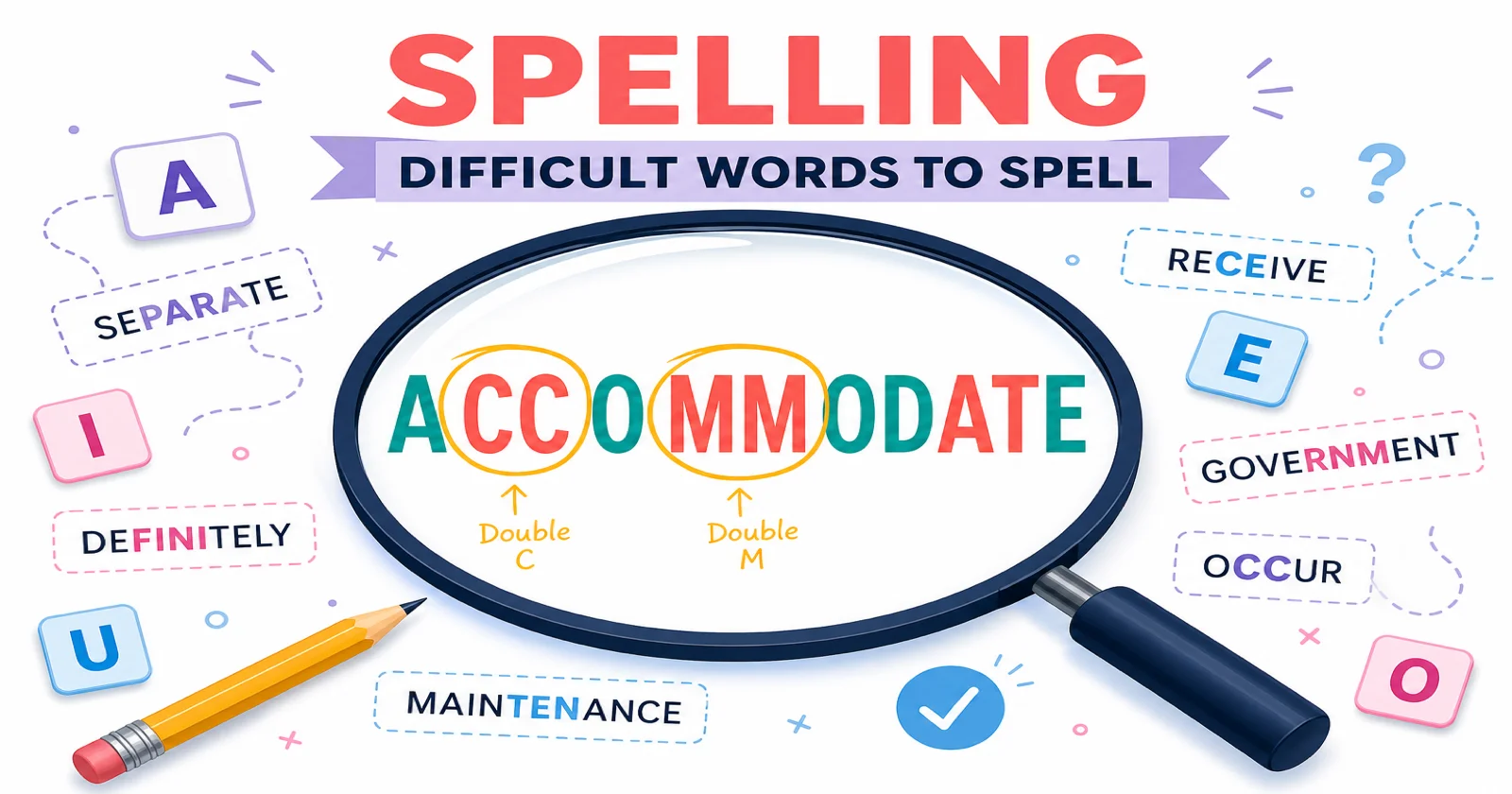
영어 철자가 어려운 단어 200개: 헷갈리는 단어와 암기 팁
영어 철자는 불규칙하기로 유명합니다. 같은 소리를 열 가지 방식으로 쓸 수 있고(through, too, blue, shoe, crew, you, flu, coup, Hugh, lieu), 같은 글자 조합이 완전히 다른 소리를 내기도 합니다(cough, through, though, thought, tough). 원어민도 흔히 쓰는 단어의 철자를 평생 잘못 쓰곤 합니다.
영어 철자는 왜 이렇게 혼란스러울까요? 영어가 라틴어와 그리스어, 프랑스어, 독일어, 고대 노르드어, 아랍어, 힌디어를 비롯한 수십 개 언어에서 단어를 빌려 오면서 발음은 바꾸고 원래 철자는 그대로 둔 경우가 많기 때문입니다. 그 결과 “colonel”은 “kernel”처럼 발음되고 “Wednesday”에서는 “d”가 묵음인 언어가 되었습니다.
이 가이드에서는 가장 자주 틀리는 영어 단어 200개를 철자 함정의 유형별로 정리합니다. 각 단어에 흔한 오답과 올바른 철자, 정확히 쓸 수 있도록 도와주는 암기 팁을 담았습니다.
- 전체: 철자가 어려운 단어 200개
- 구성: 올바른 철자 → 흔한 오답 → 암기 팁
- 분류: 묵음, 이중 자음 등 철자 패턴별
- 수준: A2–C1
- 추천 대상: 철자 향상, 시험 준비, 글쓰기 자신감
철자 외에 어려운 영어 단어를 더 알아보려면 어려운 영어 단어 500개 이상을 참고하세요.
영어 철자가 어려운 이유
영어에는 소리가 44개 있지만 글자는 26개뿐입니다. 이 불일치가 혼란을 만듭니다.
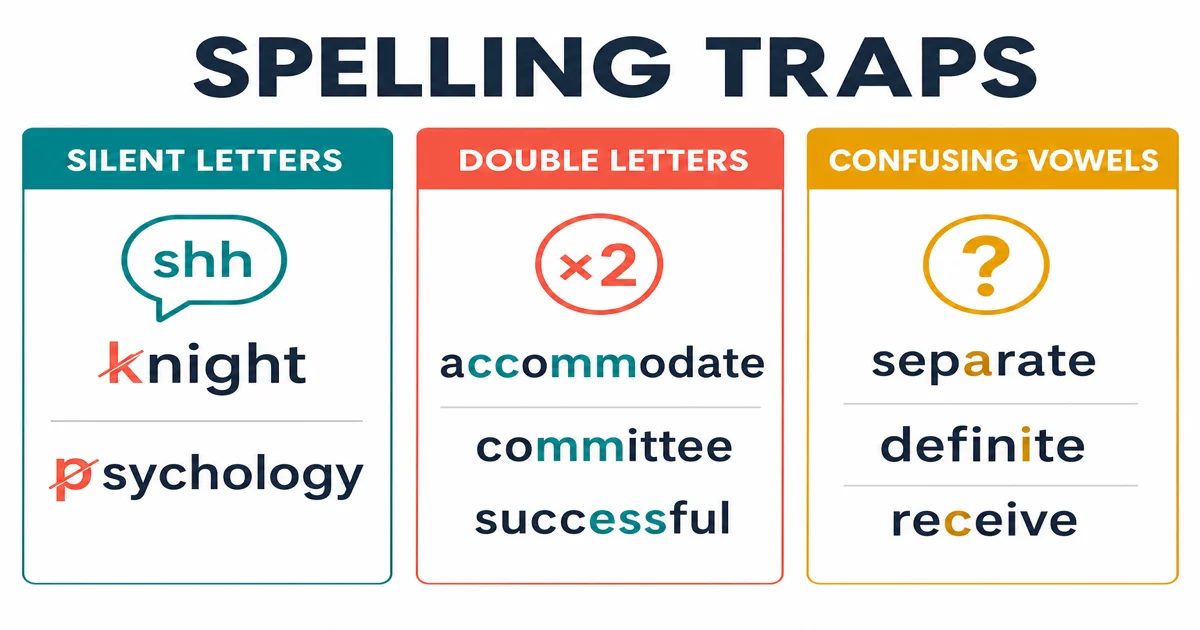
| 문제 | 예시 | 무엇이 어려운가 |
|---|---|---|
| 묵음 | knight, psychology, receipt | 보이지만 발음되지 않는 글자 |
| 이중 자음 | accommodate, occurrence | 한 개일까 두 개일까? 기억하기 어렵다 |
| 강세가 없는 모음 | separate, definitely | 말할 때 “어”처럼 들리는 모음 |
| -ible과 -able | responsible, comfortable | 어느 어미를 써야 하는지 분명한 규칙이 없다 |
| -ence와 -ance | occurrence, resistance | 두 어미의 발음이 똑같다 |
| i before e | receive, weird, seize | 이 “규칙”을 따르지 않는 예외가 훨씬 많다 |
좋은 소식은 철자 오류 대부분이 예상할 수 있는 패턴에 속한다는 점입니다. 패턴을 익히면 실수의 80%를 줄일 수 있습니다.
묵음이 있는 단어 (30개)
이 단어에는 글로 쓰지만 발음하지 않는 글자가 들어 있습니다. 영어 철자에서 가장 속기 쉬운 함정입니다.
| 번호 | 올바른 철자 | 흔한 오답 | 암기 팁 |
|---|---|---|---|
| 1 | acquaintance |
|
ACQuire an ACQuaintance — 두 단어에 모두 ACQ가 들어갑니다. |
| 2 | acknowledge |
|
aCKnowledge에서 CK를 기억하세요. |
| 3 | column |
|
기둥(column)이 조용히 서 있는 것처럼 N은 묵음입니다. |
| 4 | conscience |
|
CON + SCIENCE = conscience. |
| 5 | fascinate |
|
science처럼 안에 숨은 SC를 기억하세요. |
| 6 | foreign |
|
FORE + IGN — 낯선 순서를 기억하세요. |
| 7 | government |
|
GOVERN + MENT — N을 빼지 마세요. |
| 8 | guarantee |
|
GUA + RAN + TEE, 세 부분으로 나누세요. |
| 9 | handkerchief |
|
HAND + KERCHIEF — 손(hand)에 쓰는 물건입니다. |
| 10 | island |
|
island에는 IS LAND가 들어 있습니다. |
| 11 | knight |
|
고대 영어에서 온 묵음 K입니다. |
| 12 | knowledge |
|
KNOW + LEDGE — 아는 곳(ledge)을 떠올려 보세요. |
| 13 | listen |
|
LISTEN의 T는 묵음입니다. |
| 14 | mortgage |
|
MORT(죽음) + GAGE — “죽음의 서약”이라는 어원을 떠올리세요. |
| 15 | muscle |
|
MUSC + LE — muscular를 생각해 보세요. |
| 16 | pneumonia |
|
그리스어 pneuma(숨)에서 온 묵음 P입니다. |
| 17 | psychology |
|
그리스어 psyche(마음)에서 온 묵음 P입니다. |
| 18 | receipt |
|
묵음 P를 기억하세요: receiPt. |
| 19 | rhythm |
|
Rhythm Has Your Two Hips Moving의 머리글자를 떠올리세요. |
| 20 | salmon |
|
묵음 L을 기억하세요: SALmon. |
| 21 | scissors |
|
SC + ISSORS — S가 두 개입니다. |
| 22 | subtle |
|
subtle의 B는 눈에 잘 띄지 않습니다. |
| 23 | sword |
|
고대 영어에서 온 묵음 W입니다. |
| 24 | technique |
|
TECH + NIQUE — H를 빼지 마세요. |
| 25 | Wednesday |
|
WED + NES + DAY — Woden의 이름에서 왔습니다. |
| 26 | whistle |
|
처음의 WH와 중간의 T를 기억하세요. |
| 27 | wrestle |
|
write, wrong처럼 W가 묵음입니다. |
| 28 | yacht |
|
네덜란드어에서 왔으며 CH는 묵음입니다. |
| 29 | answer |
|
묵음 W를 기억하세요: ansWer. |
| 30 | doubt |
|
라틴어 dubitare에서 온 묵음 B입니다. |
이중 자음이 있는 단어 (35개)
가장 흔한 철자 실수는 자음을 두 번 써야 하는 곳에서 한 번만 쓰거나, 엉뚱한 글자를 두 번 쓰는 것입니다.
| 번호 | 올바른 철자 | 흔한 오답 | 암기 팁 |
|---|---|---|---|
| 31 | accommodate |
|
C 두 개, M 두 개 — 둘 다 들어갈 만큼 넉넉한 단어입니다. |
| 32 | accelerate |
|
C 두 개, L 한 개 — aCCeLerate. |
| 33 | accessory |
|
C 두 개, S 두 개 — aCCeSSory. |
| 34 | aggressive |
|
G 두 개 — aGGressive. |
| 35 | apparent |
|
P 두 개 — aPParent. |
| 36 | broccoli |
|
C 두 개, L 한 개 — broCColi. |
| 37 | Caribbean |
|
R 한 개, B 두 개 — caRiBBean. |
| 38 | committed |
|
M 두 개, T 두 개 — coMMiTTed. |
| 39 | committee |
|
M 두 개, T 두 개, E 두 개 — coMMiTTEE. |
| 40 | disappear |
|
S 한 개, P 두 개 — diSaPPear. |
| 41 | disappoint |
|
S 한 개, P 두 개 — diSaPPoint. |
| 42 | embarrass |
|
R 두 개, S 두 개 — embaRRaSS. |
| 43 | exaggerate |
|
G 두 개 — exaGGerate. |
| 44 | excellence |
|
L 두 개 — exceLLence. |
| 45 | harass |
|
R 한 개, S 두 개 — haRaSS. |
| 46 | innocence |
|
N 두 개 — iNNocence. |
| 47 | interrupt |
|
R 두 개 — inteRRupt. |
| 48 | millennium |
|
L 두 개, N 두 개 — miLLeNNium. |
| 49 | misspell |
|
MIS + SPELL — 아이러니하게도 S가 두 개입니다. |
| 50 | necessary |
|
C 한 개, S 두 개 — 셔츠에는 깃(Collar) 하나와 소매(Sleeves) 두 개가 있습니다. |
| 51 | occasion |
|
C 두 개, S 한 개 — oCCaSion. |
| 52 | occurrence |
|
C 두 개, R 두 개 — oCCuRRence. |
| 53 | parallel |
|
가운데 L이 두 개 — paraLLel. |
| 54 | possession |
|
S가 두 번씩 두 개 — poSSESSion. |
| 55 | professional |
|
F 한 개, S 두 개 — proFeSSional. |
| 56 | questionnaire |
|
N 두 개 — questioNNaire. |
| 57 | recommend |
|
C 한 개, M 두 개 — reCoMMend. |
| 58 | referring |
|
R 두 개 — refeRRing. |
| 59 | succeed |
|
C 두 개 — suCCeed. |
| 60 | suggest |
|
G 두 개 — suGGest. |
| 61 | tomorrow |
|
M 한 개, R 두 개 — toMoRRow. |
| 62 | address |
|
D 두 개 — aDDress. |
| 63 | assistant |
|
S 두 개 — aSSistant. |
| 64 | beginning |
|
N 두 개 — begiNNing. |
| 65 | different |
|
F 두 개 — diFFerent. |
헷갈리는 모음 (30개)
모음에 강세가 없으면 모두 “어”(/ə/, 슈와 소리)처럼 들립니다. 그래서 귀로 듣고 철자를 쓰기가 불가능해집니다.
| 번호 | 올바른 철자 | 흔한 오답 | 암기 팁 |
|---|---|---|---|
| 66 | separate |
|
separate 안에 A RAT가 있다고 기억하세요. |
| 67 | definitely |
|
가운데에 FINITE가 있습니다 — deFINITEly. |
| 68 | desperate |
|
PARATE가 아니라 PERATE를 떠올리세요. |
| 69 | calendar |
|
cAlEndAr — A가 두 개입니다. |
| 70 | cemetery |
|
E만 쓰는 단어 — cEmEtEry. |
| 71 | category |
|
catEgory — 가운데는 E입니다. |
| 72 | privilege |
|
D는 없습니다 — priviLEGE. |
| 73 | relevant |
|
relEvAnt — E 다음에 A가 옵니다. |
| 74 | independent |
|
끝은 DENT입니다 — indepenDENT. |
| 75 | repetition |
|
rEpEtition — E가 두 개입니다. |
| 76 | resistance |
|
resistANCE — E가 아니라 A입니다. |
| 77 | maintenance |
|
MAIN + TEN + ANCE. |
| 78 | miniature |
|
MINI + ATURE — I를 빼지 마세요. |
| 79 | original |
|
ORIGIN + AL. |
| 80 | temperature |
|
TEMPER + ATURE — 두 번째 E를 남기세요. |
| 81 | tolerance |
|
tolerANCE — E가 아니라 A입니다. |
| 82 | ignorance |
|
ignorANCE — E가 아니라 A입니다. |
| 83 | abundance |
|
abundANCE — E가 아니라 A입니다. |
| 84 | existence |
|
existENCE — A가 아니라 E입니다. |
| 85 | occurrence |
|
occurrENCE — A가 아니라 E입니다. |
| 86 | preference |
|
preferENCE — A가 아니라 E입니다. |
| 87 | reference |
|
referENCE — A가 아니라 E입니다. |
| 88 | experience |
|
experiENCE — A가 아니라 E입니다. |
| 89 | absence |
|
abSENCE — SENSE가 아닙니다. |
| 90 | license |
|
LICENSE — C 다음에 S가 옵니다. |
| 91 | medicine |
|
mEDICine — 안에 MEDIC이 있습니다. |
| 92 | vegetable |
|
E가 세 번 들어갑니다 — vEGEtablE. |
| 93 | secretary |
|
SECRET + ARY. |
| 94 | laboratory |
|
LABOR + ATORY — 두 번째 O를 남기세요. |
| 95 | vocabulary |
|
VOCAB + ULARY. |
-ible과 -able (20개)
믿을 만한 규칙은 없습니다. 각 단어에 어떤 어미가 붙는지 익혀야 합니다.
| 번호 | 올바른 철자 | 흔한 오답 | 암기 팁 |
|---|---|---|---|
| 96 | responsible |
|
responsIBLE. |
| 97 | terrible |
|
terrIBLE. |
| 98 | visible |
|
visIBLE. |
| 99 | possible |
|
possIBLE. |
| 100 | flexible |
|
flexIBLE. |
| 101 | incredible |
|
incredIBLE. |
| 102 | accessible |
|
accessIBLE. |
| 103 | compatible |
|
compatIBLE. |
| 104 | comfortable |
|
comfortABLE. |
| 105 | available |
|
availABLE. |
| 106 | reasonable |
|
reasonABLE. |
| 107 | knowledgeable |
|
knowledgeABLE. |
| 108 | manageable |
|
manageABLE. |
| 109 | noticeable |
|
noticeABLE — E를 남기세요. |
| 110 | changeable |
|
changeABLE — E를 남기세요. |
| 111 | believable |
|
believABLE. |
| 112 | dependable |
|
dependABLE. |
| 113 | considerable |
|
considerABLE. |
| 114 | inevitable |
|
inevitABLE. |
| 115 | memorable |
|
memorABLE. |
ie와 ei (15개)
“i before e, except after c”라는 규칙에는 예외가 너무 많아 규칙이라고 하기 어렵습니다.
| 번호 | 올바른 철자 | 흔한 오답 | 암기 팁 |
|---|---|---|---|
| 116 | receive |
|
C 다음에는 EI: reCEIve. |
| 117 | believe |
|
C가 없으면 IE: beLIEve (거짓말(LIE)을 믿지 마세요). |
| 118 | achieve |
|
C가 없으면 IE: achIEve. |
| 119 | deceive |
|
C 다음에는 EI: deCEIve. |
| 120 | perceive |
|
C 다음에는 EI: perCEIve. |
| 121 | conceive |
|
C 다음에는 EI: conCEIve. |
| 122 | ceiling |
|
C 다음에는 EI: cEIling. |
| 123 | weird |
|
예외입니다! WEIRD는 정말 이상한 단어입니다. |
| 124 | seize |
|
예외입니다! SEIze. |
| 125 | their |
|
예외입니다! THEIR = THEy + IR. |
| 126 | height |
|
예외입니다! HEIght — “아이”처럼 발음됩니다. |
| 127 | neighbor |
|
“에이” 소리가 나면 EI: nEIghbor. |
| 128 | freight |
|
“에이” 소리가 나면 EI: frEIght. |
| 129 | protein |
|
예외입니다! protEIn. |
| 130 | foreign |
|
예외입니다! forEIgn. |
사람들이 자주 혼동하는 단어 (25개)
이 단어들은 철자만 어려운 것이 아니라 서로 구별하기도 어렵습니다.
| 번호 | 올바른 형태 | 혼동하는 단어 | 차이점 |
|---|---|---|---|
| 131 | affect (동사) | effect (명사) | The rain will affect your plans. / The effect was immediate. |
| 132 | principal (주요한/교장) | principle (원칙) | The principal announced a new principle. |
| 133 | stationary (움직이지 않는) | stationery (문구류) | Stationary = stand still(가만히 서 있다); Stationery = pen and pencil(펜과 연필) |
| 134 | complement (보완하다) | compliment (칭찬) | Complement completes(완성하다); Compliment = “I like you”(나는 네가 좋아) |
| 135 | conscience (양심) | conscious (의식이 있는) | ConsciENCE = inner sENSE(내면의 감각); ConsciOUS = YOU are aware(당신이 의식하고 있음) |
| 136 | desert (건조한 땅) | dessert (단 음식) | Dessert에는 S가 두 개 — 디저트는 늘 한 번 더(Seconds) 먹고 싶으니까요. |
| 137 | loose (헐렁한) | lose (잃어버리다) | Loose = goose; Lose = O 하나가 사라짐 (잃어버렸으니까요!) |
| 138 | its (소유격) | it’s (it is의 축약형) | It’s = it IS (아포스트로피는 축약 표시) |
| 139 | their (소유격) | there/they’re | Their = 소유; There = 장소; They’re = they are |
| 140 | your (소유격) | you’re (you are) | You’re = you ARE |
| 141 | than (비교) | then (시간) | ThAN = compArison(비교); ThEN = whEN(언제) |
| 142 | weather (기후) | whether (인지 아닌지) | wEAther에는 EAr가 있습니다 — 일기예보(weather forecasts)를 듣습니다. |
| 143 | advice (명사) | advise (동사) | AdvICE = 명사 (ICE처럼); AdvISE = 동사 (wISE처럼) |
| 144 | practice (명사) | practise (동사) | 같은 패턴: PractICE = 명사; PractISE = 동사 (영국식 영어) |
| 145 | licence (명사) | license (동사) | 같은 패턴 (영국식 영어) |
| 146 | brake (멈추다) | break (깨뜨리다) | BrAKE = 멈춰 세우는 말뚝(stAKE); BreAK = 무언가가 깨지다(breAKs) |
| 147 | quiet (조용한) | quite (꽤) | quiET = pET는 조용합니다; quiTE = 꽤 다릅니다. |
| 148 | accept (받아들이다) | except (~을 제외하고) | ACcept = ACquire(얻다); EXcept = EXclude(제외하다) |
| 149 | ensure (확실하게 하다) | insure (보험에 들다) | ENsure = 확실하게 만들다; INsure = 보험(INsurance) |
| 150 | emigrate (떠나다) | immigrate (들어오다) | Emigrate = Exit(나가다); Immigrate = come In(들어오다) |
| 151 | elicit (끌어내다) | illicit (불법의) | eLICit = 합법적(Legal); iLLICit = 불법적(iLLegal) |
| 152 | farther (거리) | further (더, 추가로) | fARther = 얼마나 멀리(fAR); fURther = 더 많이 |
| 153 | discreet (신중한) | discrete (분리된) | discrEET = 비밀을 지키는(sEEcretive); discrETE = 분리된(separaTE) |
| 154 | proceed | precede | proCEED = 앞으로 나아가다; preCEDE = 먼저 오다 |
| 155 | personnel (직원) | personal (개인적인) | personNEL = 직원; personAL = 개인적인 |
일상에서 자주 틀리는 단어 (45개)
매일 쓰는 단어인데도 많은 사람이 늘 틀리곤 합니다.
| 번호 | 올바른 철자 | 흔한 오답 | 암기 팁 |
|---|---|---|---|
| 156 | accommodation |
|
C 두 개, M 두 개. |
| 157 | argument |
|
argue에서 E를 빼세요. |
| 158 | beautiful |
|
BEAUTY + FUL (L은 하나). |
| 159 | beginning |
|
N 두 개 — begiNNing. |
| 160 | business |
|
BUS + I + NESS. |
| 161 | completely |
|
COMPLETE + LY. |
| 162 | convenience |
|
conVENience — VENI는 라틴어로 “오다”라는 뜻입니다. |
| 163 | curiosity |
|
“ous”를 빼세요 — CURIOS + ITY. |
| 164 | decision |
|
DECIS + ION (decide에서 왔습니다). |
| 165 | description |
|
DESCription — DESCRIBE에서 B를 빼고 + TION. |
| 166 | development |
|
DEVELOP + MENT (MENT 앞에 E가 없습니다). |
| 167 | dictionary |
|
DICTION + ARY. |
| 168 | disappearance |
|
S 하나, P 두 개 — DIS + APPEARANCE. |
| 169 | discipline |
|
DISC + IP + LINE. |
| 170 | environment |
|
ENVIRON + MENT — N을 남기세요. |
| 171 | especially |
|
E + SPECIAL + LY. |
| 172 | exaggeration |
|
G 두 개 — exaGGeration. |
| 173 | exercise |
|
EXER + CISE. |
| 174 | February |
|
FEB + RU + ARY — 첫 번째 R을 남기세요. |
| 175 | grammar |
|
grammAR는 ER이 아니라 AR로 끝납니다. |
| 176 | immediately |
|
M 두 개 — iMMediately. |
| 177 | jewelry |
|
JEWEL + RY. |
| 178 | judgment |
|
JUDGE에서 E를 빼고 + MENT (미국식 영어). |
| 179 | library |
|
LIB + RARY — 첫 R을 남기세요. |
| 180 | lightning |
|
LIGHT + NING (E가 없습니다). |
| 181 | occasionally |
|
C 두 개, S 한 개 — oCCaSionally. |
| 182 | particular |
|
PARTICULAR — PER가 아니라 PAR. |
| 183 | perseverance |
|
perseverANCE — E가 아니라 A. |
| 184 | preferred |
|
R 두 개 — prefeRRed. |
| 185 | probably |
|
PROB + ABLY. |
| 186 | pronunciation |
|
proNUNciation — “OUNCE”가 없습니다. |
| 187 | restaurant |
|
REST + AU + RANT. |
| 188 | schedule |
|
SCHED + ULE. |
| 189 | sentence |
|
SENT + ENCE. |
| 190 | surprise |
|
SUR + PRISE — 첫 R을 잊지 마세요. |
| 191 | thorough |
|
THOROUGH — 끝에 OUGH가 옵니다. |
| 192 | truly |
|
TRUE에서 E를 빼고 + LY. |
| 193 | twelfth |
|
TWELF + TH — F를 남기세요. |
| 194 | unnecessary |
|
C 한 개, S 두 개 — UN + NECESSARY. |
| 195 | until |
|
L 하나 — untiL. |
| 196 | usually |
|
USUAL + LY. |
| 197 | vacuum |
|
C 한 개, U 두 개 — vaCUUm. |
| 198 | various |
|
VARI + OUS. |
| 199 | weather |
|
WEATH + ER. |
| 200 | weird |
|
WEIRD는 ie/ei 규칙의 예외입니다 — 정말 이상하죠. |
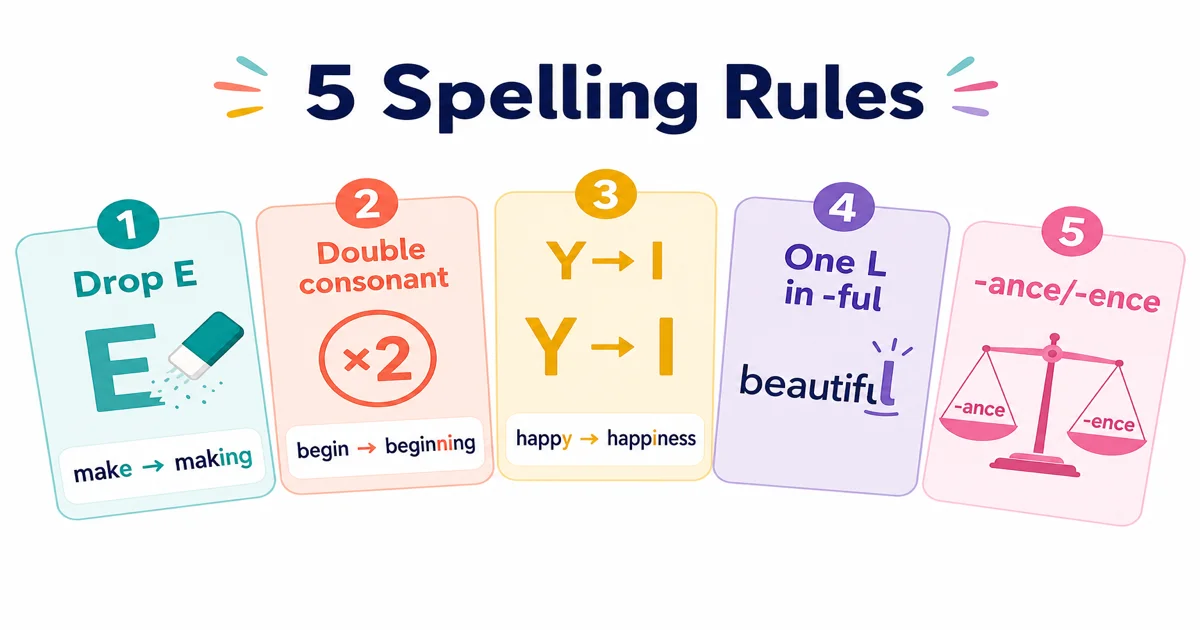
실제로 도움이 되는 철자 규칙 5가지
규칙 1: -ing와 -able을 붙일 때 E를 빼기
make → making, love → lovable, write → writing
예외: noticeable, changeable (부드러운 C나 G 뒤의 E는 유지합니다).
규칙 2: 마지막 음절에 강세가 있으면 -ing/-ed 앞에서 끝 자음을 두 번 쓰기
begin → beginning, prefer → preferred, commit → committed
하지만 offer → offering은 첫 음절에 강세가 있으므로 자음을 두 번 쓰지 않습니다.
규칙 3: 접미사를 붙이기 전에 Y를 I로 바꾸기
happy → happiness, carry → carried, beauty → beautiful
하지만 -ing 앞에서는 Y를 유지합니다: carry → carrying, study → studying.
규칙 4: -full이 아니라 -ful을 쓰기
-ful로 끝나는 형용사는 모두 L이 하나입니다: beautiful, wonderful, grateful, helpful.
-ly를 붙이면 L이 두 개가 됩니다: beautifully, wonderfully, gratefully.
규칙 5: -ance/-ence는 동사 형태에 따라 달라짐
동사가 -ate로 끝나면 명사는 보통 -ance로 끝납니다: tolerate → tolerance. 동사가 -ere로 끝나면 명사는 보통 -ence로 끝납니다: interfere → interference.
철자를 향상하는 방법
더 많이 읽으세요. 철자는 주로 시각적 기억에 의존합니다. 단어의 올바른 형태를 자주 볼수록 정확하게 쓰는 일이 더 자연스러워집니다.
손으로 쓰세요. 자동 완성은 실수를 눈치채지 못하게 고쳐 줍니다. 손글씨는 철자를 능동적으로 떠올리게 합니다. 매일 어려운 단어 다섯 개에서 열 개를 손으로 쓰세요.
간격 반복을 활용하세요. 개인적으로 “자주 틀리는 단어”를 Linglify에 추가하세요. 올바른 철자가 자동으로 떠오를 때까지 최적의 간격으로 복습시켜 줍니다.
단어의 어근을 익히세요. 라틴어와 그리스어 어근으로 만들어진 단어는 일관된 패턴을 따릅니다. psych-가 그리스어로 “마음”이라는 뜻임을 알면 psychology, psychiatrist, psyche에서 묵음 P를 잊지 않을 수 있습니다.
기억법을 만드세요. 가장 좋은 암기 요령은 자신에게 맞는 것입니다. “There’s A RAT in separate”는 엉뚱하지만 효과적입니다. 계속 틀리는 단어에는 자신만의 기억법을 만들어 보세요.
연습할 단어
이 25개 단어는 학술 및 직업 글쓰기에 자주 등장합니다. 간격 반복을 위해 Linglify 사전에 추가하세요.
boom
명사
-
예문
- The boom of thunder echoed across the valley.
- The technology boom created many new millionaires.
cooperate
동사
-
evaluate
동사
-
예문
- Companies evaluate job candidates based on experience, skills, and personality.
- Teachers evaluate student progress through tests, projects, and classroom participation.
graduate
동사
-
예문
- She will graduate from university next year with a degree in engineering.
- Students must complete all requirements before they can graduate from high school.
horizon
명사
-
예문
- The sun disappeared behind the horizon as evening approached.
- Traveling broadens your horizon and exposes you to new cultures.
indispensable
형용사
-
예문
- Clean water is indispensable for human survival and good health.
- Her experience and skills make her indispensable to the research team.
jury
명사
-
예문
- The jury deliberated for several hours before reaching a verdict.
- The talent show jury consisted of professional musicians and entertainers.
lifelong
형용사
-
예문
- Learning is a lifelong process that never truly ends.
- Their lifelong friendship began during elementary school years.
motivated
형용사
-
예문
- Motivated employee seeks additional responsibilities and challenges at work.
- Success requires being motivated even when facing difficult obstacles.
normally
부사
-
예문
- Heart normally beats between sixty and hundred times per minute.
- Students normally arrive at school before morning bell rings.
off
동사
-
예문
- Please turn off the lights before leaving the room.
- The dog ran off into the forest chasing wild rabbits.
prejudice
명사
-
예문
- Education helps overcome prejudice and promotes understanding.
- Racial prejudice damages communities and individuals alike.
resolve
동사
-
예문
- Mediator helps parties resolve dispute through negotiation.
- Technical team will resolve software problems quickly.
stress
동사
-
예문
- Heavy workload may stress employees beyond limits.
- Teacher will stress importance of homework completion.
total
형용사
-
예문
- Total cost includes all fees and expenses.
- Total silence fills room during meditation session.
tragedy
명사
-
예문
- Natural tragedy affects thousands of innocent people.
- Personal tragedy changes person's life perspective completely.
union
명사
-
예문
- Labor union protects worker rights and interests.
- Marriage union joins two people in partnership.
voyage
명사
-
예문
- Space exploration represents humanity's greatest voyage into the unknown.
- The ocean voyage from Europe to America took several weeks in the past.
candidate
명사
-
예문
- Each presidential candidate presented their policy plans to voters.
- The job candidate impressed the interview panel with her experience.
discourage
동사
-
예문
- Don't let one failure discourage you from pursuing your dreams.
- High prices discourage many people from buying organic food products.
donate
동사
-
예문
- Many people donate money to charities that help homeless individuals.
- She decided to donate blood to help patients in emergency situations.
firmly
부사
-
예문
- Hold the rope firmly while climbing down the steep mountain slope.
- The manager firmly believed in treating all employees with respect.
guide
동사
-
예문
- Parents should guide their children to make responsible decisions.
- The experienced hiker will guide the group through the mountain trail safely.
humorous
형용사
-
예문
- She writes humorous articles about everyday life and family experiences.
- The humorous speech made everyone laugh and lightened the serious mood.
admission
명사
-
예문
- Her admission to the prestigious medical school was the result of hard work.
- The museum offers free admission on the first Sunday of every month.
다음 단계
-
스스로 점검하세요. 위 목록을 읽으면서 한 번이라도 틀린 적이 있는 단어를 표시하세요. 먼저 그 단어부터 익히면 됩니다.
-
패턴별로 공부하세요. 한 번에 범주 하나에 집중하세요. 이번 주에는 묵음, 다음 주에는 이중 자음을 익힙니다. 패턴 학습은 무작위 목록보다 효과적입니다.
-
자주 틀리는 단어를 Linglify에 추가해 간격 반복으로 복습하세요. 집중 복습을 위해 “spelling” 태그를 붙이세요.
-
전체 가이드 읽기: 어려운 영어 단어 500개 이상에서는 철자가 어렵거나 발음 또는 사용이 까다로운 단어를 다룹니다.
-
글을 쓸 때 연습하세요. 이메일과 에세이, 메모에서 자주 틀리는 단어를 의식적으로 사용하세요. 실제로 쓰면 수동적인 복습보다 손에 익는 속도가 빠릅니다.
자주 묻는 질문
영어에서 철자가 가장 어려운 단어 10개는 무엇인가요?
가장 자주 틀리는 단어에는 accommodate (C 두 개, M 두 개), separate (가운데는 E가 아니라 A), definitely (A가 없음 — FINITE가 들어 있음), occurrence (C 두 개, R 두 개), embarrass (R 두 개, S 두 개), rhythm (가운데 모음이 없음), millennium (L 두 개, N 두 개), conscience (SC 조합), questionnaire (N 두 개), pronunciation (“ounce”가 없음)이 있습니다. 원어민도 자주 틀리는 단어입니다.
영어 철자는 왜 이렇게 불규칙한가요?
영어는 라틴어와 그리스어, 프랑스어, 독일어, 고대 노르드어를 비롯한 많은 언어에서 단어를 빌려 오면서 수 세기에 걸쳐 발음은 바뀌어도 원래 철자는 유지한 경우가 많습니다. 또 대모음 추이(Great Vowel Shift)로 1400~1700년 사이 영어 발음이 크게 변했지만, 그때는 철자가 이미 표준화되어 있었습니다. 그래서 현대 발음이 아니라 중세 발음을 반영하는 문자 체계가 남게 되었습니다.
철자를 빠르게 향상하려면 어떻게 해야 하나요?
다음 세 가지 방법을 함께 활용하는 것이 가장 좋습니다. (1) 많이 읽으세요. 철자는 주로 시각적 기억에 의존하며 올바른 형태를 반복해서 보면 무의식적으로 알아보게 됩니다. (2) 손으로 쓰세요. 자동 완성에 의존하지 않고 능동적으로 철자를 떠올릴 수 있습니다. (3) 간격 반복을 활용하세요. 자주 틀리는 단어를 복습 시스템에 추가하고 간격을 늘려 가며 연습하세요. 무작위 목록보다 이중 자음이나 묵음처럼 패턴을 묶어서 익히세요.
영어 철자 규칙은 실제로 도움이 되나요?
몇 가지 규칙은 믿을 만합니다. “-ing 앞에서 E 빼기” (make → making), “마지막 음절에 강세가 있을 때 자음 두 번 쓰기” (begin → beginning), “-ful에는 L 하나“ (beautiful, not beautifull)가 있습니다. 하지만 “i before e except after c”처럼 많은 규칙에는 예외가 있어 문제를 해결하기보다 혼란을 더할 수 있습니다. 가장 효율적인 방법은 범주별 패턴을 익히고 예외는 간격 반복으로 복습하는 것입니다.
영국식 철자는 미국식 철자와 다른가요?
네, 예측할 수 있는 차이가 있습니다. 영국식은 -our (colour, favour), -ise (organise, realise), -re (centre, theatre), -ence (licence, defence)를 사용합니다. 미국식은 -or (color, favor), -ize (organize, realize), -er (center, theater), -ense (license, defense)를 씁니다. 둘 다 맞습니다. 한 가지 표기 체계를 일관되게 사용하세요. IELTS 같은 국제 시험에서는 둘 중 하나만 일관되게 쓰면 됩니다.


