
Ví dụ về cụm động từ: 200 câu cho mọi trình độ
Định nghĩa cho biết cụm động từ có nghĩa gì. Ví dụ cho thấy cụm từ đó thực sự vận hành như thế nào. Mọi sách ngữ pháp đều có câu ví dụ vì một lý do: khi thấy cụm động từ trong ngữ cảnh, bạn sẽ hiểu ngữ pháp của nó (có thể tách thành phần hay không?), sắc thái (trang trọng hay thân mật?) và các kết hợp từ tự nhiên (thường đi với danh từ và tình huống nào?).
Cẩm nang này đưa ra 200 ví dụ cụm động từ trong những câu hoàn chỉnh, tự nhiên. Các câu được sắp xếp theo trình độ CEFR — từ cụm cơ bản A2 như “wake up” và “turn off” đến cách diễn đạt C1 như “play down” và “phase out”. Mỗi mục có nghĩa, câu ví dụ rõ ràng và ghi chú cách dùng khi cần.
Hãy dùng bài viết làm tài liệu tham khảo khi viết, danh sách học tập để tăng sự tự tin hoặc nguồn tham khảo các mẫu câu tự nhiên. Bạn càng đọc và nhắc lại nhiều câu ví dụ, cụm động từ sẽ càng tự nhiên xuất hiện khi bạn giao tiếp.
- Tổng số ví dụ: 200 câu
- Các trình độ: A2, B1, B2, C1
- Định dạng: cụm động từ → nghĩa → câu ví dụ
- Phù hợp với: người học biết định nghĩa nhưng khó dùng cụm động từ một cách tự nhiên
Để xem định nghĩa và giải thích chi tiết từng cụm động từ, hãy đọc Cẩm nang đầy đủ về cụm động từ tiếng Anh. Để xem cụm động từ được nhóm theo động từ gốc, hãy đọc Cụm động từ với GET hoặc Cụm động từ với MAKE.
Cách sử dụng các ví dụ này
Đọc câu ví dụ một cách thụ động có ích, nhưng chủ động luyện tập mới giúp bạn giao tiếp trôi chảy. Sau đây là cách khai thác danh sách hiệu quả nhất:
- Đọc câu thành tiếng. Cách phát âm và nhịp điệu rất quan trọng. Cụm động từ có trọng âm khác với từng từ riêng lẻ — “pick UP” có trọng âm khác với “pick” + “up” khi đọc tách rời.
- Che phần nghĩa và đoán theo ngữ cảnh. Hãy tự kiểm tra. Nếu hiểu được câu mà không cần xem định nghĩa, bạn đang tiến bộ.
- Tự viết câu của mình. Thay danh từ và chi tiết bằng những điều trong cuộc sống của bạn. “She turned down the job offer” → “I turned down the invitation to the party.” Câu gắn với trải nghiệm cá nhân sẽ dễ nhớ hơn.
- Chú ý ngữ pháp. Tân ngữ nằm giữa động từ và tiểu từ (cụm có thể tách) hay đứng sau cả cụm (cụm không thể tách)? Điều này giúp bạn tự tạo câu đúng.
Trình độ A2: Cụm động từ cơ bản (50 ví dụ)
Đây là những cụm động từ mà người học thường gặp đầu tiên. Chúng diễn tả thói quen hằng ngày, hành động cơ bản và tương tác đơn giản.
Thói quen hằng ngày
| # | Cụm động từ | Nghĩa | Câu ví dụ |
|---|---|---|---|
| 1 | wake up | dừng ngủ, thức giấc | I wake up at 7 every morning, even on weekends. |
| 2 | get up | rời khỏi giường, thức dậy | She got up immediately when the alarm rang. |
| 3 | put on | mặc quần áo lên người | He put on his coat and went outside. |
| 4 | take off | cởi bỏ quần áo | Please take off your shoes at the door. |
| 5 | turn on | bật thiết bị | Can you turn on the light? It’s getting dark. |
| 6 | turn off | tắt thiết bị | Turn off the TV — dinner is ready. |
| 7 | go out | ra khỏi nhà | We usually go out on Friday evenings. |
| 8 | come back | quay trở lại | She went to the store and came back in ten minutes. |
| 9 | sit down | ngồi xuống | Please sit down. The meeting will start soon. |
| 10 | stand up | đứng lên | Everyone stood up when the teacher entered. |
Hành động cơ bản
| # | Cụm động từ | Nghĩa | Câu ví dụ |
|---|---|---|---|
| 11 | pick up | nhấc vật gì đó khỏi một bề mặt | He picked up the phone and called his mother. |
| 12 | put down | đặt vật gì đó xuống một bề mặt | She put down her bag and sat on the sofa. |
| 13 | throw away | vứt vào thùng rác | Don’t throw away that box — I need it. |
| 14 | give back | trả lại vật gì đó cho ai | Can you give back my pen when you’re finished? |
| 15 | look for | cố tìm | I’m looking for my keys. Have you seen them? |
| 16 | find out | tìm ra thông tin | I found out that the store closes at 9 PM. |
| 17 | write down | ghi lại trên giấy | Write down the address so you don’t forget it. |
| 18 | fill in | điền vào biểu mẫu | Please fill in your name and email address. |
| 19 | hand in | nộp | Students must hand in their homework by Friday. |
| 20 | try on | mặc thử quần áo | She tried on three dresses before choosing one. |
Giao tiếp và con người
| # | Cụm động từ | Nghĩa | Câu ví dụ |
|---|---|---|---|
| 21 | call back | gọi điện lại | He’s busy right now. Can he call you back in an hour? |
| 22 | hang up | kết thúc cuộc gọi | She said goodbye and hung up. |
| 23 | look after | chăm sóc | My neighbor looks after our cat when we travel. |
| 24 | get along | có mối quan hệ tốt | The new employee gets along with everyone in the office. |
| 25 | grow up | lớn lên, trưởng thành | She grew up in a small town near the coast. |
| 26 | ask for | yêu cầu | He asked for a glass of water. |
| 27 | talk about | thảo luận | We talked about the problem for over an hour. |
| 28 | wait for | chờ ai hoặc vật gì đến | I waited for the bus for twenty minutes in the rain. |
| 29 | listen to | chú ý lắng nghe âm thanh | She listens to podcasts every morning on her commute. |
| 30 | belong to | thuộc quyền sở hữu của | This laptop belongs to the company, not to me. |
Di chuyển và phương hướng
| # | Cụm động từ | Nghĩa | Câu ví dụ |
|---|---|---|---|
| 31 | come in | đi vào | Come in! The door is open. |
| 32 | go away | rời đi | The headache went away after I took medicine. |
| 33 | get on | lên xe buýt, tàu hỏa hoặc máy bay | We got on the bus at the Central Station stop. |
| 34 | get off | xuống khỏi phương tiện | Get off at the next stop — that’s the city center. |
| 35 | get in | lên ô tô hoặc taxi | She got in the taxi and told the driver the address. |
| 36 | get out | ra khỏi ô tô hoặc một không gian nhỏ | He got out of the car and walked to the building. |
| 37 | run away | chạy trốn | The cat ran away when it heard the thunder. |
| 38 | fall down | ngã xuống đất | The child fell down but got up without crying. |
| 39 | move in | bắt đầu sống ở nơi mới | They moved in last weekend and are still unpacking. |
| 40 | move out | rời khỏi nhà để chuyển đi nơi khác | He moved out of his parents’ house at 18. |
Thời gian và thói quen
| # | Cụm động từ | Nghĩa | Câu ví dụ |
|---|---|---|---|
| 41 | hurry up | làm nhanh lên | Hurry up! The movie starts in five minutes. |
| 42 | slow down | giảm tốc độ | The driver slowed down when he saw the school. |
| 43 | carry on | tiếp tục | Carry on reading — I didn’t mean to interrupt. |
| 44 | go on | tiếp diễn; xảy ra | What’s going on? I heard a loud noise. |
| 45 | end up | cuối cùng rơi vào một tình huống | We got lost and ended up in the wrong part of town. |
| 46 | set up | chuẩn bị, sắp xếp | They set up the chairs for the presentation. |
| 47 | clean up | dọn dẹp một nơi | We need to clean up before the guests arrive. |
| 48 | use up | dùng hết hoàn toàn | We used up all the milk — someone needs to buy more. |
| 49 | run out | không còn lại thứ gì | We ran out of coffee, so I’m drinking tea today. |
| 50 | show up | đến nơi; xuất hiện | He showed up 20 minutes late to the meeting. |
Trình độ B1: Cụm động từ trung cấp (50 ví dụ)
Ở trình độ B1, cụm động từ trở nên trừu tượng hơn. Khó đoán nghĩa từ các từ riêng lẻ hơn, và nhiều cụm có nhiều nghĩa.
Công việc và năng suất
| # | Cụm động từ | Nghĩa | Câu ví dụ |
|---|---|---|---|
| 51 | take over | đảm nhận quyền kiểm soát | She took over as team leader when Mark resigned. |
| 52 | set up | thành lập, bắt đầu một doanh nghiệp | He set up his own company after years of working for others. |
| 53 | carry out | thực hiện, hoàn thành một nhiệm vụ | The researchers carried out experiments for six months. |
| 54 | deal with | xử lý, quản lý | She deals with customer complaints every day. |
| 55 | put off | hoãn lại | They put off the decision until next week. |
| 56 | come up with | nghĩ ra, sáng tạo | He came up with a brilliant idea during the meeting. |
| 57 | figure out | hiểu ra sau khi suy nghĩ | I can’t figure out how to use this software. |
| 58 | keep up with | theo kịp cùng tốc độ | It’s hard to keep up with all the changes in technology. |
| 59 | work out | tính toán; tập thể dục; thành công | We need to work out the total cost before signing the contract. |
| 60 | take on | nhận thêm (trách nhiệm) | She took on extra work to save money for the trip. |
Các mối quan hệ và đời sống xã hội
| # | Cụm động từ | Nghĩa | Câu ví dụ |
|---|---|---|---|
| 61 | break up | kết thúc một mối quan hệ | They broke up after three years together. |
| 62 | make up | làm hòa sau một cuộc tranh cãi | They argued all morning but made up before dinner. |
| 63 | get together | gặp gỡ, giao lưu | Let’s get together for coffee this weekend. |
| 64 | look up to | ngưỡng mộ, kính trọng | She looks up to her grandmother as a role model. |
| 65 | let down | làm thất vọng | I trusted him, and he let me down. |
| 66 | put up with | chịu đựng | I can’t put up with this noise anymore. |
| 67 | fall out | cãi nhau, không còn là bạn | They fell out over money and haven’t spoken since. |
| 68 | bring up | đề cập một chủ đề; nuôi dạy trẻ | Don’t bring up politics at the dinner table. |
| 69 | turn out | cuối cùng có kết quả, diễn ra | The party turned out to be much better than I expected. |
| 70 | cheer up | trở nên vui hơn; làm ai vui hơn | She bought him flowers to cheer him up after the bad news. |
Học tập và hiểu biết
| # | Cụm động từ | Nghĩa | Câu ví dụ |
|---|---|---|---|
| 71 | look up | tra cứu thông tin | I looked up the word in the dictionary. |
| 72 | find out | phát hiện ra | She found out that her flight was canceled only at the airport. |
| 73 | go over | xem lại, kiểm tra | Let’s go over the plan one more time before we start. |
| 74 | point out | chỉ ra, thu hút sự chú ý đến điều gì | My teacher pointed out several errors in my essay. |
| 75 | make sense | hợp lý, dễ hiểu | This explanation doesn’t make sense to me at all. |
| 76 | pick up | học một cách tự nhiên, không chính thức | He picked up some Spanish while living in Barcelona. |
| 77 | catch on | bắt đầu hiểu | The new system is complex, but most people catch on quickly. |
| 78 | mix up | nhầm lẫn thứ này với thứ khác | I always mix up “affect” and “effect.” |
| 79 | come across | tình cờ tìm thấy | I came across an interesting article while browsing online. |
| 80 | think over | suy nghĩ kỹ, cân nhắc | I need to think it over before making a decision. |
Thay đổi trong cuộc sống và quyết định
| # | Cụm động từ | Nghĩa | Câu ví dụ |
|---|---|---|---|
| 81 | give up | bỏ cuộc; từ bỏ một thói quen | He gave up smoking three years ago. |
| 82 | turn down | từ chối | She turned down the job offer because the salary was too low. |
| 83 | take up | bắt đầu một sở thích hoặc hoạt động mới | I took up running during the pandemic and still do it. |
| 84 | drop out | bỏ học hoặc bỏ một khóa học | He dropped out of university to start a business. |
| 85 | sign up | đăng ký tham gia | Over 500 people signed up for the online course. |
| 86 | go ahead | tiến hành, bắt đầu | The project was approved — we can go ahead with construction. |
| 87 | hold on | chờ một lát | Hold on — I’ll check the schedule and call you back. |
| 88 | come up | bất ngờ nảy sinh, xuất hiện | Something came up at work, so I’ll be late tonight. |
| 89 | sort out | sắp xếp, giải quyết | We need to sort out the accommodation before the trip. |
| 90 | get over | hồi phục sau | It took her weeks to get over the flu this winter. |
Tình huống thường ngày
| # | Cụm động từ | Nghĩa | Câu ví dụ |
|---|---|---|---|
| 91 | run into | gặp tình cờ | I ran into my old teacher at the supermarket yesterday. |
| 92 | look forward to | mong chờ một sự kiện trong tương lai | I’m looking forward to the holiday — I need a break. |
| 93 | cut down on | giảm số lượng | The doctor told him to cut down on sugar and salt. |
| 94 | get rid of | loại bỏ, vứt đi | We got rid of the old sofa and bought a new one. |
| 95 | put away | cất vào đúng chỗ | Please put away your toys before dinner. |
| 96 | check in | làm thủ tục nhận phòng ở khách sạn hoặc sân bay | We checked in at the hotel at around 3 PM. |
| 97 | check out | trả phòng; xem xét | We need to check out by 11 AM tomorrow. |
| 98 | come along | tiến triển; đi cùng | How is your English coming along? |
| 99 | calm down | bình tĩnh lại, bớt buồn bực hoặc kích động | Calm down — getting angry won’t solve anything. |
| 100 | break down | ngừng hoạt động (máy móc) | Our car broke down on the highway during the trip. |
Trình độ B2: Cụm động từ trên trung cấp (50 ví dụ)
Ở trình độ B2, cụm động từ mang tính thành ngữ nhiều hơn. Nhiều cụm có nghĩa bóng khác hẳn nghĩa đen của từng từ.
Công việc chuyên môn và học thuật
| # | Cụm động từ | Nghĩa | Câu ví dụ |
|---|---|---|---|
| 101 | draw up | soạn thảo một văn bản chính thức | The lawyers drew up a new contract with revised terms. |
| 102 | lay off | chấm dứt việc làm | The company laid off 200 workers due to falling revenue. |
| 103 | take into account | tính đến như một yếu tố | You need to take into account the cost of shipping when pricing products. |
| 104 | rule out | loại bỏ khỏi các khả năng | The police have not ruled out foul play in the investigation. |
| 105 | account for | giải thích; chiếm một tỷ lệ | Online sales account for 40% of the company’s revenue. |
| 106 | bring about | gây ra, khiến điều gì xảy ra | The new policy brought about significant changes in working conditions. |
| 107 | follow up | tiếp tục tìm hiểu hoặc theo đuổi | I’ll follow up with the supplier next week about the delivery date. |
| 108 | come up against | gặp phải khó khăn | We came up against several technical problems during testing. |
| 109 | call off | hủy bỏ | They called off the outdoor event because of the storm warning. |
| 110 | hand over | chuyển giao quyền kiểm soát hoặc quyền sở hữu | She handed over her responsibilities to her replacement before leaving. |
Suy nghĩ và ra quyết định
| # | Cụm động từ | Nghĩa | Câu ví dụ |
|---|---|---|---|
| 111 | narrow down | lọc bớt lựa chọn thành danh sách ngắn hơn | We’ve narrowed down the candidates to three finalists. |
| 112 | weigh up | cân nhắc ưu và nhược điểm | He spent days weighing up whether to accept the transfer. |
| 113 | talk into | thuyết phục ai làm điều gì | She talked me into running the marathon with her. |
| 114 | talk out of | thuyết phục ai không làm điều gì | His friends talked him out of quitting his job impulsively. |
| 115 | go through with | hoàn thành việc gì dù gặp khó khăn | She was nervous but went through with the presentation anyway. |
| 116 | back out of | rút khỏi một cam kết | They backed out of the deal at the last minute. |
| 117 | look into | điều tra, tìm hiểu | The manager promised to look into the customer’s complaint. |
| 118 | open up | bắt đầu sẵn lòng chia sẻ cảm xúc | He finally opened up about the stress he’d been feeling at work. |
| 119 | come around | đổi ý; tỉnh lại sau khi bất tỉnh | She was against the idea at first but eventually came around. |
| 120 | work through | giải quyết vấn đề một cách có hệ thống | They worked through their disagreements with the help of a mediator. |
Giao tiếp và diễn đạt
| # | Cụm động từ | Nghĩa | Câu ví dụ |
|---|---|---|---|
| 121 | speak up | nói to hơn; bày tỏ ý kiến | If you disagree, you should speak up during the meeting. |
| 122 | bring up | nêu một chủ đề trong cuộc trò chuyện | She brought up an interesting point about the budget. |
| 123 | get across | truyền đạt thành công | He tried to get his point across, but nobody was listening. |
| 124 | brush off | gạt đi, xem là không quan trọng | She brushed off the criticism and continued with her plan. |
| 125 | turn to | tìm đến ai để nhờ giúp đỡ | When things got difficult, she turned to her family for support. |
| 126 | pass on | truyền đạt thông tin cho người khác | Could you pass on the message to everyone in the team? |
| 127 | take back | rút lại một phát ngôn | I take back what I said — you were completely right. |
| 128 | cut in | ngắt lời người khác | He cut in before she could finish explaining her idea. |
| 129 | go into | bàn luận chi tiết | I won’t go into all the reasons now — we can talk later. |
| 130 | sum up | tóm tắt | To sum up, we need to reduce costs and increase sales. |
Thay đổi và phát triển
| # | Cụm động từ | Nghĩa | Câu ví dụ |
|---|---|---|---|
| 131 | build up | tăng dần | She built up her savings over five years before buying the apartment. |
| 132 | break through | vượt qua trở ngại để đạt được điều gì | After months of research, the team finally broke through with a solution. |
| 133 | set back | làm chậm tiến độ | The funding problem set the project back by three months. |
| 134 | cut back | giảm chi tiêu hoặc mức tiêu thụ | The government cut back on education funding this year. |
| 135 | branch out | mở rộng sang lĩnh vực mới | The restaurant branched out into catering for corporate events. |
| 136 | phase in | đưa vào từng bước | The company is phasing in a new remote work policy over six months. |
| 137 | wind down | giảm dần hoạt động; thư giãn | The conference was winding down, and people started leaving. |
| 138 | step down | từ chức khỏi một vị trí | The CEO stepped down after 15 years leading the company. |
| 139 | scale up | mở rộng quy mô hoặc phạm vi | They scaled up production to meet the sudden demand. |
| 140 | hold back | cản trở tiến độ; kiềm chế | Fear of failure held her back from applying for the promotion. |
Cảm xúc và hành vi
| # | Cụm động từ | Nghĩa | Câu ví dụ |
|---|---|---|---|
| 141 | bottle up | kìm nén cảm xúc | He bottles up his feelings and never talks about what’s bothering him. |
| 142 | lash out | công kích bằng lời nói hoặc hành động | She lashed out at her colleague after a stressful morning. |
| 143 | pull through | vượt qua một tình huống khó khăn | The patient was critical but pulled through after surgery. |
| 144 | burn out | kiệt sức do làm việc quá sức | She burned out after working 70-hour weeks for six months straight. |
| 145 | snap out of | buộc bản thân thoát khỏi trạng thái tiêu cực | He told himself to snap out of it and focus on the solution. |
| 146 | live up to | đáp ứng kỳ vọng | The film didn’t live up to the hype — it was disappointing. |
| 147 | own up to | thừa nhận trách nhiệm | Nobody owned up to breaking the window in the office. |
| 148 | play along | giả vờ đồng ý hoặc hợp tác | She didn’t believe his excuse but played along to avoid conflict. |
| 149 | wear off | tác dụng (của thuốc, hiệu ứng) giảm dần | The excitement of the new job wore off after a few months. |
| 150 | get away with | thoát bị phạt | He was late every day and somehow got away with it for months. |
Trình độ C1: Cụm động từ nâng cao (50 ví dụ)
Những cụm động từ này xuất hiện trong văn viết học thuật, ngữ cảnh chuyên môn và lời nói tinh tế. Chúng giúp bạn thể hiện mình là người nói tiếng Anh tự tin, diễn đạt sắc thái tốt.
Kinh doanh và chiến lược
| # | Cụm động từ | Nghĩa | Câu ví dụ |
|---|---|---|---|
| 151 | buy out | mua lại phần sở hữu của ai đó trong doanh nghiệp | The partners disagreed, so one bought the other out for $2 million. |
| 152 | bail out | cứu trợ tài chính | The government bailed out the failing bank to prevent economic collapse. |
| 153 | cash in on | kiếm lời từ một tình huống | Competitors were quick to cash in on the company’s PR disaster. |
| 154 | ramp up | tăng nhanh | They ramped up marketing spending ahead of the product launch. |
| 155 | phase out | ngừng dần một hoạt động hoặc sản phẩm | The manufacturer is phasing out the old model by the end of the year. |
| 156 | pencil in | xếp lịch tạm thời | Let’s pencil in Thursday for the review — we can confirm later. |
| 157 | hammer out | đàm phán khó khăn để đạt thỏa thuận | The two sides hammered out an agreement after twelve hours of talks. |
| 158 | sign off on | chính thức phê duyệt | The director still hasn’t signed off on the revised budget. |
| 159 | factor in | tính đến như một yếu tố | You need to factor in inflation when planning your retirement savings. |
| 160 | iron out | giải quyết các vấn đề nhỏ | We need to iron out the details before presenting to the board. |
Giao tiếp tinh tế
| # | Cụm động từ | Nghĩa | Câu ví dụ |
|---|---|---|---|
| 161 | play down | làm cho điều gì có vẻ kém quan trọng hơn | The spokesperson played down the severity of the data breach. |
| 162 | talk down to | nói với ai bằng giọng trịch thượng | She hated how her manager talked down to her in front of clients. |
| 163 | come out with | nói ra điều gì gây ngạc nhiên | He came out with the most bizarre excuse anyone had ever heard. |
| 164 | own up | thừa nhận lỗi | After a week of denials, the politician finally owned up to the mistake. |
| 165 | water down | làm suy yếu, giảm hiệu quả | Critics accused the government of watering down the environmental regulations. |
| 166 | gloss over | lướt qua mà không bàn chi tiết | The report glossed over the safety concerns raised by engineers. |
| 167 | spell out | giải thích thật rõ ràng và đơn giản | Let me spell out exactly what will happen if we miss the deadline. |
| 168 | fend off | chống đỡ, kháng cự | The company fended off a hostile takeover attempt from a larger rival. |
| 169 | put forward | đề xuất chính thức | She put forward a radical plan to restructure the entire department. |
| 170 | touch on | đề cập ngắn gọn | The speaker touched on climate change but didn’t go into detail. |
Phân tích và lập luận
| # | Cụm động từ | Nghĩa | Câu ví dụ |
|---|---|---|---|
| 171 | boil down to | rút gọn về điểm cốt yếu | The whole argument boils down to one question: who pays? |
| 172 | stem from | bắt nguồn từ, do điều gì gây ra | Most of the delays stem from poor planning in the early stages. |
| 173 | hinge on | hoàn toàn phụ thuộc vào | The success of the project hinges on securing funding by March. |
| 174 | pan out | diễn biến, cuối cùng có kết quả | We’ll have to wait and see how the new strategy pans out. |
| 175 | stack up | so sánh với điều gì | How does our proposal stack up against the competition? |
| 176 | flesh out | bổ sung chi tiết cho một ý tưởng | The concept is good — now we need to flesh out the implementation plan. |
| 177 | zero in on | tập trung sát vào một điều | The investigators zeroed in on a discrepancy in the financial records. |
| 178 | piece together | ghép các mảnh thông tin để hiểu ra | Detectives pieced together what happened from CCTV footage and witness statements. |
| 179 | rule out | loại trừ khỏi các khả năng | Doctors ruled out serious illness but ordered further tests. |
| 180 | map out | lập kế hoạch chi tiết | She mapped out her career goals for the next five years. |
Xã hội và thay đổi
| # | Cụm động từ | Nghĩa | Câu ví dụ |
|---|---|---|---|
| 181 | crack down on | tăng cường thực thi quy định | The authorities cracked down on illegal parking near schools. |
| 182 | clamp down on | mạnh tay ngăn chặn | The platform clamped down on fake accounts spreading misinformation. |
| 183 | stand for | đại diện cho; chịu đựng | What does this abbreviation stand for? |
| 184 | stamp out | xóa bỏ hoàn toàn | The campaign aims to stamp out bullying in schools. |
| 185 | cave in | nhượng bộ trước sức ép | After weeks of protests, the council caved in and reversed the decision. |
| 186 | opt out of | chọn không tham gia | More families are opting out of traditional schooling. |
| 187 | usher in | đưa vào, đánh dấu sự khởi đầu của | The invention of the internet ushered in a new era of communication. |
| 188 | die down | dần dịu đi, bớt gay gắt | The controversy eventually died down after the company issued an apology. |
| 189 | crop up | bất ngờ xuất hiện | Problems keep cropping up whenever we try to launch the feature. |
| 190 | fall through | không diễn ra như kế hoạch | The acquisition fell through because the two companies couldn’t agree on price. |
Cá nhân và cảm xúc (nâng cao)
| # | Cụm động từ | Nghĩa | Câu ví dụ |
|---|---|---|---|
| 191 | draw on | sử dụng như một nguồn lực | She drew on her years of experience to handle the crisis calmly. |
| 192 | measure up | đáp ứng tiêu chuẩn yêu cầu | He constantly felt he didn’t measure up to his parents’ expectations. |
| 193 | see through | nhận ra sự lừa dối | She saw through his apology immediately — it wasn’t sincere. |
| 194 | come to terms with | chấp nhận một điều khó khăn | It took him months to come to terms with the loss. |
| 195 | dwell on | quá tập trung suy nghĩ về điều tiêu cực | Don’t dwell on past mistakes — focus on what you can do now. |
| 196 | wear down | làm suy yếu sự phản kháng theo thời gian | Constant criticism from her boss gradually wore her down. |
| 197 | fall back on | dựa vào khi không còn cách nào khác | If the business fails, at least he has his engineering degree to fall back on. |
| 198 | write off | gạt bỏ, xem là không quan trọng hoặc vô vọng | Critics wrote off the startup, but it’s now worth $500 million. |
| 199 | turn around | chuyển biến từ xấu sang tốt | The new CEO managed to turn the company around in just two years. |
| 200 | pay off | mang lại kết quả tốt sau nỗ lực | All those late nights studying finally paid off — she got the highest score. |
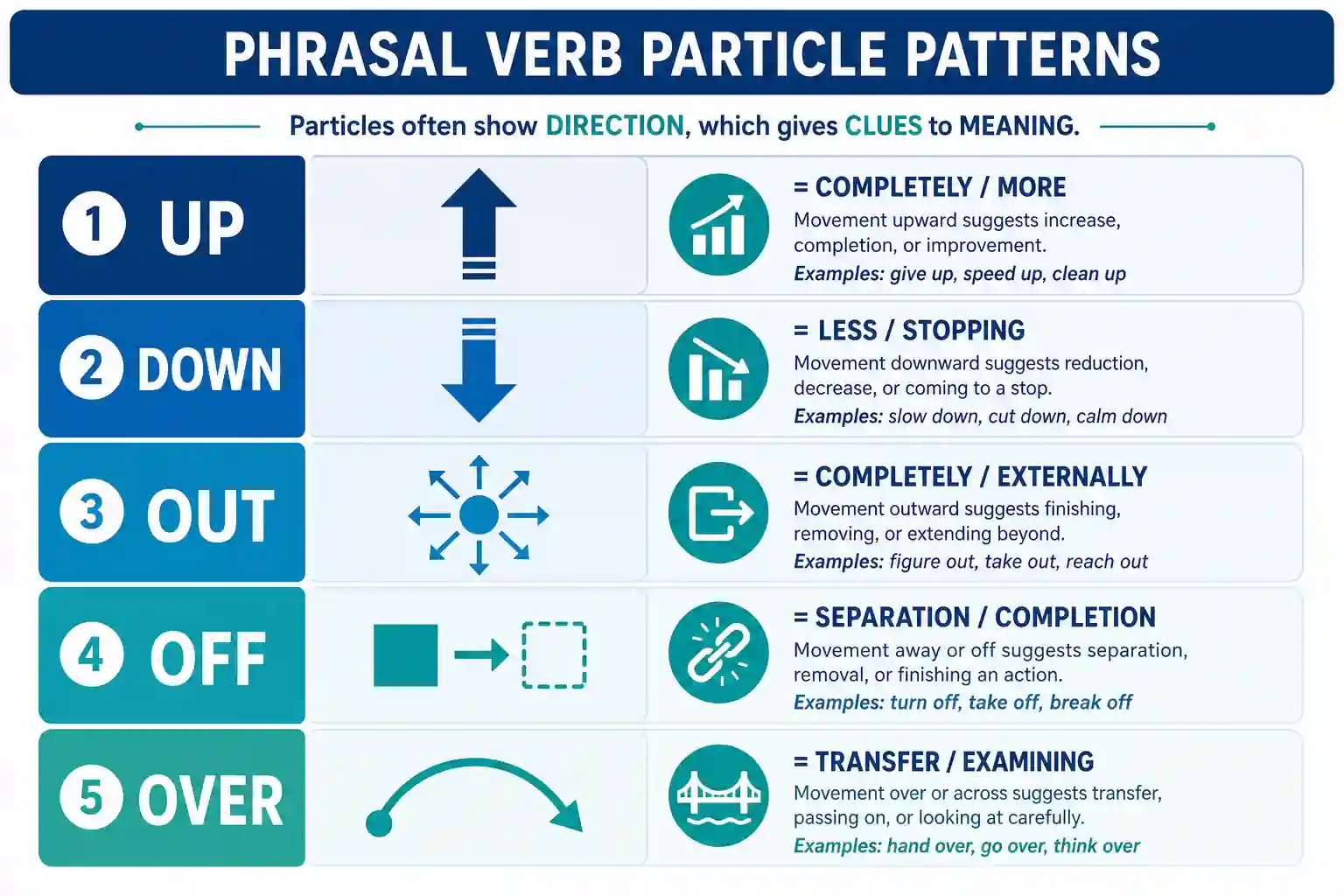
Những mẫu nghĩa cần chú ý
Sau khi đọc 200 ví dụ, bạn sẽ thấy một số mẫu nghĩa rõ ràng. Chúng giúp bạn hiểu cụm động từ mới mà không cần tra cứu.
UP thường mang nghĩa “hoàn toàn” hoặc “nhiều hơn”
| Cụm động từ | Nghĩa của UP |
|---|---|
| clean up | dọn dẹp hoàn toàn |
| use up | dùng hết (không còn gì) |
| build up | tăng dần |
| hurry up | tăng tốc độ |
| speak up | nói to hơn / mạnh dạn hơn |
DOWN thường mang nghĩa “ít hơn” hoặc “dừng hẳn”
| Cụm động từ | Nghĩa của DOWN |
|---|---|
| slow down | giảm tốc độ |
| cut down | giảm số lượng |
| break down | ngừng hoạt động hoàn toàn |
| calm down | bớt kích động |
| wind down | dần dừng lại |
OUT thường mang nghĩa “hoàn toàn” hoặc “ra ngoài”
| Cụm động từ | Nghĩa của OUT |
|---|---|
| find out | phát hiện ra (thông tin được hé lộ) |
| work out | giải quyết triệt để |
| phase out | loại bỏ hoàn toàn (theo thời gian) |
| spell out | giải thích đầy đủ, rõ ràng |
| burn out | làm kiệt sức hoàn toàn |
OFF thường mang nghĩa “tách rời” hoặc “hoàn tất”
| Cụm động từ | Nghĩa của OFF |
|---|---|
| call off | hủy bỏ (tách khỏi kế hoạch) |
| pay off | đạt kết quả (khoản nợ được trả hết) |
| brush off | gạt đi (đẩy ra xa) |
| wear off | dần biến mất |
| lay off | sa thải khỏi công việc |
OVER thường mang nghĩa “chuyển giao” hoặc “xem xét”
| Cụm động từ | Nghĩa của OVER |
|---|---|
| take over | chuyển giao quyền kiểm soát |
| hand over | chuyển giao quyền sở hữu |
| go over | xem xét kỹ lưỡng |
| think over | cân nhắc thật kỹ |
| get over | vượt qua, bước tiếp |
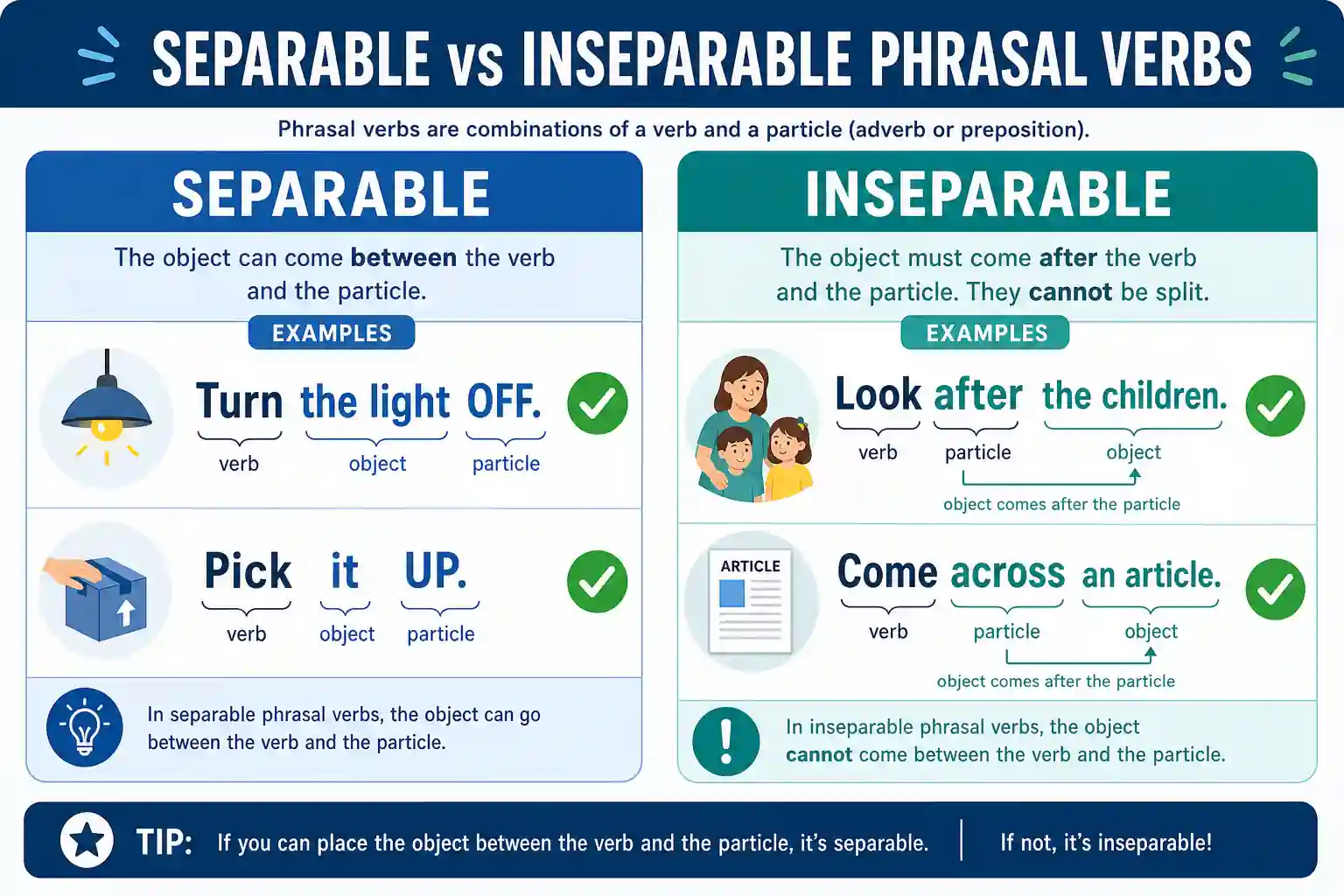
Cụm động từ có thể tách và không thể tách: tham khảo nhanh
Nhiều người học gặp khó khăn với trật tự từ. Sau đây là cách kiểm tra một cụm động từ có thể tách hay không:
Có thể tách — bạn có thể (và đôi khi bắt buộc phải) đặt tân ngữ giữa động từ và tiểu từ:
- Turn off the light → Turn the light off → Turn it off (với đại từ, bắt buộc phải tách)
- Pick up the book → Pick the book up → Pick it up
Không thể tách — động từ và tiểu từ phải đứng cạnh nhau:
-
Look after the children →
Look the children after(sai) -
Come across an article →
Come an article across(sai)
Cụm động từ ba từ luôn không thể tách:
- Look forward to → I look forward to the trip
- Put up with → She put up with the noise
- Come up with → He came up with a plan
Từ để luyện tập
Dưới đây là 25 động từ tần suất cao làm gốc cho phần lớn cụm động từ trong bài. Thêm chúng vào từ điển và luyện kết hợp với các tiểu từ khác nhau.
artery
danh từ
động mạch
Ví dụ
- The blocked artery required immediate surgical intervention to save his life.
- This highway is a major artery connecting the city to surrounding areas.
coastal
tính từ
ven biển, duyên hải
Ví dụ
- Coastal towns often depend on fishing and tourism for their economy.
- The coastal erosion threatens many beachfront properties and buildings.
cooperate
động từ
hợp tác, phối hợp
donate
động từ
quyên góp, ủng hộ
Ví dụ
- Many people donate money to charities that help homeless individuals.
- She decided to donate blood to help patients in emergency situations.
evaluate
động từ
đánh giá, thẩm định
Ví dụ
- Companies evaluate job candidates based on experience, skills, and personality.
- Teachers evaluate student progress through tests, projects, and classroom participation.
graduate
động từ
tốt nghiệp
Ví dụ
- She will graduate from university next year with a degree in engineering.
- Students must complete all requirements before they can graduate from high school.
guide
động từ
hướng dẫn, chỉ dẫn
Ví dụ
- Parents should guide their children to make responsible decisions.
- The experienced hiker will guide the group through the mountain trail safely.
implication
danh từ
hàm ý, ý ngầm
Ví dụ
- Scientists are studying the implications of climate change for future generations.
- The implication of his statement was that he disagreed with the policy.
candidate
danh từ
ứng cử viên, thí sinh
Ví dụ
- Each presidential candidate presented their policy plans to voters.
- The job candidate impressed the interview panel with her experience.
prejudice
danh từ
thành kiến, định kiến
Ví dụ
- Education helps overcome prejudice and promotes understanding.
- Racial prejudice damages communities and individuals alike.
discourage
động từ
làm nản lòng, làm mất tự tin
Ví dụ
- Don't let one failure discourage you from pursuing your dreams.
- High prices discourage many people from buying organic food products.
resolve
động từ
giải quyết, tìm ra lời giải
Ví dụ
- Mediator helps parties resolve dispute through negotiation.
- Technical team will resolve software problems quickly.
off
tính từ
ôi thiu, hỏng
Ví dụ
- Please turn off the lights before leaving the room.
- The dog ran off into the forest chasing wild rabbits.
tragedy
danh từ
bi kịch, thảm kịch
Ví dụ
- Natural tragedy affects thousands of innocent people.
- Personal tragedy changes person's life perspective completely.
admission
danh từ
sự cho phép vào, sự nhập học
Ví dụ
- Her admission to the prestigious medical school was the result of hard work.
- The museum offers free admission on the first Sunday of every month.
boom
danh từ
tiếng nổ trầm, sự bùng nổ
Ví dụ
- The boom of thunder echoed across the valley.
- The technology boom created many new millionaires.
horizon
danh từ
đường chân trời
Ví dụ
- The sun disappeared behind the horizon as evening approached.
- Traveling broadens your horizon and exposes you to new cultures.
jury
danh từ
bồi thẩm đoàn
Ví dụ
- The jury deliberated for several hours before reaching a verdict.
- The talent show jury consisted of professional musicians and entertainers.
lifelong
tính từ
suốt đời, lâu dài
Ví dụ
- Learning is a lifelong process that never truly ends.
- Their lifelong friendship began during elementary school years.
motivated
tính từ
có động lực, đầy quyết tâm
Ví dụ
- Motivated employee seeks additional responsibilities and challenges at work.
- Success requires being motivated even when facing difficult obstacles.
total
tính từ
toàn bộ, trọn vẹn
Ví dụ
- Total cost includes all fees and expenses.
- Total silence fills room during meditation session.
humorous
tính từ
hài hước, khôi hài
Ví dụ
- She writes humorous articles about everyday life and family experiences.
- The humorous speech made everyone laugh and lightened the serious mood.
indispensable
tính từ
thiết yếu, không thể thiếu
Ví dụ
- Clean water is indispensable for human survival and good health.
- Her experience and skills make her indispensable to the research team.
firmly
trạng từ
chắc chắn, kiên quyết
Ví dụ
- Hold the rope firmly while climbing down the steep mountain slope.
- The manager firmly believed in treating all employees with respect.
normally
trạng từ
thường, thông thường
Ví dụ
- Heart normally beats between sixty and hundred times per minute.
- Students normally arrive at school before morning bell rings.
Tiếp theo nên làm gì?
-
Chọn trình độ phù hợp. Tìm phần tương ứng với năng lực hiện tại và tập trung vào 50 ví dụ ở đó trước.
-
Tự viết 5 câu. Chọn 5 cụm động từ ở trình độ của bạn rồi viết câu về cuộc sống của mình. Câu gắn với trải nghiệm cá nhân dễ nhớ hơn nhiều so với ví dụ trong sách.
-
Học theo động từ gốc. Để xem giải thích chi tiết từng nghĩa, hãy đọc các cẩm nang theo động từ: GET, MAKE hoặc 50 cụm phổ biến nhất.
-
Ôn tập bằng phương pháp lặp lại ngắt quãng. Thêm cụm động từ vào từ điển Linglify và ôn vào những khoảng thời gian phù hợp. Xem thư viện cụm động từ để tìm danh sách theo nhóm.
-
Học các quy tắc. Nếu bạn chưa rõ cụm động từ có thể tách hay không, hãy đọc Cẩm nang đầy đủ về cụm động từ để tìm hiểu chi tiết ngữ pháp.
Câu hỏi thường gặp
Cụm động từ kèm ví dụ là gì?
Cụm động từ là sự kết hợp giữa một động từ với giới từ hoặc trạng từ, tạo nên nghĩa mới khác với nghĩa ban đầu của động từ. Ví dụ, “give up” nghĩa là bỏ cuộc (không phải nghĩa đen “give” + “up”), “run into” nghĩa là tình cờ gặp và “break down” nghĩa là ngừng hoạt động. Tiếng Anh có hàng nghìn cụm động từ và người bản ngữ thường xuyên dùng chúng trong giao tiếp hằng ngày.
Dùng cụm động từ trong câu như thế nào?
Hãy dùng cụm động từ ở vị trí tương tự động từ thông thường. “She gave up smoking” có cách dùng tương tự “She quit smoking”. Quy tắc quan trọng: với cụm có thể tách, đại từ phải đứng giữa động từ và tiểu từ (“Turn it off”, không phải “Turn off it”). Với cụm không thể tách, tân ngữ luôn đứng sau toàn bộ cụm (“Look after the children”, không phải “Look the children after”).
Có 10 ví dụ cụm động từ trong câu nào?
Dưới đây là 10 ví dụ thông dụng: (1) I wake up at 7 AM. (2) Please turn off the light. (3) She gave up her job. (4) We ran out of time. (5) He came up with a great idea. (6) They broke up last month. (7) I’m looking forward to the weekend. (8) She turned down the offer. (9) The car broke down on the highway. (10) He picked up Spanish while living abroad.
Tiếng Anh có bao nhiêu cụm động từ?
Các ước tính dao động từ 5.000 đến 10.000, tùy vào cách tính các nghĩa khác nhau. Tuy nhiên, phần lớn người bản ngữ thường dùng khoảng 200–300 cụm trong giao tiếp hằng ngày. Với người học, nắm được 100 cụm động từ phổ biến nhất (có trong cẩm nang 100 cụm động từ) sẽ giúp xử lý phần lớn tình huống thường gặp.
Cụm động từ thuộc trình độ nào?
Cụm động từ xuất hiện ở mọi trình độ. Những cụm cơ bản như “wake up”, “turn on” và “sit down” ở trình độ A2. Các cụm phổ biến như “give up”, “look forward to” và “find out” ở B1. Cụm trừu tượng hơn như “bring about”, “rule out” và “phase in” ở B2. Cụm mang tính thành ngữ cao như “cash in on”, “boil down to” và “play down” ở C1. Bài viết sắp xếp cụm từ theo trình độ để giúp bạn học có hệ thống.