英語動詞清單:按程度分類的300個最重要動詞
動詞是每個英語句子的引擎。沒有動詞,什麼都不會發生——沒有人做任何事情、成為任何事情或體驗任何事情。名詞命名世界;形容詞描述它;但動詞讓它動起來。
英語大約有25,000個動詞,但你不需要大多數。研究表明,300個最常見的動詞涵蓋了日常交流中大約90%的所有動詞使用。掌握這300個,你幾乎可以表達你需要說的任何東西。
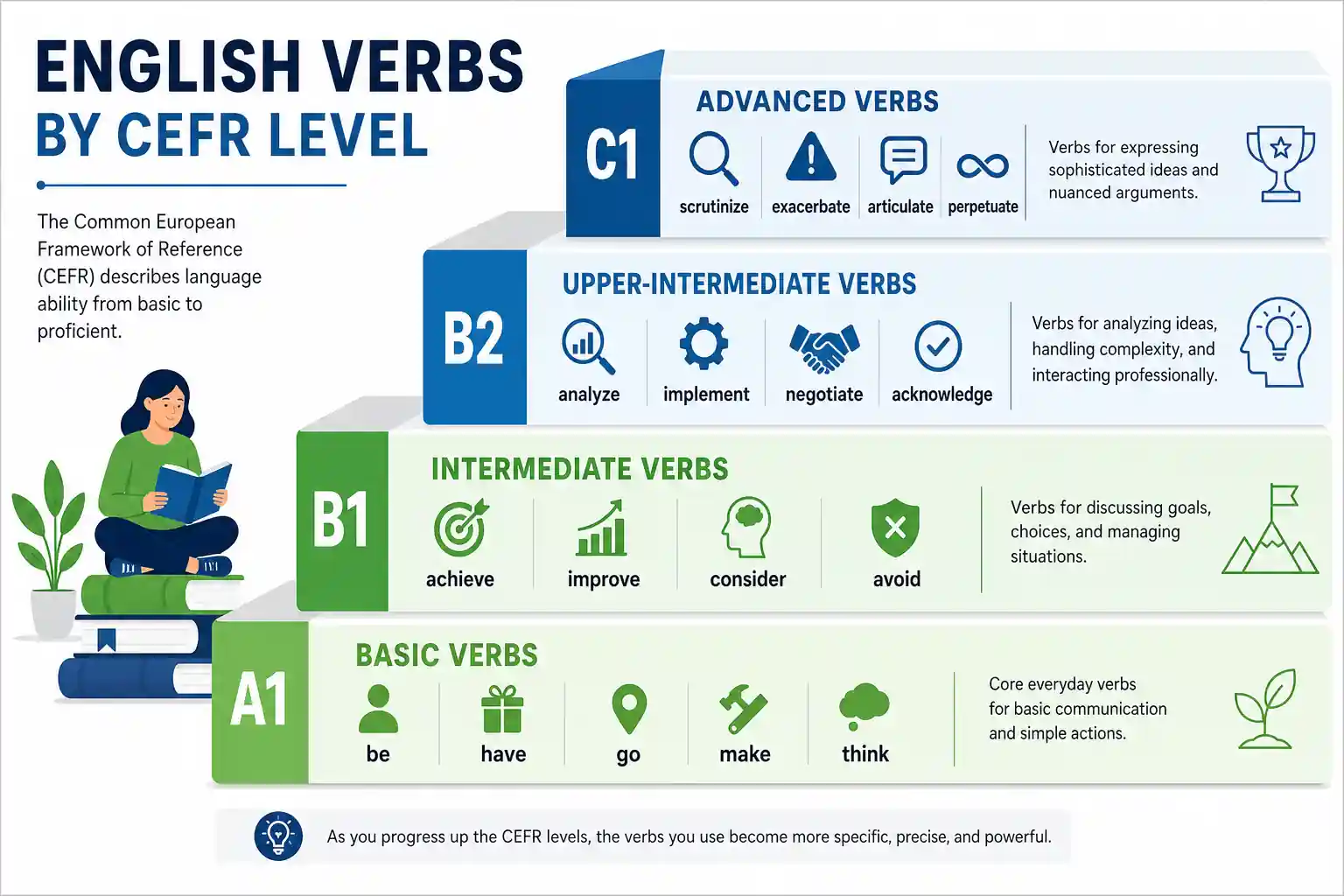
本指南按CEFR程度(A1-C1)和使用類別分類給你這300個動詞。每個動詞包含其含義、例句和顯示母語者如何實際使用它的常見句型。
- 動詞總數:300
- 分類方式:CEFR程度(A1-C1)和語義類別
- 格式:動詞 → 含義 → 句型 → 例句
- 最適合:詞彙建立、語法參考、考試準備
英語動詞的工作原理:快速概覽
動詞形式
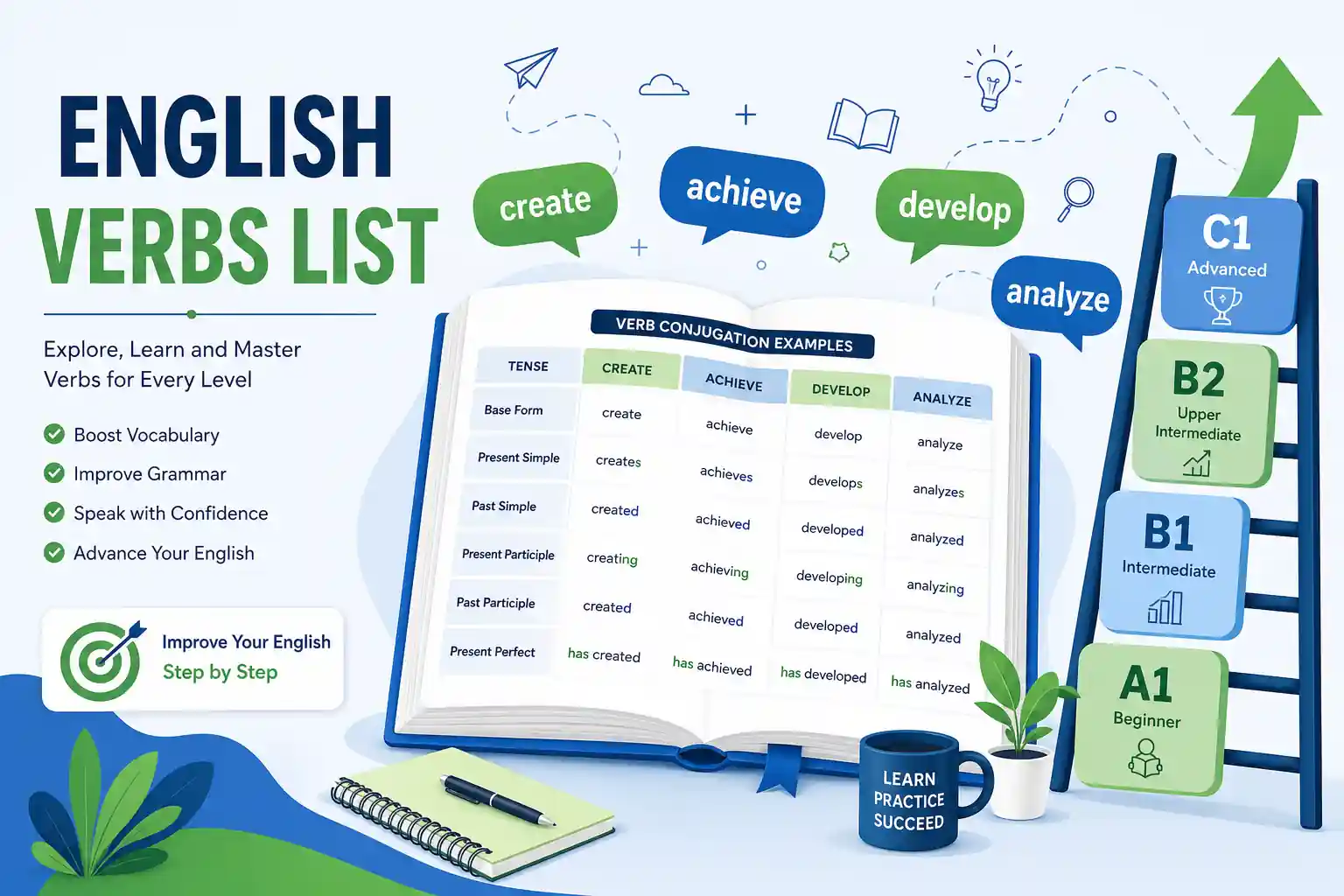
每個英語動詞有5種形式(規則動詞)或最多5種不規則形式:
| 形式 | 規則(work) | 不規則(go) | 用途 |
|---|---|---|---|
| 原形 | work | go | 一般現在式、不定式 |
| 第三人稱-s | works | goes | He/she/it現在式 |
| 過去式 | worked | went | 過去事件 |
| 過去分詞 | worked | gone | 完成式、被動語態 |
| -ing形式 | working | going | 進行式、動名詞 |
及物 vs 不及物
| 類型 | 定義 | 例句 |
|---|---|---|
| 及物 | 需要賓語 | She wrote a letter. |
| 不及物 | 不需要賓語 | He arrived late. |
| 兩者皆可 | 兩種方式都可使用 | She runs a company. / She runs every morning. |
動詞句型
知道動詞的含義是不夠的——你需要知道它後面跟什麼:
| 句型 | 例句 |
|---|---|
| 動詞 + 不定式(to + 動詞) | I want to learn English. |
| 動詞 + -ing | I enjoy reading books. |
| 動詞 + 賓語 | She made a decision. |
| 動詞 + 賓語 + 不定式 | He asked me to help. |
| 動詞 + 介詞 | She depends on her family. |
A1程度:基本動詞(75個動詞)
這些動詞是絕對的基礎。每個英語學習者從第一天就需要它們。
存在和擁有
| # | 動詞 | 含義 | 句型 | 例句 |
|---|---|---|---|---|
| 1 | be | 存在;等同 | be + 形容詞/名詞 | She is happy. / He is a teacher. |
| 2 | have | 擁有;體驗 | have + 名詞 | I have two children. |
| 3 | do | 執行動作 | do + 名詞 | He does his homework every evening. |
| 4 | become | 變成 | become + 形容詞/名詞 | She became a doctor. |
| 5 | seem | 看起來像是 | seem + 形容詞/to + 動詞 | He seems tired. |
移動
| # | 動詞 | 含義 | 句型 | 例句 |
|---|---|---|---|---|
| 6 | go | 移動到某地 | go + to + 地點 | I go to work at 8 AM. |
| 7 | come | 向說話者移動 | come + to/from | Come to my office after lunch. |
| 8 | get | 獲得;到達;變成 | get + 名詞/形容詞/to | I got a message. |
| 9 | run | 快速跑步 | run + 方向 | He runs every morning. |
| 10 | walk | 步行 | walk + to/along | We walked to the station. |
| 11 | move | 改變位置/地點 | move + to/from | They moved to London last year. |
| 12 | leave | 離開 | leave + 地點/時間 | She leaves the office at 6 PM. |
| 13 | arrive | 到達目的地 | arrive + at/in | We arrived at the airport two hours early. |
| 14 | return | 回來/回去 | return + to | He returned to his hometown. |
交流
| # | 動詞 | 含義 | 句型 | 例句 |
|---|---|---|---|---|
| 15 | say | 說話 | say + that/引語 | She said she was busy. |
| 16 | tell | 告知某人 | tell + 人 + that/to | Tell me what happened. |
| 17 | ask | 請求信息/幫助 | ask + 人 + 問題/to | He asked me to wait outside. |
| 18 | speak | 使用語言 | speak + 語言/to 某人 | She speaks three languages fluently. |
| 19 | talk | 進行對話 | talk + to/about | We talked about the project. |
| 20 | call | 打電話;稱呼 | call + 人/名詞 | I’ll call you tomorrow. |
| 21 | write | 寫文字 | write + 名詞/to 某人 | He wrote a long email. |
| 22 | read | 理解書面文字 | read + 名詞 | She reads the newspaper. |
| 23 | listen | 注意聲音 | listen + to | Listen to this song. |
行動和工作
| # | 動詞 | 含義 | 句型 | 例句 |
|---|---|---|---|---|
| 24 | make | 創造;引起 | make + 名詞/形容詞 | She made a cake. |
| 25 | take | 獲取;攜帶;需要時間 | take + 名詞/時間 | Take your keys. |
| 26 | give | 遞給某人 | give + 人 + 東西 | He gave her a gift. |
| 27 | put | 放置在某位置 | put + 東西 + 地點 | Put the book on the table. |
| 28 | use | 用於某目的 | use + 名詞 + to/for | I use this app to learn vocabulary. |
| 29 | work | 做工作;運作 | work + at/for/as | She works for a tech company. |
| 30 | help | 協助某人 | help + 人 + (to) 動詞 | Can you help me? |
| 31 | try | 嘗試 | try + to 動詞/-ing | I’m trying to learn 5 new words. |
| 32 | start | 開始 | start + -ing/to 動詞 | She started learning English. |
| 33 | stop | 停止 | stop + -ing | Stop talking and listen. |
| 34 | pay | 給付金錢 | pay + for/金額 | She paid $50 for the ticket. |
思考和感受
| # | 動詞 | 含義 | 句型 | 例句 |
|---|---|---|---|---|
| 35 | think | 用頭腦思考;認為 | think + about/that | I think this is a good idea. |
| 36 | know | 擁有信息/技能 | know + that/how/名詞 | I know how to cook Italian food. |
| 37 | want | 想要 | want + to 動詞/名詞 | She wants to travel the world. |
| 38 | need | 需要 | need + to 動詞/名詞 | You need to study more. |
| 39 | like | 享受;覺得愉快 | like + -ing/名詞 | I like reading before bed. |
| 40 | love | 感受強烈愛意 | love + -ing/名詞/人 | She loves her job. |
| 41 | feel | 體驗情緒/感覺 | feel + 形容詞 | I feel tired after a long day. |
| 42 | believe | 認為某事是真的 | believe + that/in | I believe this plan will work. |
| 43 | understand | 理解含義 | understand + 名詞/that | I don’t understand this question. |
| 44 | remember | 記住 | remember + -ing/to 動詞 | I remember meeting her. |
| 45 | forget | 忘記 | forget + to 動詞/about | Don’t forget to lock the door. |
| 46 | hope | 希望某事 | hope + to 動詞/that | I hope to see you again soon. |
日常生活
| # | 動詞 | 含義 | 例句 |
|---|---|---|---|
| 47 | live | 居住;存活 | She lives in a small apartment downtown. |
| 48 | eat | 進食 | We usually eat dinner at 7 PM. |
| 49 | drink | 喝飲料 | He drinks three cups of coffee a day. |
| 50 | sleep | 休息 | I slept for ten hours last night. |
| 51 | buy | 購買 | She bought a new laptop. |
| 52 | sell | 換取金錢 | They sold their house. |
| 53 | bring | 攜帶向某處 | Bring your book to class. |
| 54 | send | 使其被送達 | I sent the document to your email. |
| 55 | look | 注視 | Look at this photo. |
| 56 | see | 用眼睛感知 | I can see the mountains. |
| 57 | watch | 有意觀察 | She watches the news every evening. |
| 58 | hear | 用耳朵感知 | I heard a strange noise. |
| 59 | find | 發現;定位 | I found the exercise difficult. |
| 60 | keep | 繼續擁有;維持 | Keep studying — you’re making progress. |
| 61 | learn | 獲得知識/技能 | She learned to drive when she was 17. |
| 62 | teach | 傳授知識 | He teaches English to beginners. |
| 63 | change | 使/變得不同 | The city has changed a lot. |
B1程度:中級動詞(75個動詞)
在B1,動詞變得更加具體和富有表達力。你超越了基本動作,進入了描述過程、意見和抽象概念。
工作和成就
| # | 動詞 | 含義 | 例句 |
|---|---|---|---|
| 64 | manage | 負責;成功做到 | She manages a team of 15 people. |
| 65 | achieve | 通過努力達到目標 | He achieved his target. |
| 66 | develop | 成長;創建 | The company developed a new product line. |
| 67 | improve | 使或變得更好 | Her English has improved significantly. |
| 68 | produce | 製造;創造輸出 | The factory produces 10,000 units per day. |
| 69 | provide | 給予;供應 | The school provides lunch. |
| 70 | create | 創造新事物 | She created a website. |
| 71 | support | 幫助;支撐 | I support your decision. |
| 72 | lead | 引導;在前面 | She leads the marketing department. |
| 73 | complete | 完全完成 | She completed her degree in three years. |
| 74 | continue | 繼續進行 | They continued working despite the difficulty. |
| 75 | increase | 使或變得更大 | Sales increased by 20%. |
| 76 | reduce | 使更小/更少 | We reduced costs by eliminating waste. |
決定和控制
| # | 動詞 | 含義 | 例句 |
|---|---|---|---|
| 77 | decide | 做出選擇 | She decided to accept the job offer. |
| 78 | choose | 從選項中選擇 | I chose the cheaper option. |
| 79 | allow | 許可 | The company allows employees to work from home. |
| 80 | prevent | 阻止發生 | The barrier prevents cars from entering. |
| 81 | avoid | 遠離 | She avoids eating sugar. |
| 82 | accept | 同意接受/相信 | He accepted the invitation. |
| 83 | refuse | 說不;拒絕 | She refused to sign the contract. |
| 84 | offer | 提供以供接受 | They offered her a promotion. |
| 85 | suggest | 提出想法 | I suggest taking a break. |
進階交流
| # | 動詞 | 含義 | 例句 |
|---|---|---|---|
| 86 | explain | 使清晰 | Can you explain how this works? |
| 87 | describe | 說明某物是什麼樣的 | She described the experience as life-changing. |
| 88 | discuss | 詳細談論 | We discussed the plan with the whole team. |
| 89 | argue | 給出理由;不同意 | They argued about politics for hours. |
| 90 | admit | 承認;接受為真 | She admitted that she had made a mistake. |
| 91 | promise | 承諾做某事 | He promised to call her every day. |
| 92 | warn | 警告危險 | The sign warns visitors not to feed the animals. |
| 93 | encourage | 給予信心/支持 | His teacher encouraged him to apply to university. |
體驗和情感
| # | 動詞 | 含義 | 例句 |
|---|---|---|---|
| 94 | enjoy | 從中獲得樂趣 | I really enjoy traveling. |
| 95 | prefer | 更喜歡某事 | She prefers working from home. |
| 96 | miss | 因缺席感到悲傷 | I miss living near the sea. |
| 97 | expect | 認為某事將發生 | I didn’t expect to win. |
| 98 | notice | 意識到 | I noticed a change in his behavior. |
| 99 | realize | 意識到;理解 | She realized she had left her keys at home. |
| 100 | consider | 仔細思考 | Have you considered changing jobs? |
| 101 | imagine | 在腦中形成畫面 | Imagine living in a city with no cars. |
B2程度:中高級動詞(75個動詞)
在B2,動詞表達細微差別、職業能力和抽象思維。這些是區分「好」英語和「流利」英語的動詞。
分析和研究
| # | 動詞 | 含義 | 例句 |
|---|---|---|---|
| 102 | analyze | 詳細檢查 | The team analyzed the data. |
| 103 | examine | 仔細查看 | The doctor examined the patient. |
| 104 | investigate | 搜尋事實 | Police are investigating the cause. |
| 105 | determine | 查明;正式決定 | Scientists determined that the drug was effective. |
| 106 | identify | 認識;確定什麼 | Researchers identified stress as the main factor. |
| 107 | assess | 評估質量或重要性 | We need to assess the risks. |
| 108 | evaluate | 判斷價值 | The committee evaluated all applications. |
| 109 | indicate | 顯示;指向 | Studies indicate that exercise reduces anxiety. |
影響和控制
| # | 動詞 | 含義 | 例句 |
|---|---|---|---|
| 110 | influence | 影響某事的發展 | Social media influences consumer behavior. |
| 111 | affect | 對…產生影響 | The new policy will affect all employees. |
| 112 | establish | 建立;證明 | The company established a new office. |
| 113 | maintain | 保持良好狀態;聲稱 | It’s expensive to maintain an old building. |
| 114 | ensure | 確保 | Double-check to ensure that everything is correct. |
| 115 | require | 需要;正式要求 | The position requires five years of experience. |
| 116 | enable | 使成為可能 | Technology enables us to work from anywhere. |
商業和策略
| # | 動詞 | 含義 | 例句 |
|---|---|---|---|
| 117 | invest | 投入資金 | She invested in renewable energy. |
| 118 | acquire | 獲得;收購 | The tech giant acquired three startups. |
| 119 | generate | 產生;創造 | The campaign generated significant media coverage. |
| 120 | launch | 公開推出新事物 | They launched the product. |
| 121 | expand | 擴大;增加 | The company expanded into Asian markets. |
| 122 | implement | 將計劃付諸行動 | The school implemented a new attendance policy. |
| 123 | negotiate | 討論達成協議 | She negotiated a better salary. |
| 124 | distribute | 分配給許多人 | The charity distributed food. |
精緻交流
| # | 動詞 | 含義 | 例句 |
|---|---|---|---|
| 125 | acknowledge | 認識;公開承認 | The CEO acknowledged that mistakes were made. |
| 126 | clarify | 使更清晰 | Could you clarify what you mean? |
| 127 | emphasize | 強調重要性 | She emphasized the need for communication. |
| 128 | convince | 說服相信/行動 | She convinced me to apply. |
| 129 | confirm | 確認為真 | Can you confirm that the meeting is at 3 PM? |
| 130 | deny | 說某事不是真的 | He denied taking the money. |
| 131 | reveal | 公開;顯示 | The report revealed that costs had doubled. |
| 132 | respond | 回覆;反應 | The company responded to criticism. |
C1程度:進階動詞(75個動詞)
C1動詞是精確、複雜的,標誌著你是一個高度熟練的英語使用者。
批判性思維
| # | 動詞 | 含義 | 例句 |
|---|---|---|---|
| 133 | perceive | 注意;以特定方式理解 | The public perceived the decision as unfair. |
| 134 | anticipate | 預期並準備 | We anticipated strong demand. |
| 135 | speculate | 在沒有證據的情況下形成理論 | Analysts speculated that the company might be sold. |
| 136 | infer | 從證據中得出結論 | From his tone, I inferred that he was not happy. |
| 137 | scrutinize | 非常仔細地檢查 | The auditors scrutinized every transaction. |
| 138 | validate | 確認為正確/有價值 | The experiment validated the hypothesis. |
| 139 | undermine | 逐漸削弱 | Constant criticism undermines confidence. |
| 140 | contradict | 說相反的話;與…衝突 | The new evidence contradicts earlier findings. |
因果和變化
| # | 動詞 | 含義 | 例句 |
|---|---|---|---|
| 141 | trigger | 引起突然發生 | The announcement triggered protests. |
| 142 | provoke | 引起反應;激怒 | His comments provoked an angry response. |
| 143 | facilitate | 使更容易;促進 | Good infrastructure facilitates economic growth. |
| 144 | accelerate | 加快速度 | The pandemic accelerated remote work. |
| 145 | diminish | 使或變得更小/更少 | His influence has diminished. |
| 146 | exacerbate | 使更糟 | Poor communication exacerbated the conflict. |
| 147 | sustain | 長期維持 | The economy cannot sustain this growth. |
| 148 | erode | 逐漸破壞/削弱 | Neglect eroded public trust. |
| 149 | disrupt | 中斷;從根本上改變 | Streaming services disrupted TV industry. |
精確交流
| # | 動詞 | 含義 | 例句 |
|---|---|---|---|
| 150 | articulate | 清晰表達 | She articulated her vision with clarity. |
| 151 | convey | 傳達(含義/感受) | The painting conveys a sense of loneliness. |
| 152 | elaborate | 更詳細地解釋 | Could you elaborate on your second point? |
| 153 | reiterate | 為強調再次說明 | I want to reiterate that safety is our top priority. |
| 154 | dispute | 不同意;質疑 | Scientists dispute the claim. |
| 155 | advocate | 公開支持 | She advocates for better working conditions. |
| 156 | assert | 堅定自信地陳述 | He asserted that the project would finish on schedule. |
| 157 | concede | 不情願地承認;放棄 | She conceded that the argument had some merit. |
抽象精確
| # | 動詞 | 含義 | 例句 |
|---|---|---|---|
| 158 | constitute | 組成;等同於 | Women constitute 60% of the graduates. |
| 159 | encompass | 包含廣泛範圍 | The study encompasses data from 30 countries. |
| 160 | entail | 必然涉及 | The role entails extensive travel. |
| 161 | warrant | 證明有理由;使成為必要 | The situation warrants immediate action. |
| 162 | transcend | 超越界限 | Good music transcends language barriers. |
| 163 | manifest | 清晰顯示;出現 | His anxiety manifests as insomnia. |
| 164 | fluctuate | 頻繁且不規律地變化 | Oil prices fluctuate regularly. |
| 165 | correlate | 有相互關係 | Exercise correlates with better sleep. |
| 166 | proliferate | 數量迅速增加 | Misinformation has proliferated online. |
| 167 | deteriorate | 變得更糟 | His health deteriorated rapidly. |
| 168 | alleviate | 使不那麼嚴重 | New measures aim to alleviate congestion. |
| 169 | mitigate | 減少有害影響 | Steps were taken to mitigate the environmental impact. |
| 170 | perpetuate | 使無限期繼續 | The media perpetuates harmful stereotypes. |
| 171 | supersede | 取代較舊的東西 | New guidelines supersede all previous versions. |
| 172 | withhold | 拒絕給予 | The company withheld information from investors. |
| 173 | elucidate | 使清晰;解釋 | The professor elucidated the theory. |
| 174 | synthesize | 將元素組合成整體 | The essay synthesizes ideas from multiple fields. |
快速進度檢查
使用這個表格誠實地評估你的動詞知識。
| 程度 | 總數 | 我能使用 | 我能識別 | 我不知道 | 你的程度 |
|---|---|---|---|---|---|
| A1 | 75 | _ | _ | _ | 如果60+「使用」→ 準備好B1 |
| B1 | 75 | _ | _ | _ | 如果60+「使用」→ 準備好B2 |
| B2 | 75 | _ | _ | _ | 如果60+「使用」→ 準備好C1 |
| C1 | 75 | _ | _ | _ | 如果50+「使用」→ 進階使用者 |
目標: 將動詞從「識別」移動到「使用」。這就是被動和主動詞彙之間的區別。
動詞句型:主要參考
動詞 + TO + 不定式
這些動詞後面接「to + 動詞」:
want, need, decide, hope, plan, offer, refuse, promise, agree, learn, seem, appear, tend, manage, fail, afford, attempt, expect
She decided to leave early. / They agreed to pay the full amount.
動詞 + -ING(動名詞)
這些動詞後面接-ing形式:
enjoy, avoid, consider, suggest, finish, mind, keep, practice, deny, admit, imagine, involve, risk, miss, delay, recommend
I enjoy reading before bed. / She avoided answering the question.
動詞 + 賓語 + TO + 不定式
ask, tell, want, expect, allow, encourage, invite, force, remind, persuade, advise, warn, convince, enable, require
He asked me to help. / They encouraged her to apply.
動詞 + 介詞
| 動詞 | 正確介詞 | 例句 |
|---|---|---|
| depend | on | It depends on the weather. |
| consist | of | The team consists of ten people. |
| belong | to | This belongs to me. |
| apply | for (職位) / to (規則) | She applied for a visa. |
| suffer | from | He suffers from allergies. |
| contribute | to | Exercise contributes to good health. |
| comply | with | You must comply with the rules. |
練習詞彙
cooperate
動詞
合作
evaluate
動詞
評估, 估價
範例
- Companies evaluate job candidates based on experience, skills, and personality.
- Teachers evaluate student progress through tests, projects, and classroom participation.
donate
動詞
捐贈
範例
- Many people donate money to charities that help homeless individuals.
- She decided to donate blood to help patients in emergency situations.
discourage
動詞
使灰心, 洩氣
範例
- Don't let one failure discourage you from pursuing your dreams.
- High prices discourage many people from buying organic food products.
graduate
動詞
畢業
範例
- She will graduate from university next year with a degree in engineering.
- Students must complete all requirements before they can graduate from high school.
resolve
動詞
解決
範例
- Mediator helps parties resolve dispute through negotiation.
- Technical team will resolve software problems quickly.
off
形容詞
去除
範例
- Please turn off the lights before leaving the room.
- The dog ran off into the forest chasing wild rabbits.
stress
動詞
使緊張
範例
- Heavy workload may stress employees beyond limits.
- Teacher will stress importance of homework completion.
guide
動詞
指導, 引導
範例
- Parents should guide their children to make responsible decisions.
- The experienced hiker will guide the group through the mountain trail safely.
artery
名詞
動脈
範例
- The blocked artery required immediate surgical intervention to save his life.
- This highway is a major artery connecting the city to surrounding areas.
coastal
形容詞
沿海的
範例
- Coastal towns often depend on fishing and tourism for their economy.
- The coastal erosion threatens many beachfront properties and buildings.
candidate
名詞
候選人
範例
- Each presidential candidate presented their policy plans to voters.
- The job candidate impressed the interview panel with her experience.
horizon
名詞
地平線
範例
- The sun disappeared behind the horizon as evening approached.
- Traveling broadens your horizon and exposes you to new cultures.
jury
名詞
陪審團
範例
- The jury deliberated for several hours before reaching a verdict.
- The talent show jury consisted of professional musicians and entertainers.
prejudice
名詞
偏見
範例
- Education helps overcome prejudice and promotes understanding.
- Racial prejudice damages communities and individuals alike.
tragedy
名詞
悲劇
範例
- Natural tragedy affects thousands of innocent people.
- Personal tragedy changes person's life perspective completely.
boom
名詞
繁榮
範例
- The boom of thunder echoed across the valley.
- The technology boom created many new millionaires.
admission
名詞
入學許可
範例
- Her admission to the prestigious medical school was the result of hard work.
- The museum offers free admission on the first Sunday of every month.
union
名詞
聯盟
範例
- Labor union protects worker rights and interests.
- Marriage union joins two people in partnership.
voyage
名詞
航程
範例
- Space exploration represents humanity's greatest voyage into the unknown.
- The ocean voyage from Europe to America took several weeks in the past.
humorous
形容詞
幽默的, 風趣的
範例
- She writes humorous articles about everyday life and family experiences.
- The humorous speech made everyone laugh and lightened the serious mood.
lifelong
形容詞
終身的
範例
- Learning is a lifelong process that never truly ends.
- Their lifelong friendship began during elementary school years.
motivated
形容詞
有動力的
範例
- Motivated employee seeks additional responsibilities and challenges at work.
- Success requires being motivated even when facing difficult obstacles.
indispensable
形容詞
不可或缺的
範例
- Clean water is indispensable for human survival and good health.
- Her experience and skills make her indispensable to the research team.
total
形容詞
全部的
範例
- Total cost includes all fees and expenses.
- Total silence fills room during meditation session.
接下來做什麼
-
找到你的程度。 掃描你當前CEFR程度的清單。標記你能理解但不能主動使用的動詞——那些是你的優先目標。
-
每天學習5個動詞。 對每個動詞,學習其含義、主要句型(它後面跟什麼)和一個例句。
-
關注句型。 知道「suggest」後接-ing(而不是「to + 動詞」)可以防止即使是進階學習者也會犯的錯誤。
-
閱讀動詞豐富的內容。 新聞文章、學術文本和商業寫作充滿了B2-C1動詞。我們的部落格文章就是為了自然地讓你接觸這些動詞而撰寫的。
常見問題
英語中最常見的動詞是什麼?
10個最常見的英語動詞是:be, have, do, say, go, get, make, know, think, take。這些佔口語英語中所有動詞使用的大約25%。
英語中有多少個動詞?
英語總共大約有25,000個動詞,但大多數是罕見的或高度專業化的。對於實際流暢性,知道300-500個動詞(附其句型和搭配)足以在日常交流中表達幾乎任何東西。
規則動詞和不規則動詞有什麼區別?
規則動詞通過添加「-ed」形成過去式(work → worked)。不規則動詞有不可預測的過去形式,必須記憶(go → went, think → thought, be → was)。大約200個常用英語動詞是不規則的,它們往往是最常見的動詞。
動詞句型是什麼,為什麼重要?
動詞句型是跟在特定動詞後面的語法結構。例如,「enjoy」後面永遠跟-ing(enjoy reading),而「want」後面永遠跟「to + 動詞」(want to read)。使用錯誤的句型(enjoy to read)是母語者立即注意到的語法錯誤。