Basic English for Speaking: Essential Words and Phrases
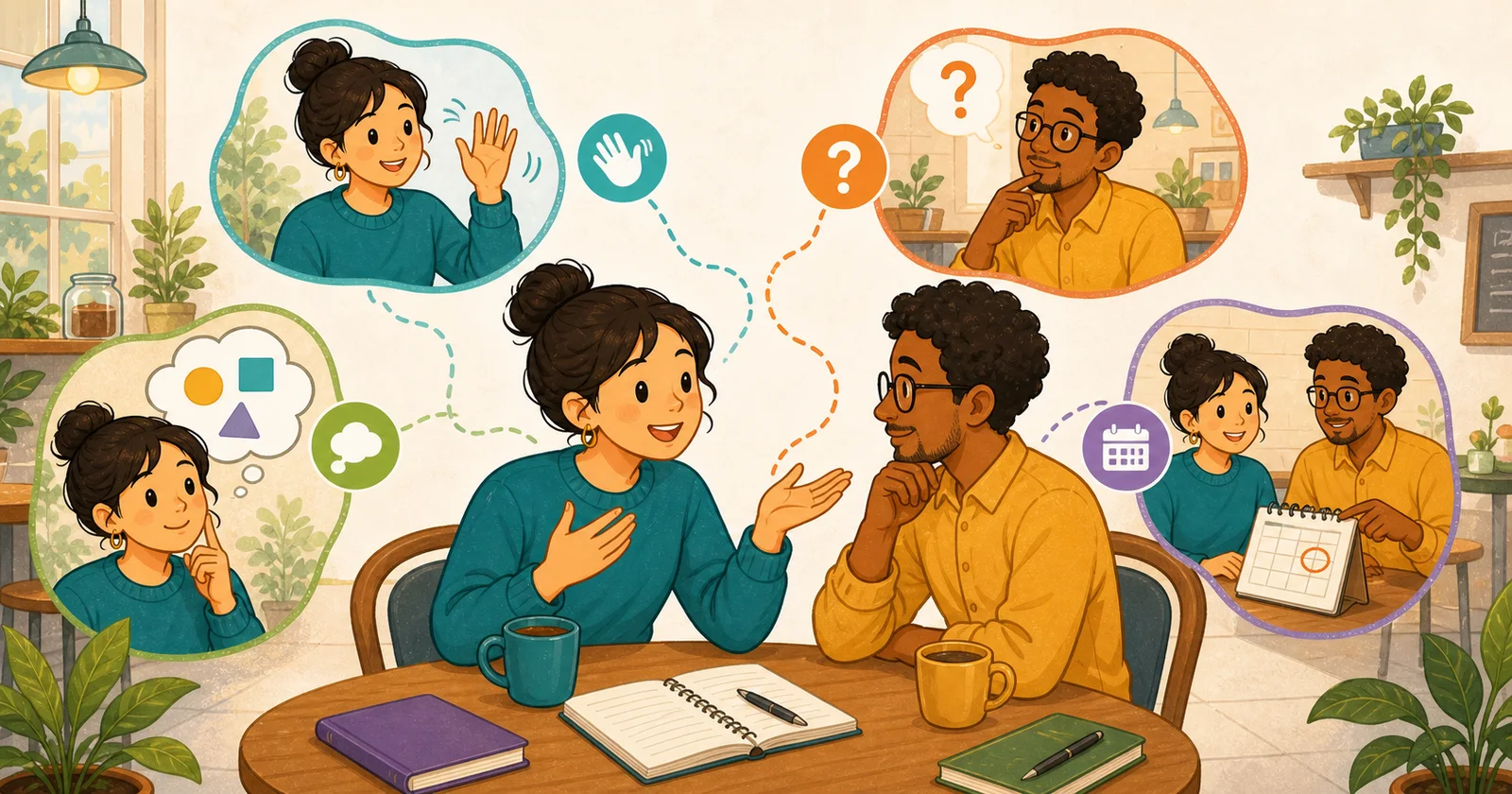
Basic English for speaking is not about memorizing long dialogues. It is about having a small set of words and phrase frames that you can change for your own life. With a few reliable patterns, you can greet someone, ask for help, give an opinion, and make a simple plan.
This guide focuses on language you can use from your first conversations.
- Level: A1–A2 moving toward B1
- Focus: everyday speaking, not grammar terminology
- Best for: learners who understand words but hesitate to speak
- Study goal: learn one phrase frame and make it personal
If you are starting from zero, first build a base with English for Beginners. Then use the A2 vocabulary library to practise words in small groups.
Start with Useful Speaking Frames
A speaking frame is a short pattern with one changeable part. You do not need to invent every sentence from the beginning.
| Frame | Use it for | Personal example |
|---|---|---|
| I’m from … | saying where you come from | I’m from Brazil. |
| I work as a … | talking about work | I work as a designer. |
| I’m interested in … | sharing interests | I’m interested in photography. |
| Could you …? | making a polite request | Could you repeat that? |
| I’d like to … | saying what you want | I’d like to practise more. |
Say the frame slowly, then replace only one word. This gives you fluency through repetition without making your speech sound memorized.
Introductions and Everyday Questions
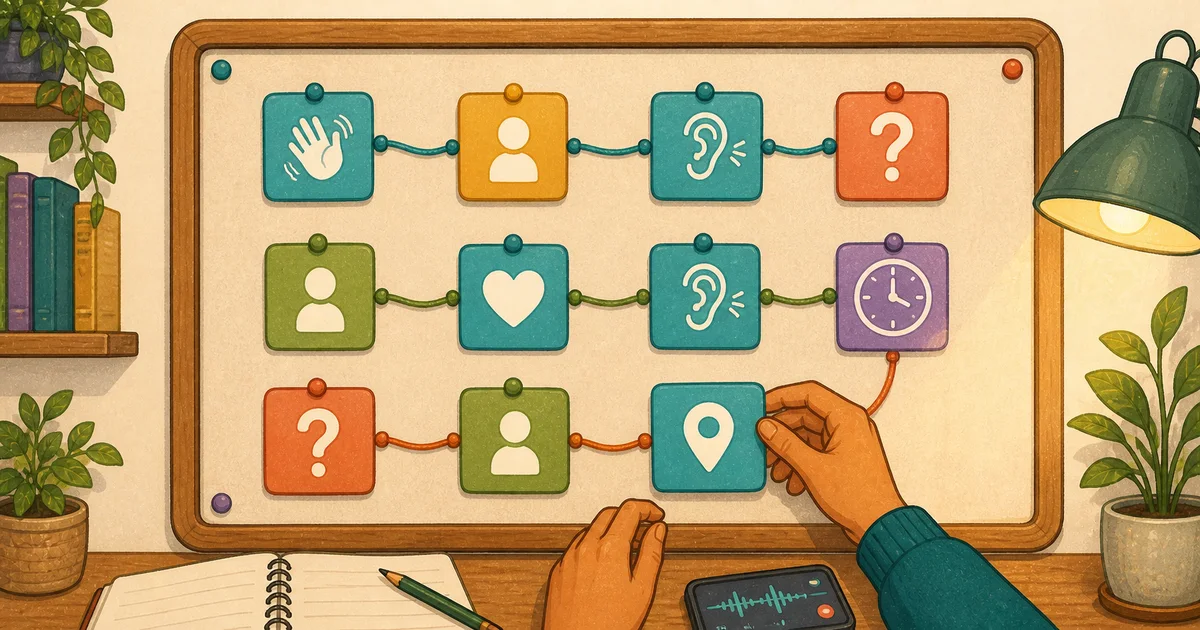
These phrases help you start, continue, and finish a simple conversation.
| Phrase | Meaning or use | Example |
|---|---|---|
| Nice to meet you. | first meeting | Nice to meet you. I’m Mina. |
| How’s it going? | friendly greeting | How’s it going today? |
| What do you do? | asking about work or study | What do you do for work? |
| Where are you from? | asking about origin | Where are you from originally? |
| What do you mean? | asking for clarification | Sorry, what do you mean? |
The goal is not to speak fast. Pause, listen to the answer, and ask one follow-up question. A calm two-minute conversation is more useful than a rushed perfect sentence.
Asking for Help and Clarification
Good speakers do not understand everything immediately. They use clear phrases to keep the conversation moving.
| Phrase | Use | Example |
|---|---|---|
| Could you say that again? | asking someone to repeat | Could you say that again, please? |
| Could you speak more slowly? | asking for a slower pace | Could you speak more slowly? |
| How do you spell that? | checking a word or name | How do you spell your surname? |
| I don’t understand yet. | being honest politely | I don’t understand yet. Could you show me? |
| Do you mean …? | checking your understanding | Do you mean the meeting is tomorrow? |
These phrases give you time to think. They are not signs of failure; they are tools for real conversation.
Sharing Opinions and Feelings
Simple opinion language lets you take part in a conversation even when your vocabulary is still small.
| Phrase | Meaning or use | Example |
|---|---|---|
| I think … | giving an opinion | I think this film is funny. |
| In my opinion, … | giving a slightly more formal opinion | In my opinion, online classes are useful. |
| I agree. | showing agreement | I agree. That sounds fair. |
| I’m not sure. | soft disagreement or uncertainty | I’m not sure. Maybe we should check. |
| That sounds great. | positive response | A walk after work? That sounds great. |
Add one short reason when you can: “I think it is useful because it saves time.” This small extra step makes your answer clearer and gives your partner something to respond to.
Keep a Conversation Moving
You do not need a long answer to sound interested. A short response plus one small follow-up keeps the other person talking and gives you more time to think.
| Short response | Follow-up question | Example |
|---|---|---|
| Really? | How was it? | “I went to a concert.” “Really? How was it?” |
| That sounds nice. | Who did you go with? | “I visited my cousin.” “That sounds nice. Who did you go with?” |
| I see. | What happened next? | “My train was late.” “I see. What happened next?” |
| Me too. | How often do you do that? | “I like cooking.” “Me too. How often do you do that?” |
| I’m not sure. | What do you think? | “Is this the best option?” “I’m not sure. What do you think?” |
These short pairs are easier than trying to produce a perfect long sentence. Learn them as complete chunks, then use the one that fits the real person and topic.
Two Mini Conversations to Reuse
Short models show how familiar frames connect in a real exchange. Replace the details with your own city, work, plans, or interests.
Meeting someone
- A: Hi, I’m Leo. Nice to meet you.
- B: Nice to meet you too. Where are you from?
- A: I’m from Madrid. What about you?
- B: I’m from Seoul. I’m interested in photography.
Making a plan
- A: Are you free on Saturday?
- B: I think so. What time works for you?
- A: Let’s meet at three near the station.
- B: Great. That sounds good.
Read both roles aloud. Then change just one detail: the day, the place, the activity, or the question. This creates many useful conversations from a very small amount of language.
Use Simple Fillers to Give Yourself Time
Native speakers also pause while they think. A few polite fillers help you hold the turn without sounding silent.
| Filler | When to use it |
|---|---|
| Well, … | before a short opinion or answer |
| Let me think. | when you need a moment |
| I mean, … | when you want to explain an idea more clearly |
| How can I say this? | when you know the idea but need a word |
Use one filler, then continue with a simple sentence. Do not wait until you know every word; communication usually improves when you keep the exchange moving.
Making Plans and Talking about Time
Conversation often moves to simple plans: time, place, and availability.
| Phrase | Use | Example |
|---|---|---|
| Are you free on …? | checking availability | Are you free on Saturday? |
| What time works for you? | arranging a time | What time works for you? |
| Let’s meet at … | suggesting a meeting | Let’s meet at six. |
| I’ll be there in … | saying when you will arrive | I’ll be there in ten minutes. |
| Can we change the plan? | changing an arrangement | Can we change the plan to Sunday? |
Make plans aloud, even when you are studying alone. Describe a real small plan for tomorrow using a time, a place, and one action.
A Simple Speaking Practice Cycle
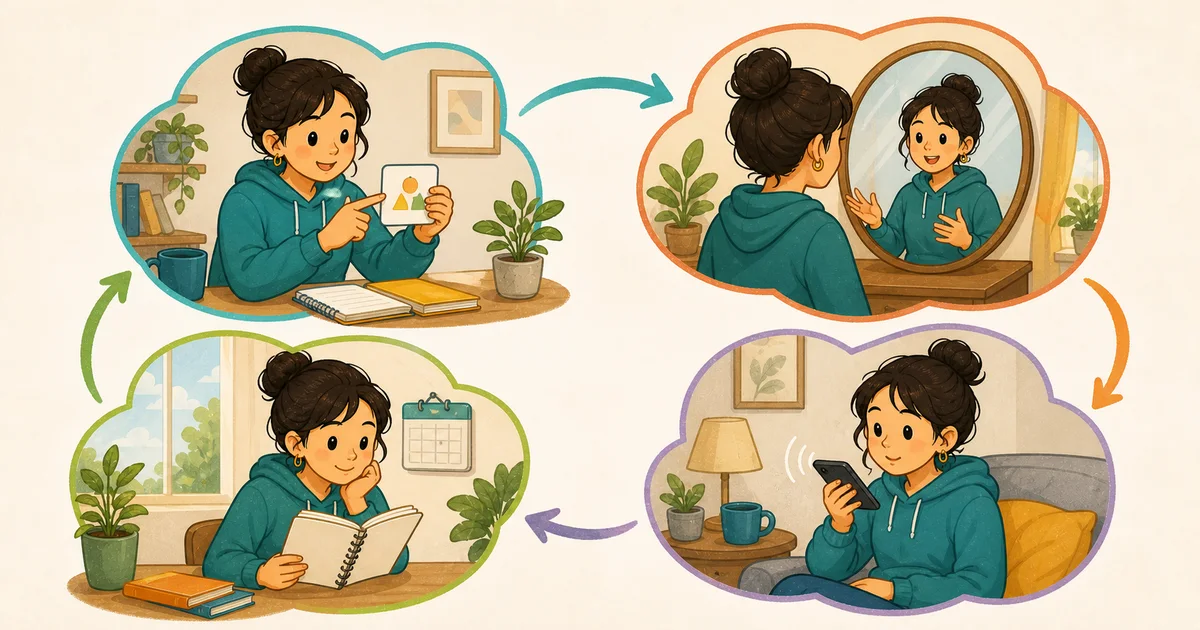
Try this ten-minute routine four times a week.
- Choose three phrases. Read them aloud twice.
- Make them true. Replace the details with your name, city, work, or plans.
- Record a short answer. Speak for 30 seconds without stopping to correct every word.
- Review and repeat. Listen once, improve one sentence, and save key words in Linglify.
For more everyday vocabulary by situation, use English Words for Daily Use. When your short answers feel easy, move to the B1 vocabulary library.
Vocabulary to Practise
Save these useful words in Linglify, then build short conversations around them. Aim to use each word in one true sentence before you learn another group.
abuse
noun
Wrong or improper use of something, often causing harm or damage.
Examples
- It's important to report any signs of child abuse to the authorities.
- The investigation revealed serious abuse of power by government officials.
actually
adverb
In fact; in truth; used to emphasize something surprising or true.
Examples
- I thought the meeting was today, but it's actually scheduled for tomorrow.
- The book looks boring, but it's actually quite interesting and engaging.
affection
noun
A feeling of fondness or warmth towards someone or something.
Examples
- The child showed deep affection for his grandmother who raised him.
- Their mutual affection was evident to everyone who saw them together.
agreement
noun
A formal statement of shared understanding or arrangement.
Examples
- The trade agreement will benefit both countries' economic development significantly.
- There was general agreement among the committee members about the proposed changes.
airport
noun
A place where aircraft take off and land.
Examples
- International airports handle millions of travelers and tons of cargo annually.
- We need to arrive at the airport two hours before our departure time.
alternate
adjective
Describing something that can be used instead of another.
Examples
- The parking lot uses alternate spaces for cars and motorcycles.
- We need an alternate plan in case the weather doesn't cooperate.
announce
verb
To make a public statement about something or tell people about it.
Examples
- Airlines announce flight delays through the terminal's public address system.
- The principal will announce the scholarship winners during tomorrow's assembly.
apart
adverb
Separated by a distance; not together.
Examples
- Please keep these chemicals apart to prevent dangerous reactions.
- The two friends lived far apart but stayed in regular contact.
apply
verb
To make a formal request or to put to use.
Examples
- Apply pressure to the wound to stop the bleeding immediately.
- Students can apply for financial aid to help pay tuition costs.
arrest
noun
A formal act of stopping someone and taking them into custody.
Examples
- He was under arrest for suspected involvement in the robbery.
- The arrest of the criminal was reported on the evening news.
attend
verb
To be present at an event, meeting, or activity.
Examples
- All students must attend classes regularly to pass their courses.
- The nurse will attend to the patient's needs throughout the night.
ballet
noun
A form of dance performed to music, often involving graceful movements and storytelling.
Examples
- She studied ballet for many years before becoming a professional dancer.
- The ballet performance featured graceful movements and beautiful costumes.
basis
noun
The underlying support or reason for something.
Examples
- The selection process is conducted on the basis of merit alone.
- Trust forms the basis of any successful relationship or partnership.
bedroom
noun
A room used for sleeping in a house or apartment.
Examples
- She decorated her bedroom with posters and colorful curtains.
- The master bedroom has a beautiful view of the garden.
biotechnology
noun
The use of living organisms or systems to develop products or processes.
Examples
- Agricultural biotechnology helps create disease-resistant crop varieties.
- Biotechnology companies develop new medical treatments and therapies.
borrow
verb
To take something temporarily for use, usually with permission, expecting to return it.
Examples
- Can I borrow your pen for a few minutes?
- He had to borrow money from the bank for repairs.
browser
noun
A software application used to access and view websites on the internet.
Examples
- Chrome is the most popular web browser worldwide.
- The store welcomes browsers as well as buyers.
candidate
noun
A person who is competing in an election or contest.
Examples
- Each presidential candidate presented their policy plans to voters.
- The job candidate impressed the interview panel with her experience.
cat
noun
A small domesticated animal with fur, often kept as a pet.
Examples
- The fluffy cat sat peacefully by the warm fireplace in the evening.
- Their pet cat loves to play with colorful balls of yarn.
cherished
adjective
Deeply loved or valued; treasured.
Examples
- His cherished dream of becoming a pilot finally came true.
- The old photograph was her most cherished possession from childhood.
cloudy
adjective
This describes the sky when it is covered with many clouds, making it appear dull or gray.
Examples
- The water became cloudy after stirring up sediment from the bottom.
- The weather forecast predicts cloudy skies with possible rain this evening.
commute
verb
To travel regularly between two places, especially to work.
Examples
- Public transportation helps people commute efficiently reducing traffic congestion.
- Workers commute daily between suburban homes and downtown offices.
confirmation
noun
A statement or proof that something is true or correct.
Examples
- She received confirmation of her job application via email yesterday.
- The confirmation ceremony was held at the local church on Sunday.
correspond
verb
A verb that means to match or be in agreement with something else.
Examples
- She corresponds regularly with her friends who live in different countries.
- The witness testimony should correspond with the physical evidence found at the scene.
custom
noun
A traditional way of doing things that is specific to a community or society.
Examples
- It is a local custom to remove shoes before entering homes.
- The wedding ceremony followed traditional customs from their culture.
What to Do Next
- Learn five core words in the A2 vocabulary library.
- Read Basic English Words for Beginners to strengthen your word base.
- Practise one short answer each day, then add the words you missed to Linglify.
- When you can hold a simple conversation, build range with the B1 vocabulary library.
FAQ
How can I start speaking English when I know very few words?
Use short frames such as “I’m from …”, “I think …”, and “Could you …?” Add personal details instead of trying to create long original sentences. Repetition makes these patterns automatic.
Should I learn words or full phrases for speaking?
Learn both together. A word gives you choice, while a phrase shows you how the word works in a real sentence. Save useful chunks such as make a plan or ask a question.
Is it okay to ask someone to repeat a sentence?
Yes. Phrases such as “Could you say that again?” and “Could you speak more slowly?” are normal parts of real conversation. They help you keep communicating while you learn.
How often should I practise speaking?
Short regular sessions work well. Ten minutes four times a week is enough to build a habit if you speak aloud, make personal examples, and review the same phrases later.