1000 Most Common English Words: The Essential List
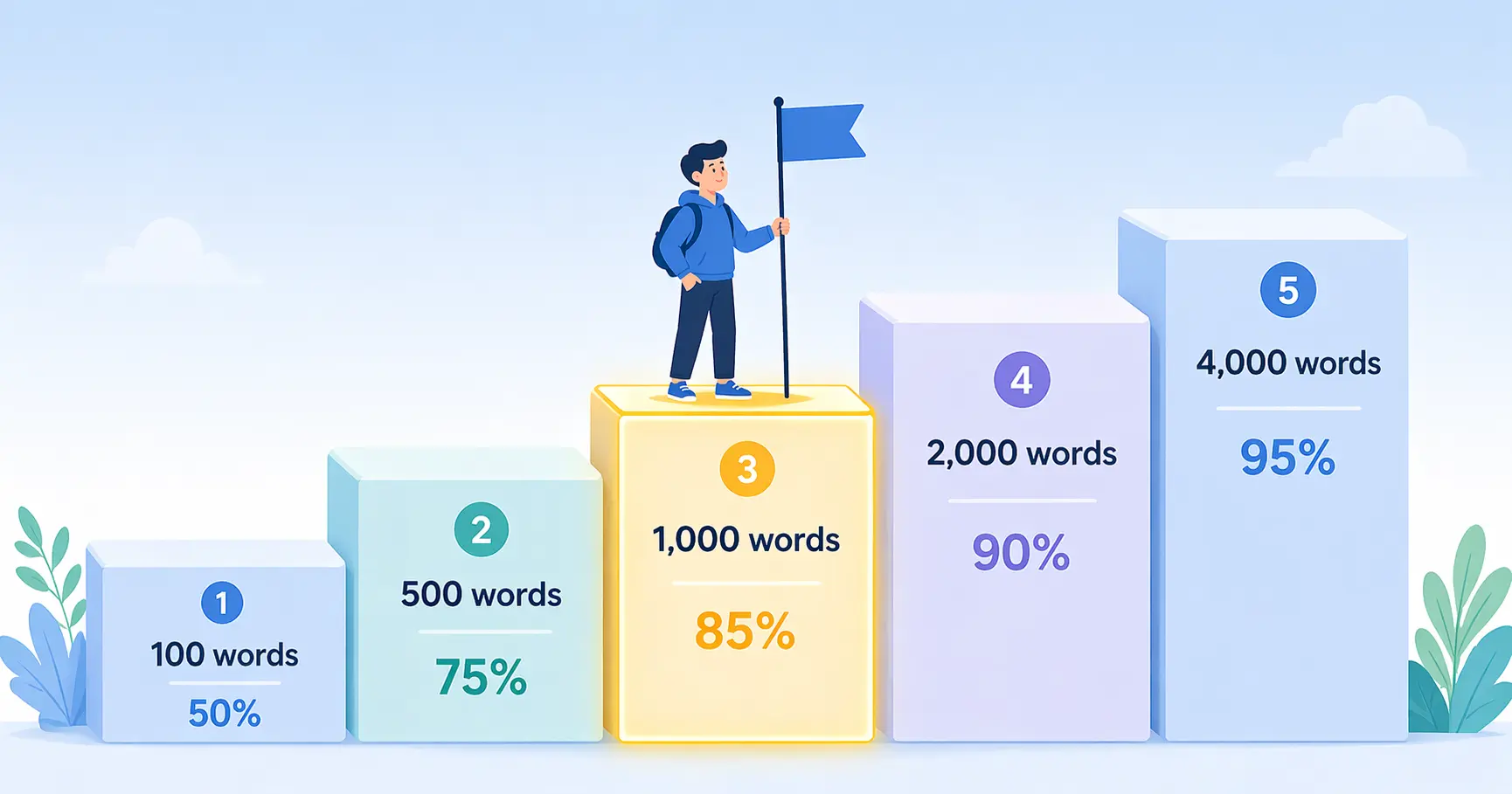
The 1,000 most common English words cover approximately 85% of everyday speech and 75% of written text. That means if you truly know these 1,000 words — not just recognize them, but understand their meanings, use them in sentences, and spell them correctly — you can follow most English conversations, read basic news articles, and communicate in everyday situations.
This article gives you a curated list of the most common English words with meanings, organized alphabetically from A to Z. You will also find sample sentences, a breakdown by part of speech, and a realistic study plan.
Why the First 1,000 Words Matter Most
Vocabulary research consistently shows that a small number of words do most of the work in English:
| Words known | Speech understood | Text understood |
|---|---|---|
| 100 | ~50% | ~45% |
| 500 | ~75% | ~65% |
| 1,000 | ~85% | ~75% |
| 2,000 | ~90% | ~80% |
| 4,000 | ~95% | ~90% |
The first 1,000 words give you the biggest return on investment. Every word you learn after 1,000 adds smaller and smaller incremental understanding. Learning the word “available” (ranked ~400) improves your comprehension far more than learning “ambivalent” (ranked ~8,000).
This is why frequency-based learning works: you study the words that appear most often first, so every hour of study gives you maximum real-world understanding.
The 1,000 Most Common English Words A to Z
Below is a curated selection of the most essential words at each letter, with meanings and example sentences. The full 1,000-word list is organized by frequency within each letter group.
A
| Word | Part of Speech | Meaning | Example |
|---|---|---|---|
| about | preposition/adverb | concerning; approximately | The book is about Japanese history. There were about 50 people. |
| above | preposition | higher than; more than | The temperature rose above 30 degrees. |
| accept | verb | agree to receive or do | She accepted the job offer immediately. |
| across | preposition | from one side to the other | He walked across the bridge in the rain. |
| actually | adverb | in fact; really | The test was actually easier than I expected. |
| add | verb | put together with something else | Add two tablespoons of sugar to the mixture. |
| affect | verb | have an influence on | The weather affects my mood every winter. |
| afraid | adjective | feeling fear | She is afraid of flying. |
| after | preposition/conjunction | later than; following | We went for a walk after dinner. |
| again | adverb | one more time | Can you say that again, please? |
| age | noun | how old someone/something is | Children start school at the age of five in most countries. |
| agree | verb | have the same opinion | I agree with everything you said. |
| ahead | adverb | in front; in the future | The road ahead was completely empty. |
| allow | verb | give permission | The teacher does not allow phones in class. |
| almost | adverb | nearly; not quite | We have almost finished the project. |
| along | preposition/adverb | moving forward on; beside | We walked along the river for an hour. |
| already | adverb | before now; by this time | I have already seen that movie twice. |
| also | adverb | in addition; too | She speaks French and also a little German. |
| always | adverb | at all times; every time | He always arrives early for meetings. |
| among | preposition | in the middle of; part of a group | She was among the best students in her class. |
| amount | noun | a quantity of something | The recipe requires a small amount of salt. |
| appear | verb | become visible; seem | Stars appear in the sky after sunset. |
| apply | verb | make a formal request; be relevant | She applied for three jobs last week. |
| area | noun | a region or part of a place | This area is known for its excellent restaurants. |
| around | preposition/adverb | in a circle; approximately | There are trees all around the house. |
| arrive | verb | reach a destination | The train arrives at 6:45 PM. |
| ask | verb | say something to get an answer | Can I ask you a question? |
| attention | noun | focusing your mind on something | Pay attention — this part is important. |
| available | adjective | able to be used; free to do something | The doctor is available on Tuesday afternoon. |
| avoid | verb | stay away from; prevent | I avoid eating sugar before bed. |
B
| Word | Part of Speech | Meaning | Example |
|---|---|---|---|
| back | noun/adverb | the rear part; returning | He sat at the back of the room. |
| bad | adjective | of poor quality; unpleasant | The weather was bad all week. |
| base | noun/verb | the bottom or foundation | The company is based in London. |
| beautiful | adjective | very attractive or pleasing | The sunset over the ocean was beautiful. |
| because | conjunction | for the reason that | She left early because she felt sick. |
| become | verb | start to be; grow into | He became a doctor after years of study. |
| before | preposition/conjunction | earlier than | Finish your homework before dinner. |
| begin | verb | start | The concert begins at 8 PM. |
| behind | preposition | at the back of | The car park is behind the building. |
| believe | verb | think something is true; have faith | I believe she is telling the truth. |
| below | preposition/adverb | lower than | The temperature dropped below zero last night. |
| best | adjective/adverb | of the highest quality | This is the best restaurant in the city. |
| better | adjective/adverb | of higher quality; improved | Your English is getting better every week. |
| between | preposition | in the space separating two things | The meeting is between 2 and 4 PM. |
| beyond | preposition | further than; more than | The view beyond the mountains was incredible. |
| big | adjective | large in size | They live in a big house near the park. |
| body | noun | the physical structure of a person or animal | Exercise is good for your body and mind. |
| book | noun/verb | pages bound together; reserve | I booked a hotel room for Friday night. |
| both | determiner/pronoun | two things together | Both answers are correct. |
| bring | verb | carry something to a place | Please bring your laptop to the meeting. |
| build | verb | construct; create | They are building a new hospital downtown. |
| business | noun | commercial activity; a company | She started her own business at 25. |
| buy | verb | get something by paying money | I need to buy a new phone. |
C
| Word | Part of Speech | Meaning | Example |
|---|---|---|---|
| call | verb/noun | speak to someone by phone; name | I will call you tomorrow morning. |
| care | verb/noun | feel concern; look after | She cares about the environment. |
| carry | verb | hold and move something | He carried the boxes up the stairs. |
| case | noun | a situation; a container | In that case, we should leave early. |
| cause | noun/verb | the reason for something; make happen | What caused the delay? |
| certain | adjective | sure; particular | I am certain the answer is correct. |
| change | verb/noun | make or become different | The city has changed a lot in ten years. |
| check | verb | examine; verify | Check your email — I sent the document an hour ago. |
| child | noun | a young person | Every child in the school receives free lunch. |
| choose | verb | pick from options; decide | You can choose any color you like. |
| city | noun | a large town | Tokyo is the largest city in Japan. |
| claim | verb/noun | state something is true | He claims he was at home all evening. |
| clear | adjective/verb | easy to understand; transparent | The instructions were clear and simple. |
| close | verb/adjective | shut; nearby | Please close the door. The shop is close to my house. |
| come | verb | move toward; arrive | Come here — I want to show you something. |
| common | adjective | happening often; shared by many | Spelling mistakes are very common among beginners. |
| community | noun | a group of people living in the same area | The local community organized a cleanup day. |
| company | noun | a business organization | She works for a technology company. |
| compare | verb | examine differences and similarities | Compare the two products before you buy. |
| complete | adjective/verb | finished; with all parts | The project is now complete. |
| concern | noun/verb | worry; relate to | Safety is our main concern. |
| consider | verb | think carefully about | We should consider all the options before deciding. |
| continue | verb | keep doing; not stop | She continued reading despite the noise. |
| control | noun/verb | the power to direct; manage | You need to control your spending. |
| cost | noun/verb | the price of something | The cost of living has increased by 8%. |
| could | modal verb | past ability; possibility | She could speak three languages by age 12. |
| country | noun | a nation; rural area | Japan is a beautiful country. |
| couple | noun | two; a pair of people | We stayed for a couple of hours. |
| course | noun | a series of lessons; direction | She is taking an online course in marketing. |
| cover | verb/noun | put something over; include | Snow covered the entire city overnight. |
| create | verb | make something new | The artist created a stunning painting. |
| current | adjective/noun | happening now; a flow | What is the current population of London? |
| cut | verb | divide with a sharp instrument; reduce | The government plans to cut taxes next year. |
D–F
| Word | Part of Speech | Meaning | Example |
|---|---|---|---|
| deal | noun/verb | an agreement; handle | We made a deal with the supplier. |
| decide | verb | make a choice | Have you decided where to go for dinner? |
| describe | verb | say what something is like | Can you describe the apartment? |
| develop | verb | grow; create over time | The company developed a new product. |
| different | adjective | not the same | The two brothers have very different personalities. |
| difficult | adjective | hard to do or understand | The exam was more difficult than expected. |
| discover | verb | find something for the first time | Scientists discovered a new species of fish. |
| drive | verb/noun | operate a vehicle; a trip | She drives to work every morning. |
| drop | verb/noun | fall; let something fall | Be careful not to drop the glass. |
| during | preposition | throughout a period of time | I fell asleep during the movie. |
| each | determiner | every one of two or more | Each student receives a textbook. |
| early | adjective/adverb | before the expected time | We arrived early to get good seats. |
| easy | adjective | not difficult | The first questions were easy. |
| effect | noun | a result or change caused by something | The new law had an immediate effect on traffic. |
| enough | determiner/adverb | as much as needed | We have enough food for everyone. |
| enter | verb | go into | Please enter through the main door. |
| entire | adjective | whole; complete | She ate the entire pizza by herself. |
| especially | adverb | particularly; more than usual | I love all fruits, especially strawberries. |
| even | adverb/adjective | used for emphasis; flat/equal | Even the teacher made a mistake. |
| ever | adverb | at any time | Have you ever been to Australia? |
| every | determiner | all; each one | I go to the gym every morning. |
| example | noun | something that shows what others are like | Can you give me an example? |
| expect | verb | think something will happen | I expect the results tomorrow. |
| experience | noun/verb | knowledge from doing things | She has ten years of experience in marketing. |
| explain | verb | make something clear | The teacher explained the grammar rule again. |
| face | noun/verb | the front of the head; deal with | We need to face the problem directly. |
| fact | noun | something that is true | It is a fact that the Earth orbits the Sun. |
| far | adjective/adverb | a long distance | The station is not far from here. |
| fast | adjective/adverb | moving quickly | The train is very fast — it reaches 300 km/h. |
| feel | verb | experience an emotion or physical sensation | I feel much better today. |
| few | determiner/pronoun | a small number | Only a few students passed the test. |
| fill | verb | make full | She filled the glass with water. |
| finally | adverb | at last; after a long time | We finally found the restaurant after walking for 20 minutes. |
| find | verb | discover; locate | I cannot find my keys. |
| finish | verb | complete; end | What time does the class finish? |
| follow | verb | go after; obey | Follow the instructions on the screen. |
| force | noun/verb | strength; make someone do something | The wind was strong enough to force the door open. |
| foreign | adjective | from another country | She is learning two foreign languages. |
| form | noun/verb | a type; shape; create | Please fill in the application form. |
| free | adjective/verb | costing nothing; not restricted | Admission to the museum is free on Sundays. |
| friend | noun | a person you know and like | She has been my best friend since school. |
| full | adjective | containing as much as possible | The bus was completely full. |
| future | noun/adjective | the time yet to come | Nobody knows what the future will bring. |
G–L
| Word | Part of Speech | Meaning | Example |
|---|---|---|---|
| general | adjective | affecting or involving all; not specific | The general opinion is that the plan will work. |
| give | verb | hand something to someone | She gave me her phone number. |
| government | noun | the group that rules a country | The government announced new education policies. |
| great | adjective | very good; large | The concert was great — we had an amazing time. |
| group | noun | a number of people or things together | A group of students visited the factory. |
| grow | verb | increase in size; develop | The company has grown rapidly in three years. |
| half | noun/determiner | one of two equal parts | Half the class was absent due to illness. |
| happen | verb | take place; occur | What happened at the meeting yesterday? |
| hard | adjective/adverb | difficult; with great effort | She works hard to support her family. |
| head | noun/verb | the top of the body; lead | He is the head of the marketing department. |
| help | verb/noun | make something easier for someone | Can you help me carry these bags? |
| high | adjective/adverb | tall; at a great level | The price of petrol is very high right now. |
| hold | verb | have in your hand; organize | She held the baby carefully. The event is held every June. |
| home | noun/adverb | where you live | I usually get home at 6 PM. |
| hope | verb/noun | want something to happen | I hope you feel better soon. |
| however | adverb | despite that; in contrast | The hotel was expensive. However, the service was excellent. |
| human | adjective/noun | relating to people | Human memory is surprisingly unreliable. |
| idea | noun | a thought or suggestion | That is a great idea — let us try it. |
| important | adjective | having great significance | Sleep is important for learning. |
| include | verb | contain as part of something larger | The price includes breakfast and parking. |
| increase | verb/noun | become larger or more | Sales increased by 15% last quarter. |
| information | noun | facts about something | For more information, visit our website. |
| interest | noun/verb | curiosity; money earned on savings | She has a strong interest in science. |
| issue | noun | a topic; a problem | Climate change is a critical issue today. |
| job | noun | paid work; a task | He got a new job at a bank. |
| join | verb | become part of a group; connect | She joined the company last month. |
| just | adverb | only; a moment ago; exactly | I just arrived — give me one minute. |
| keep | verb | continue to have; store | Keep the receipt in case you need to return it. |
| kind | noun/adjective | a type; friendly and caring | What kind of music do you like? She is a very kind person. |
| know | verb | have information in your mind | I know the answer to that question. |
| large | adjective | big in size or amount | They need a large conference room for 50 people. |
| last | adjective/verb | most recent; continue | The meeting lasted two hours. I saw her last week. |
| late | adjective/adverb | after the expected time | Sorry I am late — the traffic was terrible. |
| lead | verb/noun | show the way; be in charge | She leads a team of 20 people. |
| learn | verb | gain knowledge or skill | She learned to speak English in two years. |
| leave | verb | go away from; let stay | I leave the house at 7:30 every morning. |
| less | determiner/adverb | a smaller amount | I try to spend less money on things I do not need. |
| level | noun | a position on a scale | Her English is at an intermediate level. |
| life | noun | the state of being alive; existence | She lived a long and happy life. |
| likely | adjective/adverb | probable; probably | Rain is likely this afternoon. |
| line | noun | a long narrow mark; a row of people | There was a long line outside the store. |
| list | noun/verb | a series of items written together | Make a list of everything you need to buy. |
| live | verb/adjective | have your home somewhere; be alive | They live in a small town near the coast. |
| long | adjective/adverb | measuring a great distance; for much time | The journey was long but enjoyable. |
| look | verb | use your eyes to see; seem | Look at this photo — is that your friend? |
| lose | verb | no longer have; fail to win | I always lose my keys. |
| low | adjective | close to the ground; small in amount | The price is surprisingly low. |
M–P
| Word | Part of Speech | Meaning | Example |
|---|---|---|---|
| main | adjective | most important | The main reason I moved was the job. |
| make | verb | create; cause | She made dinner for the whole family. |
| matter | noun/verb | a subject; be important | It does not matter — either day works for me. |
| may | modal verb | possibility; permission | It may rain later. You may leave early today. |
| mean | verb/adjective | intend; signify; unkind | What does this word mean? |
| meet | verb | come together with; satisfy | Nice to meet you. The product meets all safety standards. |
| mind | noun/verb | the part that thinks; object to | She changed her mind at the last minute. |
| miss | verb | fail to hit; feel sad about absence | I miss my family when I travel. |
| money | noun | what you use to buy things | She saves money by cooking at home. |
| most | determiner/adverb | the greatest amount | Most students passed the exam. |
| move | verb | change position or place | We moved to a new apartment in January. |
| much | determiner/adverb | a large amount | How much does this cost? |
| must | modal verb | necessity; strong probability | You must wear a seatbelt. She must be tired after the flight. |
| name | noun/verb | what someone or something is called | My name is Anna. Can you name three countries in Africa? |
| natural | adjective | existing in nature; normal | It is natural to feel nervous before an interview. |
| near | preposition/adjective | close to | The school is near the train station. |
| need | verb/noun | require; necessity | I need to finish this report by tomorrow. |
| never | adverb | at no time; not ever | I have never been to South America. |
| new | adjective | not existing before; recently made | She bought a new laptop for work. |
| next | adjective/adverb | coming immediately after | The next train leaves in 10 minutes. |
| nothing | pronoun | not anything | There is nothing in the fridge. |
| notice | verb/noun | become aware of | Did you notice anything strange? |
| now | adverb | at the present time | We need to leave now or we will be late. |
| number | noun | a mathematical value; amount | A large number of people attended the event. |
| offer | verb/noun | present for acceptance; a proposal | They offered her a higher salary. |
| often | adverb | many times; frequently | How often do you exercise? |
| only | adjective/adverb | no more than; single | There are only two tickets left. |
| open | adjective/verb | not closed; make accessible | The store is open from 9 to 6. |
| order | noun/verb | arrangement; request to buy | I ordered a coffee and a sandwich. |
| other | adjective/pronoun | additional; different | Do you have any other questions? |
| outside | preposition/noun | not inside; the exterior | It is cold outside — take a jacket. |
| own | adjective/verb | belonging to yourself; possess | She has her own apartment now. |
| part | noun | a piece of something larger | This is the hardest part of the exam. |
| pay | verb/noun | give money for something | How much do they pay you? |
| people | noun | human beings in general | About 500 people work in this building. |
| place | noun/verb | a location; put somewhere | This is a nice place for a picnic. |
| plan | noun/verb | a detailed proposal; intend | What are your plans for the weekend? |
| point | noun/verb | an idea; indicate | That is a good point. She pointed at the map. |
| possible | adjective | able to happen or be done | Is it possible to change the date? |
| power | noun | ability to control; energy | Solar power is becoming cheaper every year. |
| present | adjective/noun/verb | current; a gift; show | All members were present at the meeting. |
| problem | noun | a difficulty; something to solve | The main problem is the lack of funding. |
| produce | verb | make; create | The factory produces 500 cars per day. |
| program | noun | a plan; a TV show; software | The training program lasts six weeks. |
| provide | verb | give; supply | The hotel provides free breakfast for guests. |
| public | adjective/noun | for everyone; people in general | Public transport is free for children under 5. |
| put | verb | move something into a position | Put your bag on the table. |
Q–S
| Word | Part of Speech | Meaning | Example |
|---|---|---|---|
| question | noun | something you ask | Can I ask a question? |
| quite | adverb | fairly; completely | The movie was quite good, actually. |
| reach | verb | arrive at; extend to | We reached the hotel at midnight. |
| read | verb | look at and understand written words | She reads for 30 minutes before bed every night. |
| ready | adjective | prepared | Dinner is ready — come to the table. |
| real | adjective | actually existing; genuine | Is that a real diamond? |
| reason | noun | why something happens or is done | What is the reason for the delay? |
| receive | verb | get; be given | I received your email this morning. |
| record | noun/verb | information stored; the best achievement | She broke the world record in the 100 meters. |
| remain | verb | stay; continue to exist | Please remain seated until the plane stops. |
| remember | verb | keep in your memory | I remember the first day I arrived in London. |
| report | noun/verb | an account of something; describe | The report shows a 10% increase in sales. |
| require | verb | need; demand | This job requires three years of experience. |
| result | noun | what happens because of something | Hard work leads to good results. |
| return | verb/noun | come or go back | She returned to work after two weeks. |
| right | adjective/noun/adverb | correct; a moral entitlement; direction | That is the right answer. Turn right at the corner. |
| run | verb | move fast on foot; manage | He runs 5 kilometers every morning. She runs a small business. |
| same | adjective | identical; not different | We take the same bus every day. |
| say | verb | speak words | She said she would call me back. |
| seem | verb | appear to be | He seems tired today. |
| send | verb | cause something to go to another place | I sent the package yesterday. |
| serious | adjective | important; not joking | This is a serious problem that needs attention. |
| serve | verb | provide food or a service | The restaurant serves breakfast from 7 to 10 AM. |
| set | verb/noun | put in a position; a group of things | She set the alarm for 6 AM. |
| several | determiner | more than two but not very many | I have visited that city several times. |
| share | verb/noun | give part of something; a portion | She shared her lunch with her colleague. |
| short | adjective | not long; not tall | It was a short meeting — only 15 minutes. |
| should | modal verb | advice; expectation | You should see a doctor about that. |
| show | verb/noun | let someone see; display | Can you show me how to do this? |
| similar | adjective | alike but not exactly the same | The two houses are very similar in design. |
| simple | adjective | easy to understand or do | The recipe is simple — only five ingredients. |
| since | preposition/conjunction | from a past time until now; because | I have lived here since 2019. Since you asked, I will tell you. |
| situation | noun | the circumstances at a particular time | The situation is improving slowly. |
| small | adjective | little in size | They live in a small village in the mountains. |
| social | adjective | relating to society or interaction | Social media has changed how we communicate. |
| some | determiner | an unspecified amount | Can I have some water, please? |
| soon | adverb | in the near future | The bus should arrive soon. |
| speak | verb | talk; say words | Do you speak English? |
| special | adjective | better or different from usual | Today is a special day — it is her birthday. |
| spend | verb | use money; use time | How much time do you spend studying? |
| stand | verb | be on your feet; be located | Please stand up when the teacher enters. |
| start | verb/noun | begin | The movie starts at 8 PM. |
| state | noun/verb | a condition; express in words | The building is in a poor state. He stated his opinion clearly. |
| stay | verb | remain in a place | We stayed at a small hotel near the beach. |
| still | adverb/adjective | continuing until now; not moving | She still lives with her parents. |
| stop | verb | cease moving or doing | The bus stops right in front of the school. |
| strong | adjective | having great power or ability | She has a strong opinion about education. |
| suggest | verb | propose an idea | I suggest we meet at 10 AM instead. |
| support | verb/noun | help; backing | Her family supports her decision to study abroad. |
| sure | adjective | certain; confident | Are you sure about that? |
| system | noun | a set of connected things that work together | The education system needs reform. |
T–Z
| Word | Part of Speech | Meaning | Example |
|---|---|---|---|
| take | verb | hold; carry; require | Take an umbrella — it might rain. |
| talk | verb/noun | speak; a conversation | We need to talk about the project. |
| tell | verb | say something to someone; inform | Can you tell me the time? |
| test | noun/verb | an exam; check something | She passed her driving test on the first attempt. |
| thing | noun | an object; a fact or situation | I have a few things to finish before I leave. |
| think | verb | use your mind; believe | I think this is the right decision. |
| through | preposition | from one side to another; because of | We walked through the park. |
| together | adverb | with each other; at the same time | We worked together on the project. |
| top | noun/adjective | the highest part; the best | She graduated at the top of her class. |
| total | adjective/noun | complete; the full amount | The total cost was $450. |
| toward | preposition | in the direction of | She walked toward the exit. |
| turn | verb/noun | change direction; rotate | Turn left at the traffic lights. |
| type | noun/verb | a kind or category | What type of phone do you have? |
| understand | verb | know the meaning of; comprehend | I understand the instructions now. |
| until | preposition/conjunction | up to the time when | Wait here until I come back. |
| use | verb/noun | employ for a purpose | May I use your phone? |
| usually | adverb | in most cases; normally | I usually wake up at 7 AM. |
| value | noun/verb | how much something is worth; importance | The value of the house has doubled. |
| very | adverb | to a high degree | The test was very difficult. |
| view | noun/verb | what you can see; an opinion | The view from the top floor is amazing. |
| voice | noun | the sound you make when speaking | She has a very calm voice. |
| wait | verb | stay until something happens | Please wait here — I will be right back. |
| walk | verb/noun | move on foot | I walk to work every day — it takes 20 minutes. |
| want | verb | desire; wish for | What do you want for dinner? |
| watch | verb/noun | look at for a period; a device that shows time | We watched a documentary about space last night. |
| water | noun | the clear liquid in rivers, lakes, and rain | Drink at least 2 liters of water per day. |
| way | noun | a method; a route | This is the easiest way to solve the problem. |
| week | noun | a period of 7 days | I go to the gym three times a week. |
| whole | adjective | entire; complete | She read the whole book in one day. |
| without | preposition | not having; lacking | She left without saying goodbye. |
| word | noun | a unit of language | What does this word mean? |
| work | verb/noun | do a job; effort | She works for an international organization. |
| world | noun | the Earth; all people | English is spoken all over the world. |
| write | verb | put words on paper or a screen | Write your name at the top of the page. |
| wrong | adjective | not correct; not morally right | Something is wrong with my computer. |
| year | noun | a period of 365 days | She lived in Berlin for three years. |
| yet | adverb/conjunction | until now; but | I have not finished yet. The hotel is small, yet very comfortable. |
| young | adjective | not old | Young people are increasingly interested in sustainability. |
How These 1,000 Words Break Down by Part of Speech
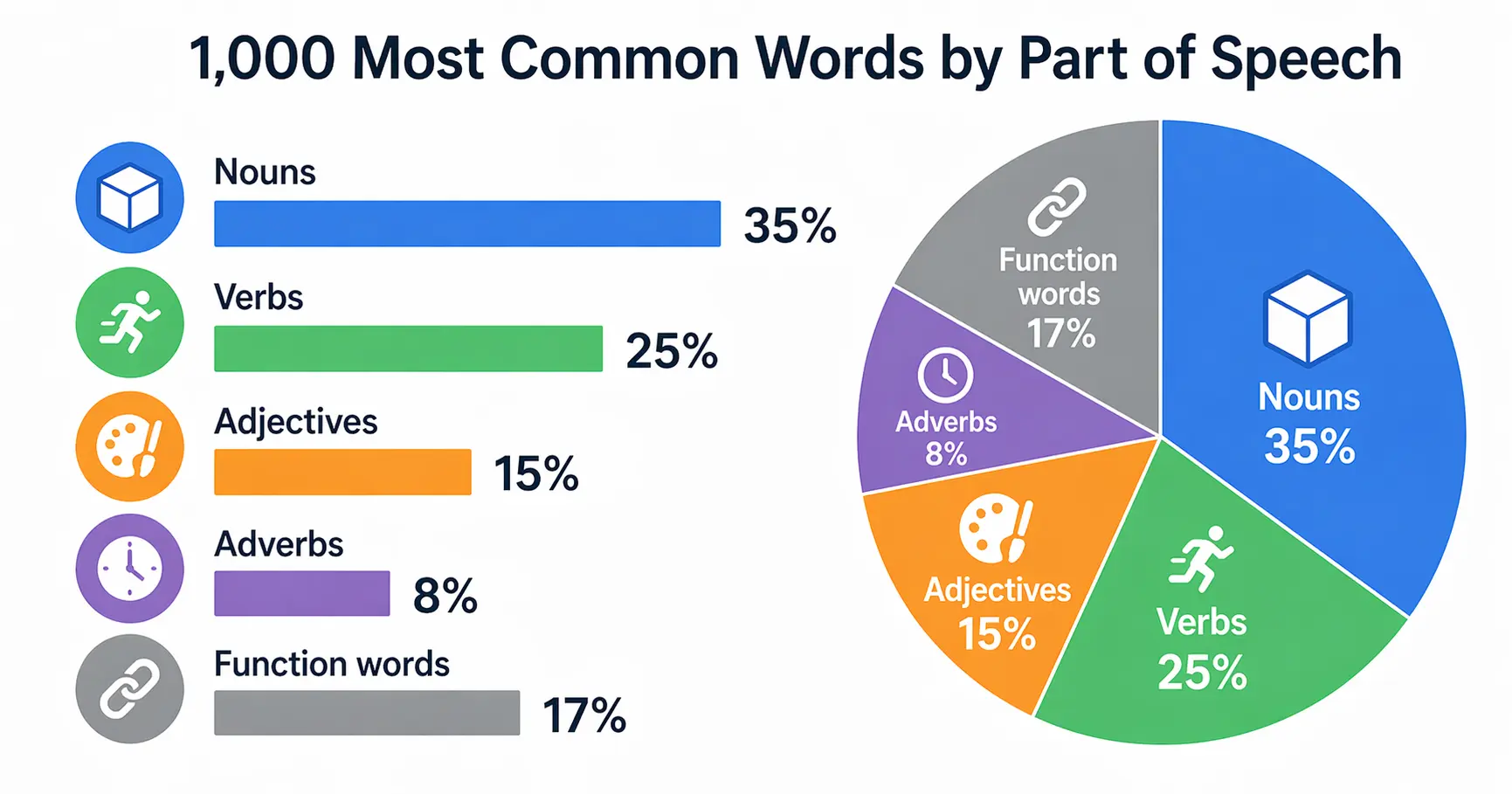
Understanding the distribution helps you study more effectively:
| Part of Speech | Approximate % | Count | What they do |
|---|---|---|---|
| Nouns | 35% | ~350 | Name things: problem, area, information, government |
| Verbs | 25% | ~250 | Describe actions: provide, include, continue, require |
| Adjectives | 15% | ~150 | Describe qualities: important, different, possible, strong |
| Adverbs | 8% | ~80 | Modify how/when/where: already, however, often, usually |
| Function words | 17% | ~170 | Connect ideas: the, in, with, because, which, although |
Function words (prepositions, conjunctions, determiners, pronouns) are the most frequent individual words but the smallest category by total count. You already know most of them. The biggest gap for learners is usually in verbs and adjectives — words like require, previous, significant, and maintain that appear constantly in real English but are often skipped in basic courses.
Your Study Plan: 1,000 Words in 8 Weeks
You do not need to learn all 1,000 words from scratch. Most learners already know 400–600 of them. The goal is to fill your gaps efficiently.
Week 1–2: Assessment and Foundation
- Scan the lists above. Mark every word you are not 100% sure about — both meaning and usage.
- Take stock. Most learners find 200–400 unknown or partially known words.
-
Sort into three piles:
- Know well — you can use it in a sentence without thinking
- Recognize but unsure — you understand it when reading but cannot use it confidently
- Do not know — unfamiliar or very unclear
Focus your study time on the “Recognize but unsure” and “Do not know” groups.
Week 3–6: Active Learning (25 words per day)
| Day | Activity | Time |
|---|---|---|
| Morning | Quick recall test on yesterday’s words | 5 min |
| Afternoon | Learn 25 new words — read definition and example, write your own sentence for 5 of them | 15 min |
| Evening | Review today’s new words + words from 3 days ago | 10 min |
At 25 words per day, 5 days per week, you cover 500 words in 4 weeks. Many of these are “recognize but unsure” words that only need a few reviews to become solid.
Week 7–8: Review and Active Use
- Stop learning new words. Focus entirely on review and use.
- Test yourself on all words from weeks 3–6.
- Write 10 sentences per day using words you find difficult.
- Read one English article per day and notice how many of these 1,000 words you encounter.
After Week 8
Move to the next level. Our 4000 Essential English Words study guide picks up where this list leaves off, covering words 1,001–4,000 in a structured 6-month plan.
Words to Practice Right Now
Here are 25 essential words from this list. Add them to your dictionary with one click — spaced repetition reviews start automatically.
experience
noun
Knowledge or skill gained from doing or experiencing something.
Examples
- Her previous work experience made her an ideal candidate for the position.
- Traveling to different countries provides valuable cultural experience.
meeting
noun
An organized gathering of people for discussion or activity.
Examples
- The business meeting discussed budget plans for next fiscal year.
- Town meeting allows residents to voice concerns about local issues.
reply
noun
A short answer or reaction to a question or statement.
Examples
- Quick reply shows professional customer service quality.
- Written reply confirms agreement terms and conditions.
create
verb
To bring something into existence or make something new.
Examples
- Artists create beautiful works that inspire and move people emotionally.
- The new policy will create opportunities for economic growth.
mention
verb
To refer to or briefly talk about something.
Examples
- Please mention my name when you call about job opening.
- The report fails to mention important environmental concerns.
describe
verb
To give an account of or describe something in detail.
Examples
- Can you describe what the suspect looked like to police officers?
- The travel guide describes many interesting places to visit in Europe.
impact
noun
The effect or influence of one thing on another.
Examples
- Climate change has a significant impact on global weather patterns.
- The impact of the collision damaged both cars severely.
exam
noun
A short test to see how much someone knows or can do.
Examples
- Students study hard for weeks before taking their final exams.
- The driving exam tests both knowledge and practical skills behind wheel.
powerful
adjective
Having great strength, influence, or effect.
Examples
- Powerful computer processes data very quickly.
- Powerful speech moves audience to take action.
wonderful
adjective
Extremely good or enjoyable; causing pleasure.
Examples
- The restaurant serves wonderful food with excellent service.
- We had a wonderful time at the beach during summer vacation.
confident
adjective
Feeling sure of oneself and not uncertain about one's abilities or qualities.
Examples
- She felt confident about passing the difficult examination successfully.
- The confident speaker delivered an inspiring presentation to the audience.
favor
noun
Support or approval for someone or something.
Examples
- Could you do me a favor and pick up my dry cleaning?
- The proposal gained favor among the committee members after lengthy discussion.
ambition
noun
A strong desire to achieve something or succeed.
Examples
- Her ambition is to become a successful doctor and help people worldwide.
- Sometimes ambition can drive people to work too hard and neglect family.
tourist
noun
A noun for a person who travels to a place for pleasure or sightseeing.
Examples
- Foreign tourist visits famous landmarks and museums.
- Tourist season brings economic benefits to region.
student
noun
A person who is learning at a school or college.
Examples
- Diligent student completes homework assignments on time.
- Graduate student conducts research for doctoral degree.
relaxed
adjective
Feeling calm and not worried or tense.
Examples
- Relaxed atmosphere encourages open discussion among participants.
- Relaxed person handles pressure situations more effectively.
hot
adjective
Having a high temperature or feeling very warm.
Examples
- Summer weather is extremely hot in desert regions around the world.
- The coffee is too hot to drink right now - let it cool down.
cool
verb
To make something cooler in temperature or less warm.
orange
noun
A citrus fruit that is typically round, orange in color, and eaten raw.
Examples
- Fresh orange juice contains vitamin C and natural sugar.
- The sunset painted sky in beautiful shades of orange.
meat
noun
Flesh of animals used as food.
Examples
- Fresh meat should be stored in refrigerator for food safety.
- Vegetarians choose not to eat meat for ethical reasons.
football
noun
A sport played with a round ball on a large field, where players try to score goals.
Examples
- Football is the most popular sport in many countries around the world.
- The children play football in the school yard during their lunch break.
noun
A collection of written, printed, or digital messages sent or received, often through the postal system.
Examples
- Check mail every day for important bills and official documents.
- Electronic mail has largely replaced traditional postal letters today.
father
noun
A male parent of a child.
Examples
- His father taught him how to ride a bicycle in the park.
- The young father proudly carried his baby daughter in his arms.
rush
noun
A sudden movement forward, often with urgency or speed.
Examples
- Last-minute rush creates stress and mistakes often.
- Morning rush causes traffic jams in city.
result
noun
A result or effect of an action or situation.
Examples
- Election result surprises political analysts and voters.
- Test result shows significant improvement in performance.
How to Use This List Effectively
Do not just read — test yourself. Cover the “Meaning” column and try to define each word from memory. Cover the “Word” column and try to recall the English word from the definition. Active recall is far more effective than passive reading.
Pay attention to words with multiple meanings. Many of the 1,000 most common words have 3–5 meanings. “Right” means correct, a moral entitlement, and a direction. “Run” means move fast, manage a business, and operate a machine. Learn the most common meaning first, then add others.
Notice collocations. Common words have natural partners: make a decision (not “do” a decision), take a photo (not “make” a photo), do homework (not “make” homework). Learning the right collocations is what separates natural English from textbook English.
Track your unknown words. Every word on this list that you do not know is a high-priority learning target. These words appear in English more often than any others — the sooner you learn them, the faster your comprehension improves.
What to Read Next
-
Level up to 4,000 words. The first 1,000 words give you 85% comprehension. The next 3,000 take you to 95%. Follow our 4000 Essential English Words guide for a structured plan.
-
Learn words in sentences. See our simple English sentences for daily use — 200+ ready-made sentences using common vocabulary.
-
Build a memorization system. Read how to memorize vocabulary for 8 science-backed techniques that make words stick permanently.
-
Improve your overall method. Our guide on how to improve your vocabulary gives you 10 proven strategies for long-term growth.
-
Study by level. Browse A2 Elementary and B1 Intermediate vocabulary lists for words organized by CEFR level.
FAQ
What are the 1000 most common English words?
The 1,000 most common English words are the words that appear most frequently in everyday speech and writing. They include function words (the, is, in), basic verbs (make, take, give, know), common nouns (time, people, way, day), and essential adjectives (new, good, different, important). Together, they cover approximately 85% of everyday English conversation. This article lists them alphabetically with meanings and examples.
Are 1,000 words enough to speak English?
1,000 words give you enough vocabulary for basic conversations — greetings, daily routines, simple opinions, shopping, and travel situations. You can survive in an English-speaking country with 1,000 words. However, for comfortable communication at work, understanding the news, or passing exams like IELTS, you need 3,000–5,000 words. Think of 1,000 words as a strong foundation, not the finish line.
How long does it take to learn 1,000 English words?
If you already know some English, you likely recognize 400–600 of these words already. Learning the remaining 400–600 takes about 6–8 weeks at a pace of 15–25 new words per day with daily review. Complete beginners starting from zero need 10–12 weeks. The key is not speed but consistency — 15 minutes of study every day beats 2 hours once a week.
What is the best way to learn common English words?
Learn in context, not isolation. For each word, read the definition, study 2–3 example sentences, and write your own sentence. Use spaced repetition to review at increasing intervals (1 day, 3 days, 7 days, 14 days). Focus on words you almost know first — converting partial knowledge into confident usage is faster than learning completely new words.
Should I learn the 1000 most common words alphabetically or by frequency?
For study purposes, frequency order is more efficient — you learn the most impactful words first. The A-to-Z organization in this article is designed for reference and quick lookup. When actively studying, start with the words you encounter most often: basic verbs (be, have, do, say, get, make, go, know, take, see), common nouns (time, year, people, way, day), and high-frequency adjectives (good, new, first, last, long, great, little, own, other, old).
What comes after the first 1000 words?
The next step is expanding to 2,000–4,000 words, which takes you from 85% comprehension to 95% — the level where you can learn new words from context without a dictionary. Our 4000 Essential English Words guide provides a structured level-by-level plan. You can also focus on topic-specific vocabulary: technology, work, or exam preparation through our IELTS vocabulary guide.