
100 Phrasal Verbs with Meanings and Sentences: The Essential List
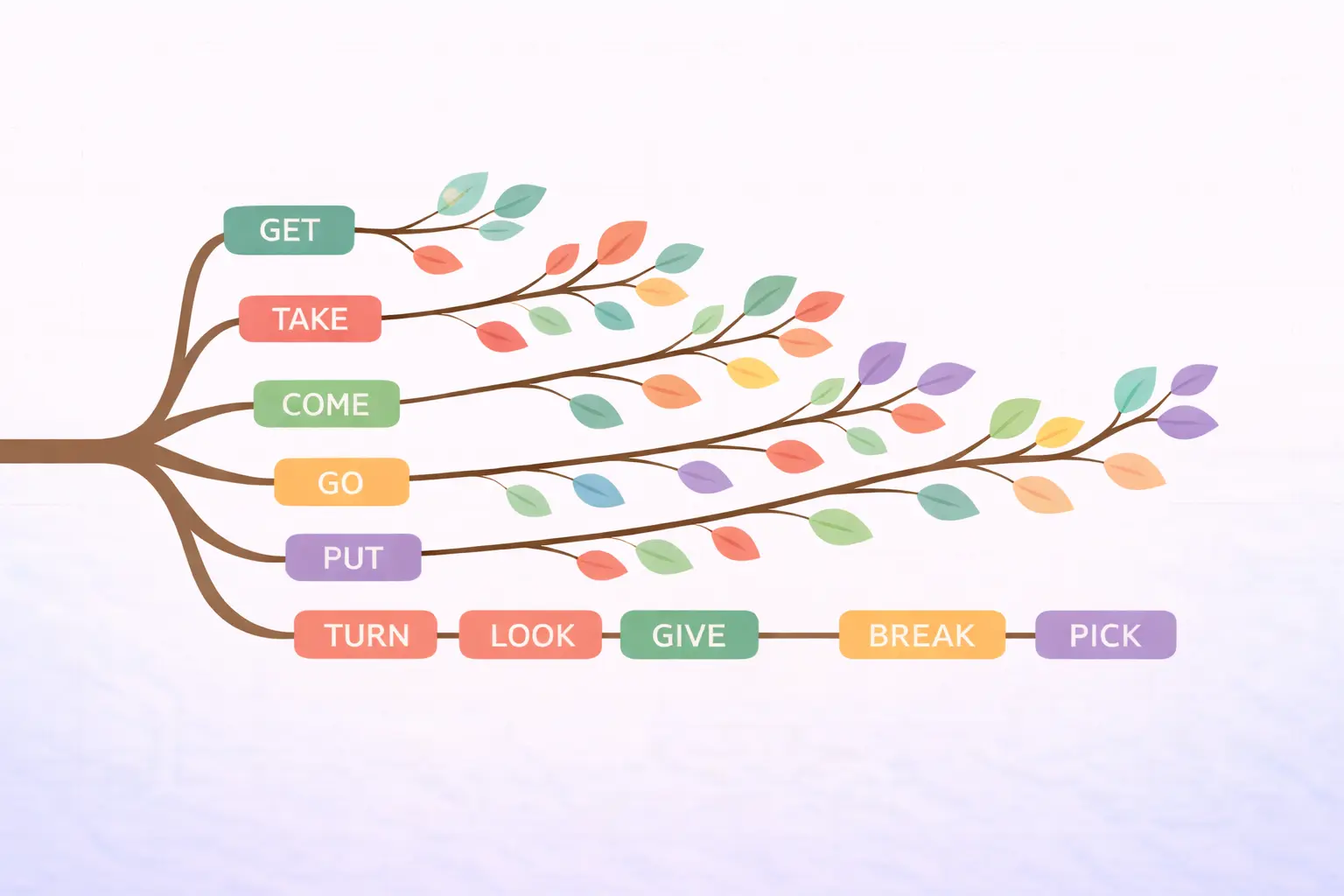
Phrasal verbs are the hardest part of English vocabulary for non-native speakers. Native speakers use them in every conversation, every email, and every text message — but they are almost impossible to guess from the individual words. “Put up with” does not mean “put” + “up” + “with.” It means “tolerate.”
This list gives you the 100 most common phrasal verbs in English, each with a clear meaning and a real example sentence. They are organized by topic so you can learn the ones you need first and find them quickly when you need a reference.
- Total phrasal verbs: 100
- Level: A2–B2 (elementary to upper-intermediate)
- Best for: general English fluency, IELTS preparation, conversation practice, everyday communication
How These Phrasal Verbs Were Selected
We analyzed the most frequent phrasal verbs in spoken and written English corpora (the British National Corpus and the Corpus of Contemporary American English). The 100 phrasal verbs on this list meet three criteria:
- High frequency — they appear in the top 200 most-used phrasal verbs in English
- Wide usefulness — they work across daily conversation, academic English, and professional contexts
- Exam relevance — all of them appear in IELTS, Cambridge, and TOEFL materials
If you learn all 100, you will understand the vast majority of phrasal verbs you encounter in movies, podcasts, news articles, and everyday conversation.
Daily Life and Routines
These phrasal verbs describe actions you do every day — from waking up to going to bed.
| # | Phrasal Verb | Meaning | Example |
|---|---|---|---|
| 1 | wake up | stop sleeping | I usually wake up at 7 AM, but on weekends I sleep until 9. |
| 2 | get up | rise from bed; stand up | He got up, stretched, and walked to the kitchen. |
| 3 | turn on | start a device or machine | Can you turn on the light? It is too dark in here. |
| 4 | turn off | stop a device or machine | Please turn off your phone before the movie starts. |
| 5 | put on | dress in a piece of clothing | She put on her coat and left the house. |
| 6 | take off | remove clothing; (of a plane) leave the ground | Take off your shoes before entering the house. |
| 7 | throw away | discard; put in the trash | Do not throw away that box — I need it for the move. |
| 8 | clean up | make a place tidy | We spent the whole afternoon cleaning up after the party. |
| 9 | put away | return something to its proper place | The kids never put away their toys without being asked. |
| 10 | lie down | move to a horizontal position to rest | I need to lie down for a few minutes — I have a headache. |
| 11 | use up | consume completely; exhaust a supply | We used up all the milk, so I need to go to the store. |
| 12 | run out of | have no more of something | We have run out of coffee — can you buy some on the way home? |
| 13 | tidy up | make neat and organized | Tidy up your room before your grandparents arrive. |
Communication and Relationships
Phrasal verbs for talking to people, maintaining relationships, and social interaction.
| # | Phrasal Verb | Meaning | Example |
|---|---|---|---|
| 14 | get along with | have a good relationship with someone | I get along with all my colleagues, but especially with my team lead. |
| 15 | break up | end a romantic relationship | They broke up after three years together. |
| 16 | make up | become friends again after a disagreement | They argued on Monday but made up by Wednesday. |
| 17 | bring up | mention a topic in conversation; raise a child | She brought up an interesting point about the budget. |
| 18 | catch up with | reach the same level; meet someone after a long time | Let us meet for coffee this weekend — I want to catch up with you. |
| 19 | fall out with | have a disagreement that damages a relationship | He fell out with his brother over money. |
| 20 | ask out | invite someone on a date | He finally asked her out after months of hesitation. |
| 21 | let down | disappoint someone | I promised to help and I do not want to let you down. |
| 22 | put up with | tolerate something unpleasant | I cannot put up with this noise any longer. |
| 23 | look after | take care of someone or something | Can you look after the dog while I am on holiday? |
| 24 | grow up | become an adult; mature | She grew up in a small town in northern England. |
| 25 | hang out | spend time with someone casually | We usually hang out at the park on Saturday afternoons. |
Work, Study, and Productivity
Phrasal verbs you need for the office, the classroom, and getting things done.
| # | Phrasal Verb | Meaning | Example |
|---|---|---|---|
| 26 | set up | organize or arrange something; start a system | She set up a meeting for next Tuesday at 10 AM. |
| 27 | carry out | perform or complete a task | The team carried out the experiment over three weeks. |
| 28 | fill in | complete a form or document | Please fill in the application form and submit it online. |
| 29 | hand in | submit work or a document | You need to hand in your essay by Friday afternoon. |
| 30 | take on | accept a task, responsibility, or job | She took on extra work to cover for her absent colleague. |
| 31 | put off | postpone to a later time | Do not put off your homework — do it now and relax later. |
| 32 | call off | cancel a planned event | The meeting was called off because the manager was sick. |
| 33 | keep up with | maintain the same speed or level | It is hard to keep up with the workload during exam season. |
| 34 | come up with | think of an idea or plan | The marketing team came up with a brilliant campaign. |
| 35 | work out | exercise; solve a problem; calculate | I work out three times a week at the gym. |
| 36 | go ahead | proceed; start or continue | The project was approved — we can go ahead with the plan. |
| 37 | take over | assume control of something | When the CEO retired, his daughter took over the company. |
| 38 | drop out | quit a course, school, or competition | He dropped out of university in his second year to start a business. |
The First 50: Movement and Travel
Phrasal verbs for getting around — by foot, car, bus, or plane.
| # | Phrasal Verb | Meaning | Example |
|---|---|---|---|
| 39 | get on | board a bus, train, or plane | We got on the train just before the doors closed. |
| 40 | get off | leave a bus, train, or plane | Get off at the next stop — the museum is right there. |
| 41 | get in | enter a car or taxi | She got in the taxi and gave the driver her address. |
| 42 | get out | exit a car or enclosed space | He got out of the car and slammed the door. |
| 43 | pick up | collect someone; lift something from a surface | I will pick you up at the airport at 6 PM. |
| 44 | drop off | take someone to a place and leave them there | Can you drop me off at the train station on your way to work? |
| 45 | set off | begin a journey | We set off at dawn to avoid the traffic. |
| 46 | check in | register at a hotel or airport | We checked in at the hotel and went straight to the pool. |
| 47 | check out | leave a hotel; examine something | You need to check out before 11 AM. |
| 48 | head out | leave; depart | I am heading out now — see you at the restaurant. |
| 49 | pull over | stop a vehicle at the side of the road | The police officer signaled the driver to pull over. |
| 50 | slow down | reduce speed | Slow down — there is a school zone ahead. |
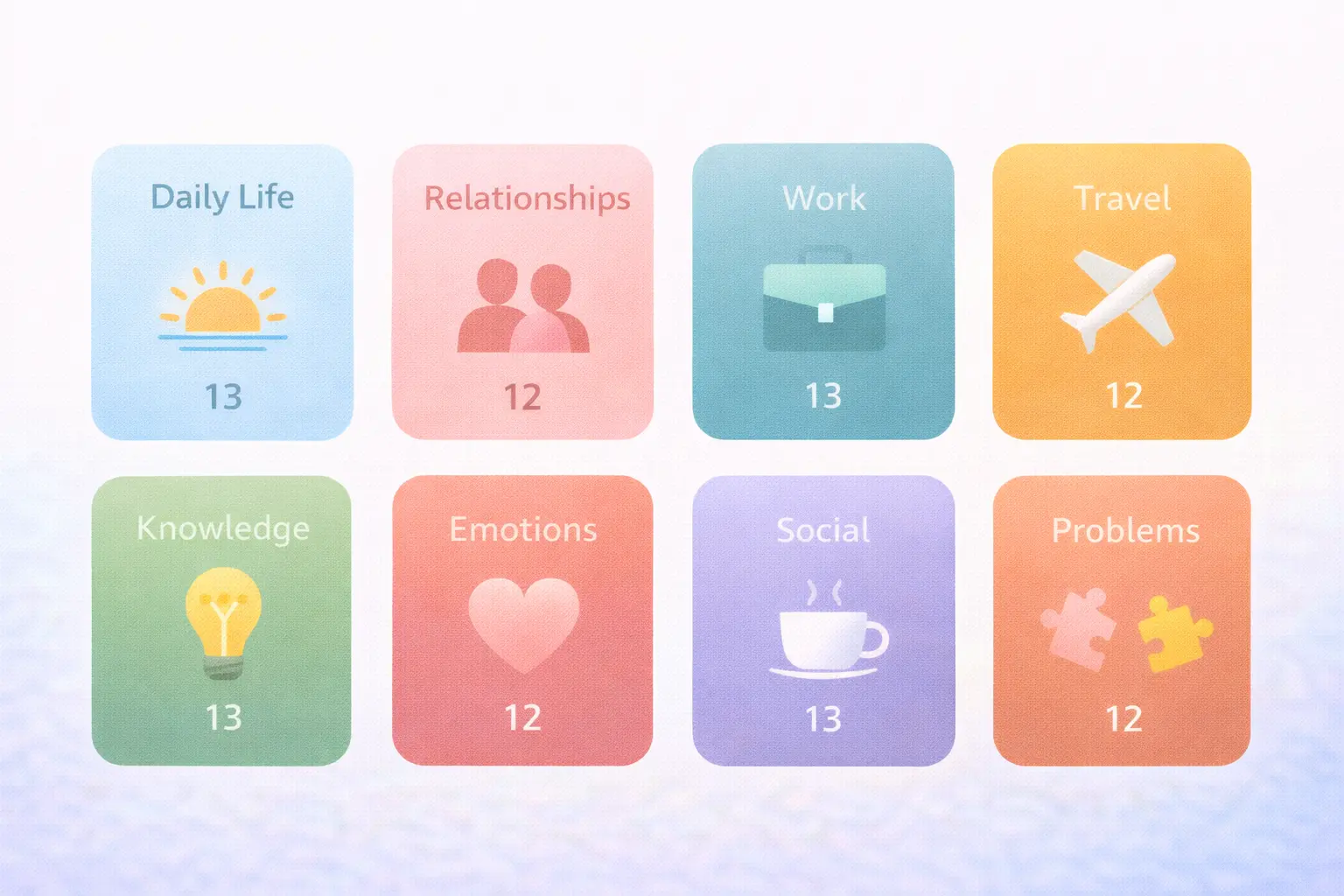
You have now reached 50 phrasal verbs — the halfway mark. If you are short on time, focus on these first 50 for everyday English. They cover daily life, relationships, work, and travel. The next 50 add depth in thinking, emotions, social situations, and problem-solving.
Knowledge, Discovery, and Thinking
Phrasal verbs for learning, investigating, and understanding.
| # | Phrasal Verb | Meaning | Example |
|---|---|---|---|
| 51 | find out | discover new information | I just found out that the concert is sold out. |
| 52 | look up | search for information (in a book or online) | If you do not know the word, look it up in a dictionary. |
| 53 | go through | examine something carefully | The accountant went through every receipt from the past year. |
| 54 | figure out | solve or understand something | It took me an hour to figure out how to use the new software. |
| 55 | sort out | organize or resolve a problem | We need to sort out the schedule before the conference. |
| 56 | point out | draw attention to something | She pointed out several errors in the report. |
| 57 | turn out | have a particular result; prove to be | The project turned out to be much harder than expected. |
| 58 | come across | find something by chance | I came across an old photo album while cleaning the attic. |
| 59 | look into | investigate or examine | The police are looking into the cause of the accident. |
| 60 | make out | see, hear, or understand with difficulty | The writing was so small I could barely make out the words. |
| 61 | stand for | represent; mean | “UN” stands for “United Nations.” |
| 62 | rule out | eliminate as a possibility | Doctors have ruled out any serious illness. |
| 63 | think over | consider something carefully before deciding | I need a few days to think over your offer. |
Emotions and Attitudes
Phrasal verbs for how you feel, react, and cope.
| # | Phrasal Verb | Meaning | Example |
|---|---|---|---|
| 64 | give up | stop trying; quit | Do not give up — you are so close to finishing. |
| 65 | cheer up | become happier; make someone happier | Cheer up — the exam is over and you did your best. |
| 66 | calm down | become less upset or angry | Take a deep breath and calm down before you respond. |
| 67 | freak out | become very anxious or upset (informal) | She freaked out when she realized she lost her passport. |
| 68 | look forward to | feel excited about a future event | I am looking forward to the summer holidays. |
| 69 | get over | recover from an illness, shock, or bad experience | It took her months to get over the breakup. |
| 70 | hold on | wait for a short time | Hold on — let me grab my keys before we leave. |
| 71 | count on | depend on; rely on | You can always count on Maria — she never lets anyone down. |
| 72 | show off | display proudly to impress others | He was showing off his new car to everyone at the party. |
| 73 | end up | finally arrive at a situation or place | We got lost and ended up on the wrong side of town. |
| 74 | burn out | become exhausted from too much work | After working 80-hour weeks for a year, she completely burned out. |
| 75 | back up | support someone; make a copy of data | My whole team backed me up during the disagreement. |
Social Situations and Everyday Activities
Phrasal verbs for going out, shopping, and daily social life.
| # | Phrasal Verb | Meaning | Example |
|---|---|---|---|
| 76 | show up | arrive; appear | He showed up 30 minutes late with no explanation. |
| 77 | turn up | arrive (often unexpectedly); increase volume | She turned up at the party without an invitation. |
| 78 | come over | visit someone at their home | Why do you not come over for dinner on Saturday? |
| 79 | eat out | eat at a restaurant | We eat out at least twice a week — cooking every day is exhausting. |
| 80 | dress up | wear formal or fancy clothes | You need to dress up for the company gala. |
| 81 | try on | test clothing by wearing it in a store | She tried on five dresses before choosing one. |
| 82 | give back | return something to its owner | I need to give back the book I borrowed from the library. |
| 83 | pay back | return money that was borrowed | I will pay you back on Friday when I get paid. |
| 84 | save up | accumulate money over time | They are saving up to buy their first apartment. |
| 85 | cut down on | reduce the amount of something | The doctor told him to cut down on sugar and salt. |
| 86 | go on | continue; happen | Please go on — I am listening. |
| 87 | join in | participate in an activity with others | Everyone was dancing, so I decided to join in. |
| 88 | take back | return an item to a store | These shoes do not fit — I need to take them back. |
Problems, Challenges, and Situations
Phrasal verbs for dealing with unexpected events and difficulties.
| # | Phrasal Verb | Meaning | Example |
|---|---|---|---|
| 89 | deal with | handle; manage a problem | I do not know how to deal with this situation. |
| 90 | look out | be careful; watch out for danger | Look out! There is a car coming. |
| 91 | break down | stop functioning; collapse emotionally | The car broke down on the highway and we had to call for help. |
| 92 | blow up | explode; suddenly become very angry | He blew up at his assistant for losing the files. |
| 93 | run into | meet someone by chance; encounter a problem | I ran into my old teacher at the supermarket yesterday. |
| 94 | come up | arise; be mentioned | Something has come up at work — I will be home late. |
| 95 | hold up | delay; cause a delay | The flight was held up for two hours because of fog. |
| 96 | mix up | confuse one thing with another | I always mix up “affect” and “effect.” |
| 97 | make up for | compensate for something bad | He bought her flowers to make up for forgetting her birthday. |
| 98 | pass out | lose consciousness; faint | It was so hot in the room that one of the students passed out. |
| 99 | shut down | close permanently; turn off completely | The factory shut down last year, and 200 people lost their jobs. |
| 100 | take apart | disassemble into pieces | He took apart the old radio to see how it worked. |
Vocabulary to Practice
These 25 words appear frequently alongside the phrasal verbs above. Click any word to see its definition, pronunciation, and examples.
finance
verb
This verb means to provide money for a project or activity, or to manage financial matters.
Examples
- Many students need loans to finance their college education expenses.
- The bank agreed to finance the construction of the new shopping center.
executive
adjective
Relating to people in high positions of management or authority.
Examples
- Executive decisions require careful consideration of multiple factors and consequences.
- The executive branch of government is responsible for implementing laws.
valid
adjective
Having legal or official force; acceptable.
Examples
- Valid argument supports logical reasoning and conclusion.
- Valid passport allows international travel without problems.
flexible
adjective
Able to change or bend without breaking; adaptable.
Examples
- Flexible working arrangements help employees balance work and family life.
- The flexible plastic tube can bend without breaking or cracking.
culmination
noun
The highest point or final stage of a process or event.
Examples
- The graduation ceremony was the culmination of four years of hard study.
- Winning the championship represented the culmination of the team's efforts.
transmit
verb
To send or pass on information, signals, or messages.
Examples
- Disease may transmit through contact with surfaces.
- Satellites transmit signals across vast distances effectively.
gulp
verb
This verb means to swallow quickly or in large amounts, often with a gulping sound.
Examples
- She had to gulp nervously before giving her presentation to the board.
- The thirsty runner gulped down an entire bottle of cold water.
cherished
adjective
Deeply loved or valued; treasured.
Examples
- His cherished dream of becoming a pilot finally came true.
- The old photograph was her most cherished possession from childhood.
fate
noun
The power or force that is believed to determine what happens in the future.
Examples
- She believes that fate brought them together at the right moment.
- The explorer's fate remained unknown after he disappeared in the jungle.
spellbound
adjective
Fascinated or captivated by something.
Examples
- Audience sits spellbound during magical performance tonight.
- Children remain spellbound by storyteller's fascinating tales.
pet
adjective
Relating to a domesticated animal kept for companionship or amusement.
Examples
- Pet project receives extra attention and resources.
- Pet theory explains professor's research focus area.
master
noun
A person who has control or authority over something or someone, often skilled in a particular area.
Examples
- Apprentices learn traditional crafts from experienced master craftsmen.
- The chess master defeated opponents using brilliant strategic moves.
payable
adjective
Able to be paid; due for payment.
Examples
- All dues are payable at the end of the month.
- The invoice is payable within 30 days.
serenity
noun
A state of calm, peacefulness, and mental clarity.
Examples
- She maintained her serenity despite the chaos.
- The serenity of the lake was calming.
classy
adjective
This adjective describes someone or something that is stylish, elegant, or of high quality.
Examples
- Classy restaurant serves gourmet food in elegant dining atmosphere.
- Her classy appearance impressed everyone at formal business meeting.
revolt
verb
To openly oppose or fight against authority, rules, or established order.
Examples
- A revolt broke out in the city center last night.
- The workers decided to revolt against the unfair conditions.
rethink
verb
To reconsider or think about something again, often leading to a new decision or opinion.
Examples
- He decided to rethink his position on the issue.
- We need to rethink our strategy for the project.
gypsy
noun
A member of a traditionally nomadic ethnic group known for their itinerant lifestyle and distinct culture.
Examples
- Traditional gypsy music features violin and passionate vocals.
- Wandering gypsy caravan traveled through European countryside.
buffoon
noun
A person who acts in a silly or foolish way, often to entertain others.
Examples
- Court buffoon entertained royal family with silly performances.
- Don't act like buffoon during important business presentation.
execution
noun
The act of carrying out a plan or law; the process of killing or executing.
Examples
- Perfect execution of the dance routine impressed judges and audience members.
- The execution of the business plan requires careful coordination and timing.
territory
noun
An area of land with defined borders, often controlled by a country.
Examples
- Animal territory provides food and shelter resources.
- National territory requires protection from foreign invasion.
tribe
noun
A group of people who share a common culture, language, or history.
Examples
- Ancient tribe lived in harmony with nature.
- Indigenous tribe preserves traditional customs and languages.
resolve
verb
To find a solution or answer to a problem or question.
Examples
- Mediator helps parties resolve dispute through negotiation.
- Technical team will resolve software problems quickly.
How to Study Phrasal Verbs Effectively
1. Learn by category, not alphabetically. The table groups above are designed for this. When you learn “get on,” “get off,” “get in,” and “get out” together, the patterns become obvious and they stick faster.
2. Learn the full phrase, not just the verb. “Put up with” is a single unit. If you only memorize “put” + “up,” you will never produce the correct phrase in conversation. Always learn phrasal verbs as complete chunks.
3. Use them the same day. After learning 5 new phrasal verbs, write a short paragraph or have a conversation using all of them. Active production within 24 hours is the strongest memory technique.
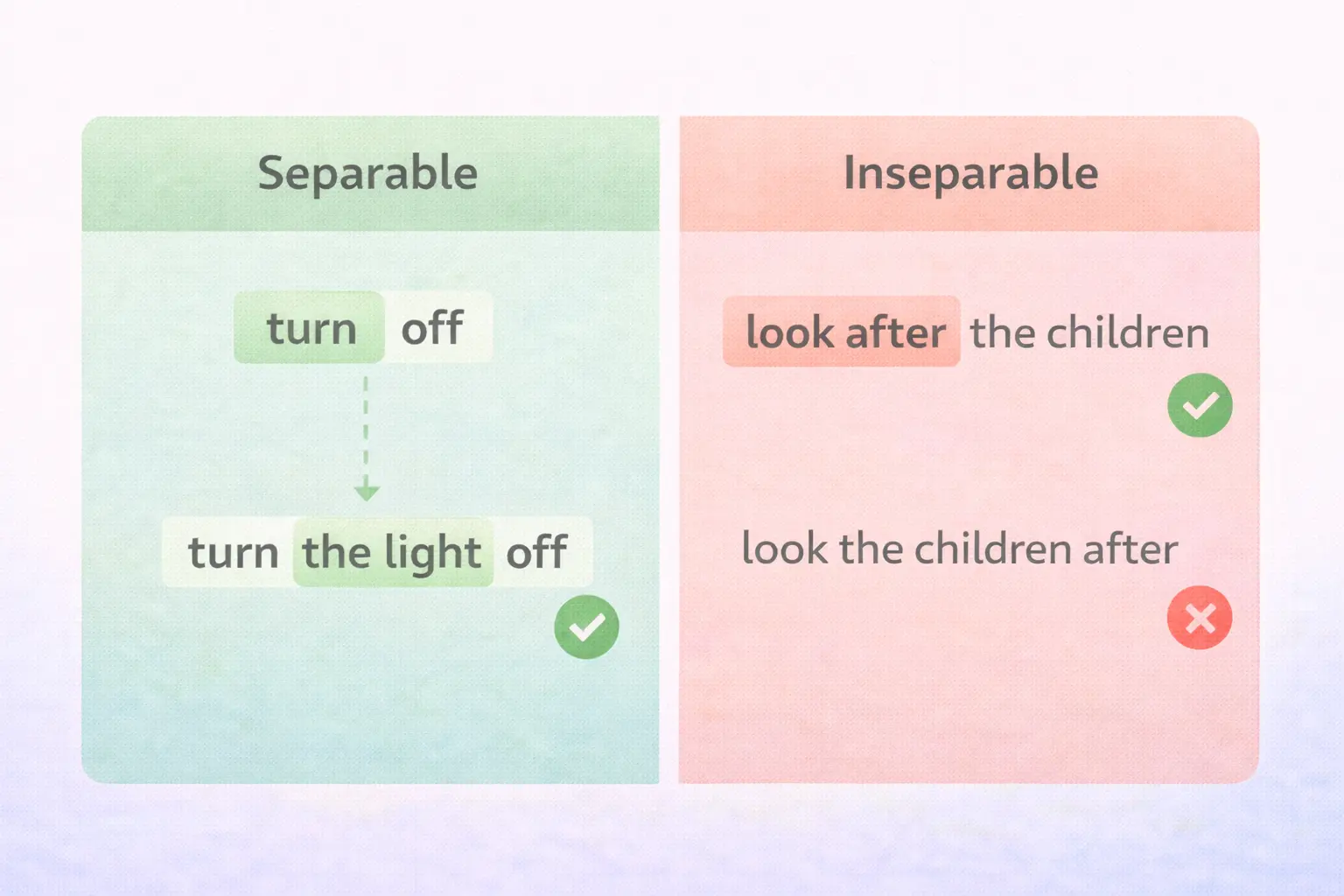
4. Pay attention to separable vs. inseparable. Some phrasal verbs can be split: “turn the light off” = “turn off the light.” Others cannot: “look after the children“ (not “look the children after”). When in doubt, keep the verb and particle together.
5. Review with spaced repetition. Add phrasal verbs to your Linglify dictionary and review them at increasing intervals. Ten minutes per day beats one hour once a week.
For a complete study system, read our guide on how to improve your vocabulary.
What to Do Next
-
Start with the top 50. If 100 feels overwhelming, start with our 50 most common phrasal verbs — organized by base verb with pattern explanations that make them easier to remember.
-
Level up to advanced phrasal verbs. Once you are comfortable with this list, move to our advanced phrasal verbs guide for 60+ C1–C2 level phrasal verbs used in academic and professional contexts.
-
Learn by verb group. For a deep dive into all phrasal verbs built from one verb, start with phrasal verbs with MAKE — the most versatile set.
-
Explore business contexts. If you work in English, our business phrasal verbs guide covers 60+ professional phrases for meetings, emails, and negotiations.
-
Build a daily study habit. Follow our step-by-step vocabulary learning system to turn these 100 phrasal verbs into active vocabulary within weeks.
FAQ
What are the 50 most important phrasal verbs?
The first 50 phrasal verbs in this article (#1–#50) are the most commonly used in everyday English. They cover daily routines (wake up, turn on, put on), relationships (get along with, break up, make up), work (set up, carry out, hand in), and travel (get on, pick up, check in). If you learn only 50, focus on these — or see our dedicated 50 most common phrasal verbs guide organized by base verb for easier memorization.
How many phrasal verbs are there in English?
There are over 10,000 phrasal verb combinations in English, but only about 200–300 are commonly used. The 100 in this list cover the most frequent ones. You do not need to learn thousands — mastering this list puts you ahead of most non-native speakers.
What is the fastest way to learn phrasal verbs?
Learn them in thematic groups (travel, work, emotions), not alphabetically. Write your own example sentences using real situations from your life. Review with spaced repetition. Most importantly, use them actively in conversation and writing — passive memorization does not work for phrasal verbs.
Are phrasal verbs used in formal English?
Many phrasal verbs are appropriate for formal English: “carry out” (conduct), “set up” (establish), “point out” (indicate), “rule out” (eliminate). Others are informal: “hang out,” “freak out,” “blow up.” The formality depends on the specific phrasal verb, not on phrasal verbs as a category. Our advanced phrasal verbs guide focuses on formal and academic options.
Do I need phrasal verbs for IELTS?
Yes. IELTS examiners reward natural use of phrasal verbs in Speaking (it shows fluency) and appropriate use in Writing (it shows vocabulary range). However, in Writing Task 2, limit yourself to formal phrasal verbs: “account for,” “bring about,” “carry out.” In Speaking, more casual phrasal verbs like “hang out” and “catch up with” sound natural and authentic. See our IELTS vocabulary guide for band-specific strategies.
What is the difference between phrasal verbs and idioms?
Phrasal verbs are verb + particle combinations where the meaning is different from the individual words: “give up” = quit. Idioms are fixed expressions that do not follow grammar rules literally: “it is raining cats and dogs” = it is raining heavily. Phrasal verbs always function as verbs. Idioms can be any part of a sentence. Some overlap exists — “let the cat out of the bag” is an idiom, while “give up” is a phrasal verb.