Los 50 Verbos Frasales más Comunes del Inglés Cotidiano
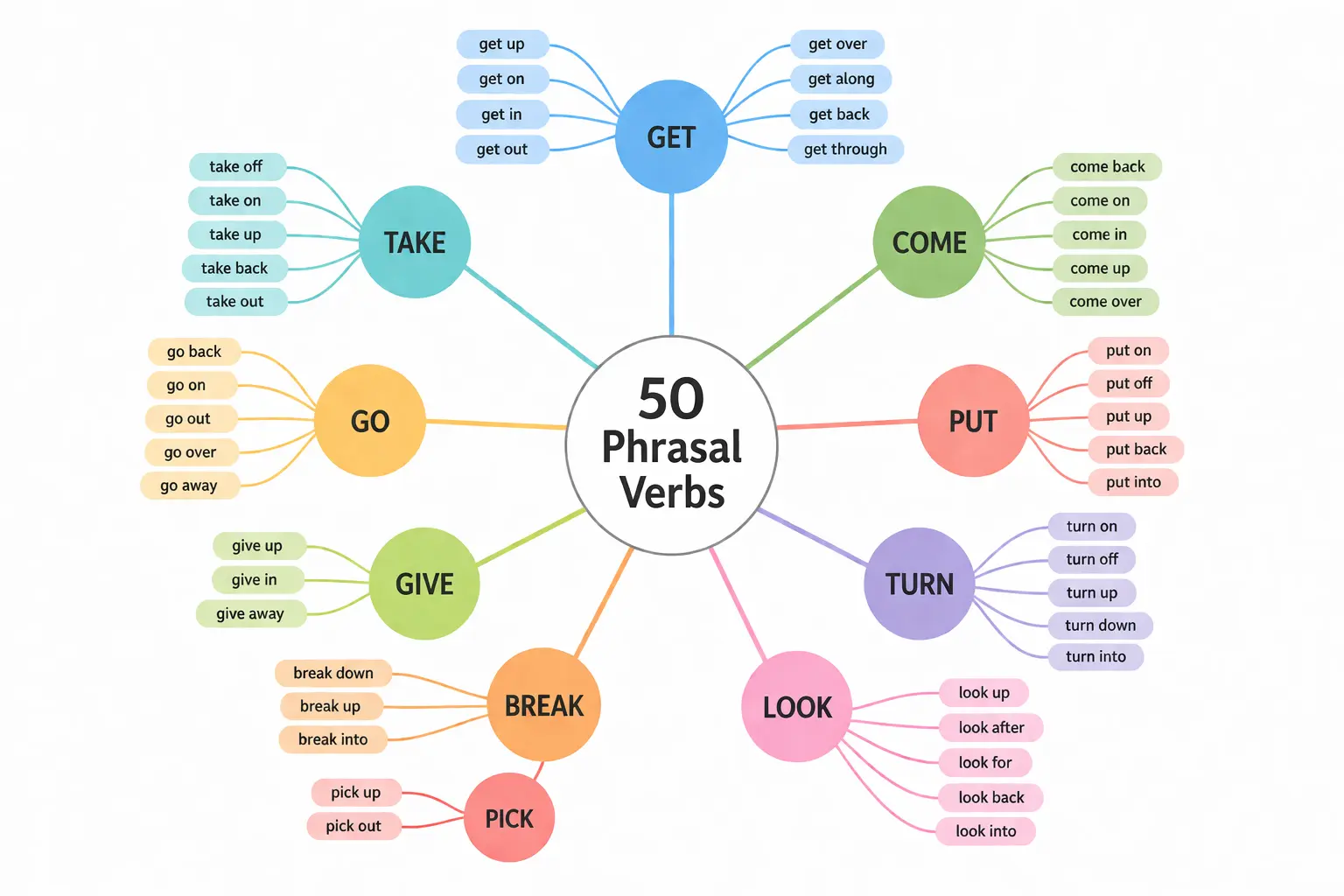
El inglés tiene más de 10.000 combinaciones de verbos frasales, pero no necesitas ni de lejos esa cantidad. Solo 50 verbos frasales cubren la gran mayoría de lo que los hablantes nativos dicen en la conversación diaria. Si aprendes los 50 de esta lista, entenderás la mayoría de los verbos frasales que escuches en películas, pódcasts, conversaciones en el trabajo y mensajes informales.
Esta guía los organiza por verbo base: GET, TAKE, GO, PUT, TURN, LOOK y otros, porque los verbos frasales son más fáciles de recordar cuando los aprendes en familias verbales. Cada entrada incluye el significado y dos frases de ejemplo con uso real cotidiano.
- Total de verbos frasales: 50
- Nivel: A2–B2 (elemental a intermedio-alto)
- Ideal para: conversación cotidiana, Speaking del IELTS, fluidez general
- Organización: por verbo base (10 familias verbales)
¿Por qué aprender por verbo base?
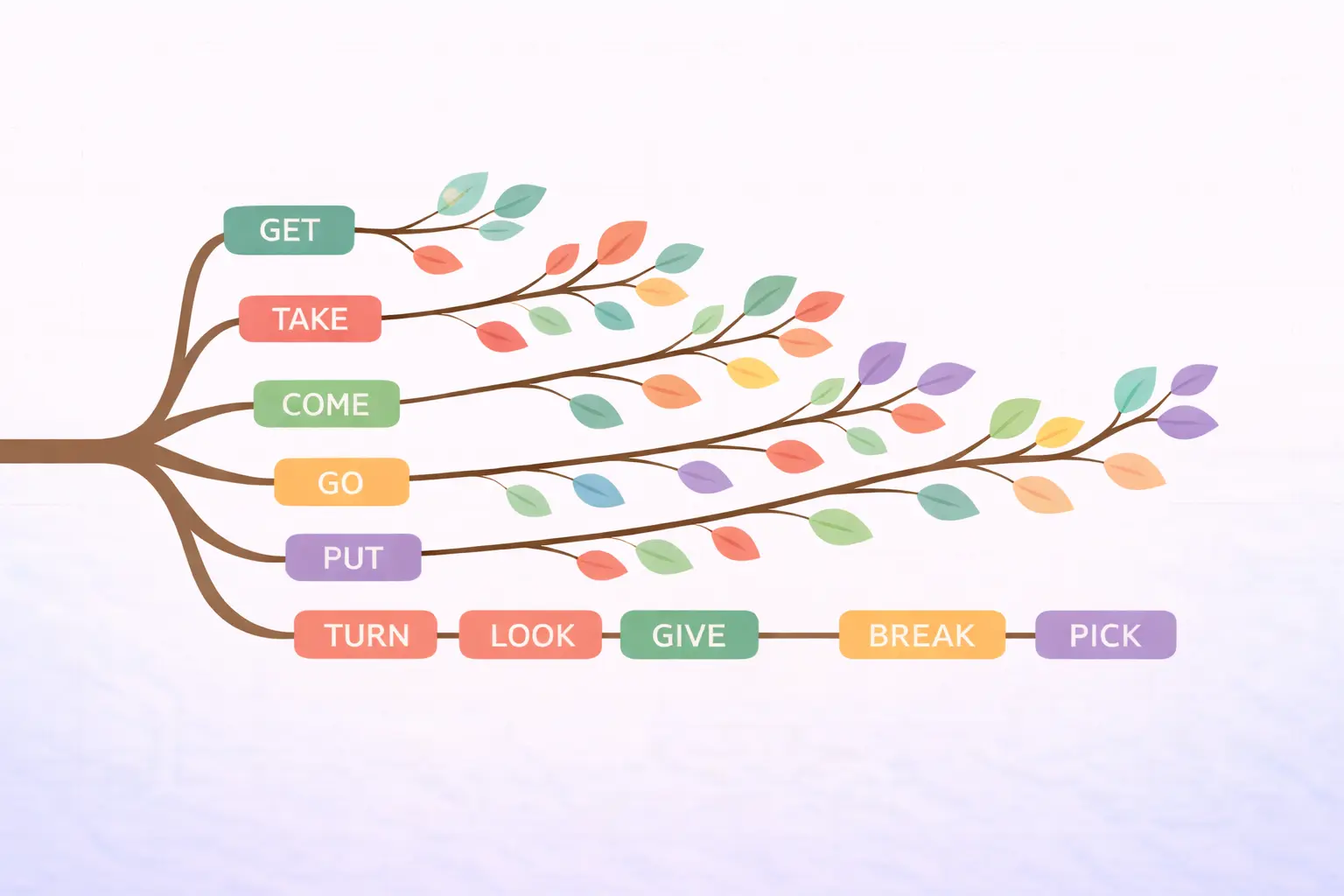
La mayoría de las listas de verbos frasales meten 100 verbos aleatorios en una tabla. Eso los hace difíciles de memorizar. Cuando los agrupas por verbo base, aparecen patrones:
- GET = movimiento, cambio de estado, obtención
- TAKE = eliminación, aceptación, inicio
- GO = movimiento, continuación, cambio
- PUT = colocación, tolerancia, aplazamiento
- TURN = cambio de dirección o estado
Aprender «get up», «get on», «get off» y «get over» juntos es más rápido que aprenderlos dispersos en una lista alfabética. Tu cerebro los vincula a la misma raíz, y cada nuevo verbo frasal se vuelve más fácil.
GET — El verbo más versátil
GET forma más verbos frasales comunes que cualquier otro verbo del inglés. Estos ocho aparecen en casi todas las conversaciones.
| # | Verbo frasal | Significado | Ejemplos |
|---|---|---|---|
| 1 | get up | levantarse de la cama; ponerse de pie | I get up at 6:30 every morning for work. / She got up from her chair and walked to the window. |
| 2 | get on | subir a un vehículo; llevarse bien | We got on the bus just as it was about to leave. / How do you get on with your new neighbours? |
| 3 | get off | bajar de un vehículo; terminar el trabajo | Get off at the third stop — the library is right there. / What time do you get off work today? |
| 4 | get along with | llevarse bien con alguien | She gets along with everyone in the office. / My cat does not get along with the new dog. |
| 5 | get over | recuperarse de algo | It took him weeks to get over the flu. / She finally got over the shock of losing her job. |
| 6 | get back | volver; recuperar algo | What time did you get back from the trip? / I lent him my book a month ago and still have not got it back. |
| 7 | get into | entrar; interesarse o involucrarse en | He got into the car without saying a word. / She got into photography during the lockdown. |
| 8 | get rid of | deshacerse de algo no deseado | We need to get rid of this old sofa — it is falling apart. / I finally got rid of those annoying pop-up ads on my phone. |
Patrón a observar: GET casi siempre implica un cambio: de posición (get up, get on, get off), de estado (get over, get into) o de posesión (get back, get rid of).
TAKE — Quitar, aceptar, empezar
Los verbos frasales con TAKE implican quitar algo, aceptar responsabilidad o comenzar una actividad.
| # | Verbo frasal | Significado | Ejemplos |
|---|---|---|---|
| 9 | take off | quitarse ropa; (un avión) despegar; volverse exitoso | Take off your jacket — it is warm inside. / The plane took off 20 minutes late because of the weather. |
| 10 | take on | aceptar una tarea o responsabilidad; contratar | She took on the project even though she was already busy. / The company is taking on 50 new employees this quarter. |
| 11 | take up | empezar un nuevo hobby o actividad; ocupar espacio o tiempo | He took up running last year and has already done a marathon. / This table takes up too much space in the kitchen. |
| 12 | take care of | cuidar; gestionar | Can you take care of the kids while I go to the dentist? / Do not worry about the invoice — I will take care of it. |
| 13 | take out | sacar del interior; llevar a alguien a un restaurante o evento | He took out his wallet and paid for the meal. / I am taking my parents out for dinner on their anniversary. |
Patrón a observar: TAKE a menudo significa «sacar de un lugar o estado». Te quitas (take off) la ropa, sacas (take out) la cartera del bolsillo, asumes (take on) el trabajo de otra persona.
COME — Llegar, ocurrir, descubrir
Los verbos frasales con COME describen la llegada, el surgimiento de eventos y descubrimientos inesperados.
| # | Verbo frasal | Significado | Ejemplos |
|---|---|---|---|
| 14 | come back | volver a un lugar | She went to Australia for a year but came back because she missed her family. / When are you coming back from lunch? |
| 15 | come in | entrar a una habitación o edificio | Come in and sit down — the meeting is about to start. / The door was open, so I just came in. |
| 16 | come up | surgir; mencionarse; acercarse | Something urgent came up at work, so I will be late. / Your name came up in the conversation. |
| 17 | come up with | pensar en una idea, plan o solución | She came up with a creative solution to the problem. / We need to come up with a name for the new product. |
| 18 | come across | encontrar algo por casualidad; dar una impresión | I came across your article while researching online. / He comes across as confident, but he is actually quite shy. |
Patrón a observar: COME implica movimiento hacia el hablante o hacia un resultado. Las cosas vuelven (come back), surgen (come up) y aparecen en tu camino (come across).
GO — Moverse, continuar, cambiar
Los verbos frasales con GO expresan movimiento, continuación y cambio.
| # | Verbo frasal | Significado | Ejemplos |
|---|---|---|---|
| 19 | go on | continuar; ocurrir | Please go on — I did not mean to interrupt you. / What is going on here? Why is everyone shouting? |
| 20 | go out | salir para una actividad social; apagarse | We go out for dinner every Friday night. / The candle went out because of the wind. |
| 21 | go ahead | proceder; comenzar | Go ahead and start without me — I will catch up. / The concert will go ahead despite the rain. |
| 22 | go back | volver a un lugar o estado anterior | I left my phone at the office and had to go back for it. / Once you send the email, you cannot go back and change it. |
| 23 | go through | vivir algo difícil; examinar con detenimiento | She went through a very tough period after the divorce. / The lawyer went through every clause in the contract. |
Patrón a observar: GO implica movimiento alejándose de la posición actual. Sales (go out), vuelves adonde estabas (go back) y atraviesas experiencias difíciles (go through).
PUT — Colocar, aplazar, tolerar
Los verbos frasales con PUT implican colocar cosas, posponer y manejar situaciones.
| # | Verbo frasal | Significado | Ejemplos |
|---|---|---|---|
| 24 | put on | ponerse ropa; añadir peso; poner música | Put on a warm coat — it is freezing outside. / She put on some music to help her concentrate. |
| 25 | put off | posponer; hacer que alguien no quiera hacer algo | Do not put off the dentist appointment again — you need to go. / The long commute put me off taking the job. |
| 26 | put up with | tolerar algo molesto o desagradable | I cannot put up with his constant complaining anymore. / How do you put up with the noise from the construction site? |
| 27 | put away | devolver algo a su lugar | Please put away the dishes after you dry them. / The kids need to put away their toys before bedtime. |
| 28 | put down | colocar sobre una superficie; criticar a alguien | He put down his phone and looked at me. / Stop putting yourself down — your work is excellent. |
Patrón a observar: PUT implica colocar algo en algún lugar: literalmente (ponerse ropa, guardar platos, dejar el teléfono) o figuradamente (put off = colocar en el futuro, put up with = colocarte por debajo de algo desagradable).
TURN — Cambiar de dirección o estado
Los verbos frasales con TURN describen interruptores, cambios y transformaciones.
| # | Verbo frasal | Significado | Ejemplos |
|---|---|---|---|
| 29 | turn on | encender un aparato; hacer que algo funcione | Turn on the air conditioning — it is too hot in here. / She turned on the laptop and checked her emails. |
| 30 | turn off | apagar un aparato; salir de una carretera | Please turn off the lights when you leave the room. / Turn off at the next exit to reach the hotel. |
| 31 | turn out | tener un resultado concreto; resultar ser | The party turned out to be much more fun than I expected. / It turned out that he had been lying the whole time. |
| 32 | turn up | llegar (a menudo de forma inesperada); subir el volumen | She turned up at the party without telling anyone. / Can you turn up the volume? I cannot hear the news. |
| 33 | turn down | rechazar; bajar el volumen | She turned down the job offer because the salary was too low. / Turn down the music — the baby is sleeping. |
Patrón a observar: TURN siempre implica un cambio de estado. ON/OFF = estado de funcionamiento. UP/DOWN = nivel de algo. OUT = el estado final que algo alcanza. DOWN (rechazar) = girarse en sentido contrario a algo que te ofrecen.
LOOK — Buscar, observar, esperar
Los verbos frasales con LOOK se relacionan con ver, buscar y dirigir la atención.
| # | Verbo frasal | Significado | Ejemplos |
|---|---|---|---|
| 34 | look for | intentar encontrar algo | I am looking for my car keys — have you seen them? / She has been looking for a new apartment for three months. |
| 35 | look after | cuidar de | My mother looks after the children when I am at work. / You need to look after your health — you have been working too hard. |
| 36 | look up | buscar información; mejorar | Look up the word in a dictionary if you do not know it. / Business has been looking up since the new manager arrived. |
| 37 | look forward to | tener ganas de un evento futuro | I am looking forward to the weekend. / We look forward to meeting you at the interview. |
| 38 | look out | tener cuidado; estar alerta | Look out! There is a step right in front of you. / Look out for pickpockets in crowded tourist areas. |
Patrón a observar: LOOK siempre consiste en dirigir tu atención. FOR = hacia algo que quieres. AFTER = hacia alguien que te necesita. UP = hacia una fuente de información. FORWARD TO = hacia el futuro. OUT = hacia un peligro potencial.
GIVE — Dejar, devolver, distribuir
| # | Verbo frasal | Significado | Ejemplos |
|---|---|---|---|
| 39 | give up | dejar de intentarlo; abandonar un hábito | She gave up smoking three years ago. / The puzzle is impossible — I give up. |
| 40 | give back | devolver algo a su dueño | Can you give back the tools you borrowed last week? / The charity works to give back to the community. |
| 41 | give away | donar; revelar un secreto | We gave away our old furniture when we moved. / Do not give away the ending of the movie! |
BREAK — Terminar, parar, entrar
| # | Verbo frasal | Significado | Ejemplos |
|---|---|---|---|
| 42 | break up | terminar una relación; perder la señal | They broke up after dating for two years. / You are breaking up — I will call you back on a better connection. |
| 43 | break down | dejar de funcionar; perder el control emocional | The car broke down in the middle of the highway. / She broke down in tears when she heard the news. |
| 44 | break into | entrar por la fuerza; empezar de repente | Someone broke into the house while they were on holiday. / He broke into a run when he saw the bus leaving. |
PICK — Elegir, recoger, aprender
| # | Verbo frasal | Significado | Ejemplos |
|---|---|---|---|
| 45 | pick up | recoger a alguien; aprender de forma casual; mejorar | I will pick you up at the station at 5 PM. / She picked up some Spanish while living in Barcelona. |
| 46 | pick out | elegir; seleccionar de un grupo | She picked out a dress for the wedding. / Can you pick out the best candidate from these CVs? |
SET y BRING — Iniciar e introducir
| # | Verbo frasal | Significado | Ejemplos |
|---|---|---|---|
| 47 | set up | organizar; establecer; preparar | He set up his own business after leaving the bank. / Can you help me set up the projector for the presentation? |
| 48 | set off | iniciar un viaje; activar | We set off early to avoid the morning traffic. / The alarm was set off by a cat walking past the sensor. |
| 49 | bring up | mencionar un tema; criar a un niño | He brought up the salary issue during the meeting. / She was brought up in a small village in the south of France. |
| 50 | bring back | devolver algo; traer recuerdos | Please bring back the library books before Friday. / This song brings back memories of my school days. |
Referencia rápida: los 50 de un vistazo
| Verbo base | Verbos frasales | Cantidad |
|---|---|---|
| GET | get up, get on, get off, get along with, get over, get back, get into, get rid of | 8 |
| TAKE | take off, take on, take up, take care of, take out | 5 |
| COME | come back, come in, come up, come up with, come across | 5 |
| GO | go on, go out, go ahead, go back, go through | 5 |
| PUT | put on, put off, put up with, put away, put down | 5 |
| TURN | turn on, turn off, turn out, turn up, turn down | 5 |
| LOOK | look for, look after, look up, look forward to, look out | 5 |
| GIVE | give up, give back, give away | 3 |
| BREAK | break up, break down, break into | 3 |
| PICK | pick up, pick out | 2 |
| SET | set up, set off | 2 |
| BRING | bring up, bring back | 2 |
| Total | 50 |
Vocabulario para practicar
Estas 25 palabras aparecen frecuentemente junto a los verbos frasales comunes. Añádelas a tu diccionario de Linglify para practicar con repetición espaciada.
finance
verbo
financiar, costear
Ejemplos
- Many students need loans to finance their college education expenses.
- The bank agreed to finance the construction of the new shopping center.
executive
adjetivo
ejecutivo, directivo, gerente
Ejemplos
- Executive decisions require careful consideration of multiple factors and consequences.
- The executive branch of government is responsible for implementing laws.
valid
adjetivo
válido, justo
Ejemplos
- Valid argument supports logical reasoning and conclusion.
- Valid passport allows international travel without problems.
culmination
sustantivo
culminación
Ejemplos
- The graduation ceremony was the culmination of four years of hard study.
- Winning the championship represented the culmination of the team's efforts.
transmit
verbo
transmitir, difundir, emitir
Ejemplos
- Disease may transmit through contact with surfaces.
- Satellites transmit signals across vast distances effectively.
gulp
verbo
beber, tragar
Ejemplos
- She had to gulp nervously before giving her presentation to the board.
- The thirsty runner gulped down an entire bottle of cold water.
cherished
adjetivo
valorado, querido
Ejemplos
- His cherished dream of becoming a pilot finally came true.
- The old photograph was her most cherished possession from childhood.
fate
sustantivo
destino, suerte, fatum
Ejemplos
- She believes that fate brought them together at the right moment.
- The explorer's fate remained unknown after he disappeared in the jungle.
spellbound
adjetivo
absorto, hipnotizado, fascinado
Ejemplos
- Audience sits spellbound during magical performance tonight.
- Children remain spellbound by storyteller's fascinating tales.
pet
adjetivo
pequeño, chico, menudo
Ejemplos
- Pet project receives extra attention and resources.
- Pet theory explains professor's research focus area.
master
sustantivo
maestro, experto, jefe
Ejemplos
- Apprentices learn traditional crafts from experienced master craftsmen.
- The chess master defeated opponents using brilliant strategic moves.
payable
adjetivo
pagadero, a pagar, de pago
Ejemplos
- All dues are payable at the end of the month.
- The invoice is payable within 30 days.
serenity
sustantivo
serenidad, tranquilidad, calma
Ejemplos
- She maintained her serenity despite the chaos.
- The serenity of the lake was calming.
classy
adjetivo
elegante, clase, distinguido
Ejemplos
- Classy restaurant serves gourmet food in elegant dining atmosphere.
- Her classy appearance impressed everyone at formal business meeting.
revolt
verbo
rebelarse, levantarse, revoltarse
Ejemplos
- A revolt broke out in the city center last night.
- The workers decided to revolt against the unfair conditions.
rethink
verbo
repensar, reconsiderar, reflexionar
Ejemplos
- He decided to rethink his position on the issue.
- We need to rethink our strategy for the project.
gypsy
sustantivo
gitano, romani, nómada
Ejemplos
- Traditional gypsy music features violin and passionate vocals.
- Wandering gypsy caravan traveled through European countryside.
buffoon
sustantivo
bufón, payaso
Ejemplos
- Court buffoon entertained royal family with silly performances.
- Don't act like buffoon during important business presentation.
execution
sustantivo
ejecución, cumplimiento, desempeño
Ejemplos
- Perfect execution of the dance routine impressed judges and audience members.
- The execution of the business plan requires careful coordination and timing.
territory
sustantivo
territorio, zona
Ejemplos
- Animal territory provides food and shelter resources.
- National territory requires protection from foreign invasion.
tribe
sustantivo
tribu, clan, pueblo
Ejemplos
- Ancient tribe lived in harmony with nature.
- Indigenous tribe preserves traditional customs and languages.
resolve
verbo
resolver, solucionar, determinar
Ejemplos
- Mediator helps parties resolve dispute through negotiation.
- Technical team will resolve software problems quickly.
flexible
adjetivo
flexible, maleable, adaptable
Ejemplos
- Flexible working arrangements help employees balance work and family life.
- The flexible plastic tube can bend without breaking or cracking.
Cómo estudiar estos 50 verbos frasales
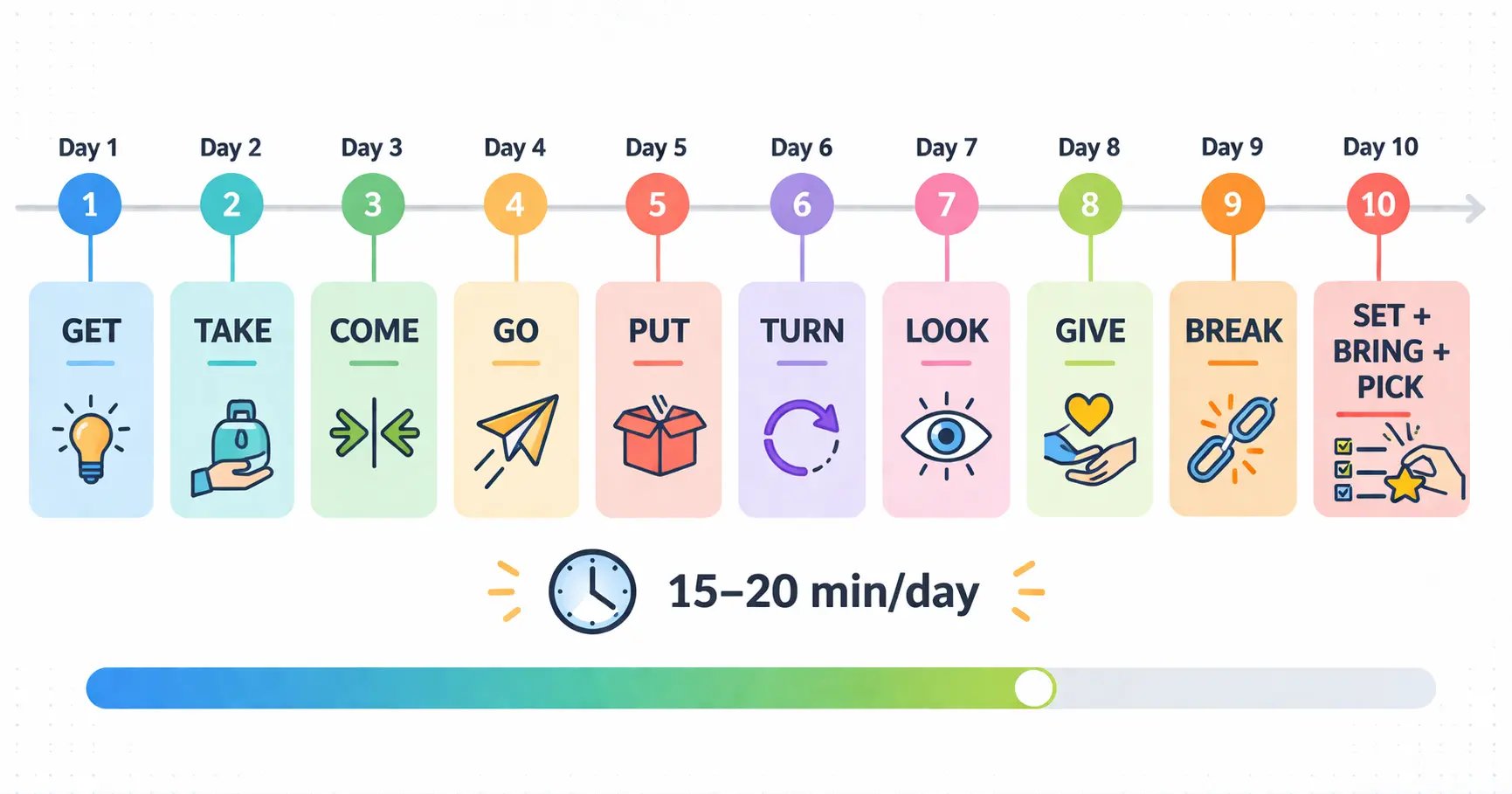
1. Aprende una familia verbal al día. Lunes = verbos frasales con GET. Martes = TAKE. Miércoles = COME. En 10 días habrás cubierto los 50. Dedica entre 15 y 20 minutos a cada familia.
2. Escribe frases sobre tu propia vida. No te limites a leer los ejemplos: escribe los tuyos. «I got up at 7 today.» «I need to get rid of my old phone.» Las frases personales crean recuerdos más sólidos que los ejemplos genéricos del libro de texto.
3. Usa el método «reemplaza y mejora». Durante un día, intenta reemplazar los verbos básicos en tu habla: en lugar de «I started running», di «I took up running». En lugar de «I returned», di «I came back». La sustitución consciente construye el hábito.
4. Ve contenido en inglés con subtítulos. Elige una serie o un canal de YouTube y cuenta cuántos de estos 50 verbos frasales escuchas en un episodio. Te sorprenderá: la mayoría de los episodios contienen entre 15 y 20.
5. Ponte a prueba con el verbo base. Tapa la columna del significado e intenta recordar qué significa cada verbo frasal. Luego tapa la columna del verbo frasal e intenta producirlo a partir del significado. Ambas direcciones construyen un recuerdo más sólido.
Para un sistema completo de aprendizaje de vocabulario, lee nuestra guía sobre cómo mejorar tu vocabulario.
Qué hacer a continuación
-
Amplía a 100. Cuando te sientas cómodo con estos 50, pasa a nuestros 100 verbos frasales con significado y ejemplos para la lista esencial completa organizada por tema.
-
Profundiza en verbos específicos. Para un desglose completo de todos los verbos frasales con MAKE (más de 5 significados solo para «make up»), consulta nuestra guía de verbos frasales con MAKE.
-
Sube al nivel avanzado. Para verbos frasales de nivel C1–C2 usados en inglés académico y profesional, lee nuestra guía de verbos frasales avanzados.
-
Aplícalos en el trabajo. Para verbos frasales específicos de reuniones, correos y comunicación empresarial, consulta nuestra guía de verbos frasales de negocios.
-
Crea un hábito de estudio diario. Sigue nuestro sistema de vocabulario paso a paso para convertir estos 50 en vocabulario activo en dos semanas.
Preguntas frecuentes
¿Cuáles son los 10 verbos frasales más comunes del inglés?
Según datos de frecuencia, los 10 principales son: get up, go on, come back, find out, give up, turn out, pick up, look for, take off y go out. Estos aparecen miles de veces por millón de palabras en el inglés hablado. Si solo aprendes 10, que sean estos.
¿Cuál es la diferencia entre esta lista y la de los 100 verbos frasales?
Este artículo enseña 50 verbos frasales organizados por verbo base (GET, TAKE, COME, etc.) con dos ejemplos y una explicación del patrón para cada familia. Nuestra lista de 100 verbos frasales está organizada por tema (vida diaria, trabajo, viajes, emociones) y cubre el doble de verbos con un ejemplo cada uno. Usa este artículo para aprender los patrones; usa la lista de 100 como referencia.
¿Cuánto tiempo lleva aprender 50 verbos frasales?
Con estudio diario enfocado, la mayoría de los estudiantes pueden aprender 50 verbos frasales en 2–3 semanas. Aprende una familia verbal al día (15–20 minutos), luego repasa la familia del día anterior antes de empezar la nueva. Después de 10 días de aprendizaje, dedica otra semana a la práctica activa: escribir y hablar usándolos.
¿Son iguales estos verbos frasales en inglés británico y americano?
Sí, los 50 verbos frasales de esta lista se usan tanto en inglés británico como americano. Hay algunas diferencias leves de preferencia: los americanos tienden a usar «get rid of» más que los británicos, quienes también podrían usar «dispose of», pero los 50 son universalmente entendidos y usados en ambas variedades.
¿Puedo usar estos verbos frasales en el Writing del IELTS?
Algunos son apropiados para el Writing del IELTS: «go through», «come up with» y «set up» funcionan bien en ensayos. Otros como «hang out» y «get rid of» son mejores para el Speaking. Para consejos específicos de verbos frasales para el IELTS, consulta nuestra guía de vocabulario para el IELTS.
¿Por qué son tan difíciles de aprender los verbos frasales?
Por tres razones: (1) el significado normalmente no es predecible a partir de las palabras: «put up with» no significa lógicamente «tolerar»; (2) muchos verbos frasales tienen varios significados: «take off» significa quitarse ropa, despegar o volverse exitoso; (3) la gramática es complicada: algunos son separables («turn the light off») y otros no («look after the kids», no «look the kids after»). La organización por verbo base de este artículo ayuda con la razón n.º 1 al mostrar patrones dentro de las familias verbales.