Argot Británico: 200+ Expresiones que Necesitas Conocer
Si aprendiste inglés con libros de texto americanos y luego viste una serie británica, probablemente entendiste el 70% del contenido. No por el acento, sino por el vocabulario. Cuando un británico dice «I’m absolutely knackered after that dodgy kebab, and now I need to pop to the chemist before I go to my mate’s gaff», cada palabra es inglés, pero la frase podría perfectamente ser un idioma extranjero para quien aprendió inglés americano.
El inglés británico tiene su propio y extenso vocabulario de argot, palabras informales y expresiones que rara vez aparecen en los libros de texto. Algunas de estas palabras se usan en todo el Reino Unido; otras son propias de Londres, el norte del país o Escocia. Muchas existen desde hace siglos; otras aparecieron el año pasado.
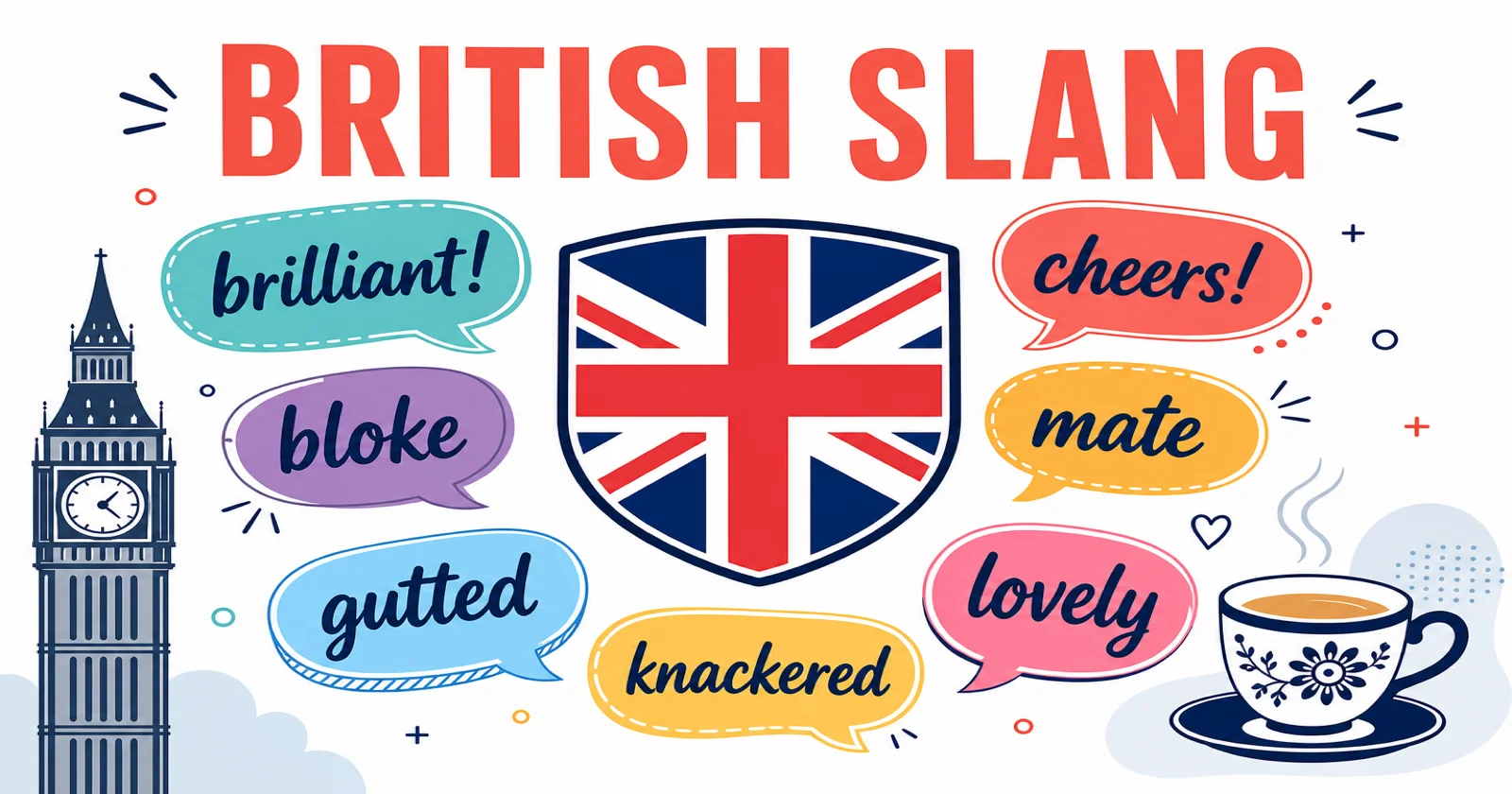
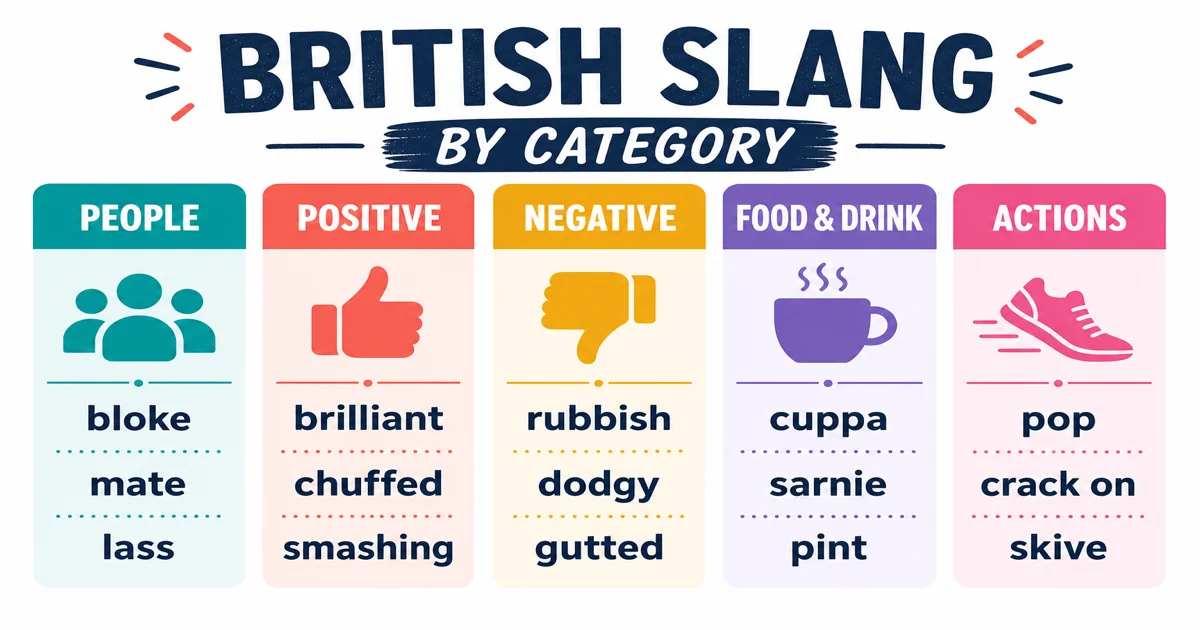
Esta guía cubre 200+ de las palabras y expresiones del argot británico más útiles, organizadas por categoría. Cada palabra incluye una definición, una frase de ejemplo y notas sobre su uso. Tanto si planeas vivir en el Reino Unido, como si ves series británicas o simplemente quieres entender lo que dicen tus amigos británicos, esta es tu guía de referencia.
- Total: 200+ palabras del argot británico
- Organizado por: 10 categorías
- Formato: Palabra → Significado → Ejemplo
- Nivel: B1–C2
- Para: comprender el inglés británico, preparación para viajes, cultura
Personas y relaciones
| # | Palabra/Expresión | Significado | Ejemplo |
|---|---|---|---|
| 1 | bloke | hombre, tío | He’s a nice bloke — you’d like him. (Es un buen tío — te caería bien.) |
| 2 | mate | amigo; también saludo informal | Alright, mate? How’s it going? (¿Qué hay, colega?) |
| 3 | lad | chico, joven | The lads are going to the pub tonight. (Los chicos van al pub esta noche.) |
| 4 | lass | chica, mujer joven (del norte) | She’s a lovely lass from Yorkshire. (Es una chica encantadora de Yorkshire.) |
| 5 | chap | hombre (ligeramente anticuado, cortés) | He’s a decent chap, that one. (Es un tipo decente, ese.) |
| 6 | bird | mujer, novia (informal, puede ser ofensivo) | He’s been seeing some bird from Manchester. (Ha estado saliendo con una chica de Mánchester.) |
| 7 | missus / Mrs | esposa o novia | I need to check with the missus first. (Tengo que consultarlo con mi mujer primero.) |
| 8 | geezer | tío (Londres) | Some geezer just knocked on the door. (Acaba de llamar un tío a la puerta.) |
| 9 | bruv | hermano, amigo (Londres) | Thanks, bruv — I owe you one. (Gracias, tío — te debo una.) |
| 10 | muppet | persona tonta | He forgot his passport — what a muppet! (Olvidó el pasaporte — ¡qué imbécil!) |
| 11 | plonker | persona estúpida | Don’t be such a plonker, Rodney! (¡No seas tan idiota, Rodney!) |
| 12 | nutter | persona loca | He jumped in the river — absolute nutter. (Se tiró al río — un loco de remate.) |
| 13 | tosser | persona desagradable o despreciable | The boss is a complete tosser. (El jefe es un completo imbécil.) |
| 14 | numpty | persona tonta o incompetente (escocés) | Some numpty parked across two spaces. (Algún zoquete aparcó ocupando dos plazas.) |
| 15 | bairn | niño (escocés/del norte) | She’s got three bairns under five. (Tiene tres niños menores de cinco años.) |
| 16 | love / luv | término de trato afectivo (como «cariño») | What can I get you, love? (¿Qué le pongo, cariño?) |
| 17 | darling | querido/a (usado de forma casual en el sur) | Thanks, darling — that’s very kind. (Gracias, cielo — muy amable.) |
| 18 | posh | de clase alta, elegante | She went to a posh school in Surrey. (Fue a un colegio de élite en Surrey.) |
| 19 | chav | persona percibida como de clase baja y agresiva | The media loves stereotyping chavs. (Los medios adoran los estereotipos de los chavs.) |
| 20 | punter | cliente; persona corriente | The punters seemed happy with the show. (El público pareció contento con el espectáculo.) |
Sentimientos positivos y aprobación
| # | Palabra/Expresión | Significado | Ejemplo |
|---|---|---|---|
| 21 | brilliant | genial, maravilloso | “How was the concert?” “Brilliant!” («¿Qué tal el concierto?» «¡Genial!») |
| 22 | lovely | estupendo, agradable | That was a lovely meal — thank you. (Fue una comida estupenda, gracias.) |
| 23 | smashing | excelente, maravilloso | We had a smashing time at the festival. (Lo pasamos genial en el festival.) |
| 24 | cracking | excelente, muy bueno | She’s done a cracking job on this report. (Ha hecho un trabajo excelente con este informe.) |
| 25 | proper | de verdad, genuino (intensificador) | That’s a proper cup of tea. (Eso sí que es una taza de té de verdad.) |
| 26 | well | muy (intensificador) | That film was well good. (Esa peli estaba muy bien.) |
| 27 | dead | muy (intensificador, del norte) | She’s dead funny when she wants to be. (Es muy graciosa cuando quiere.) |
| 28 | mint | excelente (del norte) | “How was the match?” “Mint!” («¿Qué tal el partido?» «¡Genial!») |
| 29 | sound | bueno, fiable; también «de acuerdo» | He’s a sound bloke. / “I’ll be there at 7.” “Sound.” (Es un buen tío. / «Estaré allí a las 7.» «Perfecto.») |
| 30 | chuffed | muy contento, orgulloso | She was chuffed to bits with her exam results. (Estaba contentísima con sus notas.) |
| 31 | over the moon | extremadamente feliz | He was over the moon when he got the job. (Estaba en las nubes cuando le dieron el trabajo.) |
| 32 | buzzing | muy emocionado | I’m absolutely buzzing about the trip. (Estoy emocionadísimo con el viaje.) |
| 33 | gobsmacked | asombrado, impresionado | I was gobsmacked when I heard the news. (Me quedé boquiabierto cuando escuché la noticia.) |
| 34 | ace | genial, brillante | “How was the party?” “Ace!” («¿Qué tal la fiesta?» «¡Genial!») |
| 35 | wicked | increíble, guay (informal) | That trick was wicked! (¡Ese truco fue increíble!) |
| 36 | lush | precioso, atractivo (galés) | The cake was absolutely lush. (El pastel estaba de muerte.) |
| 37 | fit | atractivo (referido a una persona) | She’s well fit, isn’t she? (Está muy buena, ¿verdad?) |
| 38 | tidy | bien, ordenado (galés) | “How was the gig?” “Tidy!” («¿Qué tal el concierto?» «¡Bien!») |
| 39 | belting | excelente (del norte) | We had a belting night out. (Tuvimos una noche de salida increíble.) |
| 40 | boss | excelente (Liverpool) | That goal was boss! (¡Ese gol fue de lujo!) |
Sentimientos negativos y desaprobación
| # | Palabra/Expresión | Significado | Ejemplo |
|---|---|---|---|
| 41 | rubbish | tonterías; de mala calidad | “He said he’ll be on time.” “That’s rubbish.” («Dijo que llegaría a tiempo.» «Eso son tonterías.») |
| 42 | naff | pasado de moda, soso | That jumper is a bit naff, isn’t it? (Ese jersey es un poco hortera, ¿no?) |
| 43 | pants | terrible, horrible | The film was absolutely pants. (La peli fue absolutamente horrible.) |
| 44 | dodgy | sospechoso, poco fiable, arriesgado | That kebab looks a bit dodgy. (Ese kebab tiene mala pinta.) |
| 45 | grim | desagradable, deprimente | The weather’s been grim all week. (El tiempo ha sido horrible toda la semana.) |
| 46 | manky | asqueroso, sucio | The kitchen was absolutely manky. (La cocina estaba totalmente asquerosa.) |
| 47 | rank | repugnante | That milk smells rank — throw it out. (Esa leche huele fatal — tírala.) |
| 48 | gutted | muy decepcionado | I was gutted when they cancelled the concert. (Me quedé destrozado cuando cancelaron el concierto.) |
| 49 | miffed | ligeramente molesto | She was a bit miffed about not being invited. (Estaba un poco molesta por no haber sido invitada.) |
| 50 | narked | molesto, irritado | He was well narked about the traffic. (Estaba muy mosqueado con el tráfico.) |
| 51 | minging | feo, asqueroso | That toilet was absolutely minging. (Ese baño era absolutamente repugnante.) |
| 52 | bog-standard | ordinario, básico | It’s just a bog-standard laptop — nothing special. (Es solo un portátil del montón, nada especial.) |
| 53 | daft | tonto, estúpido | Don’t be daft — of course I’ll help. (No seas tonto, claro que te ayudaré.) |
| 54 | barmy | chiflado, loco | You want to swim in January? You’re barmy! (¿Quieres nadar en enero? ¡Estás chiflado!) |
| 55 | bonkers | loco | The housing prices in London are bonkers. (Los precios de la vivienda en Londres son una locura.) |
| 56 | mental | loco (informal) | The traffic was mental this morning. (El tráfico esta mañana era una locura.) |
| 57 | knackered | agotadísimo | I’m absolutely knackered after that shift. (Estoy agotadísimo después de ese turno.) |
| 58 | shattered | exhausto | We walked 20 miles — I’m shattered. (Caminamos 32 km — estoy hecho polvo.) |
| 59 | cream-crackered | agotado (argot rimado cockney de «knackered») | I’m cream-crackered — need a kip. (Estoy para el arrastre — necesito echar una cabezada.) |
| 60 | fed up | harto, frustrado | I’m fed up with this rain. (Estoy harto de esta lluvia.) |
Comida y bebida
| # | Palabra/Expresión | Significado | Ejemplo |
|---|---|---|---|
| 61 | cuppa | taza de té | Fancy a cuppa? (¿Te apetece una taza de té?) |
| 62 | brew | taza de té | Put the kettle on — I need a brew. (Pon el hervidor — necesito un té.) |
| 63 | biscuit | galleta (en inglés americano: cookie) | Would you like a biscuit with your tea? (¿Quieres una galleta con el té?) |
| 64 | chips | patatas fritas (en inglés americano: french fries) | Fish and chips, please. (Pescado con patatas fritas, por favor.) |
| 65 | crisps | patatas chips (en inglés americano: potato chips) | Pass me the crisps — salt and vinegar. (Pásame las chips — sal y vinagre.) |
| 66 | sarnie | sándwich | I’ll grab a bacon sarnie for lunch. (Me pillo un sándwich de bacon para comer.) |
| 67 | butty | sándwich (del norte) | A chip butty is a Northern classic. (Un bocadillo de patatas fritas es un clásico del norte.) |
| 68 | nosh | comida; comer | Let’s grab some nosh before the film. (Pillemos algo de comer antes de la peli.) |
| 69 | scran | comida (del norte/militar) | What’s for scran tonight? (¿Qué hay de comer esta noche?) |
| 70 | peckish | con un poco de hambre | I’m a bit peckish — got any snacks? (Tengo un poco de hambre, ¿tienes algo para picar?) |
| 71 | starving | con mucha hambre (exageración) | I’m starving — can we eat soon? (Me muero de hambre, ¿podemos comer pronto?) |
| 72 | brekkie | desayuno | What are you having for brekkie? (¿Qué vas a desayunar?) |
| 73 | tea | cena/comida de la tarde (del norte) | “What’s for tea, Mum?” («¿Qué hay de cenar, mamá?») |
| 74 | gaffer tape | cinta americana | Fix it with gaffer tape — that’ll do. (Arréglalo con cinta americana — con eso vale.) |
| 75 | ploughman’s | almuerzo frío de pan, queso y encurtidos | I’ll have the ploughman’s, please. (Tomaré el plato del campesino, por favor.) |
| 76 | pint | una cerveza (literalmente, medio litro) | Let’s grab a pint after work. (Tomemos una cerveza después del trabajo.) |
| 77 | off-licence | tienda de bebidas alcohólicas | Pop to the off-licence and grab some wine. (Pásate por la licorería y coge vino.) |
| 78 | bladdered / trolleyed | completamente borracho | He was absolutely bladdered by 9 o’clock. (Estaba como una cuba a las 9.) |
| 79 | legless | extremadamente borracho | She was legless after three cocktails. (Estaba sin poder tenerse en pie después de tres cócteles.) |
| 80 | pissed | borracho (¡NO significa enfadado, como en inglés americano!) | He got pissed at the office Christmas party. (Se emborrachó en la fiesta de Navidad de la empresa.) |
Acciones cotidianas
| # | Palabra/Expresión | Significado | Ejemplo |
|---|---|---|---|
| 81 | pop | ir rápidamente | I’m just going to pop to the shops. (Solo voy un momento a las tiendas.) |
| 82 | nip | ir rápidamente (del norte) | I’ll nip out for some milk. (Salgo un momento a por leche.) |
| 83 | crack on | empezar, continuar trabajando | Right, let’s crack on with the meeting. (Venga, sigamos con la reunión.) |
| 84 | faff about | perder el tiempo, entretenerse | Stop faffing about and get ready! (¡Deja de perder el tiempo y prepárate!) |
| 85 | have a go | intentarlo | I’ve never tried it, but I’ll have a go. (Nunca lo he probado, pero lo intentaré.) |
| 86 | sort it | arreglarlo, organizarlo | Don’t worry — I’ll sort it. (No te preocupes, yo lo arreglo.) |
| 87 | suss out | averiguar, investigar | I need to suss out the best route. (Tengo que averiguar la mejor ruta.) |
| 88 | take the mickey / take the mick | burlarse, tomar el pelo | Are you taking the mick? (¿Me estás tomando el pelo?) |
| 89 | wind someone up | irritar o provocar a alguien intencionadamente | He loves winding his sister up. (Le encanta provocar a su hermana.) |
| 90 | leg it | salir corriendo | We saw the security guard and legged it. (Vimos al guardia de seguridad y salimos pitando.) |
| 91 | skive | evitar el trabajo o la escuela | He skived off school to go to the cinema. (Se escapó del colegio para ir al cine.) |
| 92 | bunk off | saltarse el colegio o el trabajo | We used to bunk off on Fridays. (Antes nos saltábamos las clases los viernes.) |
| 93 | chat up | coquetear | He was trying to chat up the barmaid. (Intentaba ligar con la camarera.) |
| 94 | kip | siesta; dormir | I need a quick kip before we go out. (Necesito echar una cabezada antes de salir.) |
| 95 | bog | baño | Where’s the bog? I need a wee. (¿Dónde está el baño? Necesito hacer pis.) |
| 96 | loo | baño (educado) | Excuse me, where’s the loo? (Perdone, ¿dónde está el servicio?) |
| 97 | ring / give a bell | llamar por teléfono | Give me a bell when you arrive. (Llámame cuando llegues.) |
| 98 | nick | robar; también «comisaría» o «cárcel» | Someone nicked my bike! (¡Alguien me ha robado la bici!) |
| 99 | grass | delatar, chivarse | Don’t grass on your mates. (No te chives de tus amigos.) |
| 100 | chuck | tirar; también «romper una relación» | Chuck that in the bin. / She chucked him last week. (Tíralo a la basura. / Ella le dejó la semana pasada.) |
Lugares y cosas
| # | Palabra/Expresión | Significado | Ejemplo |
|---|---|---|---|
| 101 | gaff | casa, hogar | Come round to my gaff tonight. (Ven a mi casa esta noche.) |
| 102 | flat | piso, apartamento | She lives in a flat in Notting Hill. (Vive en un piso en Notting Hill.) |
| 103 | the tube | el metro de Londres | Take the tube to Piccadilly Circus. (Toma el metro hasta Piccadilly Circus.) |
| 104 | chemist | farmacia | I need to pop to the chemist for some paracetamol. (Tengo que pasarme por la farmacia a por paracetamol.) |
| 105 | off-licence | tienda de bebidas alcohólicas | Grab a bottle from the off-licence. (Coge una botella de la licorería.) |
| 106 | boot | maletero del coche | Put the bags in the boot. (Pon las bolsas en el maletero.) |
| 107 | bonnet | capó del coche | Open the bonnet — something’s rattling. (Abre el capó — algo hace ruido.) |
| 108 | lorry | camión | A lorry broke down on the M25. (Un camión se averió en la M25.) |
| 109 | motorway | autopista | Take the motorway — it’s faster. (Coge la autopista — es más rápido.) |
| 110 | pavement | acera | Walk on the pavement, not the road. (Camina por la acera, no por la calzada.) |
| 111 | zebra crossing | paso de peatones | Use the zebra crossing to get across. (Usa el paso de cebra para cruzar.) |
| 112 | roundabout | rotonda | Take the third exit at the roundabout. (Toma la tercera salida en la rotonda.) |
| 113 | queue | cola (de personas esperando) | There’s a massive queue outside the shop. (Hay una cola enorme en la puerta de la tienda.) |
| 114 | telly | tele, televisión | What’s on the telly tonight? (¿Qué ponen en la tele esta noche?) |
| 115 | mobile | teléfono móvil | What’s your mobile number? (¿Cuál es tu número de móvil?) |
| 116 | quid | libra esterlina (£1) | That’ll be five quid, mate. (Son cinco libras, colega.) |
| 117 | fiver | billete de £5 | Have you got a fiver I can borrow? (¿Tienes un billete de cinco libras que me puedas prestar?) |
| 118 | tenner | billete de £10 | It only costs a tenner to get in. (Solo cuesta diez libras entrar.) |
| 119 | brolly | paraguas | Grab your brolly — it’s going to rain. (Coge el paraguas — va a llover.) |
| 120 | jumper | jersey, suéter | Put a jumper on — it’s freezing. (Ponte un jersey — hace un frío que pela.) |
Frases de conversación
| # | Palabra/Expresión | Significado | Ejemplo |
|---|---|---|---|
| 121 | alright? | hola, ¿cómo estás? | “Alright, mate?” “Yeah, not bad.” («¿Qué tal, colega?» «Tirando.») |
| 122 | cheers | gracias; también un brindis | Cheers for helping me with that. (Gracias por ayudarme con eso.) |
| 123 | ta | gracias (muy informal) | “Here’s your change.” “Ta!” («Aquí tiene su cambio.» «¡Gracias!») |
| 124 | sorted | listo, arreglado, resuelto | “Is everything ready?” “Yeah, sorted.” («¿Está todo listo?» «Sí, todo arreglado.») |
| 125 | no worries | no hay problema, no te preocupes | “Sorry I’m late.” “No worries.” («Perdona el retraso.» «No hay problema.») |
| 126 | fair enough | está bien, lo acepto | “I can’t come tonight.” “Fair enough.” («No puedo venir esta noche.» «Está bien.») |
| 127 | innit | ¿verdad? (Londres) | Cold today, innit? (Hace frío hoy, ¿verdad?) |
| 128 | you what? | ¿qué? ¿cómo? (sorpresa o incredulidad) | “I’m moving to Australia.” “You what?!” («Me mudo a Australia.» «¿¡Qué!?») |
| 129 | blimey | expresión de sorpresa | Blimey, that was quick! (¡Vaya, qué rápido!) |
| 130 | bloody hell | expresión de sorpresa o frustración | Bloody hell, look at the time! (¡Por Dios, mira qué hora es!) |
| 131 | crikey | expresión de sorpresa (anticuado) | Crikey, the prices have gone up! (¡Vaya, cómo han subido los precios!) |
| 132 | cor blimey | expresión fuerte de sorpresa | Cor blimey, that’s expensive! (¡Dios mío, qué caro!) |
| 133 | bob’s your uncle | y listo (= ya está hecho) | Put it in the oven for 20 minutes, and Bob’s your uncle. (Mételo al horno 20 minutos y listo.) |
| 134 | easy peasy | muy fácil | “Is it hard to make?” “No, easy peasy.” («¿Es difícil de hacer?» «No, es facilísimo.») |
| 135 | spot on | exactamente correcto, perfecto | Your prediction was spot on. (Tu predicción fue perfectamente acertada.) |
| 136 | not my cup of tea | no es algo que disfrute | Horror films aren’t my cup of tea. (Las películas de terror no son lo mío.) |
| 137 | taking the biscuit | pasarse de la raya, el colmo | Arriving two hours late really takes the biscuit. (Llegar dos horas tarde es el colmo.) |
| 138 | you’re having a laugh | debes estar de broma | £200 for a parking fine? You’re having a laugh! (¿200 libras de multa de aparcamiento? ¡No me lo puedo creer!) |
| 139 | do one | vete de aquí (grosero) | Tell him to do one. (Dile que se vaya a paseo.) |
| 140 | get in! | ¡sí! (celebración) | “We won the match!” “Get in!” («¡Ganamos el partido!» «¡Sí!») |
El tiempo y los estados de ánimo
| # | Palabra/Expresión | Significado | Ejemplo |
|---|---|---|---|
| 141 | chilly | fresco (pero no helado) | It’s a bit chilly out — grab a jacket. (Hace un poco de fresco fuera, coge una chaqueta.) |
| 142 | nippy | frío | It’s nippy this morning! (¡Esta mañana hace frío!) |
| 143 | brass monkeys | un frío extremo | It’s brass monkeys outside — stay in. (Fuera hace un frío polar — quédate dentro.) |
| 144 | bucketing down | lloviendo a cántaros | It’s absolutely bucketing down out there. (Está lloviendo a mares fuera.) |
| 145 | drizzle | llovizna | It’s just a drizzle — you don’t need a brolly. (Solo llovizna — no necesitas paraguas.) |
| 146 | scorching | abrasador, muy caliente | It’s scorching today — 35 degrees! (Hoy abrasa — ¡35 grados!) |
| 147 | muggy | caliente y húmedo | It’s so muggy — I can barely breathe. (Hay tanta humedad que apenas puedo respirar.) |
| 148 | miserable | desagradable (el tiempo) | What miserable weather we’re having. (Qué tiempo tan horrible tenemos.) |
| 149 | moody | temperamental, imprevisible | The weather’s been dead moody this week. (El tiempo ha sido muy caprichoso esta semana.) |
| 150 | right | muy, total (intensificador) | He’s a right laugh. / It’s a right mess. (Es muy gracioso. / Es un desastre total.) |
Trabajo y dinero
| # | Palabra/Expresión | Significado | Ejemplo |
|---|---|---|---|
| 151 | sack / get the sack | despedir / ser despedido | He got the sack for being late too often. (Le despidieron por llegar tarde con frecuencia.) |
| 152 | make redundant | prescindir de alguien, ERE | They made 200 workers redundant. (Despidieron a 200 trabajadores.) |
| 153 | do overtime | hacer horas extras | I’ve been doing overtime all month. (He estado haciendo horas extras todo el mes.) |
| 154 | cushy | fácil, cómodo (trabajo) | He’s got a cushy job in the city. (Tiene un trabajo cómodo en la ciudad.) |
| 155 | doddle | algo muy fácil | The exam was an absolute doddle. (El examen fue un auténtico paseo.) |
| 156 | skint | sin dinero | I’m skint until payday. (Estoy sin blanca hasta el día de cobro.) |
| 157 | loaded | muy rico | Her parents are absolutely loaded. (Sus padres están forrados.) |
| 158 | splash out | gastar mucho dinero | We splashed out on a fancy dinner. (Nos gastamos un dineral en una cena de lujo.) |
| 159 | rip-off | algo demasiado caro, timo | £8 for a coffee? What a rip-off! (¿8 libras por un café? ¡Qué timo!) |
| 160 | a steal | una ganga | That coat was a steal at £30. (Ese abrigo fue una ganga a 30 libras.) |
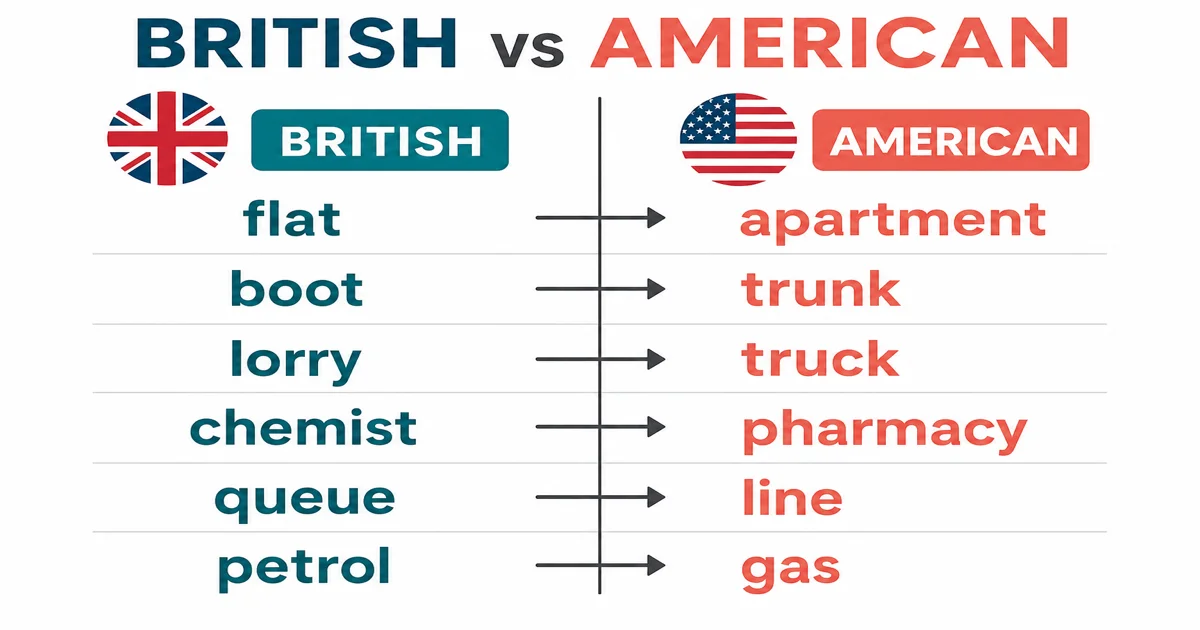
Inglés británico vs. inglés americano: diferencias clave
Estas no son palabras de argot, sino inglés británico estándar que difiere del inglés americano.
| Británico | Americano | Significado |
|---|---|---|
| flat | apartment | un piso en una planta |
| lift | elevator | transporte vertical |
| boot | trunk | parte trasera del coche |
| bonnet | hood | parte delantera del coche |
| lorry | truck | vehículo grande |
| petrol | gas/gasoline | combustible |
| nappy | diaper | pañal |
| dummy | pacifier | chupete |
| cot | crib | cuna |
| post | cartas y paquetes | |
| torch | flashlight | linterna portátil |
| holiday | vacation | tiempo libre |
| queue | line | personas esperando |
| bin | trash can | contenedor de basura |
| rubber | eraser | borra marcas de lápiz |
| autumn | fall | la estación |
| football | soccer | el deporte |
| trousers | pants | pantalón |
| pants | underwear | ropa interior |
| trainers | sneakers | zapatillas deportivas |
Advertencia: «Pants» significa ropa interior en inglés británico. Decirle «nice pants» a un británico tendrá una reacción muy diferente a la que tendría en América.
Variaciones regionales
El argot británico varía enormemente según la región:
| Región | Argot característico | Ejemplos |
|---|---|---|
| Londres | Argot rimado cockney | dog and bone (teléfono), plates of meat (pies) |
| Mánchester | Mancuniano | mint (genial), our kid (hermano/amigo íntimo) |
| Liverpool | Scouse | boss (genial), la (tío, amigo) |
| Newcastle | Geordie | canny (majo), gan (ir), howay (vamos) |
| Birmingham | Brummie | bostin (brillante), bab (cariño, apelativo) |
| Yorkshire | Dialecto de Yorkshire | reyt (muy/correcto), nowt (nada), summat (algo) |
| Escocia | Scots | braw (bien, bueno), wee (pequeño), ken (saber) |
| Gales | Inglés galés | lush (precioso), tidy (bien), tamping (muy enfadado) |
Cómo entender el argot británico
1. Ve series de televisión británicas. Programas como Peep Show, The Inbetweeners, Derry Girls y Top Boy son minas de argot británico real en contexto.
2. Fíjate en el contexto. Aunque no conozcas una palabra, el tono y las palabras que la rodean suelen revelar si es positiva o negativa.
3. Pregunta. A los británicos les encanta explicar su argot. «What does ‘chuffed’ mean?» es una pregunta completamente normal.
4. Empieza a usarlo (con cuidado). Comienza con palabras entendidas en todo el país como «brilliant», «cheers», «mate» y «lovely». Evita el argot regional o potencialmente ofensivo hasta que entiendas el contexto social.
5. Añade a Linglify. Añade el argot británico a tu vocabulario para practicar con repetición espaciada.
Palabras para practicar
boom
sustantivo
auge, explosión
Ejemplos
- The boom of thunder echoed across the valley.
- The technology boom created many new millionaires.
cooperate
verbo
colaborar, trabajar juntos
evaluate
verbo
evaluar, valor, valoración
Ejemplos
- Companies evaluate job candidates based on experience, skills, and personality.
- Teachers evaluate student progress through tests, projects, and classroom participation.
graduate
verbo
graduar
Ejemplos
- She will graduate from university next year with a degree in engineering.
- Students must complete all requirements before they can graduate from high school.
horizon
sustantivo
horizonte, línea de visión, línea de horizonte
Ejemplos
- The sun disappeared behind the horizon as evening approached.
- Traveling broadens your horizon and exposes you to new cultures.
indispensable
adjetivo
indispensable, esencial, necesario
Ejemplos
- Clean water is indispensable for human survival and good health.
- Her experience and skills make her indispensable to the research team.
jury
sustantivo
jurado
Ejemplos
- The jury deliberated for several hours before reaching a verdict.
- The talent show jury consisted of professional musicians and entertainers.
lifelong
adjetivo
de por vida, para siempre
Ejemplos
- Learning is a lifelong process that never truly ends.
- Their lifelong friendship began during elementary school years.
motivated
adjetivo
motivado, inspirado, entusiasmado
Ejemplos
- Motivated employee seeks additional responsibilities and challenges at work.
- Success requires being motivated even when facing difficult obstacles.
normally
adverbio
normalmente
Ejemplos
- Heart normally beats between sixty and hundred times per minute.
- Students normally arrive at school before morning bell rings.
off
adjetivo
fuera, apagado, desactivado
Ejemplos
- Please turn off the lights before leaving the room.
- The dog ran off into the forest chasing wild rabbits.
prejudice
sustantivo
prejuicio, sesgo
Ejemplos
- Education helps overcome prejudice and promotes understanding.
- Racial prejudice damages communities and individuals alike.
resolve
verbo
resolver, solucionar, determinar
Ejemplos
- Mediator helps parties resolve dispute through negotiation.
- Technical team will resolve software problems quickly.
stress
verbo
estresar, tensar, presionar
Ejemplos
- Heavy workload may stress employees beyond limits.
- Teacher will stress importance of homework completion.
total
adjetivo
total, completo, global
Ejemplos
- Total cost includes all fees and expenses.
- Total silence fills room during meditation session.
tragedy
sustantivo
tragedia, catástrofe, desgracia
Ejemplos
- Natural tragedy affects thousands of innocent people.
- Personal tragedy changes person's life perspective completely.
union
sustantivo
sindicato, asociación, alianza
Ejemplos
- Labor union protects worker rights and interests.
- Marriage union joins two people in partnership.
voyage
sustantivo
viaje, excursión, trayecto
Ejemplos
- Space exploration represents humanity's greatest voyage into the unknown.
- The ocean voyage from Europe to America took several weeks in the past.
candidate
sustantivo
candidato
Ejemplos
- Each presidential candidate presented their policy plans to voters.
- The job candidate impressed the interview panel with her experience.
discourage
verbo
desalentar
Ejemplos
- Don't let one failure discourage you from pursuing your dreams.
- High prices discourage many people from buying organic food products.
donate
verbo
donar, contribuir
Ejemplos
- Many people donate money to charities that help homeless individuals.
- She decided to donate blood to help patients in emergency situations.
firmly
adverbio
firmemente, con firmeza
Ejemplos
- Hold the rope firmly while climbing down the steep mountain slope.
- The manager firmly believed in treating all employees with respect.
guide
verbo
guiar, dirigir, orientar
Ejemplos
- Parents should guide their children to make responsible decisions.
- The experienced hiker will guide the group through the mountain trail safely.
humorous
adjetivo
gracioso, humorístico, cómico
Ejemplos
- She writes humorous articles about everyday life and family experiences.
- The humorous speech made everyone laugh and lightened the serious mood.
admission
sustantivo
admisión, entrada
Ejemplos
- Her admission to the prestigious medical school was the result of hard work.
- The museum offers free admission on the first Sunday of every month.
Qué hacer a continuación
-
Elige 10 palabras de esta lista que hayas escuchado antes pero nunca usado. Apúntalas con sus significados.
-
Ve una serie de televisión británica y escucha estas palabras. Observa cómo se usan en conversaciones reales.
-
Añade el argot británico a Linglify para practicarlo con repetición espaciada.
-
Aprende también los modismos británicos — Modismos en inglés: 500+ expresiones comunes incluye muchos modismos específicamente británicos.
-
Compara con el inglés americano — entender las diferencias te evitará malentendidos embarazosos (especialmente con «pants»).
Preguntas frecuentes
¿Cuáles son las palabras del argot británico más comunes?
Las más utilizadas en todas las regiones son: mate (amigo), brilliant (genial), cheers (gracias), lovely (estupendo), rubbish (tonterías/malo), knackered (agotado), quid (libra), dodgy (sospechoso), sorted (arreglado) y bloke (tío/hombre). Estas palabras se entienden en todo el Reino Unido y se pueden usar en la mayoría de situaciones informales.
¿El argot británico se considera grosero?
Depende de la palabra y del contexto. Palabras como «brilliant», «lovely», «cheers» y «mate» son perfectamente educadas. Palabras como «bloody», «pissed» y «sod off» son ligeramente malsonantes. Palabras como «tosser» y términos más fuertes son ofensivos y deben evitarse en entornos formales. Como regla general, si no usarías una palabra delante de tu abuela, no la uses con desconocidos.
¿Todos los británicos usan el mismo argot?
No. El argot británico varía enormemente según la región, la edad y la clase social. Un adolescente londinense usa un argot muy diferente al de un agricultor de Yorkshire o un estudiante de Edimburgo. Algunas palabras son universales («cheers», «mate»), mientras que otras te identifican inmediatamente como de una zona concreta («boss» = Liverpool, «mint» = Mánchester, «braw» = Escocia).
¿Puedo usar argot británico en el IELTS o en situaciones formales?
No. Los examinadores del IELTS y los contextos formales requieren inglés estándar. Usar argot en redacciones académicas, presentaciones de negocios o entrevistas de trabajo perjudicará tu credibilidad. El argot británico es para conversaciones informales, mensajes de texto y situaciones sociales. En la prueba de Speaking del IELTS, palabras muy comunes como «brilliant» o «lovely» son aceptables, pero argot marcado como «gutted» o «well fit» no lo es.
¿En qué se diferencia el argot británico del americano?
El argot británico y el americano evolucionaron de forma independiente a partir de diferentes influencias culturales. Diferencias clave: «pissed» (británico: borracho / americano: enfadado), «pants» (británico: ropa interior / americano: pantalones), «chips» (británico: patatas fritas / americano: chips), «fit» (británico: atractivo / americano: en forma físicamente). Muchas palabras del argot británico no tienen equivalente americano («chuffed», «gobsmacked», «knackered») y viceversa.