Modismos en Inglés: 500+ Expresiones Comunes con Significados y Ejemplos
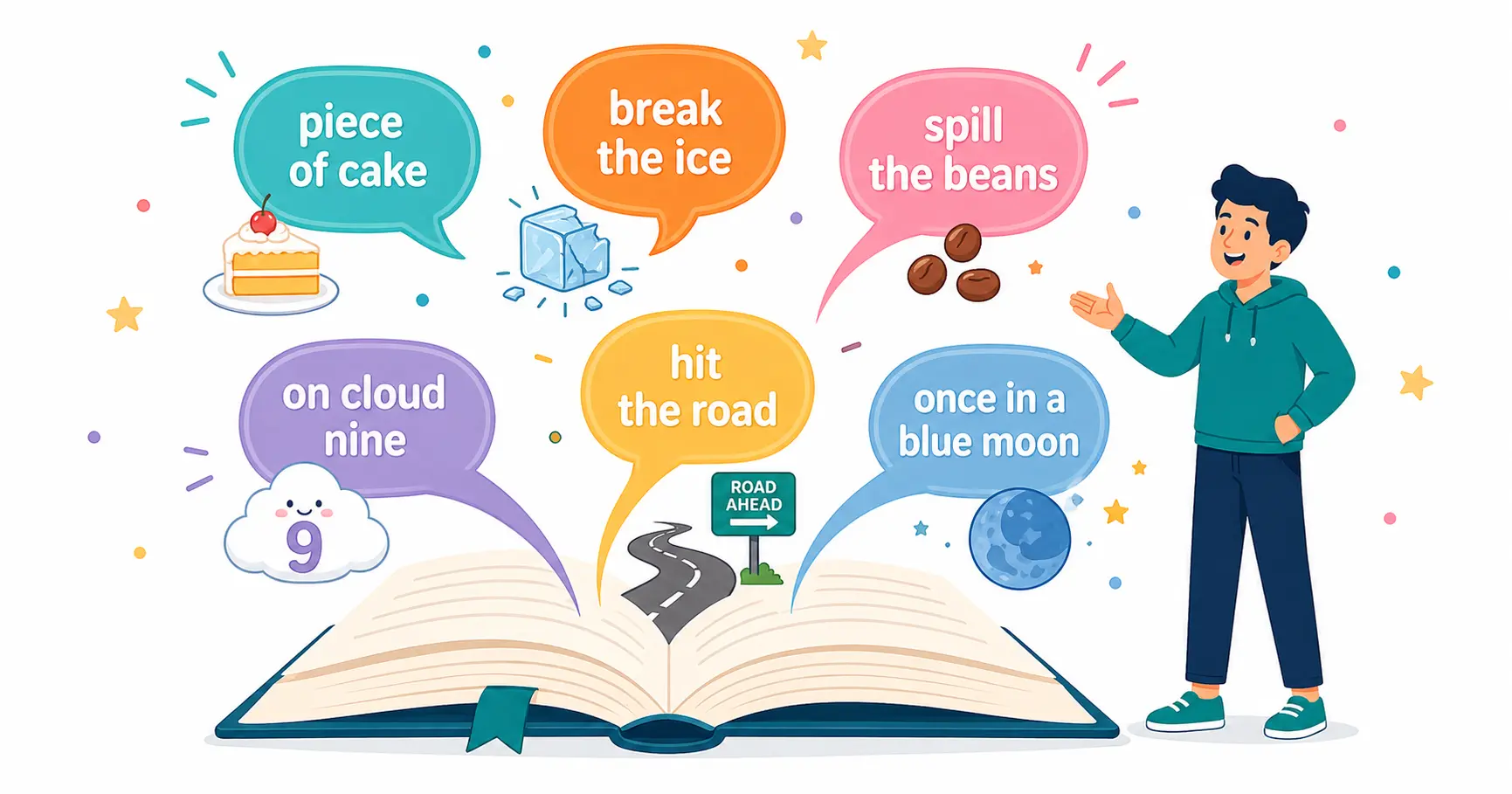
Todos los idiomas tienen expresiones que no tienen sentido si las traduces literalmente. El inglés tiene miles. «It’s raining cats and dogs» no tiene nada que ver con animales. «Break a leg» no es una amenaza: significa «buena suerte». «Spill the beans» no es sobre comida: significa revelar un secreto.
Estas expresiones se llaman modismos y están en todas partes del inglés: en conversaciones, películas, música, noticias, negocios y literatura. Los hablantes nativos usan los modismos con tanta naturalidad que rara vez se dan cuenta. Pero para los estudiantes, los modismos son uno de los mayores obstáculos para la fluidez. Puedes tener una gramática perfecta, un vocabulario amplio y una pronunciación clara, y aun así perder el significado de la mitad de las frases que escuchas por culpa de los modismos.
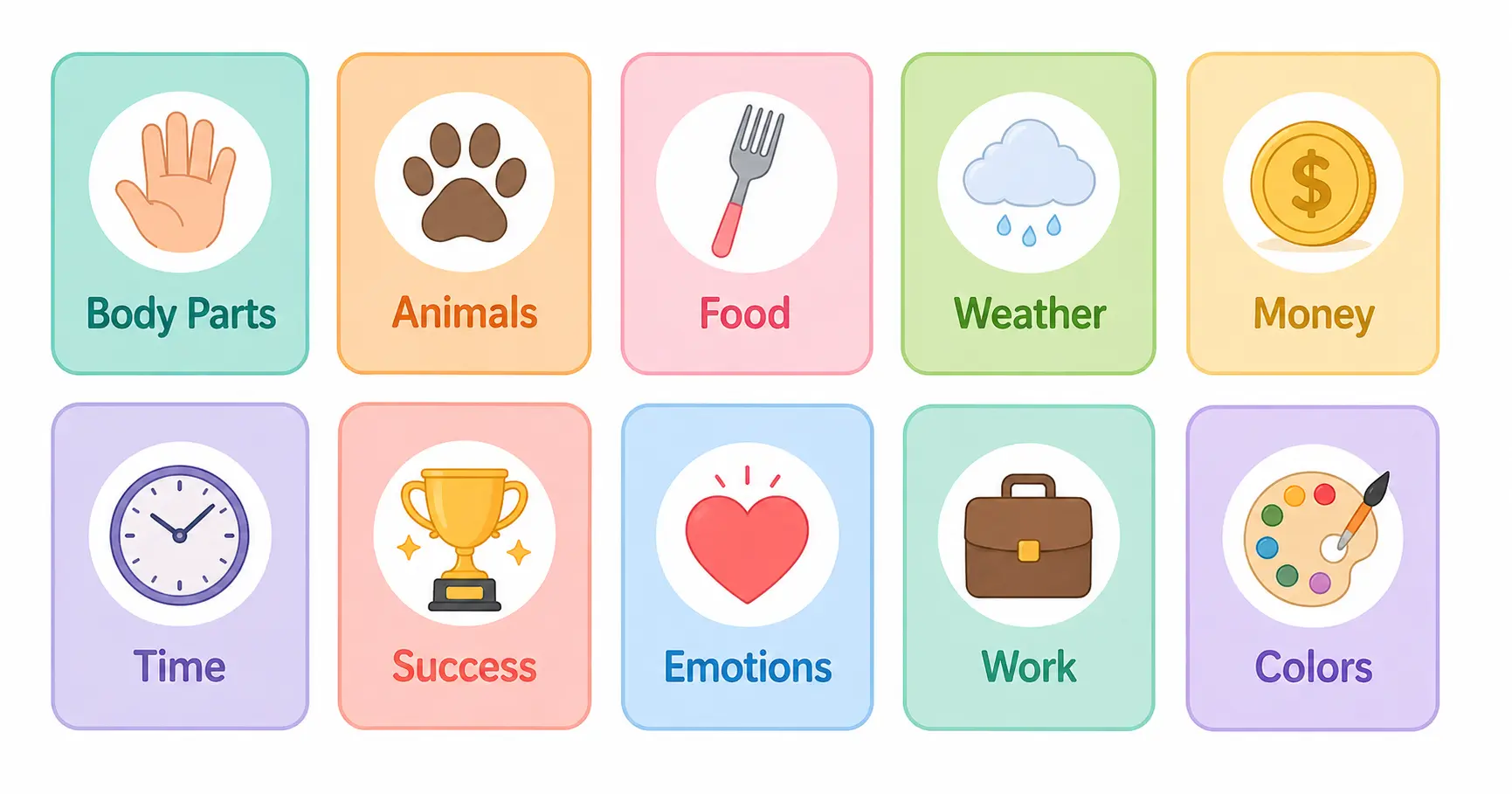
Esta guía cubre más de 500 de los modismos más comunes del inglés, organizados por tema para que puedas aprenderlos en grupos significativos. Cada modismo incluye un significado claro y una oración de ejemplo natural. Tanto si te estás preparando para el IELTS, estudiando para un título universitario o simplemente quieres entender el inglés como lo hablan realmente los nativos, esta es la referencia que necesitas.
- Total de modismos: 500+
- Organizados por: 20 categorías temáticas
- Nivel: A2–C2 (de principiante a avanzado)
- Ideal para: fluidez general, preparación para IELTS/TOEFL, entender a los hablantes nativos, conversación cotidiana
¿Qué es un modismo?
Un modismo es una expresión fija cuyo significado no puede entenderse a partir de las palabras individuales. La característica clave: toda la frase significa algo diferente de sus partes.
| Expresión | Significado literal | Significado real (idiomático) |
|---|---|---|
| break the ice | romper el hielo congelado | iniciar una conversación en una situación incómoda |
| hit the nail on the head | golpear un clavo con un martillo | acertar exactamente en algo |
| under the weather | bajo el clima | sentirse un poco enfermo |
| piece of cake | un trozo de pastel | algo muy fácil |
Modismos vs. verbos frasales vs. colocaciones
Estas tres categorías se superponen, lo que genera confusión. Esta es la diferencia:
| Categoría | Definición | Ejemplo |
|---|---|---|
| Modismo | Expresión fija con significado no literal | kick the bucket (= morir) |
| Verbo frasal | Verbo + partícula con un nuevo significado | give up (= rendirse) |
| Colocación | Palabras que van naturalmente juntas | make a decision (no «do a decision») |
Para una guía completa de verbos frasales, consulta Verbos frasales del inglés: la guía completa.
Partes del cuerpo
Los modismos corporales son de los más antiguos y universales del inglés. Muchos existen en formas similares en otros idiomas.
| # | Modismo | Significado | Ejemplo |
|---|---|---|---|
| 1 | keep an eye on | vigilar con atención | Keep an eye on the soup — don’t let it boil over. (Vigila la sopa para que no se derrame.) |
| 2 | turn a blind eye | ignorar deliberadamente | The manager turned a blind eye to the late arrivals. (El gerente hizo la vista gorda con los retrasos.) |
| 3 | see eye to eye | estar completamente de acuerdo | We don’t always see eye to eye, but we respect each other. (No siempre estamos de acuerdo, pero nos respetamos.) |
| 4 | in the blink of an eye | muy rápidamente | The accident happened in the blink of an eye. (El accidente ocurrió en un abrir y cerrar de ojos.) |
| 5 | catch someone’s eye | atraer la atención | The red dress in the window caught my eye. (El vestido rojo del escaparate me llamó la atención.) |
| 6 | play it by ear | improvisar; decidir sobre la marcha | I don’t have a plan — let’s just play it by ear. (No tengo un plan, improvisemos.) |
| 7 | turn a deaf ear | negarse a escuchar | He turned a deaf ear to all our warnings. (Hizo oídos sordos a todas nuestras advertencias.) |
| 8 | keep your chin up | mantener el ánimo | I know things are tough, but keep your chin up. (Sé que las cosas están difíciles, pero no te desanimes.) |
| 9 | bite your tongue | contenerse sin decir algo | I wanted to argue, but I bit my tongue. (Quería discutir, pero me mordí la lengua.) |
| 10 | on the tip of my tongue | casi capaz de recordar algo | His name is on the tip of my tongue. (Tengo su nombre en la punta de la lengua.) |
| 11 | by the skin of your teeth | por muy poco | We passed the exam by the skin of our teeth. (Aprobamos el examen por los pelos.) |
| 12 | give someone the cold shoulder | ignorar a alguien deliberadamente | After the argument, she gave me the cold shoulder for a week. (Tras la discusión, me ignoró durante una semana.) |
| 13 | cost an arm and a leg | ser muy caro | That car repair cost an arm and a leg. (La reparación del coche costó un ojo de la cara.) |
| 14 | get something off your chest | hablar de algo que te preocupa | I need to get this off my chest — I lied about the deadline. (Necesito desahogarme: mentí sobre el plazo.) |
| 15 | have a heart of gold | ser muy amable y generoso | She has a heart of gold — she’d help anyone. (Tiene un corazón de oro; ayudaría a cualquiera.) |
| 16 | stab someone in the back | traicionar a alguien | He stabbed me in the back by telling the boss about my mistake. (Me apuñaló por la espalda contándole al jefe mi error.) |
| 17 | break someone’s heart | causar a alguien una gran tristeza | Leaving the country broke his mother’s heart. (Marcharse del país le partió el corazón a su madre.) |
| 18 | get cold feet | ponerse nervioso y dudar | She got cold feet the night before the wedding. (Le entró el pánico la noche antes de la boda.) |
| 19 | put your foot in your mouth | decir algo embarazoso por accidente | I put my foot in my mouth when I asked about her ex. (Metí la pata cuando pregunté por su ex.) |
| 20 | have butterflies in your stomach | sentir nerviosismo | I always have butterflies in my stomach before presentations. (Siempre me pongo nervioso antes de las presentaciones.) |
| 21 | a pain in the neck | una persona o cosa molesta | This paperwork is a real pain in the neck. (Este papeleo es un auténtico dolor de cabeza.) |
| 22 | keep your fingers crossed | esperar buena suerte | Keep your fingers crossed — the results come out tomorrow. (Cruza los dedos; mañana salen los resultados.) |
| 23 | point the finger at | culpar a alguien | Don’t point the finger at me — it wasn’t my fault. (No me señales con el dedo; no fue culpa mía.) |
| 24 | pull someone’s leg | gastar una broma a alguien | Are you serious, or are you pulling my leg? (¿Hablas en serio o me estás tomando el pelo?) |
| 25 | give a hand | ayudar | Could you give me a hand with these boxes? (¿Podrías echarme una mano con estas cajas?) |
| 26 | an old hand | una persona con experiencia | She’s an old hand at negotiations. (Es toda una experta en negociaciones.) |
| 27 | wash your hands of | negarse a seguir siendo responsable | After years of trying, he washed his hands of the project. (Tras años intentándolo, se desentendió del proyecto.) |
| 28 | the apple of someone’s eye | la persona favorita de alguien | Their youngest daughter is the apple of their eye. (Su hija menor es la niña de sus ojos.) |
| 29 | a head start | una ventaja desde el principio | Being bilingual gave her a head start in her career. (Ser bilingüe le dio ventaja en su carrera.) |
| 30 | head over heels | profundamente enamorado | He fell head over heels for her on the first date. (Se enamoró perdidamente de ella en la primera cita.) |
Animales
Los modismos con animales son coloridos y fáciles de recordar porque las imágenes son muy vívidas.
| # | Modismo | Significado | Ejemplo |
|---|---|---|---|
| 31 | let the cat out of the bag | revelar un secreto accidentalmente | I was planning a surprise party, but Tom let the cat out of the bag. (Planeaba una fiesta sorpresa, pero Tom fue y lo contó.) |
| 32 | raining cats and dogs | lloviendo a cántaros | Take an umbrella — it’s raining cats and dogs outside. (Llévate un paraguas; fuera está lloviendo a mares.) |
| 33 | the elephant in the room | un problema obvio del que nadie quiere hablar | Nobody mentioned the budget cut — it was the elephant in the room. (Nadie mencionó el recorte presupuestario; era el elefante en la habitación.) |
| 34 | kill two birds with one stone | conseguir dos cosas con una sola acción | By cycling to work, I kill two birds with one stone. (Yendo al trabajo en bici mato dos pájaros de un tiro.) |
| 35 | a little bird told me | alguien me lo dijo (sin revelar quién) | A little bird told me you’re getting promoted. (Un pajarito me dijo que te van a ascender.) |
| 36 | the early bird catches the worm | el éxito llega a quien madruga | I always arrive at the office at 7 AM — the early bird catches the worm. (Siempre llego a la oficina a las 7; al que madruga, Dios le ayuda.) |
| 37 | when pigs fly | nunca (algo imposible) | He’ll clean his room when pigs fly. (Limpiará su habitación cuando las ranas críen pelo.) |
| 38 | hold your horses | espera; ten paciencia | Hold your horses — we haven’t even started yet. (Para el carro; ni siquiera hemos empezado.) |
| 39 | straight from the horse’s mouth | directamente de la fuente original | I heard the news straight from the horse’s mouth. (Me enteré de la noticia de primera mano.) |
| 40 | a wild goose chase | una búsqueda inútil | Looking for that document was a wild goose chase. (Buscar ese documento fue una pérdida de tiempo total.) |
| 41 | monkey around | comportarse de forma tonta | Stop monkeying around and finish your homework. (Deja de hacer el tonto y termina los deberes.) |
| 42 | have a whale of a time | pasárselo en grande | We had a whale of a time at the festival. (Nos lo pasamos en grande en el festival.) |
| 43 | the black sheep | el raro o diferente de una familia o grupo | He’s the black sheep of the family. (Es la oveja negra de la familia.) |
| 44 | a fish out of water | alguien incómodo en su entorno | At the fashion show, I felt like a fish out of water. (En el desfile de moda me sentí como pez fuera del agua.) |
| 45 | open a can of worms | crear nuevos problemas | If you bring up the budget, you’ll open a whole can of worms. (Si sacas el tema del presupuesto, abrirás la caja de Pandora.) |
| 46 | take the bull by the horns | enfrentarse a una situación difícil con valentía | She took the bull by the horns. (Cogió el toro por los cuernos.) |
| 47 | have ants in your pants | ser incapaz de estarse quieto | The kids have ants in their pants today. (Los niños tienen hormigas en el cuerpo hoy.) |
| 48 | the lion’s share | la mayor parte | The lion’s share of the budget goes to marketing. (La parte del león del presupuesto va a marketing.) |
| 49 | a wolf in sheep’s clothing | alguien que parece inofensivo pero es peligroso | Be careful with that salesman — he’s a wolf in sheep’s clothing. (Ten cuidado con ese vendedor; es un lobo con piel de cordero.) |
| 50 | every dog has its day | todo el mundo tiene su momento | Don’t worry about losing today — every dog has its day. (No te preocupes por perder hoy; a cada cerdo le llega su San Martín.) |
Comida y bebida
| # | Modismo | Significado | Ejemplo |
|---|---|---|---|
| 51 | a piece of cake | algo muy fácil | The exam was a piece of cake. (El examen fue pan comido.) |
| 52 | spill the beans | revelar un secreto | Come on, spill the beans — what did she say? (Venga, suéltalo; ¿qué dijo?) |
| 53 | have your cake and eat it too | querer dos cosas incompatibles | You can’t work part-time and earn a full salary. (No puedes tenerlo todo.) |
| 54 | go bananas | volverse loco o muy emocionado | The crowd went bananas when the band came on stage. (El público se volvió loco cuando salió la banda.) |
| 55 | bring home the bacon | ganar el sueldo del hogar | Both parents bring home the bacon in most families today. (En la mayoría de las familias actuales, ambos padres trabajan.) |
| 56 | butter someone up | adular a alguien para conseguir algo | He’s just buttering up the boss to get a promotion. (Solo está dándole jabón al jefe para que le asciendan.) |
| 57 | cry over spilled milk | lamentarse por algo que ya no tiene remedio | The project failed, but there’s no point crying over spilled milk. (El proyecto fracasó, pero no vale la pena llorar sobre la leche derramada.) |
| 58 | in a nutshell | en resumen; brevemente | In a nutshell, we need more funding. (En pocas palabras, necesitamos más financiación.) |
| 59 | take something with a grain of salt | no creer algo del todo | Take his promises with a grain of salt. (Tómate sus promesas con pinzas.) |
| 60 | the cream of the crop | lo mejor de un grupo | These students are the cream of the crop. (Estos estudiantes son la flor y nata.) |
| 61 | egg someone on | animar a alguien a hacer algo (normalmente arriesgado) | His friends egged him on to jump off the bridge. (Sus amigos le animaron a saltar del puente.) |
| 62 | walk on eggshells | tener mucho cuidado de no ofender a alguien | I walk on eggshells around my boss. (Con mi jefa voy con pies de plomo.) |
| 63 | a tough cookie | una persona fuerte y resistente | She’s a tough cookie — nothing gets her down. (Es de armas tomar; nada la derrumba.) |
| 64 | a hot potato | un tema controvertido que nadie quiere tratar | Immigration is a hot potato. (La inmigración es una patata caliente.) |
| 65 | full of beans | lleno de energía y entusiasmo | The kids are full of beans today. (Los niños están hoy con muchas pilas.) |
| 66 | cool as a cucumber | muy tranquilo, especialmente bajo presión | She was cool as a cucumber during the interview. (Estuvo tan fresca como una lechuga durante la entrevista.) |
| 67 | use your noodle | pensar; usar el cerebro | Come on, use your noodle — the answer is obvious. (Venga, usa la cabeza; la respuesta es obvia.) |
| 68 | in hot water | en apuros | He’s in hot water for missing the deadline again. (Está metido en un buen lío por saltarse el plazo otra vez.) |
| 69 | a recipe for disaster | una situación que probablemente saldrá mal | Mixing inexperienced drivers with icy roads is a recipe for disaster. (Mezclar conductores sin experiencia con hielo es una receta para el desastre.) |
| 70 | bite off more than you can chew | asumir más de lo que puedes manejar | I bit off more than I could chew with four courses. (Abarqué más de lo que podía con cuatro asignaturas.) |
Tiempo atmosférico y naturaleza
| # | Modismo | Significado | Ejemplo |
|---|---|---|---|
| 71 | under the weather | sentirse un poco mal | I’m a bit under the weather today. (Hoy no me encuentro muy bien.) |
| 72 | a storm in a teacup | mucho revuelo por una tontería | The controversy over the new logo was just a storm in a teacup. (La polémica por el nuevo logo fue una tormenta en un vaso de agua.) |
| 73 | break the ice | iniciar una conversación en una situación incómoda | He told a joke to break the ice. (Contó un chiste para romper el hielo.) |
| 74 | tip of the iceberg | una pequeña parte visible de un problema mucho mayor | The cases we see are just the tip of the iceberg. (Los casos que vemos son solo la punta del iceberg.) |
| 75 | on cloud nine | extremadamente feliz | She’s been on cloud nine since she got the job offer. (Desde que le ofrecieron el trabajo está en las nubes.) |
| 76 | every cloud has a silver lining | algo positivo surge de cada situación mala | I lost my job, but every cloud has a silver lining. (Perdí el trabajo, pero no hay mal que por bien no venga.) |
| 77 | save it for a rainy day | ahorrar dinero para cuando se necesite | Don’t spend everything — save some for a rainy day. (No gastes todo; guarda algo para cuando vengan mal dadas.) |
| 78 | take a rain check | declinar educadamente pero proponer hacerlo después | I can’t make dinner tonight — can I take a rain check? (Esta noche no puedo cenar; ¿lo dejamos para otro día?) |
| 79 | a breath of fresh air | algo nuevamente refrescante | The new teacher was a breath of fresh air. (El nuevo profesor fue un soplo de aire fresco.) |
| 80 | weather the storm | sobrevivir un período difícil | The company weathered the storm of the recession. (La empresa capeo el temporal de la recesión.) |
| 81 | steal someone’s thunder | arrebatar el protagonismo a alguien | She stole my thunder by announcing the results before I could. (Me robó el protagonismo anunciando los resultados antes que yo.) |
| 82 | come rain or shine | pase lo que pase | I go running every morning, come rain or shine. (Salgo a correr cada mañana, llueva o truene.) |
| 83 | the calm before the storm | un período tranquilo antes del problema | Everything seems quiet now, but this could be the calm before the storm. (Todo parece tranquilo ahora, pero esta puede ser la calma que precede a la tormenta.) |
Dinero y negocios
| # | Modismo | Significado | Ejemplo |
|---|---|---|---|
| 86 | break the bank | ser muy caro | The new phone is nice, but it won’t break the bank. (El nuevo teléfono es bonito, pero no arruinará la economía.) |
| 87 | make ends meet | ganar justo lo suficiente para cubrir los gastos | Many families struggle to make ends meet. (Muchas familias tienen dificultades para llegar a fin de mes.) |
| 88 | go broke | quedarse sin dinero | The restaurant went broke after only six months. (El restaurante quebró a los seis meses.) |
| 89 | a dime a dozen | muy común y sin valor | MBAs are a dime a dozen — you need real experience. (Los MBA están por todas partes; necesitas experiencia real.) |
| 90 | money doesn’t grow on trees | el dinero es limitado y hay que ganárselo | I can’t buy you a new phone every year — money doesn’t grow on trees. (No puedo comprarte un teléfono nuevo cada año; el dinero no cae del cielo.) |
| 91 | from rags to riches | de la pobreza a la riqueza | Her story is a classic rags-to-riches tale. (Su historia es un clásico de de pobre a millonaria.) |
| 92 | cut corners | hacer algo de forma barata saltándose pasos | The builder cut corners and now the roof leaks. (El constructor ahorró donde no debía y ahora el tejado tiene goteras.) |
| 93 | the bottom line | el hecho más importante; el beneficio/pérdida | The bottom line is that we need to increase revenue by 20%. (En resumidas cuentas, necesitamos aumentar los ingresos un 20%.) |
| 94 | ballpark figure | un número aproximado | Can you give me a ballpark figure for the renovation costs? (¿Puedes darme una cifra orientativa para los costes de reforma?) |
| 95 | get the ball rolling | poner en marcha un proceso | Let’s get the ball rolling on this project today. (Pongamos en marcha este proyecto hoy.) |
| 96 | think outside the box | pensar de forma creativa | We need to think outside the box to solve this problem. (Necesitamos pensar de forma innovadora para resolver este problema.) |
| 97 | back to the drawing board | volver a empezar desde cero | The plan was rejected, so it’s back to the drawing board. (Rechazaron el plan, así que hay que volver al principio.) |
| 98 | on the same page | de acuerdo; entendiendo lo mismo | Let’s have a meeting to make sure we’re all on the same page. (Hagamos una reunión para asegurarnos de que todos estamos en la misma sintonía.) |
| 99 | burn the midnight oil | trabajar hasta muy tarde | We burned the midnight oil to finish the proposal. (Quemamos las cejas para terminar la propuesta.) |
| 100 | a golden opportunity | una oportunidad perfecta | This job offer is a golden opportunity. (Esta oferta de trabajo es una oportunidad de oro.) |
| 101 | strike while the iron is hot | actuar rápidamente cuando se presenta la oportunidad | Interest rates are low — strike while the iron is hot. (Los tipos de interés están bajos; a hierro caliente, batir de repente.) |
Tiempo
| # | Modismo | Significado | Ejemplo |
|---|---|---|---|
| 106 | in the nick of time | justo a tiempo; en el último momento | The ambulance arrived in the nick of time. (La ambulancia llegó justo a tiempo.) |
| 107 | once in a blue moon | muy raramente | I eat fast food once in a blue moon. (Como comida rápida de higos a brevas.) |
| 108 | around the clock | las 24 horas del día | The hospital operates around the clock. (El hospital funciona las 24 horas.) |
| 109 | time flies | el tiempo pasa rápidamente | Time flies when you’re having fun. (El tiempo vuela cuando te estás divirtiendo.) |
| 110 | better late than never | hacer algo tarde es mejor que no hacerlo | You finally apologized — better late than never. (Al final te disculpaste; más vale tarde que nunca.) |
| 111 | kill time | hacer algo para pasar el tiempo mientras se espera | I killed time at the airport by reading a book. (Maté el tiempo en el aeropuerto leyendo un libro.) |
| 112 | against the clock | con mucha prisa por terminar antes de un plazo | We’re working against the clock to launch by Friday. (Estamos trabajando contrarreloj para lanzarlo el viernes.) |
| 113 | at the drop of a hat | inmediatamente; sin dudar | She’ll help you at the drop of a hat. (Te ayudará sin pensárselo dos veces.) |
| 114 | a matter of time | algo que inevitablemente ocurrirá | It’s only a matter of time before they find out the truth. (Es solo cuestión de tiempo que descubran la verdad.) |
| 115 | on the spur of the moment | espontáneamente | We decided on the spur of the moment to go to Paris. (Decidimos de forma espontánea irnos a París.) |
| 116 | behind the times | anticuado | His teaching methods are behind the times. (Sus métodos de enseñanza están anticuados.) |
Éxito y fracaso
| # | Modismo | Significado | Ejemplo |
|---|---|---|---|
| 121 | hit the nail on the head | acertar exactamente | You hit the nail on the head — that’s exactly the problem. (Has dado en el clavo; ese es exactamente el problema.) |
| 122 | miss the boat | perder una oportunidad | I missed the boat on buying Bitcoin in 2015. (Perdí el tren de comprar Bitcoin en 2015.) |
| 123 | back to square one | volver a empezar desde el principio | The experiment failed, so we’re back to square one. (El experimento falló y hemos vuelto al punto de partida.) |
| 124 | go the extra mile | hacer más de lo esperado | Good employees always go the extra mile. (Los buenos empleados siempre van un paso más allá.) |
| 125 | pass with flying colors | triunfar brillantemente | She passed the final exam with flying colors. (Aprobó el examen final con sobresaliente.) |
| 126 | a blessing in disguise | algo malo que resulta ser bueno | Losing that job was a blessing in disguise. (Perder ese trabajo fue una suerte disfrazada.) |
| 127 | from scratch | desde el principio | He built the website from scratch. (Construyó el sitio web desde cero.) |
| 128 | the last straw | el último detonante que provoca una reacción | Arriving late again was the last straw. (Llegar tarde otra vez fue la gota que colmó el vaso.) |
| 129 | burn bridges | arruinar una relación de forma permanente | Don’t burn bridges when you leave a job. (No quemes las naves cuando dejes un trabajo.) |
| 130 | fall flat | fracasar completamente | His joke fell flat — nobody laughed. (Su chiste cayó en saco roto; nadie se rió.) |
| 131 | up in the air | sin decidir; incierto | Our vacation plans are still up in the air. (Nuestros planes de vacaciones siguen en el aire.) |
| 132 | nip it in the bud | detener un problema antes de que crezca | If you notice bullying, nip it in the bud immediately. (Si detectas acoso, córtalo de raíz inmediatamente.) |
| 133 | at the end of the day | en última instancia | At the end of the day, family is what matters most. (Al fin y al cabo, la familia es lo que más importa.) |
| 134 | pull it off | tener éxito en algo difícil | Nobody thought she could run a marathon, but she pulled it off. (Nadie creía que pudiera correr un maratón, pero lo consiguió.) |
Emociones y sentimientos
| # | Modismo | Significado | Ejemplo |
|---|---|---|---|
| 136 | over the moon | extremadamente feliz | She was over the moon when she got accepted to Harvard. (Estaba en el séptimo cielo cuando la aceptaron en Harvard.) |
| 137 | down in the dumps | sentirse triste y deprimido | He’s been down in the dumps since his girlfriend left. (Está muy bajoneado desde que se fue su novia.) |
| 138 | on edge | nervioso y tenso | Everyone’s been on edge since the layoffs were announced. (Todo el mundo está en tensión desde que se anunciaron los despidos.) |
| 139 | lose your cool | perder la calma y enfadarse | He lost his cool when the waiter spilled wine on his suit. (Perdió los estribos cuando el camarero le derramó vino en el traje.) |
| 140 | have mixed feelings | sentir cosas positivas y negativas a la vez | I have mixed feelings about moving abroad. (Tengo sentimientos encontrados sobre mudarme al extranjero.) |
| 141 | blow off steam | liberar el estrés o la frustración | I go to the gym to blow off steam after a long day. (Voy al gimnasio a desahogarme después de un día largo.) |
| 142 | get on someone’s nerves | irritar a alguien | His constant humming gets on my nerves. (Su tarareo constante me saca de quicio.) |
| 143 | wear your heart on your sleeve | mostrar las emociones abiertamente | She wears her heart on her sleeve. (Lleva el corazón en la mano.) |
| 144 | have a change of heart | cambiar de opinión o decisión | He was going to reject the offer, but he had a change of heart. (Iba a rechazar la oferta, pero cambió de opinión.) |
| 145 | sick and tired | extremadamente harto | I’m sick and tired of repeating myself. (Estoy harto de repetirme.) |
| 146 | a gut feeling | una sensación instintiva | I had a gut feeling that something was wrong. (Tuve la corazonada de que algo iba mal.) |
| 147 | drive someone up the wall | poner a alguien muy nervioso | That dripping tap is driving me up the wall. (Ese grifo que gotea me saca de mis casillas.) |
| 148 | feel blue | sentirse triste | She’s been feeling blue since the holidays ended. (Está alicaída desde que acabaron las vacaciones.) |
Relaciones y personas
| # | Modismo | Significado | Ejemplo |
|---|---|---|---|
| 151 | get along like a house on fire | hacerse amigos rápidamente | We met at a conference and got along like a house on fire. (Nos conocimos en un congreso y conectamos al instante.) |
| 152 | birds of a feather flock together | las personas parecidas se juntan | They both love hiking and cooking — birds of a feather flock together. (A los dos les encanta el senderismo y cocinar; Dios los cría y ellos se juntan.) |
| 153 | keep someone at arm’s length | evitar acercarse a alguien | She keeps her colleagues at arm’s length. (Mantiene a sus colegas a distancia.) |
| 154 | be in someone’s shoes | imaginar estar en la situación de otra persona | If I were in your shoes, I’d accept the job offer. (Si estuviera en tu lugar, aceptaría la oferta de trabajo.) |
| 155 | blood is thicker than water | los lazos familiares son los más importantes | He always sides with his brother — blood is thicker than water. (Siempre se pone de parte de su hermano; la sangre es la sangre.) |
| 156 | bury the hatchet | hacer las paces; poner fin a un conflicto | After years of fighting, the two families buried the hatchet. (Tras años de peleas, las dos familias enterraron el hacha de guerra.) |
| 157 | hit it off | llevarse bien desde el principio | We hit it off at the party and have been friends ever since. (Conectamos en la fiesta y desde entonces somos amigos.) |
| 158 | tie the knot | casarse | They tied the knot in a small ceremony last June. (Se casaron en una pequeña ceremonia el pasado junio.) |
| 159 | give someone the benefit of the doubt | confiar en alguien a pesar de las dudas | I’ll give him the benefit of the doubt. (Le daré el beneficio de la duda.) |
| 160 | down to earth | práctico y amigable; sin arrogancia | Despite her fame, she’s very down to earth. (A pesar de su fama, tiene los pies en el suelo.) |
| 161 | a shoulder to cry on | alguien que escucha tus problemas | She’s always been a shoulder to cry on. (Siempre ha sido un hombro en el que apoyarme.) |
Trabajo y esfuerzo
| # | Modismo | Significado | Ejemplo |
|---|---|---|---|
| 166 | pull your weight | hacer tu parte del trabajo | Everyone needs to pull their weight on this project. (Todos deben arrimar el hombro en este proyecto.) |
| 167 | climb the career ladder | avanzar profesionalmente | She climbed the career ladder faster than anyone. (Escalaré puestos más rápido que nadie.) |
| 168 | call it a day | dejar de trabajar por el día | We’ve done enough — let’s call it a day. (Ya hemos hecho bastante; dejémoslo por hoy.) |
| 169 | throw in the towel | rendirse | After three failed attempts, he threw in the towel. (Tras tres intentos fallidos, tiró la toalla.) |
| 170 | the daily grind | la rutina del trabajo cotidiano | The daily grind of commuting and working 9-to-5 can wear you down. (La rutina diaria del trabajo de nueve a cinco puede agotarte.) |
| 171 | bite the bullet | afrontar una situación difícil con valentía | I bit the bullet and told my boss I was leaving. (Me armé de valor y le dije a mi jefe que me marchaba.) |
| 172 | jack of all trades | alguien que sabe hacer muchas cosas | He’s a jack of all trades — he can fix anything. (Es un manitas; puede arreglar cualquier cosa.) |
| 173 | put all your eggs in one basket | arriesgar todo en un solo plan | Don’t put all your eggs in one basket — apply to several companies. (No pongas todos los huevos en la misma cesta; solicita trabajo en varias empresas.) |
| 174 | a steep learning curve | una situación en la que hay que aprender rápido | The first month was a steep learning curve. (El primer mes fue de aprendizaje acelerado.) |
| 175 | cut to the chase | ir al grano | Let’s cut to the chase — how much will it cost? (Vayamos al grano; ¿cuánto va a costar?) |
| 176 | in a rut | atascado en una rutina aburrida | I feel like I’m in a rut — every day is the same. (Me siento estancado; cada día es igual.) |
| 177 | run the show | estar al mando | She basically runs the show around here. (Básicamente, es ella quien lleva las riendas aquí.) |
Conocimiento y aprendizaje
| # | Modismo | Significado | Ejemplo |
|---|---|---|---|
| 181 | learn the hard way | aprender de una experiencia dolorosa | I learned the hard way not to skip backups. (Aprendí a las malas que no hay que saltarse las copias de seguridad.) |
| 182 | hit the books | estudiar mucho | Finals are next week — time to hit the books. (Los exámenes finales son la semana que viene; hay que ponerse a estudiar.) |
| 183 | pick someone’s brain | pedir la opinión experta de alguien | Can I pick your brain about the marketing strategy? (¿Puedo aprovechar tu experiencia sobre la estrategia de marketing?) |
| 184 | ring a bell | sonar vagamente familiar | That name rings a bell, but I can’t remember where I heard it. (Ese nombre me suena, pero no recuerdo dónde lo escuché.) |
| 185 | know something inside out | saber algo extremadamente bien | She knows the tax code inside out. (Se sabe el código fiscal al dedillo.) |
| 186 | it’s not rocket science | no es complicado | Making pasta isn’t rocket science — anyone can do it. (Hacer pasta no es cosa del otro mundo; cualquiera puede hacerlo.) |
| 187 | wrap your head around | entender algo complicado | I can’t wrap my head around quantum physics. (No consigo entender la física cuántica.) |
| 188 | food for thought | algo que vale la pena reflexionar | The documentary gave me a lot of food for thought. (El documental me dio mucho en qué pensar.) |
| 189 | read between the lines | entender un significado oculto | If you read between the lines, the email is clearly a rejection. (Si lees entre líneas, el correo es claramente un rechazo.) |
| 190 | the bigger picture | la situación en su conjunto | Don’t focus on small details — look at the bigger picture. (No te centres en los detalles; mira el panorama general.) |
| 191 | a wake-up call | un evento que te hace darte cuenta de algo | Failing the exam was a wake-up call to study harder. (Suspender el examen fue un aviso de que necesitaba estudiar más.) |
| 192 | a no-brainer | una decisión que no requiere reflexión | Taking the higher-paying job was a no-brainer. (Aceptar el trabajo mejor pagado era de cajón.) |
Comunicación y habla
| # | Modismo | Significado | Ejemplo |
|---|---|---|---|
| 196 | beat around the bush | evitar decir algo directamente | Stop beating around the bush and tell me what happened. (Deja de andarte por las ramas y dime qué pasó.) |
| 197 | get to the point | decir lo más importante | Could you please get to the point? (¿Podrías ir al grano, por favor?) |
| 198 | actions speak louder than words | lo que haces importa más que lo que dices | He promised to change, but actions speak louder than words. (Prometió cambiar, pero las palabras se las lleva el viento.) |
| 199 | easier said than done | difícil de hacer en la práctica | Losing weight is easier said than done. (Perder peso es más fácil decirlo que hacerlo.) |
| 200 | keep someone in the loop | mantener a alguien informado | Please keep me in the loop about any changes. (Por favor, mantenme al corriente de cualquier cambio.) |
| 201 | off the record | no para conocimiento público | Off the record, I think the CEO is going to resign. (Extraoficialmente, creo que el CEO va a dimitir.) |
| 202 | a slip of the tongue | algo dicho por accidente | I called my teacher “Mom” — it was a slip of the tongue. (Llamé «mamá» a mi profesora; fue un lapsus.) |
| 203 | speak volumes | expresar mucho sin palabras | Her silence spoke volumes about how she felt. (Su silencio decía mucho sobre cómo se sentía.) |
| 204 | long story short | resumiendo | Long story short, we missed the flight and had to stay overnight. (En resumidas cuentas, perdimos el vuelo y tuvimos que quedarnos a dormir.) |
Colores
| # | Modismo | Significado | Ejemplo |
|---|---|---|---|
| 211 | out of the blue | inesperadamente | She called me out of the blue after 10 years. (Me llamó de repente después de 10 años.) |
| 212 | see red | ponerse muy furioso | I saw red when I found out they’d lied. (Me puse furioso cuando descubrí que habían mentido.) |
| 213 | a red flag | una señal de advertencia | His lack of references was a major red flag. (Su falta de referencias fue una señal de alarma importante.) |
| 214 | red tape | burocracia excesiva | The project was delayed by government red tape. (El proyecto se retrasó por los trámites burocráticos del gobierno.) |
| 215 | caught red-handed | pillado in fraganti | The thief was caught red-handed. (Pillaron al ladrón con las manos en la masa.) |
| 216 | green with envy | muy envidioso | She was green with envy when her colleague got promoted. (Se murió de envidia cuando ascendieron a su compañera.) |
| 217 | give the green light | dar permiso | The council gave the green light for the new building. (El ayuntamiento dio luz verde al nuevo edificio.) |
| 218 | grey area | una situación poco clara o ambigua | The law on this issue is a grey area. (La ley sobre este tema es una zona gris.) |
| 219 | paint the town red | salir a celebrar | It’s your birthday — let’s paint the town red! (Es tu cumpleaños; ¡salgamos a celebrarlo por todo lo alto!) |
| 220 | a white lie | una mentira inofensiva para no herir a alguien | I told her the dress looked nice — it was just a white lie. (Le dije que el vestido le quedaba bien; fue solo una mentira piadosa.) |
Viajes y movimiento
| # | Modismo | Significado | Ejemplo |
|---|---|---|---|
| 226 | hit the road | marcharse; empezar un viaje | It’s getting late — time to hit the road. (Se está haciendo tarde; hora de ponerse en camino.) |
| 227 | off the beaten track | lejos de las zonas turísticas populares | We found an amazing restaurant off the beaten track. (Encontramos un restaurante increíble fuera de los circuitos turísticos.) |
| 228 | at a crossroads | ante una decisión importante | I’m at a crossroads in my career. (Estoy en una encrucijada en mi carrera.) |
| 229 | jump on the bandwagon | seguir una moda popular | Everyone’s jumping on the AI bandwagon. (Todo el mundo se está subiendo al carro de la IA.) |
| 230 | on the right track | progresando correctamente | Your essay is on the right track. (Tu ensayo va por buen camino.) |
| 231 | go around in circles | debatir sin llegar a ninguna conclusión | We’ve been going around in circles — let’s make a decision. (Llevamos dando vueltas al tema; tomemos una decisión.) |
| 232 | pave the way | crear condiciones para que algo ocurra | Her research paved the way for modern vaccines. (Su investigación allanó el camino para las vacunas modernas.) |
| 233 | bridge the gap | reducir una diferencia | Education can bridge the gap between rich and poor. (La educación puede tender un puente entre ricos y pobres.) |
| 234 | a dead end | una situación sin más posibilidades de avance | The investigation reached a dead end. (La investigación llegó a un callejón sin salida.) |
| 235 | the road to recovery | el proceso de mejora | After the accident, it was a long road to recovery. (Tras el accidente, fue un largo camino hacia la recuperación.) |
Deportes y competición
| # | Modismo | Significado | Ejemplo |
|---|---|---|---|
| 241 | a level playing field | condiciones iguales para todos | We need a level playing field so small businesses can compete. (Necesitamos igualdad de condiciones para que las pequeñas empresas puedan competir.) |
| 242 | drop the ball | cometer un error o no hacer algo | The marketing team really dropped the ball on this campaign. (El equipo de marketing la cagó de verdad en esta campaña.) |
| 243 | move the goalposts | cambiar las reglas una vez empezado algo | Every time I meet their requirements, they move the goalposts. (Cada vez que cumplo sus requisitos, cambian las reglas del juego.) |
| 244 | the ball is in your court | es tu turno de actuar | I’ve made my offer — the ball is in your court now. (He hecho mi oferta; ahora te toca a ti.) |
| 245 | throw a curveball | sorprender a alguien con algo inesperado | The interview threw me a curveball with a question about coding. (La entrevista me pilló desprevenido con una pregunta sobre programación.) |
| 246 | step up your game | mejorar tu rendimiento | If you want the promotion, you need to step up your game. (Si quieres el ascenso, tienes que ponerte las pilas.) |
| 247 | neck and neck | muy igualados en una competición | The two candidates are neck and neck in the polls. (Los dos candidatos van codo con codo en las encuestas.) |
Modismos cotidianos misceláneos
Estos modismos se usan en muchos contextos y son de los más escuchados en el inglés del día a día.
| # | Modismo | Significado | Ejemplo |
|---|---|---|---|
| 386 | break a leg | buena suerte (antes de una actuación) | You’re on stage in five minutes — break a leg! (Sales al escenario en cinco minutos; ¡mucha mierda!) |
| 387 | hang in there | no te rindas; aguanta | I know it’s hard, but hang in there. (Sé que es difícil, pero aguanta.) |
| 388 | get the show on the road | empezar a hacer algo | Enough talking — let’s get the show on the road. (Ya basta de hablar; manos a la obra.) |
| 389 | a shot in the dark | una suposición con pocas posibilidades de éxito | Asking him was a shot in the dark, but it worked. (Preguntarle era un tiro a ciegas, pero funcionó.) |
| 390 | you can’t judge a book by its cover | las apariencias engañan | She looks shy, but she’s actually hilarious. (Parece tímida, pero en realidad es muy graciosa; las apariencias engañan.) |
| 391 | have a lot on your plate | estar muy ocupado | I can’t help right now — I have a lot on my plate. (Ahora mismo no puedo ayudar; tengo mucho entre manos.) |
| 392 | make a mountain out of a molehill | exagerar un problema menor | You lost one mark on the test — don’t make a mountain out of a molehill. (Perdiste un punto en el examen; no hagas una montaña de un grano de arena.) |
| 393 | cut someone some slack | ser menos crítico con alguien | She’s new to the job — cut her some slack. (Es nueva en el trabajo; sé un poco más comprensivo.) |
| 394 | hit the ground running | empezar algo con gran energía y velocidad | She hit the ground running on her first day. (Entró pisando fuerte desde el primer día.) |
| 395 | water under the bridge | hechos del pasado que ya no importan | We argued years ago, but that’s water under the bridge now. (Discutimos hace años, pero eso es agua pasada.) |
| 396 | when push comes to shove | cuando una situación se vuelve crítica | When push comes to shove, you’ll find out who your real friends are. (Cuando llegue el momento de la verdad, descubrirás quiénes son tus amigos de verdad.) |
| 397 | a taste of your own medicine | el mismo mal trato que diste a otros | He was rude to everyone and finally got a taste of his own medicine. (Era grosero con todos y al final le devolvieron con la misma moneda.) |
| 398 | there’s no such thing as a free lunch | todo tiene un coste | The “free” app sells your data — there’s no such thing as a free lunch. (La app «gratuita» vende tus datos; no hay nada gratis en esta vida.) |
Modismos por nivel de dificultad
Para principiantes (A2–B1)
Empieza con estos: son los más usados y los más fáciles de entender:
a piece of cake, break the ice, in a nutshell, hit the road, once in a blue moon, under the weather, 24/7, keep your fingers crossed, the bigger picture, time flies, better late than never, a no-brainer, from scratch, call it a day, the last straw, on cloud nine, go viral, get the hang of, the ball is in your court, hang in there
Nivel intermedio (B1–B2)
Estos requieren más contexto para usarlos correctamente:
a blessing in disguise, the elephant in the room, hit the nail on the head, kill two birds with one stone, bite the bullet, burn the midnight oil, on the same page, cut corners, think outside the box, a double-edged sword, back to square one, cost an arm and a leg, go the extra mile, spill the beans, the tip of the iceberg, a red flag, make ends meet, on the fence, the early bird catches the worm, actions speak louder than words
Avanzado (B2–C1)
Estos son menos frecuentes pero demuestran un inglés sofisticado:
a wolf in sheep’s clothing, penny-wise pound-foolish, out of the frying pan into the fire, live on borrowed time, can’t see the forest for the trees, pull the wool over someone’s eyes, have your cake and eat it too, barking up the wrong tree, move the goalposts, burn your boats, leave no stone unturned, come full circle, go out on a limb
Vocabulario para practicar
Añade estas 25 palabras asociadas habitualmente con el lenguaje idiomático a tu diccionario de Linglify para la repetición espaciada.
affordable
adjetivo
asequible, económico, barato
Ejemplos
- The government is working to provide affordable housing for low-income families.
- This restaurant offers delicious and affordable meals for college students.
commute
verbo
comutar, desplazarse, viajar
Ejemplos
- Public transportation helps people commute efficiently reducing traffic congestion.
- Workers commute daily between suburban homes and downtown offices.
conservation
sustantivo
conservación, protección, ahorro
Ejemplos
- Water conservation becomes increasingly important during periods of severe drought.
- Wildlife conservation is essential for protecting endangered species from extinction.
demanding
adjetivo
exigente, demandante, estricto
Ejemplos
- Medical school is very demanding and requires years of intensive study.
- She has a demanding boss who expects perfection in all tasks.
DJ
sustantivo
DJ, disc jockey
Ejemplos
- The DJ played my favorite song.
- The DJ took song requests all night.
heritage
sustantivo
herencia, patrimonio, legado
Ejemplos
- She inherited a rich heritage of family traditions from her grandparents.
- The ancient castle is an important part of our cultural heritage.
leisure
sustantivo
ocio, diversión
Ejemplos
- People enjoy various leisure activities during weekends and holidays.
- Reading books is popular leisure pursuit for many educated people.
luxurious
adjetivo
lujoso
Ejemplos
- She dreams of owning luxurious car with leather seats and sunroof.
- The luxurious hotel suite includes marble bathroom and ocean view.
memorable
adjetivo
memorable, inolvidable
Ejemplos
- Graduation day was memorable occasion for entire family.
- The memorable speech inspired students to pursue their dreams.
nutritious
adjetivo
nutritivo
Ejemplos
- Fresh vegetables are nutritious and support overall health.
- Nutritious breakfast provides energy for productive school day.
passionate
adjetivo
apasionado
Ejemplos
- Passionate speech moves audience to take action.
- Passionate teacher inspires students to learn more.
pollution
sustantivo
contaminación
Ejemplos
- Air pollution affects public health in cities.
- Ocean pollution threatens marine life worldwide.
privacy
sustantivo
privacidad
Ejemplos
- Hotel guests expect privacy during their stay.
- Internet privacy becomes increasingly important issue nowadays.
scenic
adjetivo
pintoresco
Ejemplos
- Scenic overlook provides perfect spot for photographs.
- Scenic route takes longer but offers beautiful.
traditional
adjetivo
tradicional, clásico, ancestral
Ejemplos
- Traditional cooking methods preserve authentic flavors perfectly.
- Traditional music reflects cultural history and values.
uneven
adjetivo
desigual
Ejemplos
- Uneven ground makes walking difficult and dangerous.
- Uneven performance shows inconsistent skill level development.
volunteer
verbo
ofrecerse, ayudar, participar
Ejemplos
- Citizens volunteer time for community improvement projects.
- Students volunteer at local charity organizations regularly.
substantially
adverbio
básicamente, considerablemente, en gran medida
Ejemplos
- Her performance substantially improved after additional training and practice.
- Prices have increased substantially over the past few months.
liaison
sustantivo
enlace, contacto, lazo
Ejemplos
- Military liaison officers coordinate operations between allied forces.
- She serves as liaison between different departments.
sustainable
adjetivo
sostenible, viable, que se mantiene
Ejemplos
- Company implements sustainable business model for long-term success.
- Sustainable farming practices protect soil and water resources.
acclaimed
adjetivo
aclamado, famoso, reconocido
Ejemplos
- His performance was acclaimed by critics.
- The acclaimed author received many awards for her novel.
cancellation
sustantivo
cancelación, anulación
Ejemplos
- Due to weather, the flight cancellation was inevitable.
- The concert's cancellation disappointed many fans.
discretion
sustantivo
discreción, prudencia, juicio
Ejemplos
- He exercised discretion in his decisions.
- Use your discretion when sharing information.
indication
sustantivo
indicación, señal, muestra
Ejemplos
- The indication of his illness was clear after the tests.
- There was no indication that she was unhappy.
serenity
sustantivo
serenidad, tranquilidad, calma
Ejemplos
- She maintained her serenity despite the chaos.
- The serenity of the lake was calming.
Cómo aprender modismos eficazmente
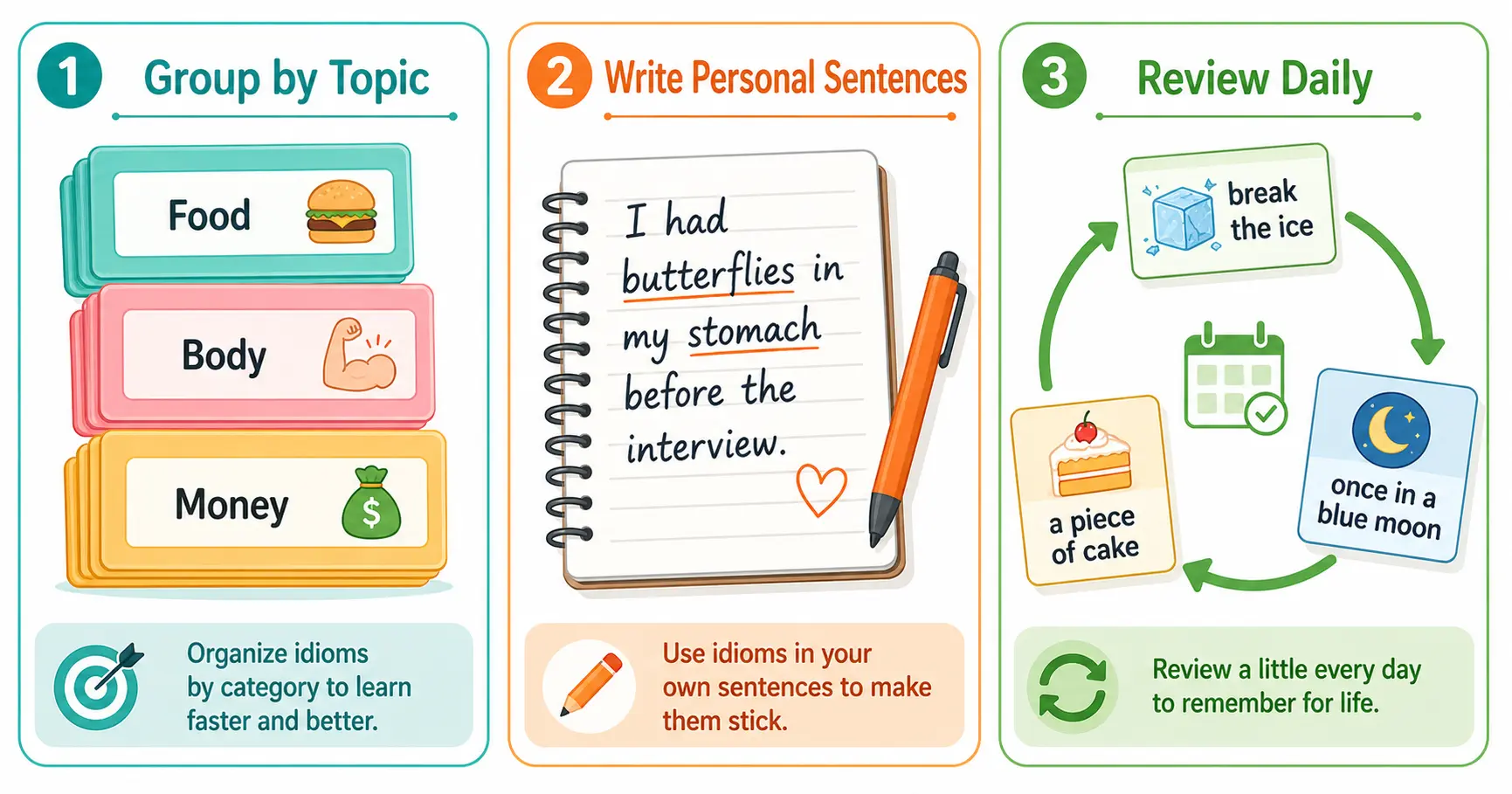
1. Aprende por grupos temáticos, no en listas aleatorias
Las 20 categorías temáticas existen por una razón. Cuando aprendes «spill the beans», «in a nutshell» y «a recipe for disaster» juntos (todos modismos de comida), tu cerebro crea conexiones más fuertes que si memorizas modismos aleatorios en orden alfabético.
2. Aprende de forma activa: úsalos en frases sobre tu vida
Para cada modismo que aprendas, escribe una oración sobre una situación real de tu propia vida. «I had butterflies in my stomach before my driving test» es mucho más memorable que un ejemplo genérico de un libro de texto.
3. Empieza con 50, no con 500
No intentes memorizar esta lista entera. Elige 50 modismos que te parezcan naturales para los temas que realmente tratas. Si nunca hablas de deportes, sáltate los modismos deportivos. Si trabajas en los negocios, da prioridad a los modismos de dinero y trabajo.
4. Estate atento a los modismos en los medios
Las películas, series, podcasts y canciones en inglés están llenos de modismos. Cuando escuches uno, haz una pausa y comprueba su significado. Escuchar un modismo en un contexto real te enseña más sobre su uso que cualquier definición.
5. Usa la repetición espaciada
Añade los modismos que quieres aprender a Linglify o a cualquier sistema de repetición espaciada. Las investigaciones muestran que necesitas entre 8 y 12 exposiciones antes de que una expresión entre en tu vocabulario activo. Sesiones de repaso diarias de 5 minutos superan a las sesiones semanales de 30 minutos.
Para un enfoque de memorización de vocabulario respaldado por la ciencia, consulta Cómo memorizar vocabulario.
6. No fuerces los modismos
El mayor error que cometen los estudiantes es usar modismos en exceso. Uno o dos por conversación es natural. Cinco en un párrafo suena ensayado. Los hablantes nativos usan los modismos con moderación; tú también deberías.
Qué leer a continuación
Para los exámenes:
- Modismos para el Speaking del IELTS: 50 expresiones naturales — modismos que funcionan en el contexto del examen
Vocabulario relacionado:
- Verbos frasales del inglés: la guía completa — verbos que trabajan junto a los modismos
- Palabras avanzadas del inglés: 300+ vocabulario C1–C2 — palabras individuales que complementan el lenguaje idiomático
- Cómo mejorar tu vocabulario — una estrategia completa para construir vocabulario
Preguntas frecuentes
¿Cuántos modismos hay en inglés?
Las estimaciones oscilan entre 10.000 y 25.000 según cómo los contemos. Para la fluidez general, conocer entre 200 y 300 modismos comunes cubre la gran mayoría de lo que encontrarás en el inglés cotidiano.
¿Cuál es la diferencia entre un modismo y un proverbio?
Un proverbio es un dicho breve y conocido que expresa una verdad general o un consejo: «The early bird catches the worm». Un modismo es una expresión fija con un significado no literal: «kick the bucket» (= morir). La prueba clave: si la expresión da un consejo o enuncia una verdad universal, probablemente es un proverbio. Si es una frase que usas dentro de una oración para describir una situación específica, es más probablemente un modismo.
¿Puedo usar modismos en la escritura formal?
Úsalos muy escasamente en la escritura formal. En ensayos académicos, informes de empresa y correspondencia oficial, los modismos pueden parecer poco profesionales o demasiado informales. Sin embargo, en contextos semiformales (entradas de blog, columnas de opinión, diapositivas de presentaciones), uno o dos modismos bien colocados pueden añadir personalidad. La regla: cuanto más formal sea el contexto, menos modismos debes usar.
¿Se traducen los modismos entre idiomas?
Algunos modismos tienen equivalentes en otros idiomas («break the ice» existe en muchos idiomas europeos), pero la mayoría no se traducen literalmente. Por eso precisamente los modismos son difíciles para los estudiantes: no puedes usar tu idioma nativo como atajo. Aprende cada modismo en inglés como una expresión fija y completa.
¿Qué modismos debo aprender primero?
Empieza con los 20 modismos para principiantes de la sección «Modismos por nivel de dificultad» de arriba. Luego pasa a la lista de nivel intermedio. Da prioridad a los modismos que correspondan a los temas que realmente tratas.
¿Cuántos modismos necesito para el IELTS?
Para la Banda 7 del IELTS, necesitas usar algo de lenguaje idiomático «de forma natural y apropiada» en el Speaking. En la práctica, entre 10 y 15 modismos bien practicados son suficientes. Consulta nuestra guía Modismos para el Speaking del IELTS para los 50 mejores modismos para el examen.