
50 Phrasal Verb Paling Umum untuk Bahasa Inggris Sehari-hari
Bahasa Inggris memiliki lebih dari 10.000 kombinasi phrasal verb, tetapi Anda tidak perlu menguasai sebanyak itu. Hanya 50 phrasal verb mencakup sebagian besar hal yang diucapkan penutur asli dalam percakapan sehari-hari. Jika Anda mempelajari 50 yang ada di daftar ini, Anda akan memahami sebagian besar phrasal verb yang terdengar dalam film, podcast, percakapan kantor, dan pesan santai.
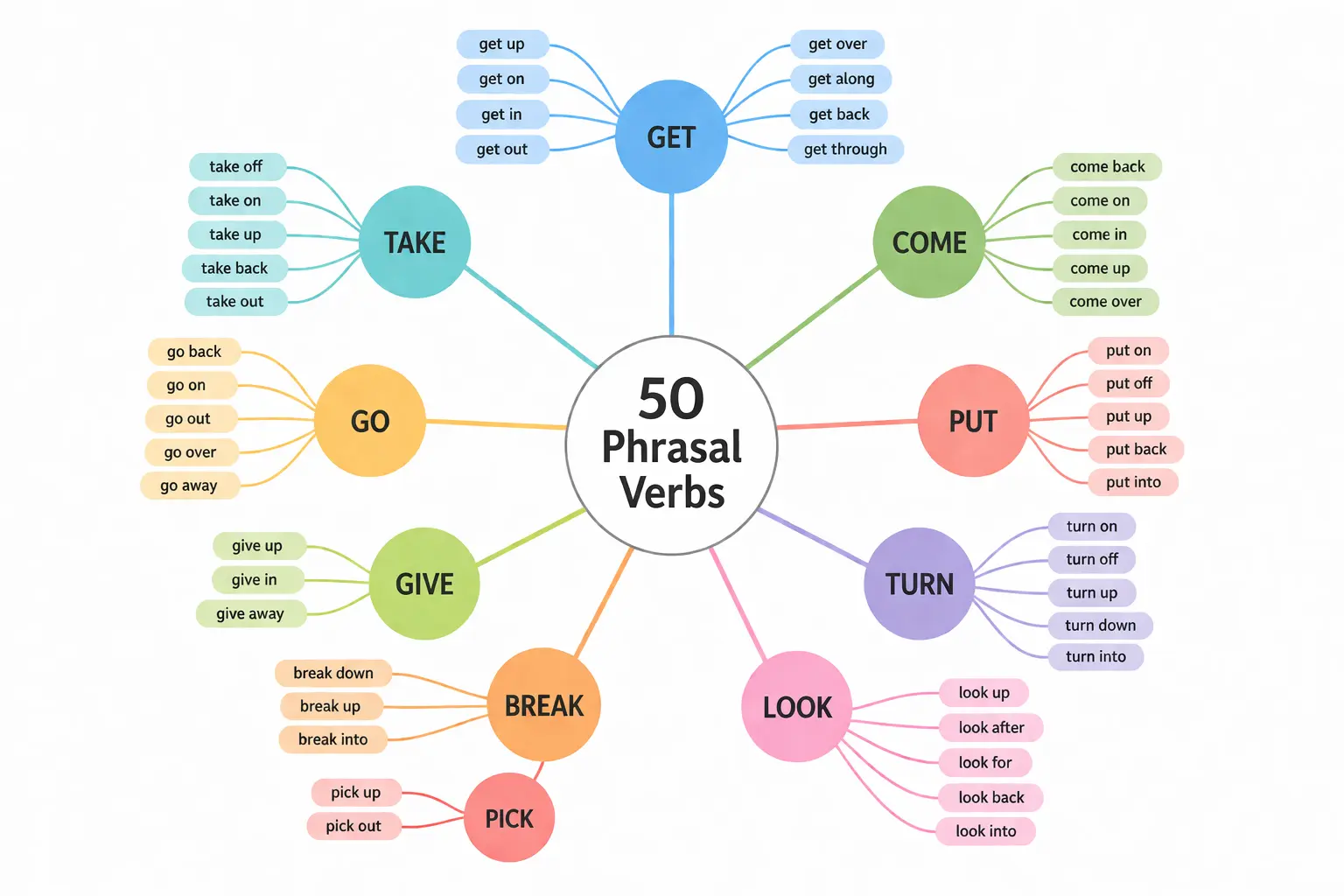
Panduan ini mengelompokkannya berdasarkan kata kerja dasar—GET, TAKE, GO, PUT, TURN, LOOK, dan lainnya—karena phrasal verb lebih mudah diingat saat dipelajari dalam keluarga kata kerja. Setiap entri mencantumkan arti dan dua contoh penggunaan sehari-hari yang nyata.
- Jumlah phrasal verb: 50
- Level: A2–B2 (dasar hingga menengah atas)
- Paling cocok untuk: percakapan sehari-hari, IELTS Speaking, kelancaran umum
- Pengelompokan: berdasarkan kata kerja dasar (10 keluarga kata kerja)
Mengapa Belajar Berdasarkan Kata Kerja Dasar?
Sebagian besar daftar phrasal verb menaruh 100 kata kerja acak dalam satu tabel. Hal itu membuatnya sulit dihafal. Saat dikelompokkan berdasarkan kata kerja dasar, pola-pola mulai terlihat:
- GET = perpindahan, perubahan keadaan, memperoleh
- TAKE = mengambil, menerima, memulai
- GO = bergerak, melanjutkan, berubah
- PUT = menaruh, menoleransi, menunda
- TURN = mengubah arah atau keadaan
Mempelajari “get up”, “get on”, “get off”, dan “get over” bersama-sama lebih cepat daripada mempelajarinya terpencar dalam daftar alfabetis. Otak Anda menghubungkannya dengan akar yang sama, sehingga setiap phrasal verb baru menjadi lebih mudah.
GET — Kata Kerja Paling Serbaguna
GET membentuk phrasal verb umum lebih banyak daripada kata kerja Inggris lainnya. Delapan berikut muncul di hampir setiap percakapan.
| # | Phrasal Verb | Arti | Contoh |
|---|---|---|---|
| 1 | get up | bangun dari tempat tidur; berdiri | I get up at 6:30 every morning for work. / She got up from her chair and walked to the window. |
| 2 | get on | naik kendaraan; memiliki hubungan | We got on the bus just as it was about to leave. / How do you get on with your new neighbours? |
| 3 | get off | turun dari kendaraan; selesai bekerja | Get off at the third stop — the library is right there. / What time do you get off work today? |
| 4 | get along with | berhubungan baik dengan | She gets along with everyone in the office. / My cat does not get along with the new dog. |
| 5 | get over | pulih dari sesuatu | It took him weeks to get over the flu. / She finally got over the shock of losing her job. |
| 6 | get back | kembali; menerima sesuatu lagi | What time did you get back from the trip? / I lent him my book a month ago and still have not got it back. |
| 7 | get into | masuk; mulai tertarik atau terlibat dalam | He got into the car without saying a word. / She got into photography during the lockdown. |
| 8 | get rid of | menyingkirkan atau membuang sesuatu yang tidak diinginkan | We need to get rid of this old sofa — it is falling apart. / I finally got rid of those annoying pop-up ads on my phone. |
Pola yang perlu diperhatikan: GET hampir selalu menyiratkan perubahan—perubahan posisi (get up, get on, get off), keadaan (get over, get into), atau kepemilikan (get back, get rid of).
TAKE — Mengambil, Menerima, Memulai
Phrasal verb dengan TAKE berkaitan dengan mengambil sesuatu, menerima tanggung jawab, atau memulai kegiatan.
| # | Phrasal Verb | Arti | Contoh |
|---|---|---|---|
| 9 | take off | melepas pakaian; (pesawat) lepas landas; tiba-tiba sukses | Take off your jacket — it is warm inside. / The plane took off 20 minutes late because of the weather. |
| 10 | take on | menerima tugas atau tanggung jawab; merekrut | She took on the project even though she was already busy. / The company is taking on 50 new employees this quarter. |
| 11 | take up | memulai hobi atau kegiatan baru; memakan ruang atau waktu | He took up running last year and has already done a marathon. / This table takes up too much space in the kitchen. |
| 12 | take care of | menjaga; menangani | Can you take care of the kids while I go to the dentist? / Do not worry about the invoice — I will take care of it. |
| 13 | take out | mengeluarkan dari dalam; mengajak seseorang ke restoran atau acara | He took out his wallet and paid for the meal. / I am taking my parents out for dinner on their anniversary. |
Pola yang perlu diperhatikan: TAKE sering berarti “mengambil dari suatu tempat atau keadaan”. Anda take off pakaian (melepasnya), take out dompet (mengeluarkannya dari saku), dan take on pekerjaan (mengambilnya dari beban orang lain).
COME — Tiba, Terjadi, Menemukan
Phrasal verb dengan COME menggambarkan kedatangan, sesuatu yang terjadi, dan penemuan tak terduga.
| # | Phrasal Verb | Arti | Contoh |
|---|---|---|---|
| 14 | come back | kembali ke suatu tempat | She went to Australia for a year but came back because she missed her family. / When are you coming back from lunch? |
| 15 | come in | masuk ke ruangan atau bangunan | Come in and sit down — the meeting is about to start. / The door was open, so I just came in. |
| 16 | come up | muncul; disebutkan; mendekat | Something urgent came up at work, so I will be late. / Your name came up in the conversation. |
| 17 | come up with | memikirkan ide, rencana, atau solusi | She came up with a creative solution to the problem. / We need to come up with a name for the new product. |
| 18 | come across | menemukan secara kebetulan; tampak atau terkesan | I came across your article while researching online. / He comes across as confident, but he is actually quite shy. |
Pola yang perlu diperhatikan: COME menyiratkan gerakan menuju pembicara atau menuju hasil. Sesuatu come back (kembali kepada Anda), come up (muncul dalam perhatian Anda), dan come across your path (muncul dalam pengalaman Anda).
GO — Bergerak, Melanjutkan, Berubah
Phrasal verb dengan GO menyatakan pergerakan menjauh, kelanjutan, dan perubahan.
| # | Phrasal Verb | Arti | Contoh |
|---|---|---|---|
| 19 | go on | melanjutkan; terjadi | Please go on — I did not mean to interrupt you. / What is going on here? Why is everyone shouting? |
| 20 | go out | keluar rumah untuk kegiatan sosial; padam | We go out for dinner every Friday night. / The candle went out because of the wind. |
| 21 | go ahead | melanjutkan; mulai | Go ahead and start without me — I will catch up. / The concert will go ahead despite the rain. |
| 22 | go back | kembali ke tempat atau keadaan sebelumnya | I left my phone at the office and had to go back for it. / Once you send the email, you cannot go back and change it. |
| 23 | go through | mengalami sesuatu yang sulit; memeriksa dengan cermat | She went through a very tough period after the divorce. / The lawyer went through every clause in the contract. |
Pola yang perlu diperhatikan: GO menyiratkan gerakan menjauh dari posisi saat ini. Anda go out (pergi), go back (kembali ke tempat sebelumnya), dan go through pengalaman sulit (melewati dari satu sisi ke sisi lain).
PUT — Menaruh, Menunda, Menoleransi
Phrasal verb dengan PUT melibatkan menaruh sesuatu, menunda, dan menangani situasi.
| # | Phrasal Verb | Arti | Contoh |
|---|---|---|---|
| 24 | put on | mengenakan; menambah berat badan; memutar musik atau pertunjukan | Put on a warm coat — it is freezing outside. / She put on some music to help her concentrate. |
| 25 | put off | menunda; membuat seseorang enggan melakukan sesuatu | Do not put off the dentist appointment again — you need to go. / The long commute put me off taking the job. |
| 26 | put up with | menoleransi sesuatu yang menjengkelkan atau tidak menyenangkan | I cannot put up with his constant complaining anymore. / How do you put up with the noise from the construction site? |
| 27 | put away | mengembalikan sesuatu ke tempat semestinya | Please put away the dishes after you dry them. / The kids need to put away their toys before bedtime. |
| 28 | put down | menaruh di permukaan; merendahkan seseorang | He put down his phone and looked at me. / Stop putting yourself down — your work is excellent. |
Pola yang perlu diperhatikan: PUT melibatkan meletakkan sesuatu di suatu tempat—secara harfiah (put on pakaian, put away piring, put down ponsel) atau kiasan (put off = menaruh di masa depan, put up with = menempatkan diri di bawah sesuatu yang tidak menyenangkan).
TURN — Mengubah Arah atau Keadaan
Phrasal verb dengan TURN menggambarkan sakelar, perubahan, dan transformasi.
| # | Phrasal Verb | Arti | Contoh |
|---|---|---|---|
| 29 | turn on | menyalakan perangkat; membuat sesuatu berfungsi | Turn on the air conditioning — it is too hot in here. / She turned on the laptop and checked her emails. |
| 30 | turn off | mematikan perangkat; keluar dari jalan | Please turn off the lights when you leave the room. / Turn off at the next exit to reach the hotel. |
| 31 | turn out | ternyata memiliki hasil tertentu; terbukti | The party turned out to be much more fun than I expected. / It turned out that he had been lying the whole time. |
| 32 | turn up | datang (sering kali tak terduga); menaikkan volume | She turned up at the party without telling anyone. / Can you turn up the volume? I cannot hear the news. |
| 33 | turn down | menolak; menurunkan volume | She turned down the job offer because the salary was too low. / Turn down the music — the baby is sleeping. |
Pola yang perlu diperhatikan: TURN selalu menyiratkan perubahan keadaan. ON/OFF = keadaan beroperasi. UP/DOWN = tingkat sesuatu. OUT = keadaan akhir yang dicapai. DOWN (menolak) = berpaling dari sesuatu yang ditawarkan.
LOOK — Mencari, Memperhatikan, Menantikan
Phrasal verb dengan LOOK berkaitan dengan melihat, mencari, dan mengarahkan perhatian.
| # | Phrasal Verb | Arti | Contoh |
|---|---|---|---|
| 34 | look for | berusaha menemukan sesuatu | I am looking for my car keys — have you seen them? / She has been looking for a new apartment for three months. |
| 35 | look after | menjaga atau merawat | My mother looks after the children when I am at work. / You need to look after your health — you have been working too hard. |
| 36 | look up | mencari informasi; membaik | Look up the word in a dictionary if you do not know it. / Business has been looking up since the new manager arrived. |
| 37 | look forward to | menantikan suatu peristiwa di masa depan | I am looking forward to the weekend. / We look forward to meeting you at the interview. |
| 38 | look out | berhati-hati; waspada terhadap bahaya | Look out! There is a step right in front of you. / Look out for pickpockets in crowded tourist areas. |
Pola yang perlu diperhatikan: LOOK selalu tentang mengarahkan perhatian. FOR = menuju sesuatu yang Anda inginkan. AFTER = kepada seseorang yang membutuhkan Anda. UP = ke sumber informasi. FORWARD TO = ke masa depan. OUT = ke potensi bahaya.
GIVE — Berhenti, Mengembalikan, Membagikan
| # | Phrasal Verb | Arti | Contoh |
|---|---|---|---|
| 39 | give up | berhenti berusaha; menghentikan kebiasaan | She gave up smoking three years ago. / The puzzle is impossible — I give up. |
| 40 | give back | mengembalikan sesuatu kepada pemiliknya | Can you give back the tools you borrowed last week? / The charity works to give back to the community. |
| 41 | give away | menyumbangkan; membocorkan rahasia | We gave away our old furniture when we moved. / Do not give away the ending of the movie! |
BREAK — Mengakhiri, Berhenti, Masuk
| # | Phrasal Verb | Arti | Contoh |
|---|---|---|---|
| 42 | break up | mengakhiri hubungan; sinyal terputus-putus | They broke up after dating for two years. / You are breaking up — I will call you back on a better connection. |
| 43 | break down | rusak; kehilangan kendali emosi | The car broke down in the middle of the highway. / She broke down in tears when she heard the news. |
| 44 | break into | masuk secara paksa; tiba-tiba mulai | Someone broke into the house while they were on holiday. / He broke into a run when he saw the bus leaving. |
PICK — Memilih, Menjemput, Mempelajari
| # | Phrasal Verb | Arti | Contoh |
|---|---|---|---|
| 45 | pick up | menjemput; mempelajari secara santai; meningkat | I will pick you up at the station at 5 PM. / She picked up some Spanish while living in Barcelona. |
| 46 | pick out | memilih dari suatu kelompok | She picked out a dress for the wedding. / Can you pick out the best candidate from these CVs? |
SET dan BRING — Memulai dan Memperkenalkan
| # | Phrasal Verb | Arti | Contoh |
|---|---|---|---|
| 47 | set up | mengatur; mendirikan; menyiapkan | He set up his own business after leaving the bank. / Can you help me set up the projector for the presentation? |
| 48 | set off | memulai perjalanan; memicu | We set off early to avoid the morning traffic. / The alarm was set off by a cat walking past the sensor. |
| 49 | bring up | menyebutkan topik; membesarkan anak | He brought up the salary issue during the meeting. / She was brought up in a small village in the south of France. |
| 50 | bring back | mengembalikan sesuatu; membangkitkan kenangan | Please bring back the library books before Friday. / This song brings back memories of my school days. |
Referensi Cepat: Semua 50 Sekilas Pandang
| Kata Kerja Dasar | Phrasal Verb | Jumlah |
|---|---|---|
| GET | get up, get on, get off, get along with, get over, get back, get into, get rid of | 8 |
| TAKE | take off, take on, take up, take care of, take out | 5 |
| COME | come back, come in, come up, come up with, come across | 5 |
| GO | go on, go out, go ahead, go back, go through | 5 |
| PUT | put on, put off, put up with, put away, put down | 5 |
| TURN | turn on, turn off, turn out, turn up, turn down | 5 |
| LOOK | look for, look after, look up, look forward to, look out | 5 |
| GIVE | give up, give back, give away | 3 |
| BREAK | break up, break down, break into | 3 |
| PICK | pick up, pick out | 2 |
| SET | set up, set off | 2 |
| BRING | bring up, bring back | 2 |
| Total | 50 |
Kosakata untuk Dipraktikkan
25 kata ini sering muncul bersama phrasal verb umum. Tambahkan ke kamus Linglify Anda untuk berlatih dengan pengulangan berspasi.
finance
verba
membiayai, mendanai, mengelola keuangan
Contoh
- Many students need loans to finance their college education expenses.
- The bank agreed to finance the construction of the new shopping center.
executive
adjektiva
eksekutif
Contoh
- Executive decisions require careful consideration of multiple factors and consequences.
- The executive branch of government is responsible for implementing laws.
valid
adjektiva
sah, berlaku
Contoh
- Valid argument supports logical reasoning and conclusion.
- Valid passport allows international travel without problems.
culmination
nomina
puncak, titik kulminasi
Contoh
- The graduation ceremony was the culmination of four years of hard study.
- Winning the championship represented the culmination of the team's efforts.
transmit
verba
mengirimkan, meneruskan
Contoh
- Disease may transmit through contact with surfaces.
- Satellites transmit signals across vast distances effectively.
gulp
verba
meneguk, menelan cepat
Contoh
- She had to gulp nervously before giving her presentation to the board.
- The thirsty runner gulped down an entire bottle of cold water.
cherished
adjektiva
tersayang, berharga
Contoh
- His cherished dream of becoming a pilot finally came true.
- The old photograph was her most cherished possession from childhood.
fate
nomina
takdir, nasib
Contoh
- She believes that fate brought them together at the right moment.
- The explorer's fate remained unknown after he disappeared in the jungle.
spellbound
adjektiva
terpesona, terpukau
Contoh
- Audience sits spellbound during magical performance tonight.
- Children remain spellbound by storyteller's fascinating tales.
pet
adjektiva
peliharaan
Contoh
- Pet project receives extra attention and resources.
- Pet theory explains professor's research focus area.
master
nomina
tuan, penguasa, ahli
Contoh
- Apprentices learn traditional crafts from experienced master craftsmen.
- The chess master defeated opponents using brilliant strategic moves.
payable
adjektiva
harus dibayar, dapat dibayar, terutang
Contoh
- All dues are payable at the end of the month.
- The invoice is payable within 30 days.
serenity
nomina
ketenangan, kedamaian
Contoh
- She maintained her serenity despite the chaos.
- The serenity of the lake was calming.
classy
adjektiva
berkelas, elegan
Contoh
- Classy restaurant serves gourmet food in elegant dining atmosphere.
- Her classy appearance impressed everyone at formal business meeting.
revolt
verba
memberontak
Contoh
- A revolt broke out in the city center last night.
- The workers decided to revolt against the unfair conditions.
rethink
verba
mempertimbangkan kembali, memikirkan ulang
Contoh
- He decided to rethink his position on the issue.
- We need to rethink our strategy for the project.
gypsy
nomina
orang Gipsi
Contoh
- Traditional gypsy music features violin and passionate vocals.
- Wandering gypsy caravan traveled through European countryside.
buffoon
nomina
badut, orang konyol
Contoh
- Court buffoon entertained royal family with silly performances.
- Don't act like buffoon during important business presentation.
execution
nomina
pelaksanaan, eksekusi
Contoh
- Perfect execution of the dance routine impressed judges and audience members.
- The execution of the business plan requires careful coordination and timing.
territory
nomina
wilayah, daerah
Contoh
- Animal territory provides food and shelter resources.
- National territory requires protection from foreign invasion.
tribe
nomina
suku, kelompok etnis
Contoh
- Ancient tribe lived in harmony with nature.
- Indigenous tribe preserves traditional customs and languages.
resolve
verba
menyelesaikan, memecahkan
Contoh
- Mediator helps parties resolve dispute through negotiation.
- Technical team will resolve software problems quickly.
flexible
adjektiva
fleksibel, mudah menyesuaikan diri
Contoh
- Flexible working arrangements help employees balance work and family life.
- The flexible plastic tube can bend without breaking or cracking.
Cara Mempelajari 50 Phrasal Verb Ini
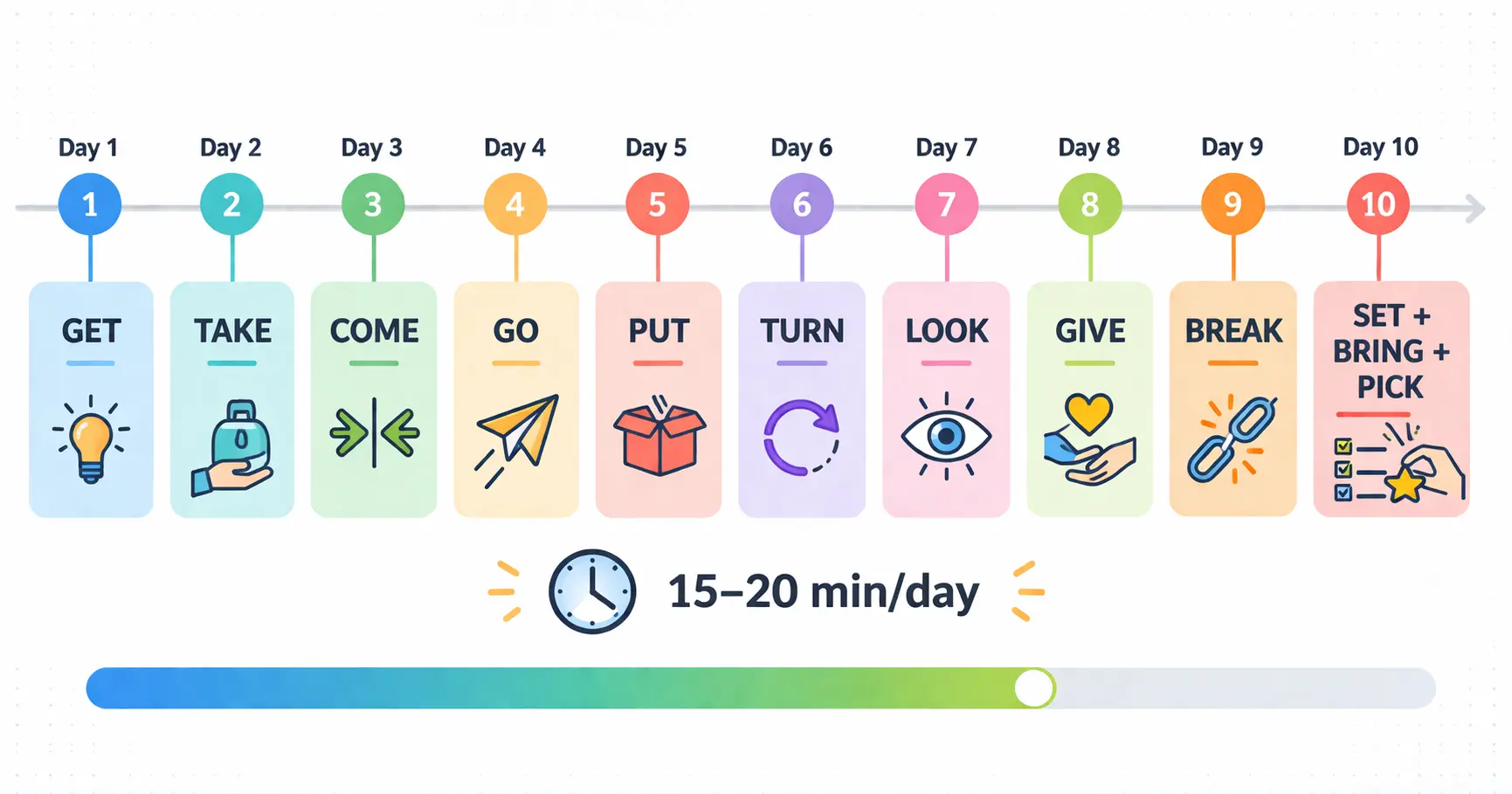
1. Pelajari satu keluarga kata kerja setiap hari. Senin = phrasal verb GET. Selasa = TAKE. Rabu = COME. Dalam 10 hari, Anda akan mencakup semuanya. Luangkan 15–20 menit per keluarga.
2. Tulis kalimat tentang kehidupan Anda sendiri. Jangan hanya membaca contoh—tulis kalimat sendiri. “I got up at 7 today.” “I need to get rid of my old phone.” Kalimat pribadi membentuk ingatan yang lebih kuat daripada contoh buku teks yang umum.
3. Gunakan metode “ganti dan tingkatkan”. Selama satu hari, cobalah mengganti kata kerja dasar dalam ucapan: alih-alih “I started running”, ucapkan “I took up running”. Alih-alih “I returned”, ucapkan “I came back”. Penggantian sadar membentuk kebiasaan.
4. Tonton konten bahasa Inggris dengan subtitle. Pilih serial TV atau kanal YouTube dan hitung berapa dari 50 phrasal verb ini yang Anda dengar dalam satu episode. Anda akan terkejut—kebanyakan episode memuat 15–20 di antaranya.
5. Uji diri Anda dengan kata kerja dasar. Tutup kolom arti dan coba ingat arti setiap phrasal verb. Lalu tutup kolom phrasal verb dan coba hasilkan kata tersebut dari artinya. Kedua arah membangun ingatan yang lebih kuat.
Untuk sistem belajar kosakata yang lengkap, baca panduan kami tentang cara meningkatkan kosakata.
Langkah Selanjutnya
-
Perluas menjadi 100. Setelah nyaman dengan 50 ini, lanjutkan ke 100 phrasal verb beserta arti dan contoh kalimat untuk daftar penting lengkap yang dikelompokkan berdasarkan topik.
-
Dalami kata kerja tertentu. Untuk uraian lengkap setiap phrasal verb dengan MAKE (hanya “make up” punya 5+ arti), baca panduan phrasal verb dengan MAKE.
-
Naik ke tingkat lanjut. Untuk phrasal verb C1–C2 yang dipakai dalam bahasa Inggris akademik dan profesional, baca panduan phrasal verb tingkat lanjut.
-
Terapkan di tempat kerja. Untuk phrasal verb khusus rapat, email, dan komunikasi bisnis, lihat panduan phrasal verb bisnis.
-
Bangun kebiasaan belajar harian. Ikuti sistem kosakata langkah demi langkah kami untuk menjadikan 50 ini kosakata aktif dalam dua minggu.
FAQ
Apa 10 phrasal verb yang paling umum dalam bahasa Inggris?
Berdasarkan data frekuensi, 10 teratas adalah: get up, go on, come back, find out, give up, turn out, pick up, look for, take off, dan go out. Semuanya muncul ribuan kali per satu juta kata dalam bahasa Inggris lisan. Jika Anda hanya mempelajari 10, pilih yang ini.
Apa perbedaan daftar ini dengan daftar 100 phrasal verb?
Artikel ini mengajarkan 50 phrasal verb yang dikelompokkan berdasarkan kata kerja dasar (GET, TAKE, COME, dan seterusnya), dengan dua contoh dan penjelasan pola tiap keluarga. Daftar 100 phrasal verb kami dikelompokkan menurut topik (kehidupan sehari-hari, kerja, perjalanan, emosi), mencakup dua kali lebih banyak kata kerja, dan memiliki satu contoh untuk masing-masing. Gunakan artikel ini untuk mempelajari pola; gunakan daftar 100 sebagai referensi.
Berapa lama waktu yang dibutuhkan untuk mempelajari 50 phrasal verb?
Dengan belajar terfokus setiap hari, sebagian besar pelajar dapat menguasai 50 phrasal verb dalam 2–3 minggu. Pelajari satu keluarga kata kerja per hari (15–20 menit), lalu ulangi keluarga hari sebelumnya sebelum memulai yang baru. Setelah 10 hari belajar, luangkan satu minggu lagi untuk latihan aktif—menulis dan berbicara dengan kata-kata tersebut.
Apakah phrasal verb ini sama dalam bahasa Inggris Britania dan Amerika?
Ya, semua 50 phrasal verb dalam daftar ini dipakai baik dalam bahasa Inggris Britania maupun Amerika. Beberapa memiliki perbedaan preferensi kecil—orang Amerika cenderung memakai “get rid of” lebih sering daripada penutur Britania yang juga mungkin memakai “dispose of”—tetapi semuanya dipahami dan digunakan secara universal dalam kedua variasi.
Bisakah saya menggunakan phrasal verb ini dalam IELTS Writing?
Beberapa sesuai untuk IELTS Writing: “carry out” (tidak ada dalam daftar ini tetapi berkaitan), “go through”, “come up with”, dan “set up” cocok dalam esai. Yang lain seperti “hang out” dan “get rid of” lebih baik untuk Speaking. Untuk saran phrasal verb khusus IELTS, lihat panduan kosakata IELTS kami.
Mengapa phrasal verb begitu sulit dipelajari?
Ada tiga alasan: (1) artinya biasanya tidak dapat diprediksi dari kata-katanya—“put up with” secara logis tidak berarti “menoleransi”; (2) banyak phrasal verb memiliki beberapa arti—“take off” berarti melepas pakaian, lepas landas, atau menjadi sukses; (3) tata bahasanya rumit—ada yang dapat dipisahkan (“turn the light off”) dan ada yang tidak (“look after the kids”, bukan “look the kids after”). Pengelompokan berdasarkan kata kerja dasar dalam artikel ini membantu masalah pertama dengan memperlihatkan pola di dalam keluarga kata kerja.


