
Phrasal Verb dengan GET: Semua Arti dan Contoh
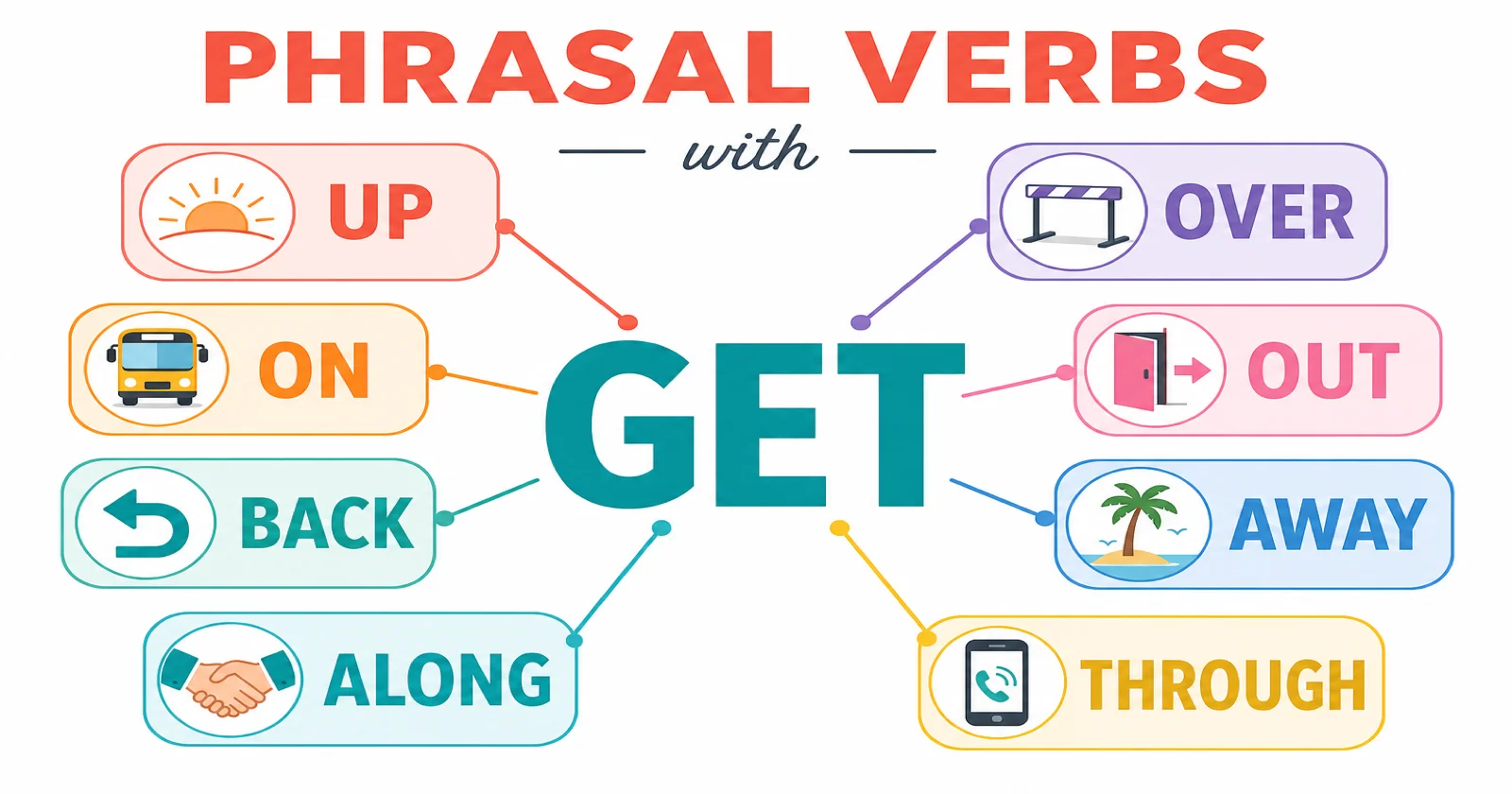
GET adalah kata kerja paling serbaguna dalam bahasa Inggris. Sendiri, artinya “memperoleh” atau “menjadi.” Namun, tambahkan preposisi—up, over, on, away, through, out, along, by—dan artinya berubah sepenuhnya. “Get over” dapat berarti pulih dari penyakit, memanjat tembok, atau melupakan patah hati. “Get out” dapat berarti meninggalkan tempat, lolos dari bahaya, atau menjadi diketahui publik.
Penutur asli menggunakan phrasal verb dengan GET puluhan kali sehari, sering tanpa menyadarinya. Bagi pelajar, ini menciptakan kesenjangan: Anda memahami setiap kata dalam “She couldn’t get through to him,” tetapi kalimat itu berarti sesuatu yang sama sekali berbeda dari yang disarankan kata-kata individualnya.
Panduan ini membahas setiap phrasal verb utama dengan GET, disusun menurut partikelnya (up, over, on, dan seterusnya). Setiap entri mencakup semua arti, contoh kehidupan nyata, catatan formalitas, dan kesalahan umum. Di akhir, phrasal verb GET akan terasa intuitif—bukan membingungkan.
- Phrasal verb yang dibahas: 25+
- Arti yang dijelaskan: 60+
- Level: B1–C1 (menengah hingga lanjutan)
- Fokus: arti, contoh kalimat, catatan penggunaan, kesalahan umum
Untuk panduan lengkap phrasal verb bahasa Inggris, lihat Phrasal Verb Bahasa Inggris: Panduan Lengkap.
GET UP — 3 Arti
1. Bangun dari tempat tidur; terbangun
Arti yang paling umum. Digunakan setiap hari oleh semua orang.
I get up at 6:30 every morning. She got up early to catch the first train. What time do you usually get up on weekends?
2. Berdiri dari posisi duduk atau berbaring
He fell on the ice but got up quickly. The audience got up and applauded. She got up from her desk and stretched.
3. Mengorganisasi atau menyiapkan (bahasa Inggris Britania, informal)
They got up a petition to save the park. We should get up a group to visit the museum.
Kesalahan umum: “I got up from the bed”—tidak perlu artikel. Katakan “I got up” atau “I got out of bed.”
GET OVER — 4 Arti
1. Pulih dari (penyakit, syok, atau rasa sakit emosional)
Arti yang paling umum. Pemulihan membutuhkan waktu, dan “get over” menyiratkan proses itu selesai.
It took her months to get over the flu. He still hasn’t gotten over his breakup. You need time to get over the shock.
2. Mengatasi (masalah atau kesulitan)
We need to get over this obstacle before moving forward. Once you get over the initial confusion, the software is easy to use.
3. Menerima sesuatu yang mengejutkan atau sulit dipercaya
Sering digunakan dalam bentuk negatif atau dengan “can’t.”
I can’t get over how much the city has changed! She couldn’t get over the fact that she had actually won.
4. Menyeberang atau memanjat penghalang fisik
The cat managed to get over the fence. We need to get over this hill before sunset.
Kesalahan umum: “Get over it” terdengar meremehkan dalam percakapan. Gunakan dengan hati-hati—ini menyiratkan orang tersebut harus berhenti mengeluh.
GET ON — 5 Arti
1. Naik (bus, kereta, pesawat, atau kendaraan besar)
We got on the bus at the wrong stop. Hurry — we need to get on the plane before they close the gate. She got on the train to London at 8 a.m.
2. Memiliki hubungan yang baik (Inggris Britania: get on; Amerika: get along)
Do you get on with your colleagues? They don’t get on very well — they argue constantly. I’ve always gotten on well with my neighbors.
3. Melanjutkan tugas; membuat kemajuan
Stop talking and get on with your work. Let’s get on with the meeting — we’re behind schedule. How are you getting on with the project?
4. Mengelola atau bertahan (bahasa Inggris Britania)
How’s your mother getting on these days? He’s getting on well after the surgery.
5. Menjadi tua (informal)
She’s getting on in years, but she’s still very active. He’s getting on a bit — he’ll be 70 next month.
Kesalahan umum: “Get on” untuk kendaraan bergantung pada ukurannya. Gunakan GET ON untuk bus/kereta/pesawat (besar). Gunakan GET IN untuk mobil/taksi (kecil).
GET OFF — 4 Arti
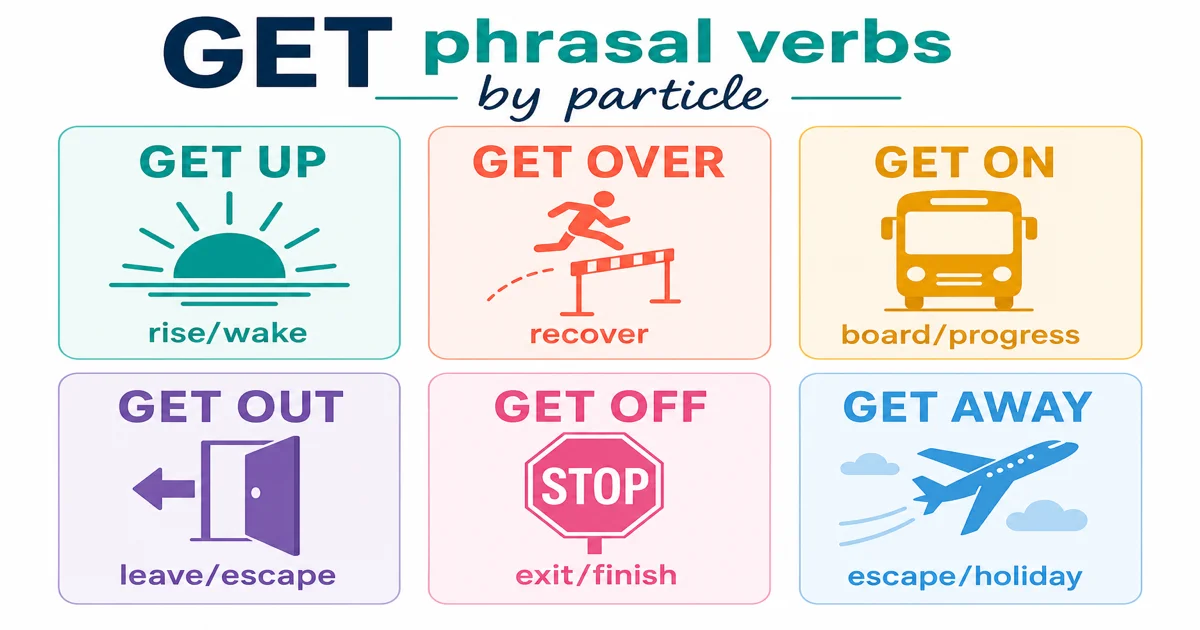
1. Turun atau keluar (dari bus, kereta, atau kendaraan besar)
Kebalikan dari “get on.”
We get off at the next stop. She got off the train and walked to the office. Don’t forget to get off at Central Station.
2. Pulang kerja; selesai bekerja untuk hari itu
What time do you get off work today? I get off at 5, so I can meet you at 5:30.
3. Menghindari hukuman atau menerima hukuman ringan
He got off with just a warning. The lawyer helped her get off the charges. He committed fraud but somehow got off scot-free.
4. Berhenti menyentuh atau memegang (imperatif)
Get off my phone! The sign said “Get off the grass.”
Kesalahan umum: “Get off FROM the bus”—tidak perlu “from.” Katakan “get off the bus.”
GET OUT — 4 Arti
1. Meninggalkan suatu tempat
Get out of my house! We should get out of here before the storm hits. She got out of the car and slammed the door.
2. Melarikan diri
The prisoners tried to get out through a tunnel. How did the dog get out of the yard?
3. Menjadi diketahui (tentang informasi atau rahasia)
If this information gets out, there will be a scandal. Word got out that the company was closing.
4. Mengeluarkan atau mengambil sesuatu
I can’t get this stain out of my shirt. She got out her wallet and paid the bill.
GET AWAY — 3 Arti
1. Melarikan diri atau kabur
The thieves got away before the police arrived. The bird got away from the cat.
2. Pergi berlibur; pergi untuk beristirahat
We need to get away for a few days — I’m exhausted. They got away to the mountains for the weekend.
3. Menghindari konsekuensi (get away with)
He cheated on the test and got away with it. You can’t get away with lying to your boss forever. She always gets away with coming to work late.
Catatan: “Get away!” sebagai seruan berarti “Saya tidak percaya!” (informal Britania) atau “Pergi!” (imperatif).
GET ALONG — 2 Arti
1. Memiliki hubungan yang ramah
Padanan bahasa Inggris Amerika untuk “get on” dari Inggris Britania. Sangat umum dalam percakapan sehari-hari.
Do you get along with your sister? The new employee gets along well with everyone. They didn’t get along at first, but now they’re good friends.
2. Mengelola diri atau bertahan hidup
How do you get along on such a small salary? We get along fine without a car.
GET THROUGH — 4 Arti
1. Menyelesaikan (tugas, periode, atau jumlah)
I got through all 500 pages in three days. How are we going to get through all this work by Friday? She finally got through the exam preparation.
2. Bertahan melewati periode sulit
It was a tough year, but we got through it. Music helped me get through the lockdown.
3. Menghubungi seseorang lewat telepon
I’ve been trying to call her all day, but I can’t get through. I finally got through to customer service after 40 minutes.
4. Membuat seseorang memahami
I tried to explain, but I couldn’t get through to him. How can I get through to my teenager about the importance of studying?
GET BACK — 3 Arti
1. Kembali
What time did you get back from vacation? I’ll get back to London by Friday. She got back home late last night.
2. Mendapatkan kembali sesuatu
I got my money back after returning the product. Did you ever get back the book you lent him?
3. Membalas dendam (get back at)
He’s trying to get back at his ex-partner. She got back at him by revealing his secret.
GET IN — 3 Arti
1. Masuk ke kendaraan kecil (mobil, taksi)
Kebalikan dari “get out of.”
Get in the car — we’re late! She got in a taxi and headed to the airport.
2. Tiba
What time does your flight get in? The train gets in at 9:15. He got in late last night.
3. Diterima (di sekolah, program, atau acara)
She applied to five universities and got in to three. It’s a popular club — it’s hard to get in. Did you get in? I heard the competition was fierce.
GET INTO — 3 Arti
1. Mulai tertarik atau terlibat dalam
She’s really getting into photography lately. He got into cooking during the pandemic. I can’t get into this book — it’s too slow.
2. Masuk (ke sekolah, program, atau profesi)
Getting into medical school is extremely competitive. How did you get into marketing?
3. Mendapat masalah
He keeps getting into fights at school. Don’t get into an argument with her — you won’t win. What has gotten into you today? You’re acting strange.
GET BY — 2 Arti
1. Bertahan dengan sumber daya terbatas
It’s hard to get by on minimum wage. We don’t have much, but we get by. She gets by with a little help from her family.
2. Lewat (bergerak secara fisik melewati seseorang)
Excuse me, could I get by? I need to reach the exit. The hallway is so narrow, it’s hard to get by.
GET DOWN — 3 Arti
1. Membuat seseorang merasa sedih atau tidak bahagia
The constant rain is really getting me down. Don’t let the criticism get you down.
2. Turun secara fisik atau merendahkan diri
Get down from that tree before you fall! She got down on her knees to search under the sofa.
3. Menuliskan atau mencatat
Let me get that down before I forget. Did you get down her phone number?
GET AROUND — 3 Arti
1. Bepergian dari satu tempat ke tempat lain
It’s easy to get around Tokyo by subway. How do you get around without a car?
2. Menghindari atau menemukan jalan melewati (aturan atau masalah)
There’s no way to get around this regulation. She always finds a way to get around the rules.
3. Menjadi diketahui secara luas (tentang berita atau informasi)
News gets around fast in a small town. Word got around that the company was being sold.
GET AHEAD — 1 Arti
Membuat kemajuan, terutama dalam karier atau kehidupan
You need to work hard to get ahead in this industry. She’s determined to get ahead in her career. It’s difficult to get ahead when you’re always playing catch-up.
GET ACROSS — 1 Arti
Berhasil menyampaikan gagasan
I’m trying to get my point across, but nobody seems to understand. The teacher got the concept across using simple examples. How can I get this message across to the team?
GET RID OF — 1 Arti
Menyingkirkan, membuang, atau menghilangkan
Salah satu frasa paling berguna dalam bahasa Inggris—digunakan terus-menerus dalam kehidupan sehari-hari.
We need to get rid of this old furniture. How do I get rid of these ants in the kitchen? She finally got rid of her cold after a week of rest.
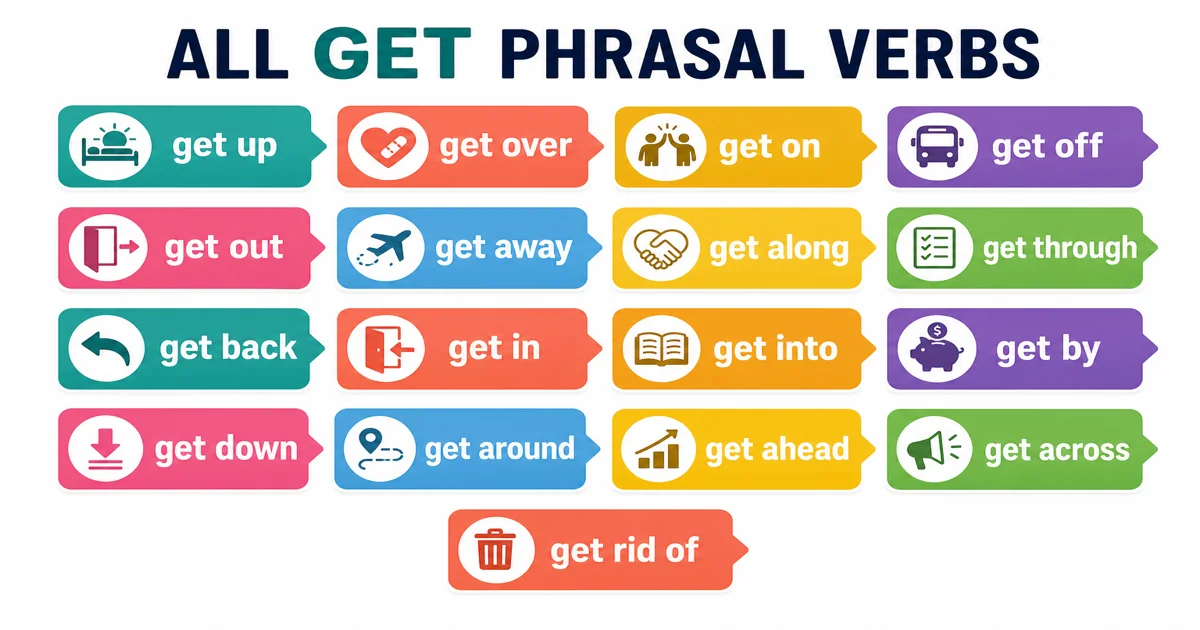
Tabel Referensi Cepat
| Phrasal Verb | Arti Utama | Contoh |
|---|---|---|
| get up | bangun dari tempat tidur | I get up at 7 every day. |
| get over | pulih dari | She got over the illness quickly. |
| get on | naik; memiliki hubungan yang baik | Get on the bus. / We get on well. |
| get off | turun dari kendaraan; selesai kerja | Get off at the next stop. |
| get out | keluar; melarikan diri | Get out of here! |
| get away | melarikan diri; pergi berlibur | The thieves got away. |
| get along | memiliki hubungan ramah | Do you get along with your boss? |
| get through | menyelesaikan; bertahan; menghubungi via telepon | I can’t get through to her. |
| get back | kembali; mendapatkan kembali | When did you get back? |
| get in | masuk (mobil); tiba; diterima | Get in the car. |
| get into | mulai tertarik pada | She’s getting into yoga. |
| get by | berhasil bertahan | We get by on a small budget. |
| get down | merasa sedih; turun; mencatat | The news got me down. |
| get around | bepergian; menghindari aturan | It’s easy to get around by bus. |
| get ahead | membuat kemajuan | Work hard to get ahead. |
| get across | menyampaikan gagasan | I couldn’t get my point across. |
| get rid of | menyingkirkan atau membuang | Get rid of the old files. |
GET IN vs. GET ON: Kendaraan Mana?
Ini membingungkan hampir setiap pelajar. Aturannya didasarkan pada ukuran kendaraan:
| Gunakan GET ON | Gunakan GET IN |
|---|---|
| bus | car |
| train | taxi |
| plane | van (small) |
| ship | truck cab |
| bicycle | canoe |
| motorcycle | helicopter |
Pola: GET ON = Anda dapat berdiri atau berjalan di dalam. GET IN = Anda duduk masuk ke ruang tertutup kecil.
Kebalikannya: GET OFF (bus, train) / GET OUT OF (car, taxi).
Kesalahan Umum dengan Phrasal Verb GET
| Kesalahan | Bentuk Benar | Alasannya |
|---|---|---|
|
|
get on the bus | Tidak ada preposisi setelah “get on” |
|
|
get off the train | Tidak perlu “from” |
|
|
I got up / I got out of bed | Hilangkan “bed” atau gunakan “get out of” |
|
|
get over an illness | Tidak ada “from” setelah “get over” |
|
|
I can’t get through to her | Perlu “to” untuk telepon/komunikasi |
Kata untuk Dilatih
Tambahkan phrasal verb penting ini dan kosakata terkait ke kamus Linglify Anda.
boom
nomina
dentuman, lonjakan
Contoh
- The boom of thunder echoed across the valley.
- The technology boom created many new millionaires.
cooperate
verba
bekerja sama
evaluate
verba
menilai, mengevaluasi
Contoh
- Companies evaluate job candidates based on experience, skills, and personality.
- Teachers evaluate student progress through tests, projects, and classroom participation.
graduate
verba
lulus
Contoh
- She will graduate from university next year with a degree in engineering.
- Students must complete all requirements before they can graduate from high school.
horizon
nomina
cakrawala, horizon
Contoh
- The sun disappeared behind the horizon as evening approached.
- Traveling broadens your horizon and exposes you to new cultures.
indispensable
adjektiva
mutlak diperlukan, sangat penting
Contoh
- Clean water is indispensable for human survival and good health.
- Her experience and skills make her indispensable to the research team.
jury
nomina
juri
Contoh
- The jury deliberated for several hours before reaching a verdict.
- The talent show jury consisted of professional musicians and entertainers.
lifelong
adjektiva
seumur hidup, sepanjang hidup
Contoh
- Learning is a lifelong process that never truly ends.
- Their lifelong friendship began during elementary school years.
motivated
adjektiva
termotivasi, terdorong
Contoh
- Motivated employee seeks additional responsibilities and challenges at work.
- Success requires being motivated even when facing difficult obstacles.
normally
adverbia
biasanya, secara normal
Contoh
- Heart normally beats between sixty and hundred times per minute.
- Students normally arrive at school before morning bell rings.
off
adjektiva
basi
Contoh
- Please turn off the lights before leaving the room.
- The dog ran off into the forest chasing wild rabbits.
prejudice
nomina
prasangka
Contoh
- Education helps overcome prejudice and promotes understanding.
- Racial prejudice damages communities and individuals alike.
resolve
verba
menyelesaikan, memecahkan
Contoh
- Mediator helps parties resolve dispute through negotiation.
- Technical team will resolve software problems quickly.
stress
verba
merasa tertekan, menekankan
Contoh
- Heavy workload may stress employees beyond limits.
- Teacher will stress importance of homework completion.
total
adjektiva
utuh, menyeluruh
Contoh
- Total cost includes all fees and expenses.
- Total silence fills room during meditation session.
tragedy
nomina
tragedi, musibah
Contoh
- Natural tragedy affects thousands of innocent people.
- Personal tragedy changes person's life perspective completely.
union
nomina
persatuan, gabungan
Contoh
- Labor union protects worker rights and interests.
- Marriage union joins two people in partnership.
voyage
nomina
pelayaran, perjalanan jauh
Contoh
- Space exploration represents humanity's greatest voyage into the unknown.
- The ocean voyage from Europe to America took several weeks in the past.
candidate
nomina
calon, kandidat
Contoh
- Each presidential candidate presented their policy plans to voters.
- The job candidate impressed the interview panel with her experience.
discourage
verba
mematahkan semangat, membuat kecil hati
Contoh
- Don't let one failure discourage you from pursuing your dreams.
- High prices discourage many people from buying organic food products.
donate
verba
menyumbangkan, mendonasikan
Contoh
- Many people donate money to charities that help homeless individuals.
- She decided to donate blood to help patients in emergency situations.
firmly
adverbia
dengan teguh, secara mantap
Contoh
- Hold the rope firmly while climbing down the steep mountain slope.
- The manager firmly believed in treating all employees with respect.
guide
verba
memandu, membimbing
Contoh
- Parents should guide their children to make responsible decisions.
- The experienced hiker will guide the group through the mountain trail safely.
humorous
adjektiva
lucu, jenaka
Contoh
- She writes humorous articles about everyday life and family experiences.
- The humorous speech made everyone laugh and lightened the serious mood.
admission
nomina
penerimaan, izin masuk
Contoh
- Her admission to the prestigious medical school was the result of hard work.
- The museum offers free admission on the first Sunday of every month.
Yang Harus Dilakukan Selanjutnya
-
Pilih area terlemah Anda. Baca daftar di atas dan kenali phrasal verb GET mana yang Anda bingungkan atau tidak pernah gunakan. Berfokuslah pada kata-kata itu terlebih dahulu.
-
Buat kalimat. Untuk setiap phrasal verb, tulis 2–3 kalimat tentang kehidupan Anda sendiri. Hubungan pribadi membuat kosakata lebih melekat.
-
Tambahkan ke Linglify untuk pengulangan berjarak. Sistem akan menguji Anda pada interval optimal sampai phrasal verb ini menjadi otomatis.
-
Baca panduan phrasal verb lengkap—Phrasal Verb Bahasa Inggris: Panduan Lengkap mencakup 200+ phrasal verb dari semua kata kerja dasar.
-
Pelajari phrasal verb dengan MAKE—Phrasal Verb dengan MAKE mengikuti format yang sama untuk kata kerja penting lainnya.
FAQ
Apa phrasal verb dengan GET yang paling umum?
Lima yang paling sering digunakan adalah: get up (bangun dari tempat tidur), get on/along (memiliki hubungan baik), get over (pulih dari), get through (menyelesaikan/bertahan), dan get rid of (menyingkirkan/membuang). Kata-kata ini muncul puluhan kali per hari dalam percakapan sehari-hari. Penutur asli menggunakannya secara otomatis, sehingga memahaminya sangat penting untuk mengikuti bahasa Inggris alami.
Mengapa GET memiliki begitu banyak phrasal verb?
GET adalah salah satu kata kerja bahasa Inggris tertua dan paling mendasar. Arti intinya—“memperoleh” atau “menjadi”—sangat fleksibel, sehingga dapat digabungkan dengan hampir semua preposisi untuk menciptakan arti baru. Secara historis, phrasal verb menggantikan kata yang lebih panjang dan berasal dari Latin dalam percakapan sehari-hari (misalnya, “get over” menggantikan “recover,” “get rid of” menggantikan “eliminate”), menjadikan GET dasar alami untuk puluhan kombinasi.
Bagaimana mengetahui kapan menggunakan GET IN vs. GET ON?
Gunakan GET ON untuk kendaraan besar tempat Anda dapat berdiri dan berjalan (bus, kereta, pesawat, kapal). Gunakan GET IN untuk kendaraan kecil ketika Anda duduk masuk ke ruang tertutup (mobil, taksi). Pola yang sama berlaku sebaliknya: GET OFF the bus, GET OUT OF the car. Jika Anda dapat berjalan di dalamnya, gunakan ON/OFF. Jika harus membungkuk untuk masuk, gunakan IN/OUT.
Apakah phrasal verb GET formal atau informal?
Kebanyakan phrasal verb GET netral hingga informal dan sangat sesuai untuk percakapan sehari-hari, email, serta tulisan umum. Dalam tulisan akademik atau hukum yang sangat formal, kata kerja asal Latin lebih disukai: recover alih-alih “get over,” eliminate alih-alih “get rid of,” comprehend alih-alih “get.” Namun, dalam bahasa Inggris bisnis, presentasi, dan sebagian besar konteks profesional, phrasal verb GET sepenuhnya dapat diterima dan alami.
Berapa banyak arti yang dapat dimiliki satu phrasal verb GET?
Sebagian dapat memiliki hingga lima arti berbeda. “Get on” dapat berarti naik kendaraan, memiliki hubungan, membuat kemajuan, mengelola/bertahan, atau menjadi tua. “Get through” berarti menyelesaikan, bertahan, menghubungi lewat telepon, atau menyampaikan gagasan. Konteks selalu menentukan artinya—kata-kata di sekitar phrasal verb memberi tahu definisi mana yang berlaku. Karena itulah mempelajari phrasal verb dengan contoh kalimat jauh lebih efektif daripada menghafal definisi terpisah.


