英語のスペルが難しい単語200選:間違えやすい綴りと覚え方
英語のスペルは、ヨーロッパ言語の中でも特に不規則です。同じ音が10通りもの綴りで書かれたり(through, too, blue, shoe, crew, you, flu, coup, Hugh, lieu)、同じ文字の組み合わせがまったく違う音になったり(cough, through, though, thought, tough)します。ネイティブスピーカーでさえ、日常的な単語のスペルを一生間違え続けることがあります。
なぜこれほど混沌としているのでしょうか。英語はラテン語、ギリシャ語、フランス語、ドイツ語、古ノルド語、アラビア語、ヒンディー語など数十の言語から単語を借用し、発音を変えながら元の綴りを残すことが多かったからです。その結果、「colonel」が「kernel」と発音され、「Wednesday」に発音しない「d」が含まれる言語が生まれました。
このガイドでは、最もスペルを間違えやすい英単語200語を、綴りの「罠」の種類別にまとめています。各単語には、よくある間違い、正しいスペル、記憶のコツがついています。
- 収録数:200語
- 形式:正しいスペル → よくある間違い → 覚え方
- 分類:スペルパターン別(サイレントレター、二重子音など)
- レベル:A2〜C1
- 用途:スペル改善、試験対策、ライティング力向上
スペル以外の難しい単語については、Hard English Words: 500+ Difficult Words をご覧ください。
なぜ英語のスペルは難しいのか
英語には44の音がありますが、文字はわずか26しかありません。このミスマッチが混乱を生みます。
| 問題 | 例 | 何が起こるか |
|---|---|---|
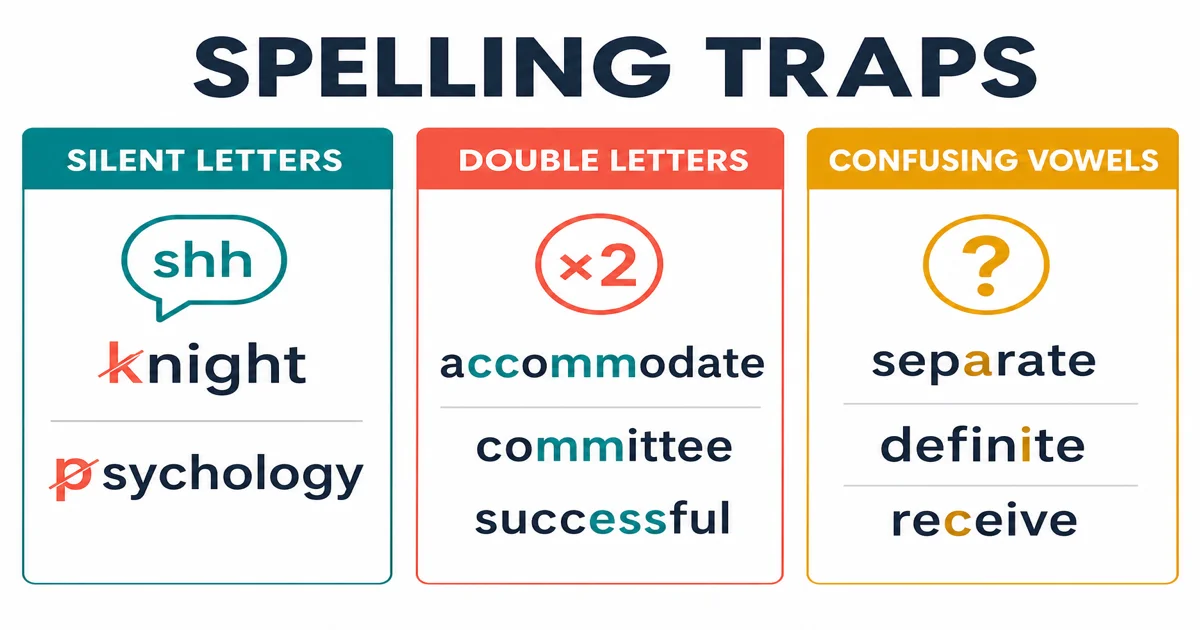
| サイレントレター | knight, psychology, receipt | 書くけれど発音しない文字 |
| 二重子音 | accommodate, occurrence | 1つか2つか?覚えにくい |
| 弱母音 | separate, definitely | 「ア」のように聞こえる母音 |
| -ible vs. -able | responsible, comfortable | 明確なルールがない |
| -ence vs. -ance | occurrence, resistance | まったく同じ音 |
| i before e | receive, weird, seize | 例外のほうが多い「ルール」 |
良いニュースは、ほとんどのスペルミスが予測可能なパターンに当てはまることです。パターンを学べば、ミスの80%を防げます。
サイレントレター(30語)
書くけれど発音しない文字を含む単語 — 英語で最も厄介な罠です。
| # | 正しいスペル | よくある間違い | 覚え方 |
|---|---|---|---|
| 1 | acquaintance |
|
ACQuire an ACQuaintance |
| 2 | acknowledge |
|
aCKnowledgeのCKを忘れずに |
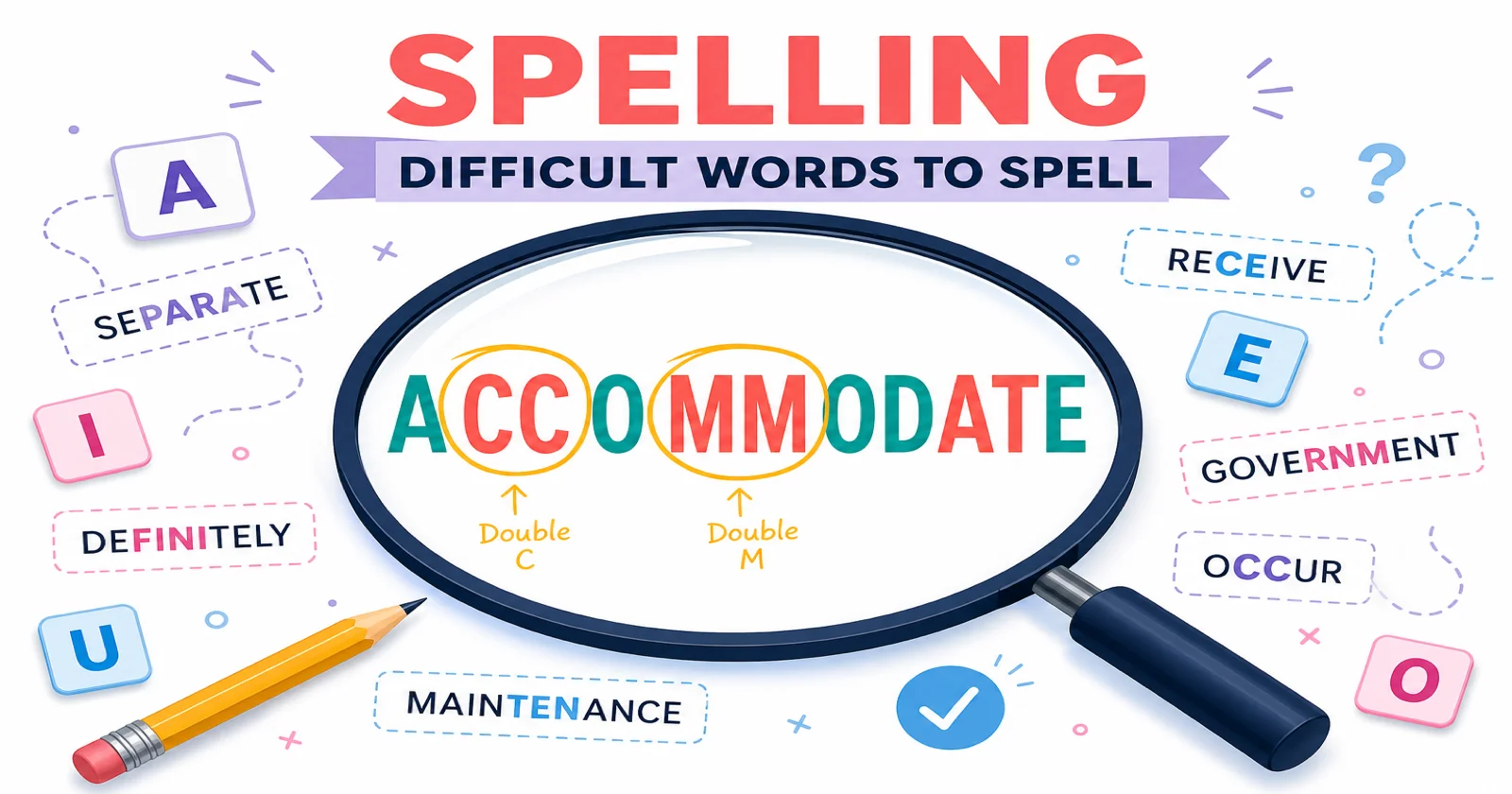
| 3 | column |
|
Nはcolumn(柱)のように静かに立っている |
| 4 | conscience |
|
CON + SCIENCE = conscience |
| 5 | fascinate |
|
SCが隠れている — 「science」と同じ |
| 6 | foreign |
|
FORE + IGN |
| 7 | government |
|
GOVERN + MENT — Nを保持 |
| 8 | guarantee |
|
GUA + RAN + TEE — 3つのパーツ |
| 9 | handkerchief |
|
HAND + KERCHIEF — 手(hand)用 |
| 10 | island |
|
An island IS LAND |
| 11 | knight |
|
サイレントK — 古英語由来 |
| 12 | knowledge |
|
KNOW + LEDGE |
| 13 | listen |
|
LISTENにはサイレントTがある |
| 14 | mortgage |
|
MORT(死)+ GAGE — 「死の誓約」 |
| 15 | muscle |
|
MUSC + LE — 「muscular」を思い出して |
| 16 | pneumonia |
|
Pは無音 — ギリシャ語「pneuma」(息)から |
| 17 | psychology |
|
Pは無音 — ギリシャ語「psyche」(心)から |
| 18 | receipt |
|
サイレントP — receiPt |
| 19 | rhythm |
|
Rhythm Has Your Two Hips Moving |
| 20 | salmon |
|
サイレントL — SALmon |
| 21 | scissors |
|
SC + ISSORS — Sが二重 |
| 22 | subtle |
|
「subtle」のBはsubtleに隠れている |
| 23 | sword |
|
サイレントW — 古英語由来 |
| 24 | technique |
|
TECH + NIQUE — Hを保持 |
| 25 | Wednesday |
|
WED + NES + DAY — 北欧神ウォーデンに由来 |
| 26 | whistle |
|
WHが最初、Tが真ん中 |
| 27 | wrestle |
|
サイレントW — 「write」「wrong」と同じ |
| 28 | yacht |
|
オランダ語由来 — CHは無音 |
| 29 | answer |
|
サイレントW — ansWer |
| 30 | doubt |
|
サイレントB — ラテン語「dubitare」から |
二重子音(35語)
最も多いスペルミス:文字の二重を忘れる、または間違った文字を二重にすること。
| # | 正しいスペル | よくある間違い | 覚え方 |
|---|---|---|---|
| 31 | accommodate |
|
Cが2つ、Mが2つ — 両方を収容(accommodate)できる |
| 32 | accelerate |
|
Cが2つ、Lは1つ — aCCeLerate |
| 33 | accessory |
|
Cが2つ、Sが2つ — aCCeSSory |
| 34 | aggressive |
|
Gが2つ — aGGressive |
| 35 | apparent |
|
Pが2つ — aPParent |
| 36 | broccoli |
|
Cが2つ、Lは1つ — broCColi |
| 37 | Caribbean |
|
Rは1つ、Bが2つ — caRiBBean |
| 38 | committed |
|
Mが2つ、Tが2つ — coMMiTTed |
| 39 | committee |
|
Mが2つ、Tが2つ、Eが2つ — coMMiTTEE |
| 40 | disappear |
|
Sは1つ、Pが2つ — diSaPPear |
| 41 | disappoint |
|
Sは1つ、Pが2つ — diSaPPoint |
| 42 | embarrass |
|
Rが2つ、Sが2つ — embaRRaSS |
| 43 | exaggerate |
|
Gが2つ — exaGGerate |
| 44 | excellence |
|
Lが2つ — exceLLence |
| 45 | harass |
|
Rは1つ、Sが2つ — haRaSS |
| 46 | innocence |
|
Nが2つ — iNNocence |
| 47 | interrupt |
|
Rが2つ — inteRRupt |
| 48 | millennium |
|
Lが2つ、Nが2つ — miLLeNNium |
| 49 | misspell |
|
MIS + SPELL — Sが2つ(皮肉なことに!) |
| 50 | necessary |
|
Cは1つ、Sが2つ — シャツの襟(Collar)は1つ、袖(Sleeves)は2つ |
| 51 | occasion |
|
Cが2つ、Sは1つ — oCCaSion |
| 52 | occurrence |
|
Cが2つ、Rが2つ — oCCuRRence |
| 53 | parallel |
|
真ん中にLが2つ — paraLLel |
| 54 | possession |
|
Sが2つずつ — poSSESSion |
| 55 | professional |
|
Fは1つ、Sが2つ — proFeSSional |
| 56 | questionnaire |
|
Nが2つ — questioNNaire |
| 57 | recommend |
|
Cは1つ、Mが2つ — reCcoMMend |
| 58 | referring |
|
Rが2つ — refeRRing |
| 59 | succeed |
|
Cが2つ — suCCeed |
| 60 | suggest |
|
Gが2つ — suGGest |
| 61 | tomorrow |
|
Mは1つ、Rが2つ — toMoRRow |
| 62 | address |
|
Dが2つ — aDDress |
| 63 | assistant |
|
Sが2つ — aSSistant |
| 64 | beginning |
|
Nが2つ — begiNNing |
| 65 | different |
|
Fが2つ — diFFerrent |
紛らわしい母音(30語)
母音が弱く発音されると、すべて「ア」のような音(シュワ /ə/)になります。そのため、耳で聞いて正しく綴ることは不可能です。
| # | 正しいスペル | よくある間違い | 覚え方 |
|---|---|---|---|
| 66 | separate |
|
separateにはA RATが隠れている |
| 67 | definitely |
|
真ん中にFINITE — deFINITEly |
| 68 | desperate |
|
「PERATE」であって「PARATE」ではない |
| 69 | calendar |
|
cAlEndAr — Aが3つ |
| 70 | cemetery |
|
すべてE — cEmEtEry |
| 71 | category |
|
catEgory — 真ん中はE |
| 72 | privilege |
|
Dなし — priviLEGE |
| 73 | relevant |
|
relEvAnt — EそしてA |
| 74 | independent |
|
末尾はDENT — indepenDENT |
| 75 | repetition |
|
rEpEtition — Eが2つ |
| 76 | resistance |
|
resistANCE — EではなくA |
| 77 | maintenance |
|
MAIN + TEN + ANCE |
| 78 | miniature |
|
MINI + ATURE — Iを保持 |
| 79 | original |
|
ORIGIN + AL |
| 80 | temperature |
|
TEMPER + ATURE — 2番目のEを保持 |
| 81 | tolerance |
|
tolerANCE — EではなくA |
| 82 | ignorance |
|
ignorANCE — EではなくA |
| 83 | abundance |
|
abundANCE — EではなくA |
| 84 | existence |
|
existENCE — AではなくE |
| 85 | occurrence |
|
occurrENCE — AではなくE |
| 86 | preference |
|
preferENCE — AではなくE |
| 87 | reference |
|
referENCE — AではなくE |
| 88 | experience |
|
experiENCE — AではなくE |
| 89 | absence |
|
abSENCE — SENSEではない |
| 90 | license |
|
LICENSE — CがSの前 |
| 91 | medicine |
|
mEDICine — 中にMEDICがある |
| 92 | vegetable |
|
vEGEtable — Eが2つ |
| 93 | secretary |
|
SECRET + ARY |
| 94 | laboratory |
|
LABOR + ATORY |
| 95 | vocabulary |
|
VOCAB + ULARY |
-ible vs. -able(20語)
信頼できるルールはありません。どちらの語尾を取るか、それぞれ覚える必要があります。
| # | 正しいスペル | よくある間違い | 覚え方 |
|---|---|---|---|
| 96 | responsible |
|
responsIBLE |
| 97 | terrible |
|
terrIBLE |
| 98 | visible |
|
visIBLE |
| 99 | possible |
|
possIBLE |
| 100 | flexible |
|
flexIBLE |
| 101 | incredible |
|
incredIBLE |
| 102 | accessible |
|
accessIBLE |
| 103 | compatible |
|
compatIBLE |
| 104 | comfortable |
|
comfortABLE |
| 105 | available |
|
availABLE |
| 106 | reasonable |
|
reasonABLE |
| 107 | knowledgeable |
|
knowledgeABLE |
| 108 | manageable |
|
manageABLE |
| 109 | noticeable |
|
noticeABLE — Eを残す |
| 110 | changeable |
|
changeABLE — Eを残す |
| 111 | believable |
|
believABLE |
| 112 | dependable |
|
dependABLE |
| 113 | considerable |
|
considerABLE |
| 114 | inevitable |
|
inevitABLE |
| 115 | memorable |
|
memorABLE |
ie vs. ei(15語)
「i before e, except after c」というルールは例外が多すぎて、ルールとしてほとんど機能しません。
| # | 正しいスペル | よくある間違い | 覚え方 |
|---|---|---|---|
| 116 | receive |
|
Cの後 → EI:reCEIve |
| 117 | believe |
|
Cなし → IE:beLIEve(LIE = 嘘を信じるな) |
| 118 | achieve |
|
Cなし → IE:achIEve |
| 119 | deceive |
|
Cの後 → EI:deCEIve |
| 120 | perceive |
|
Cの後 → EI:perCEIve |
| 121 | conceive |
|
Cの後 → EI:conCEIve |
| 122 | ceiling |
|
Cの後 → EI:cEIling |
| 123 | weird |
|
例外!WEIRD自体がweird(奇妙) |
| 124 | seize |
|
例外!SEIze |
| 125 | their |
|
例外!THEIR = THEy + IR |
| 126 | height |
|
例外!HEIght |
| 127 | neighbor |
|
「エイ」と発音するときはEI:nEIghbor |
| 128 | freight |
|
「エイ」と発音するときはEI:frEIght |
| 129 | protein |
|
例外!protEIn |
| 130 | foreign |
|
例外!forEIgn |
間違えやすい日常単語(45語)
毎日使う単語なのに、多くの人が毎回間違えるものです。
| # | 正しいスペル | よくある間違い | 覚え方 |
|---|---|---|---|
| 156 | accommodation |
|
Cが2つ、Mが2つ |
| 157 | argument |
|
「argue」からEを取る |
| 158 | beautiful |
|
BEAUTY + FUL(Lは1つ) |
| 159 | beginning |
|
Nが2つ — begiNNing |
| 160 | business |
|
BUS + I + NESS |
| 161 | completely |
|
COMPLETE + LY |
| 162 | convenience |
|
conVENience — VENI(ラテン語:来る) |
| 163 | curiosity |
|
「ous」を取る — CURIOS + ITY |
| 164 | decision |
|
DECIS + ION(「decide」から) |
| 165 | description |
|
DESCription — DESCRIBEから |
| 166 | development |
|
DEVELOP + MENT(MENTの前にEなし) |
| 167 | dictionary |
|
DICTION + ARY |
| 168 | disappearance |
|
Sは1つ、Pが2つ — DIS + APPEARANCE |
| 169 | discipline |
|
DISC + IP + LINE |
| 170 | environment |
|
ENVIRON + MENT — Nを保持 |
| 171 | especially |
|
E + SPECIAL + LY |
| 172 | exaggeration |
|
Gが2つ — exaGGeration |
| 173 | exercise |
|
EXER + CISE |
| 174 | February |
|
FEB + RU + ARY — 最初のRを保持 |
| 175 | grammar |
|
grammAR — ERではなくARで終わる |
| 176 | immediately |
|
Mが2つ — iMMediately |
| 177 | jewelry |
|
JEWEL + RY |
| 178 | judgment |
|
JUDGE − E + MENT(米語) |
| 179 | library |
|
LIB + RARY — 最初のRを保持 |
| 180 | lightning |
|
LIGHT + NING(Eなし) |
| 181 | occasionally |
|
Cが2つ、Sは1つ — oCCaSionally |
| 182 | particular |
|
PARTICULAR — PERではなくPAR |
| 183 | perseverance |
|
perseverANCE — EではなくA |
| 184 | preferred |
|
Rが2つ — prefeRRed |
| 185 | probably |
|
PROB + ABLY |
| 186 | pronunciation |
|
proNUNciation — 「OUNCE」なし |
| 187 | restaurant |
|
REST + AU + RANT |
| 188 | schedule |
|
SCHED + ULE |
| 189 | sentence |
|
SENT + ENCE |
| 190 | surprise |
|
SUR + PRISE — 最初のRを忘れずに |
| 191 | thorough |
|
THOROUGH — 末尾はOUGH |
| 192 | truly |
|
TRUE − E + LY |
| 193 | twelfth |
|
TWELF + TH — Fを保持 |
| 194 | unnecessary |
|
Cは1つ、Sが2つ — UN + NECESSARY |
| 195 | until |
|
Lは1つ — untiL |
| 196 | usually |
|
USUAL + LY |
| 197 | vacuum |
|
Cは1つ、Uが2つ — vaCUUm |
| 198 | various |
|
VARI + OUS |
| 199 | weather |
|
WEATH + ER |
| 200 | weird |
|
WEIRDはie/eiルールを破る — それ自体が奇妙 |
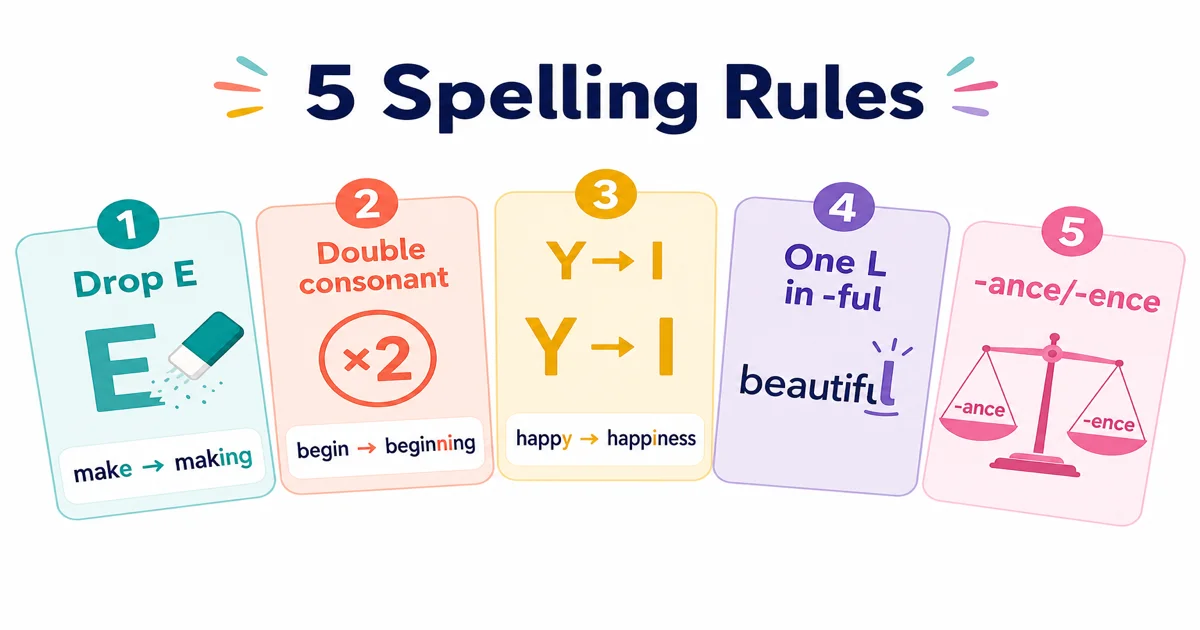
本当に役立つ5つのルール
ルール1:-ingや-ableの前でEを取る
make → making, love → lovable, write → writing
例外:noticeable, changeable(軟音のCやGの後はEを残す)。
ルール2:最終音節にアクセントがある場合、-ing/-edの前で最後の子音を二重にする
begin → beginning, prefer → preferred, commit → committed
ただし:offer → offering(アクセントが最初の音節なので二重にしない)。
ルール3:接尾辞を付ける前にYをIに変える
happy → happiness, carry → carried, beauty → beautiful
ただし、-ingの前はYを残す:carry → carrying, study → studying。
ルール4:-fulであって-fullではない
-fulで終わるすべての形容詞はLが1つ:beautiful, wonderful, grateful, helpful。
-lyを付けるとLが2つになります:beautifully, wonderfully, gratefully。
ルール5:-ance/-enceは動詞の形による
動詞が-ateで終わる場合 → 名詞は通常-ance:tolerate → tolerance 動詞が-ereで終わる場合 → 名詞は通常-ence:interfere → interference
スペルを上達させる方法
たくさん読みましょう。 スペルは主に視覚的記憶です。正しく綴られた単語を多く見れば見るほど、正しいスペルが自動的になります。
手書きしましょう。 タイピングでは自動修正がミスを黙って直してしまいます。手書きはスペルを能動的に思い出す必要があります。毎日5〜10語の苦手な単語を手書きしましょう。
間隔反復を使いましょう。 自分の「問題単語」をLinglifyに追加してください。最適な間隔でテストされ、正しいスペルが自動的になるまで練習できます。
語根を学びましょう。 ラテン語やギリシャ語の語根から成り立つ単語は、一貫したパターンに従います。「psych-」が「心」(ギリシャ語)を意味することを知っていれば、psychology, psychiatrist, psyche の無音のPを忘れることはありません。
記憶術を作りましょう。 最も効果的な記憶術は個人的なものです。「There’s A RAT in separate」はばかげていますが効果的です。常に間違える単語について、自分だけの記憶術を作りましょう。
練習用の単語
boom
名詞
急増, ブーム, 爆発
例
- The boom of thunder echoed across the valley.
- The technology boom created many new millionaires.
cooperate
動詞
協力する, 協働する
evaluate
動詞
評価する, 査定する
例
- Companies evaluate job candidates based on experience, skills, and personality.
- Teachers evaluate student progress through tests, projects, and classroom participation.
graduate
動詞
卒業する
例
- She will graduate from university next year with a degree in engineering.
- Students must complete all requirements before they can graduate from high school.
horizon
名詞
地平線
例
- The sun disappeared behind the horizon as evening approached.
- Traveling broadens your horizon and exposes you to new cultures.
indispensable
形容詞
不可欠な
例
- Clean water is indispensable for human survival and good health.
- Her experience and skills make her indispensable to the research team.
jury
名詞
陪審団, 陪審
例
- The jury deliberated for several hours before reaching a verdict.
- The talent show jury consisted of professional musicians and entertainers.
lifelong
形容詞
一生の, 生涯の
例
- Learning is a lifelong process that never truly ends.
- Their lifelong friendship began during elementary school years.
motivated
形容詞
やる気のある
例
- Motivated employee seeks additional responsibilities and challenges at work.
- Success requires being motivated even when facing difficult obstacles.
normally
副詞
通常は, 普通は, ふつうは
例
- Heart normally beats between sixty and hundred times per minute.
- Students normally arrive at school before morning bell rings.
off
副詞
離れて, 切れて, 休みの
例
- Please turn off the lights before leaving the room.
- The dog ran off into the forest chasing wild rabbits.
prejudice
名詞
偏見, 先入観, 差別
例
- Education helps overcome prejudice and promotes understanding.
- Racial prejudice damages communities and individuals alike.
resolve
動詞
解決する, 決意する
例
- Mediator helps parties resolve dispute through negotiation.
- Technical team will resolve software problems quickly.
stress
動詞
強調する, 緊張させる
例
- Heavy workload may stress employees beyond limits.
- Teacher will stress importance of homework completion.
total
形容詞
全体の, 総合的な, 完全な
例
- Total cost includes all fees and expenses.
- Total silence fills room during meditation session.
tragedy
名詞
悲劇
例
- Natural tragedy affects thousands of innocent people.
- Personal tragedy changes person's life perspective completely.
union
名詞
連合, 結合, 協会
例
- Labor union protects worker rights and interests.
- Marriage union joins two people in partnership.
voyage
名詞
航海, 旅行
例
- Space exploration represents humanity's greatest voyage into the unknown.
- The ocean voyage from Europe to America took several weeks in the past.
candidate
名詞
候補者, 志願者
例
- Each presidential candidate presented their policy plans to voters.
- The job candidate impressed the interview panel with her experience.
discourage
動詞
落胆させる, 思いとどまらせる, 意欲をなくさせる
例
- Don't let one failure discourage you from pursuing your dreams.
- High prices discourage many people from buying organic food products.
donate
動詞
寄付する
例
- Many people donate money to charities that help homeless individuals.
- She decided to donate blood to help patients in emergency situations.
firmly
副詞
しっかりと, 堅く
例
- Hold the rope firmly while climbing down the steep mountain slope.
- The manager firmly believed in treating all employees with respect.
guide
動詞
案内する
例
- Parents should guide their children to make responsible decisions.
- The experienced hiker will guide the group through the mountain trail safely.
humorous
形容詞
ユーモラスな, 面白い, 滑稽な
例
- She writes humorous articles about everyday life and family experiences.
- The humorous speech made everyone laugh and lightened the serious mood.
admission
名詞
入場, 入学, 認めること
例
- Her admission to the prestigious medical school was the result of hard work.
- The museum offers free admission on the first Sunday of every month.
次のステップ
-
自分をテストしましょう。 上のリストを見て、今まで間違えたことのある単語にすべて印をつけてください。それが優先単語です。
-
パターンで学びましょう。 一度に1つのカテゴリに集中しましょう — 1週目はサイレントレター、次の週は二重子音。
-
苦手な単語をLinglifyに追加 して間隔反復で学習しましょう。
-
完全ガイドを読みましょう — Hard English Words: 500+ Difficult Words はスペル、発音、使い方が難しい単語を網羅しています。
-
ライティングで練習しましょう。 メール、エッセイ、メモで苦手な単語を意識的に使いましょう。能動的な使用は受動的な復習よりも速く記憶を定着させます。
FAQ
英語で最もスペルが難しい10語は何ですか?
最も頻繁にミスされる単語は、accommodate(CとMが二重)、separate(真ん中はEではなくA)、definitely(Aなし — FINITEが含まれる)、occurrence(CとRが二重)、embarrass(RとSが二重)、rhythm(真ん中に母音なし)、millennium(LとNが二重)、conscience(SCの組み合わせ)、questionnaire(Nが二重)、pronunciation(「ounce」なし)です。これらの単語はネイティブスピーカーでさえ間違えます。
なぜ英語のスペルはこれほど不規則なのですか?
英語はラテン語、ギリシャ語、フランス語、ドイツ語、古ノルド語など多くの言語から単語を借用し、発音を変えながら元の綴りを残すことが多かったからです。さらに、1400〜1700年の間に英語の発音は劇的に変化しましたが(大母音推移)、綴りはすでに標準化されていました。その結果、現代の発音ではなく中世の発音を反映する書記体系が残されました。
スペルを素早く上達させるにはどうすればいいですか?
3つの方法を組み合わせるのが最も効果的です。(1)たくさん読む — スペルは主に視覚的記憶であり、正しい形を繰り返し見ることで無意識の認識が構築されます。(2)手書きする — 自動修正に頼らず能動的に思い出す必要があります。(3)間隔反復を使う — 苦手な単語を復習システムに追加し、増加する間隔で練習します。ランダムなリストではなく、パターンごとにグループ化しましょう。
英語のスペルルールは本当に機能しますか?
いくつかのルールは信頼できます。「-ingの前でEを取る」(make → making)、「最終音節にアクセントがある場合に子音を二重にする」(begin → beginning)、「-fulは常にLが1つ」(beautiful, beautifullではない)。しかし、「i before e except after c」のような多くの「ルール」は例外が多すぎて、解決するよりも混乱を招きます。最も効率的なアプローチは、カテゴリ別にパターンを学び、例外には間隔反復を使うことです。
イギリス英語とアメリカ英語でスペルは違いますか?
はい、予測可能なパターンで異なります。イギリス英語は-our(colour, favour)、-ise(organise, realise)、-re(centre, theatre)、-ence(licence, defence)を使います。アメリカ英語は-or(color, favor)、-ize(organize, realize)、-er(center, theater)、-ense(license, defense)を使います。どちらも正しいですが、1つのシステムを一貫して使いましょう。IELTSなどの国際試験では、混ぜなければどちらでも受け入れられます。