
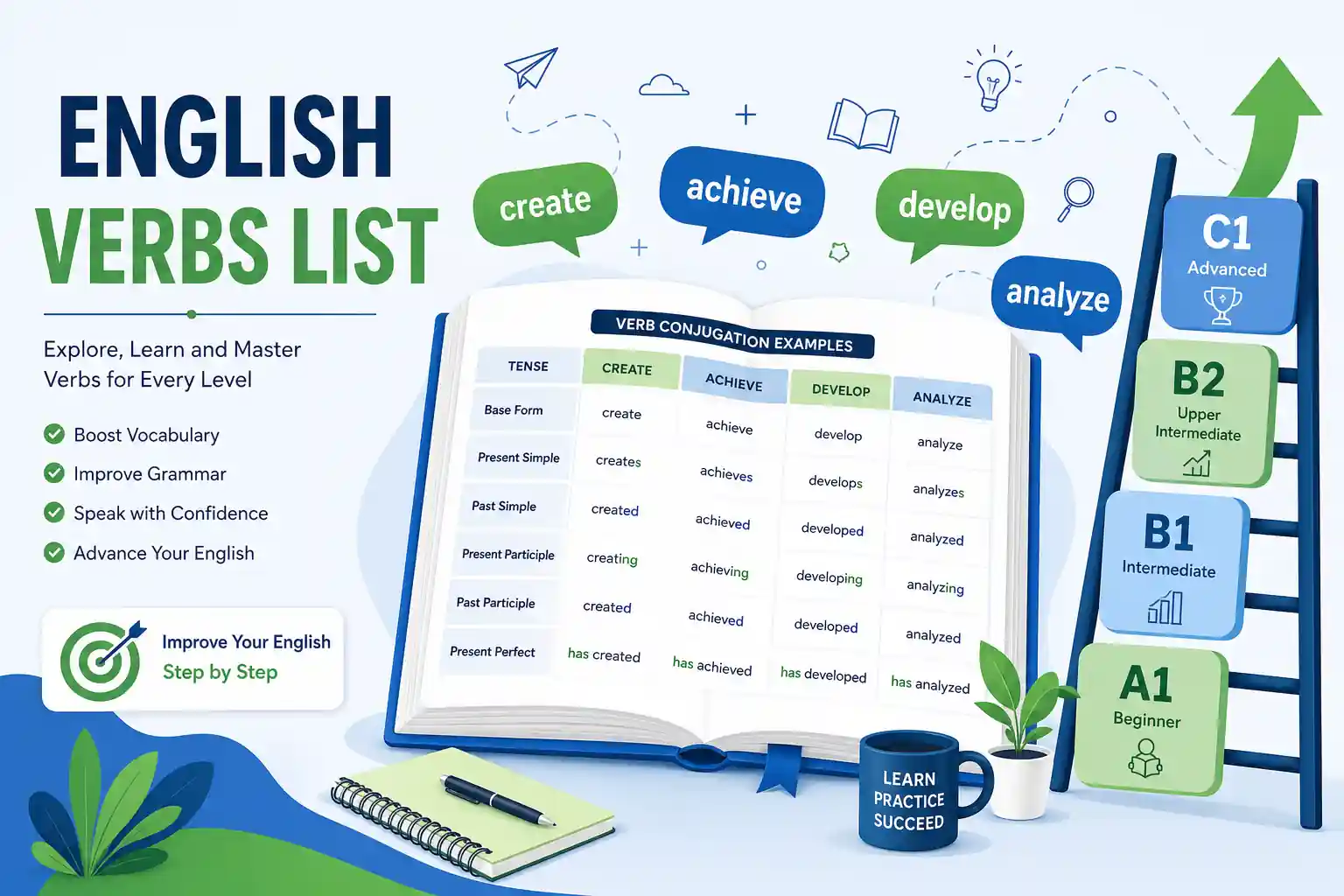
英語動詞一覧:レベル別に整理された最重要動詞300選
動詞は英語の文の原動力です。動詞がなければ、何も起こりません。誰も何もしないし、何にもならないし、何も経験しません。名詞は世界に名前をつけ、形容詞はそれを描写しますが、動詞こそが世界を動かすのです。
英語には約25,000の動詞がありますが、そのほとんどは必要ありません。話し言葉と書き言葉に関する研究によると、最も頻出する300の動詞が日常コミュニケーションにおける動詞使用の約90%をカバーしています。この300語をマスターすれば、言いたいことのほぼすべてを表現できるようになります。
このガイドでは、その300の動詞をCEFRレベル(A1〜C1)と使用カテゴリー別に整理してご紹介します。各動詞には意味、例文、ネイティブスピーカーが実際に使う一般的なパターンが含まれています。学習リスト、リファレンス、あるいは語彙の弱点を見つけるためのセルフチェックツールとしてお使いください。
- 動詞数: 300
- 整理方法: CEFRレベル(A1〜C1)と意味カテゴリー
- 形式: 動詞 → 意味 → パターン → 例文
- 最適な用途: 語彙力強化、文法リファレンス、試験対策
不規則動詞の活用形(過去形・過去分詞)については、不規則動詞一覧:過去形付き200動詞をご覧ください。前置詞と組み合わせて使う動詞については、英語句動詞:完全ガイドを参照してください。
英語動詞の仕組み:概要
リストの前に、英語動詞の特徴を確認しましょう。
動詞の活用形
すべての英語動詞には5つの形があります(規則動詞)。不規則動詞の場合は最大5つの不規則な形を持ちます。
| 形 | 規則動詞 (work) | 不規則動詞 (go) | 用途 |
|---|---|---|---|
| 原形 | work | go | 現在形、不定詞 |
| 三人称単数 -s | works | goes | He/she/it の現在形 |
| 過去形 | worked | went | 過去の出来事 |
| 過去分詞 | worked | gone | 完了形、受動態 |
| -ing 形 | working | going | 進行形、動名詞 |
他動詞と自動詞
| 種類 | 定義 | 例 |
|---|---|---|
| 他動詞 | 目的語が必要 | She wrote a letter. (何を書いた?) |
| 自動詞 | 目的語不要 | He arrived late. (何に到着? — なし) |
| 両方 | どちらでも使える | She runs a company. (他動詞) / She runs every morning. (自動詞) |
動詞パターン
動詞の意味を知るだけでは不十分です。その動詞の後に何が続くかを知る必要があります。
| パターン | 例 |
|---|---|
| verb + infinitive (to + verb) | I want to learn English. |
| verb + -ing | I enjoy reading books. |
| verb + object | She made a decision. |
| verb + object + infinitive | He asked me to help. |
| verb + preposition | She depends on her family. |
以下の動詞リストには、各動詞の最も一般的なパターンが含まれていますので、意味だけでなく使い方も分かるようになっています。
A1レベル:基本動詞(75語)
これらは絶対的な基礎となる動詞です。すべての英語学習者が初日から必要とする動詞です。
存在と所有
| # | Verb | Meaning | Pattern | Example |
|---|---|---|---|---|
| 1 | be | 存在する;〜である | be + adjective/noun | She is happy. / He is a teacher. |
| 2 | have | 持っている;経験する | have + noun | I have two children. / She had a great time. |
| 3 | do | する;行う | do + noun | He does his homework every evening. |
| 4 | become | 〜になる | become + adjective/noun | She became a doctor. / It became clear. |
| 5 | seem | 〜のように見える | seem + adjective/to + verb | He seems tired. / It seems to work. |
移動
| # | Verb | Meaning | Pattern | Example |
|---|---|---|---|---|
| 6 | go | 行く | go + to + place | I go to work at 8 AM. |
| 7 | come | 来る | come + to/from | Come to my office after lunch. |
| 8 | get | 得る;到着する;〜になる | get + noun/adj/to | I got a message. / She got angry. |
| 9 | run | 走る | run + direction | He runs every morning in the park. |
| 10 | walk | 歩く | walk + to/along | We walked to the station in ten minutes. |
| 11 | move | 動く;引っ越す | move + to/from | They moved to London last year. |
| 12 | leave | 去る;出発する | leave + place/time | She leaves the office at 6 PM. |
| 13 | arrive | 到着する | arrive + at/in | We arrived at the airport two hours early. |
| 14 | return | 戻る | return + to | He returned to his hometown after 10 years. |
| 15 | follow | ついて行く;従う | follow + noun | Follow this road until you reach the bridge. |
コミュニケーション
| # | Verb | Meaning | Pattern | Example |
|---|---|---|---|---|
| 16 | say | 言う | say + that/quote | She said she was busy. |
| 17 | tell | 伝える;話す | tell + person + that/to | Tell me what happened. |
| 18 | ask | 尋ねる;頼む | ask + person + question/to | He asked me to wait outside. |
| 19 | speak | 話す;言語を知っている | speak + language/to person | She speaks three languages fluently. |
| 20 | talk | 会話する | talk + to/about | We talked about the project for an hour. |
| 21 | call | 電話する;呼ぶ | call + person/noun | I’ll call you tomorrow morning. |
| 22 | answer | 答える | answer + noun/that | She didn’t answer my question. |
| 23 | write | 書く | write + noun/to person | He wrote a long email to the team. |
| 24 | read | 読む | read + noun | She reads the newspaper every morning. |
| 25 | listen | 聞く(注意して) | listen + to | Listen to this song — it’s beautiful. |
動作と仕事
| # | Verb | Meaning | Pattern | Example |
|---|---|---|---|---|
| 26 | make | 作る;〜させる | make + noun/adj | She made a cake for his birthday. |
| 27 | take | 取る;持っていく;時間がかかる | take + noun/time | Take your keys. / It takes 20 minutes. |
| 28 | give | 与える | give + person + thing | He gave her a beautiful gift. |
| 29 | put | 置く | put + thing + place | Put the book on the table. |
| 30 | use | 使う | use + noun + to/for | I use this app to learn vocabulary. |
| 31 | work | 働く;機能する | work + at/for/as | She works for a tech company. |
| 32 | play | 遊ぶ;スポーツをする | play + sport/music | The children play in the park every afternoon. |
| 33 | help | 助ける | help + person + (to) verb | Can you help me carry these boxes? |
| 34 | try | 試みる | try + to verb / -ing | I’m trying to learn 5 new words every day. |
| 35 | start | 始める | start + -ing/to verb | She started learning English two years ago. |
| 36 | stop | やめる;止まる | stop + -ing | Stop talking and listen. |
| 37 | open | 開ける | open + noun | He opened the door and invited us in. |
| 38 | close | 閉める | close + noun | Please close the window — it’s cold. |
| 39 | turn | 回る;方向を変える | turn + direction | Turn left at the traffic light. |
| 40 | pay | 支払う | pay + for/amount | She paid $50 for the ticket. |
思考と感情
| # | Verb | Meaning | Pattern | Example |
|---|---|---|---|---|
| 41 | think | 考える;思う | think + about/that | I think this is a good idea. |
| 42 | know | 知っている | know + that/how/noun | I know how to cook Italian food. |
| 43 | want | 欲しい;〜したい | want + to verb/noun | She wants to travel the world. |
| 44 | need | 必要とする | need + to verb/noun | You need to study more before the exam. |
| 45 | like | 好む;気に入る | like + -ing/noun | I like reading before bed. |
| 46 | love | 愛する;大好きである | love + -ing/noun/person | She loves her job. |
| 47 | feel | 感じる | feel + adjective | I feel tired after a long day. |
| 48 | believe | 信じる | believe + that/in | I believe this plan will work. |
| 49 | understand | 理解する | understand + noun/that | I don’t understand this question. |
| 50 | remember | 覚えている | remember + -ing/to verb | I remember meeting her at the conference. |
| 51 | forget | 忘れる | forget + to verb/about | Don’t forget to lock the door. |
| 52 | hope | 望む;希望する | hope + to verb/that | I hope to see you again soon. |
| 53 | worry | 心配する | worry + about | Don’t worry about the exam — you’ll be fine. |
日常生活
| # | Verb | Meaning | Pattern | Example |
|---|---|---|---|---|
| 54 | live | 住む;生きる | live + in/at | She lives in a small apartment downtown. |
| 55 | eat | 食べる | eat + noun | We usually eat dinner at 7 PM. |
| 56 | drink | 飲む | drink + noun | He drinks three cups of coffee a day. |
| 57 | sleep | 眠る | sleep + time/place | I slept for ten hours last night. |
| 58 | buy | 買う | buy + noun + for | She bought a new laptop for work. |
| 59 | sell | 売る | sell + noun + to/for | They sold their house for a good price. |
| 60 | bring | 持ってくる | bring + noun + to | Bring your book to class tomorrow. |
| 61 | carry | 運ぶ | carry + noun | He carried the bags to the car. |
| 62 | send | 送る | send + noun + to | I sent the document to your email. |
| 63 | wait | 待つ | wait + for | We waited for the bus in the rain. |
| 64 | look | 見る;目を向ける | look + at/for | Look at this photo — isn’t it beautiful? |
| 65 | see | 見える;会う | see + noun/that | I can see the mountains from my window. |
| 66 | watch | 見る(意図的に) | watch + noun/-ing | She watches the news every evening. |
| 67 | hear | 聞こえる | hear + noun/that | I heard a strange noise outside. |
| 68 | find | 見つける | find + noun + adjective | I found the exercise difficult. |
| 69 | keep | 保つ;続ける | keep + -ing/noun | Keep studying — you’re making progress. |
| 70 | hold | 持つ;握る | hold + noun | She held the baby carefully. |
| 71 | sit | 座る | sit + down/on | Please sit down and make yourself comfortable. |
| 72 | stand | 立つ | stand + up/place | He stood at the window and looked out. |
| 73 | learn | 学ぶ | learn + to verb/noun | She learned to drive when she was 17. |
| 74 | teach | 教える | teach + person + noun/to | He teaches English to beginners. |
| 75 | change | 変える;変わる | change + noun/into | The city has changed a lot in ten years. |
B1レベル:中級動詞(75語)
B1レベルでは、動詞はより具体的で表現力が豊かになります。基本的な動作を超えて、プロセス、意見、抽象的な概念を表現する段階に入ります。
仕事と達成
| # | Verb | Meaning | Pattern | Example |
|---|---|---|---|---|
| 76 | manage | 管理する;なんとか〜する | manage + to verb/noun | She manages a team of 15 people. |
| 77 | achieve | 達成する | achieve + noun | He achieved his target of saving $10,000. |
| 78 | develop | 発展させる;開発する | develop + noun/into | The company developed a new product line. |
| 79 | improve | 改善する | improve + noun/at | Her English has improved significantly this year. |
| 80 | produce | 生産する;生み出す | produce + noun | The factory produces 10,000 units per day. |
| 81 | provide | 提供する | provide + noun + for/to | The school provides lunch for all students. |
| 82 | create | 創造する;作り出す | create + noun | She created a website for her small business. |
| 83 | build | 建てる;構築する | build + noun | They built the house in just four months. |
| 84 | support | 支援する;支える | support + noun/person | I support your decision completely. |
| 85 | lead | 導く;先頭に立つ | lead + noun/to | She leads the marketing department. |
| 86 | serve | 仕える;提供する | serve + noun/as | He served as president for two terms. |
| 87 | complete | 完了する | complete + noun | She completed her degree in three years. |
| 88 | continue | 続ける | continue + -ing/to verb | They continued working despite the difficulty. |
| 89 | increase | 増加する;増やす | increase + noun/by | Sales increased by 20% this quarter. |
| 90 | reduce | 減らす | reduce + noun + by/to | We reduced costs by eliminating waste. |
決定と制御
| # | Verb | Meaning | Pattern | Example |
|---|---|---|---|---|
| 91 | decide | 決める | decide + to verb/that | She decided to accept the job offer. |
| 92 | choose | 選ぶ | choose + noun/to verb | I chose the cheaper option to save money. |
| 93 | allow | 許可する | allow + person + to verb | The company allows employees to work from home. |
| 94 | prevent | 防ぐ | prevent + noun + from -ing | The barrier prevents cars from entering the area. |
| 95 | control | 制御する;支配する | control + noun | The software controls the temperature automatically. |
| 96 | avoid | 避ける | avoid + -ing/noun | She avoids eating sugar during the week. |
| 97 | accept | 受け入れる | accept + noun/that | He accepted the invitation to speak at the conference. |
| 98 | refuse | 拒否する | refuse + to verb/noun | She refused to sign the contract without changes. |
| 99 | offer | 提供する;申し出る | offer + to verb/noun | They offered her a promotion with a higher salary. |
| 100 | suggest | 提案する | suggest + -ing/that | I suggest taking a break before continuing. |
コミュニケーション(上級)
| # | Verb | Meaning | Pattern | Example |
|---|---|---|---|---|
| 101 | explain | 説明する | explain + noun/that/how | Can you explain how this works? |
| 102 | describe | 描写する | describe + noun + as | She described the experience as life-changing. |
| 103 | discuss | 議論する | discuss + noun/with | We discussed the plan with the whole team. |
| 104 | mention | 言及する | mention + noun/that | He mentioned that he was planning to leave. |
| 105 | argue | 主張する;議論する | argue + that/with/about | They argued about politics for hours. |
| 106 | complain | 不満を言う | complain + about/that | Customers complained about the long waiting times. |
| 107 | admit | 認める | admit + -ing/that | She admitted that she had made a mistake. |
| 108 | promise | 約束する | promise + to verb/that | He promised to call her every day. |
| 109 | warn | 警告する | warn + person + about/not to | The sign warns visitors not to feed the animals. |
| 110 | encourage | 励ます;促す | encourage + person + to verb | His teacher encouraged him to apply to university. |
経験と感情
| # | Verb | Meaning | Pattern | Example |
|---|---|---|---|---|
| 111 | enjoy | 楽しむ | enjoy + -ing/noun | I really enjoy traveling to new countries. |
| 112 | prefer | 好む(〜より) | prefer + noun/-ing + to | She prefers working from home to commuting. |
| 113 | miss | 寂しく思う;逃す | miss + -ing/noun | I miss living near the sea. |
| 114 | expect | 予期する;期待する | expect + to verb/that | I didn’t expect to win — it was a surprise. |
| 115 | notice | 気づく | notice + noun/that | I noticed a change in his behavior recently. |
| 116 | realize | 気づく;悟る | realize + that | She realized she had left her keys at home. |
| 117 | wonder | 〜かなと思う | wonder + if/why/what | I wonder why he didn’t come to the meeting. |
| 118 | suppose | 思う;仮定する | suppose + that | I suppose you’re right — we should wait. |
| 119 | consider | 検討する;考慮する | consider + -ing/noun | Have you considered changing jobs? |
| 120 | imagine | 想像する | imagine + -ing/noun | Imagine living in a city with no cars. |
物理的変化
| # | Verb | Meaning | Pattern | Example |
|---|---|---|---|---|
| 121 | grow | 成長する;育てる | grow + adjective/noun | The company has grown rapidly this year. |
| 122 | fall | 落ちる;下がる | fall + down/off | The temperature fell to minus 10 last night. |
| 123 | rise | 上がる;上昇する | rise + by/to | Prices have risen by 15% since January. |
| 124 | drop | 落とす;下落する | drop + noun/by | She dropped her phone and cracked the screen. |
| 125 | push | 押す | push + noun/direction | He pushed the door open with one hand. |
| 126 | pull | 引く | pull + noun/direction | She pulled the curtains shut. |
| 127 | throw | 投げる | throw + noun + to/at | He threw the ball to his son in the garden. |
| 128 | catch | 捕まえる;間に合う | catch + noun | She caught the bus just in time. |
| 129 | hit | 打つ;ぶつかる | hit + noun | The car hit a tree and stopped. |
| 130 | break | 壊す;壊れる | break + noun | Who broke the window? |
| 131 | cut | 切る | cut + noun + into | Cut the pizza into eight slices. |
| 132 | connect | つなげる | connect + noun + to/with | Connect your phone to the Wi-Fi network. |
| 133 | fill | 満たす | fill + noun + with | She filled the glass with water. |
| 134 | contain | 含む | contain + noun | This box contains all my old photos. |
| 135 | mix | 混ぜる | mix + noun + with | Mix the flour with water to make the dough. |
社会と交流
| # | Verb | Meaning | Pattern | Example |
|---|---|---|---|---|
| 136 | share | 共有する;分ける | share + noun + with | She shared her experience with the audience. |
| 137 | join | 加わる;参加する | join + noun/person | He joined the company straight after university. |
| 138 | introduce | 紹介する | introduce + person + to | Let me introduce you to my colleague. |
| 139 | invite | 招待する | invite + person + to | She invited everyone to her birthday party. |
| 140 | visit | 訪問する | visit + noun | We visited the museum during our trip. |
| 141 | meet | 会う;出会う | meet + person/at | I’m meeting my friend at 3 PM. |
| 142 | agree | 同意する | agree + with/to/that | I agree with your suggestion completely. |
| 143 | compare | 比較する | compare + noun + with/to | Compare these two options and choose the better one. |
| 144 | depend | 〜次第である;頼る | depend + on | The result depends on how hard you work. |
| 145 | belong | 属する;所有物である | belong + to | This book belongs to the library. |
| 146 | include | 含む | include + noun | The price includes breakfast and parking. |
| 147 | involve | 伴う;関わる | involve + -ing/noun | The job involves traveling twice a month. |
| 148 | represent | 代表する;表す | represent + noun | She represents the company at international conferences. |
| 149 | remain | 〜のままである | remain + adjective/noun | He remained calm during the emergency. |
| 150 | appear | 現れる;〜のように見える | appear + adjective/to verb | She appeared confident but was actually nervous. |
B2レベル:中上級動詞(75語)
B2レベルでは、動詞はニュアンス、専門性、抽象的思考を表現します。「まあまあの英語」と「流暢な英語」を分けるのが、これらの動詞です。
分析と研究
| # | Verb | Meaning | Pattern | Example |
|---|---|---|---|---|
| 151 | analyze | 分析する | analyze + noun | The team analyzed the data and found three trends. |
| 152 | examine | 調べる;検査する | examine + noun | The doctor examined the patient thoroughly. |
| 153 | investigate | 調査する | investigate + noun/whether | Police are investigating the cause of the fire. |
| 154 | determine | 特定する;決定する | determine + noun/that/whether | Scientists determined that the drug was effective. |
| 155 | identify | 特定する;識別する | identify + noun + as | Researchers identified stress as the main factor. |
| 156 | assess | 評価する;査定する | assess + noun | We need to assess the risks before proceeding. |
| 157 | evaluate | 評価する | evaluate + noun | The committee evaluated all applications carefully. |
| 158 | measure | 測定する | measure + noun + in/by | Success cannot be measured by money alone. |
| 159 | observe | 観察する;気づく | observe + noun/that | I observed that he always arrives early on Mondays. |
| 160 | indicate | 示す;指し示す | indicate + that/noun | Studies indicate that exercise reduces anxiety. |
影響と支配
| # | Verb | Meaning | Pattern | Example |
|---|---|---|---|---|
| 161 | influence | 影響を与える | influence + noun | Social media strongly influences consumer behavior. |
| 162 | affect | 影響する | affect + noun | The new policy will affect all employees. |
| 163 | determine | 決定づける | determine + noun | Your preparation determines your exam result. |
| 164 | establish | 設立する;確立する | establish + noun/that | The company established a new office in Berlin. |
| 165 | maintain | 維持する;主張する | maintain + noun/that | It’s expensive to maintain an old building. |
| 166 | ensure | 確実にする | ensure + that | Double-check to ensure that everything is correct. |
| 167 | require | 必要とする;要求する | require + noun/-ing | The position requires five years of experience. |
| 168 | impose | 課す;押し付ける | impose + noun + on | The government imposed new regulations on banks. |
| 169 | restrict | 制限する | restrict + noun + to | Access is restricted to authorized personnel only. |
| 170 | enable | 可能にする | enable + person + to verb | Technology enables us to work from anywhere. |
ビジネスと戦略
| # | Verb | Meaning | Pattern | Example |
|---|---|---|---|---|
| 171 | invest | 投資する | invest + in + noun | She invested heavily in renewable energy stocks. |
| 172 | acquire | 取得する;買収する | acquire + noun | The tech giant acquired three startups last year. |
| 173 | generate | 生み出す;生成する | generate + noun | The campaign generated significant media coverage. |
| 174 | launch | 開始する;発売する | launch + noun | They launched the product with a global marketing campaign. |
| 175 | expand | 拡大する | expand + noun/into | The company expanded into Asian markets in 2024. |
| 176 | implement | 実施する | implement + noun | The school implemented a new attendance policy. |
| 177 | negotiate | 交渉する | negotiate + noun/with | She negotiated a better salary before accepting. |
| 178 | estimate | 見積もる | estimate + that/noun | Engineers estimated the cost at $2 million. |
| 179 | fund | 資金を提供する | fund + noun | The project is funded by private donations. |
| 180 | distribute | 配布する;流通させる | distribute + noun + to | The charity distributed food to 500 families. |
コミュニケーション(洗練)
| # | Verb | Meaning | Pattern | Example |
|---|---|---|---|---|
| 181 | acknowledge | 認める;認知する | acknowledge + noun/that | The CEO acknowledged that mistakes were made. |
| 182 | clarify | 明確にする | clarify + noun/that | Could you clarify what you mean by “soon”? |
| 183 | emphasize | 強調する | emphasize + noun/that | She emphasized the need for better communication. |
| 184 | imply | 暗示する | imply + that | Are you implying that I was wrong? |
| 185 | convince | 説得する;納得させる | convince + person + to verb/that | She convinced me to apply for the position. |
| 186 | confirm | 確認する | confirm + noun/that | Can you confirm that the meeting is at 3 PM? |
| 187 | deny | 否定する | deny + -ing/that | He denied taking the money from the register. |
| 188 | reveal | 明らかにする | reveal + noun/that | The report revealed that costs had doubled. |
| 189 | propose | 提案する | propose + -ing/that/noun | She proposed a new approach to the problem. |
| 190 | respond | 応答する;反応する | respond + to + noun | The company responded to criticism by changing its policy. |
社会とシステム
| # | Verb | Meaning | Pattern | Example |
|---|---|---|---|---|
| 191 | contribute | 貢献する;寄与する | contribute + to + noun | Everyone contributed to the success of the project. |
| 192 | participate | 参加する | participate + in | Over 200 people participated in the survey. |
| 193 | promote | 促進する;昇進させる | promote + noun/person | She was promoted to senior manager after two years. |
| 194 | operate | 運営する;操作する | operate + noun/in | The airline operates flights to 40 countries. |
| 195 | regulate | 規制する | regulate + noun | The industry is heavily regulated by the government. |
| 196 | transform | 変革する;一変させる | transform + noun + into | Technology has transformed how we communicate. |
| 197 | demonstrate | 実証する;示す | demonstrate + noun/that/how | The experiment demonstrates that the theory is correct. |
| 198 | illustrate | 例示する;説明する | illustrate + noun/how | This chart illustrates the growth in revenue. |
| 199 | interpret | 解釈する;通訳する | interpret + noun + as | Some people interpreted his silence as agreement. |
| 200 | apply | 適用する;応募する | apply + noun + to / apply + for | These rules apply to all employees equally. |
抽象・学術
| # | Verb | Meaning | Pattern | Example |
|---|---|---|---|---|
| 201 | assume | 仮定する;思い込む | assume + that | I assumed you already knew about the change. |
| 202 | conclude | 結論づける;終える | conclude + that/noun | The study concluded that diet affects concentration. |
| 203 | define | 定義する | define + noun + as | The dictionary defines “resilience” as the ability to recover quickly. |
| 204 | justify | 正当化する | justify + -ing/noun | How can you justify spending so much money? |
| 205 | distinguish | 区別する | distinguish + between | It’s important to distinguish between facts and opinions. |
| 206 | recognize | 認識する;認める | recognize + noun/that | She recognized his voice immediately on the phone. |
| 207 | reflect | 振り返る;反映する | reflect + on/noun | Take some time to reflect on what you’ve learned this year. |
| 208 | occur | 起こる;思い浮かぶ | occur + to person/in place | It suddenly occurred to me that I had forgotten her birthday. |
| 209 | consist | 〜から成る | consist + of | The team consists of five engineers and two designers. |
| 210 | relate | 関連する;話す | relate + to/noun | This chapter relates to what we discussed last week. |
| 211 | vary | 異なる;変化する | vary + from/by | Prices vary depending on the season. |
| 212 | arise | 生じる;発生する | arise + from | Several problems arose from the misunderstanding. |
| 213 | involve | 含む;必要とする | involve + -ing/noun | The project involves working with international teams. |
| 214 | obtain | 入手する;得る | obtain + noun + from | She obtained permission from the director. |
| 215 | replace | 取り替える;置き換える | replace + noun + with | They replaced the old system with a modern one. |
| 216 | remove | 取り除く | remove + noun + from | Please remove your personal items from the locker. |
| 217 | eliminate | 排除する | eliminate + noun | The new process eliminates unnecessary paperwork. |
| 218 | solve | 解決する | solve + noun | We need to solve this problem before it gets worse. |
| 219 | handle | 対処する;扱う | handle + noun | She handled the situation with impressive calm. |
| 220 | commit | 専念する;約束する;犯す | commit + to -ing/noun | He committed to studying for one hour every day. |
| 221 | engage | 従事する;関与する | engage + in/with | The students were fully engaged in the discussion. |
| 222 | seek | 探し求める | seek + noun/to verb | She is seeking a new job in marketing. |
| 223 | adapt | 適応する | adapt + to + noun | It took time to adapt to the new work environment. |
| 224 | overcome | 克服する | overcome + noun | She overcame her fear of public speaking with practice. |
| 225 | recover | 回復する | recover + from | He fully recovered from the surgery within a month. |
C1レベル:上級動詞(75語)
C1レベルの動詞は正確で洗練されており、あなたが高度な英語力を持つことを示します。これらの動詞により、よりシンプルな動詞では表現できない微妙なニュアンスを伝えることができます。
批判的思考
| # | Verb | Meaning | Pattern | Example |
|---|---|---|---|---|
| 226 | perceive | 知覚する;〜と捉える | perceive + noun + as | The public perceived the decision as unfair. |
| 227 | anticipate | 予測する;見越す | anticipate + noun/that | We anticipated strong demand and increased production. |
| 228 | speculate | 推測する | speculate + about/that | Analysts speculated that the company might be sold. |
| 229 | infer | 推論する | infer + that/noun + from | From his tone, I inferred that he was not happy. |
| 230 | deduce | 演繹する;推理する | deduce + that/noun | She deduced the answer from the clues available. |
| 231 | contemplate | 熟考する | contemplate + -ing/noun | He contemplated leaving his career for a year of travel. |
| 232 | scrutinize | 精査する | scrutinize + noun | The auditors scrutinized every transaction from the past year. |
| 233 | validate | 検証する;立証する | validate + noun | The experiment validated the original hypothesis. |
| 234 | undermine | 弱体化させる | undermine + noun | Constant criticism undermines a person’s confidence. |
| 235 | contradict | 矛盾する;反論する | contradict + noun/person | The new evidence contradicts earlier findings. |
因果と変化
| # | Verb | Meaning | Pattern | Example |
|---|---|---|---|---|
| 236 | trigger | 引き起こす | trigger + noun | The announcement triggered widespread protests. |
| 237 | provoke | 挑発する;引き起こす | provoke + noun/person | His comments provoked an angry response from the audience. |
| 238 | facilitate | 促進する;容易にする | facilitate + noun | Good infrastructure facilitates economic growth. |
| 239 | accelerate | 加速させる | accelerate + noun | The pandemic accelerated the shift to remote work. |
| 240 | diminish | 減少する;弱まる | diminish + noun | His influence has diminished over the past decade. |
| 241 | intensify | 激化する;強化する | intensify + noun | Competition in the sector has intensified significantly. |
| 242 | exacerbate | 悪化させる | exacerbate + noun | Poor communication exacerbated the conflict between teams. |
| 243 | sustain | 持続させる;維持する | sustain + noun | The economy cannot sustain this level of growth indefinitely. |
| 244 | erode | 侵食する;徐々に弱める | erode + noun | Years of neglect eroded public trust in the institution. |
| 245 | disrupt | 混乱させる;破壊的変革を起こす | disrupt + noun | Streaming services disrupted the traditional TV industry. |
専門・制度
| # | Verb | Meaning | Pattern | Example |
|---|---|---|---|---|
| 246 | allocate | 割り当てる;配分する | allocate + noun + to/for | The government allocated additional funds for healthcare. |
| 247 | authorize | 許可する;認可する | authorize + noun/person + to | Only the manager is authorized to approve refunds over $500. |
| 248 | oversee | 監督する | oversee + noun | She oversees the operations of three regional offices. |
| 249 | enforce | 施行する;強制する | enforce + noun | The new parking rules will be strictly enforced. |
| 250 | comply | 従う;遵守する | comply + with | All companies must comply with the new data protection law. |
| 251 | mandate | 義務づける | mandate + that/noun | The law mandates that all buildings have fire exits. |
| 252 | consolidate | 統合する;強化する | consolidate + noun | The merger consolidated their position as market leader. |
| 253 | delegate | 委任する | delegate + noun + to | Good managers delegate tasks instead of doing everything themselves. |
| 254 | terminate | 終了させる;解雇する | terminate + noun | The company terminated his contract due to repeated absences. |
| 255 | stipulate | 規定する;条件とする | stipulate + that/noun | The agreement stipulates that payment must be received within 30 days. |
精密なコミュニケーション
| # | Verb | Meaning | Pattern | Example |
|---|---|---|---|---|
| 256 | articulate | 明確に述べる | articulate + noun | She articulated her vision for the company with impressive clarity. |
| 257 | convey | 伝える(意味・感情を) | convey + noun + to | The painting conveys a sense of loneliness and isolation. |
| 258 | elaborate | 詳しく述べる | elaborate + on | Could you elaborate on your second point? |
| 259 | reiterate | 繰り返し述べる | reiterate + that/noun | I want to reiterate that safety is our top priority. |
| 260 | dispute | 異議を唱える;争う | dispute + noun/that | Scientists dispute the claim that the product is safe. |
| 261 | denounce | 非難する;糾弾する | denounce + noun/person + as | Human rights organizations denounced the policy as inhumane. |
| 262 | advocate | 提唱する;支持する | advocate + for/noun/-ing | She advocates for better working conditions in factories. |
| 263 | endorse | 支持する;推薦する | endorse + noun | Several celebrities endorsed the environmental campaign. |
| 264 | assert | 断言する;主張する | assert + that/noun | He asserted that the project would be finished on schedule. |
| 265 | concede | しぶしぶ認める;譲歩する | concede + that/noun | She conceded that the opposing argument had some merit. |
社会・心理
| # | Verb | Meaning | Pattern | Example |
|---|---|---|---|---|
| 266 | empathize | 共感する | empathize + with | I empathize with anyone trying to learn a new language as an adult. |
| 267 | resent | 憤慨する;恨む | resent + -ing/noun | He resented being passed over for promotion twice. |
| 268 | cherish | 大切にする | cherish + noun | She cherishes the memories from that summer in Italy. |
| 269 | endure | 耐える;持ちこたえる | endure + noun | The team endured months of setbacks before succeeding. |
| 270 | yearn | 切望する | yearn + for/to verb | After years abroad, she yearned to return home. |
| 271 | nurture | 育てる;育む | nurture + noun | Good teachers nurture curiosity in their students. |
| 272 | alienate | 疎外する | alienate + person/noun | His arrogant behavior alienated his colleagues. |
| 273 | captivate | 魅了する | captivate + person | The speaker captivated the audience for a full hour. |
| 274 | compel | 強いる;やむを得ずさせる | compel + person + to verb | The evidence compelled them to change their conclusion. |
| 275 | inhibit | 阻害する;抑制する | inhibit + noun | Fear of making mistakes inhibits many learners from speaking. |
抽象的精密表現
| # | Verb | Meaning | Pattern | Example |
|---|---|---|---|---|
| 276 | constitute | 構成する;〜に相当する | constitute + noun | Women constitute 60% of the university’s graduates. |
| 277 | encompass | 包含する | encompass + noun | The study encompasses data from 30 countries over 20 years. |
| 278 | entail | 伴う;必然的に含む | entail + -ing/noun | The role entails extensive international travel. |
| 279 | warrant | 正当化する;必要とする | warrant + noun/-ing | The situation warrants immediate action. |
| 280 | preclude | 不可能にする;妨げる | preclude + noun/-ing | Heavy rain precluded any outdoor activities that weekend. |
| 281 | transcend | 超越する | transcend + noun | Good music transcends language and cultural barriers. |
| 282 | epitomize | 典型である | epitomize + noun | She epitomizes dedication — 15 years without missing a single day. |
| 283 | manifest | 表れる;明らかにする | manifest + itself + in/as | His anxiety manifests itself as insomnia and irritability. |
| 284 | fluctuate | 変動する | fluctuate + between | Oil prices fluctuate between $60 and $80 per barrel. |
| 285 | correlate | 相関する | correlate + with | Research shows that exercise correlates with better sleep quality. |
| 286 | deviate | 逸脱する | deviate + from | The results deviated significantly from our predictions. |
| 287 | converge | 収束する;集中する | converge + on | Several lines of evidence converge on the same conclusion. |
| 288 | diverge | 分岐する;異なる | diverge + from | Opinions on the issue diverge sharply along political lines. |
| 289 | proliferate | 急増する | proliferate + across/in | Misinformation has proliferated across social media platforms. |
| 290 | stagnate | 停滞する | stagnate + — | Wages have stagnated while the cost of living continues to rise. |
| 291 | deteriorate | 悪化する | deteriorate + — | His health deteriorated rapidly after the diagnosis. |
| 292 | alleviate | 緩和する;軽減する | alleviate + noun | The new measures aim to alleviate traffic congestion in the city center. |
| 293 | mitigate | 軽減する;和らげる | mitigate + noun | Steps were taken to mitigate the environmental impact of the construction. |
| 294 | perpetuate | 永続させる | perpetuate + noun | The media perpetuates harmful stereotypes about certain groups. |
| 295 | supersede | 取って代わる | supersede + noun | The new guidelines supersede all previous versions. |
| 296 | relinquish | 放棄する;手放す | relinquish + noun | He relinquished control of the company to his daughter. |
| 297 | withhold | 差し控える;隠す | withhold + noun + from | The company withheld information from investors. |
| 298 | invoke | 発動する;援用する | invoke + noun | The lawyer invoked the right to remain silent. |
| 299 | elucidate | 解明する;明らかにする | elucidate + noun | The professor elucidated the theory with a series of examples. |
| 300 | synthesize | 統合する;合成する | synthesize + noun | The essay synthesizes ideas from multiple fields into a coherent argument. |
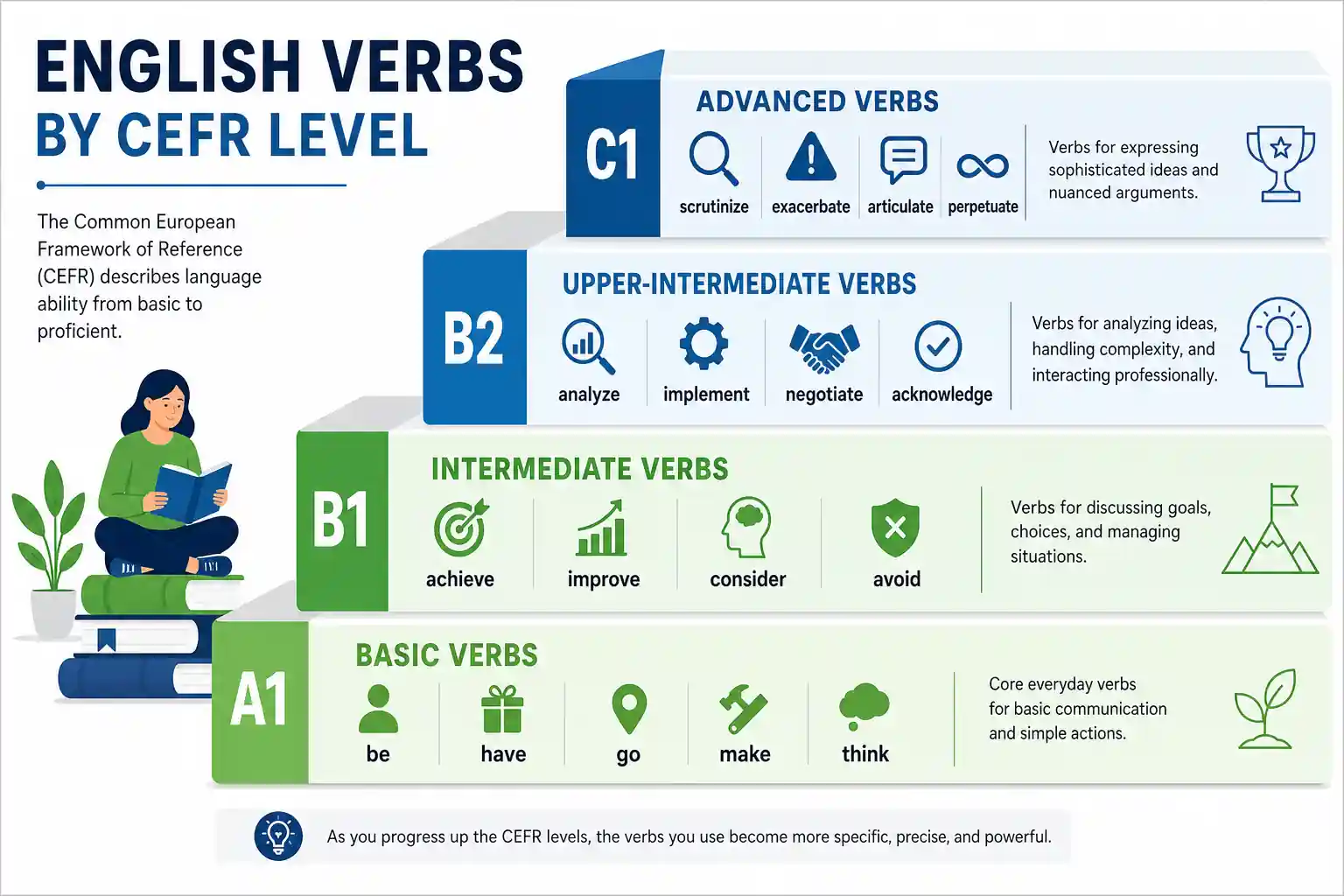
進捗チェック
このテーブルを使って、自分の動詞知識を正直に評価してみましょう。各レベルについて、動詞をいくつ:
- 使える — 考えずにスピーキングやライティングで使える
- 理解できる — 読んだり聞いたりしたとき理解できる
- 知らない — 全く馴染みがない
| レベル | 合計 | 使える | 理解できる | 知らない | あなたのレベル |
|---|---|---|---|---|---|
| A1 | 75 | _ | _ | _ | 「使える」が60以上 → B1に進む準備OK |
| B1 | 75 | _ | _ | _ | 「使える」が60以上 → B2に進む準備OK |
| B2 | 75 | _ | _ | _ | 「使える」が60以上 → C1に進む準備OK |
| C1 | 75 | _ | _ | _ | 「使える」が50以上 → 上級話者 |
目標: 「理解できる」から「使える」に移行させることです。それが受動語彙と能動語彙の違いです。文を書いたり、会話で動詞を使ったり、間隔反復で復習しましょう。
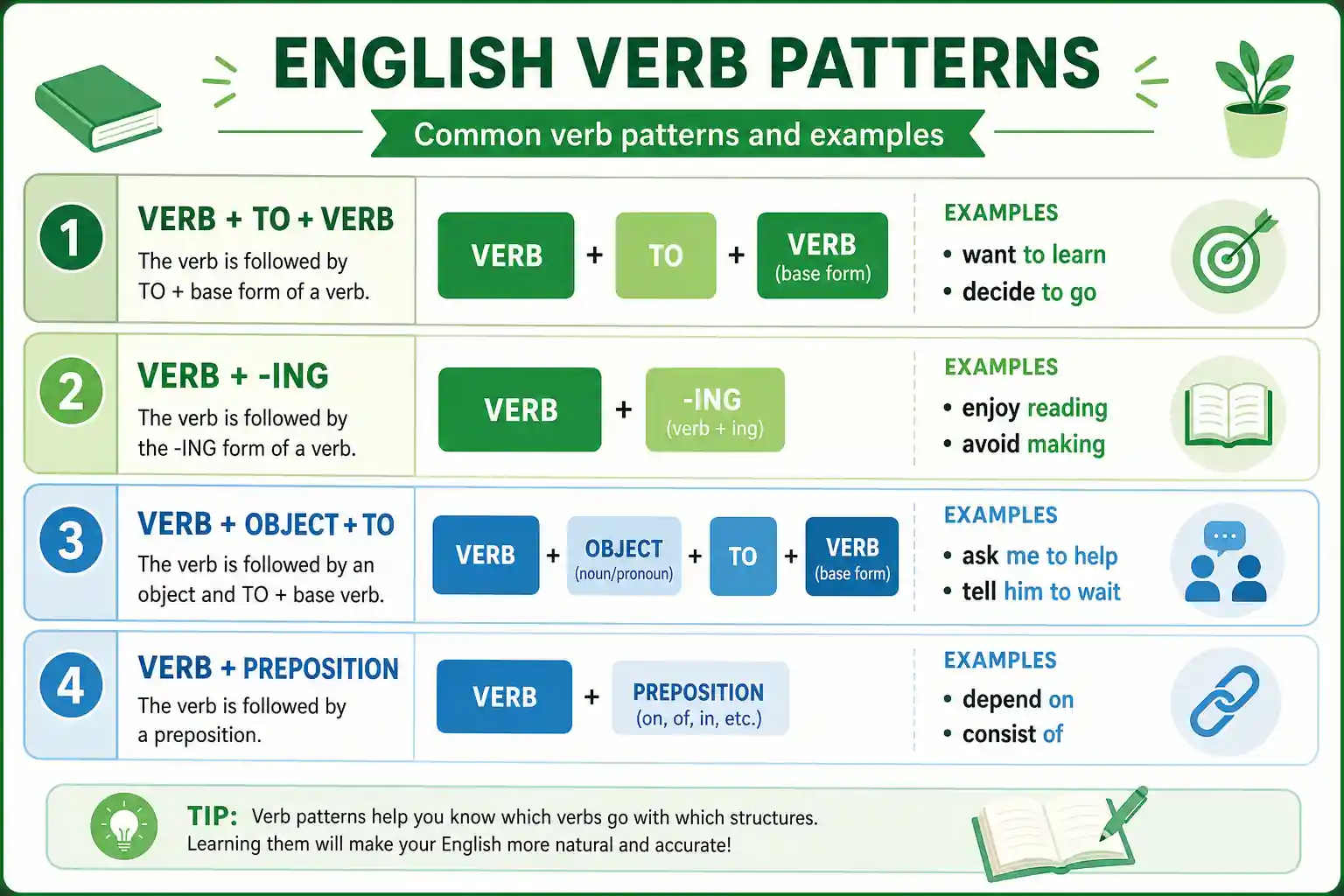
動詞パターン:マスターリファレンス
最も多いエラーの原因は動詞の意味ではなく、動詞の後に何が続くかです。ここに主要パターンのマスターリファレンスをまとめます。
Verb + TO + 不定詞
これらの動詞の後には “to + 動詞” が続きます:
want, need, decide, hope, plan, offer, refuse, promise, agree, learn, seem, appear, tend, manage, fail, afford, attempt, expect, intend, pretend
She decided to leave early. / They agreed to pay the full amount.
Verb + -ING(動名詞)
これらの動詞の後には -ing 形が続きます:
enjoy, avoid, consider, suggest, finish, mind, keep, practice, deny, admit, imagine, involve, risk, miss, delay, recommend, appreciate
I enjoy reading before bed. / She avoided answering the question.
Verb + 目的語 + TO + 不定詞
これらの動詞には目的語が必要で、その後に “to + 動詞” が続きます:
ask, tell, want, expect, allow, encourage, invite, force, remind, persuade, advise, warn, convince, enable, require
He asked me to help. / They encouraged her to apply.
Verb + 前置詞
以下の一般的な動詞+前置詞の組み合わせは、学習者が間違った前置詞を使うことでミスが生じやすいものです:
| Verb | Correct Preposition | Example |
|---|---|---|
| depend | on | It depends on the weather. |
| consist | of | The team consists of ten people. |
| belong | to | This belongs to me. |
| apply | for (a job) / to (a rule) | She applied for a visa. |
| suffer | from | He suffers from allergies. |
| contribute | to | Exercise contributes to good health. |
| result | in / from | The error resulted in delays. |
| comply | with | You must comply with the rules. |
| object | to | She objected to the proposal. |
| cope | with | He couldn’t cope with the pressure. |
練習用の単語
B1〜B2セクションから、汎用性の高い25の動詞を紹介します。これらを語彙に追加し、正しいパターンを使った文で練習してみましょう。
cooperate
動詞
協力する, 協働する
evaluate
動詞
評価する, 査定する
例
- Companies evaluate job candidates based on experience, skills, and personality.
- Teachers evaluate student progress through tests, projects, and classroom participation.
donate
動詞
寄付する
例
- Many people donate money to charities that help homeless individuals.
- She decided to donate blood to help patients in emergency situations.
discourage
動詞
落胆させる, 思いとどまらせる, 意欲をなくさせる
例
- Don't let one failure discourage you from pursuing your dreams.
- High prices discourage many people from buying organic food products.
graduate
動詞
卒業する
例
- She will graduate from university next year with a degree in engineering.
- Students must complete all requirements before they can graduate from high school.
resolve
動詞
解決する, 決意する
例
- Mediator helps parties resolve dispute through negotiation.
- Technical team will resolve software problems quickly.
off
副詞
離れて, 切れて, 休みの
例
- Please turn off the lights before leaving the room.
- The dog ran off into the forest chasing wild rabbits.
stress
動詞
強調する, 緊張させる
例
- Heavy workload may stress employees beyond limits.
- Teacher will stress importance of homework completion.
guide
動詞
案内する
例
- Parents should guide their children to make responsible decisions.
- The experienced hiker will guide the group through the mountain trail safely.
artery
名詞
動脈
例
- The blocked artery required immediate surgical intervention to save his life.
- This highway is a major artery connecting the city to surrounding areas.
coastal
形容詞
沿岸の, 海岸の, 海辺の
例
- Coastal towns often depend on fishing and tourism for their economy.
- The coastal erosion threatens many beachfront properties and buildings.
candidate
名詞
候補者, 志願者
例
- Each presidential candidate presented their policy plans to voters.
- The job candidate impressed the interview panel with her experience.
horizon
名詞
地平線
例
- The sun disappeared behind the horizon as evening approached.
- Traveling broadens your horizon and exposes you to new cultures.
jury
名詞
陪審団, 陪審
例
- The jury deliberated for several hours before reaching a verdict.
- The talent show jury consisted of professional musicians and entertainers.
prejudice
名詞
偏見, 先入観, 差別
例
- Education helps overcome prejudice and promotes understanding.
- Racial prejudice damages communities and individuals alike.
tragedy
名詞
悲劇
例
- Natural tragedy affects thousands of innocent people.
- Personal tragedy changes person's life perspective completely.
boom
名詞
急増, ブーム, 爆発
例
- The boom of thunder echoed across the valley.
- The technology boom created many new millionaires.
admission
名詞
入場, 入学, 認めること
例
- Her admission to the prestigious medical school was the result of hard work.
- The museum offers free admission on the first Sunday of every month.
union
名詞
連合, 結合, 協会
例
- Labor union protects worker rights and interests.
- Marriage union joins two people in partnership.
voyage
名詞
航海, 旅行
例
- Space exploration represents humanity's greatest voyage into the unknown.
- The ocean voyage from Europe to America took several weeks in the past.
humorous
形容詞
ユーモラスな, 面白い, 滑稽な
例
- She writes humorous articles about everyday life and family experiences.
- The humorous speech made everyone laugh and lightened the serious mood.
lifelong
形容詞
一生の, 生涯の
例
- Learning is a lifelong process that never truly ends.
- Their lifelong friendship began during elementary school years.
motivated
形容詞
やる気のある
例
- Motivated employee seeks additional responsibilities and challenges at work.
- Success requires being motivated even when facing difficult obstacles.
indispensable
形容詞
不可欠な
例
- Clean water is indispensable for human survival and good health.
- Her experience and skills make her indispensable to the research team.
total
形容詞
全体の, 総合的な, 完全な
例
- Total cost includes all fees and expenses.
- Total silence fills room during meditation session.
次にやるべきこと
-
自分のレベルを見つける。 現在のCEFRレベルのリストを確認しましょう。理解はできるが、能動的に使えない動詞をマークしてください。それらが優先的に学ぶべきターゲットです。
-
1日5動詞を学ぶ。 各動詞について、意味、主要パターン(何が後に続くか)、例文を1つ学びましょう。同じパターンを使って自分の文を書いてみてください。
-
パターンに注目する。 「suggest」は -ing を取る(”to + verb” ではない)ことを知っていれば、上級学習者でもよくするエラーを防げます。意味と同じくらいパターンにも注意を払いましょう。
-
動詞が多い文章を読む。 ニュース記事、学術論文、ビジネス文書にはB2〜C1の動詞が豊富に含まれています。私たちのブログ記事は、こうした動詞に自然に触れられるように書かれています。
-
関連語形を学ぶ。 各動詞は単語ファミリーにつながっています。Analyze → analysis(名詞)、analytical(形容詞)、analytically(副詞)。1つの動詞から語族全体を学ぶことで、効率的に語彙を増やせます。CEFRレベル別ライブラリで整理された単語リストをご覧ください。
よくある質問
英語で最もよく使う動詞は何ですか?
英語で最も頻出する10の動詞は、be、have、do、say、go、get、make、know、think、takeです。これらは話し言葉における動詞使用の約25%を占めています。次に多い40の動詞(上記A1セクション参照)と合わせると、日常的な動詞使用の約70%をカバーします。残りの30%は、頻度は低いものの重要な何千もの動詞に分散しています。
英語には動詞がいくつありますか?
英語には合計で約25,000の動詞がありますが、そのほとんどはまれか非常に専門的なものです。一般的な辞書には約5,000の動詞が掲載されています。実践的な流暢さのためには、300〜500の動詞(そのパターンとコロケーションを含む)を知っていれば、日常のコミュニケーションでほぼすべてを表現できます。学術的・専門的な場面では、さらに200〜300の専門動詞を追加しましょう。
規則動詞と不規則動詞の違いは何ですか?
規則動詞は “-ed” を付けて過去形を作ります(work → worked, play → played)。不規則動詞は予測できない過去形を持ち、暗記する必要があります(go → went, think → thought, be → was)。よく使われる英語動詞のうち約200語が不規則動詞で、最も頻繁に使われる動詞に多い傾向があります。すべての活用形を含む完全な不規則動詞リストは、不規則動詞ガイドをご覧ください。
動詞パターンとは何ですか?なぜ重要なのですか?
動詞パターンとは、特定の動詞の後に続く文法構造のことです。例えば、”enjoy” の後には常に -ing が続き(enjoy reading)、”want” の後には常に “to + 動詞” が続きます(want to read)。間違ったパターン(enjoy to read や want reading)は文法エラーであり、ネイティブスピーカーはすぐに気づきます。動詞の意味と一緒に動詞パターンを学ぶことで、これらのエラーを防ぎ、自然な英語になります。
英語の動詞をもっと速く覚えるにはどうすればいいですか?
動詞は孤立してではなく、文脈の中で学びましょう。新しい動詞ごとに:(1) 意味を学ぶ、(2) 主要パターン(何が後に続くか)を学ぶ、(3) 例文を2〜3個読む、(4) 自分の文を書く。復習には間隔反復を活用しましょう。動詞をアルファベット順ではなくテーマ別(「コミュニケーション」の動詞をまとめてなど)にグループ化すると、脳が関連語をネットワークとして記憶するため、より覚えやすくなります。