Palavras Difíceis de Escrever em Inglês: 200 Palavras Complicadas com Dicas
A ortografia do inglês é famosamente irregular. O mesmo som pode ser escrito de dez formas diferentes (through, too, blue, shoe, crew, you, flu, coup, Hugh, lieu), e as mesmas letras podem produzir sons completamente diferentes (cough, through, though, thought, tough). Até falantes nativos escrevem palavras comuns errado a vida toda.
Por que a ortografia do inglês é tão caótica? Porque o inglês tomou emprestado palavras do latim, grego, francês, alemão, nórdico antigo, árabe, hindi e dezenas de outros idiomas — e frequentemente manteve a grafia original enquanto mudava a pronúncia. O resultado: uma língua onde “colonel” é pronunciado “kernel” e “Wednesday” tem um “d” mudo.
Este guia lista 200 das palavras mais comumente escritas de forma errada em inglês, organizadas pelo tipo de armadilha ortográfica. Cada palavra inclui o erro comum, a grafia correta e um truque de memória para acertar.
- Total: 200 palavras difíceis
- Formato: Grafia correta → Erro comum → Dica de memória
- Organizado por: padrão ortográfico (letras mudas, letras duplas, etc.)
- Nível: A2–C1
- Para: melhorar a ortografia, preparar-se para exames e escrever com confiança
Para conhecer outras palavras difíceis além das que têm grafia complicada, veja Palavras Difíceis em Inglês: 500+ Palavras Complicadas.
Por Que a Ortografia do Inglês é Tão Difícil
O inglês tem 44 sons mas apenas 26 letras. Essa incompatibilidade cria caos:
| Problema | Exemplo | O Que Dá Errado |
|---|---|---|
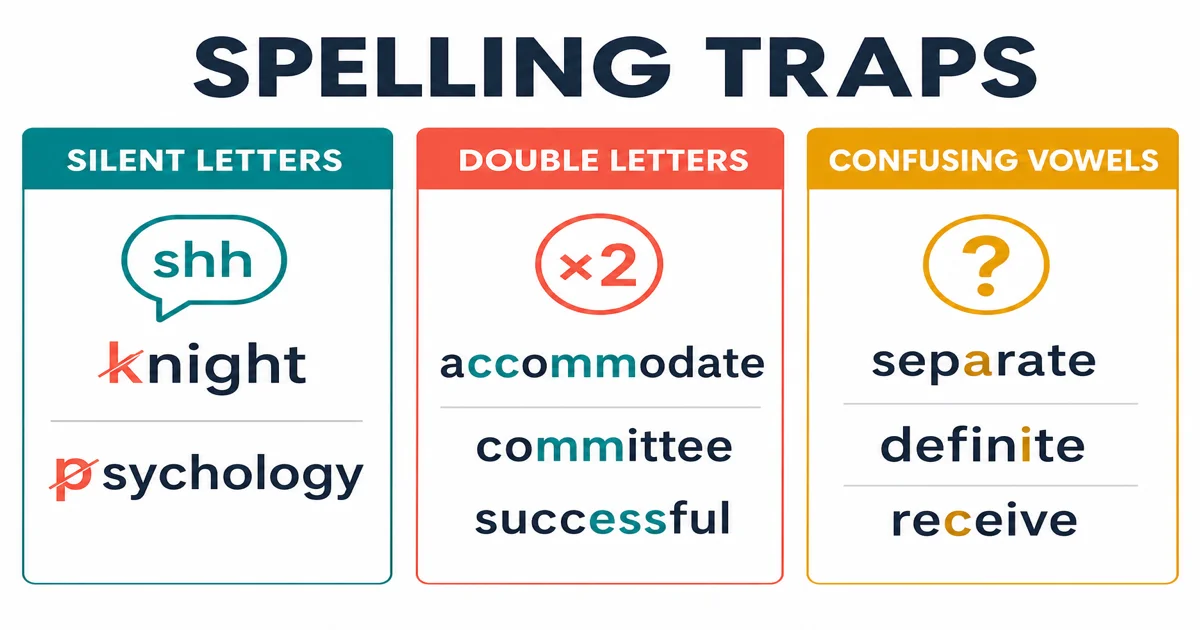
| Letras mudas | knight, psychology, receipt | Letras que você vê mas não ouve |
| Letras duplas | accommodate, occurrence | Uma ou duas? Difícil de lembrar |
| Vogais átonas | separate, definitely | Vogais que soam como “uh” na fala |
| -ible vs. -able | responsible, comfortable | Sem regra clara para qual terminação |
| -ence vs. -ance | occurrence, resistance | Ambas soam idênticas |
| i antes de e | receive, weird, seize | A “regra” tem mais exceções do que seguidores |
A boa notícia: a maioria dos erros de ortografia segue padrões previsíveis. Aprenda esses padrões e você eliminará 80% dos erros.
Letras Mudas (30 Palavras)
Estas palavras contêm letras que são escritas, mas não pronunciadas — a armadilha ortográfica mais enganosa do inglês.
| # | Grafia Correta | Erro Comum | Dica de Memória |
|---|---|---|---|
| 1 | acquaintance |
|
ACQuire an ACQuaintance |
| 2 | acknowledge |
|
You need to aCKnowledge the CK |
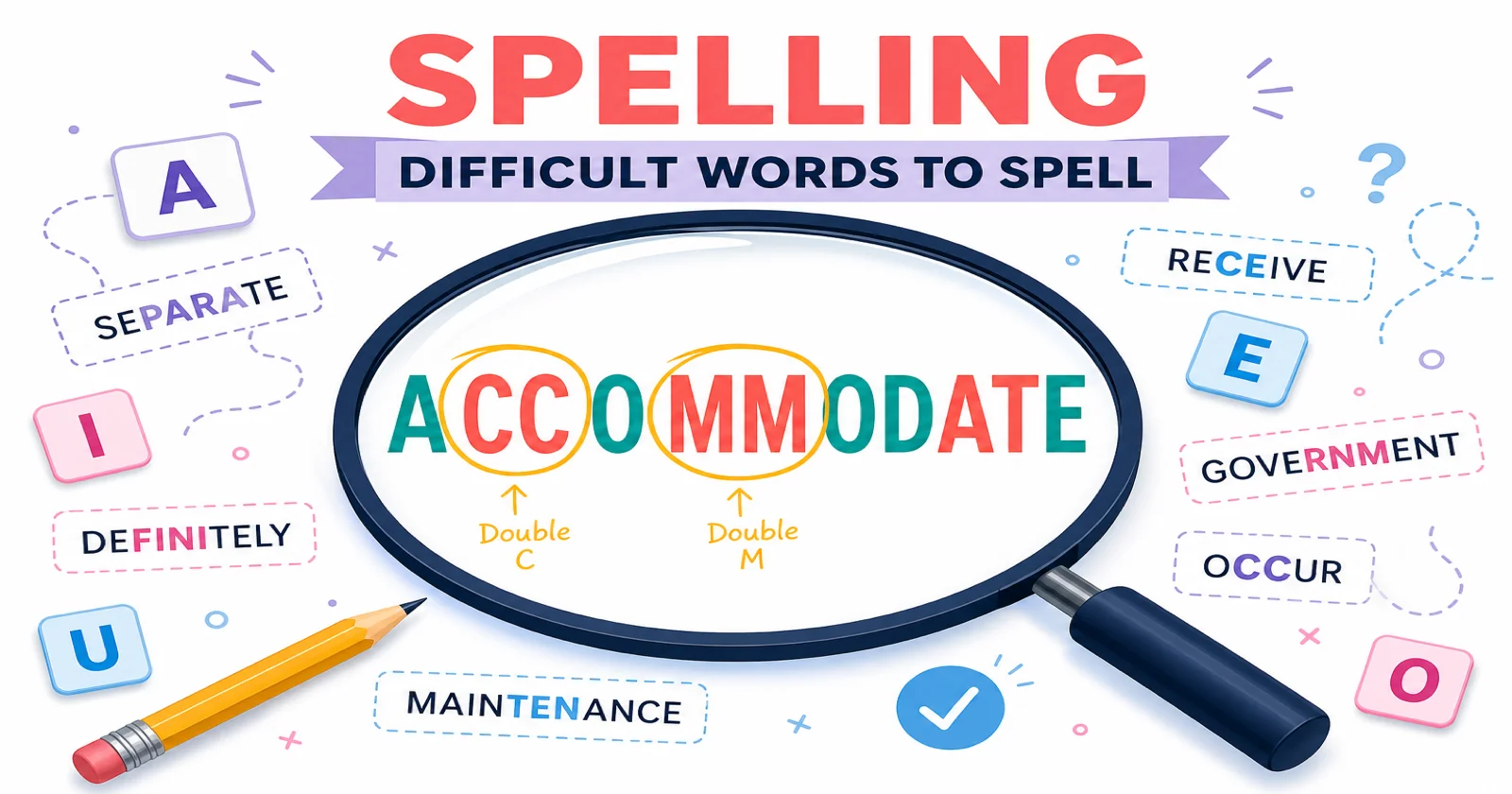
| 3 | column |
|
O N é mudo como uma coluna parada |
| 4 | conscience |
|
CON + SCIENCE = conscience |
| 5 | fascinate |
|
Há um SC escondido — como em “science” |
| 6 | foreign |
|
FORE + IGN — ignore a ordem estranha |
| 7 | government |
|
GOVERN + MENT — mantenha o N |
| 8 | guarantee |
|
GUA + RAN + TEE — três partes |
| 9 | handkerchief |
|
HAND + KERCHIEF — é para sua mão |
| 10 | island |
|
An island IS LAND |
| 11 | knight |
|
K mudo — do inglês antigo |
| 12 | knowledge |
|
KNOW + LEDGE — você conhece a borda |
| 13 | listen |
|
LISTEN tem um T mudo |
| 14 | mortgage |
|
MORT (morte) + GAGE — penhor de morte |
| 15 | muscle |
|
MUSC + LE — pense em “muscular” |
| 16 | pneumonia |
|
P é mudo — do grego “pneuma” (respiração) |
| 17 | psychology |
|
P é mudo — do grego “psyche” (mente) |
| 18 | receipt |
|
P mudo — receiPt |
| 19 | rhythm |
|
Rhythm Has Your Two Hips Moving |
| 20 | salmon |
|
L mudo — SALmon |
| 21 | scissors |
|
SC + ISSORS — SS duplo |
| 22 | subtle |
|
O B é sutil em “subtle” |
| 23 | sword |
|
W mudo — do inglês antigo |
| 24 | technique |
|
TECH + NIQUE — mantenha o H |
| 25 | Wednesday |
|
WED + NES + DAY — nomeado após Woden |
| 26 | whistle |
|
WH no início, T no meio |
| 27 | wrestle |
|
W mudo — como “write” e “wrong” |
| 28 | yacht |
|
Do holandês — o CH é mudo |
| 29 | answer |
|
W mudo — ansWer |
| 30 | doubt |
|
B mudo — do latim “dubitare” |
Letras Duplas (35 Palavras)
O erro de ortografia mais comum: esquecer de dobrar uma letra, ou dobrar a errada.
| # | Grafia Correta | Erro Comum | Dica de Memória |
|---|---|---|---|
| 31 | accommodate |
|
2 C’s e 2 M’s — é grande o suficiente para acomodar os dois |
| 32 | accelerate |
|
2 C’s, 1 L — aCCeLerate |
| 33 | accessory |
|
2 C’s, 2 S’s — aCCeSSory |
| 34 | aggressive |
|
2 G’s — aGGressive |
| 35 | apparent |
|
2 P’s — aPParent |
| 36 | broccoli |
|
2 C’s, 1 L — broCColi |
| 37 | Caribbean |
|
1 R, 2 B’s — caRiBBean |
| 38 | committed |
|
2 M’s, 2 T’s — coMMiTTed |
| 39 | committee |
|
2 M’s, 2 T’s, 2 E’s — coMMiTTEE |
| 40 | disappear |
|
1 S, 2 P’s — diSaPPear |
| 41 | disappoint |
|
1 S, 2 P’s — diSaPPoint |
| 42 | embarrass |
|
2 R’s, 2 S’s — embaRRaSS |
| 43 | exaggerate |
|
2 G’s — exaGGerate |
| 44 | excellence |
|
2 L’s — exceLLence |
| 45 | harass |
|
1 R, 2 S’s — haRaSS |
| 46 | innocence |
|
2 N’s — iNNocence |
| 47 | interrupt |
|
2 R’s — inteRRupt |
| 48 | millennium |
|
2 L’s, 2 N’s — miLLeNNium |
| 49 | misspell |
|
MIS + SPELL — 2 S’s (ironicamente!) |
| 50 | necessary |
|
1 C, 2 S’s — uma camisa tem 1 Colarinho e 2 mangas |
| 51 | occasion |
|
2 C’s, 1 S — oCCaSion |
| 52 | occurrence |
|
2 C’s, 2 R’s — oCCuRRence |
| 53 | parallel |
|
2 L’s no meio — paraLLel |
| 54 | possession |
|
2 S’s duas vezes — poSSESSion |
| 55 | professional |
|
1 F, 2 S’s — proFeSSional |
| 56 | questionnaire |
|
2 N’s — questioNNaire |
| 57 | recommend |
|
1 C, 2 M’s — reCcoMMend |
| 58 | referring |
|
2 R’s — refeRRing |
| 59 | succeed |
|
2 C’s — suCCeed |
| 60 | suggest |
|
2 G’s — suGGest |
| 61 | tomorrow |
|
1 M, 2 R’s — toMoRRow |
| 62 | address |
|
2 D’s — aDDress |
| 63 | assistant |
|
2 S’s — aSSistant |
| 64 | beginning |
|
2 N’s — begiNNing |
| 65 | different |
|
2 F’s — diFFerrent |
Vogais Confusas (30 Palavras)
Quando as vogais não são tônicas, todas soam como “uh” (o som schwa /ə/). Por isso, é impossível escrever corretamente apenas pelo som.
| # | Grafia Correta | Erro Comum | Dica de Memória |
|---|---|---|---|
| 66 | separate |
|
There’s A RAT in separate |
| 67 | definitely |
|
FINITE está no meio — deFINITEly |
| 68 | desperate |
|
Pense em “PERATE” não “PARATE” |
| 69 | calendar |
|
cAlEndAr — três A’s |
| 70 | cemetery |
|
Todos E’s — cEmEtEry |
| 71 | category |
|
catEgory — E no meio |
| 72 | privilege |
|
Sem D — é priviLEGE |
| 73 | relevant |
|
relEvAnt — E depois A |
| 74 | independent |
|
DENT no final — indepenDENT |
| 75 | repetition |
|
rEpEtition — dois E’s |
| 76 | resistance |
|
resistANCE — A não E |
| 77 | maintenance |
|
MAIN + TEN + ANCE |
| 78 | miniature |
|
MINI + ATURE — mantenha o I |
| 79 | original |
|
ORIGIN + AL |
| 80 | temperature |
|
TEMPER + ATURE — mantenha o segundo E |
| 81 | tolerance |
|
tolerANCE — A não E |
| 82 | ignorance |
|
ignorANCE — A não E |
| 83 | abundance |
|
abundANCE — A não E |
| 84 | existence |
|
existENCE — E não A |
| 85 | occurrence |
|
occurrENCE — E não A |
| 86 | preference |
|
preferENCE — E não A |
| 87 | reference |
|
referENCE — E não A |
| 88 | experience |
|
experiENCE — E não A |
| 89 | absence |
|
abSENCE — não SENSE |
| 90 | license |
|
LICENSE — C antes de S |
| 91 | medicine |
|
mEDICine — MEDIC está dentro |
| 92 | vegetable |
|
vEGEtable — dois E’s |
| 93 | secretary |
|
SECRET + ARY |
| 94 | laboratory |
|
LABOR + ATORY — mantenha o segundo O |
| 95 | vocabulary |
|
VOCAB + ULARY |
-ible vs. -able (20 Palavras)
Não existe uma regra confiável. É preciso aprender qual terminação cada palavra usa.
| # | Grafia Correta | Erro Comum | Dica de Memória |
|---|---|---|---|
| 96 | responsible |
|
responsIBLE |
| 97 | terrible |
|
terrIBLE |
| 98 | visible |
|
visIBLE |
| 99 | possible |
|
possIBLE |
| 100 | flexible |
|
flexIBLE |
| 101 | incredible |
|
incredIBLE |
| 102 | accessible |
|
accessIBLE |
| 103 | compatible |
|
compatIBLE |
| 104 | comfortable |
|
comfortABLE |
| 105 | available |
|
availABLE |
| 106 | reasonable |
|
reasonABLE |
| 107 | knowledgeable |
|
knowledgeABLE |
| 108 | manageable |
|
manageABLE |
| 109 | noticeable |
|
noticeABLE — mantenha o E |
| 110 | changeable |
|
changeABLE — mantenha o E |
| 111 | believable |
|
believABLE |
| 112 | dependable |
|
dependABLE |
| 113 | considerable |
|
considerABLE |
| 114 | inevitable |
|
inevitABLE |
| 115 | memorable |
|
memorABLE |
ie vs. ei (15 Palavras)
A regra “i antes de e, exceto depois de c” tem tantas exceções que mal pode ser chamada de regra.
| # | Grafia Correta | Erro Comum | Dica de Memória |
|---|---|---|---|
| 116 | receive |
|
Após C → EI: reCEIve |
| 117 | believe |
|
Sem C → IE: beLIEve |
| 118 | achieve |
|
Sem C → IE: achIEve |
| 119 | deceive |
|
Após C → EI: deCEIve |
| 120 | perceive |
|
Após C → EI: perCEIve |
| 121 | conceive |
|
Após C → EI: conCEIve |
| 122 | ceiling |
|
Após C → EI: cEIling |
| 123 | weird |
|
Exceção! WEIRD is weird |
| 124 | seize |
|
Exceção! SEIze |
| 125 | their |
|
Exceção! THEIR = THEy + IR |
| 126 | height |
|
Exceção! HEIght |
| 127 | neighbor |
|
EI quando soa como “ay”: nEIghbor |
| 128 | freight |
|
EI quando soa como “ay”: frEIght |
| 129 | protein |
|
Exceção! protEIn |
| 130 | foreign |
|
Exceção! forEIgn |
Palavras que as Pessoas Confundem (25 Palavras)
Estas palavras não são apenas difíceis de escrever — também são fáceis de confundir entre si.
| # | Forma Correta | Confundida Com | A Diferença |
|---|---|---|---|
| 131 | affect (verbo) | effect (substantivo) | The rain will affect your plans. / The effect was immediate. |
| 132 | principal (principal/diretor) | principle (regra) | The principal announced a new principle. |
| 133 | stationary (sem movimento) | stationery (papel) | Stationary = parado; Stationery = papel e caneta |
| 134 | complement (completar) | compliment (elogio) | Complement completa; Compliment = “I gosto de você” |
| 135 | conscience (moral) | conscious (consciente) | ConsciENCE = senso interno; ConsciOUS = VOCÊ está ciente |
| 136 | desert (deserto) | dessert (sobremesa) | Dessert tem 2 S’s — você sempre quer Segundos de deSSert |
| 137 | loose (solto) | lose (perder) | Loose = solto; Lose = um O foi embora (você perdeu!) |
| 138 | its (possessivo) | it’s (it is) | It’s = it IS (apóstrofo = contração) |
| 139 | their (possessivo) | there/they’re | Their = posse; There = lugar; They’re = they are |
| 140 | your (possessivo) | you’re (you are) | You’re = you ARE |
| 141 | than (comparação) | then (tempo) | thAN = compAração; thEN = quANdo |
| 142 | weather (clima) | whether (se) | wEAther tem ouvido — você ouve previsões do tempo |
| 143 | advice (substantivo) | advise (verbo) | AdvICE = substantivo; AdvISE = verbo |
| 144 | practice (substantivo) | practise (verbo) | PractICE = substantivo; PractISE = verbo (inglês britânico) |
| 145 | licence (substantivo) | license (verbo) | Mesmo padrão (inglês britânico) |
| 146 | brake (freio) | break (quebrar) | BrAKE = freAr; BreAK = algo quebra |
| 147 | quiet (silencioso) | quite (bastante) | quiET = quieto; quiTE = quite diferente |
| 148 | accept (aceitar) | except (exceto) | ACcept = Adquirir; EXcept = EXcluir |
| 149 | ensure (garantir) | insure (segurar) | ENsure = garantir; INsure = INsurance |
| 150 | emigrate (sair) | immigrate (chegar) | Emigrate = Exit; Immigrate = In |
| 151 | elicit (extrair) | illicit (ilegal) | eLICit = Legal; iLLICit = iLLegal |
| 152 | farther (distância) | further (mais) | fARther = how fAR; fURther = mais |
| 153 | discreet (cuidadoso) | discrete (separado) | discrEET = secreto; discrETE = separaTE |
| 154 | proceed | precede | proCEED = avançar; preCEDE = vir antes |
| 155 | personnel (funcionários) | personal (pessoal) | personNEL = funcionários; personAL = privado |
Palavras do Dia a Dia Comumente Escritas Errado (45 Palavras)
São palavras que você usa todos os dias — e que muita gente escreve errado repetidamente.
| # | Grafia Correta | Erro Comum | Dica de Memória |
|---|---|---|---|
| 156 | accommodation |
|
2 C’s, 2 M’s |
| 157 | argument |
|
Tire o E de “argue” |
| 158 | beautiful |
|
BEAUTY + FUL (um L) |
| 159 | beginning |
|
N duplo — begiNNing |
| 160 | business |
|
BUS + I + NESS |
| 161 | completely |
|
COMPLETE + LY |
| 162 | convenience |
|
conVENience — VENI (latim: vir) |
| 163 | curiosity |
|
Tire o “ous” — CURIOS + ITY |
| 164 | decision |
|
DECIS + ION (de “decide”) |
| 165 | description |
|
DESCription — DESCRIBE sem o B + TION |
| 166 | development |
|
DEVELOP + MENT (sem E antes de MENT) |
| 167 | dictionary |
|
DICTION + ARY |
| 168 | disappearance |
|
1 S, 2 P’s — DIS + APPEARANCE |
| 169 | discipline |
|
DISC + IP + LINE |
| 170 | environment |
|
ENVIRON + MENT — mantenha o N |
| 171 | especially |
|
E + SPECIAL + LY |
| 172 | exaggeration |
|
2 G’s — exaGGeration |
| 173 | exercise |
|
EXER + CISE |
| 174 | February |
|
FEB + RU + ARY — mantenha o primeiro R |
| 175 | grammar |
|
grammAR termina em AR, não ER |
| 176 | immediately |
|
2 M’s — iMMediately |
| 177 | jewelry |
|
JEWEL + RY |
| 178 | judgment |
|
JUDGE − E + MENT (inglês americano) |
| 179 | library |
|
LIB + RARY — mantenha o primeiro R |
| 180 | lightning |
|
LIGHT + NING (sem E) |
| 181 | occasionally |
|
2 C’s, 1 S — oCCaSionally |
| 182 | particular |
|
PARTICULAR — PAR não PER |
| 183 | perseverance |
|
perseverANCE — A não E |
| 184 | preferred |
|
2 R’s — prefeRRed |
| 185 | probably |
|
PROB + ABLY |
| 186 | pronunciation |
|
proNUNciation — sem “OUNCE” |
| 187 | restaurant |
|
REST + AU + RANT |
| 188 | schedule |
|
SCHED + ULE |
| 189 | sentence |
|
SENT + ENCE |
| 190 | surprise |
|
SUR + PRISE — não esqueça o primeiro R |
| 191 | thorough |
|
THOROUGH — OUGH no final |
| 192 | truly |
|
TRUE − E + LY |
| 193 | twelfth |
|
TWELF + TH — mantenha o F |
| 194 | unnecessary |
|
1 C, 2 S’s — UN + NECESSARY |
| 195 | until |
|
1 L — untiL |
| 196 | usually |
|
USUAL + LY |
| 197 | vacuum |
|
1 C, 2 U’s — vaCUUm |
| 198 | various |
|
VARI + OUS |
| 199 | weather |
|
WEATH + ER |
| 200 | weird |
|
WEIRD quebra a regra ie/ei — é mesmo WEIRD |
5 Regras que Realmente Ajudam
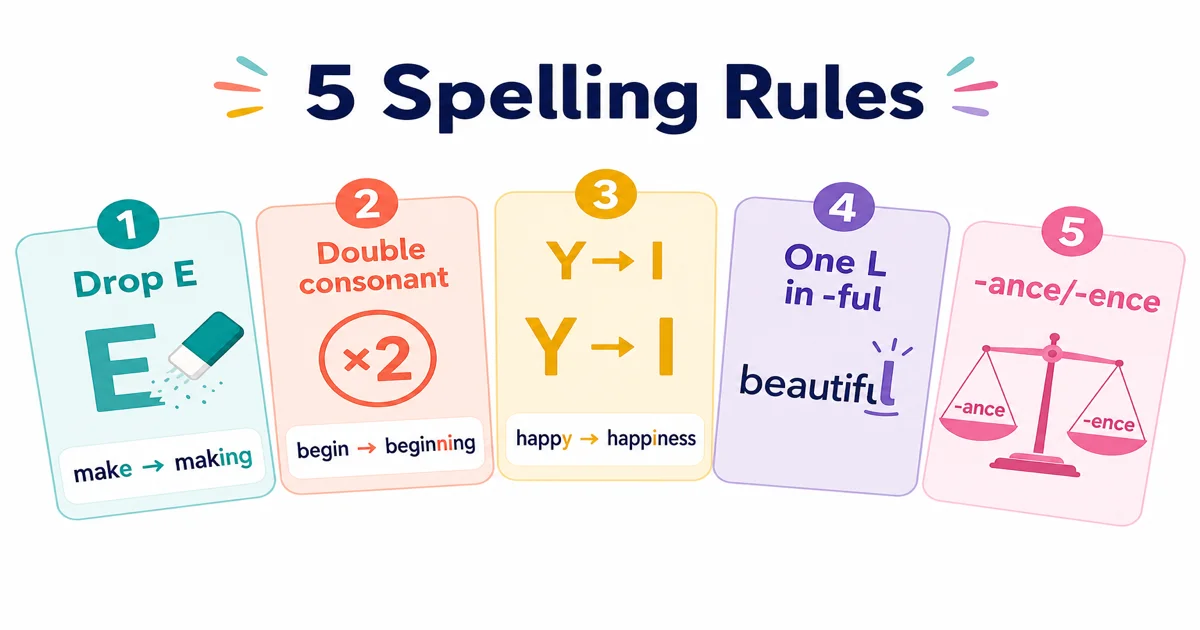
Regra 1: Tire o E antes de -ing e -able
make → making, love → lovable, write → writing
Exceções: noticeable, changeable (mantenha E após C ou G suave).
Regra 2: Dobre a consoante final antes de -ing/-ed se a última sílaba for tônica
begin → beginning, prefer → preferred, commit → committed
Mas: offer → offering (tônica na PRIMEIRA sílaba, então sem dobrar).
Regra 3: Troque Y por I antes de adicionar um sufixo
happy → happiness, carry → carried, beauty → beautiful
Mas mantenha Y antes de -ing: carry → carrying, study → studying.
Regra 4: Use -ful, não -full
Todo adjetivo terminado em -ful tem UM L: beautiful, wonderful, grateful, helpful.
Adicione -ly e você tem dois L’s: beautifully, wonderfully, gratefully.
Regra 5: -ance/-ence depende da forma do verbo
Se o verbo termina em -ate → substantivo geralmente termina em -ance: tolerate → tolerance Se o verbo termina em -ere → substantivo geralmente termina em -ence: interfere → interference
Como Melhorar sua Ortografia
Leia mais. A ortografia é principalmente memória visual. Quanto mais você vê palavras escritas corretamente, mais automática a ortografia correta se torna.
Escreva à mão. A digitação corrige seus erros silenciosamente. A escrita à mão força a memorização ativa. Escreva 5 a 10 palavras problemáticas à mão todos os dias.
Use repetição espaçada. Adicione suas “palavras problemáticas” pessoais ao Linglify. O sistema vai testá-lo em intervalos ideais até que a ortografia correta seja automática.
Aprenda raízes das palavras. Palavras formadas a partir de raízes latinas e gregas seguem padrões consistentes. Se você souber que psych- significa “mente” em grego, nunca esquecerá o P mudo em psychology, psychiatrist e psyche.
Crie mnemônicos. Os melhores truques de memória são pessoais: “There’s A RAT in separate” é bobo, mas eficaz. Crie os seus para as palavras que costuma escrever errado.
Palavras para Praticar
Estas 25 palavras aparecem com frequência em textos acadêmicos e profissionais. Adicione-as ao seu dicionário do Linglify para praticar com repetição espaçada.
boom
substantivo
explosão, auge
Exemplos
- The boom of thunder echoed across the valley.
- The technology boom created many new millionaires.
cooperate
verbo
cooperar, colaborar
evaluate
verbo
avaliar, julgar
Exemplos
- Companies evaluate job candidates based on experience, skills, and personality.
- Teachers evaluate student progress through tests, projects, and classroom participation.
graduate
verbo
se formar
Exemplos
- She will graduate from university next year with a degree in engineering.
- Students must complete all requirements before they can graduate from high school.
horizon
substantivo
horizonte
Exemplos
- The sun disappeared behind the horizon as evening approached.
- Traveling broadens your horizon and exposes you to new cultures.
indispensable
adjetivo
indispensável, essencial, fundamental
Exemplos
- Clean water is indispensable for human survival and good health.
- Her experience and skills make her indispensable to the research team.
jury
substantivo
juri
Exemplos
- The jury deliberated for several hours before reaching a verdict.
- The talent show jury consisted of professional musicians and entertainers.
lifelong
adjetivo
para toda a vida
Exemplos
- Learning is a lifelong process that never truly ends.
- Their lifelong friendship began during elementary school years.
motivated
adjetivo
motivado
Exemplos
- Motivated employee seeks additional responsibilities and challenges at work.
- Success requires being motivated even when facing difficult obstacles.
normally
advérbio
normalmente
Exemplos
- Heart normally beats between sixty and hundred times per minute.
- Students normally arrive at school before morning bell rings.
off
adjetivo
fora, desligado, apagado
Exemplos
- Please turn off the lights before leaving the room.
- The dog ran off into the forest chasing wild rabbits.
prejudice
substantivo
preconceito
Exemplos
- Education helps overcome prejudice and promotes understanding.
- Racial prejudice damages communities and individuals alike.
resolve
verbo
resolver
Exemplos
- Mediator helps parties resolve dispute through negotiation.
- Technical team will resolve software problems quickly.
stress
verbo
estressar, sobrecarregar, pressionar
Exemplos
- Heavy workload may stress employees beyond limits.
- Teacher will stress importance of homework completion.
total
adjetivo
total
Exemplos
- Total cost includes all fees and expenses.
- Total silence fills room during meditation session.
tragedy
substantivo
tragédia
Exemplos
- Natural tragedy affects thousands of innocent people.
- Personal tragedy changes person's life perspective completely.
union
substantivo
união, associação
Exemplos
- Labor union protects worker rights and interests.
- Marriage union joins two people in partnership.
voyage
substantivo
viagem
Exemplos
- Space exploration represents humanity's greatest voyage into the unknown.
- The ocean voyage from Europe to America took several weeks in the past.
candidate
substantivo
candidato
Exemplos
- Each presidential candidate presented their policy plans to voters.
- The job candidate impressed the interview panel with her experience.
discourage
verbo
desencorajar
Exemplos
- Don't let one failure discourage you from pursuing your dreams.
- High prices discourage many people from buying organic food products.
donate
verbo
doar
Exemplos
- Many people donate money to charities that help homeless individuals.
- She decided to donate blood to help patients in emergency situations.
firmly
advérbio
firmemente, com firmeza
Exemplos
- Hold the rope firmly while climbing down the steep mountain slope.
- The manager firmly believed in treating all employees with respect.
guide
verbo
orientar
Exemplos
- Parents should guide their children to make responsible decisions.
- The experienced hiker will guide the group through the mountain trail safely.
humorous
adjetivo
engraçado, divertido, cômico
Exemplos
- She writes humorous articles about everyday life and family experiences.
- The humorous speech made everyone laugh and lightened the serious mood.
admission
substantivo
admissão
Exemplos
- Her admission to the prestigious medical school was the result of hard work.
- The museum offers free admission on the first Sunday of every month.
O Que Fazer a Seguir
-
Teste-se. Leia as listas acima e marque cada palavra que já escreveu errado. Essas são suas palavras prioritárias.
-
Aprenda por padrão. Foque em uma categoria por vez — letras mudas numa semana, letras duplas na seguinte. Aprender por padrões é mais eficaz do que estudar listas aleatórias.
-
Adicione palavras problemáticas ao Linglify para praticar com repetição espaçada. Marque-as com a etiqueta “spelling” para criar sessões de revisão específicas.
-
Leia o guia completo — nosso Palavras Difíceis em Inglês: 500+ Palavras Complicadas cobre palavras difíceis de soletrar, pronunciar e usar.
-
Pratique escrevendo. Use suas palavras problemáticas de propósito em e-mails, redações e anotações. O uso ativo desenvolve a memória motora mais rápido do que a revisão passiva.
FAQ
Quais são as 10 palavras mais difíceis de escrever em inglês?
Entre as palavras mais frequentemente escritas errado estão: accommodate (dois C e dois M), separate (A, não E, no meio), definitely (sem A — termina em FINITE), occurrence (dois C e dois R), embarrass (dois R e dois S), rhythm (sem vogais no meio), millennium (dois L e dois N), conscience (combinação SC), questionnaire (dois N) e pronunciation (não tem ounce). Até falantes nativos erram essas palavras.
Por que a ortografia do inglês é tão irregular?
O inglês tomou palavras emprestadas do latim, grego, francês, alemão, nórdico antigo e muitos outros idiomas — frequentemente mantendo a grafia original enquanto a pronúncia mudava ao longo dos séculos. Além disso, entre 1400 e 1700, a pronúncia do inglês mudou drasticamente durante a Grande Mudança Vocálica (Great Vowel Shift), mas a grafia já havia sido padronizada. O resultado é um sistema escrito que reflete a pronúncia medieval, não a fala moderna.
Como posso melhorar minha ortografia rapidamente?
Três métodos funcionam melhor juntos: (1) leia bastante — a ortografia é principalmente memória visual, e ver as formas corretas repetidamente cria reconhecimento automático; (2) escreva à mão — isso exige evocação ativa, em vez de depender da correção automática; (3) use repetição espaçada — adicione suas palavras problemáticas pessoais a um sistema de revisão e pratique em intervalos cada vez maiores. Concentre-se em padrões (por exemplo, todas as palavras com letras duplas juntas) em vez de estudar listas aleatórias.
As regras de ortografia realmente funcionam em inglês?
Algumas regras são confiáveis: “retire o E antes de -ing” (make → making), “dobre a consoante se a última sílaba for tônica” (begin → beginning) e “-ful sempre tem um L” (beautiful, não beautifull). No entanto, regras como “i antes de e, exceto depois de c” têm tantas exceções que causam mais confusão do que resolvem. O método mais eficaz é aprender os padrões por categoria e usar repetição espaçada para as exceções.
A ortografia britânica é diferente da americana?
Sim, de maneiras previsíveis. No inglês britânico, aparecem as terminações -our (colour, favour), -ise (organise, realise), -re (centre, theatre) e -ence (licence, defence). No americano, são comuns -or (color, favor), -ize (organize, realize), -er (center, theater) e -ense (license, defense). Ambas as variantes estão corretas — escolha uma e mantenha a consistência. Em exames internacionais como o IELTS, qualquer uma é aceita, desde que você não misture os padrões.