Homônimos em Inglês: 200+ Exemplos com Significados e Frases
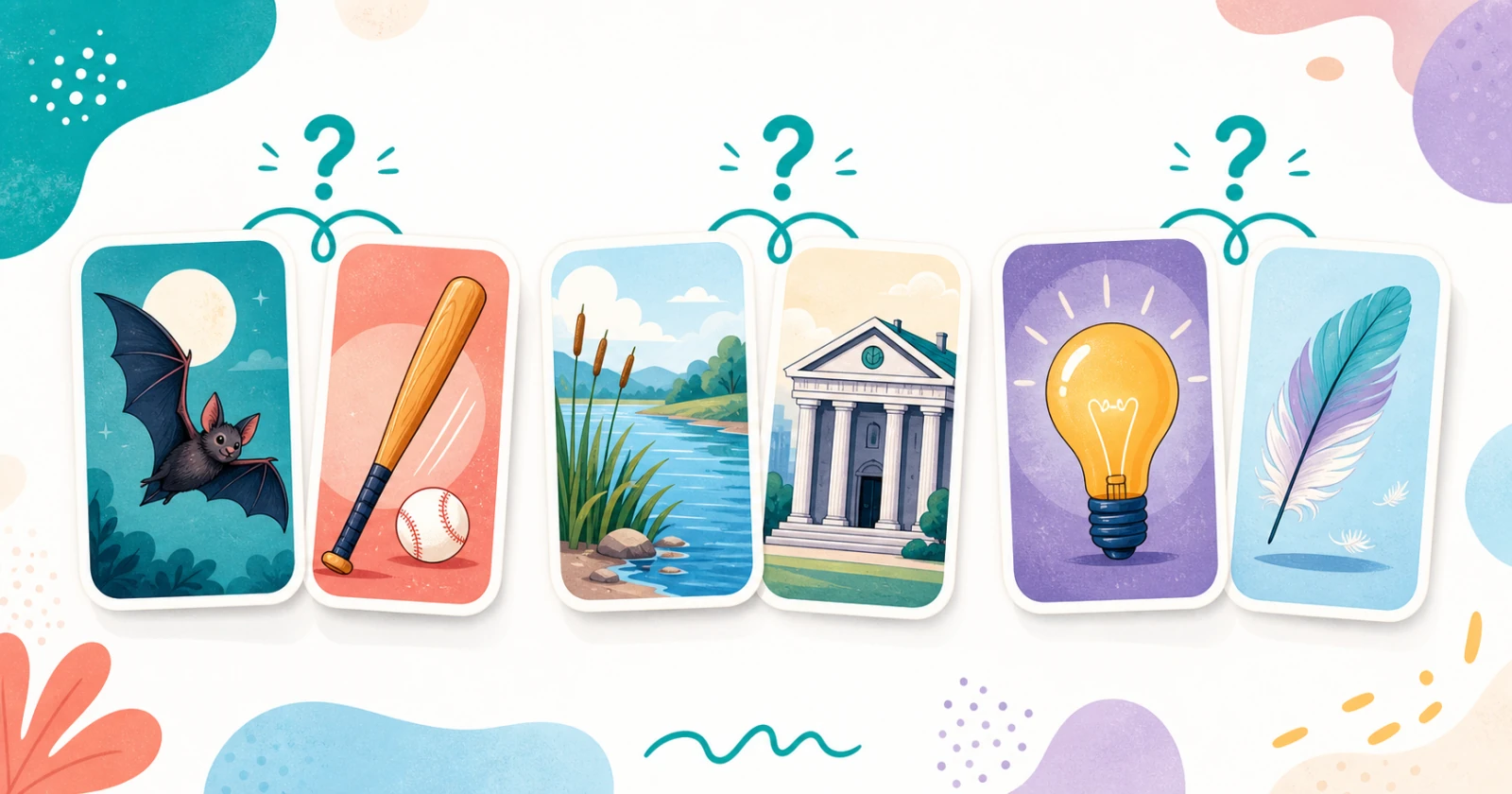
A palavra “bat” significa um animal voador e um equipamento esportivo. “Bank” significa uma instituição financeira e a margem de um rio. “Light” significa brilho e também significa não pesado. Esses são homônimos — palavras que compartilham a mesma ortografia ou pronúncia, mas têm significados completamente diferentes.
Os homônimos são um dos aspectos mais complicados do inglês. Você não consegue adivinhar o significado pretendido apenas pela palavra: precisa do contexto. Para quem está aprendendo, isso gera confusão constante: você conhece a palavra, mas não sabe qual significado se aplica.
Este guia reúne mais de 200 dos homônimos mais comuns em inglês, organizados por tipo. Cada entrada traz os principais significados e frases de exemplo claras, para você ver como o contexto determina o sentido usado.
- Total: 200+ homônimos
- Formato: Palavra → Significados → Frases de exemplo
- Organizado por: Tipo (homônimos verdadeiros, homógrafos, homófonos)
- Nível: A2–C1
Para consultar uma lista completa de homófonos, veja nosso guia de homófonos em inglês com mais de 300 exemplos.
O Que São Homônimos?
Um homônimo é uma palavra que tem a mesma ortografia ou pronúncia que outra palavra, mas um significado diferente. O termo vem do grego: homo (mesmo) + onym (nome).
Existem três tipos:
| Tipo | Mesma Ortografia? | Mesma Pronúncia? | Exemplo |
|---|---|---|---|
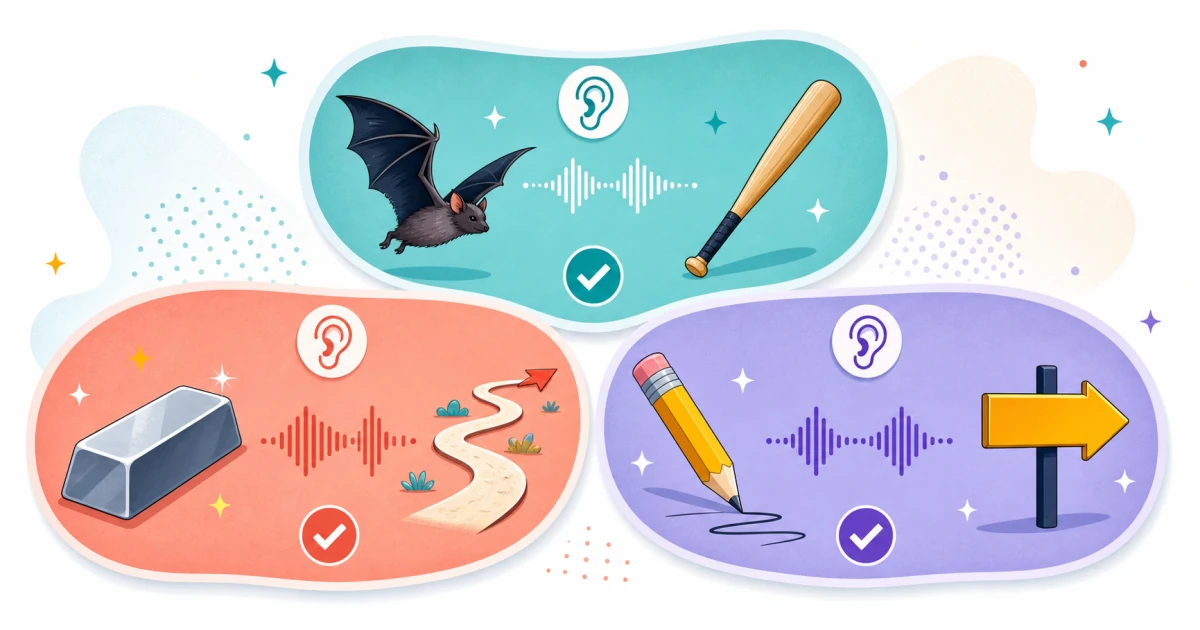
| Homônimo Verdadeiro | Sim | Sim | bat (animal) / bat (esporte) |
| Homógrafo | Sim | Não | lead (metal) / lead (guiar) |
| Homófono | Não | Sim | write / right |
Homônimos verdadeiros são escritos da mesma forma E pronunciados da mesma forma, mas têm significados não relacionados. Homógrafos são escritos da mesma forma mas pronunciados diferentemente. Homófonos soam da mesma forma mas são escritos diferentemente.
No uso cotidiano, as pessoas costumam chamar os três tipos de “homônimos”. Este guia aborda todos eles e indica o tipo em cada entrada.
Homônimos Verdadeiros (Mesma Ortografia + Mesma Pronúncia)
Estes são os homônimos clássicos: têm a mesma grafia e a mesma pronúncia, mas significados completamente diferentes.
A–D
| # | Palavra | Significado 1 | Significado 2 | Significado 3 |
|---|---|---|---|---|
| 1 | arm | parte do corpo abaixo do ombro — She broke her arm. | arma — The country armed its soldiers. | |
| 2 | ball | objeto redondo — Throw the ball! | dança formal — Cinderella went to the ball. | |
| 3 | band | grupo de músicos — The band played rock music. | tira de material — She wore a rubber band around her wrist. | |
| 4 | bank | instituição financeira — I went to the bank to deposit money. | margem de um rio — We sat on the bank of the Thames. | |
| 5 | bark | som que um cachorro faz — The dog barked at the stranger. | cobertura externa de uma árvore — The bark of the oak was rough. | |
| 6 | bat | mamífero voador — Bats come out at night. | equipamento esportivo — He swung the bat and hit the ball. | |
| 7 | bear | grande animal — We saw a bear in the forest. | carregar ou suportar — I can’t bear the noise. | |
| 8 | bill | uma nota de dinheiro — He paid with a $20 bill. | uma declaração de cobranças — The electricity bill was high. | bico de um pássaro — The duck’s bill was orange. |
| 9 | block | peça sólida de material — a block of ice | impedir — He blocked the entrance. | área entre ruas — Walk two blocks north. |
| 10 | board | peça plana de madeira — She nailed the board to the wall. | embarcar (num avião, ônibus) — We boarded the flight at 3 PM. | grupo de diretores — The board approved the plan. |
| 11 | book | uma obra escrita — I’m reading a great book. | reservar — I booked a hotel room. | |
| 12 | bow | parte frontal de um navio — The bow cut through the waves. | nó com dois laços — She tied a bow in her hair. | arma para atirar flechas — He practiced with a bow and arrow. |
| 13 | bright | cheio de luz — The room is very bright. | inteligente — She’s a bright student. | |
| 14 | can | recipiente de metal — a can of soup | ser capaz de — I can swim. | |
| 15 | capital | cidade onde fica o governo — Tokyo is the capital of Japan. | dinheiro/riqueza — We need capital to start the business. | letra maiúscula — Write your name in capitals. |
| 16 | change | tornar diferente — I changed my mind. | moedas — Do you have any change? | |
| 17 | chest | parte superior frontal do corpo — He felt pain in his chest. | caixa grande e forte — The treasure chest was locked. | |
| 18 | club | organização — She joined the chess club. | bastão pesado — a golf club | local de vida noturna — We went to a club on Saturday. |
| 19 | coat | roupa externa — Put on your coat — it’s cold. | camada de tinta — Apply two coats of paint. | |
| 20 | cool | ligeiramente frio — The water was cool and refreshing. | calmo e composto — Stay cool under pressure. | moderno, impressionante — That’s a cool jacket. |
| 21 | count | contar — Count the chairs in the room. | um nobre — Count Dracula | |
| 22 | crane | uma grande ave — We saw a crane by the lake. | uma máquina para levantar — A crane lifted the steel beams. | |
| 23 | current | fluxo de água/eletricidade — The river current is strong. | acontecendo agora — The current situation is stable. | |
| 24 | date | dia do mês — What’s today’s date? | uma fruta doce — I bought some dates at the market. | saída romântica — They went on a date. |
| 25 | deck | convés de um navio — We stood on the upper deck. | um baralho — Shuffle the deck. | |
| 26 | draft | versão preliminar — This is the first draft of the essay. | fluxo de ar frio — Close the window — there’s a draft. | selecionar para serviço militar — He was drafted in 1942. |
| 27 | draw | fazer uma imagem — She drew a portrait. | empate num jogo — The match ended in a draw. | puxar — Draw the curtains. |
| 28 | drop | uma gota de líquido — A drop of rain fell on my face. | cair ou deixar cair — I dropped my phone. | |
| 29 | duck | uma ave aquática — We fed the ducks in the park. | abaixar a cabeça rapidamente — Duck! The ball is coming! |
E–L
| # | Palavra | Significado 1 | Significado 2 | Significado 3 |
|---|---|---|---|---|
| 30 | express | rápido — an express train | comunicar — He expressed his concern. | |
| 31 | fair | justo, razoável — The decision was fair. | um evento público com atrações — We went to the county fair. | de pele clara — She has fair skin. |
| 32 | fan | dispositivo para mover ar — Turn on the fan. | um apoiador entusiasmado — She’s a big fan of soccer. | |
| 33 | file | pasta para documentos — Put it in the file cabinet. | alisar com uma ferramenta — She filed her nails. | enviar oficialmente — He filed a complaint. |
| 34 | fine | de alta qualidade — The wine was very fine. | dinheiro pago como punição — He got a $100 fine for speeding. | aceitável — “How are you?” “I’m fine.” |
| 35 | fire | chamas — The fire spread quickly. | demitir de um emprego — She was fired last week. | atirar — The soldier fired his weapon. |
| 36 | flat | superfície nivelada — The land is flat. | apartamento (britânico) — She lives in a flat in London. | murcho — I got a flat tire. |
| 37 | fly | um inseto — A fly landed on my food. | viajar de avião — We flew to Paris. | |
| 38 | foot | parte do corpo — My left foot hurts. | base de algo — at the foot of the mountain | 30 centímetros — The room is 10 feet wide. |
| 39 | grave | local de sepultamento — They visited the grave. | muito sério — This is a grave mistake. | |
| 40 | groom | homem que vai se casar — The groom looked nervous. | limpar ou preparar um animal — She groomed the horse. | |
| 41 | ground | superfície da terra — The ball hit the ground. | passado de “grind” — She ground the coffee beans. | |
| 42 | jam | geleia de frutas — strawberry jam | ficar preso — The printer jammed again. | congestionamento — We’re stuck in a traffic jam. |
| 43 | key | dispositivo para abrir fechaduras — I lost my house key. | crucial, importante — This is the key issue. | tom musical — The song is in the key of C. |
| 44 | kind | tipo, sorte — What kind of music do you like? | generoso e atencioso — She’s a very kind person. | |
| 45 | lap | uma volta numa pista — He completed 10 laps. | espaço sobre as coxas quando alguém está sentado — The cat sat on her lap. | |
| 46 | last | final — This is the last chance. | continuar — The meeting lasted two hours. | |
| 47 | lead | guiar — She led the team to victory. | uma coleira — Keep your dog on a lead. | |
| 48 | leaves | plural de “leaf” — The leaves turned brown. | parte — She leaves for work at 8 AM. | |
| 49 | letter | mensagem escrita — I received a letter. | símbolo do alfabeto — The letter ‘A’ is a vowel. | |
| 50 | lie | deitar — Lie down and rest. | dizer algo falso — Don’t lie to me. | |
| 51 | light | brilho — Turn on the light. | não pesado — The bag is very light. | pálido em cor — She has light blue eyes. |
| 52 | line | uma marca longa — Draw a straight line. | uma fila de pessoas — There’s a long line outside. | texto num roteiro — He forgot his lines. |
M–R
| # | Palavra | Significado 1 | Significado 2 | Significado 3 |
|---|---|---|---|---|
| 53 | match | competição esportiva — We watched the football match. | graveto para acender fogo — He struck a match. | corresponder — The colors don’t match. |
| 54 | mean | pretender — What do you mean? | cruel — Don’t be so mean to your sister. | média — the mean temperature |
| 55 | mine | pertencendo a mim — This book is mine. | escavação subterrânea — a coal mine | |
| 56 | miss | falhar em acertar ou pegar — I missed the bus. | título para mulher solteira — Miss Johnson | sentir falta de — I miss my family. |
| 57 | mole | um pequeno animal que cava túneis — A mole dug up the garden. | uma pinta na pele — She has a mole on her cheek. | unidade de medida em química — One mole of water |
| 58 | nail | metal fino e pontudo — He hammered the nail. | cobertura dura no dedo — She painted her nails red. | |
| 59 | net | material em malha — a fishing net | remanescente após deduções — net income | |
| 60 | note | mensagem escrita — She left a note on the desk. | tom musical — He played a high note. | dinheiro em papel — a ten-pound note |
| 61 | novel | uma longa história de ficção — She wrote a novel. | novo e incomum — That’s a novel approach. | |
| 62 | order | arranjo — Put them in alphabetical order. | pedir — I ordered a pizza. | comando — The officer gave an order. |
| 63 | organ | órgão do corpo — The heart is a vital organ. | instrumento musical — She plays the church organ. | |
| 64 | palm | parte interna da mão — He placed the coin in her palm. | palmeira tropical — palm trees on the beach | |
| 65 | park | área verde pública — We walked in the park. | estacionar um veículo — I parked the car. | |
| 66 | patient | pessoa recebendo cuidados médicos — The patient is recovering. | capaz de esperar calmamente — Be patient — your turn will come. | |
| 67 | pen | instrumento de escrita — Sign with a pen. | cercado para animais — a sheep pen | |
| 68 | pick | escolher — Pick a card, any card. | colher — We picked apples from the tree. | uma ferramenta pontuda — an ice pick |
| 69 | pitch | campo de jogo — a football pitch | arremessar — She pitched the ball. | frequência musical — a high pitch |
| 70 | plant | organismo vivo — Water the plants. | fábrica — a manufacturing plant | colocar no chão — We planted trees. |
| 71 | play | participar de um jogo — The children played outside. | apresentação teatral — We saw a play at the theater. | |
| 72 | point | ponta afiada — the point of a needle | objetivo ou ideia — What’s your point? | indicar uma direção — She pointed at the map. |
| 73 | pool | piscina — We swam in the pool. | recurso compartilhado — a car pool | jogo de bilhar — Let’s play pool. |
| 74 | pound | unidade de peso — a pound of butter | moeda britânica — It costs five pounds. | bater com força — He pounded on the door. |
| 75 | present | presente — She opened her birthday present. | tempo atual — at the present moment | mostrar ou introduzir — He presented the report. |
| 76 | press | apertar — Press the button. | imprensa — The press covered the event. | passar a ferro — Press your shirt before the interview. |
| 77 | race | competição de velocidade — She won the race. | grupo étnico — people of every race | |
| 78 | ring | anel circular — a wedding ring | som de um sino — The phone is ringing. | área de boxe — The boxer entered the ring. |
| 79 | rock | pedra dura — She sat on a rock. | gênero musical — rock and roll | balançar suavemente — She rocked the baby to sleep. |
| 80 | run | mover-se rapidamente — He runs every morning. | gerenciar — She runs a business. | fluir — The river runs through the valley. |
| 81 | ruler | ferramenta de medição — Use a ruler to draw the line. | pessoa que governa — the ruler of the kingdom |
S–Z
| # | Palavra | Significado 1 | Significado 2 | Significado 3 |
|---|---|---|---|---|
| 82 | safe | livre de perigo — This neighborhood is safe. | um cofre — He kept the documents in a safe. | |
| 83 | scale | dispositivo de medição — Stand on the scale. | proporção ou tamanho — a large-scale project | placas finas num peixe — fish scales |
| 84 | seal | animal marinho — We saw seals on the beach. | fechar firmemente — Seal the envelope. | carimbo oficial — the government seal |
| 85 | second | após o primeiro — She finished second. | unidade de tempo — Wait a second. | apoiar — I second that motion. |
| 86 | sentence | grupo de palavras — Write a complete sentence. | punição de um tribunal — He received a 5-year sentence. | |
| 87 | set | um grupo de coisas — a set of tools | colocar — Set the table for dinner. | pôr (sol) — The sun sets at 7 PM. |
| 88 | sharp | tendo uma borda cortante — a sharp knife | exatamente (tempo) — Be there at 3 o’clock sharp. | inteligente — She has a sharp mind. |
| 89 | sink | pia de cozinha — Wash the dishes in the sink. | afundar — The ship sank. | |
| 90 | sole | único — She was the sole survivor. | parte inferior de um sapato — The soles of my shoes are worn. | um tipo de peixe — grilled sole |
| 91 | spring | estação do ano — Flowers bloom in spring. | fonte de água — a natural spring | metal enrolado — a mattress spring | pular — The cat sprang off the chair. | | 92 | stable | edifício para cavalos — The horses are in the stable. | estável, sem mudanças — The patient is in stable condition. | | | 93 | staff | funcionários — The staff were very helpful. | um bastão comprido — a wizard’s staff | | | 94 | stage | plataforma para apresentação — She walked onto the stage. | fase ou período — the early stages of development | | | 95 | stake | estaca pontiaguda — He drove a stake into the ground. | participação financeira — He has a stake in the company. | | | 96 | star | corpo celeste — The stars are bright tonight. | pessoa famosa — She’s a movie star. | | | 97 | stick | pedaço de madeira — The dog fetched the stick. | grudar — Stick the poster on the wall. | | | 98 | story | narrativa — She told a funny story. | andar de um edifício — a three-story building | | | 99 | suit | roupa formal — He wore a grey suit. | ser apropriado — Does Monday suit you? | ação legal — She filed a suit against the company. | | 100 | tank | recipiente para líquidos — a fish tank | veículo militar — The army deployed tanks. | | | 101 | temple | lugar de culto — an ancient temple | lado da testa — He rubbed his temples. | | | 102 | tender | macio, delicado — a tender touch | proposta formal — They submitted a tender for the contract. | | | 103 | tie | gravata — He wore a red tie. | resultado igual — The game ended in a tie. | amarrar — Tie your shoelaces. | | 104 | toast | pão torrado — I had toast for breakfast. | brinde comemorativo — Let’s raise a toast! | | | 105 | trip | uma viagem — a business trip | tropeçar — She tripped on the step. | | | 106 | trunk | tronco principal de uma árvore — The trunk was three meters wide. | porta-malas (inglês americano) — Put the bags in the trunk. | tromba de elefante — The elephant used its trunk. | | 107 | type | tipo, categoria — What type of music do you like? | digitar num teclado — She typed the report. | | | 108 | vessel | navio — a cargo vessel | recipiente para líquidos — a blood vessel | | | 109 | watch | um relógio de pulso — a gold watch | olhar para — Watch this video. | | | 110 | wave | movimento oceânico — The waves were huge. | mover a mão em saudação — She waved at us. | | | 111 | well | com boa saúde — I feel well today. | um buraco para água — They dug a well. | | | 112 | wind | ar em movimento — The wind was strong. | girar ou torcer — Wind the clock. (pronúncias diferentes) | |
Homógrafos Comuns (Mesma Ortografia, Pronúncia Diferente)
| # | Palavra | Pronúncia 1 | Pronúncia 2 |
|---|---|---|---|
| 113 | bass | /bæs/ — som musical grave — He plays bass guitar. | /bæs/ — um tipo de peixe — We caught a bass. |
| 114 | bow | /baʊ/ — inclinar — He bowed to the audience. | /boʊ/ — uma fita / arma — She tied a bow. |
| 115 | close | /kloʊz/ — fechar — Close the door. | /kloʊs/ — perto — She lives close to the school. |
| 116 | content | /ˈkɒntent/ — o que está contido — the content of the book | /kənˈtent/ — satisfeito — She felt content with her life. |
| 117 | desert | /ˈdezərt/ — área seca e arenosa — the Sahara desert | /dɪˈzɜːrt/ — abandonar — He deserted his post. |
| 118 | dove | /dʌv/ — uma ave — a white dove | /doʊv/ — passado de dive — She dove into the pool. |
| 119 | lead | /liːd/ — guiar — She leads the team. | /led/ — um metal pesado — lead pipes |
| 120 | live | /lɪv/ — existir — I live in Tokyo. | /laɪv/ — acontecendo agora — a live broadcast |
| 121 | minute | /ˈmɪnɪt/ — 60 segundos — Wait a minute. | /maɪˈnjuːt/ — extremamente pequeno — minute details |
| 122 | object | /ˈɒbdʒekt/ — uma coisa — a flying object | /əbˈdʒekt/ — discordar — I object to this plan. |
| 123 | polish | /ˈpɒlɪʃ/ — dar brilho — Polish your shoes. | /ˈpoʊlɪʃ/ — da Polônia — Polish cuisine |
| 124 | present | /ˈprezənt/ — um presente — a birthday present | /prɪˈzent/ — mostrar — He presented the report. |
| 125 | produce | /ˈprɒdjuːs/ — produtos frescos — fresh produce | /prəˈdjuːs/ — fazer — The factory produces cars. |
| 126 | project | /ˈprɒdʒekt/ — uma tarefa planejada — a school project | /prəˈdʒekt/ — estimar — They projected a 10% increase. |
| 127 | read | /riːd/ — presente — I read books daily. | /red/ — passado — She read the letter yesterday. |
| 128 | record | /ˈrekɔːrd/ — informação armazenada — a world record | /rɪˈkɔːrd/ — armazenar informação — Record the meeting. |
| 129 | refuse | /rɪˈfjuːz/ — recusar — She refused the offer. | /ˈrefjuːs/ — lixo, resíduos — Refuse collection is on Mondays. |
| 130 | row | /roʊ/ — uma fileira — a row of chairs | /raʊ/ — uma discussão barulhenta — They had a terrible row. |
| 131 | subject | /ˈsʌbdʒekt/ — tema — the subject of the essay | /səbˈdʒekt/ — obrigar alguém a passar por algo — He was subjected to questioning. |
| 132 | tear | /tɪər/ — uma gota do olho — Tears rolled down her cheek. | /teər/ — rasgar — She tore the paper in half. |
| 133 | wind | /wɪnd/ — ar em movimento — The wind is strong today. | /waɪnd/ — girar — Wind the handle clockwise. |
| 134 | wound | /wuːnd/ — uma ferida — a deep wound | /waʊnd/ — passado de wind — She wound the thread around the spool. |
Homófonos Comuns (Mesma Pronúncia, Ortografia Diferente)
| # | Palavra 1 | Palavra 2 | Pronúncia | Significados |
|---|---|---|---|---|
| 135 | write | right | /raɪt/ | escrever / correto; direção |
| 136 | their | there / they’re | /ðeər/ | pertencendo a eles / naquele lugar / eles são |
| 137 | to | too / two | /tuː/ | preposição / também; excessivo / o número 2 |
| 138 | your | you’re | /jɔːr/ | pertencendo a você / você é |
| 139 | its | it’s | /ɪts/ | pertencendo a isso / isso é |
| 140 | know | no | /noʊ/ | estar ciente / negativo |
| 141 | hear | here | /hɪər/ | perceber som / neste lugar |
| 142 | sea | see | /siː/ | corpo de água / perceber com os olhos |
| 143 | son | sun | /sʌn/ | filho / a estrela |
| 144 | one | won | /wʌn/ | o número 1 / passado de win |
| 145 | flower | flour | /flaʊər/ | uma planta / pó para assar |
| 146 | meet | meat | /miːt/ | encontrar / carne de animal |
| 147 | piece | peace | /piːs/ | uma parte / ausência de guerra |
| 148 | wait | weight | /weɪt/ | esperar / peso |
| 149 | break | brake | /breɪk/ | danificar / dispositivo para parar |
| 150 | sail | sale | /seɪl/ | tecido num barco / venda a preço reduzido |
| 151 | tail | tale | /teɪl/ | apêndice de animal / uma história |
| 152 | pair | pear / pare | /peər/ | duas coisas / uma fruta / descascar |
| 153 | steal | steel | /stiːl/ | tomar ilegalmente / um metal |
| 154 | been | bean | /biːn/ | particípio passado de be / um vegetal |
| 155 | die | dye | /daɪ/ | parar de viver / tingir |
| 156 | heal | heel | /hiːl/ | recuperar / parte traseira do pé |
| 157 | knight | night | /naɪt/ | guerreiro medieval / tempo após o pôr do sol |
| 158 | threw | through | /θruː/ | passado de throw / de um lado ao outro |
| 159 | whole | hole | /hoʊl/ | completo / uma abertura |
| 160 | week | weak | /wiːk/ | sete dias / não forte |
| 161 | which | witch | /wɪtʃ/ | qual? / uma mulher que pratica magia |
| 162 | wood | would | /wʊd/ | madeira / verbo usado em condicionais |
| 163 | wear | where | /weər/ | vestir ou usar no corpo / em que lugar |
| 164 | made | maid | /meɪd/ | passado de make / uma criada |
| 165 | waste | waist | /weɪst/ | usar descuidadamente / cintura do corpo |
| 166 | rain | reign | /reɪn/ | água das nuvens / período de reinado |
| 167 | board | bored | /bɔːrd/ | tábua de madeira / entediado |
| 168 | cereal | serial | /ˈsɪriəl/ | grão do café da manhã / acontecendo em série |
| 169 | principal | principle | /ˈprɪnsəpəl/ | diretor escolar / uma regra fundamental |
| 170 | stationary | stationery | /ˈsteɪʃənəri/ | imóvel / materiais de escrita |
| 171 | affect | effect | /əˈfekt/ | influenciar (verbo) / um resultado (substantivo) |
| 172 | complement | compliment | /ˈkɒmplɪment/ | completar / elogiar |
| 173 | accept | except | /əkˈsept/ | receber / não incluindo |
| 174 | aloud | allowed | /əˈlaʊd/ | em voz alta / permitido |
| 175 | bare | bear | /beər/ | descoberto / grande animal |
| 176 | cite | site / sight | /saɪt/ | citar como referência / local / capacidade de enxergar |
| 177 | deer | dear | /dɪər/ | um animal / querido; caro |
| 178 | feat | feet | /fiːt/ | um feito notável / plural de foot |
| 179 | grown | groan | /ɡroʊn/ | particípio passado de grow / um som de dor |
| 180 | hair | hare | /heər/ | cabelo / um animal parecido com o coelho |
| 181 | hour | our | /aʊər/ | 60 minutos / pertencendo a nós |
| 182 | knot | not | /nɒt/ | corda amarrada / negativo |
| 183 | lesson | lessen | /ˈlesən/ | uma aula / reduzir |
| 184 | muscle | mussel | /ˈmʌsəl/ | tecido corporal / um molusco |
| 185 | naval | navel | /ˈneɪvəl/ | relativo a navios / umbigo |
| 186 | passed | past | /pæst/ | foi por / tempo anterior |
| 187 | patience | patients | /ˈpeɪʃəns/ | capacidade de esperar / pessoas em cuidados médicos |
| 188 | profit | prophet | /ˈprɒfɪt/ | ganho financeiro / líder religioso |
| 189 | role | roll | /roʊl/ | um papel desempenhado / rolar; pão |
| 190 | scene | seen | /siːn/ | parte de uma peça / particípio passado de see |
| 191 | sew | so / sow | /soʊ/ | costurar / portanto / semear |
| 192 | stair | stare | /steər/ | um degrau / olhar fixamente |
| 193 | toe | tow | /toʊ/ | dedo do pé / rebocar um veículo |
| 194 | vain | vein / vane | /veɪn/ | convencido / vaso sanguíneo / indicador de direção do vento |
| 195 | wary | weary | semelhante | cauteloso / cansado |
| 196 | weather | whether | /ˈweðər/ | condições climáticas / se |
| 197 | idle | idol | /ˈaɪdəl/ | não ativo / objeto de adoração |
| 198 | morning | mourning | /ˈmɔːrnɪŋ/ | início do dia / luto |
| 199 | council | counsel | /ˈkaʊnsəl/ | corpo governante / conselho |
| 200 | dessert | desert | /dɪˈzɜːrt/ | sobremesa doce / área seca arenosa |
Como Dominar os Homônimos
1. Sempre aprenda palavras em contexto. Quando você encontra “bank”, a frase diz se é uma instituição financeira ou uma margem de rio. Habitue-se a ler a frase inteira, não palavras isoladas.
2. Preste atenção na pronúncia. Para homógrafos como “lead” e “wind”, a pronúncia é a única forma de distinguir significados na fala. Pratique as duas pronúncias.
3. Aprenda o significado mais comum primeiro. Para “bat”, aprenda primeiro o significado do equipamento esportivo (é mais comum), depois adicione o significado do animal.
4. Use associações visuais. Para homófonos como “write/right”, crie uma imagem mental que conecte a ortografia ao significado: write tem um “w”, como word (“palavra”).
5. Adicione ao Linglify para prática de repetição espaçada com frases de contexto.
Palavras para Praticar
boom
substantivo
explosão, auge
Exemplos
- The boom of thunder echoed across the valley.
- The technology boom created many new millionaires.
cooperate
verbo
cooperar, colaborar
evaluate
verbo
avaliar, julgar
Exemplos
- Companies evaluate job candidates based on experience, skills, and personality.
- Teachers evaluate student progress through tests, projects, and classroom participation.
graduate
verbo
se formar
Exemplos
- She will graduate from university next year with a degree in engineering.
- Students must complete all requirements before they can graduate from high school.
horizon
substantivo
horizonte
Exemplos
- The sun disappeared behind the horizon as evening approached.
- Traveling broadens your horizon and exposes you to new cultures.
indispensable
adjetivo
indispensável, essencial, fundamental
Exemplos
- Clean water is indispensable for human survival and good health.
- Her experience and skills make her indispensable to the research team.
jury
substantivo
juri
Exemplos
- The jury deliberated for several hours before reaching a verdict.
- The talent show jury consisted of professional musicians and entertainers.
lifelong
adjetivo
para toda a vida
Exemplos
- Learning is a lifelong process that never truly ends.
- Their lifelong friendship began during elementary school years.
motivated
adjetivo
motivado
Exemplos
- Motivated employee seeks additional responsibilities and challenges at work.
- Success requires being motivated even when facing difficult obstacles.
normally
advérbio
normalmente
Exemplos
- Heart normally beats between sixty and hundred times per minute.
- Students normally arrive at school before morning bell rings.
off
adjetivo
fora, desligado, apagado
Exemplos
- Please turn off the lights before leaving the room.
- The dog ran off into the forest chasing wild rabbits.
prejudice
substantivo
preconceito
Exemplos
- Education helps overcome prejudice and promotes understanding.
- Racial prejudice damages communities and individuals alike.
resolve
verbo
resolver
Exemplos
- Mediator helps parties resolve dispute through negotiation.
- Technical team will resolve software problems quickly.
stress
verbo
estressar, sobrecarregar, pressionar
Exemplos
- Heavy workload may stress employees beyond limits.
- Teacher will stress importance of homework completion.
total
adjetivo
total
Exemplos
- Total cost includes all fees and expenses.
- Total silence fills room during meditation session.
tragedy
substantivo
tragédia
Exemplos
- Natural tragedy affects thousands of innocent people.
- Personal tragedy changes person's life perspective completely.
union
substantivo
união, associação
Exemplos
- Labor union protects worker rights and interests.
- Marriage union joins two people in partnership.
voyage
substantivo
viagem
Exemplos
- Space exploration represents humanity's greatest voyage into the unknown.
- The ocean voyage from Europe to America took several weeks in the past.
candidate
substantivo
candidato
Exemplos
- Each presidential candidate presented their policy plans to voters.
- The job candidate impressed the interview panel with her experience.
discourage
verbo
desencorajar
Exemplos
- Don't let one failure discourage you from pursuing your dreams.
- High prices discourage many people from buying organic food products.
donate
verbo
doar
Exemplos
- Many people donate money to charities that help homeless individuals.
- She decided to donate blood to help patients in emergency situations.
firmly
advérbio
firmemente, com firmeza
Exemplos
- Hold the rope firmly while climbing down the steep mountain slope.
- The manager firmly believed in treating all employees with respect.
guide
verbo
orientar
Exemplos
- Parents should guide their children to make responsible decisions.
- The experienced hiker will guide the group through the mountain trail safely.
humorous
adjetivo
engraçado, divertido, cômico
Exemplos
- She writes humorous articles about everyday life and family experiences.
- The humorous speech made everyone laugh and lightened the serious mood.
admission
substantivo
admissão
Exemplos
- Her admission to the prestigious medical school was the result of hard work.
- The museum offers free admission on the first Sunday of every month.
FAQ
O que é um homônimo? Dê 5 exemplos.
Um homônimo é uma palavra que tem a mesma ortografia ou pronúncia que outra palavra, mas um significado diferente. Cinco exemplos: (1) bat — um animal voador / equipamento esportivo, (2) bank — instituição financeira / margem do rio, (3) light — brilho / não pesado, (4) ring — joia / som de telefone, (5) fair — justo / um evento público. O ponto principal é que o contexto determina qual significado se aplica.
Qual é a diferença entre homônimos, homófonos e homógrafos?
Homônimos são escritos E pronunciados da mesma forma, mas têm significados diferentes (bat/bat). Homófonos são pronunciados da mesma forma mas escritos diferentemente (write/right). Homógrafos são escritos da mesma forma mas pronunciados diferentemente (lead — o metal /led/ vs. lead — guiar /liːd/). No uso cotidiano, “homônimo” também é usado como termo abrangente para as três categorias.
Quantos homônimos existem em inglês?
O inglês tem aproximadamente 450–500 conjuntos de homônimos verdadeiros (mesma ortografia e pronúncia, mas significados diferentes), além de cerca de 600+ pares de homófonos e 150+ pares de homógrafos. O número exato depende de quão rigorosamente se define “significados diferentes”: algumas palavras têm dezenas de sentidos relacionados, cujas nuances se sobrepõem.
Por que o inglês tem tantos homônimos?
Ao longo dos séculos, o inglês incorporou palavras de muitos idiomas — latim, francês, nórdico, línguas germânicas e grego. Palavras de origens diferentes às vezes acabaram com a mesma ortografia ou pronúncia por coincidência. Bank, no sentido de instituição financeira, vem do italiano banca (“banco”, no sentido de assento); bank, como margem de um rio, vem do nórdico antigo banki. A semelhança entre elas é acidental.
Os homônimos são um problema para IA e tradução automática?
Sim. Os homônimos são um dos maiores desafios para o processamento de linguagem natural. Ao ler “I went to the bank”, por exemplo, a máquina precisa usar o contexto ao redor para determinar se bank significa uma instituição financeira ou a margem de um rio. Modelos modernos de IA, como os GPT, lidam bem com isso usando análise estatística do contexto, mas ainda cometem erros, sobretudo com sentidos menos comuns.