
Слова-антонимы на английском: 500+ противоположных слов от A до Z
Знание противоположного слова удваивает силу вашего словарного запаса. Когда вы учите «brave», одновременное запоминание «cowardly» даёт вам два слова вместо одного — и создаёт мысленную карту значений, благодаря которой оба слова запоминаются лучше. Это не просто теория: исследования показывают, что запоминание слов парами (синонимы и антонимы вместе) улучшает удержание на 30–40% по сравнению с изолированным заучиванием.
В этом списке — более 500 пар противоположных слов на английском, организованных по алфавиту. Каждая пара сопровождается примером, показывающим оба слова в контексте. Используйте его как справочник для учёбы, подготовки к экзаменам или как инструмент при написании текстов.
- Всего: более 500 пар противоположных слов
- Формат: Слово ↔ Антоним + Пример
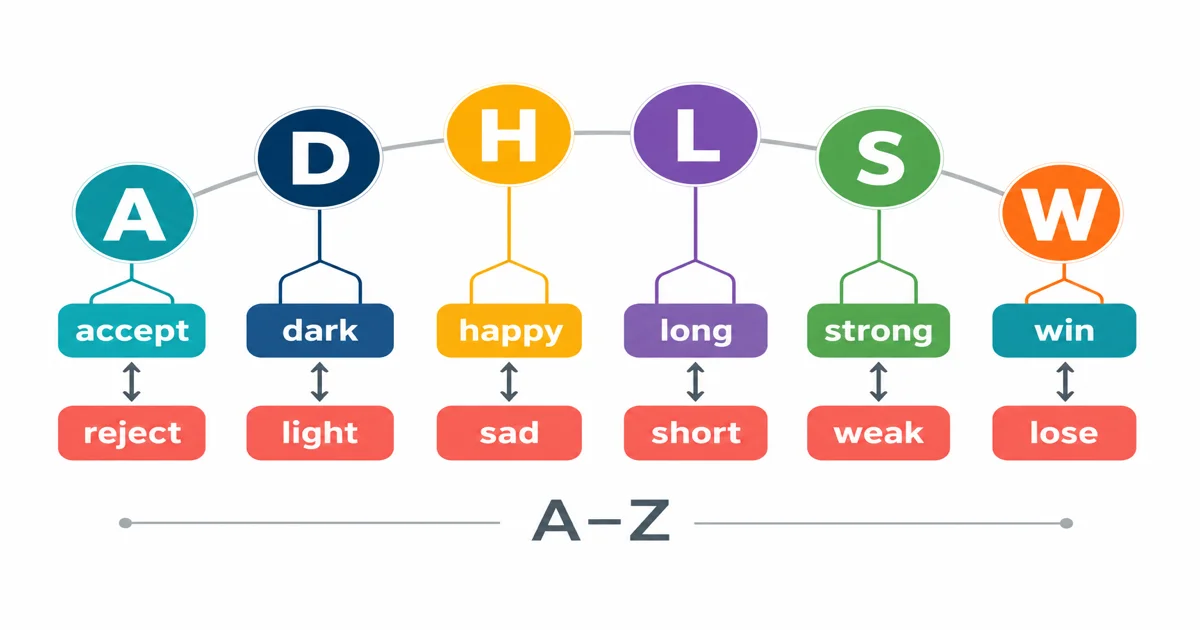
- Организация: по алфавиту A–Z
- Уровень: A1–C1
- Подойдёт для: расширения лексики, подготовки к IELTS/TOEFL, написания эссе
Подробнее о синонимах и антонимах — в нашем полном руководстве.
Что такое антонимы?
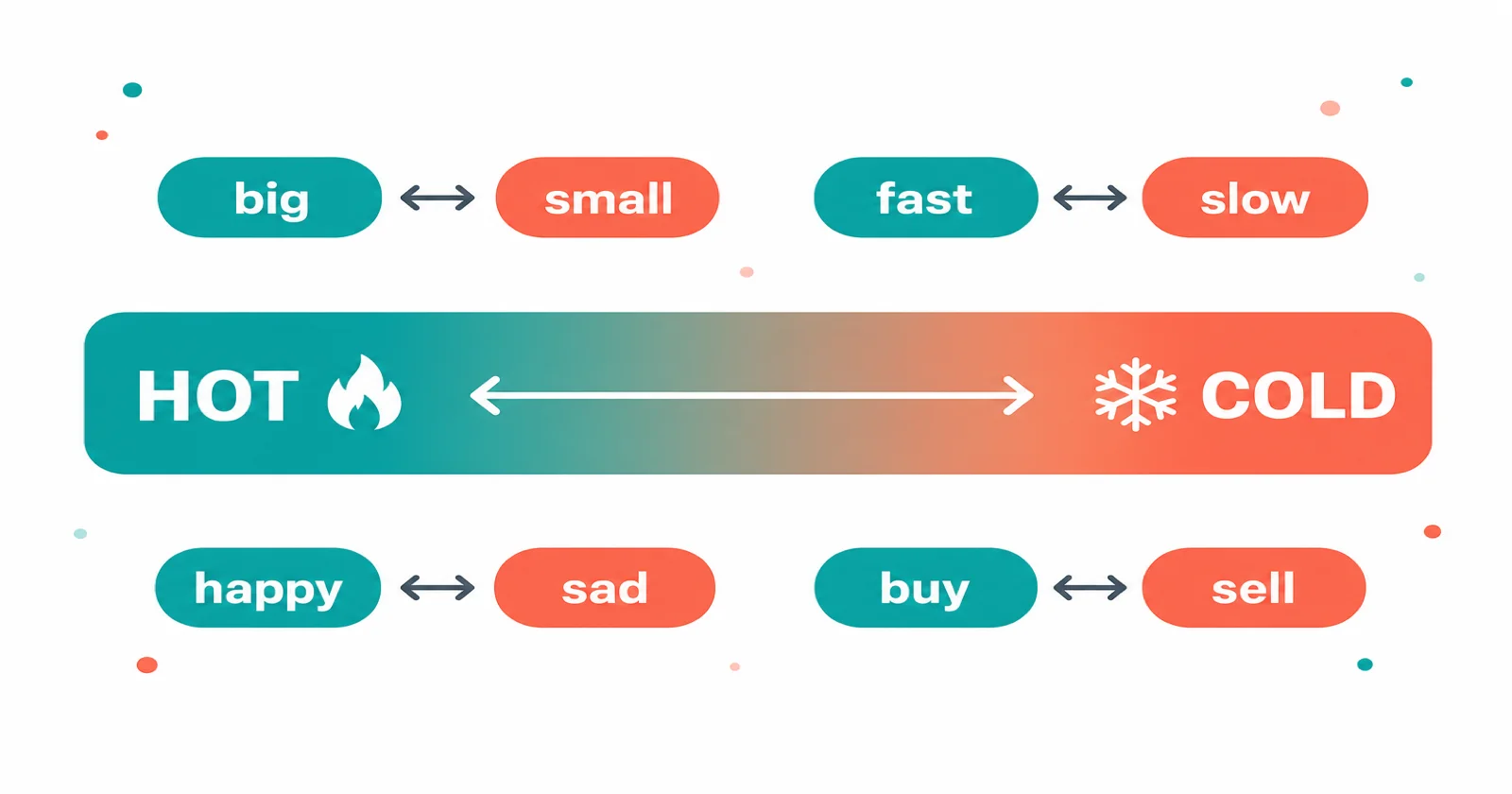
Антоним — это слово, противоположное по значению другому слову. Термин происходит от греческого: anti- (против) + onoma (имя) — буквально «противоположное имя».
| Слово | Антоним |
|---|---|
| hot | cold |
| big | small |
| fast | slow |
| happy | sad |
| begin | end |
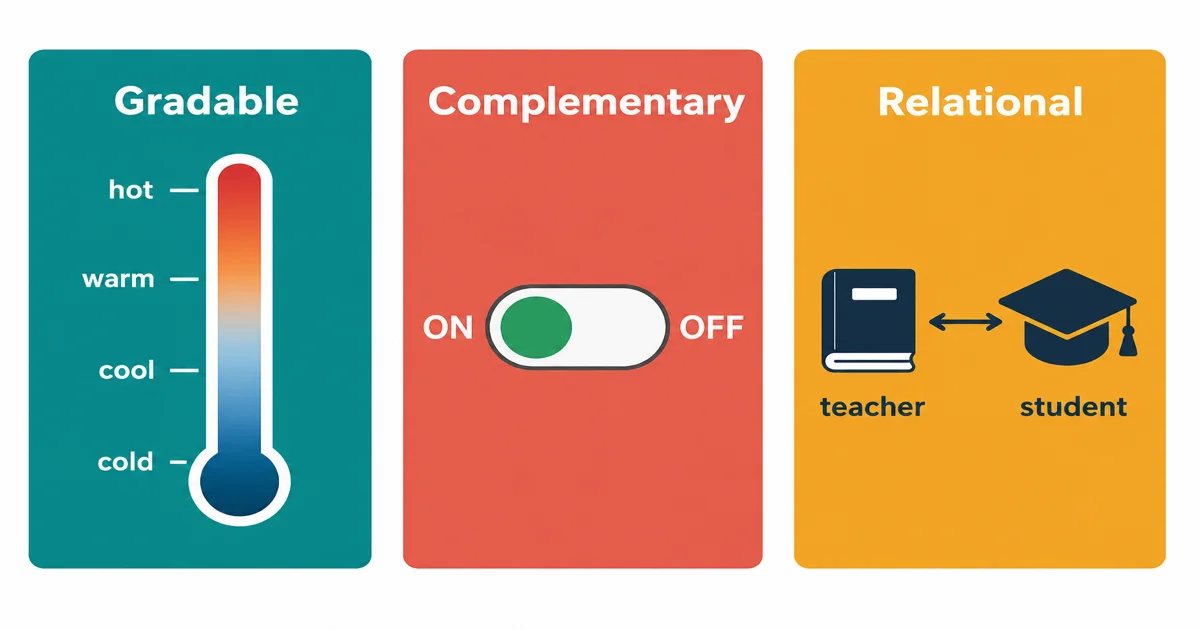
Три типа антонимов
| Тип | Описание | Примеры |
|---|---|---|
| Градуальные | Противоположности на шкале; возможны степени | hot–cold, big–small, fast–slow |
| Комплементарные | Либо одно, либо другое; середины нет | alive–dead, true–false, on–off |
| Относительные | Каждое слово подразумевает другое | teacher–student, buy–sell, parent–child |
Большинство антонимов в этом списке — градуальные: они представляют два конца шкалы с множеством промежуточных точек («warm» находится между «hot» и «cold»).
Противоположные слова: A–B
| # | Слово | Антоним | Пример |
|---|---|---|---|
| 1 | above — над | below — под | The painting hangs above the fireplace; the shoes are below the bench. |
| 2 | absent — отсутствующий | present — присутствующий | Three students were absent; the rest were present. |
| 3 | abstract — абстрактный | concrete — конкретный | Abstract ideas need concrete examples to be understood. |
| 4 | accept — принимать | reject — отвергать | She decided to accept the offer rather than reject it. |
| 5 | accurate — точный | inaccurate — неточный | The report was accurate, but the summary was inaccurate. |
| 6 | active — активный | passive — пассивный | An active learner asks questions; a passive learner just listens. |
| 7 | add — прибавлять | subtract — вычитать | Add the tax, then subtract the discount. |
| 8 | admit — признавать | deny — отрицать | He admitted the mistake instead of denying it. |
| 9 | advance — наступать | retreat — отступать | The army advanced in the morning and retreated by evening. |
| 10 | after — после | before — до | The meeting is after lunch, not before. |
| 11 | agree — соглашаться | disagree — не соглашаться | I agree with the first point but disagree with the conclusion. |
| 12 | alive — живой | dead — мёртвый | The plant looked dead, but it was still alive. |
| 13 | allow — разрешать | forbid — запрещать | The school allows casual clothes on Fridays but forbids them on exam days. |
| 14 | always — всегда | never — никогда | She always arrives early; he never does. |
| 15 | ancient — древний | modern — современный | Ancient ruins stand next to modern skyscrapers. |
| 16 | answer — ответ | question — вопрос | Every answer raises a new question. |
| 17 | appear — появляться | disappear — исчезать | Stars appear at night and disappear at dawn. |
| 18 | approve — одобрять | disapprove — не одобрять | The board approved the budget but disapproved the staffing plan. |
| 19 | arrive — прибывать | depart — отбывать | Guests arrive at 6 PM and depart by 10 PM. |
| 20 | artificial — искусственный | natural — натуральный | The flowers looked real but were artificial, not natural. |
| 21 | ascend — подниматься | descend — спускаться | We ascended the mountain in the morning and descended before dark. |
| 22 | ask — спрашивать | answer — отвечать | She asked a question, and I answered immediately. |
| 23 | asleep — спящий | awake — бодрствующий | The baby was asleep, but the dog was wide awake. |
| 24 | attack — атаковать | defend — защищать | The lawyer attacked the claim, and the witness tried to defend it. |
| 25 | attractive — привлекательный | unattractive — непривлекательный | The package design was attractive; the old one was unattractive. |
| 26 | backward — назад | forward — вперёд | Take one step backward, then two steps forward. |
| 27 | bad — плохой | good — хороший | The food was bad at that restaurant, but the service was good. |
| 28 | beautiful — красивый | ugly — уродливый | The sunset was beautiful; the building next to it was ugly. |
| 29 | begin — начинать | end — заканчивать | Classes begin in September and end in June. |
| 30 | beneficial — полезный | harmful — вредный | Exercise is beneficial to health; smoking is harmful. |
| 31 | best — лучший | worst — худший | This is the best pizza I’ve had — and that was the worst. |
| 32 | big — большой | small — маленький | She lives in a big house; I live in a small apartment. |
| 33 | bitter — горький | sweet — сладкий | The coffee was bitter without sugar; add some to make it sweet. |
| 34 | bold — смелый | timid — робкий | She gave a bold speech; he was too timid to speak at all. |
| 35 | boring — скучный | exciting — захватывающий | The first half was boring, but the second half was exciting. |
| 36 | bottom — низ | top — верх | The heaviest items go at the bottom; the lightest at the top. |
| 37 | brave — храбрый | cowardly — трусливый | The brave firefighter ran in; the cowardly bystander ran away. |
| 38 | break — ломать | fix — чинить | He managed to break the machine, and she managed to fix it. |
| 39 | brief — краткий | lengthy — длинный | Keep the introduction brief; the analysis can be more lengthy. |
| 40 | bright — яркий | dim — тусклый | The living room was bright; the hallway was dim. |
| 41 | broad — широкий | narrow — узкий | The river is broad at the delta but narrow near the source. |
| 42 | build — строить | destroy — разрушать | It takes years to build trust and seconds to destroy it. |
| 43 | busy — занятый | free — свободный | I’m busy on Monday, but I’m free on Tuesday. |
| 44 | buy — покупать | sell — продавать | I want to buy a car; she wants to sell hers. |
Противоположные слова: C–D
| # | Слово | Антоним | Пример |
|---|---|---|---|
| 45 | calm — спокойный | anxious — тревожный | She remained calm while everyone else was anxious. |
| 46 | capable — способный | incapable — неспособный | He’s capable of running the department; the other candidate is incapable. |
| 47 | careful — осторожный | careless — неосторожный | A careful driver avoids accidents; a careless one causes them. |
| 48 | cheap — дешёвый | expensive — дорогой | The generic brand is cheap; the designer version is expensive. |
| 49 | cheerful — весёлый | gloomy — мрачный | Her cheerful attitude brightened the gloomy office. |
| 50 | clean — чистый | dirty — грязный | The kitchen was clean this morning but dirty by evening. |
| 51 | clear — ясный | unclear — неясный | The instructions were clear; the footnotes were unclear. |
| 52 | clever — умный | foolish — глупый | A clever strategy beats a foolish one every time. |
| 53 | close — закрывать | open — открывать | Close the window if it’s cold; open it if it’s warm. |
| 54 | cold — холодный | hot — горячий | The soup was too cold; the tea was too hot. |
| 55 | combine — соединять | separate — разделять | Combine the ingredients first, then separate the mixture into two bowls. |
| 56 | common — распространённый | rare — редкий | Pigeons are common in the city; eagles are rare. |
| 57 | complex — сложный | simple — простой | The tax code is complex; the instructions should be simple. |
| 58 | confident — уверенный | insecure — неуверенный | She seems confident in meetings, but she feels insecure inside. |
| 59 | connect — подключать | disconnect — отключать | Connect the charger to charge; disconnect it when full. |
| 60 | constant — постоянный | variable — переменный | The speed was constant; the direction was variable. |
| 61 | construct — строить | demolish — сносить | They plan to construct a new building after they demolish the old one. |
| 62 | continue — продолжать | stop — останавливать | Continue reading if you enjoy it; stop if you don’t. |
| 63 | correct — правильный | incorrect — неправильный | Your first answer was correct; the second was incorrect. |
| 64 | create — создавать | destroy — разрушать | Artists create; wars destroy. |
| 65 | cruel — жестокий | kind — добрый | The villain was cruel; the hero was kind. |
| 66 | cry — плакать | laugh — смеяться | The children cry during sad movies and laugh during comedies. |
| 67 | curious — любопытный | indifferent — безразличный | She was curious about the results; he was completely indifferent. |
| 68 | dangerous — опасный | safe — безопасный | The old bridge is dangerous; the new one is safe. |
| 69 | dark — тёмный | light — светлый | The basement was dark, but the attic was full of light. |
| 70 | deep — глубокий | shallow — мелкий | The ocean is deep in the center and shallow near the shore. |
| 71 | defeat — поражение | victory — победа | After years of defeat, they finally tasted victory. |
| 72 | definite — определённый | indefinite — неопределённый | We need a definite answer, not an indefinite “maybe.” |
| 73 | demand — спрос | supply — предложение | When demand exceeds supply, prices rise. |
| 74 | different — разный | similar — похожий | The twins look similar but have very different personalities. |
| 75 | difficult — трудный | easy — лёгкий | The first question was easy; the last one was difficult. |
| 76 | divide — разделять | unite — объединять | Conflict divides people; shared goals unite them. |
| 77 | domestic — внутренний | foreign — иностранный | Domestic sales are strong, but foreign markets are growing faster. |
| 78 | doubt — сомневаться | trust — доверять | I doubt his intentions, but I trust his ability. |
| 79 | dry — сухой | wet — мокрый | The towel was dry this morning and wet by afternoon. |
| 80 | dull — тупой | sharp — острый | A dull knife is more dangerous than a sharp one. |
Противоположные слова: E–F
| # | Слово | Антоним | Пример |
|---|---|---|---|
| 81 | early — рано | late — поздно | I arrived early; he arrived late. |
| 82 | earn — зарабатывать | spend — тратить | You need to earn money before you can spend it. |
| 83 | east — восток | west — запад | The sun rises in the east and sets in the west. |
| 84 | easy — лёгкий | hard — трудный | The first part was easy, but the second was hard. |
| 85 | efficient — эффективный | inefficient — неэффективный | The new system is efficient; the old one was inefficient. |
| 86 | empty — пустой | full — полный | The glass was empty; I filled it until it was full. |
| 87 | encourage — поощрять | discourage — отговаривать | Good teachers encourage students; bad feedback can discourage them. |
| 88 | enemy — враг | friend — друг | Yesterday’s enemy can become tomorrow’s friend. |
| 89 | enjoy — наслаждаться | hate — ненавидеть | I enjoy cooking, but I hate cleaning up. |
| 90 | enormous — огромный | tiny — крошечный | The cathedral was enormous; the chapel was tiny. |
| 91 | enter — входить | exit — выходить | Please enter through the front door and exit through the back. |
| 92 | equal — равный | unequal — неравный | All employees deserve equal treatment, not unequal pay. |
| 93 | expand — расширяться | contract — сужаться | Metals expand when heated and contract when cooled. |
| 94 | export — экспорт | import — импорт | Japan exports cars and imports oil. |
| 95 | external — внешний | internal — внутренний | The external walls are stone; the internal walls are plaster. |
| 96 | fact — факт | fiction — вымысел | It’s hard to tell fact from fiction in the news. |
| 97 | fail — терпеть неудачу | succeed — преуспевать | You may fail ten times before you succeed once. |
| 98 | fair — справедливый | unfair — несправедливый | The decision seemed fair to some but unfair to others. |
| 99 | fake — поддельный | genuine — подлинный | The painting was fake; the signature was genuine. |
| 100 | famous — знаменитый | unknown — неизвестный | She went from unknown to famous in a single year. |
| 101 | far — далеко | near — близко | The airport is far from the city, but the train station is near. |
| 102 | fast — быстрый | slow — медленный | Internet in the office is fast; at home it’s slow. |
| 103 | few — мало | many — много | A few people came early; many arrived late. |
| 104 | final — окончательный | initial — первоначальный | The final draft was much better than the initial one. |
| 105 | find — находить | lose — терять | I always find my keys where I’m most likely to lose them. |
| 106 | finish — заканчивать | start — начинать | We need to start the project today if we want to finish by Friday. |
| 107 | first — первый | last — последний | She was the first to arrive and the last to leave. |
| 108 | flexible — гибкий | rigid — жёсткий | The company has a flexible schedule, not a rigid one. |
| 109 | float — плавать | sink — тонуть | Wood floats; iron sinks. |
| 110 | forget — забывать | remember — помнить | Don’t forget your passport — remember to check before you leave. |
| 111 | formal — формальный | informal — неформальный | The dinner is formal; the lunch is informal. |
| 112 | free — свободный | captive — пленный | The bird was captive for years before being set free. |
| 113 | freeze — замерзать | melt — таять | Water freezes at 0°C and ice melts above it. |
| 114 | frequent — частый | rare — редкий | Bus service is frequent in the city but rare in rural areas. |
| 115 | fresh — свежий | stale — чёрствый | The bread was fresh in the morning and stale by night. |
| 116 | front — перед | back — зад | Sit at the front if you want to see; sit at the back for quiet. |
| 117 | full — полный | empty — пустой | The restaurant was full at 7 PM and empty by 10 PM. |
Противоположные слова: G–L
| # | Слово | Антоним | Пример |
|---|---|---|---|
| 118 | gain — приобретать | lose — терять | You gain experience by working; you lose it by staying idle. |
| 119 | general — общий | specific — конкретный | Give me a specific answer, not a general one. |
| 120 | generous — щедрый | selfish — эгоистичный | She’s generous with her time; he’s selfish with his. |
| 121 | gentle — нежный | rough — грубый | Handle the glass with gentle hands, not rough ones. |
| 122 | give — давать | take — брать | It’s better to give than to take. |
| 123 | glad — рад | sad — грустный | I’m glad you came; I’d be sad if you hadn’t. |
| 124 | global — глобальный | local — местный | The company has both global and local operations. |
| 125 | good — хороший | bad — плохой | The news was good in the morning and bad in the evening. |
| 126 | grateful — благодарный | ungrateful — неблагодарный | Be grateful for what you have, not ungrateful for what you lack. |
| 127 | great — отличный | terrible — ужасный | The food was great; the service was terrible. |
| 128 | grow — расти | shrink — уменьшаться | The economy grew last year but may shrink this year. |
| 129 | guilty — виновный | innocent — невиновный | The jury found him guilty, though he claimed to be innocent. |
| 130 | happy — счастливый | sad — грустный | She looked sad in the morning but happy by afternoon. |
| 131 | hard — твёрдый | soft — мягкий | The mattress was too hard; I prefer a softer one. |
| 132 | harm — вредить | help — помогать | Pollution harms the environment; recycling helps it. |
| 133 | harsh — суровый | mild — мягкий | The winter was harsh; the spring was mild. |
| 134 | hate — ненавидеть | love — любить | Some people hate mornings; others love them. |
| 135 | healthy — здоровый | unhealthy — нездоровый | A balanced diet is healthy; fast food daily is unhealthy. |
| 136 | heavy — тяжёлый | light — лёгкий | The suitcase was heavy; the backpack was light. |
| 137 | here — здесь | there — там | The keys are not here — they must be over there. |
| 138 | hide — прятать | reveal — раскрывать | She tried to hide her disappointment, but her face revealed it. |
| 139 | high — высокий | low — низкий | Prices are high in the city and low in the countryside. |
| 140 | hire — нанимать | fire — увольнять | The company plans to hire 50 people this year, not fire anyone. |
| 141 | honest — честный | dishonest — нечестный | An honest answer is always better than a dishonest one. |
| 142 | hope — надежда | despair — отчаяние | Where there is hope, there is no despair. |
| 143 | huge — огромный | tiny — крошечный | The difference was huge — not tiny. |
| 144 | humble — скромный | arrogant — высокомерный | The best leaders are humble, not arrogant. |
| 145 | hungry — голодный | full — сытый | I was hungry before lunch and full afterward. |
| 146 | ignore — игнорировать | notice — замечать | Don’t ignore the warning signs — notice them early. |
| 147 | impossible — невозможный | possible — возможный | What seems impossible today may be possible tomorrow. |
| 148 | improve — улучшать | worsen — ухудшать | The situation will improve if we act; it will worsen if we don’t. |
| 149 | include — включать | exclude — исключать | The price includes breakfast but excludes dinner. |
| 150 | increase — увеличивать | decrease — уменьшать | Sales increased in Q1 and decreased in Q2. |
| 151 | inferior — низший | superior — высший | The cheap version is inferior; the premium version is superior. |
| 152 | innocent — невиновный | guilty — виновный | She was proven innocent after being falsely declared guilty. |
| 153 | inside — внутри | outside — снаружи | It’s warm inside but freezing outside. |
| 154 | intelligent — умный | stupid — глупый | An intelligent decision saves time; a stupid one wastes it. |
| 155 | join — соединять | separate — разделять | The rivers join at the delta and separate upstream. |
| 156 | joy — радость | sorrow — печаль | Life is a balance of joy and sorrow. |
| 157 | junior — младший | senior — старший | She started as a junior developer and became a senior in three years. |
| 158 | just — справедливый | unjust — несправедливый | A just society treats everyone fairly; an unjust one does not. |
| 159 | keep — хранить | discard — выбрасывать | Keep the important files and discard the rest. |
| 160 | kind — добрый | cruel — жестокий | A kind word heals; a cruel one wounds. |
| 161 | knowledge — знание | ignorance — невежество | Knowledge leads to understanding; ignorance leads to fear. |
| 162 | large — большой | small — маленький | We ordered a large pizza, not a small one. |
| 163 | laugh — смеяться | cry — плакать | The audience would laugh one moment and cry the next. |
| 164 | lazy — ленивый | hardworking — трудолюбивый | He’s too lazy to study; his sister is incredibly hardworking. |
| 165 | lead — вести | follow — следовать | Some people lead; others prefer to follow. |
| 166 | legal — законный | illegal — незаконный | Driving at 60 mph is legal here; 90 is illegal. |
| 167 | lend — давать взаймы | borrow — брать взаймы | I’ll lend you the book; you can borrow it for a week. |
| 168 | less — меньше | more — больше | Spend less time worrying and more time acting. |
| 169 | long — длинный | short — короткий | The movie was too long; the trailer was too short. |
| 170 | loud — громкий | quiet — тихий | The music was loud downstairs and quiet upstairs. |
| 171 | love — любовь | hate — ненависть | Thin line between love and hate, they say. |
| 172 | low — низкий | high — высокий | The river is low in summer and high in spring. |
| 173 | loyal — верный | disloyal — неверный | A loyal friend stays; a disloyal one leaves. |
| 174 | lucky — везучий | unlucky — невезучий | She was lucky to win; he was unlucky to miss by one point. |
Противоположные слова: M–R
| # | Слово | Антоним | Пример |
|---|---|---|---|
| 175 | major — основной | minor — незначительный | The major issues are fixed; only minor ones remain. |
| 176 | majority — большинство | minority — меньшинство | The majority agreed; the minority dissented. |
| 177 | many — много | few — мало | Many applied, but few were selected. |
| 178 | mature — зрелый | immature — незрелый | A mature response helps; an immature one escalates conflict. |
| 179 | maximum — максимум | minimum — минимум | The maximum speed is 120 km/h; the minimum is 60. |
| 180 | messy — неряшливый | neat — аккуратный | His desk is messy; hers is neat. |
| 181 | modern — современный | traditional — традиционный | The design blends modern elements with traditional ones. |
| 182 | narrow — узкий | wide — широкий | The hallway was narrow; the lobby was wide. |
| 183 | natural — натуральный | artificial — искусственный | The flavoring is natural, not artificial. |
| 184 | negative — отрицательный | positive — положительный | A negative attitude produces negative results; a positive one attracts opportunities. |
| 185 | new — новый | old — старый | The new policy replaces the old one. |
| 186 | night — ночь | day — день | Owls hunt at night; hawks hunt during the day. |
| 187 | noisy — шумный | quiet — тихий | The restaurant was noisy downstairs but quiet on the terrace. |
| 188 | normal — нормальный | abnormal — аномальный | The test results were normal, not abnormal. |
| 189 | nothing — ничего | everything — всё | He went from having nothing to having everything. |
| 190 | obey — подчиняться | disobey — не подчиняться | Children who obey rules learn discipline; those who disobey learn consequences. |
| 191 | obvious — очевидный | hidden — скрытый | The answer was obvious to some but hidden from others. |
| 192 | old — старый | young — молодой | The old generation learns from experience; the young from technology. |
| 193 | open — открытый | closed — закрытый | The shop is open on weekdays and closed on Sundays. |
| 194 | optimistic — оптимистичный | pessimistic — пессимистичный | She’s optimistic about the future; he’s pessimistic. |
| 195 | order — порядок | chaos — хаос | The system brought order to what was previously chaos. |
| 196 | ordinary — обычный | extraordinary — необычный | What seemed like an ordinary day became an extraordinary one. |
| 197 | over — над | under — под | The bridge goes over the river; the tunnel goes under it. |
| 198 | pass — сдать | fail — не сдать | She managed to pass the exam, while many others failed. |
| 199 | past — прошлое | future — будущее | Learn from the past and plan for the future. |
| 200 | patient — терпеливый | impatient — нетерпеливый | A patient teacher gets better results than an impatient one. |
| 201 | peace — мир | war — война | Nations choose between peace and war. |
| 202 | permanent — постоянный | temporary — временный | The fix is temporary; we need a permanent solution. |
| 203 | permit — разрешать | prohibit — запрещать | The law permits free speech but prohibits hate speech. |
| 204 | pleasant — приятный | unpleasant — неприятный | The first impression was pleasant; the second was unpleasant. |
| 205 | polite — вежливый | rude — грубый | A polite email gets a better response than a rude one. |
| 206 | poor — бедный | rich — богатый | The gap between poor and rich continues to widen. |
| 207 | possible — возможный | impossible — невозможный | What seems impossible today may be possible tomorrow. |
| 208 | powerful — мощный | weak — слабый | A powerful argument beats a weak one. |
| 209 | practical — практический | theoretical — теоретический | The course has both practical and theoretical components. |
| 210 | praise — хвалить | criticize — критиковать | It’s easy to criticize and hard to praise. |
| 211 | private — частный | public — публичный | The meeting was private; the announcement was public. |
| 212 | profit — прибыль | loss — убыток | The first year showed a profit; the second showed a loss. |
| 213 | progress — прогресс | decline — упадок | The economy shows progress in one sector and decline in another. |
| 214 | proud — гордый | ashamed — пристыженный | She was proud of her work; he was ashamed of his. |
| 215 | push — толкать | pull — тянуть | Push the door to open it; pull to close it. |
| 216 | quick — быстрый | slow — медленный | Send a quick reply — don’t be slow. |
| 217 | raise — поднимать | lower — опускать | Raise your hand to ask a question; lower it when done. |
| 218 | rapid — быстрый | gradual — постепенный | The change was rapid in cities and gradual in rural areas. |
| 219 | real — настоящий | fake — поддельный | Is the diamond real or fake? |
| 220 | receive — получать | give — давать | To receive, you must first be willing to give. |
| 221 | reduce — сокращать | increase — увеличивать | We need to reduce costs and increase efficiency. |
| 222 | reject — отвергать | accept — принимать | The publisher rejected the first manuscript and accepted the revised one. |
| 223 | reliable — надёжный | unreliable — ненадёжный | The old system was unreliable; the new one is much more reliable. |
| 224 | remember — помнить | forget — забывать | Remember your password — don’t forget it again. |
| 225 | reveal — раскрывать | conceal — скрывать | The investigation revealed what they tried to conceal. |
| 226 | reward — награждать | punish — наказывать | Reward good behavior and punish rule violations. |
| 227 | right — правый | wrong — неправый | There’s a right way and a wrong way to apologize. |
| 228 | rise — подниматься | fall — падать | Prices rise in summer and fall in winter. |
| 229 | rough — шероховатый | smooth — гладкий | The surface was rough on one side and smooth on the other. |
| 230 | rural — сельский | urban — городской | Life in rural areas differs greatly from urban areas. |
Противоположные слова: S–Z
| # | Слово | Антоним | Пример |
|---|---|---|---|
| 231 | safe — безопасный | dangerous — опасный | The neighborhood is safe during the day but dangerous at night. |
| 232 | same — одинаковый | different — разный | We have the same goal but very different methods. |
| 233 | save — экономить | waste — тратить впустую | Save your energy — don’t waste it on arguments. |
| 234 | seldom — редко | often — часто | I seldom eat fast food; she eats it often. |
| 235 | serious — серьёзный | playful — игривый | He’s always serious; she’s naturally playful. |
| 236 | sharp — острый | blunt — тупой | A sharp pencil writes well; a blunt one does not. |
| 237 | short — низкий | tall — высокий | The short child stood next to the tall teenager. |
| 238 | shout — кричать | whisper — шептать | Don’t shout — just whisper it to me. |
| 239 | show — показывать | hide — прятать | Show your strengths; don’t hide them. |
| 240 | sick — больной | healthy — здоровый | She was sick last week but is healthy now. |
| 241 | significant — значительный | insignificant — незначительный | The change was significant, not insignificant. |
| 242 | simple — простой | complicated — сложный | The idea is simple, but the execution is complicated. |
| 243 | single — холостой | married — женатый/замужем | He was single for years before getting married. |
| 244 | slow — медленный | fast — быстрый | The download was slow; the upload was fast. |
| 245 | smooth — гладкий | rough — шероховатый | The road was smooth in the city and rough in the countryside. |
| 246 | solid — твёрдый | liquid — жидкий | Ice is solid; water is liquid. |
| 247 | speak — говорить | listen — слушать | A good leader knows when to speak and when to listen. |
| 248 | spend — тратить | save — экономить | They spend too much and save too little. |
| 249 | start — начинать | finish — заканчивать | Let’s start now so we can finish early. |
| 250 | strange — странный | normal — нормальный | His behavior was strange — not at all normal. |
| 251 | strength — сила | weakness — слабость | Knowing your strengths and weaknesses is key to growth. |
| 252 | strict — строгий | lenient — снисходительный | The new teacher is strict; the old one was lenient. |
| 253 | strong — сильный | weak — слабый | The coffee was strong in the morning and weak by the afternoon. |
| 254 | succeed — преуспевать | fail — терпеть неудачу | If you prepare, you will succeed; if not, you may fail. |
| 255 | success — успех | failure — неудача | Success teaches confidence; failure teaches resilience. |
| 256 | sudden — внезапный | gradual — постепенный | The change was sudden, not gradual. |
| 257 | supply — предложение | demand — спрос | When supply exceeds demand, prices drop. |
| 258 | support — поддерживать | oppose — противодействовать | Half the team supports the plan; the other half opposes it. |
| 259 | sweet — сладкий | sour — кислый | The fruit was sweet on the outside and sour on the inside. |
| 260 | tall — высокий | short — низкий | The tall buildings blocked the view of the short ones. |
| 261 | temporary — временный | permanent — постоянный | This is a temporary fix; we need a permanent solution. |
| 262 | thick — толстый | thin — тонкий | The walls were thick downstairs and thin upstairs. |
| 263 | tight — тесный | loose — свободный | The lid was too tight; make it a bit looser. |
| 264 | together — вместе | apart — порознь | They worked together for years, then moved apart. |
| 265 | top — верх | bottom — низ | Start reading from the top and work your way to the bottom. |
| 266 | true — правдивый | false — ложный | Is the statement true or false? |
| 267 | trust — доверие | distrust — недоверие | There’s a deep distrust in politics where there should be trust. |
| 268 | ugly — уродливый | beautiful — красивый | The caterpillar was ugly; the butterfly was beautiful. |
| 269 | under — под | over — над | The cat is under the table; the lamp is over it. |
| 270 | unique — уникальный | common — обычный | This design is unique; the other is common. |
| 271 | unite — объединять | divide — разделять | Great leaders unite; poor leaders divide. |
| 272 | unknown — неизвестный | known — известный | The cause is still unknown; the effect is well known. |
| 273 | up — вверх | down — вниз | Prices went up last month and came down this month. |
| 274 | urban — городской | rural — сельский | Urban life is fast; rural life is slower. |
| 275 | useful — полезный | useless — бесполезный | A sharp knife is useful; a broken one is useless. |
| 276 | vacant — свободный | occupied — занятый | The seat is vacant — all the others are occupied. |
| 277 | vague — расплывчатый | precise — точный | Your instructions were vague — please be more precise. |
| 278 | valuable — ценный | worthless — бесценный | The painting is valuable; the frame is worthless. |
| 279 | victory — победа | defeat — поражение | They celebrated victory while we accepted defeat. |
| 280 | visible — видимый | invisible — невидимый | The moon was visible last night; tonight it’s invisible behind clouds. |
| 281 | voluntary — добровольный | compulsory — обязательный | Overtime is voluntary, not compulsory. |
| 282 | warm — тёплый | cool — прохладный | The coffee was warm; the juice was cool. |
| 283 | wealth — богатство | poverty — бедность | Wealth without purpose feels like poverty of the soul. |
| 284 | wet — мокрый | dry — сухой | Hang the wet clothes outside until they’re dry. |
| 285 | wide — широкий | narrow — узкий | The highway is wide; the side street is narrow. |
| 286 | wild — дикий | tame — ручной | The horse was wild at first but became tame after training. |
| 287 | win — побеждать | lose — проигрывать | You win some, you lose some. |
| 288 | wise — мудрый | foolish — глупый | A wise investment grows; a foolish one shrinks. |
| 289 | wrong — неправильный | right — правильный | If something feels wrong, it probably isn’t right. |
Антонимы, образованные с помощью приставок
Многие английские антонимы образуются добавлением приставки к исходному слову. Знание этих приставок позволяет генерировать антонимы автоматически.
un-
| Слово | Антоним | Пример |
|---|---|---|
| happy | unhappy | The results made everyone unhappy. |
| fair | unfair | The decision was unfair. |
| comfortable | uncomfortable | The seats were uncomfortable. |
| likely | unlikely | A comeback seems unlikely. |
| certain | uncertain | The outcome remains uncertain. |
in-/im-/il-/ir-
| Слово | Антоним | Пример |
|---|---|---|
| possible | impossible | Finishing by Friday is impossible. |
| polite | impolite | Interrupting is impolite. |
| legal | illegal | Parking here is illegal. |
| responsible | irresponsible | That was an irresponsible decision. |
| accurate | inaccurate | The data was inaccurate. |
dis-
| Слово | Антоним | Пример |
|---|---|---|
| agree | disagree | I completely disagree. |
| appear | disappear | The fog made the bridge disappear. |
| honest | dishonest | His answers were dishonest. |
| connect | disconnect | Please disconnect the cable. |
| advantage | disadvantage | The main disadvantage is the cost. |
mis-
| Слово | Антоним | Пример |
|---|---|---|
| understand | misunderstand | Don’t misunderstand my intention. |
| lead | mislead | The headline was misleading. |
| inform | misinform | Social media can misinform the public. |
Как эффективно учить антонимы
Всегда учите парами
Никогда не учите слово изолированно. Добавляя «generous» в словарный запас, одновременно добавьте «selfish». Мозг хранит связанные понятия эффективнее, чем разрозненные.
Используйте стратегию приставок
Зная un-, in-/im-, dis- и mis-, вы можете генерировать антонимы для сотен слов, не запоминая их поштучно. Закройте столбец антонимов и попробуйте образовать противоположное слово с помощью приставки.
Практикуйте «противоположные предложения»
Возьмите любое предложение и перепишите его с противоположным значением:
- The meeting was long and boring. → The meeting was short and exciting.
- She always arrives early. → She never arrives late.
Это упражнение заставляет мыслить парами антонимов, что ускоряет припоминание.
Добавьте в интервальное повторение
Добавляйте пары слов в словарь Linglify. Помечайте тегом «antonyms» для повторения набором. Когда оба слова появляются вместе при повторении, связь между ними укрепляется.
Слова для практики
Эти 25 слов часто встречаются рядом с антонимами в естественном английском. Добавьте их в словарь Linglify для интервального повторения.
boom
существительное
бум, взрыв, процветание, грохот
Примеры
- The boom of thunder echoed across the valley.
- The technology boom created many new millionaires.
cooperate
глагол
сотрудничать, кооперироваться, содействовать
evaluate
глагол
оценивать, анализировать
Примеры
- Companies evaluate job candidates based on experience, skills, and personality.
- Teachers evaluate student progress through tests, projects, and classroom participation.
graduate
глагол
оканчивать, выпускаться
Примеры
- She will graduate from university next year with a degree in engineering.
- Students must complete all requirements before they can graduate from high school.
horizon
существительное
горизонт, кругозор
Примеры
- The sun disappeared behind the horizon as evening approached.
- Traveling broadens your horizon and exposes you to new cultures.
indispensable
прилагательное
незаменимый, необходимый
Примеры
- Clean water is indispensable for human survival and good health.
- Her experience and skills make her indispensable to the research team.
jury
существительное
жюри, суд присяжных
Примеры
- The jury deliberated for several hours before reaching a verdict.
- The talent show jury consisted of professional musicians and entertainers.
lifelong
прилагательное
пожизненный, на всю жизнь
Примеры
- Learning is a lifelong process that never truly ends.
- Their lifelong friendship began during elementary school years.
motivated
прилагательное
мотивированный
Примеры
- Motivated employee seeks additional responsibilities and challenges at work.
- Success requires being motivated even when facing difficult obstacles.
normally
наречие
обычно, нормально
Примеры
- Heart normally beats between sixty and hundred times per minute.
- Students normally arrive at school before morning bell rings.
off
наречие
выключен, прочь
Примеры
- Please turn off the lights before leaving the room.
- The dog ran off into the forest chasing wild rabbits.
prejudice
существительное
предрассудок, предубеждение
Примеры
- Education helps overcome prejudice and promotes understanding.
- Racial prejudice damages communities and individuals alike.
resolve
глагол
решать, разрешать
Примеры
- Mediator helps parties resolve dispute through negotiation.
- Technical team will resolve software problems quickly.
stress
глагол
подчёркивать
Примеры
- Heavy workload may stress employees beyond limits.
- Teacher will stress importance of homework completion.
total
прилагательное
полный
Примеры
- Total cost includes all fees and expenses.
- Total silence fills room during meditation session.
tragedy
существительное
трагедия
Примеры
- Natural tragedy affects thousands of innocent people.
- Personal tragedy changes person's life perspective completely.
union
существительное
союз
Примеры
- Labor union protects worker rights and interests.
- Marriage union joins two people in partnership.
voyage
существительное
путешествие, плавание, рейс
Примеры
- Space exploration represents humanity's greatest voyage into the unknown.
- The ocean voyage from Europe to America took several weeks in the past.
candidate
существительное
кандидат, претендент, соискатель
Примеры
- Each presidential candidate presented their policy plans to voters.
- The job candidate impressed the interview panel with her experience.
discourage
глагол
обескураживать, отговаривать
Примеры
- Don't let one failure discourage you from pursuing your dreams.
- High prices discourage many people from buying organic food products.
donate
глагол
жертвовать, дарить, передавать
Примеры
- Many people donate money to charities that help homeless individuals.
- She decided to donate blood to help patients in emergency situations.
firmly
наречие
твердо, крепко, решительно
Примеры
- Hold the rope firmly while climbing down the steep mountain slope.
- The manager firmly believed in treating all employees with respect.
guide
глагол
направлять, руководить, вести
Примеры
- Parents should guide their children to make responsible decisions.
- The experienced hiker will guide the group through the mountain trail safely.
humorous
прилагательное
юмористический, смешной
Примеры
- She writes humorous articles about everyday life and family experiences.
- The humorous speech made everyone laugh and lightened the serious mood.
admission
существительное
поступление, вход, признание
Примеры
- Her admission to the prestigious medical school was the result of hard work.
- The museum offers free admission on the first Sunday of every month.
Что делать дальше
-
Проверьте себя. Закройте столбец «Антоним» и попробуйте назвать противоположное слово по памяти.
-
Выучите приставки. Знание un-, in-/im-/il-/ir-, dis- и mis- позволяет образовывать антонимы для сотен слов. Тренируйтесь на 10 новых словах в день.
-
Добавьте пары в Linglify для интервального повторения. Повторение парами укрепляет оба слова одновременно.
-
Изучите полный справочник — наш гид Синонимы и антонимы: 1000+ пар слов охватывает синонимы и антонимы вместе.
-
Используйте антонимы в письме. В эссе IELTS и TOEFL антонимы помогают ясно выражать контраст: «While urban areas are densely populated, rural areas remain sparsely populated.»
FAQ
Что такое антоним? Приведите 5 примеров.
Антоним — это слово, противоположное по значению другому слову. Пять распространённых примеров: (1) hot–cold, (2) big–small, (3) fast–slow, (4) happy–sad, (5) buy–sell. Антонимы бывают трёх типов: градуальные (на шкале, как hot–cold), комплементарные (либо одно, либо другое, как alive–dead) и относительные (парные роли, как teacher–student).
Как образовать антонимы с помощью приставок?
Четыре самые распространённые приставки для антонимов: un- (happy → unhappy), in-/im-/il-/ir- (possible → impossible, legal → illegal, responsible → irresponsible), dis- (agree → disagree) и mis- (understand → misunderstand). Какую приставку использует слово, зависит от его происхождения и фонетики — универсального правила нет, каждый случай нужно запоминать. Однако «un-» работает с большинством прилагательных как безопасный вариант по умолчанию.
Антонимы всегда означают точные противоположности?
Не всегда. Многие антонимы «градуальные» — они представляют два конца шкалы с промежуточными значениями. «Hot» и «cold» — антонимы, но между ними есть «warm», «cool», «lukewarm» и «tepid». Только «комплементарные» антонимы — настоящие противоположности: alive–dead, true–false, on–off. Понимание этого различия помогает подобрать точное слово для нужного оттенка значения.
Зачем учить антонимы для IELTS и TOEFL?
Оба экзамена оценивают разнообразие лексики. Знание антонимов помогает тремя способами: (1) перефразировать вопросы без повторения слов — «advantages and disadvantages» становится «benefits and drawbacks»; (2) выражать контраст, что необходимо для сравнительных эссе; (3) в заданиях на чтение часто проверяют, умеете ли вы определить противоположное значение в контексте. 200–300 пар антонимов покрывают большинство экзаменационных ситуаций.