英語同音詞:完整指南附300+例子
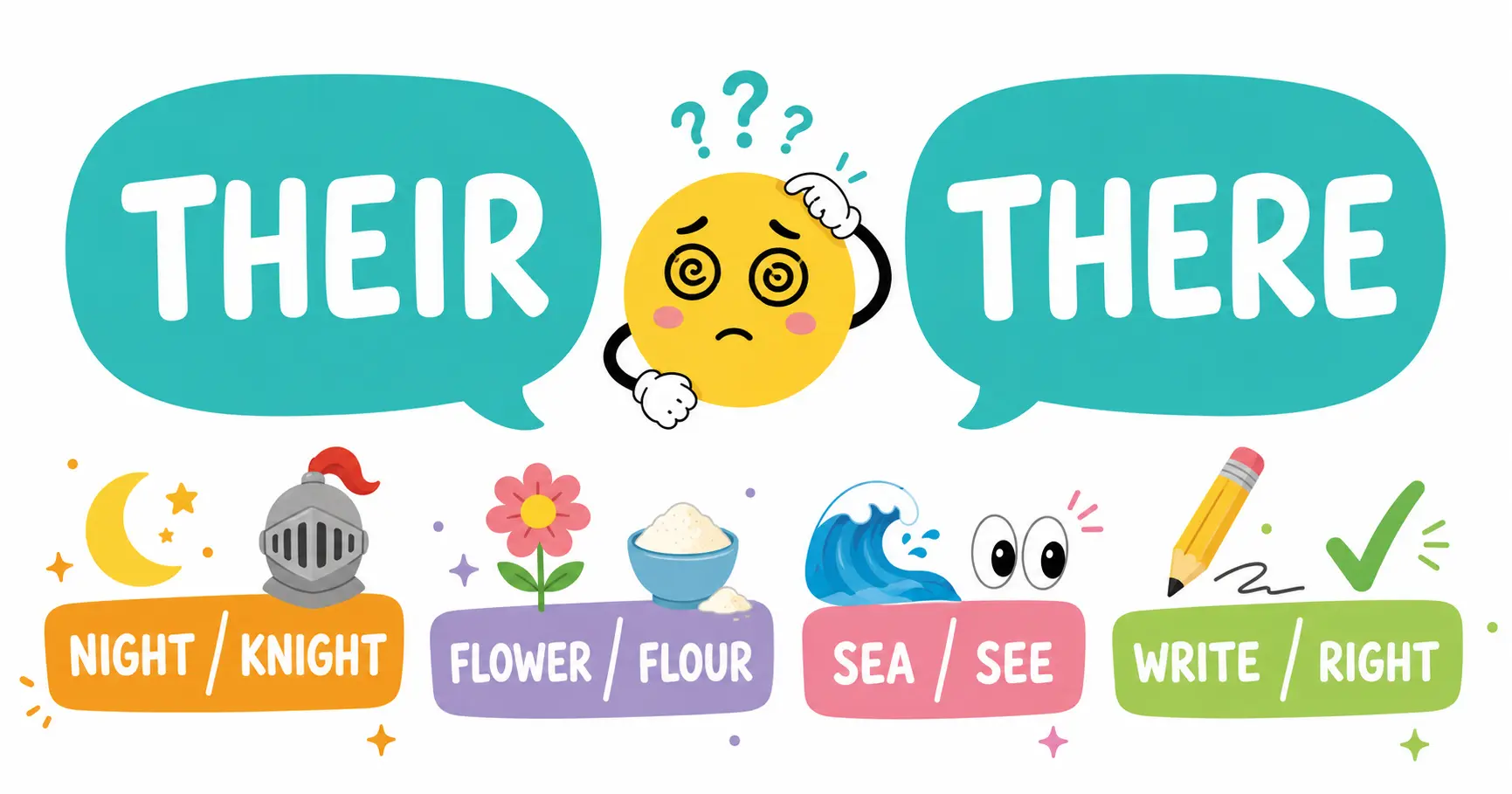
英語充滿了聽起來完全相同但含義完全不同的單字。「Their」、「there」和「they’re」聽起來完全一樣。「Knight」和「night」發音相同。「Flower」和「flour」在口語中無法區分。這些單字被稱為同音詞,它們是英語中造成最多拼寫錯誤、寫作錯誤和尷尬混淆的語言特性,比任何其他英語特性都要多。
問題不在於發音——而在於知道哪種拼寫對應哪種含義。母語者也經常拼錯這些(your/you’re是互聯網上最常被糾正的錯誤),對英語學習者來說挑戰更大,因為許多同音詞沒有邏輯規律。你只需要學習它們。
本指南涵蓋:
- 什麼是同音詞以及英語為什麼有這麼多,
- 300+同音詞對和組,附含義和例子,
- 從基礎(A2)到高級(C1)難度分類,
- 同音詞、同形異義詞和同形異音詞的區別,
- 最常見的同音詞錯誤以及如何避免。
什麼是同音詞?
同音詞是與另一個單字發音相同,但含義不同且通常拼寫不同的單字。這個詞來自希臘語:homo-(相同)+ phone(聲音)——「相同的聲音」。
| 同音詞對 | 發音 | 單字1含義 | 單字2含義 |
|---|---|---|---|
| their / there / they’re | /ðɛr/ | 屬於他們的 | 在那個地方 / 他們是 |
| to / too / two | /tuː/ | 方向 | 也 / 過度 / 數字2 |
| know / no | /noʊ/ | 知道 | 否定 |
| write / right | /raɪt/ | 書寫 | 正確 / 方向 |
| sea / see | /siː/ | 海洋 | 用眼睛感知 |
為什麼英語有這麼多同音詞?
英語拼寫在15–16世紀印刷機出現時凍結了,但發音持續變化。「Knight」這個單字曾經帶有K和GH的發音,但幾個世紀以來這些聲音消失了,而拼寫保留下來。英語還大量從法語、拉丁語、諾爾斯語和德語借用——引進了多個演變成聽起來相同的單字,儘管來源不同。
結果:英語擁有的同音詞比幾乎任何其他語言都多。
同音詞 vs. 同形異義詞 vs. 同形異音詞
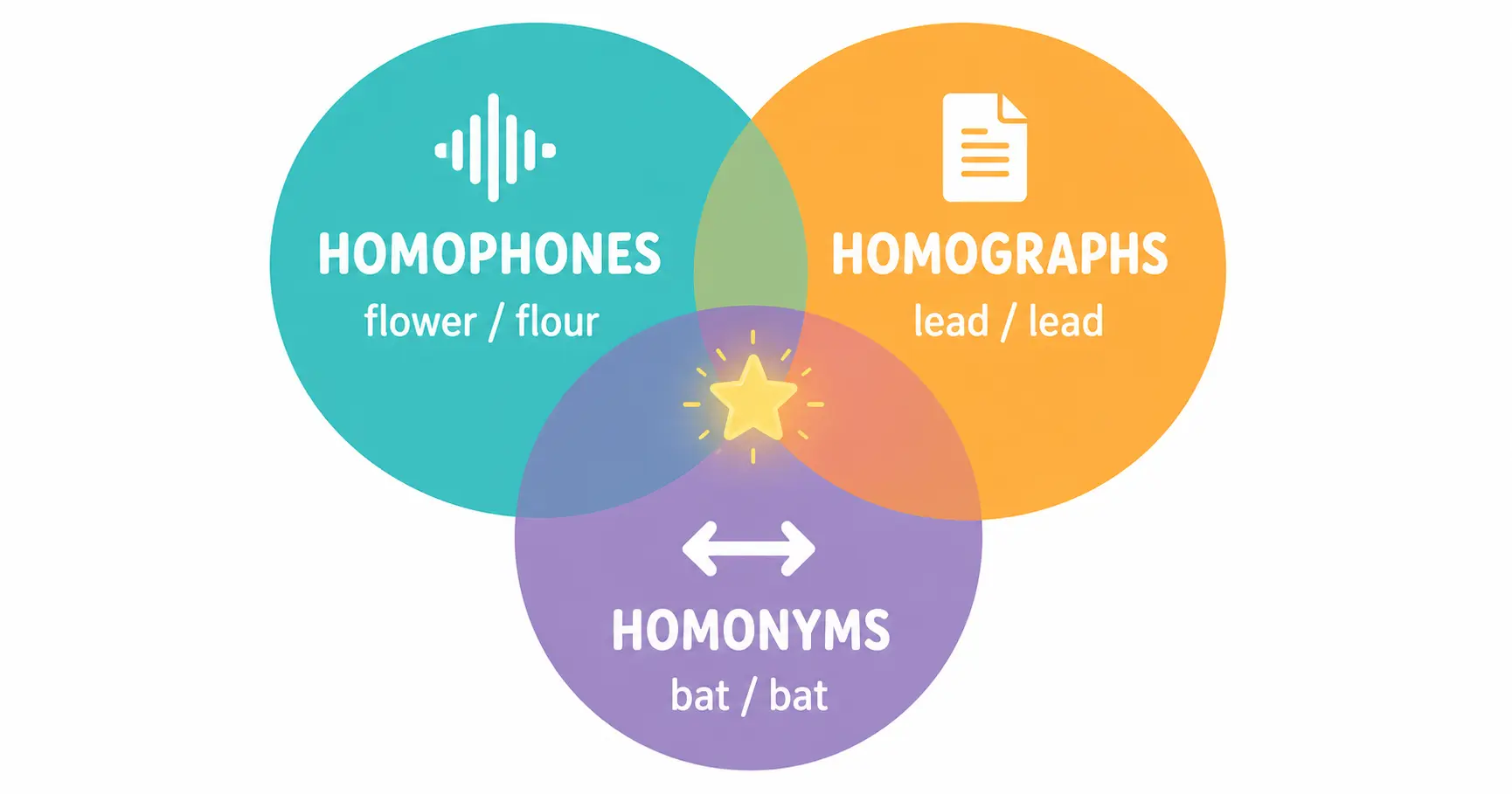
| 術語 | 相同聲音? | 相同拼寫? | 相同含義? | 例子 |
|---|---|---|---|---|
| 同音詞 | ✓ 是 | ✗ 通常不是 | ✗ 不是 | flower / flour |
| 同形異義詞 | ✓ 是 | ✓ 是 | ✗ 不是 | bank(河岸)/ bank(銀行) |
| 同形異音詞 | 有時 | ✓ 是 | ✗ 不是 | lead(引導)/ lead(鉛) |
如需詳細指南,請見同音詞 vs 同形異義詞 vs 同形異音詞。
300+同音詞按難度分類
初級同音詞(A2–B1)
這些是每個英語學習者首先遇到的詞對。正確使用這些可以消除最常見的錯誤。
五大最常混淆的
1. their / there / they’re
| 單字 | 含義 | 例句 |
|---|---|---|
| their | 所有格——屬於他們的 | Their house is on the corner. |
| there | 一個地方;也用於引入句子 | The book is over there. / There are 30 students in the class. |
| they’re | 「they are」的縮寫 | They’re coming to the party tonight. |
提示: 如果你可以用「they are」替換這個詞,用 they’re。如果它表示所有權,用 their。否則,用 there。
2. your / you’re
| 單字 | 含義 | 例句 |
|---|---|---|
| your | 所有格——屬於你的 | Is this your bag? |
| you’re | 「you are」的縮寫 | You’re going to love this restaurant. |
提示: 如果你可以說「you are」,用 you’re。否則,用 your。
3. its / it’s
| 單字 | 含義 | 例句 |
|---|---|---|
| its | 所有格——屬於它的 | The cat licked its paw. |
| it’s | 「it is」或「it has」的縮寫 | It’s raining again. |
提示: 如果「it is」或「it has」有效,用 it’s。否則,用 its(所有格的「its」沒有撇號)。
4. to / too / two
| 單字 | 含義 | 例句 |
|---|---|---|
| to | 方向;不定式的一部分 | I’m going to the store. |
| too | 也;過度地 | I want to come too. / The coffee is too hot. |
| two | 數字2 | I have two brothers. |
5. than / then
| 單字 | 含義 | 例句 |
|---|---|---|
| than | 比較 | She is taller than me. |
| then | 時間(接下來、之後) | We had dinner, then watched a movie. |
基礎詞對(A2–B1)
| 單字1 | 含義 | 單字2 | 含義 |
|---|---|---|---|
| here | 在這個地方 | hear | 感知聲音 |
| no | 否定 | know | 知道 |
| write | 書寫 | right | 正確;方向 |
| see | 用眼睛感知 | sea | 海洋 |
| one | 數字1 | won | 「win」的過去式 |
| son | 男性孩子 | sun | 天空中的星球 |
| be | 存在 | bee | 飛行昆蟲 |
| buy | 購買 | by | 在…旁邊;通過 |
| eye | 視覺器官 | I | 第一人稱代詞 |
| our | 屬於我們的 | hour | 60分鐘 |
| new | 不舊的 | knew | 「know」的過去式 |
| would | 條件式 | wood | 樹木的材料 |
| where | 在什麼地方 | wear | 穿著 |
| pair | 一組兩個 | pear | 一種水果 |
| peace | 沒有戰爭 | piece | 某物的一部分 |
| break | 損壞 | brake | 減速/停車 |
| weather | 大氣條件 | whether | 是否 |
| wait | 等待 | weight | 重量 |
| week | 七天 | weak | 不強壯 |
| meet | 遇見 | meat | 動物肉(食物) |
| flower | 花朵 | flour | 烘焙用粉 |
| night | 日落後 | knight | 中世紀武士 |
| whole | 完整的 | hole | 一個開口 |
| tail | 動物附屬物 | tale | 一個故事 |
| dear | 親愛的;昂貴的 | deer | 一種動物 |
| bare | 裸露的 | bear | 大型動物 |
| heal | 康復 | heel | 腳的後部 |
| plain | 簡單的;平坦的地區 | plane | 飛機 |
| steel | 強力金屬 | steal | 非法拿取 |
中級同音詞(B1–B2)
這些詞對不那麼常見,但在日常英語和標準化考試中定期出現。
| 單字1 | 含義 | 單字2 | 含義 |
|---|---|---|---|
| accept | 接受 | except | 除了 |
| affect | 影響(動詞) | effect | 結果(名詞) |
| allowed | 被允許的 | aloud | 大聲地 |
| board | 木板;一個群體 | bored | 無聊的 |
| complement | 補充 | compliment | 讚美 |
| council | 管理群體 | counsel | 建議;提供建議 |
| desert | 乾燥的沙地(名詞) | dessert | 晚餐後的甜食 |
| fair | 公平的;節日 | fare | 票價 |
| idle | 不活動的 | idol | 崇拜的對象 |
| loan | 借出的東西 | lone | 單獨的 |
| morning | 一天的早期部分 | mourning | 哀悼 |
| passed | 「pass」的過去式 | past | 過去的時間 |
| patience | 等待的能力 | patients | 接受醫療護理的人 |
| principal | 主要的;校長 | principle | 基本信念 |
| rain | 雲中的水 | reign | 統治時期 |
| role | 戲劇中的角色;功能 | roll | 翻轉;麵包卷 |
| stationary | 不移動的 | stationery | 紙張和書寫材料 |
| vain | 過分驕傲的 | vein | 血管 |
| warn | 警告危險 | worn | 「wear」的過去分詞 |
高級同音詞(B2–C1)
這些詞對出現在學術、文學和職業語境中。
| 單字1 | 含義 | 單字2 | 含義 |
|---|---|---|---|
| aisle | 座位之間的通道 | isle | 一個小島 |
| altar | 教堂中的神聖桌子 | alter | 改變 |
| chord | 一起演奏的音符 | cord | 一根繩子或線 |
| cue | 一個信號 | queue | 等待的人排成的隊伍 |
| descent | 向下移動 | dissent | 不同意 |
| discreet | 謹慎的,不引人注意 | discrete | 分離的;獨特的 |
| dual | 雙重的 | duel | 正式決鬥 |
| elicit | 引出 | illicit | 非法的 |
| emigrate | 離開一個國家 | immigrate | 進入一個國家 |
| ensure | 確保 | insure | 提供保險 |
| flair | 天賦 | flare | 一道光閃 |
| foreword | 書的序言 | forward | 向前 |
| heroin | 一種非法藥物 | heroine | 女英雄 |
| hoard | 囤積 | horde | 大群人 |
| marshal | 執法官員;組織 | martial | 與戰爭相關 |
| mettle | 勇氣和力量 | metal | 硬質材料 |
| miner | 挖礦的人 | minor | 小的;未成年人 |
| palate | 口腔頂部;品味 | palette | 調色板 |
| pray | 向神祈禱 | prey | 被捕獵的動物 |
| soar | 高飛 | sore | 疼痛的 |
| suite | 一組房間;系列 | sweet | 甜味的 |
| wave | 移動的水;打手勢 | waive | 放棄權利 |
20個最常混淆的同音詞
這些是造成最多錯誤的詞對——即使對母語者也是如此。
| 排名 | 詞對 | 錯誤 | 如何記住 |
|---|---|---|---|
| 1 | your / you’re | 「Your welcome」→ You’re welcome | You’re = you are。永遠如此。 |
| 2 | their / there / they’re | 混淆三個 | They’re = they are。Their = 所有權。There = 地方。 |
| 3 | its / it’s | 「The dog wagged it’s tail」→ its tail | It’s = it is。Its = 所有格(像his、hers)。 |
| 4 | to / too | 「Me to!」→ Me too! | Too = 也 / 過度。其他都是to。 |
| 5 | than / then | 「Better then ever」→ Better than ever | Than = 比較。Then = 時間。 |
| 6 | affect / effect | 交換動詞和名詞 | Affect = 動詞(影響)。Effect = 名詞(結果)。 |
| 7 | accept / except | 「Everyone accept me」→ except me | Accept = 接受。Except = 排除。 |
| 8 | lose / loose | 「Don’t loose your keys」→ Don’t lose your keys | Lose = 丟失(與「choose」押韻)。Loose = 不緊的。 |
| 9 | complement / compliment | 混淆兩個 | Complement = 補充完成。Compliment = 讚美。 |
| 10 | principal / principle | 「The principle of the school」→ principal | The principal is your pal(校長是你的朋友)。A principle is a rule(原則是規則)。 |
| 11 | stationary / stationery | 混淆它們 | Stationery = 紙張(都有「e」代表「envelope」信封)。 |
| 12 | who’s / whose | 「Whose coming?」→ Who’s coming? | Who’s = who is。Whose = 所有格。 |
| 13 | passed / past | 「I walked passed the shop」→ past the shop | Passed = 動詞。Past = 介詞/形容詞/名詞。 |
| 14 | brake / break | 「Take a brake」→ Take a break | Brake = 停止。Break = 暫停或損壞。 |
| 15 | weather / whether | 「I don’t know weather to go」→ whether | Weather = 天氣。Whether = 是否。 |
| 16 | piece / peace | 「A peace of cake」→ piece | Piece = 一部分。Peace = 沒有戰爭。 |
| 17 | patience / patients | 「Have some patients」→ patience | Patience = 平靜等待。Patients = 醫院。 |
| 18 | site / sight / cite | 混淆三個 | Site = 位置。Sight = 視力。Cite = 引用。 |
| 19 | discreet / discrete | 互換它們 | Discreet = 謹慎的。Discrete = 分離的。 |
| 20 | emigrate / immigrate | 「He emigrated to Canada」→ immigrated | Emigrate = 離開(Exit)。Immigrate = 進入(In)。 |
練習詞彙
這25個來自常混淆同音詞對的單字值得添加到你的 Linglify 字典進行間隔重複。
affordable
形容詞
經濟實惠
範例
- The government is working to provide affordable housing for low-income families.
- This restaurant offers delicious and affordable meals for college students.
commute
動詞
通勤
範例
- Public transportation helps people commute efficiently reducing traffic congestion.
- Workers commute daily between suburban homes and downtown offices.
conservation
名詞
保育
範例
- Water conservation becomes increasingly important during periods of severe drought.
- Wildlife conservation is essential for protecting endangered species from extinction.
demanding
形容詞
苛求的
範例
- Medical school is very demanding and requires years of intensive study.
- She has a demanding boss who expects perfection in all tasks.
heritage
名詞
遺產
範例
- She inherited a rich heritage of family traditions from her grandparents.
- The ancient castle is an important part of our cultural heritage.
leisure
名詞
休閒
範例
- People enjoy various leisure activities during weekends and holidays.
- Reading books is popular leisure pursuit for many educated people.
luxurious
形容詞
豪華的
範例
- She dreams of owning luxurious car with leather seats and sunroof.
- The luxurious hotel suite includes marble bathroom and ocean view.
memorable
形容詞
難忘的, 令人難忘的, 值得紀念的
範例
- Graduation day was memorable occasion for entire family.
- The memorable speech inspired students to pursue their dreams.
nutritious
形容詞
有營養的
範例
- Fresh vegetables are nutritious and support overall health.
- Nutritious breakfast provides energy for productive school day.
passionate
形容詞
熱情的, 充滿激情的
範例
- Passionate speech moves audience to take action.
- Passionate teacher inspires students to learn more.
pollution
名詞
污染
範例
- Air pollution affects public health in cities.
- Ocean pollution threatens marine life worldwide.
privacy
名詞
隱私
範例
- Hotel guests expect privacy during their stay.
- Internet privacy becomes increasingly important issue nowadays.
scenic
形容詞
風景優美的
範例
- Scenic overlook provides perfect spot for photographs.
- Scenic route takes longer but offers beautiful.
traditional
形容詞
傳統的
範例
- Traditional cooking methods preserve authentic flavors perfectly.
- Traditional music reflects cultural history and values.
uneven
形容詞
不平衡的
範例
- Uneven ground makes walking difficult and dangerous.
- Uneven performance shows inconsistent skill level development.
volunteer
動詞
志願
範例
- Citizens volunteer time for community improvement projects.
- Students volunteer at local charity organizations regularly.
substantially
副詞
大幅地, 實質上
範例
- Her performance substantially improved after additional training and practice.
- Prices have increased substantially over the past few months.
liaison
名詞
聯絡
範例
- Military liaison officers coordinate operations between allied forces.
- She serves as liaison between different departments.
sustainable
形容詞
可持續的
範例
- Company implements sustainable business model for long-term success.
- Sustainable farming practices protect soil and water resources.
acclaimed
形容詞
受到讚譽的
範例
- His performance was acclaimed by critics.
- The acclaimed author received many awards for her novel.
cancellation
名詞
取消, 撤銷
範例
- Due to weather, the flight cancellation was inevitable.
- The concert's cancellation disappointed many fans.
discretion
名詞
謹慎
範例
- He exercised discretion in his decisions.
- Use your discretion when sharing information.
indication
名詞
指示
範例
- The indication of his illness was clear after the tests.
- There was no indication that she was unhappy.
serenity
名詞
寧靜
範例
- She maintained her serenity despite the chaos.
- The serenity of the lake was calming.
如何掌握同音詞
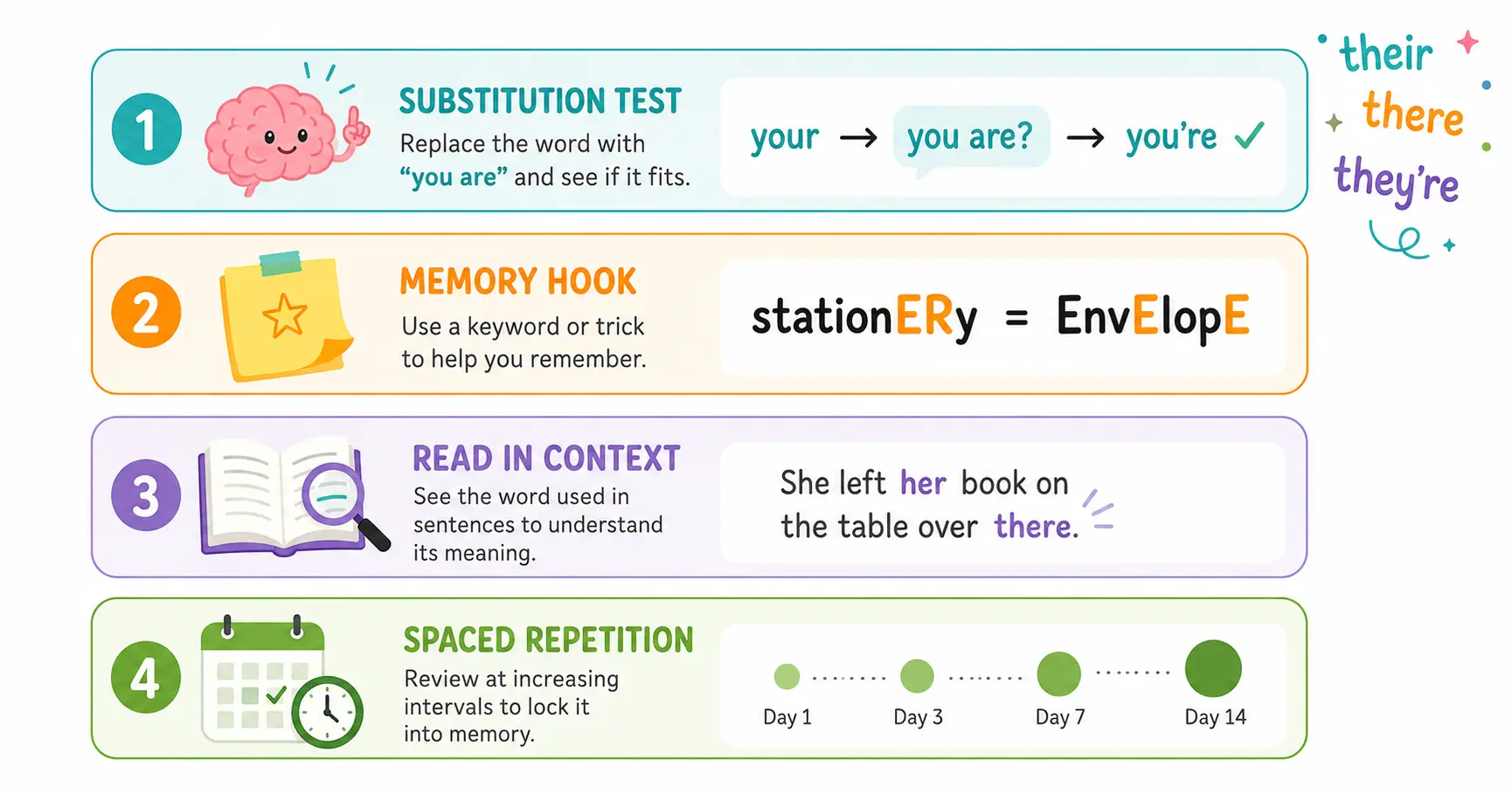
1. 學習含義,而不只是拼寫
記憶「there」和「their」拼寫不同是沒用的,除非你立刻知道哪一個意思是「屬於他們的」。始終用定義和例句學習同音詞。
2. 對縮寫使用替換測試
大多數「五大」錯誤涉及縮寫。測試很簡單:
- they’re → 試試用「they are」替換。如果句子有意義,用 they’re。
- you’re → 試試「you are」。
- it’s → 試試「it is」或「it has」。
- who’s → 試試「who is」。
如果替換不起作用,使用非縮寫版本(their、your、its、whose)。
3. 創建記憶鉤
- stationery 有一個「e」像「envelope」(信封)→ 紙張和信封
- principal 結尾是「pal」→ 校長是你的朋友
- dessert 有兩個S → 你總是想要dessert的第二份(Seconds)
- affect 以「A」開頭 → Action(動詞)。Effect 以「E」開頭 → End result(名詞)
4. 在語境中練習
廣泛閱讀讓你接觸到正確使用的同音詞。
5. 使用間隔重複
將20個最令人困惑的詞對添加到 Linglify 或任何間隔重複系統。用句子測試自己,而不只是定義。
接下來閱讀什麼
同音詞和相關內容:
拼寫和詞彙:
常見問題
英語中有多少個同音詞?
取決於方言和你如何嚴格定義它們,英語有400到7,000個同音詞組。
為什麼英語有這麼多同音詞?
兩個主要原因:(1)英語拼寫在15–16世紀標準化,但之後幾個世紀發音繼續變化;(2)英語從法語、拉丁語、諾爾斯語和德語大量借用,引進了發音相同但保留原始拼寫的單字。
同音詞在IELTS中被測試嗎?
同音詞不在IELTS中直接測試,但同音詞錯誤會影響你的寫作分數。如果你寫「there」而你的意思是「their」,或者「weather」而你的意思是「whether」,它在詞彙資源標準下算作拼寫或選詞錯誤。
拼字檢查工具能捕捉同音詞錯誤嗎?
標準拼字檢查工具通常錯過同音詞錯誤,因為兩種拼寫都是有效的英語單字。語法檢查工具(如Grammarly)更擅長捕捉這些上下文相關的錯誤,但它們不是完美的。最好的保護是自己理解含義。